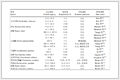
Table 1.
Optimization of reaction conditionsa

N-Heterocyclic Carbene-Catalyzed Oxidative Esterification of Aldehydes: Facile Access to α-Acyloxyacetates and Cyanomethyl Esters
Lei Ju , Chunmei Ma , Mi Tang , Yanhui Wang , Xinhong Yu , Hongmei Ma


α-Acyloxyacetates and cyanomethyl esters are found as the core structure of numerous natural products and are also useful synthetic building blocks.[1] Despite their interesting biological activities, synthetic methodologies for construction of these compounds under mild conditions are limited, especially for cyanomethyl esters derivatives. Prevalent synthesis involves the reaction of acids with α-hydroxy or α-halogeno carbonyls, [2] carboxylic acids with diazocarbonyl compounds or halogeno-acetonitrile, [3] activated carboxylates with cyanide, [4] and the Passerini reaction.[5] In general, these approaches required harsh conditions, such as relatively high temperature, long reaction times, a large excess of carboxylic acid or the toxic cyanide. Although, metal catalysis for α-acyloxy carbonyls esters formation has also reported, these reactions required protection/deprotection steps or relative instable diazo compounds.[6]
N-Heterocyclic carbenes (NHCs) have received great attention in recent years and have been widely used as versatile ligands in translation-metal catalysis, [7] and organo-catalysts.[8] Besides the classic umpolung reaction, [9] NHCs were also employed in CO2 fixation reactions, [10] cycloadditions, [11] redox reactions, [9g, 12] and in combination with photoredox catalysts, [13] cascade catalysis, [14] or cooperative catalysis.[15] Recently, NHC combining with an external oxidant was uncovered for the easy construction of carbon-heteroatom bonds, such as C—O bond (esterification), [16] C—N bond (amidation), [17] and lactone-ring- formation reactions.[18])
For example, Gois, [19] Deng, [20] Xu, [21] and Anand[22] reported NHCs-catalyzed esterification reactions of aromatic aldehydes and boronic acids, benzyl bromides, alkyl halides, or propargyl bromide, respectively. Very recently, Chi et al.[23] reported a NHC-catalyzed single-electron- transfer (SET) reactions of enals that introduces a hydroxyl group to the β-carbon of enals. By the same group, in 2015, they also demonstrated the use of a NHC catalyst to catalyze the breaking of C—C single bonds for preparation of lactams.[24] However, previous research mainly focused on the oxidative esterification of aldehydes with benzyl bromide, alkyl halides, and propargyl bromide to synthesize the corresponding esters. Herein, we report a straightforward and mild method to prepare α-acyloxyacetates and cyanomethyl esters via NHC-catalyzed oxidative esterification of aldehydes with ethyl bromoacetate or bromoacetonitrile.
We started our investigation with the reaction of ethyl bromoacetate and benzaldehyde. Unfortunately, the combination of NHC precursor (A) with cesium carbonate (Cs2CO3) in dry THF or CH2Cl2 afforded product 3aa with very poor yield (Table 1, Entries 1 and 2). Next, a variety of NHC precursors (B~F) were examined for this transformation under the same reaction conditions (Entries 3~7). Only B could afford the product with 65% yield (Entry 3). When we increased the amount of cesium carbonate to 2.0 equiv., the desired product significantly improved the yield to 86% (Entry 8). It is found that the load of catalyst and amount of base have greatly influenced the reaction yield. Decreasing the amount of catalyst and base, all led to reduction of the product yield (Entries 3, 9~11). The reaction yield was decreased to 32% when the catalyst loading was lowered to 10 mol% (Entry 11). Moreover, the effects of solvent on the reaction were also evaluated (Entries 12~15). Finally, base screening showed that cesium carbonate was the best for this process (Entries 8, 16~18).
 下载:
导出CSV
下载:
导出CSV
| Entry | NHC precursor(mol%) | Base(equiv.) | Solvent | Yield/% |
| 1 | A(20) | Cs2CO3(1.5) | THF | 35 |
| 2 | A(20) | Cs2CO3(1.5) | CH2Cl2 | 23 |
| 3 | B(20) | Cs2CO3(1.5.) | THF | 65 |
| 4 | C(20) | Cs2CO3(1.5) | THF | 20 |
| 5 | D(20) | Cs2CO3(1.5) | THF | 15 |
| 6 | E(20) | Cs2CO3(1.5) | THF | 12 |
| 7 | F(20) | Cs2CO3(1.5) | THF | 10 |
| 8 | B(20) | Cs2CO3(2.0) | THF | 86 |
| 9 | B(20) | Cs2CO3(1.0) | THF | 36 |
| 10 | B(15) | Cs2CO3(2.0) | THF | 50 |
| 11 | B(10) | Cs2CO3(2.0) | THF | 32 |
| 12 | B(20) | Cs2CO3(2.0) | CH2Cl2 | 48 |
| 13 | B(20) | Cs2CO3(2.0) | CHCl3 | 30 |
| 14 | B(20) | Cs2CO3(2.0) | Dioxane | 8 |
| 15 | B(20) | Cs2CO3(2.0) | DCE | 66 |
| 16 | B(20) | Et3N(2.0) | THF | 33 |
| 17 | B(20) | DBU(2.0) | THF | 27 |
| 18 | B(20) | (i-Pr)2NEt(2.0) | THF | 38 |
| a Reaction conditions:1a(0.2 mmol), 2a(0.24 mmol), NHC precursor(n mol%), base(0.2 mmol~0.4 mmol), solvent(2 mL), r.t. and 8 h.b Isolated yields. | ||||
With the optimized conditions in hand (Table 1, Entry 8), the scope and limitations of this protocol to aromatic aldehydes were examined. The results are summarized in Scheme 1. The results showed that, in general, the reactions took place efficiently in high yields (up to 96%) and functional group tolerance.
It is found that the nature of the electronic properties of the substituents and position on the aromatic aldehydes have a limited effect on the reaction. Substituents on para-position including halogen (3ab and 3ac), electron- donating (3ad, 3ae and 3af) and electron-withdrawing substituents (3ag, 3ah and 3ai) on the aromatic aldehydes all could give corresponding acyloxy carbonyls esters in moderate yield. Especially, the yield of the product is nearly quantified when 4-(trifluoromethyl)benzaldehyde was chosen to the reaction (3ag, 96%). Besides, 3-fluorobenzaldehyde could give the desired esters in good yields (3aj, 74%), 3-bromo-, 3-methoxy- and 3-(trifluoro- methyl)-benzaldehyde also afforded the desired products 3ak~3am in high yields. Moreover, 2-halogen (F, Cl and Br) and 2-methylbenzaldehyde also delivered the desired esters with acceptable yield (3an~3aq, 60%~92%). The reaction could proceed smoothly even though Michael receptor or phenylethynyl was introduced into the ortho-positon of aldehydes (3ar and 3as).[18c, 18e] Furthermore, 2-naphthaldehyde (3at) and heteroatom containing alde-hydes (3au, 3av and 3aw) also responded well for the esters.
|
|
Interestingly, when bromoacetonitrile was used instead of ethyl bromoacetate, the reaction could also proceed well and the desired product cyanomethyl esters were obtained in good yield (58%~88%). Substituents at different positions, such as para-methoxy (3bb), para-phenyl (3bc), para-bromo (3bd), or meta-bromo (3be) and ortho-fluoro (3bf), the desired products were still obtained without loss in reaction efficiency. 2-Naphthaldehyde with bromo- acetonitrile could also yield the product 3bg in 77% yield in the standard reactions.
A plausible mechanistic pathway is proposed to illustrate the oxidative esterification process (Table 1). As shown in Table 2, Breslow intermediate Ⅰ generating from N-heterocyclic carben catalyst and aromatic aldehyde could react with oxygen to form the peroxide anion Ⅱ. Then acid Ⅲ, which was yielded from the reaction of peroxide Ⅱ and a second molecule of aromatic aldehyde after NHC departure, reacts with substrate 2 to provide the desired products 3 in the presence of base.[21]
In conclusion, we have developed a NHC-catalyzed oxidative esterification reaction of aldehydes and ethyl bromoactate to give the corresponding 2-ethoxy-2-oxoethy- benzoates in excellent yields up to 96% under air atmosphere. By this means, a variety of α-acyloxyacetates and cyanomethyl esters were obtained mildly and efficiently. It is worth noting that this process could also tolerate ortho-functionalized aromatic aldehydes. Further study on its practical application is still ongoing in our lab.
The substrate 1 (0.5 mmol) was added to a suspension of B (0.1 mmol) and Cs2CO3 (1.0 mmol) in THF (5 mL) at room temperature (18~25 ℃) and the mixture was stirred for 10 min. The substrate 2 (0.6 mmol) was added to the reaction mixture in a dropwise manner and the resulting suspension was stirred until most of 1 had been consumed (monitored by TLC). The yield was determined by isolation of the product using flash chromatography.
2-Ethoxy-2-oxoethyl benzoate (3aa): 89 mg, pale yellow oil, 86% yield. 1H NMR (400 MHz, CDCl3) δ: 8.10 (d, J=7.6 Hz, 2H), 7.57 (t, J=7.4 Hz, 1H), 7.44 (t, J=7.7 Hz, 2H), 4.84 (s, 2H), 4.24 (q, J=7.1 Hz, 2H), 1.28 (t, J=7.1 Hz, 3H); 13C NMR (100 MHz, CDCl3) δ: 167.8, 165.9, 133.4, 129.9, 129.2, 128.4, 61.4, 61.2, 14.1; HRMS (EI) calcd for C11H12O4: 208.0736, found 208.0738.
2-Ethoxy-2-oxoethyl 4-chlorobenzoate (3ab): 109 mg, pale yellow oil, 90% yield. 1H NMR (400 MHz, CDCl3) δ: 8.03 (d, J=8.5 Hz, 2H), 7.43 (d, J=8.4 Hz, 2H), 4.84 (s, 2H), 4.26 (q, J=7.1 Hz, 2H), 1.30 (t, J=7.1 Hz, 3H); 13C NMR (100 MHz, CDCl3) δ: 167.6, 165.1, 139.9, 131.3, 128.8, 127.7, 61.5, 61.3, 14.1; HRMS (EI) calcd for C11H11ClO4: 242.0346, found 242.0348.
2-Ethoxy-2-oxoethyl 4-bromobenzoate (3ac): 126 mg, pale yellow oil, 88% yield. 1H NMR (400 MHz, CDCl3) δ: 7.95 (d, J=8.3 Hz, 2H), 7.60 (d, J=8.3 Hz, 2H), 4.84 (s, 2H), 4.26 (q, J=7.1 Hz, 2H), 1.29 (t, J=7.1 Hz, 3H); 13C NMR (100 MHz, CDCl3) δ: 167.6, 165.2, 131.8, 131.4, 128.6, 128.1, 61.5, 61.3, 14.1; HRMS (EI) calcd for C11H11BrO4: 285.9841, found 285.9846.
2-Ethoxy-2-oxoethyl 4-methoxybenzoate (3ad): 81 mg, pale yellow oil, 68% yield. 1H NMR (400 MHz, CDCl3) δ: 8.05 (d, J=8.8 Hz, 2H), 6.93 (d, J=8.8 Hz, H), 4.81 (s, 2H), 4.25 (q, J=7.1 Hz, 2H), 3.86 (s, 3H), 1.29 (t, J=7.1 Hz, 3H); 13C NMR (100 MHz, CDCl3) δ: 168.1, 165.7, 163.7, 132.0, 121.5, 113.7, 61.4, 61.0, 55.5, 14.1; HRMS (EI) calcd for C12H14O5: 238.0841, found 238.0842.
2-Ethoxy-2-oxoethyl 4-methylbenzoate (3ae): 80 mg, pale yellow oil, 72% yield. 1H NMR (400 MHz, CDCl3) δ: 7.98 (d, J=8.0 Hz, 2H), 7.24 (d, J=7.9 Hz, 2H), 4.82 (s, 2H), 4.24 (q, J=7.1 Hz, 2H), 2.40 (s, 3H), 1.28 (t, J=7.1 Hz, 3H); 13C NMR (100 MHz, CDCl3) δ: 167.9, 165.9, 144.2, 129.9, 129.2, 126.5, 61.4, 61.1, 21.7, 14.1; HRMS (EI) calcd for C12H14O4: 222.0892, found 222.0894.
2-Ethoxy-2-oxoethyl [1, 1'-biphenyl]-4-carboxylate (3af): 131 mg, pale yellow solid, 92% yield. 1H NMR (400 MHz, CDCl3) δ: 8.15 (d, J=8.1 Hz, 2H), 7.65 (d, J=8.1 Hz, 2H), 7.60 (d, J=7.5 Hz, 2H), 7.44 (t, J=7.4 Hz, 2H), 7.41~7.34 (m, 1H), 4.85 (s, 2H), 4.25 (q, J=7.1 Hz, 2H), 1.28 (t, J=7.1 Hz, 3H); 13C NMR (100 MHz, CDCl3) δ: 167.8, 165.8, 146.1, 139.9, 130.5, 128.9, 128.3, 128.0, 127.3, 127.1, 61.5, 61.2, 14.2; HRMS (EI) calcd for C17H16O4: 284.1049, found 284.1048.
2-Ethoxy-2-oxoethyl 4-(trifluoromethyl)benzoate (3ag): 133 mg, pale yellow oil, 96% yield. 1H NMR (400 MHz, CDCl3) δ: 8.22 (d, J=8.2 Hz, 2H), 7.73 (d, J=8.2 Hz, 2H), 4.88 (s, 2H), 4.27 (q, J=7.1 Hz, 2H), 1.30 (t, J=7.1 Hz, 3H); 13C NMR (100 MHz, CDCl3) δ: 167.4, 164.8, 134.8 (q, J=32.7 Hz), 132.5, 130.3, 125.5 (q, J=3.7 Hz), 123.6 (q, J=272.8 Hz), 61.6, 61.5, 14.1; HRMS (EI) calcd for C12H11F3O4: 276.0609, found 276.0610.
2-Ethoxy-2-oxoethyl methyl terephthalate (3ah): 85 mg, pale yellow solid, 75% yield. 1H NMR (400 MHz, CDCl3) δ: 8.14 (q, J=8.3 Hz, 2H), 4.87 (s, 2H), 4.27 (q, J=7.1 Hz, 2H), 3.95 (s, 3H), 1.31 (t, J=7.1 Hz, 3H); 13C NMR (100 MHz, CDCl3) δ: 167.5, 166.2, 165.2, 134.3, 132.9, 129.9, 129.6, 61.6, 61.4, 52.5, 14.1; HRMS (EI) calcd for C13H14O6: 266.0790, found 266.0792.
2-Ethoxy-2-oxoethyl 4-nitrobenzoate (3ai): 83 mg, pale yellow oil, 66% yield. 1H NMR (400 MHz, CDCl3) δ: 8.30 (q, J=9.0 Hz, 4H), 4.90 (s, 2H), 4.28 (q, J=7.1 Hz, 2H), 1.31 (t, J=7.1 Hz, 3H); 13C NMR (100 MHz, CDCl3) δ: 167.2, 164.1, 150.8, 134.6, 131.1, 123.6, 61.8, 61.7, 14.1; HRMS (EI) calcd for C11H11NO6: 253.0586, found 253.0587.
2-Ethoxy-2-oxoethyl 3-fluorobenzoate (3aj): 84 mg, pale yellow oil, 74% yield. 1H NMR (400 MHz, CDCl3) δ: 7.90 (d, J=7.7 Hz, 1H), 7.78 (d, J=9.2 Hz, 1H), 7.44 (dd, J=13.6, 7.9 Hz, 1H), 7.34~7.25 (m, 1H), 4.85 (s, 2H), 4.26 (q, J=7.1 Hz, 2H), 1.30 (t, J=7.1 Hz, 3H); 13C NMR (100 MHz, CDCl3) δ: 167.5, 164.8 (d, J=3.1 Hz), 162.5 (d, J=247.3 Hz), 131.3 (d, J=7.6 Hz), 130.1 (d, J=7.8 Hz), 125.7 (d, J=3.1 Hz), 120.5 (d, J=21.3 Hz), 116.8 (d, J=23.2 Hz), 61.6, 61.4, 14.1; HRMS (EI) calcd for C11H11FO4: 226.0641, found 226.0640.
2-Ethoxy-2-oxoethyl 3-bromobenzoate (3ak): 122 mg, pale yellow oil, 85% yield. 1H NMR (400 MHz, CDCl3) δ: 8.23 (s, 1H), 8.03 (d, J=7.8 Hz, 1H), 7.71 (d, J=8.0 Hz, 1H), 7.34 (t, J=7.9 Hz, 1H), 4.85 (s, 2H), 4.26 (q, J=7.1 Hz, 2H), 1.30 (t, J=7.1 Hz, 3H); 13C NMR (100 MHz, CDCl3) δ: 167.5, 164.7, 136.4, 132.9, 131.1, 130.1, 128.5, 122.5, 77.4, 77.1, 76.8, 61.6, 61.4, 14.1; HRMS (EI) calcd for C11H11BrO4: 285.9841, found 285.9839.
2-Ethoxy-2-oxoethyl 3-methoxybenzoate (3al): 91 mg, pale yellow oil, 76% yield. 1H NMR (400 MHz, CDCl3) δ: 7.70 (d, J=7.7 Hz, 1H), 7.60 (s, 1H), 7.36 (t, J=8.0 Hz, 1H), 7.13 (dd, J=8.3, 2.5 Hz, 1H), 4.84 (s, 2H), 4.26 (q, J=7.1 Hz, 2H), 3.85 (s, 3H), 1.29 (t, J=7.1 Hz, 3H); 13C NMR (100 MHz, CDCl3) δ: 167.8, 165.8, 159.6, 130.5, 129.5, 122.3, 120.0, 114.2, 61.4, 61.3, 55.4, 14.1; HRMS (EI) calcd for C12H14O5: 238.0841, found 238.0842.
2-Ethoxy-2-oxoethyl 3-(trifluoromethyl)benzoate (3am): 127 mg, pale yellow oil, 92% yield. 1H NMR (400 MHz, CDCl3) δ: 8.28 (s, 1H), 8.20 (d, J=7.8 Hz, 1H), 7.76 (d, J=7.8 Hz, 1H), 7.53 (t, J=7.8 Hz, 1H), 4.80 (s, 2H), 4.19 (q, J=7.1 Hz, 2H), 1.22 (t, J=7.1 Hz, 3H); 13C NMR (100 MHz, CDCl3) δ: 167.5, 164.7, 133.1 (d, J=0.8 Hz), 131.1 (q, J=33.0 Hz), 130.1, 129.9 (q, J=3.6 Hz), 129.2, 126.8 (q, J=3.8 Hz), 123.6 (q, J=272.4 Hz), 61.6, 61.5, 14.1; HRMS (EI) calcd for C12H11F3O4: 276.0609, found 276.0608.
2-Ethoxy-2-oxoethyl 2-fluorobenzoate (3an): 77 mg, pale yellow oil, 68% yield. 1H NMR (400 MHz, CDCl3) δ: 8.01 (t, J=7.4 Hz, 1H), 7.56 (dd, J=13.3, 7.0 Hz, 1H), 7.28~7.12 (m, 2H), 4.86 (s, 2H), 4.26 (q, J=7.1 Hz, 2H), 1.30 (t, J=7.1 Hz, 3H); 13C NMR (100 MHz, CDCl3) δ: 167.6, 163.6 (d, J=3.7 Hz), 162.2 (d, J=261.1 Hz), 135.0 (d, J=9.1 Hz), 132.3, 124.0 (d, J=4.0 Hz), 117.7 (d, J=9.5 Hz), 117.1 (d, J=22.1 Hz), 61.5, 61.3, 14.1; HRMS (EI) calcd for C11H11FO4: 226.0641, found 226.0642.
2-Ethoxy-2-oxoethyl 2-chlorobenzoate (3ao): 107 mg, pale yellow oil, 88% yield. 1H NMR (400 MHz, CDCl3) δ: 7.96 (d, J=7.8 Hz, 1H), 7.51~7.42 (m, 2H), 7.34 (t, J=7.3 Hz, 1H), 4.86 (s, 2H), 4.27 (q, J=7.1 Hz, 2H), 1.31 (t, J=7.1 Hz, 3H); 13C NMR (100 MHz, CDCl3) δ: 167.5, 164.7, 134.1, 133.1, 131.8, 131.2, 128.9, 126.6, 61.6, 61.4, 14.1; HRMS (EI) calcd for C11H11ClO4: 242.0346, found 242.0347.
2-Ethoxy-2-oxoethyl 2-bromobenzoate (3ap): 132 mg, pale yellow oil, 92% yield. 1H NMR (400 MHz, CDCl3) δ: 7.93 (dd, J=7.2, 2.0 Hz, 1H), 7.67 (dd, J=8.5, 7.0 Hz, 1H), 7.42~7.32 (m, 2H), 4.85 (s, 2H), 4.26 (q, J=7.1 Hz, 2H), 1.30 (t, J=7.1 Hz, 3H); 13C NMR (100 MHz, CDCl3) δ: 167.5, 165.2, 134.5, 133.1, 131.8, 130.9, 127.2, 122.1, 61.6, 61.4, 14.1; HRMS (EI) calcd for C11H11BrO4: 285.9841, found 285.9845.
2-Ethoxy-2-oxoethyl 2-methylbenzoate (3aq): 67 mg, pale yellow oil, 60% yield. 1H NMR (400 MHz, CDCl3) δ: 8.00 (d, J=8.2 Hz, 1H), 7.43 (t, J=7.5 Hz, 1H), 7.26 (t, J=6.1 Hz, 2H), 4.82 (s, 2H), 4.26 (q, J=7.1 Hz, 2H), 2.62 (s, 3H), 1.30 (t, J=7.1 Hz, 3H); 13C NMR (100 MHz, CDCl3) δ: 167.9, 166.8, 140.6, 132.4, 131.7, 130.9, 128.7, 125.8, 61.4, 61.0, 21.6, 14.1; HRMS (EI) calcd for C12H14O4: 222.0892, found 222.0893.
(E)-2-Ethoxy-2-oxoethyl 2-(3-methoxy-3-oxoprop-1- en-1-yl)benzoate (3ar): 133 mg, pale yellow oil, 91% yield. 1H NMR (400 MHz, CDCl3) δ: 8.46 (d, J=15.9 Hz, 1H), 8.06 (d, J=7.8 Hz, 1H), 7.64~7.52 (m, 2H), 7.46 (t, J=7.5 Hz, 1H), 6.33 (d, J=15.9 Hz, 1H), 4.86 (s, 2H), 4.27 (q, J=7.1 Hz, 2H), 3.80 (s, 3H), 1.30 (t, J=7.1 Hz, 3H); 13C NMR (100 MHz, CDCl3) δ: 167.6, 166.9, 165.9, 143.6, 136.7, 132.8, 131.1, 129.5, 128.9, 127.9, 120.9, 61.6, 61.4, 51.7, 14.1; HRMS (EI) calcd for C15H16O6: 292.0947, found 292.0948.
2-Ethoxy-2-oxoethyl 2-(phenylethynyl)benzoate (3as)131 mg, yellow oil, 85% yield. 1H NMR (400 MHz, CDCl3) δ: 8.06 (d, J=7.9 Hz, 1H), 7.65 (d, J=7.7 Hz, 1H), 7.59~7.54 (m, 2H), 7.50 (t, J=7.6 Hz, 1H), 7.38 (t, J=7.7 Hz, 1H), 7.33 (m, 3H), 4.87 (s, 2H), 4.23 (q, J=7.1 Hz, 2H), 1.27 (t, J=6.9 Hz, 3H); 13C NMR (100 MHz, CDCl3) δ: 167.8, 165.3, 134.1, 132.2, 131.8, 130.9, 130.8, 128.6, 128.4, 127.9, 124.2, 123.3, 94.7, 88.0, 61.5, 61.3, 14.1; HRMS (EI) calcd for C19H16O4: 308.1049, found 308.1048.
2-Ethoxy-2-oxoethyl 2-naphthoate (3at): 105 mg, pale yellow oil, 81% yield. 1H NMR (400 MHz, CDCl3) δ: 8.68 (s, 1H), 8.10 (d, J=8.6 Hz, 1H), 7.93 (t, J=8.5 Hz, 1H), 7.91~7.83 (m, 2H), 7.56 (dt, J=14.8, 7.1 Hz, 2H), 4.91 (s, 2H), 4.27 (q, J=7.1 Hz, 2H), 1.30 (t, J=7.1 Hz, 3H); 13C NMR (100 MHz, CDCl3) δ: 167.9, 166.1, 135.8, 132.4, 131.7, 129.55, 128.5, 128.3, 127.8, 126.8, 126.4, 125.3, 61.5, 61.3, 14.2; HRMS (EI) calcd for C12H11F3O4: 285.0892, found 285.0893.
2-Ethoxy-2-oxoethyl furan-2-carboxylate (3au): 59 mg, pale yellow oil, 60% yield. 1H NMR (400 MHz, CDCl3) δ: 7.62 (dd, J=1.7, 0.8 Hz, 1H), 7.29 (dd, J=3.5, 0.7 Hz, 1H), 6.55 (dd, J=3.5, 1.7 Hz, 1H), 4.82 (s, 2H), 4.26 (q, J=7.1 Hz, 2H), 1.30 (t, J=7.1 Hz, 3H); 13C NMR (100 MHz, CDCl3) δ: 167.5, 157.8, 146.9, 143.7, 119.1, 112.0, 61.6, 60.9, 14.1; HRMS (EI) calcd for C9H10O5: 198.0528, found 198.0529.
2-Ethoxy-2-oxoethyl picolinate (3av): 79 mg, pale yellow oil, 76% yield. 1H NMR (400 MHz, CDCl3) δ: 8.79 (d, J=4.6 Hz, 1H), 8.20 (d, J=7.8 Hz, 1H), 7.89 (dd, J=7.6, 6.9 Hz, 1H), 7.53 (dd, J=6.9, 5.4 Hz, 1H), 4.94 (s, 2H), 4.27 (q, J=7.1 Hz, 2H), 1.30 (t, J=7.1 Hz, 3H); 13C NMR (100 MHz, CDCl3) δ: 167.3, 164.5, 149.9, 147.1, 137.1, 127.3, 125.5, 61.7, 61.5, 14.1; HRMS (EI) calcd for C10H11NO4: 209.0688, found 209.0691.
2-Ethoxy-2-oxoethyl thiophene-3-carboxylate (3aw) 91 mg, pale yellow oil, 85% yield. 1H NMR (400 MHz, CDCl3) δ: 8.21 (d, J=1.7 Hz, 1H), 7.57 (d, J=5.0 Hz, 1H), 7.33 (dd, J=4.5, 3.3 Hz, 1H), 4.80 (s, 2H), 4.25 (q, J=7.1 Hz, 2H), 1.29 (t, J=7.1 Hz, 3H); 13C NMR (100 MHz, CDCl3) δ: 167.8, 161.9, 133.7, 132.4, 128.0, 126.2, 61.5, 60.9, 14.1; HRMS (EI) calcd for C9H10O4S: 214.0300, found 214.0301.
Cyanomethyl benzoate (3ba): 65 mg, pale yellow oil, 81% yield. 1H NMR (400 MHz, CDCl3) δ: 8.06 (d, J=7.9 Hz, 2H), 7.64 (t, J=7.4 Hz, 1H), 7.49 (t, J=7.7 Hz, 2H), 4.97 (s, 2H). 13C NMR (100 MHz, CDCl3) δ: 165.0, 134.2, 130.0, 128.7, 127.9, 114.5, 48.9; HRMS (EI) calcd for C9H7NO2: 161.0477, found 161.0480.
Cyanomethyl 4-methoxybenzoate (3bb): 55 mg, pale yellow oil, 58% yield. 1H NMR (400 MHz, CDCl3) δ: 8.01 (d, J=8.7 Hz, 2H), 6.95 (d, J=8.6 Hz, 2H), 4.94 (s, 2H), 3.88 (s, 3H); 13C NMR (100 MHz, CDCl3) δ: 164.6, 164.3, 132.2, 120.1, 114.7, 114.0, 55.6, 48.6; HRMS (EI) calcd for C10H9NO3: 191.0582, found 191.0581.
Cyanomethyl [1, 1'-biphenyl]-4-carboxylate (3bc): 102 mg, pale yellow oil, 86% yield. 1H NMR (400 MHz, CDCl3) δ: 8.10 (d, J=8.1 Hz, 2H), 7.68 (d, J=8.1 Hz, 2H), 7.61 (d, J=7.7 Hz, 2H), 7.47 (t, J=7.4 Hz, 2H), 7.44~7.38 (m, 1H), 4.96 (s, 2H); 13C NMR (100 MHz, CDCl3) δ: 164.9, 146.9, 139.6, 130.6, 129.1, 128.5, 127.3, 127.3, 126.6, 114.6, 48.9; HRMS (EI) calcd for C15H12- NO2: 237.0790, found 237.0789.
Cyanomethyl 4-bromobenzoate (3bd): 106 mg, white solid, 88% yield. 1H NMR (400 MHz, CDCl3) δ: 7.91 (d, J=8.3 Hz, 2H), 7.63 (d, J=8.3 Hz, 2H), 4.97 (s, 2H); 13C NMR (100 MHz, CDCl3) δ: 164.3, 132.1, 131.5, 129.6, 126.8, 114.3, 49.0; HRMS (EI) calcd for C9H6BrNO2: 238.9582, found 238.9583.
Cyanomethyl 3-bromobenzoate (3be): 111 mg, pale yellow oil, 65% yield. 1H NMR (400 MHz, CDCl3) δ: 8.20 (s, 1H), 8.00 (d, J=7.8 Hz, 1H), 7.77 (d, J=8.0 Hz, 1H), 7.38 (t, J=7.9 Hz, 1H), 4.98 (s, 2H); 13C NMR (100 MHz, CDCl3) δ: 163.7, 137.1, 132.9, 130.3, 129.7, 128.6, 122.8, 114.2, 49.1; HRMS (EI) calcd for C9H6BrNO2: 238.9582, found 238.9585.
Cyanomethyl 2-fluorobenzoate (3bf): 54 mg, pale yellow oil, 60% yield. 1H NMR (400 MHz, CDCl3) δ: 7.99 (t, J=7.5 Hz, 1H), 7.62 (dd, J=13.0, 7.3 Hz, 1H), 7.27 (t, J=7.6 Hz, 1H), 7.23~7.16 (m, 1H), 4.98 (s, 2H); 13C NMR (100 MHz, CDCl3) δ: 162.7 (d, J=3.9 Hz), 162.3 (d, J=262.5 Hz), 135.9 (d, J=9.2 Hz), 132.4, 124.3 (d, J=4.0 Hz), 117.3 (d, J=22.0 Hz), 116.4 (d, J=9.4 Hz), 114.2, 48.9; HRMS (EI) calcd for C9H6FNO2: 179.0383, found 179.0384.
Cyanomethyl 2-naphthoate (3bg): 81 mg, white solid, 77% yield. 1H NMR (400 MHz, CDCl3) δ: 8.61 (s, 1H), 8.01 (d, J=8.6 Hz, 1H), 7.94 (d, J=8.1 Hz, 1H), 7.89 (d, J=3.8 Hz, 1H), 7.87 (d, J=3.1 Hz, 1H), 7.62 (t, J=7.5 Hz, 1H), 7.56 (t, J=7.5 Hz, 1H), 5.01 (s, 2H); 13C NMR (100 MHz, CDCl3) δ: 165.1, 135.9, 132.3, 132.1, 129.5, 129.0, 128.6, 127.9, 127.1, 125.0, 124.9, 114.6, 49.0; HRMS (EI) calcd for C13H9NO2: 211.0633, found 211.0634.
Supporting Information 1H NMR, 13C NMR, HRMS spectra of 3aa~3bg. The Supporting Information is available free of charge via the Internet at http://sioc-journal.cn/
(a) Barratt, B. J.; Easton, C. J.; Henry, D. J.; Li, I. H.; Radom, L.; Simpson, J. S. J. Am. Chem. Soc. 2004, 126, 13306.
(b) Sarabia, F.; Chammaa, S.; Ruiz, A. S.; Ortiz, L. M.; Herrera, F. L. Curr. Med. Chem. 2004, 11, 1309.
(c) Hamada, Y.; Shioiri, T. Chem. Rev. 2005, 2009, 2009, 5390.
(d) Wang, H.-W.; Liu, Z.-C.; Chen, C.-H.; Lim, T.-S.; Fann, W.; Chao, C.-G.; Yu, J.-Y.; Lee, S.-L.; Chen, C.-H.; Huang, S.-L.; Luh, T.-Y. Chem.-Eur. J. 2009, 15, 5719.
(e) White, J. D.; Jeffrey, S. C. Tetrahedron 2009, 65, 6642.
(f) Nahrwold, M.; Bogner, T.; Eissler, S.; Verma, S.; Sewald, N. Org. Lett. 2010, 12, 1064.
(a) Drä ger, G.; Kiss, C.; Kunz, U.; Kirschning, A. Org. Biomol. Chem. 2007, 5, 3657.
(b) Allais, F.; Martinet, S.; Ducrot, P.-H. Synthesis 2009, 3571.
(c) Franz, N.; Menin, L.; Klok, H. A. Eur. J. Org. Chem. 2009, 2009, 5390.
(d) Wang, H.-W.; Liu, Z.-C.; Chen, C.-H.; Lim, T.-S.; Fann, W.; Chao, C.-G.; Yu, J.-Y.; Lee, S.-L.; Chen, C.-H.; Huang, S.-L.; Luh, T.-Y. Chem.-Eur. J. 2009, 15, 5719.
(e) White, J. D.; Jeffrey, S. C. Tetrahedron 2009, 65, 6642.
(f) Nahrwold, M.; Bogner, T.; Eissler, S.; Verma, S.; Sewald, N. Org. Lett. 2010, 12, 1064.
(a) Dumitrescu, L.; Azzouzi-Zriba, K.; Bonnet-Delpon, D.; Crousse, B. Org. Lett. 2011, 13, 692.
(b) Setzer, P.; Forcher, G.; Boeda, F.; Pearson-Long, M. S. M.; Bertus, P. Eur. J. Org. Chem. 2014, 2014, 171.
Katritzky, A. R.; Abdel-Fattah, A. A. A.; Idzik, K. R.; El-Gendy, B. E.-D. M.; Soloducho, J. Tetrahedron 2007, 63, 6477. doi: 10.1016/j.tet.2007.04.021
(a) Berłożecki, S.; Szymanski, W.; Ostaszewski, R. Tetrahedron 2008, 64, 9780.
(b) Gulevich, A. V.; Shpilevaya, I. V.; Nenajdenko, V. G. Eur. J. Org. Chem. 2009, 2009, 3801.
(a) Shinada, T.; Kawakami, T.; Sakai, H.; Takada, I.; Ohfune, Y. Tetrahedron Lett. 1998, 39, 3757.
(b) Bertelsen, S.; Nielsen, M.; Bachmann, S.; Jørgensen, K. A. Synthesis 2005, 2234.
(c) Vorob'eva, D. V.; Titanyuk, I. D.; Beletskaya, I. P.; Osipov, S. N. Mendeleev. Commun. 2005, 15, 222.
(d) Wang, Z.; Bi, X.; Liang, Y.; Liao, P.; Dong, D. Chem. Commun. 2014, 50, 3976.
(a) Kantchev, E. A. B.; O'Brien, C. J.; Organ, M. G. Angew. Chem. 2007, 119, 2824.
(b) Wuertz, S.; Glorius, F. Acc. Chem. Res. 2008, 41, 1523.
(c) Chass, G. A.; O'Brien, C. J.; Hadei, N.; Kantchev, E. A. B.; Mu, W. H.; Fang, D. C.; Hopkinson, A. C.; Csizmadia, I. G.; Organ, M. G. Chem.-Eur. J. 2009, 15, 4281.
(d) Díez-González, S.; Marion, N.; Nolan, S. P. Chem. Rev. 2009, 109, 3612.
(e) Visbal, R.; Gimeno, M. C. Chem. Soc. Rev. 2014, 43, 3551.
(f) Chirik, P. J. Acc. Chem. Res. 2015, 48, 1687.
(a) Enders, D.; Niemeier, O.; Henseler, A. Chem. Rev. 2007, 107, 5606.
(b) Flanigan, D. M.; Romanov-Michailidis, F.; White, N. A.; Rovis, T. Chem. Rev. 2015, 115, 9307.
(c) Wang, M. H.; Scheidt, K. A. Angew. Chem., Int. Ed. 2016, 55, 14912.
(d) Janssen-Müller, D.; Schlepphorst, C.; Glorius, F. Chem. Soc. Rev. 2017, 46, 4845.
(e) Chen, X.-Y.; Liu, Q.; Chauhan, P.; Enders, D. Angew. Chem., Int. Ed. 2018, 57, 3862.
(a) Enders, D.; Balensiefer, T. Acc. Chem. Res. 2004, 37, 534.
(b) Zeitler, K. Angew. Chem., Int. Ed. 2005, 44, 7506.
(c) Marion, N.; Díez-González, S.; Nolan, S. P. Angew. Chem., Int. Ed. 2007, 46, 2988.
(d) Nair, V.; Vellalath, S.; Babu, B. P. Chem. Soc. Rev. 2008, 37, 2691.
(e) Arduengo Ⅲ, A. J.; Iconaru, L. I. Dalton. Trans. 2009, 6903.
(f) Biju, A. T.; Kuhl, N.; Glorius, F. Acc. Chem. Res. 2011, 44, 1182.
(g) Nair, V.; Menon, R. S.; Biju, A. T.; Sinu, C.; Paul, R. R.; Jose, A.; Sreekumar, V. Chem. Soc. Rev. 2011, 40, 5336.
(h) Rong, Z.-Q.; Zhang, W.; Yang, G.-Q.; You, S.-L. Curr. Org. Chem. 2011, 15, 3077.
(i) Bugaut, X.; Glorius, F. Chem. Soc. Rev. 2012, 41, 3511.
(j) Cohen, D. T.; Scheidt, K. A. Chem. Sci. 2012, 3, 53.
(k) Grossmann, A.; Enders, D. Angew. Chem., Int. Ed. 2012, 51, 314.
(l) De Sarkar, S.; Biswas, A.; Samanta, R. C.; Studer, A. Chem.-Eur. J. 2013, 19, 4664.
(m) Ryan, S. J.; Candish, L.; Lupton, D. W. Chem. Soc. Rev. 2013, 42, 4906.
(n) Mahatthananchai, J.; Bode, J. W. Acc. Chem. Res. 2014, 47, 696.
(a) Kayaki, Y.; Yamamoto, M.; Ikariya, T. Angew. Chem., Int. Ed. 2009, 48, 4194.
(b) Yamashita, K.; Hase, S.; Kayaki, Y.; Ikariya, T. Org. Lett. 2015, 17, 2334.
(a) He, M.; Struble, J. R.; Bode, J. W. J. Am. Chem. Soc. 2006, 128, 8418.
(b) He, M.; Uc, G. J.; Bode, J. W. J. Am. Chem. Soc. 2006, 128, 15088.
(c) Ryan, S. J.; Candish, L.; Lupton, D. W. J. Am. Chem. Soc. 2011, 133, 4694.
(d) Allen, S. E.; Mahatthananchai, J.; Bode, J. W.; Kozlowski, M. C. J. Am. Chem. Soc. 2012, 134, 12098.
(e) Ryan, S. J.; Stasch, A.; Paddon-Row, M. N.; Lupton, D. W. J. Org. Chem. 2012, 77, 1113.
(f) Wang, M.; Huang, Z.; Xu, J.; Chi, Y. R. J. Am. Chem. Soc. 2014, 136, 1214.
(g) Zhu, T.; Zheng, P.; Mou, C.; Yang, S.; Song, B.-A.; Chi, Y. R. Nat. Commun. 2014, 5.
(h) Xu, J.; Hu, S.; Lu, Y.; Dong, Y.; Tang, W.; Lu, T.; Du, D. Adv. Synth. Catal. 2015, 357, 923.
(a) Reynolds, N. T.; Read de Alaniz, J.; Rovis, T. J. Am. Chem. Soc. 2004, 126, 9518.
(b) Chan, A.; Scheidt, K. A. Org. Lett. 2005, 7, 905.
(c) Sohn, S. S.; Bode, J. W. Angew. Chem. 2006, 118, 6167.
(d) Bode, J. W.; Sohn, S. S. J. Am. Chem. Soc. 2007, 129, 13798.
(e) Li, G.-Q.; Li, Y.; Dai, L.-X.; You, S.-L. Org. Lett. 2007, 9, 3519.
(f) Kaeobamrung, J.; Mahatthananchai, J.; Zheng, P.; Bode, J. W. J. Am. Chem. Soc. 2010, 132, 8810.
DiRocco, D. A.; Rovis, T. J. Am. Chem. Soc. 2012, 134, 8094. doi: 10.1021/ja3030164
(a) Candish, L.; Lupton, D. W. Chem. Sci. 2012, 3, 380.
(b) Wu, Z.; Wang, X.; Li, F.; Wu, J.; Wang, J. Org. Lett. 2015, 17, 3588.
(a) Cardinal-David, B.; Raup, D. E.; Scheidt, K. A. J. Am. Chem. Soc. 2010, 132, 5345.
(b) Raup, D. E.; Cardinal-David, B.; Holte, D.; Scheidt, K. A. Nat. Chem. 2010, 2, 766.
(c) Zhao, X.; DiRocco, D. A.; Rovis, T. J. Am. Chem. Soc. 2011, 133, 12466.
(d) Cohen, D. T.; Scheidt, K. A. Chem. Sci. 2012, 3, 53.
(e) Dugal-Tessier, J.; O'Bryan, E. A.; Schroeder, T. B.; Cohen, D. T.; Scheidt, K. A. Angew. Chem., Int. Ed. 2012, 51, 4963.
(f) Zhang, Y.; Lu, Y.; Tang, W.; Lu, T.; Du, D. Org. Biomol. Chem. 2014, 12, 3009.
(g) Lin, Y.; Yang, L.; Deng, Y.; Zhong, G. Chem. Commun. 2015, 51, 8330.
(h) Xu, J.; Chen, X.; Wang, M.; Zheng, P.; Song, B.-A.; Chi, Y. R. Angew. Chem. 2015, 127, 5250.
(a) Maki, B. E.; Scheidt, K. A. Org. Lett. 2008, 10, 4331.
(b) De Sarkar, S.; Grimme, S.; Studer, A. J. Am. Chem. Soc. 2010, 132, 1190.
(c) Maji, B.; Vedachalan, S.; Ge, X.; Cai, S.; Liu, X. W. J. Org. Chem. 2011, 76, 3016.
(d) Delany, E. G.; Fagan, C. L.; Gundala, S.; Mari, A.; Broja, T.; Zeitler, K.; Connon, S. J. Chem. Commun. 2013, 49, 6510.
(e) Berry, M. T.; Castrejon, D.; Hein, J. E. Org. Lett. 2014, 16, 3676.
(f) Samanta, R. C.; Studer, A. Org. Chem. Front. 2014, 1, 936.
Knappke, C. E. I.; Imami, A.; Jacobivon Wangelin, A. ChemCatChem 2012, 4, 937. doi: 10.1002/cctc.201200133
(a) De Sarkar, S.; Studer, A. Angew. Chem., Int. Ed. 2010, 49, 9266.
(b) Rose, C. A.; Zeitler, K. Org. Lett. 2010, 12, 4552.
(c) Park, J. H.; Bhilare, S. V.; Youn, S. W. Org. Lett. 2011, 13, 2228.
(d) Sun, Z.-X.; Cheng, Y. Org. Biomol. Chem. 2012, 10, 4088.
(e) Youn, S. W.; Song, H. S.; Park, J. H. Org. Biomol. Chem. 2014, 12, 2388.
(f) Youn, S. W.; Song, H. S.; Park, J. H. Org. Lett. 2014, 16, 1028.
Rosa, J. N.; Reddy, R. S.; Candeias, N. R.; Cal, P. M.; Gois, P. M. Org. Lett. 2010, 12, 2686. doi: 10.1021/ol100302e
Li, Y.; Du, W.; Deng, W.-P. Tetrahedron 2012, 68, 3611. doi: 10.1016/j.tet.2012.02.079
Xin, Y.-C.; Shi, S.-H.; Xie, D.-D.; Hui, X.-P.; Xu, P.-F. Eur. J. Org. Chem. 2011, 2011, 6527. doi: 10.1002/ejoc.v2011.32
Ramanjaneyulu, B. T.; Reddy, V.; Arde, P.; Mahesh, S.; Anand, R. V. Chem.-Asian J. 2013, 8, 1489. doi: 10.1002/asia.v8.7
Zhang, Y.; Du, Y.; Huang, Z.; Xu, J.; Wu, X.; Wang, Y.; Wang, M.; Yang, S.; Webster, R. D.; Chi, Y. R. J. Am. Chem. Soc. 2015, 137, 2416. doi: 10.1021/ja511371a
Li, B.-S.; Wang, Y.; Jin, Z.; Zheng, P.; Ganguly, R.; Chi, Y. R. Nat. Commun. 2015, 6, 6207. doi: 10.1038/ncomms7207
Table 1. Optimization of reaction conditionsa
| Entry | NHC precursor(mol%) | Base(equiv.) | Solvent | Yield/% |
| 1 | A(20) | Cs2CO3(1.5) | THF | 35 |
| 2 | A(20) | Cs2CO3(1.5) | CH2Cl2 | 23 |
| 3 | B(20) | Cs2CO3(1.5.) | THF | 65 |
| 4 | C(20) | Cs2CO3(1.5) | THF | 20 |
| 5 | D(20) | Cs2CO3(1.5) | THF | 15 |
| 6 | E(20) | Cs2CO3(1.5) | THF | 12 |
| 7 | F(20) | Cs2CO3(1.5) | THF | 10 |
| 8 | B(20) | Cs2CO3(2.0) | THF | 86 |
| 9 | B(20) | Cs2CO3(1.0) | THF | 36 |
| 10 | B(15) | Cs2CO3(2.0) | THF | 50 |
| 11 | B(10) | Cs2CO3(2.0) | THF | 32 |
| 12 | B(20) | Cs2CO3(2.0) | CH2Cl2 | 48 |
| 13 | B(20) | Cs2CO3(2.0) | CHCl3 | 30 |
| 14 | B(20) | Cs2CO3(2.0) | Dioxane | 8 |
| 15 | B(20) | Cs2CO3(2.0) | DCE | 66 |
| 16 | B(20) | Et3N(2.0) | THF | 33 |
| 17 | B(20) | DBU(2.0) | THF | 27 |
| 18 | B(20) | (i-Pr)2NEt(2.0) | THF | 38 |
| a Reaction conditions:1a(0.2 mmol), 2a(0.24 mmol), NHC precursor(n mol%), base(0.2 mmol~0.4 mmol), solvent(2 mL), r.t. and 8 h.b Isolated yields. | ||||
 下载: 导出CSV

 扫一扫看文章


扫一扫关注我们




 下载:
下载: