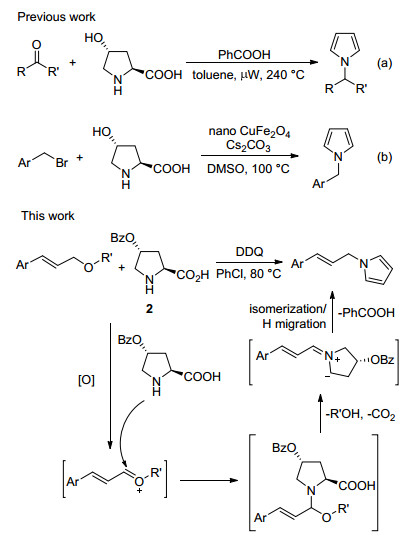
Scheme 1.
Previous Work and This Work

ipso-Oxidation of Allyl Ether/Decarboxylative Aromatization Cascade Strategy via Oxocarbenium Activation: A Novel Approach for Synthesis of N-Alkyl Pyrroles
Xubin Li , Chen Zhou , Xingtong Liu , Teng Wang , Xinhong Yu , Hongmei Ma , Cuiqing Li


Pyrrole moiety is frequently found in natural compounds, pharmaceuticals and biologically active products. Due to their special characterization, pyrroles are also exploited in electrochemistry.[1] Over the past few years, many efforts have been devoted to decarboxylative formation of N-alkyl pyrroles.[2] Seidel and coworkers[2c] demonstrated a method for the rapid synthesis of N-alkyl pyrroles starting from aldehydes or ketones with trans- 4-hydroxy-L-proline in the presence of benzoic acid under microwave irradiation (Scheme 1, a). Subsequently, our group reported an acetic acid-catalyzed efficient access to N-alkyl pyrroles, refluxing in N, N-dimethylformamide (DMF) in good to excellent yields.[2e] Additionally, Na- geswar and coworkers[2f] established a protocol using benzyl bromides and trans-4-hydroxy-L-proline to synthesize N-substituted pyrroles (Scheme 1, b). However, to the best of our knowledge, the reaction of ethers as initial reactants with α-amino acids has never been reported.
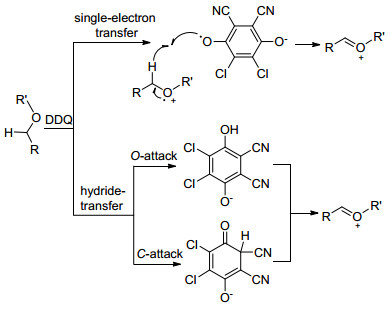
Ethers occupy an important position in organic chemistry and they are often employed as solvents and in protecting hydroxyl groups owing to their favorable stability. Oxidation of ether could be classified mainly to: (1) oxidation of ether to form carbonyl compounds, [3] and (2) α-Csp3-H cross-dehydrogenative coupling (CDC) reaction of ether.[4] This oxidative CDC reaction of ether goes through oxocarbenium ion intermediates which constitute a class of highly activated species.[5] The reactions of oxocarbenium ions are widely applied in the synthesis of natural products and bioactive molecules. In oxidative CDC reaction, several possible mechanisms of the formation of oxocarbenium ions are illustrated in Scheme 2, including single-electron transfer followed by hydrogen atom transfer and one-step hydride transfer.[6]
Herein, it was envisioned that allyl ethers could be oxidized to the corresponding oxocarbenium ions for higher reactivity to enforce decarboxylative aromatization. Gratifyingly, in this study, a novel protocol combined oxidation of allyl ether with decarboxylation has been developed, getting access to N-alkyl pyrroles via oxocarbenium activation (Scheme 1). trans-4-Benzoyloxy-L-proline 2 was utilized in place of L-hydroxyproline, which elimination tends to occur, thus the reaction could proceed under milder condition.
In the initial exploration, it was found that when the reaction was carried out with 2, 3-dichloro-5, 6-dicyano-1, 4- benzoquinone (DDQ) (2.0 equiv.) in toluene at 80 ℃ for 12 h, the desired product 3a could be detected in 27% yield based on 1H NMR analysis (Table 1, Entry 1). In addition, the yield decreased when the cinnamyl ether 1 was oxidized before adding L-hydroxyproline derivative 2 compared with the one-pot condition (Table 1, Entry 2). Further investigation of various solvents revealed that chlorobenzene was the best (Table 1, Entries 4~9). The yield was improved largely in the presence of antioxidant 300 (5-tert-butyl-4-hydroxy-2-methylphenyl sulfide) (1.0 eq- uiv.) (Table 1, Entry 14). The isolated yield of 3a could be further increased to 71% when the substituent group is ethyl instead of methyl, isopropyl or tert-butyl (Table 1, Entries 16~18).
 下载:
导出CSV
 |
||||
| Entry | Oxidant | Solvent | Additive (equiv.) | Yieldb/% |
| 1 | DDQ | Toluene | — | 27 |
| 2c | DDQ | Toluene | — | 11 |
| 3 | T+•BF4- | Toluene | — | 19 |
| 4 | DDQ | PhCl | — | 33 |
| 5 | DDQ | DCE | — | 24 |
| 6 | DDQ | CCl4 | — | 18 |
| 7 | DDQ | THF | — | 20 |
| 8 | DDQ | CHCl3 | — | 18 |
| 9 | DDQ | EtOAc | — | 23 |
| 10 | DDQ | PhCl | InCl3 (1.0) | 6 |
| 11 | DDQ | PhCl | Phenol (1.0) | 38 |
| 12 | DDQ | PhCl | TEMPO (1.0) | 27 |
| 13 | DDQ | PhCl | Antioxidant 300 (0.5) | 41 |
| 14 | DDQ | PhCl | Antioxidant 300 (1.0) | 57 |
| 15 | DDQ | PhCl | Antioxidant 300 (2.0) | 33 |
| 16e | DDQ | PhCl | Antioxidant 300 (1.0) | 71d |
| 17f | DDQ | PhCl | Antioxidant 300 (1.0) | 63d |
| 18g | DDQ | PhCl | Antioxidant 300 (1.0) | 63d |
| 19h | DDQ | PhCl | Antioxidant 300 (1.0) | 60d |
| 20i | DDQ | PhCl | Antioxidant 300 (1.0) | 55d |
| a Reaction conditions: 1 (0.2 mmol, 1.0 equiv.), 2 (0.4 mmol, 2.0 equiv.), oxidant (0.4 mmol, 2.0 equiv.), solvent (3.0 mL), 80 ℃, 12 h. b Determined by 1H NMR analysis using dibromomethane as the internal standard. c 1 was oxi- dized by oxidant before adding 2. d Isolated yields of reactions performed on 0.5 mmol scale. e R=ethyl. f R=isopropyl. g R=tert-butyl. h 70 ℃. i 90 ℃. | ||||
Under the optimized reaction conditions, a range of allyl ethers were explored. Both the electron-donating and electron-withdrawing groups on the aromatic ring were all tolerated though neither of them performed better than the unsubstituted one (Table 2). Especially when the functional groups were strong electron-donating or electron-with- drawing groups, the yields reduced a lot. In addition to aromatic groups, heteroaromatic groups such as furyl and thienyl were also employed to afford the products 3l and 3m, albeit in low yields (41% and 29%, respectively). Moreover, indoline-2-carboxylic acid was substituted for L-hydroxyproline derivative 2 as the reagent, N-alkyl indole 3o was obtained.
下载:
导出CSV
 |
|
 |
 |
 |
 |
 |
 |
 |
 |
 |
 |
 |
 |
 |
 |
 |
|
| a Reaction conditions: 1 (0.5 mmol, 1.0 equiv.), 2 (1.0 mmol, 2.0 equiv.), DDQ (1.0 mmol, 2.0 equiv.), antioxidant 300 (0.5mmol, 1.0 equiv.), PhCl (10 mL), 80 ℃, 12 h. Isolated yields. | |
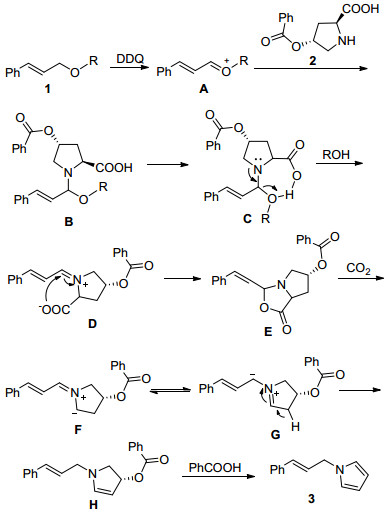
Based on the above experimental results and previous reports, [2, 6] a plausible mechanism is proposed in Scheme 3. The first step involves oxidation of ether 1 to give oxocarbenium ion A, followed by addition of L-hydroxypro- line derivative 2 to A, gaining species B. Subsequent formation of hydrogen bond (O…H—O) attains C. The extrusion of ROH from C affords D, then forming lactone E which undergoes decarboxylation to generate azomethine ylide F. Intermediate G is tautomeric isomer of F and sub-sequent hydrogen migration of G provides H. Finally, elimination of H results in the formation of product 3.
In summary, a novel protocol has been demonstrated that tandem ipso-oxidation of allyl ether/decarboxylative aromatization generates N-alkyl pyrroles via oxocarbenium activation. This approach involves formation of C—N bond and cleavage of C—O bond. This method is complementary to the reported protocols for oxocarbenium activation. Moreover, this reaction allows convenient access to 1-cinnamyl-1H-pyrrole and its derivatives with good functional group tolerance and stimulates the design of new methods to synthesize N-alkyl pyrroles.
All commercial reagents were used as received without further purification unless otherwise noted. Reaction temperatures were reported as the temperatures of the bather surrounding the flasks or tubes. 1H NMR and 13C NMR spectra were recorded at a Bruke Avance-400 spectrometer (400 MHz and 100 MHz, respectively) using TMS as an internal standard. High-resolution mass spectra (HRMS) were carried out on Micromass GCTTM gas chromatograph-mass spectrometer. Flash chromatography was performed on silica gel (300~400 mesh) using mixtures of petroleum ether (b.p. 60~90 ℃) and ethyl acetate as eluents.
trans-4-Hydroxy-L-proline (23.64 g, 180 mmol) was dissolved in CF3CO2H (100 mL) by stirring at room temperature for 15 min. The solution was cooled just below room temperature with an ice/water bath, removed from the bath, and benzoyl chloride (41.8 mL, 360 mmol) was added in one portion (mildly exothermic). The solution was stirred at room temperature for 2 h. Under cooling with an ice/water bath, Et2O (350 mL) was added carefully. Stirring was discontinued, and the sticky precipitate was allowed to settle for 15 min. The clear supernatant was decanted, and i-PrOH (100 mL) was added to the solid residue. Vigorous stirring at near reflux gave a fine white suspension. When it became homogeneous, it was cooled with an ice/water bath, and Et2O (200 mL) was added whilst stirring. The resulting suspension was vacuum-filtered, washed with Et2O (50 mL) and dried at room temperature for 16 h to give trans-4-benzoyloxy-L-proline hydrochloride as a fine white powder. All the hydrochloride salt was dissolved in EtOH (96 vol%, 100 mL) by heating. The solution was cooled to approximately room temperature in an ice/water bath, removed from the bath, and propylene oxide (20 mL, 286 mmol) was added. Stirring was discontinued and the solution left for crystallization at room temperature for 7 h. The crystals were vacuum-filtered and dried at room temperature to give 2 as small colourless crystals. The product was recrystallized from boiling water (160 mL) to give 2 as colourless crystals.
An oven-dried 25 mL reaction flask equipped with a magnetic stirring bar was charged with 1 (0.5 mmol, 1.0 equiv.), 2 (235.2 mg, 1.0 mmol, 2.0 equiv.), DDQ (227.0 mg, 1.0 mmol, 2.0 equiv.), Antioxidant 300 (179.3 mg, 0.5 mmol, 1.0 equiv.) and PhCl (10 mL). The flask equipped with a reflux condenser was heated in an oil bath at 80 ℃ for 12 h. The reaction was monitored by thin-layer chromatography (TLC). After cooling to room temperature, the resulting mixture was filtered through silica gel with EtOAc. The filtrate was removed in vacuo and the residue was purified by flash column chromatography (petroleum ether/ethyl acetate, V:V=400:1) to afford the desired products.
1-Cinnamyl-1H-pyrrole (3a): Yellow oil; yield 65 mg (71%). 1H NMR (400 MHz, CDCl3) δ: 7.39 (d, J=6.9 Hz, 2H), 7.34 (t, J=7.4 Hz, 2H), 7.28 (d, J=7.1 Hz, 1H), 6.74 (t, J=2.1 Hz, 2H), 6.51 (d, J=15.8 Hz, 1H), 6.36 (dt, J=15.8, 6.1 Hz, 1H), 6.22 (t, J=2.1 Hz, 2H), 4.67 (dd, J=6.1, 1.5 Hz, 2H); 13C NMR (101 MHz, CDCl3) δ: 136.3, 132.6, 128.6 (2C), 127.9, 126.6 (2C), 125.5, 120.7 (2C), 108.4 (2C), 51.6. HRMS (EI) calcd for C13H13N: 183.1048, found 183.1045.
(E)-1-(3-(4-Methoxyphenyl)allyl)-1H-pyrrole (3b): Yel- low oil; yield 50 mg (47%). 1H NMR (400 MHz, CDCl3) δ: 7.33 (d, J=8.8 Hz, 2H), 6.87 (d, J=8.7 Hz, 2H), 6.74 (t, J=2.2 Hz, 2H), 6.47 (d, J=15.8 Hz, 1H), 6.26~6.19 (m, 3H), 4.65 (d, J=6.3 Hz, 2H), 3.83 (s, 3H); 13C NMR (101 MHz, CDCl3) δ: 159.5, 132.1, 129.1, 127.8 (2C), 123.2, 120.6 (2C), 114.0 (2C), 108.3 (2C), 55.3, 51.7. HRMS (EI) calcd for C14H15NO: 213.1154, found 213.1156.
(E)-1-(3-(2-Methoxyphenyl)allyl)-1H-pyrrole (3c): Yellow oil; yield 41 mg (38%). 1H NMR (400 MHz, CDCl3) δ: 7.43 (dd, J=7.7, 1.7 Hz, 1H), 7.29~7.22 (m, 1H), 6.98~6.86 (m, 3H), 6.75 (t, J=2.1 Hz, 2H), 6.38 (dt, J=15.9, 6.5 Hz, 1H), 6.20 (t, J=2.1 Hz, 2H), 4.68 (dd, J=6.5, 1.5 Hz, 2H), 3.87 (s, 3H); 13C NMR (101 MHz, CDCl3) δ: 156.8, 129.0, 127.9, 127.1, 126.0, 125.3, 120.7, 120.6 (2C), 110.9, 108.2 (2C), 55.5, 52.2. HRMS (EI) calcd for C14H15NO: 213.1154, found 213.1150.
(E)-1-(3-(p-Tolyl)allyl)-1H-pyrrole (3d): Yellow oil; yield 55 mg (56%). 1H NMR (400 MHz, CDCl3) δ: 7.30 (d, J=8.1 Hz, 2H), 7.16 (d, J=7.9 Hz, 2H), 6.75 (t, J=2.1 Hz, 2H), 6.51 (d, J=15.8 Hz, 1H), 6.32 (dt, J=15.8, 6.2 Hz, 1H), 6.23 (t, J=2.1 Hz, 2H), 4.67 (dd, J=6.2, 1.4 Hz, 2H), 2.38 (s, 3H); 13C NMR (101 MHz, CDCl3) δ: 137.8, 133.5, 132.5, 129.4 (2C), 126.5 (2C), 124.5, 120.7 (2C), 108.4 (2C), 51.7, 21.3. HRMS (EI) calcd for C14H15N: 197.1204, found 197.1201.
(E)-1-(3-(m-Tolyl)allyl)-1H-pyrrole (3e): Yellow oil; yield 31 mg (31%). 1H NMR (400 MHz, CDCl3) δ: 7.25~7.19 (m, 3H), 7.09 (d, J=7.3 Hz, 1H), 6.73 (t, J=2.1 Hz, 2H), 6.48 (d, J=15.8 Hz, 1H), 6.34 (dt, J=15.7, 6.1 Hz, 1H), 6.21 (t, J=2.1 Hz, 2H), 4.66 (dd, J=6.1, 1.4 Hz, 2H), 2.36 (s, 3H); 13C NMR (101 MHz, CDCl3) δ: 138.2, 136.2, 132.7, 128.7, 128.5, 127.3, 125.3, 123.7, 120.7 (2C), 108.4 (2C), 51.6, 21.4. HRMS (EI) calcd for C14H15N: 197.1204, found 197.1201.
(E)-1-(3-(o-Tolyl)allyl)-1H-pyrrole (3f): Yellow oil; yield 68 mg (69%). 1H NMR (400 MHz, CDCl3) δ: 7.49~7.45 (m, 1H), 7.24~7.20 (m, 3H), 6.78 (t, J=2.1 Hz, 2H), 6.72 (d, J=15.9 Hz, 1H), 6.31~6.23 (m, 3H), 4.72 (dd, J=6.2, 1.6 Hz, 2H), 2.39 (s, 3H); 13C NMR (101 MHz, CDCl3) δ: 135.6, 135.5, 130.6, 130.4, 127.9, 126.9, 126.2, 125.9, 120.7 (2C), 108.4 (2C), 51.9, 19.8. HRMS (EI) calcd for C14H15N: 197.1204, found 197.1209.
(E)-1-(3-(4-Chlorophenyl)allyl)-1H-pyrrole (3g): Yellow oil; yield 62 mg (57%). 1H NMR (400 MHz, CDCl3) δ: 7.32 (s, 4H), 6.75 (t, J=2.0 Hz, 2H), 6.45 (d, J=15.8 Hz, 1H), 6.34 (dt, J=15.8, 5.9 Hz, 1H), 6.25 (t, J=2.0 Hz, 2H), 4.68 (dd, J=5.9, 1.3 Hz, 2H); 13C NMR (101 MHz, CDCl3) δ: 134.8, 133.6, 131.2, 128.8 (2C), 127.8 (2C), 126.4, 120.7 (2C), 108.6 (2C), 51.5. HRMS (EI) calcd for C13H12ClN: 217.0658, found 217.0655.
(E)-1-(3-(3-Chlorophenyl)allyl)-1H-pyrrole (3h): Yellow oil; yield 60 mg (55%). 1H NMR (400 MHz, CDCl3) δ: 7.38 (s, 1H), 7.29~7.23 (m, 3H), 6.74 (t, J=2.0 Hz, 2H), 6.42 (d, J=16.8 Hz, 1H), 6.37 (dt, J=16.7, 5.2 Hz, 1H), 6.25 (t, J=2.0 Hz, 2H), 4.68 (d, J=5.0 Hz, 2H); 13C NMR (101 MHz, CDCl3) δ: 138.2, 134.6, 131.0, 129.9, 127.9, 127.3, 126.5, 124.7, 120.7 (2C), 108.6 (2C), 51.4. HRMS (EI) calcd for C13H12ClN: 217.0658, found 217.0662.
(E)-1-(3-(2-Chlorophenyl)allyl)-1H-pyrrole (3i): Yellow oil; yield 74 mg (68%). 1H NMR (400 MHz, CDCl3) δ: 7.55 (dd, J=7.2, 2.4 Hz, 1H), 7.42 (dd, J=7.3, 2.0 Hz, 1H), 7.28~7.23 (m, 2H), 6.99 (d, J=15.8 Hz, 1H), 6.79 (t, J=2.1 Hz, 2H), 6.36 (dt, J=15.8, 6.3 Hz, 1H), 6.28 (t, J=2.2 Hz, 2H), 4.73 (dd, J=6.3, 1.7 Hz, 2H); 13C NMR (101 MHz, CDCl3) δ: 134.5, 133.2, 129.8, 129.0, 129.0, 128.5, 127.1, 127.0, 120.7 (2C), 108.6 (2C), 51.7. HRMS (EI) calcd for C13H12ClN: 217.0658, found 217.0660.
(E)-1-(3-(4-Bromophenyl)allyl)-1H-pyrrole (3j): Yellow oil; yield 77 mg (59%). 1H NMR (400 MHz, CDCl3) δ: 7.39 (d, J=8.5 Hz, 2H), 7.16 (d, J=8.5 Hz, 2H), 6.67 (t, J=2.1 Hz, 2H), 6.34 (d, J=15.9 Hz, 1H), 6.26 (dt, J=15.8, 5.6 Hz, 1H), 6.18 (t, J=2.1 Hz, 2H), 4.58 (d, J=5.6 Hz, 2H); 13C NMR (101 MHz, CDCl3) δ: 135.3, 131.8 (2C), 131.2, 128.1 (2C), 126.6, 121.8, 120.8 (2C), 108.6 (2C), 51.5. HRMS (EI) calcd for C13H12BrN: 261.0153, found 261.0156.
(E)-1-(3-(4-Fluorophenyl)allyl)-1H-pyrrole (3k): Yellow oil; yield 57 mg (57%). 1H NMR (400 MHz, CDCl3) δ: 7.35 (dd, J=8.6, 5.5 Hz, 2H), 7.02 (t, J=8.7 Hz, 2H), 6.73 (t, J=2.1 Hz, 2H), 6.46 (d, J=15.8 Hz, 1H), 6.27 (dt, J=15.9, 6.1 Hz, 1H), 6.22 (t, J=2.1 Hz, 2H), 4.66 (dd, J=6.1, 1.6 Hz, 2H); 13C NMR (101 MHz, CDCl3) δ: 162.5 (d, J=247.3 Hz), 132.5 (d, J=3.4 Hz), 131.3, 128.1 (d, J=8.0 Hz, 2C), 125.4 (d, J=2.2 Hz), 120.7 (2C), 115.6 (d, J=21.6 Hz, 2C), 108.5 (2C), 51.5. HRMS (EI) calcd for C13H12FN: 201.0954, found 201.0950.
(E)-1-(3-(Furan-2-yl)allyl)-1H-pyrrole (3l): Yellow oil; yield 35 mg (41%). 1H NMR (400 MHz, CDCl3) δ: 7.34 (d, J=1.7 Hz, 1H), 6.71 (t, J=2.1 Hz, 2H), 6.37 (dd, J=3.3, 1.9 Hz, 1H), 6.29 (dt, J=15.8, 5.5 Hz, 1H), 6.23 (d, J=2.5 Hz, 2H), 6.19 (t, J=2.1 Hz, 2H), 4.64 (d, J=5.4 Hz, 2H). 13C NMR (101 MHz, CDCl3) δ: 152.0, 142.2, 124.3, 120.8 (2C), 120.5, 111.3, 108.4, 108.4 (2C), 51.2. HRMS (EI) calcd for C11H11NO: 173.0841, found 173.0844.
(E)-1-(3-(Thiophen-2-yl)allyl)-1H-pyrrole (3m): Yellow oil; yield 27 mg (29%). 1H NMR (400 MHz, CDCl3) δ: 7.20~7.16 (m, 1H), 7.00~6.96 (m, 2H), 6.73 (t, J=2.1 Hz, 2H), 6.60 (d, J=15.6 Hz, 1H), 6.22 (t, J=2.2 Hz, 2H), 6.22~6.13 (m, 1H), 4.63 (dd, J=6.1, 1.6 Hz, 2H); 13C NMR (101 MHz, CDCl3) δ: 141.3, 127.4, 126.2, 125.6, 125.1, 124.7, 120.7 (2C), 108.4 (2C), 51.3. HRMS (EI) calcd for C11H11NS: 189.0612, found 189.0605.
(E)-1-(3-(4-(Trifluoromethyl)phenyl)allyl)-1H-pyrrole (3n): Yellow oil; yield 53 mg (42%). 1H NMR (400 MHz, CDCl3) δ: 7.60 (d, J=8.2 Hz, 2H), 7.48 (d, J=8.1 Hz, 2H), 6.75 (t, J=2.1 Hz, 2H), 6.54~6.41 (m, 2H), 6.26 (t, J=2.1 Hz, 2H), 4.71 (d, J=4.4 Hz, 2H); 13C NMR (101 MHz, CDCl3) δ: 139.8, 130.9, 129.7 (q, J=32.4 Hz), 128.5, 126.7 (2C), 125.6 (q, J=3.8 Hz, 2C), 124.2 (q, J=271.8 Hz), 120.8 (2C), 108.7 (2C), 51.4. HRMS (EI) calcd for C14H12F3N: 251.0922, found 251.0927.
1-Cinnamyl-1H-indole (3o) Yellow oil; yield 36 mg (31%). 1H NMR (400 MHz, CDCl3) δ: 7.64 (d, J=7.8 Hz, 1H), 7.36 (d, J=8.2 Hz, 1H), 7.33~7.28 (m, 3H), 7.26~7.17 (m, 3H), 7.14~7.08 (m, 2H), 6.53 (d, J=3.2 Hz, 1H), 6.46 (d, J=15.8 Hz, 1H), 6.31 (dt, J=15.9, 5.8 Hz, 1H), 4.85 (dd, J=5.7, 1.5 Hz, 2H); 13C NMR (101 MHz, CDCl3) δ: 136.3, 136.2, 132.4, 128.8, 128.6 (2C), 127.9, 127.8, 126.5 (2C), 124.9, 121.7, 121.0, 119.5, 109.7, 101.6, 48.4. HRMS (EI) calcd for C17H15N: 233.1204, found 233.1202.
Supporting Information 1H NMR and 13C NMR spectra of compounds 3a~3o. The Supporting Information is available free of charge via the Internet at http://sioc-journal.cn/.
Curran, D.; Grimshaw, J.; Perera, S. D. Chem. Soc. Rev. 1991, 20, 391. doi: 10.1039/cs9912000391
(a) Azizian, J.; Karimi, A. R.; Kazemizadeh, Z.; Mohammadi, A. A.; Mohammadizadeh, M. R. J. Org. Chem. 2005, 70, 1471.
(b) Meshram, H. M.; Prasad, B. R. V.; Aravind Kumar, D. Tetrahedron Lett. 2010, 51, 3477.
(c) Deb, I.; Coiro, D. J.; Seidel, D. Chem. Commun. 2011, 47, 6473.
(d) Mao, H.; Wang, S.; Yu, P.; Lv, H.; Xu, R.; Pan, Y. J. Org. Chem. 2011, 76, 1167.
(e) Zou, Z.; Deng, Z.; Yu, X.; Zhang, M.; Zhao, S.; Luo, T.; Yin, X.; Xu, H.; Wang, W. Sci. China Chem. 2012, 55, 43.
(f) Satish, G.; Reddy, K. H. V.; Ramesh, K.; Kumar, B. S. P. A.; Nageswar, Y. V. D. Tetrahedron Lett. 2014, 55, 2596.
(a) Miller, A. J. M.; Kaminsky, W.; Goldberg, K. I. Organometallics 2014, 33, 1245.
(b) Song, Z.-Z.; Gong, J.-L.; Zhang, M.; Wu, X.-F. Asian J. Org. Chem. 2012, 1, 214.
(c) Shen, Z.; Dai, J.; Xiong, J.; He, X.; Mo, W.; Hu, B.; Sun, N.; Hu, X. Adv. Synth. Catal. 2011, 353, 3031.
(a) Zhang, Y.; Li, C.-J. Angew. Chem., Int. Ed. 2006, 45, 1949.
(b) Zhang, Y.; Li, C.-J. J. Am. Chem. Soc. 2006, 128, 4242.
(c) Tu, W.; Liu, L.; Floreancig, P. E. Angew. Chem., Int. Ed. 2008, 47, 4184.
(d) Tu, W.; Floreancig, P. E. Angew. Chem., Int. Ed. 2009, 48, 4567.
(e) Liu, L.; Floreancig, P. E. Angew. Chem., Int. Ed. 2010, 49, 5894.
(f) Richter, H.; Rohlmann, R.; García Mancheño, O. Chem.-Eur. J. 2011, 17, 11622.
(g) Muramatsu, W.; Nakano, K.; Li, C.-J. Org. Lett. 2013, 15, 3650.
(h) Meng, Z.; Sun, S.; Yuan, H.; Lou, H.; Liu, L. Angew. Chem. Int. Ed. 2014, 53, 543.
(i) Chen, W.; Xie, Z.; Zheng, H.; Lou, H.; Liu, L. Org. Lett. 2014, 16, 5988.
(j) Yu, B.; Jiang, T.; Li, J.; Su, Y.; Pan, X.; She, X. Org. Lett. 2009, 11, 3442.
(k) Liu, L.; Floreancig, P. E. Org. Lett. 2010, 12, 4686.
(l) Liu, X.; Sun, B.; Xie, Z.; Qin, X.; Liu, L.; Lou, H. J. Org. Chem. 2013, 78, 3104.
(m) Sun, K.; Wang, X.; Li, G.; Zhu, Z.; Jiang, Y.; Xiao, B. Chem. Commun. 2014, 50, 12880.
(n) Pandit, R. P.; Lee, Y. R. Adv. Synth. Catal. 2014, 356, 3171.
(a) Reisman, S. E.; Doyle, A. G.; Jacobsen, E. N. J. Am. Chem. Soc. 2008, 130, 7198.
(b) McQuaid, K. M.; Sames, D. J. Am. Chem. Soc. 2009, 131, 402.
(c) Maity, P.; Srinivas, H. D.; Watson, M. P. J. Am. Chem. Soc. 2011, 133, 17142.
(d) Chen, Y.; Chen, M.; Liu, Y. Angew. Chem. 2012, 124, 6599.
(e) Rueping, M.; Volla, C. M. R.; Atodiresei, I. Org. Lett. 2012, 14, 4642.
(f) Lu, C.; Su, X.; Floreancig, P. E. J. Org. Chem. 2013, 78, 9366.
(g) Srinivas, H. D.; Maity, P.; Yap, G. P. A.; Watson, M. P. J. Org. Chem. 2015, 80, 4003.
(h) Kong, A.; Andreansky, E. S.; Blakey, S. B. J. Org. Chem. 2017, 82, 4477.
(i) Fan, W.-T.; Li, N.-K.; Xu, L.; Qiao, C.; Wang, X.-W. Org. Lett. 2017, 19, 6626.
(j) Lee, S.; Kaib, P. S. J.; List, B. J. Am. Chem. Soc. 2017, 139, 2156.
(a) Zhang, S.-Y.; Zhang, F.-M.; Tu, Y.-Q. Chem. Soc. Rev. 2011, 40, 1937.
(b) Morales-Rivera, C. A.; Floreancig, P. E.; Liu, P. J. Am. Chem. Soc. 2017, 139, 17935.
Table 1. Optimization of reaction conditionsa
|
||||
| Entry | Oxidant | Solvent | Additive (equiv.) | Yieldb/% |
| 1 | DDQ | Toluene | — | 27 |
| 2c | DDQ | Toluene | — | 11 |
| 3 | T+•BF4- | Toluene | — | 19 |
| 4 | DDQ | PhCl | — | 33 |
| 5 | DDQ | DCE | — | 24 |
| 6 | DDQ | CCl4 | — | 18 |
| 7 | DDQ | THF | — | 20 |
| 8 | DDQ | CHCl3 | — | 18 |
| 9 | DDQ | EtOAc | — | 23 |
| 10 | DDQ | PhCl | InCl3 (1.0) | 6 |
| 11 | DDQ | PhCl | Phenol (1.0) | 38 |
| 12 | DDQ | PhCl | TEMPO (1.0) | 27 |
| 13 | DDQ | PhCl | Antioxidant 300 (0.5) | 41 |
| 14 | DDQ | PhCl | Antioxidant 300 (1.0) | 57 |
| 15 | DDQ | PhCl | Antioxidant 300 (2.0) | 33 |
| 16e | DDQ | PhCl | Antioxidant 300 (1.0) | 71d |
| 17f | DDQ | PhCl | Antioxidant 300 (1.0) | 63d |
| 18g | DDQ | PhCl | Antioxidant 300 (1.0) | 63d |
| 19h | DDQ | PhCl | Antioxidant 300 (1.0) | 60d |
| 20i | DDQ | PhCl | Antioxidant 300 (1.0) | 55d |
| a Reaction conditions: 1 (0.2 mmol, 1.0 equiv.), 2 (0.4 mmol, 2.0 equiv.), oxidant (0.4 mmol, 2.0 equiv.), solvent (3.0 mL), 80 ℃, 12 h. b Determined by 1H NMR analysis using dibromomethane as the internal standard. c 1 was oxi- dized by oxidant before adding 2. d Isolated yields of reactions performed on 0.5 mmol scale. e R=ethyl. f R=isopropyl. g R=tert-butyl. h 70 ℃. i 90 ℃. | ||||
 下载: 导出CSV
Table 2. Substrate Scopea
| |
|
|
|
|
|
|
|
|
|
|
|
|
|
|
|
|
|
| a Reaction conditions: 1 (0.5 mmol, 1.0 equiv.), 2 (1.0 mmol, 2.0 equiv.), DDQ (1.0 mmol, 2.0 equiv.), antioxidant 300 (0.5mmol, 1.0 equiv.), PhCl (10 mL), 80 ℃, 12 h. Isolated yields. | |
下载: 导出CSV

 扫一扫看文章


扫一扫关注我们


 下载: