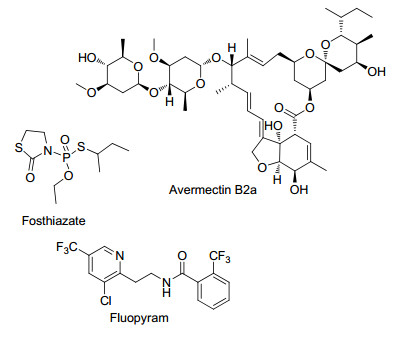
Figure 1.
Chemical structures of fosthiazate, avermectin B2a and fluopyram

Design, Synthesis and Biological Activity Screening of Novel Amide Derivatives Containing Aromatic Thioether Group
Xuewen Hua , Nannan Liu , Zhijin Fan , Guangning Zong , Yi Ma , Kang Lei , Hao Yin , Guiqing Wang


Over the past few decades, plant parasitic nematodes have caused serious damage to crop production worldwide and have recently caused even more severe problems, [1, 2] however, the varieties of nematicides used on the market are deficient. Traditional highly toxic or virulent nematocides, such as carbamates aldicarb, carbofuran, oxamyl, and organophosphates fenamiphos, cadusafos, fensulfothion, etc., have been banned or restricted in China.[3, 4] Furthermore, the early fumigant methyl bromide was also phased out due to its destruction of the ozone layer.[4] Nowadays, the chemical control agents widely used in the market are mainly fosthiazate and avermectin B2a (Figure 1), whose long-term use has produced serious resistance.
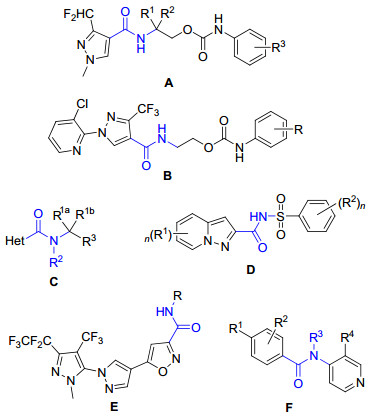
The discovery and development of new nematicides which are highly effective against the target pest, work by new modes of action, and meet societal demands of safety to humans and the environment are essential in the defense of crops.[5] Fluopyram (Figure 1), a SDHI fungicide successfully developed by Bayer AG, has also been extensively used to control soil nematodes as a new generation of highly effective nematicide.[6~8] Subsequently, some nematocidal amide structures were reported successively (Figure 2).[9~15]
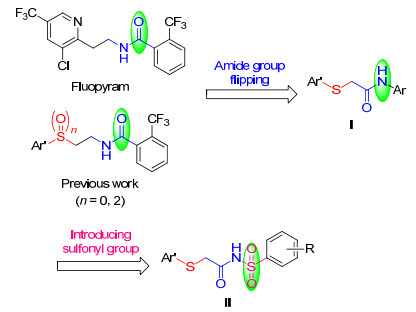
In our previous work, based on the recently reported nematocidal active ingredients, two series of amide derivatives were designed and synthesized by introducing sulfide and sulfone groups into the commercial fluopyram, most of which displayed excellent nematocidal activity at 200 μg/mL (Figure 3).[16] In order to explore the effect of structural modification of the amide bridge on biological activity in a more delicate way, another two series of novel amide target compounds were designed and prepared by adopting amide group flipping and introducing N-sulfonyl substituted amide bonds (Figure 3).
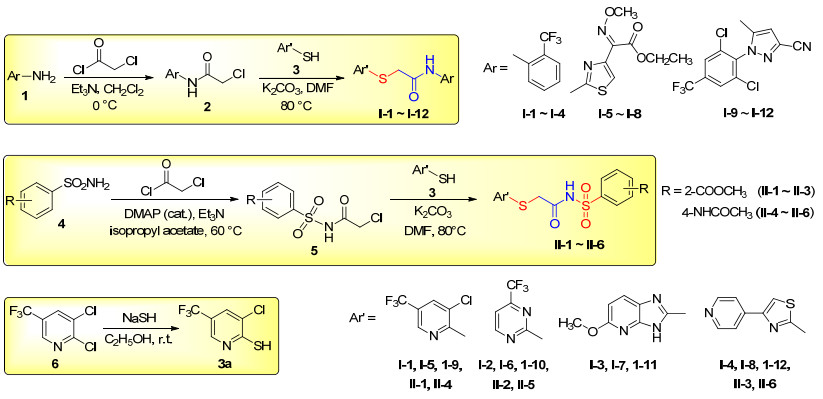
Herein, the important intermediates 2, 5 and the target compounds Ⅰ-1~Ⅰ-12, Ⅱ-1~Ⅱ-6 were designed and synthesized according to the methods in Scheme 1. Firstly, amides 2 were prepared by acylation of aromatic amines and chloroacetyl chloride. Given the weak nucleophilic property of sulfonamides, a catalytic amount of 4-dimethyl- aminopyridine (DMAP) was adopted to improve the reaction of aromatic sulfonamides and chloroacetyl chloride to provide intermediates 5. Aromatic thiophenols 3 were obtained by purchasing market varieties or laboratory preparation, of which 3-chloro-5-(trifluoromethyl)pyridine-2- thiol (3a) was synthesized by nucleophilic substitution of 2, 3-dichloro-5-(trifluoromethyl)pyridine and sodium hydrosulfide. Finally, intermediates 2, 5 and 3 were reacted respectively to generate eighteen novel amide target compounds Ⅰ-1~Ⅰ-12 and Ⅱ-1~Ⅱ-6, whose structures were identified by 1H NMR, 13C NMR and HRMS. Unfortunately, the target compounds containing 5-methoxy-3H- imidazo[4, 5-b]pyridin-2-yl group in compounds Ⅱ were unavailable to obtain through the procedures described above.
The nematocidal activities of target compounds against M. incognita, with fluopyram as a positive control, were shown in Table 1. From the data, the target compounds Ⅰ-1~Ⅰ-12 showed extremely weak nematocidal activities, however compounds Ⅱ exhibited significantly higher mortality than compounds Ⅰ. This result indicated that the introduction of the N-sulfonyl substituent on the amide group was favorable to improving the nematocidal activity in comparison with compounds Ⅰ. Compared the target compounds Ⅰ-1~Ⅰ-12 with our previous work, it can be concluded that the position of the amide bonds had a great influence on their nematocidal activity, of which directly attaching the carbonyl group to the aromatic heterocyclic ring was advantageous. In addition, there was no significant difference in nematocidal activity among the target compounds Ⅱ containing different aromatic rings on both sides of the amide bridge, which suggested that N-sulfonyl amide group played an important role in nematocidal activity. Overall, compared to the control fluopyram, no compounds displayed excellent nematocidal activities at 200 and 100 μg/mL, whereas the bioassays of compounds Ⅱ-1~Ⅱ-6 would provide a valuable guide to further explore the potential, efficient nematocidal lead compounds.

 下载:
导出CSV
下载:
导出CSV
| Compound | Mortality/% | |
| 200 μg/mL | 100 μg/mL | |
| Ⅰ-1 | 0 | 0 |
| Ⅰ-2 | 0 | 0 |
| Ⅰ-3 | 0 | 0 |
| Ⅰ-4 | 1.9±0.07 | 0 |
| Ⅰ-5 | 0 | 0 |
| Ⅰ-6 | 1.22±0.08 | 0 |
| Ⅰ-7 | 0 | 0 |
| Ⅰ-8 | 0 | 0 |
| Ⅰ-9 | 0 | 0 |
| Fluopyram | 99.3±1.14 | 99.4±1.12 |
| Ⅰ-10 | 1.66±0.31 | 1.36±0.11 |
| Ⅰ-11 | 4.44±0.81 | 0 |
| Ⅰ-12 | 2.72±0.93 | 1.71±0.58 |
| Ⅱ-1 | 62.7±1.95 | 57.0±1.34 |
| Ⅱ-2 | 66.5±1.75 | 40.4±1.04 |
| Ⅱ-3 | 57.5±1.47 | 49.7±0.17 |
| Ⅱ-4 | 77.5±0.97 | 57.2±1.43 |
| Ⅱ-5 | 50.5±2.09 | 48.9±2.31 |
| Ⅱ-6 | 50.3±0.56 | 49.6±1.36 |
Considering nematocide fluopyram was also used as an excellent SDHI fungicide, the fungicidal inhibition rates of target compounds were further measured and the results were shown in Table 2. Based on the data, no compounds displayed superior and broad-spectrum antifungal activity against all tested agricultural pathogens. In a given category, most of the target compounds exhibited higher inhibitory rates against Cercospora circumscissa Sacc. than other tested pathogens. In terms of the structural characteristics, there is no significant difference in fungicidal activity between compounds Ⅰ and Ⅱ, and among the same series. As a whole, the structural modification of the amide bridge had a great influence on the fungicidal activity.
下载:
导出CSV
| Compound | Inhibition rate/% | |||||||
| GZ | RS | CC | PM | BC | PP | AK | CS | |
| Fluopyram | 55.6±0.09 | 44.3±0.09 | 74.9±0.38 | 67.5±0.03 | 92.2±0.15 | 79.3±0.13 | 100.0 | 100.0 |
| Ⅰ-1 | 8.3±0.14 | 19.0±0.05 | 61.1±0.43 | 31.7±0.05 | 9.7±0.24 | 25.9±0.06 | 21.5±0.06 | 22.1±0.10 |
| Ⅰ-2 | 4.2±0.24 | 16.5±0.01 | 6.3±0.17 | 48.0±0.13 | 9.7±0.26 | 15.5±0.05 | 21.5±0.06 | 52.3±0.24 |
| Ⅰ-3 | 19.4±0.18 | 20.3±0.26 | 38.3±0.40 | 41.5±0.08 | 9.8±0.13 | 36.2±0.05 | 40.6±0.22 | 57.3±0.10 |
| Ⅰ-4 | 1.4±0.21 | 21.5±0.13 | 10.9±0.18 | 25.2±0.10 | 9.7±0.42 | 41.4±0.05 | 26.8±0.15 | 55.7±0.08 |
| Ⅰ-5 | 38.9±0.15 | 26.6±0.22 | 47.4±0.25 | 64.2±0.05 | 9.7±0.13 | 12.1±0.10 | 0 | 64.9±0.10 |
| Ⅰ-6 | 15.3±0.18 | 21.5±0.09 | 47.4±0.41 | 57.7±0.01 | 9.7±0.13 | 75.9±0.06 | 34.2±0.05 | 67.9±0.10 |
| Ⅰ-7 | 0 | 21.5±0.14 | 20.0±0.13 | 33.3±0.19 | 9.6±0.15 | 41.4±0.14 | 21.5±0.06 | 19.1±0.15 |
| Ⅰ-8 | 22.2±0.28 | 19.0±0.10 | 13.1±0.08 | 38.2±0.10 | 12.8±0.06 | 46.6±0.12 | 68.2±0.10 | 42.0±0.15 |
| Ⅰ-9 | 15.3±0.06 | 17.0±0.14 | 33.7±0.39 | 38.2±0.14 | 9.7±0.22 | 20.7±0.09 | 14.3±0.07 | 34.4±0.17 |
| Ⅰ-10 | 27.8±0.13 | 39.2±0.57 | 61.1±0.47 | 46.3±0.02 | 9.5±0.21 | 11.2±0.11 | 13.0±0.10 | 86.3±0.05 |
| Ⅰ-11 | 22.2±0.25 | 8.9±0.22 | 58.9±0.61 | 57.7±0.08 | 90.7±0.13 | 45.7±0.15 | 34.2±0.05 | 34.4±0.15 |
| Ⅰ-12 | 22.2±0.10 | 10.1±0.24 | 33.7±0.14 | 35.0±0.25 | 75.1±0.06 | 43.1±0.10 | 63.9±0.10 | 84.7±0.06 |
| Ⅱ-1 | 13.9±0.31 | 8.9±0.02 | 7.4±0.06 | 57.7±0.30 | 7.2±0.07 | 25.9±0.17 | 25.7±0.13 | 26.7±0.10 |
| Ⅱ-2 | 22.2±0.27 | 20.3±0.08 | 40.6±0.31 | 28.5±0.22 | 5.1±0.08 | 19.0±0.09 | 8.8±0.19 | 69.5±0.13 |
| Ⅱ-3 | 22.2±0.12 | 11.4±0.10 | 81.7±0.33 | 44.7±0.01 | 25.3±0.06 | 70.7±0.10 | 51.2±0.05 | 52.7±0.06 |
| Ⅱ-4 | 23.6±0.45 | 0 | 24.6±0.22 | 25.2±0.10 | 29.2±0.13 | 8.6±0.21 | 8.8±0.17 | 86.3±0.10 |
| Ⅱ-5 | 6.9±0.11 | 16.5±0.13 | 13.1±0.13 | 51.2±0.01 | 40.1±0.15 | 29.3±0.17 | 30.0±0.10 | 52.7±0.10 |
| Ⅱ-6 | 9.7±0.20 | 13.9±0.17 | 7.4±0.15 | 44.7±0.19 | 26.8±0.08 | 55.2±0.13 | 70.3±0.73 | 53.2±0.15 |
| a GZ: Gibberella zeae; RS: Rhizoctonia solani; CC: Colletotrichum capsici; PM: Phyllosticta melongenae Sawada; BC: Botrytis cinerea; PP: Physalospora piricola; AK: Alternaria kikuchiana Tanaka; CS: Cercospora circumscissa Sacc. | ||||||||
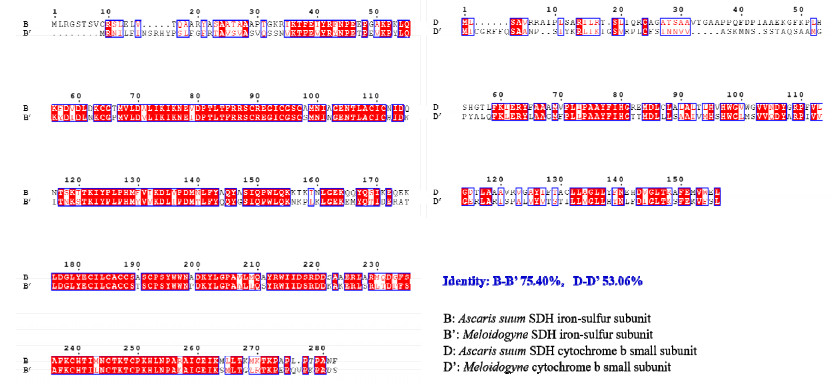
Although the composite crystal structure of fluopyram and the target enzyme SDH in nematodes has not been reported, P-BLAST found the amino acid sequences of iron- sulfur subunit (Chain B) and cytochrome b small subunit (Chain D) in Meloidogyne hapla SDH reported in Uniprot (Entry: A0A1I8BD68, A0A1I8C198) had high identity with that in Ascaris suum SDH (Figure 4). Based on Figure 4, it was inferred that SDH between Meloidogyne and Ascaris suum had high homology. In addition, the amino acid residues at the action site of flutolanil in chains B and D of Ascaris suum SDH were almost completely consistent with those in Meloidogyne hapla SDH, such as B/PRO 193, B/TRP 197, B/ILE 242, D/ASP 106, and D/TYR 107. Therefore, Ascaris suum SDH retrieved from the RCSB Protein Data Bank (PDB ID: 3VRB) was adopted as molecular docking receptor.
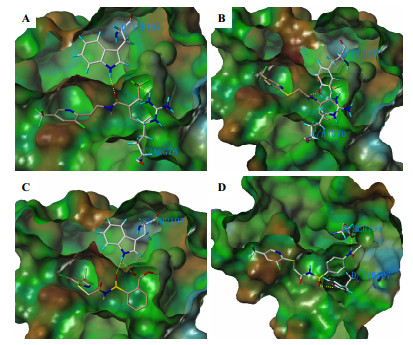
Subsequently, fluopyram, compounds Ⅰ-1, Ⅱ-1 and Ⅱ-4 were manually docked into the active site in Ascaris suum SDH on the basis of binding positions of flutolanil, and the results were illustrated in Figure 5. It showed that the amide group in compound Ⅰ-1 acted as a hydrogen-bond donor to form hydrogen bond with amino acid residue D/TYR 107, whereas the carbonyl group in fluopyram, and sulfonyl groups in compounds Ⅱ-1, Ⅱ-4 formed hydrogen bonds as acceptors with amino acid residues B/TRP197, D/TYR107, which were consistent with the binding mode of flutolanil in Ascaris suum SDH (PDB ID: 3VRB). In addition, the introduction of other hydrogen bond acceptors or donors on the amide-linked aromatic rings contributed to the interaction between the target molecules and amino acid residues. In combination with biological activity, we speculated that directly attaching the carbonyl or N-sulfonyl groups in the amide bridge to the aromatic rings containing other hydrogen bond acceptors or donors was favorable to the nematocidal activity.
In summary, eighteen novel target compounds were designed and synthesized by adopting amide group flipping and introducing N-sulfonyl substituted amide bonds. The bioassays indicated that the structural modification of the amide bridge had different effects on their nematocidal and fungicidal activities. For the fungicidal activity, no compounds displayed excellent and broad-spectrum inhibitory rates. However, the introduction of the N-sulfonyl substituent on the amide group in compounds Ⅱ was favorable to improving the nematocidal activity in comparison with compounds Ⅰ. Combined with our previous work and molecular docking, directly attaching the carbonyl or N-sulfonyl groups in the amide bridge to the aromatic rings was favorable to the nematocidal activity. These results would provide important guidance for the design and exploration of efficient nematocidal lead compounds.
All reaction reagents were analytical grade. Melting points for target compounds were determined on a X-4 binocular microscope (Gongyi Tech. Instrument Co., Henan, China). 1H NMR and 13C NMR were obtained on a Bruker AV-400 spectrometer (400 MHz), tetramethylsilane as the internal standard. Mass spectra were recorded on a high-resolution mass spectrometer (HRMS) (Varian 7.0T FTMS). Column chromatography purification was carried out using silica gel (200~300 mesh).
2-((3-Chloro-5-(trifluoromethyl)pyridin-2-yl)thio)-N-(2-(trifluoromethyl)phenyl)acet-amide (Ⅰ-1) was synthesized as follows.[16] A mixture of 3-chloro-5-(trifluoromethyl)- pyridine-2-thiol (1.1 mmol), potassium carbonate (1.3 mmol) in N, N-dimethylformamide (DMF, 5 mL) was heated to 80 ℃ and stirred for 10 min, followed by addition of 2-chloro-N-(2-(trifluoromethyl)phenyl)acetamide (1.0 mmol). The reaction was continued to stir for 3 h at 80 ℃. After reaction completion, the solution was poured into ice-water (100 mL) and then extracted with ethyl acetate (60 mL). The organic layer was dried by anhydrous magnesium sulfate, filtered and concentrated to be purified through chromatograph on silica gel using petroleum ether/ethyl acetate (V:V=3:1) as eluent to give white solid (yield 78%). Compounds Ⅰ-2~Ⅰ-12 and Ⅱ-1~Ⅱ-6 were prepared similarly.
2-((3-Chloro-5-(trifluoromethyl)pyridin-2-yl)thio)-N-(2-(trifluoromethyl)phenyl)acetamide (Ⅰ-1): White granular, yield 78%. m.p. 118~120 ℃; 1H NMR (400 MHz, CDCl3) δ: 8.89 (s, 1H, CONH), 8.63 (s, 1H, pyridine-H), 8.18 (d, J=8.2 Hz, 1H, Ph-H), 7.84 (s, 1H, pyridine-H), 7.55 (dd, J=12.8, 7.9 Hz, 2H, Ph-H), 7.21 (t, J=7.6 Hz, 1H, Ph-H), 4.06 (s, 2H, CH2); 13C NMR (100 MHz, CDCl3) δ: 166.8, 160.3, 144.0 (q, J=4.0 Hz), 134.9 (q, J=2.0 Hz), 133.2 (q, J=4.0 Hz), 132.8 (q, J=0.8 Hz), 129.4, 126.0 (q, J=6.0 Hz), 124.6, 124.5, 124.2 (q, J=33.0 Hz), 123.8 (q, J=272.0 Hz), 122.7 (q, J=270.0 Hz), 120.2 (q, J=30.0 Hz), 34.7; HRMS calcd for C15H10ClF6N2OS [M+H]+ 415.0101, found 415.0099.
2-((4-(Trifluoromethyl)pyrimidin-2-yl)thio)-N-(2- (trifluoromethyl)phenyl)acetamide (Ⅰ-2): White granular, yield 70%. m.p. 123~125 ℃; 1H NMR (400 MHz, CDCl3) δ: 8.83 (d, J=5.0 Hz, 1H, pyrimidine-H), 8.77 (s, 1H, CONH), 8.14 (d, J=8.1 Hz, 1H, Ph-H), 7.55 (t, J=8.4 Hz, 2H, Ph-H), 7.38 (d, J=5.0 Hz, 1H, pyrimidine-H), 7.23 (t, J=7.7 Hz, 1H, Ph-H), 4.03 (s, 2H, CH2); 13C NMR (100 MHz, CDCl3) δ: 171.8, 166.5, 159.9, 156.3 (q, J=36.0 Hz), 134.8, 132.8, 126.0 (q, J=5.0 Hz), 124.9, 124.8, 123.8 (q, J=272.0 Hz), 119.9 (q, J=274.0 Hz), 112.8 (q, J=3.0 Hz), 110.0, 35.5; HRMS calcd for C14H10F6N3OS [M+H]+ 382.0443, found 382.0440.
2-((5-Methoxy-3H-imidazo[4, 5-b]pyridin-2-yl)thio)-N- (2-(trifluoromethyl)phenyl) acetamide (Ⅰ-3): White granular, yield 75%. m.p. 141~142 ℃; 1H NMR (400 MHz, DMSO-d6) δ: 13.13 and 12.75 (s, 1H, imidazole-H), 10.07 (s, 1H, CONH), 7.76~7.61 (m, 4H, Ph-H), 7.41 (t, J=7.1 Hz, 1H, pyridine-H), 6.60 (d, J=8.6 Hz, 1H, pyridine-H), 4.23 (s, 2H, CH2), 3.84 (s, 3H, OCH3); 13C NMR (100 MHz, DMSO-d6) δ: 167.8, 160.4, 135.5, 133.5, 129.3, 126.9, 126.7 (q, J=5.0 Hz), 123.9 (q, J=271.0 Hz), 105.1, 53.7, 35.5; HRMS calcd for C16H14F3N4O2S [M+H]+ 383.0784, found 383.0778.
2-((4-(Pyridin-4-yl)thiazol-2-yl)thio)-N-(2-(trifluoro- methyl)phenyl)acetamide (Ⅰ-4): White granular, yield 72%. m.p. 140~141 ℃; 1H NMR (400 MHz, CDCl3) δ: 8.88 (s, 1H, CONH), 8.65~8.60 (m, 2H, pyridine-H), 8.11 (d, J=8.3 Hz, 1H, Ph-H), 7.76~7.70 (m, 2H, pyridine-H), 7.67 (s, 1H, thiazole-H), 7.55 (t, J=6.9 Hz, 2H, Ph-H), 7.23 (t, J=7.6 Hz, 1H, Ph-H), 4.20 (s, 2H, CH2); 13C NMR (100 MHz, CDCl3) δ: 166.3, 163.7, 152.3, 149.6, 149.5, 140.9, 134.6, 132.8, 126.1 (q, J=5.0 Hz), 125.1 (q, J=5.0 Hz), 123.6 (q, J=272.0 Hz), 121.0 (q, J=30.0 Hz), 120.6, 117.2, 37.2; HRMS calcd for C17H13F3N3OS2 [M+H]+ 396.0447, found 396.0442.
Ethyl 2-(2-(2-((3-chloro-5-(trifluoromethyl)pyridin-2- yl)thio)acetamido)thiazol-4-yl)-2-(methoxyimino)acetate (Ⅰ-5): White granular, yield 80%. m.p. 134~135 ℃; 1H NMR (400 MHz, CDCl3) δ: 10.23 (s, 1H, CONH), 8.66 (d, J=0.8 Hz, 1H, pyridine-H), 7.85 (d, J=1.4 Hz, 1H, pyridine-H), 7.18 (s, 1H, thiazole-H), 4.40 (q, J=7.1 Hz, 2H, CH2CH3), 4.11 (s, 2H, CH2), 4.02 (s, 3H, OCH3), 1.36 (t, J=7.1 Hz, 3H, CH2CH3); 13C NMR (100 MHz, CDCl3) δ: 166.4, 162.6, 159.8 (q, J=1.1 Hz), 158.1, 146.1, 144.0 (q, J=4.2 Hz), 141.0, 133.4 (q, J=3.4 Hz), 129.5, 124.5 (q, J=33.8 Hz), 122.6 (q, J=271.0 Hz), 115.2, 63.2, 62.1, 33.7, 14.1; HRMS calcd for C16H15ClF3N4O4S2 [M+H]+483.0170, found 483.0165.
Ethyl 2-(2-(2-((4-(trifluoromethyl)pyrimidin-2-yl)thio)- acetamido)thiazol-4-yl)-2-(methoxyimino)acetate (Ⅰ-6): Yellow sticky liquid, yield 77%. 1H NMR (400 MHz, CDCl3) δ: 10.29 (s, 1H, CONH), 8.84 (d, J=5.0 Hz, 1H, pyrimidine-H), 7.40 (d, J=5.0 Hz, 1H, pyrimidine-H), 7.20 (s, 1H, thiazole-H), 4.41 (q, J=7.1 Hz, 2H, CH2CH3), 4.08 (s, 2H, CH2), 4.01 (s, 3H, OCH3), 1.37 (t, J=7.1 Hz, 3H, CH2CH3); 13C NMR (100 MHz, CDCl3) δ: 171.5, 166.3, 162.6, 160.1, 158.1, 156.2 (q, J=37.0 Hz), 146.1, 141.0, 119.9 (q, J=274.0 Hz), 114.9, 113.0 (q, J=3.0 Hz), 63.2, 62.1, 34.6, 14.1; HRMS calcd for C15H15F3N5O4S2 [M+ H]+ 450.0512, found 450.0509.
Ethyl 2-(2-(2-((5-methoxy-3H-imidazo[4, 5-b]pyridin-2- yl)thio)acetamido)thiazol-4-yl)-2-(methoxyimino)acetate (Ⅰ-7): White granular, yield 82%. m.p. 106~108 ℃; 1H NMR (400 MHz, DMSO-d6) δ: 13.14 and 12.89 (s, 1H, imidazole-H), 12.83~12.71 (m, 1H, CONH), 7.87~7.69 (m, 1H, pyridine-H), 7.58 (s, 1H, thiazole-H), 6.60 (d, J=8.6 Hz, 1H, pyridine-H), 4.34 (dd, J=14.2, 7.1 Hz, 4H, CH2 and CH2CH3), 3.94 (s, 3H, OCH3), 3.85 (s, 3H, OCH3), 1.30 (t, J=7.1 Hz, 3H, CH2CH3); 13C NMR (100 MHz, DMSO- d6) δ: 167.4, 162.5, 160.4, 159.0, 153.7, 151.0, 147.7, 147.2, 146.8, 140.5, 130.7, 129.3, 128.6, 123.1, 122.1, 114.8, 110.0, 105.1, 63.2, 62.2, 53.8, 53.4, 35.3, 35.1, 34.9, 26.3, 14.4; HRMS calcd for C17H19N6O5S2 [M+H]+ 451.0853, found 451.0849.
Ethyl 2-(2-(2-((4-(pyridin-4-yl)thiazol-2-yl)thio)- acetamido)thiazol-4-yl)-2-(methoxy-imino)acetate (Ⅰ-8): White granular, yield 73%. Decomposed at 225 ℃; 1H NMR (400 MHz, DMSO-d6) δ: 12.92 (s, 1H, CONH), 8.50 (d, J=5.9 Hz, 2H, pyridine-H), 8.34 (s, 1H, thiazole-H), 7.76 (d, J=6.0 Hz, 2H, pyridine-H), 7.56 (s, 1H, thiazole-H), 4.37~4.27 (m, 4H, CH2 and CH2CH3), 3.93 (s, 3H, OCH3), 1.28 (t, J=7.1 Hz, 3H, CH2CH3); 13C NMR (100 MHz, DMSO-d6) δ: 167.4, 164.3, 162.6, 159.1, 151.7, 150.6, 146.9, 140.6, 140.4, 120.5, 119.3, 114.9, 63.3, 62.2, 37.1, 14.4; HRMS calcd for C18H18N5O4S3 [M+H]+ 464.0515, found 464.0514.
2-((3-Chloro-5-(trifluoromethyl)pyridin-2-yl)thio)-N-(3-cyano-1-(2, 6-dichloro-4-(trifluoromethyl)phenyl)-1H- pyrazol-5-yl)acetamide (Ⅰ-9): White granular, yield 74%. m.p. 162~164 ℃; 1H NMR (400 MHz, CDCl3) δ: 9.07 (s, 1H, CONH), 8.20 (s, 1H, pyridine-H), 7.82 (s, 1H, pyridine-H), 7.65 (s, 2H, Ph-H), 7.07 (s, 1H, pyrazole-H), 3.91 (s, 2H, CH2); 13C NMR (100 MHz, CDCl3) δ: 165.6, 160.8, 143.2 (q, J=4.0 Hz), 138.1, 136.4, 135.0, 134.7 (q, J=35.0 Hz), 133.6 (q, J=3.0 Hz), 129.7, 128.1, 125.9 (q, J=3.0 Hz), 124.6 (q, J=34.0 Hz), 122.3 (q, J=271.0 Hz), 121.6 (q, J=272.2 Hz), 112.9, 103.2, 34.1; HRMS calcd for C19H9Cl3F6N5OS [M+H]+ 573.9492, found 573.9494.
2-((4-(Trifluoromethyl)pyrimidin-2-yl)thio)-N-(3-cyano-1-(2, 6-dichloro-4-(trifluoromethyl)phenyl)-1H-pyrazol-5- yl)acetamide (Ⅰ-10): White granular, yield 71%. m.p. 160~161 ℃; 1H NMR (400 MHz, CDCl3) δ: 8.72 (s, 1H, CONH), 8.60 (d, J=5.0 Hz, 1H, pyrimidine-H), 7.65 (s, 2H, Ph-H), 7.35 (d, J=5.0 Hz, 1H, pyrimidine-H), 7.04 (s, 1H, pyrazole-H), 3.88 (s, 2H, CH2); 13C NMR (100 MHz, CDCl3) δ: 172.2, 165.7, 159.7, 156.2 (q, J=37.0 Hz), 138.1, 136.3, 135.0, 134.6 (q, J=34.0 Hz), 127.9, 126.0 (q, J=4.0 Hz), 121.7 (q, J=272.3 Hz), 119.7 (q, J=273.8 Hz), 113.0, 112.9 (q, J=2.6 Hz), 103.4, 34.7; HRMS calcd for C18H9Cl2F6N6OS [M+H]+ 540.9834, found 540.9833.
2-((5-Methoxy-3H-imidazo[4, 5-b]pyridin-2-yl)thio)-N- (3-cyano-1-(2, 6-dichloro-4-(trifluoromethyl)phenyl)-1H- pyrazol-5-yl) acetamide (Ⅰ-11): White granular, yield 67%. m.p. 131~132 ℃; 1H NMR (400 MHz, DMSO-d6) δ: 13.10 and 12.76 (s, 1H, imidazole-H), 11.03 (s, 1H, CONH), 8.22 (s, 2H, Ph-H), 7.71 (d, J=8.6 Hz, 1H, pyridine-H), 7.25 (s, 1H, pyrazole-H), 6.61 (d, J=8.6 Hz, 1H, pyridine-H), 4.22 (s, 2H, CH2), 3.86 (s, 3H, OCH3); 13C NMR (100 MHz, DMSO-d6) δ: 166.6, 160.4, 140.4, 135.9, 135.8 (q, J=1.0 Hz), 133.5 (q, J=33.3 Hz), 127.0, 126.9 (q, J=3.3 Hz), 122.6 (q, J=272.4 Hz), 113.9, 110.0, 105.1, 102.2, 53.7, 35.6; HRMS calcd for C20H13Cl2F3N7O2S [M+H]+ 542.0175, found 5642.0186.
2-((4-(Pyridin-4-yl)thiazol-2-yl)thio)-N-(3-cyano-1-(2, 6-dichloro-4-(trifluoromethyl) phenyl)-1H-pyrazol-5-yl)acet- amide (Ⅰ-12): White granular, yield 69%. m.p. 187~188 ℃; 1H NMR (400 MHz, CDCl3) δ: 9.97 (s, 1H, CONH), 8.63 (d, J=4.7 Hz, 2H, pyridine-H), 7.54 (s, 1H, thiazole-H), 7.44 (d, J=6.0 Hz, 2H, pyridine-H), 7.20 (s, 2H, Ph-H), 7.12 (s, 1H, pyrazole-H), 4.06 (s, 2H, CH2); 13C NMR (100 MHz, CDCl3) δ: 166.9, 165.9, 151.3, 150.7, 138.9, 138.6, 135.9, 134.8, 133.8 (q, J=34.0 Hz), 128.1, 125.6 (q, J=3.0 Hz), 121.7 (q, J=273.0 Hz), 119.7, 117.1, 113.0, 102.9, 37.1; HRMS calcd for C21H12Cl2F3N6OS2 [M+H]+ 554.9838, found 554.9850.
Methyl 2-(N-(2-((3-chloro-5-(trifluoromethyl)pyridin-2- yl)thio)acetyl)sulfamoyl) benzoate (Ⅱ-1): White granular, yield 66%. m.p. 149~151 ℃; 1H NMR (400 MHz, DMSO-d6) δ: 12.50 (s, 1H, NH), 8.41 (s, 1H, pyridine-H), 8.33 (s, 1H, pyridine-H), 8.07 (d, J=7.7 Hz, 1H, Ph-H), 7.78~7.68 (m, 3H, Ph-H), 4.14 (s, 2H, CH2), 3.91 (s, 3H, CH3); 13C NMR (100 MHz, DMSO-d6) δ: 167.4, 166.8, 161.0, 143.9 (q, J=4.0 Hz), 136.6, 134.2, 133.8 (q, J=3.0 Hz), 132.6, 131.1, 131.1, 129.3, 128.4, 123.4 (q, J=271.0 Hz), 122.6 (q, J=33.0 Hz), 53.6, 34.8; HRMS calcd for C16H12ClF3N2NaO5S2 [M+Na]+ 490.9720, found 490.9719.
Methyl 2-(N-(2-((4-(trifluoromethyl)pyrimidin-2- yl)thio)acetyl)sulfamoyl)benzoate (Ⅱ-2): White granular, yield 63%. m.p. 141~142 ℃; 1H NMR (400 MHz, DMSO-d6) δ: 12.48 (s, 1H, NH), 8.84 (d, J=5.0 Hz, 1H, pyrimidine-H), 8.13~8.01 (m, 1H, pyrimidine-H), 7.81~ 7.59 (m, 4H, Ph-H), 4.10 (s, 2H, CH2), 3.87 (s, 3H, CH3); 13C NMR (100 MHz, DMSO-d6) δ: 171.7, 167.3, 166.7, 161.4, 154.6 (q, J=36.0 Hz), 136.7, 134.2, 132.5, 131.2, 131.0, 129.5, 120.5 (q, J=273.0 Hz), 113.5 (q, J=2.0 Hz), 53.6, 35.4; HRMS calcd for C15H12F3N3NaO5S2 [M+Na]+458.0063, found 458.0061.
Methyl 2-(N-(2-((4-(pyridin-4-yl)thiazol-2-yl)thio)- acetyl)sulfamoyl)benzoate (Ⅱ-3): White granular, yield 68%. m.p. 209~211 ℃; 1H NMR (400 MHz, DMSO-d6) δ: 8.63 (d, J=5.7 Hz, 2H, pyridine-H), 8.36 (s, 1H, thiazole-H), 8.06 (d, J=7.3 Hz, 1H, Ph-H), 7.87 (d, J=6.0 Hz, 2H, pyridine-H), 7.74~7.57 (m, 3H, Ph-H), 4.24 (s, 2H, CH2), 3.88 (s, 3H, CH3); 13C NMR (100 MHz, DMSO-d6) δ: 167.4, 166.8, 164.5, 151.6, 150.1, 141.0, 137.0, 134.0, 132.5, 131.1, 130.8, 129.4, 120.8, 119.6, 53.6, 37.9; HRMS calcd for C18H16N3O5S3 [M+H]+ 450.0247, found 450.0246.
N-((4-Acetamidophenyl)sulfonyl)-2-((3-chloro-5- (trifluoromethyl)pyridin-2-yl)thio)acetamide (Ⅱ-4): White granular, yield 70%. Decomposed at 241 ℃; 1H NMR (400 MHz, DMSO-d6) δ: 12.37 (s, 1H, CONHSO2), 10.36 (s, 1H, CONH), 8.30 (d, J=1.4 Hz, 1H, pyridine-H), 8.20 (s, 1H, pyridine-H), 7.87 (d, J=8.9 Hz, 2H, Ph-H), 7.78 (d, J=8.9 Hz, 2H, Ph-H), 4.05 (s, 2H, CH2), 2.09 (s, 3H, CH3); 13C NMR (100 MHz, DMSO-d6) δ: 169.4, 166.5, 161.1, 144.4, 143.7 (q, J=5.0 Hz), 133.7 (q, J=4.0 Hz), 132.8, 129.4, 128.3, 123.3 (q, J=271.0 Hz), 122.5 (q, J=33.0 Hz), 118.6, 34.8, 24.5; HRMS calcd for C16H14ClF3N3O4S2 [M+H]+ 468.0061, found 468.0059.
N-((4-Acetamidophenyl)sulfonyl)-2-((4-(trifluoro- methyl)pyrimidin-2-yl)thio) acetamide (Ⅱ-5): White granular, yield 60%. m.p. 191~193 ℃; 1H NMR (400 MHz, DMSO-d6) δ: 12.39 (s, 1H, CONHSO2), 10.38 (s, 1H, CONH), 8.85 (d, J=5.0 Hz, 1H, pyrimidine-H), 7.84 (d, J=8.9 Hz, 2H, Ph-H), 7.75 (d, J=8.9 Hz, 2H, Ph-H), 7.66 (d, J=5.0 Hz, 1H, pyrimidine-H), 4.04 (s, 2H, CH2), 2.09 (s, 3H, CH3); 13C NMR (100 MHz, DMSO-d6) δ: 171.8, 169.5, 166.6, 161.4, 154.5 (q, J=36.0 Hz), 144.3, 132.9, 129.3, 120.5 (q, J=274.0 Hz), 118.8, 113.5, 35.4, 24.6; HRMS calcd for C15H14F3N4O4S2 [M+H]+ 435.0403, found 435.0405.
N-((4-Acetamidophenyl)sulfonyl)-2-((4-(pyridin-4-yl)- thiazol-2-yl)thio)acetamide (Ⅱ-6): White granular, yield 55%. m.p. 194~195 ℃; 1H NMR (400 MHz, DMSO-d6) δ: 10.59 (s, 1H, CONH), 8.86 (s, 2H, pyridine-H), 8.72 (s, 1H, thiazole-H), 8.27 (s, 2H, pyridine-H), 7.78 (d, J=8.4 Hz, 2H, Ph-H), 7.66 (d, J=8.5 Hz, 2H, Ph-H), 4.24 (s, 2H, CH2), 2.08 (s, 3H, CH3); 13C NMR (100 MHz, DMSO-d6) δ: 169.6, 166.6, 165.5, 149.7, 146.1, 144.6, 144.4, 132.7, 129.1, 124.2, 122.5, 118.6, 37.6, 24.6; HRMS calcd for C18H17N4O4S3 [M+H]+ 449.0406, found 449.0403.
The nematocidal activities of target compounds against Meloidogyne incognita were screened and evaluated referring to literatures.[17, 18] Eggs of M. incognita were extracted from infected roots of tomato (Solanum lycopersicum L.), and placed on a mesh nylon filter (openings 30 μm in diameter) to obtain second-stage juveniles (J2) of M. incognita, which were used for bioassays immediately. In addition, the fungicidal inhibition rates of target compounds were investigated as previously reported.[19] Common agricultural pathogens, including Rhizoctonia solani, Gibberella zeae, Physalospora piricola, Cercospora circumscissa Sacc., Alternaria kikuchiana Tanaka, Botrytis cinerea, Colletotrichum capsici, Phyllosticta melongenae Sawada, were taken as the test objects.
Literatures reported that the mechanism of action of nematocide fluopyram was to inhibit complex Ⅱ on the mitochondrial respiratory electron transport chain, namely succinate dehydrogenase (SDH) or succinate coenzyme Q reductase (SQR).[20] The surflex-dock method[21] was applied to study the binding mode of target compounds Ⅱ with Ascaris suum SDH using the SYBYL 6.9 software package. The receptor and the ligand molecules were prepared by standard procedures.
Supporting Information 1H NMR and 13C NMR spectra of target compounds Ⅰ-1~Ⅰ-12 and Ⅱ-1~Ⅱ-6. The Supporting Information is available free of charge via the Internet at http://sioc-journal.cn/.
Lu, H. B.; Xu, S. Y.; Zhang, W. J.; Xu, C. M.; Li, B. X.; Zhang, D. X.; Mu, W.; Liu, F. J. Agric. Food Chem. 2017, 65, 544. doi: 10.1021/acs.jafc.6b04091
Al-Idrus, A.; Carpentier, S. C.; Ahmad, M. T.; Panis, B.; Mohamed, Z. PLoS One 2017, 12, e0178438/1. https://www.ncbi.nlm.nih.gov/pmc/articles/PMC5456091/
Kearn, J.; Ludlow, E.; Dillon, J.; O'Connor, V.; Holden-Dye, L. Pestic. Biochem. Phys. 2014, 109, 44. doi: 10.1016/j.pestbp.2014.01.004
Cheng, L.; Xu, S. Y.; Xu, C. M.; Lu, H. B.; Zhang, Z. Q.; Zhang, D. X.; Mu, W.; Liu, F. Pest Manage. Sci. 2017, 73, 888. doi: 10.1002/ps.4360
Lahm, G. P.; Desaeger, J.; Smith, B. K.; Pahutski, T. F.; Rivera, M. A.; Meloro, T.; Kucharczyka, R.; Lett, R. M.; Daly, A.; Smith, B. T.; Cordova, D.; Thoden, T.; Wiles, J. A. Bioorg. Med. Chem. Lett. 2017, 27, 1572. doi: 10.1016/j.bmcl.2017.02.029
Hungenberg, H.; Fürsch, H.; Rieck, H.; Hellwege, E. US 20130253018, 2013.
Raymond, R. G.; Gray, R. M. WO 2017013083, 2017.
Slomczynska, U.; South, M. S.; Bunkers, G. J.; Edgecomb, D.; Wyse-Pester, D.; Selness, S.; Ding, Y.; Christiansen, J.; Ediger, K.; Miller, W.; Charumilind, P.; Hartmann, G.; Williams, J.; Dimmic, M.; Shortt, B.; Haakenson, W.; Wideman, A.; Crawford, M.; Hresko, M.; McCarter, J. ACS Sym. Ser. 2015, 1204, 129.
Liu, X. H.; Zhao, W.; Shen, Z. H.; Xing, J. H.; Xu, T. M.; Peng, W. L. Eur. J. Med. Chem. 2017, 125, 881. doi: 10.1016/j.ejmech.2016.10.017
Zhao, W.; Shen, Z. H.; Xing, J. H.; Yang, G.; Xu, T. M.; Peng, W. L.; Liu, X. H. Chem. Pap. 2017, 71, 921. doi: 10.1007/s11696-016-0012-8
Lahm, G. P.; Deangelis, A. J.; Campbell, M. J. WO 2017116646, 2017.
El Qacemi, M.; Bigot, A.; Edmunds, A.; Gagnepain, J. D. H.; Jeanguenat, A.; Pitterna, T.; Stoller, A.; Sabbadin, D. WO 2017055414, 2017.
Jeanguenat, A.; Pitterna, T.; El Qacemi, M.; Stoller, A.; Mondiere, R. J. G.; Bigot, A.; Edmunds, A.; Gribkov, D. WO 2017140771, 2017.
Yoneda, T.; Yoshida, K.; Tazawa, Y.; Kani, T.; Cho, Y.; Noujima, A.; Murai, Y. WO 2017222037, 2017.
Müller, K. H.; Kübbeler, S.; Greul, J.; Portz, D.; Malsam, O.; Ilg, K. WO 2015169776, 2015.
华学文, 刘南南, 殷昊, 张晨, 张娜, 张媛, 聊城大学学报(自然科学版), 2018, 31, 60. http://www.cnki.com.cn/Article/CJFDTotal-TALK201802008.htmHua, X. W.; Liu, N. N.; Yin, H.; Zhang, C.; Zhang, N.; Zhang, Y. J. Liaocheng Univ. (Nat. Sci. Ed.) 2018, 31, 60 (in Chinese). http://www.cnki.com.cn/Article/CJFDTotal-TALK201802008.htm
Song, B. A.; Chen, X. W.; Chen, Y. Z.; Hu, D. Y.; Xue, W.; Chen, J. X.; Wang, Y. L.; Wang, Z. Z. CN 105646393, 2016.
Liu, G.; Lai, D. W.; Liu, Q. Z.; Zhou, L. G.; Liu, Z. L. Molecules 2016, 21, 1276. doi: 10.3390/molecules21101276
刘阳, 刘明, 陈明桂, 吴长春, 华学文, 周莎, 王宝雷, 李正名, 有机化学, 2017, 37, 403. http://sioc-journal.cn/Jwk_yjhx/CN/abstract/abstract345771.shtmlLiu, Y.; Liu, M.; Chen, M. G.; Wu, C. C.; Hua, X. W.; Zhou, S.; Wang, B. L.; Li, Z. M. Chin. J. Org. Chem. 2017, 37, 403 (in Chinese). http://sioc-journal.cn/Jwk_yjhx/CN/abstract/abstract345771.shtml
Faske, T. R.; Hurd, K. J. Nematol. 2015, 47, 316.
Jain, A. N. J. Med. Chem. 2003, 46, 499. doi: 10.1021/jm020406h

Figure 4 Amino acid sequence comparison of iron-sulfur subunit and cytochrome b small subunit between Meloidogyne hapla SDH and Ascaris suum SDH

Figure 5 Binding mode of fluopyram (A), compounds Ⅰ-1 (B), Ⅱ-1 (C) and Ⅱ-4 (D) with Ascaris suum SDH
Table 1. Nematocidal activity of the target compounds against M. incognita
| Compound | Mortality/% | |
| 200 μg/mL | 100 μg/mL | |
| Ⅰ-1 | 0 | 0 |
| Ⅰ-2 | 0 | 0 |
| Ⅰ-3 | 0 | 0 |
| Ⅰ-4 | 1.9±0.07 | 0 |
| Ⅰ-5 | 0 | 0 |
| Ⅰ-6 | 1.22±0.08 | 0 |
| Ⅰ-7 | 0 | 0 |
| Ⅰ-8 | 0 | 0 |
| Ⅰ-9 | 0 | 0 |
| Fluopyram | 99.3±1.14 | 99.4±1.12 |
| Ⅰ-10 | 1.66±0.31 | 1.36±0.11 |
| Ⅰ-11 | 4.44±0.81 | 0 |
| Ⅰ-12 | 2.72±0.93 | 1.71±0.58 |
| Ⅱ-1 | 62.7±1.95 | 57.0±1.34 |
| Ⅱ-2 | 66.5±1.75 | 40.4±1.04 |
| Ⅱ-3 | 57.5±1.47 | 49.7±0.17 |
| Ⅱ-4 | 77.5±0.97 | 57.2±1.43 |
| Ⅱ-5 | 50.5±2.09 | 48.9±2.31 |
| Ⅱ-6 | 50.3±0.56 | 49.6±1.36 |
 下载: 导出CSV
Table 2. Fungicidal activity of the target compounds at 50 μg/mLa
| Compound | Inhibition rate/% | |||||||
| GZ | RS | CC | PM | BC | PP | AK | CS | |
| Fluopyram | 55.6±0.09 | 44.3±0.09 | 74.9±0.38 | 67.5±0.03 | 92.2±0.15 | 79.3±0.13 | 100.0 | 100.0 |
| Ⅰ-1 | 8.3±0.14 | 19.0±0.05 | 61.1±0.43 | 31.7±0.05 | 9.7±0.24 | 25.9±0.06 | 21.5±0.06 | 22.1±0.10 |
| Ⅰ-2 | 4.2±0.24 | 16.5±0.01 | 6.3±0.17 | 48.0±0.13 | 9.7±0.26 | 15.5±0.05 | 21.5±0.06 | 52.3±0.24 |
| Ⅰ-3 | 19.4±0.18 | 20.3±0.26 | 38.3±0.40 | 41.5±0.08 | 9.8±0.13 | 36.2±0.05 | 40.6±0.22 | 57.3±0.10 |
| Ⅰ-4 | 1.4±0.21 | 21.5±0.13 | 10.9±0.18 | 25.2±0.10 | 9.7±0.42 | 41.4±0.05 | 26.8±0.15 | 55.7±0.08 |
| Ⅰ-5 | 38.9±0.15 | 26.6±0.22 | 47.4±0.25 | 64.2±0.05 | 9.7±0.13 | 12.1±0.10 | 0 | 64.9±0.10 |
| Ⅰ-6 | 15.3±0.18 | 21.5±0.09 | 47.4±0.41 | 57.7±0.01 | 9.7±0.13 | 75.9±0.06 | 34.2±0.05 | 67.9±0.10 |
| Ⅰ-7 | 0 | 21.5±0.14 | 20.0±0.13 | 33.3±0.19 | 9.6±0.15 | 41.4±0.14 | 21.5±0.06 | 19.1±0.15 |
| Ⅰ-8 | 22.2±0.28 | 19.0±0.10 | 13.1±0.08 | 38.2±0.10 | 12.8±0.06 | 46.6±0.12 | 68.2±0.10 | 42.0±0.15 |
| Ⅰ-9 | 15.3±0.06 | 17.0±0.14 | 33.7±0.39 | 38.2±0.14 | 9.7±0.22 | 20.7±0.09 | 14.3±0.07 | 34.4±0.17 |
| Ⅰ-10 | 27.8±0.13 | 39.2±0.57 | 61.1±0.47 | 46.3±0.02 | 9.5±0.21 | 11.2±0.11 | 13.0±0.10 | 86.3±0.05 |
| Ⅰ-11 | 22.2±0.25 | 8.9±0.22 | 58.9±0.61 | 57.7±0.08 | 90.7±0.13 | 45.7±0.15 | 34.2±0.05 | 34.4±0.15 |
| Ⅰ-12 | 22.2±0.10 | 10.1±0.24 | 33.7±0.14 | 35.0±0.25 | 75.1±0.06 | 43.1±0.10 | 63.9±0.10 | 84.7±0.06 |
| Ⅱ-1 | 13.9±0.31 | 8.9±0.02 | 7.4±0.06 | 57.7±0.30 | 7.2±0.07 | 25.9±0.17 | 25.7±0.13 | 26.7±0.10 |
| Ⅱ-2 | 22.2±0.27 | 20.3±0.08 | 40.6±0.31 | 28.5±0.22 | 5.1±0.08 | 19.0±0.09 | 8.8±0.19 | 69.5±0.13 |
| Ⅱ-3 | 22.2±0.12 | 11.4±0.10 | 81.7±0.33 | 44.7±0.01 | 25.3±0.06 | 70.7±0.10 | 51.2±0.05 | 52.7±0.06 |
| Ⅱ-4 | 23.6±0.45 | 0 | 24.6±0.22 | 25.2±0.10 | 29.2±0.13 | 8.6±0.21 | 8.8±0.17 | 86.3±0.10 |
| Ⅱ-5 | 6.9±0.11 | 16.5±0.13 | 13.1±0.13 | 51.2±0.01 | 40.1±0.15 | 29.3±0.17 | 30.0±0.10 | 52.7±0.10 |
| Ⅱ-6 | 9.7±0.20 | 13.9±0.17 | 7.4±0.15 | 44.7±0.19 | 26.8±0.08 | 55.2±0.13 | 70.3±0.73 | 53.2±0.15 |
| a GZ: Gibberella zeae; RS: Rhizoctonia solani; CC: Colletotrichum capsici; PM: Phyllosticta melongenae Sawada; BC: Botrytis cinerea; PP: Physalospora piricola; AK: Alternaria kikuchiana Tanaka; CS: Cercospora circumscissa Sacc. | ||||||||
下载: 导出CSV

 扫一扫看文章


扫一扫关注我们


 下载:
下载: