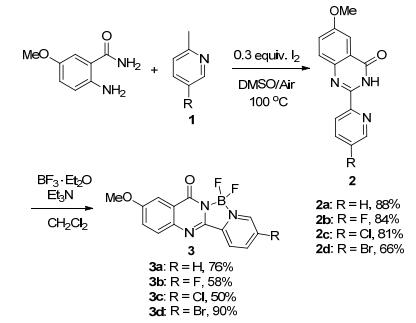
Scheme 1.
Synthesis of 6-methoxyquinazolinone-pyridine difluoroboron dyes

Synthesis and Luminescent Properties of 6-Methoxy-quinazolinone-pyridine Difluoroboron Dyes
Jia Zhou , Lu Liu , Cheng Zhong , Yang Fu , Zhibin Song , Yiyuan Peng


Fluorescent dyes with high luminous efficiency are highly desirable for their potential applications in luminescent solar concentrators, fluorescent sensors and fluorescent bio-imaging.[1~3] As a class of highly concerned fluorophores, π-conjugated difluoroboron (BF2) complexes, [4] such as boron dipyrromethene (BODIPY)[5] and difluoroboron β-diketonate complexes (BF2bdks), [6] display good photophysical properties including remarkable emission quantum yield, large absorptivity and good photostability.[7] However, two prominent disadvantages of BODIPY dyes still need to be well resolved. The first disadvantage of BODIPY is small Stokes shift (< 20 nm, in most cases), which can cause self-absorption, unavoidable high photon loss and scattering. The other is weak solid-state emission generally caused by aggregation-induced fluorescence quenching.[8] Recently, great efforts have been made to improve these situations by the structure modification of BODIPY.[9~12] But the synthesis of those BODIPY cores is usually more complicated.[13] The development of new π-conjugated BF2 complexes is a promising strategy to achieve the large Stokes shift and enhanced the solid-state fluorescence.[14~18] Recently, we firstly reported a novel series of asymmetric quinazolinone- pyridine difluoroboron dyes (BODIQPys).[19] The ultra high efficiency emissions both in solution and in the solid state with particularly high Stokes shifts were achieved in BODIQPys. The halogen atom at 6-position of BODIQPy acts as an electron donor group, suppressing the heavy atomic effect of bromine and iodine in solution. As a part of our ongoing work on the development of quinazolinone-based fluorescent dyes, we herein designed and synthesized 6-methoxyquinazolinone-pyridine difluoroboron dyes (BODIQPys) with very large Stokes shift by simple two step reactions. These quinazolinone-based BF2 complexes exhibited highly efficient green luminescence in solutions and remarkable fluorescence in the solid-state.
Based on our previous work, [19] the BODIQPy core is much more electron deficient compared to BODIPY core. And our results indicated that introduction of electron donating group at the 6-position of BODIQPy core can give rise to the increase of oscillator strength of S1 state of BODIQPy and can also increase charge transfer characters. Thus, we designed and synthesized 6-methoxy substituted BODIQPy. For further understanding the halogen effect on the pyridine ring of BODIQPy, three BODIQPys with fluorine, chlorine and bromine atom were also synthesized. Unfortunately, the BODIQPy with iodine atom at 5- position of pyridine ring was not obtained probably due to the instability of the BF2 product.
The 6-methoxy substituted quinazolinones were prepared via I2/DMSO (dimethyl sulfoxide) promoted oxidative amination of 2-methylpyridines with 2-amino-5- methoxybenzamide.[20] The BF2 complexes were prepared following the previous literatures with a slight optimization.[14~19] The structures of four 6-methoxy substituted quinazolinones with coordination to BF2 (3a~3d) can be recognized from the disappeared N—H proton signal of the quinazolinones near δ 11.8 in 1H NMR spectra, and further confirmed by 19F NMR and high resolution ESI-MS.
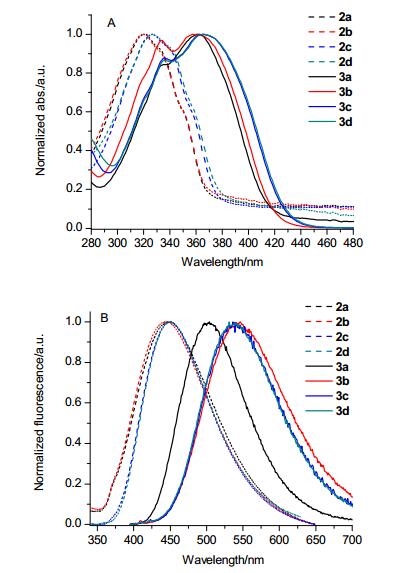
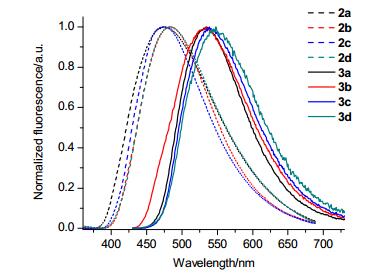
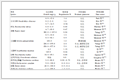
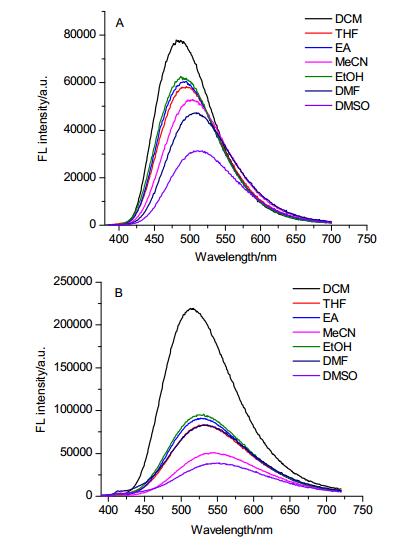
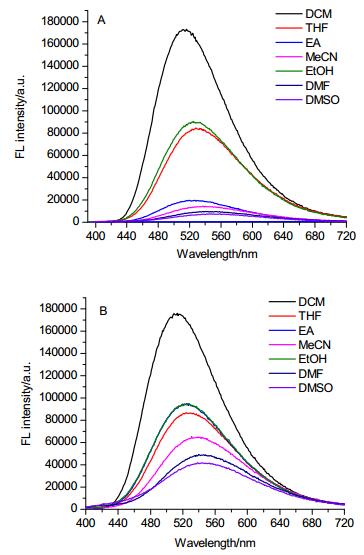
The absorption and fluorescence spectra of quinazolinone ligands and BODIQPy in MeCN are shown in Figure 1. Compared with the quinazolinone ligands, BODIQPy showed bathochromic shifted absorption and emission due to the better conjugated plane structure of these asymmetric BF2 complexes. Although the molar absorption coefficiency of BF2 complexes slightly decreased, the fluorescence intensities of BODIQPy have greatly increased. The halogen atom at 5-position of pyridine moiety can increase absorbance of BODIQPy. Moreover, remarkable fluorescence of these BF2 complexes can be observed in the solid-state (Figure 2). The emission spectra of four BODIQPy in different organic solvents are shown in Figures 3 and 4. And the detailed photophysical parameters of 3a~3d were shown in the Table 1. These results indicated that these 6-methoxy substituted BODIQPys exhibit good emission from 481 to 547 nm, which located in blue to green light region. These four BODIQPys showed little red-shifted and decreased fluorescence with the rise of polarity of selected organic solvents caused by charge transfer characters. The Stokes shifts of four BODIQPys in selected organic solvents and in the solid-state are all above 100 nm, which avoids self-absorption very well. In dichloromethane (DCM), the fluorescence quantum yields of four BODIQPy (0.99 for 3a, 0.88 for 3b, 0.95 for 3c, 0.69 for 3d) are the highest in the selected organic solvents. The introduction of methoxy group does not reduce luminous efficiency of BODIQPy, and can adjust the emission from blue to green. The fluorescence intensity changes and slight solvatochromic red shifts of the emission spectra were observed with increasing solvent polarity for 3a~3d. It indicated that a solvent-induced relative stabilization of the thermally equilibrated excited states, due to a significant difference between the dipole moments in the ground and excited states.[25] Compared with the fluorescence spectra in the solution (Figure 1), 3a showed obvious red-shift. Based on our previous report, [19] it can be attributed to the increment of the intermolecular interactions in the solid-state. But the introduction of halogen in the pyridine moiety reduced the fluorescence of BODIQPy in solution and in the solid-state. It is worth noting that 3a shows super high luminous efficiency in solution and remarkable emission in the solid state.
The excitation wavelengths were as follows: 2a~2d (350 nm) 3a (390 nm) and 3b~3d (370 nm)
 下载:
导出CSV
下载:
导出CSV
| Compd. | |
ε/(L·mol-1·cm-1) | λem/nm | ΦFd | Stokes shift/nm | τe/ns | kFf/ns-1 | kNRg/ns-1 | |||
| Solutionb | Solidc | Solution | Solid | ||||||||
| 3a | 360 | 2.18×10⁴ | 504 | 553 | 0.95 | 0.36 | 144 | 4.58 | 0.21 | 0.01 | |
| 3b | 324 | 1.54×10⁴ | 546 | 534 | 0.24 | 0.25 | 222 | 1.04 | 0.23 | 0.73 | |
| 3c | 329 | 2.30×10⁴ | 536 | 539 | 0.44 | 0.18 | 207 | 2.83 | 0.16 | 0.20 | |
| 3d | 332 | 4.61×10⁴ | 531 | 548 | 0.39 | 0.02 | 199 | 2.41 | 0.16 | 0.25 | |
| a Maximum absorption wavelength with the highest extinction coefficient, measured at a concentration of 1.0×10⁻⁵ mol·L-1 in CH3CN. b The excitation wavelength is coincident with | |||||||||||
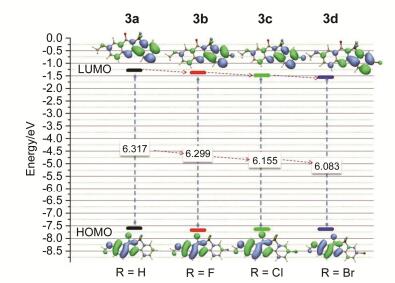
In order to better understand the electronic structure of four BODIQPys, theoretical calculations were carried out. All optimizations were done at B3LYP/def2-SVP level with Grimme's D3BJ[21] empirical dispersion correction. Then the vertical excited states are calculated at optimally-tuned[22] LC-ωPBE*/def2-SVP level with Gaussian09 program. The spin orbital coupling constants were calculated by pySOC[23] program. The electron-hole analyses of excited stated were performed using Multiwfn[24] program. As shown in Figure 5, the frontier orbital plots of highest occupied molecular orbitals (HOMOs) are predominantly localized on the quinazolinone moieties and the lowest unoccupied molecular orbitals (LUMOs) are mainly local- ized on pyridine moieties, which showed notable charge transfer characters. The introduction of halogen atom at pyridine moiety of BODIQPy can decrease the LUMO levels in regularity while their HOMO levels remain intact.
In this work, we have designed and synthesized four 6-methoxyquinazolinone-pyridine difluoroboron dyes (BODIQPy) through facile two-step reactions from readily available starting materials with high yields. These four BODIQPy displayed good green fluorescence in solution and remarkable fluorescence in the solid-state. The introduction of electron-donating group at 6-position of BODIQPy can effectively make the bathochromic shifted emission of BODIQPy caused by the enhancement of charge transfer property. It is worth noting that 6-methoxy BODIQPys have very large Stokes shift (Δλ up to 220 nm in MeCN), which would be promising for bio-imaging or Luminescent materials. Although the fluorescence intensity decreases with introduction of halogen atom at 5-position of pyridine moiety in BODIQPy, halogen atom can tune the LUMO levels in regularity while their HOMO levels remain intact. Further work will be focusing on the development of new quinazolinone-based BF2 complexes to expand conjugate structure and improve solubility in water as well as application on bioimaging.
All commercial reagents and analytical grade solvents were used without further purification unless otherwise noted. Dry dichloromethane and dry triethylamine are distilled according to the literature methods. Reactions were magnetically stirred and monitored by thin layer chromatography (TLC). The high resolution mass spectrometry (HRMS) analysis was performed by electrospray ionization (ESI-microTOF). Nuclear magnetic resonance (NMR) spectra were recorded on a Bruker Avance 400 spectrometer at ambient temperature operating at 400 MHz for 1H NMR and 376 MHz for 19F NMR by using DMSO-d6 as solvents and TMS as an internal standard. UV-Vis absorption spectra were measured on a Shimadzu UV-2450 spectrophotometer. The steady fluorescence spectra have been recorded on a Hitachi F7000 spectrometer. The fluorescence life time and quantum yields have been measured on an Edinburgh FLS980 spectrometer.
2-Amino-5-methoxybenzamide (2 mmol), 2-methyl- pyridine 1 (2 mmol) and iodine (0.3 mmol) were dissolved in DMSO (10 mL). The mixture was stirred at 100 ℃ overnight. After completion of the reaction, the reaction mixture was poured into the saturated sodium thiosulfate aqueous solution and stirred for 2 h at room temperature. The products were precipitated out and recrystallization with ethyl acetate/hexane.
6-Methoxy-2-(pyridin-2-yl)-quinazolin-4(3H)-one (2a): White solid, 88% yield. m.p. 224~226 ℃; 1H NMR (400 MHz, DMSO-d6) δ: 11.78 (s, 1H), 8.74~8.75 (m, 1H), 8.42 (d, J=8 Hz, 1H), 8.04~8.09 (m, H), 7.76 (d, J=8 Hz, 1H), 7.62~7.66 (m, 1H), 7.58~7.59 (m, 1H), 7.47~7.50 (m, 1H), 3.91 (s, 3H); HRMS calcd for C14H12N3O2 [M+H]+ 254.0924, found 254.0918.
6-Methoxy-2-(5-fluoropyridin-2-yl)-quinazolin-4(3H)-one (2b): White solid, 84% yield. m.p. 225~227 ℃; 1H NMR (400 MHz, DMSO-d6) δ: 11.85 (s, 1H), 8.73~8.74 (m, 1H), 8.46~8.50 (m, 1H), 7.96~8.01 (m, 1H), 7.74~7.76 (m, 1H), 7.57~7.58 (m, 1H), 7.46~7.49 (m, 1H), 3.91 (s, 3H); HRMS calcd for C14H11FN3O2 [M+H]+ 272.0830, found 272.0834.
6-Methoxy-2-(5-chloropyridin-2-yl)-quinazolin-4(3H)-one (2c): White solid, 81% yield. m.p. 226~228 ℃; 1H NMR (400 MHz, DMSO-d6) δ: 11.90 (s, 1H), 8.78~8.79 (m, 1H), 8.40~8.42 (m, 1H), 8.16~8.20 (m, 1H), 7.75~7.775 (m, 1H), 7.56~7.48 (m, 1H), 3.91 (s, 3H); HRMS calcd for C14H11ClN3O2 [M+H]+ 288.0534, found 288.0539.
6-Methoxy-2-(5-bromopyridin-2-yl)-quinazolin-4(3H)-one (2d): Brown solid, 66% yield. m.p. 230~232 ℃; 1H NMR (400 MHz, DMSO-d6) δ: 11.89 (s, 1H), 8.86~8.86 (m, 1H), 8.35~8.29 (m, 2H), 7.77~7.75 (m, 1H), 7.58~7.57 (m, 1H), 7.50~7.46 (m, 1H), 3.91 (s, 3H); HRMS calcd for C14H11BrN3O2 [M+H]+ 332.0029, found 332.0023.
6-Methoxy-quinazolinone 2 (1 mmol) was dissolved in dry dichloromethane (10 mL). And the dry triethylamine (2.5 mL) was added to the solution with ice-bath. The mixture was stirred at 0 ℃ for 45 min. Then BF3•Et2O (2.5 mL) were added by dripping slowly to the mixture for 10 min. After further stirring for 15 min at 40 ℃, the reaction was quenched by cold sodium bicarbonate solution (15 mL). The organic layer was dried over MgSO4 and evaporated under vacuum to dryness. The pure product was obtained by recrystallization with MeCN/CH2Cl2.[19]
6-Methoxy-2-(pyridin-2-yl)-quinazolin-4(3H)-one difluroboron (3a): White solid, 76% yield. m.p. 259~260 ℃; 1H NMR (400 MHz, DMSO-d6) δ: 9.105 (d, J=4 Hz, 1H), 8.71~8.67 (m, 1H), 8.58 (d, J=8 Hz, 1H), 8.18~8.15 (m, 1H), 7.80 (d, J=8 Hz, 1H), 7.625 (d, J=4 Hz, 1H), 7.51~7.48 (m, 1H), 3.92 (s, 3H); 19F NMR (376 MHz, DMSO-d6) δ: 153.34; HRMS calcd for C14H11B- F2N3O2 [M+H]+ 302.0907, found 302.0880.
6-Methoxy-2-(5-fluoropyridin-2-yl)-quinazolin-4(3H)-one difluroboron (3b): Yellow solid, 58% yield. m.p. 253~255 ℃; 1H NMR (400 MHz, DMSO-d6) δ: 9.49~9.48 (m, 1H), 8.70~8.62 (m, 2H), 7.80~7.78 (m, 1H), 7.62~7.61 (m, 1H), 7.51~7.48 (m, 1H), 3.92 (s, 3H); 19F NMR (376 MHz, DMSO-d6) δ: 115.84, 152.61; HRMS calcd for C14H10BF3N3O2 [M+H]+ 320.0813, found 320.0786.
6-Methoxy-2-(5-chloropyridin-2-yl)-quinazolin-4(3H)-one difluroboron (3c): Yellow solid, 50% yield. m.p. 244~246 ℃; 1H NMR (400 MHz, DMSO-d6) δ: 9.50~9.50 (m, 1H), 8.80~8.77 (m, 1H), 8.55~8.53 (m, 1H), 7.81~7.79 (m, 1H), 7.62~7.62 (m, 1H), 7.51~7.48 (m, 1H), 3.92 (s, 3H); 19F NMR (376 MHz, DMSO-d6) δ: 152.26; HRMS calcd for C14H10BClF2N3O2 [M+H]+ 336.0517, found 336.0497.
6-Methoxy-2-(5-bromopyridin-2-yl)-quinazolin-4(3H)-one difluroboron (3d): Yellow solid, 90% yield. m.p. 231~233 ℃; 1H NMR (400 MHz, DMSO-d6) δ: 9.53 (s, 1H), 8.91~8.88 (m, 1H), 8.46~8.44 (m, 1H), 7.80~7.78 (m, 1H), 7.62~7.61 (m, 1H), 7.50~7.47 (m, 1H), 3.92 (s, 3H); 19F NMR (376 MHz, DMSO-d6) δ: 152.27; HRMS calcd for C14H10BBrF2N3O2 [M+H]+ 380.0012, found 380.0005.
Supporting Information Detailed absorption and emission spectra and 1H NMR, 19F NMR spectra of 2a~2b and 3a~3b as well as calculation results of 3a~3b. The Supporting Information is available free of charge via the Internet at http://sioc-journal.cn.
(a) Bessette, A.; Hanan, G. S. Chem. Soc. Rev. 2014, 43, 3342.
(b) Bozdemir, O. A.; Erbas-Cakmak, S. O.; Ekiz, O.; Dana, A.; Akkaya, E. U. Angew. Chem., Int. Ed. 2011, 50, 10907.
(a) Boens, N.; Leen, V.; Dehaen, W. Chem. Soc. Rev. 2012, 41, 1130.
(b) Zhang, Y.; Fu, Y.-Y.; Zhu, D.-F.; Xu, J.-Q.; He, Q.-G.; Cheng, J.-G. Chin. Chem. Lett. 2016, 27, 1429.
(c) Lu, B. W.; Meng, S. X.; Feng, Y. Q. Chin. J. Org. Chem. 2018, 38, 350 (in Chinese).
(卢博为, 孟舒献, 冯亚青, 有机化学, 2018, 38, 350.)
(a) Fan, J.; Hu, M.; Zhan, P.; Peng, X. Chem. Soc. Rev. 2013, 42, 29.
(b) Wu, X.; Zhu, W. Chem. Soc. Rev. 2015, 44, 4179.
(a) Frath, D.; Massue, J.; Ulrich, G.; Ziessel, R. Angew. Chem., Int. Ed. 2014, 53, 2290.
(b) Bourget-Merle, L.; Lappert, M. F.; Severn, J. R. Chem. Rev. 2002, 102, 3031.
(c) Patalag, L. J.; Jones, P. G.; Werz, D. B. Angew. Chem., Int. Ed. 2016, 55, 13340.
(d) Wu, Y. Y.; Gou, G. Z.; Wu, X. X.; Yang, L. J.; Fu, W. F. Chin. J. Org. Chem. 2017, 37, 704 (in Chinese).
(吴云英, 苟高章, 伍贤学, 杨丽君, 傅文甫, 有机化学, 2017, 37, 704.)
(a) Zhao, J. Z.; Xu, K. J.; Yang, W. B.; Wang, Z. J.; Zhong, F. F. Chem. Soc. Rev. 2015, 44, 8904.
(b) Yu, C. J.; Wu, Q. H.; Wang, J.; Wei, Y.; Hao, E. H.; Jiao, L. J. J. Org. Chem. 2016, 81, 3761.
(a) Chen, P.-Z.; Niu, L.-Y.; Chen, Y.-Z.; Yang, Q.-Z. Coord. Chem. Rev. 2017, 350, 196.
(b) Kolemen, S.; Akkaya, E. U. Coord. Chem. Rev. 2018, 354, 121.
(c) Chen, P.-Z.; Zhang, H.; Niu, L.-Y.; Zhang, Y.; Chen, Y.-Z.; Fu, H.-B.; Yang Q.-Z. Adv. Funct. Mater. 2017, 27, 1700332.
(a) Ulrich, G.; Ziessel, R.; Harriman, A. Angew. Chem., Int. Ed. 2008, 47, 1184.
(b) Xu, S.; Evans, R. E.; Liu, T.; Zhang, G.; Demas, J. N.; Trindle, C. O.; Fraser, C. L. Inorg. Chem. 2013, 52, 3597.
(a) Loudet, A.; Burgess, K. Chem. Rev. 2007, 107, 4891.
(b) Lu, H.; Mack, J.; Yang, Y.; Shen, Z. Chem. Soc. Rev. 2014, 43, 4778.
(c) Choi, S.; Bouffard, J.; Kim, Y. Chem. Sci. 2014, 5, 751.
Chen, Y. H.; Zhao, J. Z.; Guo, H. M.; Xie, L. J. J. Org. Chem. 2012, 77, 2192. doi: 10.1021/jo202215x
Fei, Q.; Gu, X. F.; Liu, Y. J.; Shi, B.; Liu, H. Y.; Xu, G.; Li, C. B.; Shi, P.; Zhao, C. C. Org. Biomol. Chem. 2017, 15, 4072 doi: 10.1039/C7OB00383H
Hu, R. R.; Azael Gómez-Durán, C. F.; Lam, J. W. Y.; Belmonte- Vázquez, J. L.; Deng, C. M.; Chen, S. J.; Ye, R. Q.; Peña- Cabrera, E.; Zhong, Y. C.; Wong, K. S.; Tang, B. Z. Chem. Commun. 2012, 48, 10099 doi: 10.1039/c2cc35188a
Azael Gómez-Durán, C. F.; Hu, R. R.; Feng, G. X.; Li, T. Z.; Bu, F.; Arseneault, M.; Liu, B.; Peña-Cabrera, E.; Tang, B. Z. ACS Appl. Mater. Interfaces 2015, 7, 15168. doi: 10.1021/acsami.5b05033
Liu, H.; Lu, H.; Zhou, Z. K.; Shimizu, S.; Li, Z. F.; Kobayashic, N.; Shen, Z. Chem. Commun. 2015, 51, 1713. doi: 10.1039/C4CC06704E
Kubota, Y.; Tsuzuki, T.; Funabiki, K.; Ebihara, M.; Matsui, M. Org. Lett. 2010, 12, 4010. doi: 10.1021/ol101612z
Araneda, J. F.; Piers, W. E.; Heyne, B.; Parvez, M.; McDonald, R. Angew. Chem., Int. Ed. 2011, 50, 12214. doi: 10.1002/anie.v50.51
Kubota, Y.; Ozaki, Y.; Funabiki, K.; Matsui, M. J. Org. Chem. 2013, 78, 7058. doi: 10.1021/jo400879g
Nosova, E. V.; Moshkina, T. N.; Lipunova, G. N.; Baklanova, I. V.; Slepukhin, P. A.; Charushin, V. N. J. Fluorine Chem. 2015, 175, 145. doi: 10.1016/j.jfluchem.2015.04.010
Zhu, C.; Guo, Z.-H.; Mu, A. U.; Liu, Y.; Wheeler, S. E.; Fang, L. J. Org. Chem. 2016, 81, 4347. doi: 10.1021/acs.joc.6b00238
Zhou, J.; Liu, L.; Pan, Y.; Zhu, Q. Y.; Lu, Y. J.; Wei, J. C.; Luo, K.; Fu, Y.; Zhong, C.; Peng, Y. Y.; Song, Z. B. Chem.-Eur. J. 2018, 24, 17897. doi: 10.1002/chem.v24.68
Yang, L.; Shi, X.; Hu, B.-Q.; Wang, L.-X. Asian J. Org. Chem. 2016, 5, 494. doi: 10.1002/ajoc.201600041
Grimme, S.; Ehrlich, S.; Goerigk, L. J. Comput. Chem. 2011, 32, 1456. doi: 10.1002/jcc.v32.7
Sun, H.; Zhong, C.; Bredas, J.-L. J. Chem. Theory Comput. 2015, 11, 3851. doi: 10.1021/acs.jctc.5b00431
Gao, X.; Bai, S.; Fazzi, D.; Niehaus, T.; Barbatti, M.; Thiel, W. J. Chem. Theory Comput. 2017, 13, 515. doi: 10.1021/acs.jctc.6b00915
Lu, T.; Chen, F. J. Comput. Chem. 2012, 33, 580. doi: 10.1002/jcc.v33.5
Ando, Y.; Homma, Y.; Hiruta, Y.; Citterio, D. Dyes Pigm. 2009, 83, 198. doi: 10.1016/j.dyepig.2009.04.008

Figure 1 Normalized absorption (A) and emission (B) spectra of quinazolinones 2a~2d and BF2 complexes 3a~3d in MeCN

Figure 2 Normalized emission spectra of 2a~2d and 3a~3d in the solid-state
The excitation wavelengths were as follows: 2a~2d (350 nm) 3a (390 nm) and 3b~3d (370 nm)

Figure 5 Molecular orbital energy diagram and isodensity surface plots of the HOMO and LUMO of 3a~3d
Table 1. Photophysical properties of 3a~3d in solution and in the solid-state
| Compd. | |
ε/(L·mol-1·cm-1) | λem/nm | ΦFd | Stokes shift/nm | τe/ns | kFf/ns-1 | kNRg/ns-1 | |||
| Solutionb | Solidc | Solution | Solid | ||||||||
| 3a | 360 | 2.18×10⁴ | 504 | 553 | 0.95 | 0.36 | 144 | 4.58 | 0.21 | 0.01 | |
| 3b | 324 | 1.54×10⁴ | 546 | 534 | 0.24 | 0.25 | 222 | 1.04 | 0.23 | 0.73 | |
| 3c | 329 | 2.30×10⁴ | 536 | 539 | 0.44 | 0.18 | 207 | 2.83 | 0.16 | 0.20 | |
| 3d | 332 | 4.61×10⁴ | 531 | 548 | 0.39 | 0.02 | 199 | 2.41 | 0.16 | 0.25 | |
| a Maximum absorption wavelength with the highest extinction coefficient, measured at a concentration of 1.0×10⁻⁵ mol·L-1 in CH3CN. b The excitation wavelength is coincident with | |||||||||||
 下载: 导出CSV

 扫一扫看文章


扫一扫关注我们


 下载:
下载: