
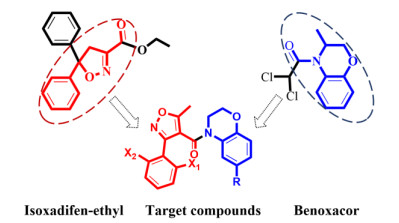
Figure 1.
Skeleton structure of the template compound


With the expansion of herbicides application, the safety issues have become serious, especially the excessive use of herbicides or damage to sensitive crops[1]. Herbicide safeners are regarded as a very effective way to solve these problems[2, 3]. In recent years, some safeners have been subsequently commercialized for different types of herbicides[4], such as isoxadifen-ethyl[5] and mefenpyr-diethyl[6].
Isoxadifen-ethyl, as a new safener for sulfonylurea herbicides, was launched by Bayer Crop Science AG in 2002[7]. It effectively alleviates the phytotoxicity of nicosulfuron to maize and increases the metabolism of nicosulfuron through non-cytochrome P450-catalyzed routes[8]. Andreas gave the mechanism of exogenous detoxification induced by isoxadifen-ethyl through multiple signaling channels in plants[9]. Benoxacor, which has been commercialized by Ciba-Geigy, is widely used to protect maize and sorghum from metolachlor and increases crops resistance to herbicides[10, 11]. As an effective ingredient of chloroacetamide herbicide safener, it usually induces the hydroxylation of primisulfuron-methyl and increases glutathione (GSH) conjugation of metolachlor, metazachlor and acetochlor to achieve the detoxification effect[12-14].
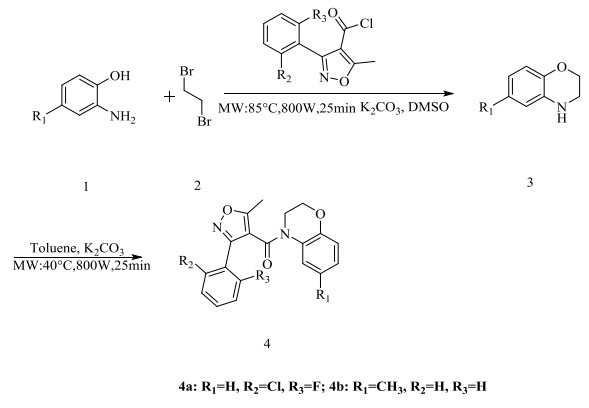
As a part of our ongoing interest in nitrogen-containing heterocyclic herbicide safeners[15-19], two novel substituted phenyl isoxazole derivatives were designed via active subunits combination with isoxadifen-ethyl and benoxacor (Fig. 1). The synthesis was carried out under microwave irradiation (Scheme 1)[20-24]. The single crystal structure was confirmed by X-ray diffraction analysis. Biological activities as safener of the target compounds were evaluated on maize in vivo.
The chemicals involved in experiment were analytically pure and applied without purification. The melting points were obtained on a Beijing Taike point instrument (X-4) and uncorrected. IR spectra were measured on a Bruker ALPHA-T spectrometer (in KBr pallets). The NMR spectrum was collected on a Bruker AV-400 spectrometer with CDCl3 as solvent and TMS as internal standard. High-resolution mass spectrometry (HRMS) data were recorded using a Varian QFT-ESI instrument. Microwave irradiation was carried out with XH100A focused microwave. Crystallogra-phic data of the compound were measured on a Rigaku R-AXIS RAPID area-detector diffractometer.
o-Aminophenol 1 (15 mmol), DMSO (40 mL) and K2CO3 (5 equivalents, 20 mmol) were added to 1, 2-dibromoethane 2 (22 mmol) in sequence. The reaction conditions were optimized by a preliminary test (800 W, 85 ℃, and 20 min)[25]. When the reaction was completed (monitored by TLC), the solution was cooled to room temperature and filtered. The mixture was extracted with ethyl acetate and the organic phase was dried. Then the solvent was removed by rotary evaporation. The crude product was purified on silica gel by column chromatography (V(ethyl acetate): V(petroleum ether) = 1:9) to obtain compound 3.
The infrared spectrum analysis of intermediates 3a and 3b shows that the absorption peaks at 3383 and 3356 cm-1 are the N–H stretching vibration peak of the benzoxazine ring, which indicates that the synthesis of the intermediate is correct.
Compound 3 (0.05 mol), substituted phenyl isoxazole carbonyl chloride (0.06 mol) and anhydrous K2CO3 (5 eq., 0.38 g) were mixed in toluene (40 mL). Then, the mixture was placed in a microwave catalytic synthesizer (800 W, 40 ℃, and 25 min)[26]. After the reaction was completed, the solution was cooled to room temperature and filtered. The crude product was purified on silica gel by column chromatography (V(ethyl acetate): V(petroleum ether) = 1:6) to obtain the target compounds 4.
3-(2΄-Chloro-6΄-fluoro-phenyl)-4-(2΄, 3΄-dihydro-1΄, 4΄-benzoxazine)-5-methyl-isoxazole formamide (4a) White crystal; m.p. 181.5~182.2 ℃; yield, 43.2%; IR (KBr, cm-1) ν: 3053~2870 (C–H), 1631 (C=O). 1H NMR (400 MHz, CDCl3, ppm) δ: 7.30~6.66 (m, 7H, Ar–H), 4.27~3.85 (m, 4H, O–CH2CH2–N), 2.58 (s, 3H, -CH3); 13C NMR (100MHz, CDCl3, ppm) δ: 172.31, 161.59, 153.92, 145.94, 134.34, 131.71, 131.62, 126.10, 125.50, 125.47, 122.34, 120.78, 117.16, 114.72, 114.50, 113.46, 66.06, 41.04, 12.45; HRMS (ESI): C19H14ClFN2O3 calculated for [M+H]+ 373.0750, found 373.0754.
3-Phenyl-4-(6-methyl-2΄, 3΄-dihydro-1΄, 4΄-benzoxazine)-5-methyl-isoxazole formamide (4b) White crystal; m.p. 125.8~127.6 ℃; yield, 75.5%; IR (KBr, cm-1) ν: 3004~2860 (C–H), 1638 (C=O). 1H NMR (400 MHz, CDCl3, ppm) δ: 7.40~7.34 (m, 4H, Ar–H), 7.29~6.46 (m, 4H, Ar–H), 4.15~3.57 (m, 4H, O–CH2CH2–N), 2.56 (s, 3H, -CH3), 2.17 (s, 3H, -CH3), 13C NMR (100MHz, CDCl3, ppm) δ: 171.18, 160.64, 160.61, 144.24, 129.99, 129.96, 129.42, 128.86, 128.21, 127.37, 127.37, 127.01, 127.01, 123.22, 112.12, 111.76, 65.61, 20.70, 12.08, 12.08; HRMS (ESI): C20H18N2O3 calculated for [M+H]+ 337.1210, found 337.1213.
Crystals (4a and 4b) suitable for X-ray analysis were obtained by the slow evaporation method with ethyl acetate as solvent at room temperature. The X-ray data were collected on a Rigaku RAXIS-RAPID diffractometer (Japan) with MoKα radiation (λ = 0.71073 Å) at 293(2) K. The structure was solved by direct methods using SHELXS-97[26] and refined with SHELXL-97[27]. The hydrogen atoms were included in calculated positions, and refined in terms of riding model (Uiso(H) = 1.5Ueq(C) for the atoms of methyl and Uiso(H) = 1.2Ueq(C) for others). Selected bond lengths and bond angles are listed in Table 1, and hydrogen bond parameters are summarized in Table 2.
 DownLoad:
CSV
DownLoad:
CSV
| 4a | 4b | |||||||||
| Bond | Dist. | Bond | Dist. | Bond | Dist. | Bond | Dist. | |||
| C(1)–C(2) | 1.373(4) | C(12)–N(2) | 1.422(2) | C(1)–C(2) | 1.399(6) | C(12)–N(2) | 1.478(4) | |||
| C(1)–C(6) | 1.391(3) | C(12)–C(13) | 1.387(2) | C(1)–C(6) | 1.370(5) | C(12)–C(13) | 1.487(5) | |||
| C(1)–F(1) | 1.386(3) | C(12)–C(17) | 1.396(2) | C(2)–C(3) | 1.384(6) | C(13)–O(3) | 1.430(4) | |||
| C(2)–C(3) | 1.371(5) | C(13)–C(14) | 1.385(3) | C(3)–C(4) | 1.375(7) | C(14)–O(3) | 1.370(4) | |||
| C(3)–C(4) | 1.366(4) | C(14)–C(15) | 1.382(3) | C(4)–C(5) | 1.399(6) | C(14)–C(15) | 1.383(5) | |||
| C(4)–C(5) | 1.379(4) | C(15)–C(16) | 1.375(3) | C(5)–C(6) | 1.404(5) | C(14)–C(19) | 1.398(5) | |||
| C(5)–C(6) | 1.396(3) | C(16)–C(17) | 1.388(3) | C(6)–C(7) | 1.471(5) | C(15)–C(16) | 1.381(5) | |||
| C(5)–Cl(1) | 1.707(2) | C(17)–O(3) | 1.367(2) | C(7)–N(1) | 1.312(4) | C(16)–C(17) | 1.405(5) | |||
| C(6)–C(7) | 1.472(3) | C(18)–O(3) | 1.426(3) | C(7)–C(8) | 1.436(5) | C(17)–C(18) | 1.383(5) | |||
| C(8)–O(1) | 1.348(2) | C(18)–C(19) | 1.501(4) | C(8)–C(9) | 1.362(5) | C(17)–C(20) | 1.509(5) | |||
| C(8)–C(9) | 1.355(3) | C(19)–N(2) | 1.467(2) | C(9)–O(1) | 1.345(4) | C(18)–C(19) | 1.404(5) | |||
| C(9)–C(11) | 1.485(2) | N(1)–O(1) | 1.409(3) | C(9)–C(10) | 1.469(6) | C(19)–N(2) | 1.440(4) | |||
| C(11)–O(2) | 1.225(2) | C(7)–N(1) | 1.310(2) | C(11)–O(2) | 1.231(4) | N(1)–O(1) | 1.416(4) | |||
| C(11)–N(2) | 1.359(2) | C(7)–N(9) | 1.424(2) | C(11)–N(2) | 1.351(4) | |||||
| Angle | (°) | Angle | (°) | Angle | (°) | Angle | (°) | |||
| C(6)–C(1)–C(2) | 123.3(2) | O(2)–C(11)–C(9) | 119.58(16) | C(6)–C(1)–C(2) | 121.7(4) | C(18)–C(17)–C(16) | 118.0(3) | |||
| C(2)–C(1)–F(1) | 117.2(2) | N(2)–C(11)–C(9) | 118.32(16) | C(3)–C(2)–C(1) | 118.6(4) | C(18)–C(17)–C(20) | 121.0(4) | |||
| F(1)–C(1)–C(6) | 119.49(19) | C(13)–C(12)–C(17) | 118.32(16) | C(4)–C(3)–C(2) | 120.2(4) | C(16)–C(17)–C(20) | 121.1(3) | |||
| C(3)–C(2)–C(1) | 118.6(2) | C(13)–C(12)–N(2) | 123.14(16) | C(3)–C(4)–C(5) | 121.5(4) | C(17)–C(18)–C(19) | 122.3(3) | |||
| C(4)–C(3)–C(2) | 120.8(2) | C(17)–C(12)–N(2) | 118.28(15) | C(4)–C(5)–C(6) | 118.2(4) | C(14)–C(19)–C(18) | 118.3(3) | |||
| C(3)–C(4)–C(5) | 119.6(3) | C(14)–C(13)–C(12) | 121.22(17) | C(1)–C(6)–C(5) | 119.7(4) | C(14)–C(19)–N(2) | 119.1(3) | |||
| C(4)–C(5)–C(6) | 122.0(2) | C(15)–C(14)–C(13) | 119.53(19) | C(1)–C(6)–C(7) | 112.9(3) | C(18)–C(19)–N(2) | 122.5(3) | |||
| C(4)–C(5)–Cl(1) | 119.2(2) | C(16)–C(15)–C(14) | 120.24(19) | C(5)–C(6)–C(7) | 118.4(3) | C(7)–N(1)–O(1) | 105.9(3) | |||
| C(6)–C(5)–Cl(1) | 118.80(16) | C(15)–C(16)–C(17) | 120.17(19) | N(1)–C(7)–C(8) | 111.0(3) | C(11)–N(2)–C(19) | 123.8(3) | |||
| C(1)–C(6)–C(5) | 115.6(2) | O(3)–C(17)–C(16) | 116.09(17) | N(1)–C(7)–C(6) | 119.5(3) | C(11)–N(2)–C(12) | 122.7(3) | |||
| C(1)–C(6)–C(7) | 121.83(18) | O(3)–C(17)–C(12) | 123.44(17) | C(8)–C(7)–C(6) | 129.3(3) | C(19)–N(2)–C(12) | 112.6(3) | |||
| C(5)–C(6)–C(7) | 122.55(17) | C(16)–C(17)–C(12) | 120.37(18) | C(9)–C(8)–C(7) | 104.3(3) | C(9)–O(1)–N(1) | 108.8(3) | |||
| N(1)–C(7)–C(9) | 111.37(17) | O(3)–C(18)–C(19) | 112.1(2) | C(9)–C(8)–C(11) | 128.0(3) | C(14)–O(3)–C(13) | 115.1(3) | |||
| N(1)–C(7)–C(6) | 120.25(16) | N(2)–C(19)–C(18) | 107.60(17) | C(7)–C(8)–C(11) | 126.4(3) | N(2)–C(12)–C(13) | 100.3(3) | |||
| C(9)–C(7)–C(6) | 128.37(15) | C(7)–N(1)–O(1) | 105.45(16) | O(1)–C(9)–C(8) | 109.9(3) | O(3)–C(13)–C(12) | 104.2(3) | |||
| O(1)–C(8)–C(9) | 109.27(18) | C(11)–N(2)–C(12) | 127.09(14) | O(1)–C(9)–C(10) | 115.6(3) | O(3)–C(14)–N(2) | 101.6(3) | |||
| O(1)–C(8)–C(10) | 117.62(18) | C(11)–N(2)–C(19) | 118.85(15) | C(8)–C(9)–C(10) | 134.6(3) | O(3)–C(14)–C(16) | 108.4(3) | |||
| C(9)–C(8)–C(10) | 133.1(2) | C(12)–N(2)–C(19) | 113.99(14) | O(2)–C(11)–N(2) | 123.3(3) | N(2)–C(14)–C(16) | 113.1(3) | |||
| C(8)–C(9)–C(7) | 104.71(15) | C(8)–O(1)–N(1) | 109.19(14) | O(2)–C(11)–C(8) | 118.8(3) | O(3)–C(14)–C(15) | 110.2(3) | |||
| C(8)–C(9)–C(11) | 125.46(17) | C(17)–O(3)–C(18) | 116.17(15) | N(2)–C(11)–C(8) | 117.9(3) | N(2)–C(14)–C(15) | 111.1(3) | |||
| C(7)–C(9)–C(11) | 121.56(15) | N(2)–C(12)–C(13) | 110.7(3) | C(7)–N(1)–O(1) | 104.8(2) | |||||
| O(3)–C(13)–C(12) | 109.8(3) | C(11)–N(2)–C(12) | 126.2(3) | |||||||
| O(3)–C(14)–C(15) | 116.2(3) | C(11)–N(2)–C(14) | 122.3(2) | |||||||
| O(3)–C(14)–C(19) | 123.9(3) | C(12)–N(2)–C(14) | 110.7(3) | |||||||
| C(15)–C(14)–C(19) | 119.9(3) | C(9)–O(1)–N(1) | 109.6(2) | |||||||
| C(16)–C(15)–C(14) | 121.0(4) | C(13)–O(3)–C(14) | 107.4(3) | |||||||
| C(15)–C(16)–C(17) | 120.5(3) | |||||||||
DownLoad:
CSV
| D–H···A | d(D–H) | d(H···A) | d(D···A) | ∠DHA | |
| 4a | C(11)–H(10A)···O(2)a | 0.96 | 2.30 | 1.225(2) | 169 |
| C(10)–H(10A)···F(1)b | 0.96 | 2.60 | 1.386(3) | 143 | |
| 4b | C(3)–H(3)···O(2)c | 0.93 | 2.70 | 3.463(21) | 148 |
| C(12)–H(12B)···N(1)d | 0.97 | 2.65 | 3.4080(48) | 135 | |
| Symmetry codes: (a) x–0.5, 1.5–x, –z; (b) 1–x, 0.5+y, 0.5–z; (c) 1–x, 2–y, 2–z; (d) 1–x, 1–y, 1–z | |||||
The title compounds (10 mg) were completely dissolved in ethanol (2 mL), and a small amount of emulsifier was added to make the solution uniform and transparent. The solution was prepared according to the principle of gradual dilution. Maize seeds (Dongnong 259) were soaked in solution (containing compounds 25 μM) overnight, and the control was treated with water. The seeds were then induced to germinate, and sown in paper cups with seven per cup with the soil mixed with acetochlor (20 mg/kg). They were incubated in an incubator (12 h of light, 26.5 ± 1 ℃, 75% relative humidity). The root length, plant height, root fresh weight and plant fresh weight of maize were measured after 7 days[28, 29].
The molecular structures of compounds 4a and 4b with atom-numbering are shown in Fig. 2. The crystal structure of 4a crystallizes in orthorhombic space group P21, and 4b in triclinic space group P
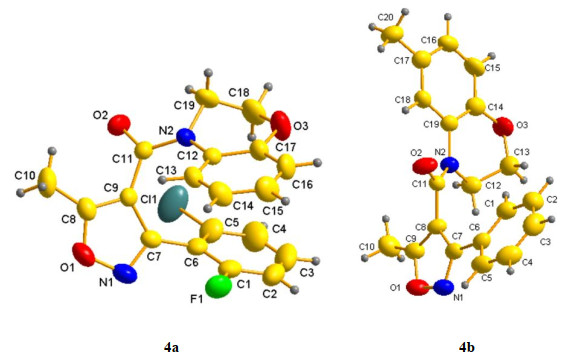
Both of the crystal structures composed three parts: a benzoxazine skeleton (A), an isoxazole ring (B) and a benzene ring (C). For compound 4a, the molecule is not coplanar. The dihedral angles between the benzoxazine skeleton (A), the isoxazole ring (B) and the benzene ring (C) are 60.66° (A/B), 18.57° (A/C), 61.08° (B/C). Obviously, there is π-π conjunctive effect between the isoxazole ring (B) and C(11)=O(2), which causes C(9)–C(11) (1.485(2) Å) shorter than the typical C–C bond (1.54 Å)[30]. And the bond C(11)–N(2) in 1.359(2) Å is shorter than the typical C−N (1.42 Å), indicating a p-π conjunction effect between N(2) and C(11)=O(2). The bond distance of C(12)–N(2) is 1.422(2) Å, similar to the typical C–N bond length, so there is no p-π conjunction effect between the benzene and N(2). There are similar crystal data for 4b. The dihedral angles between the benzoxazine skeleton (A), isoxazole ring (B) and benzene ring (C) are 89.65° (A/B), 88.48° (A/C) and 28.00° (B/C), indicating rings B and C are almost perpendicular to the plane of A. The distances between A and C are 4.1334(6) Å for 4a and 6.5455(18) Å for 4b, longer than the typical π-π conjunction effect distance.
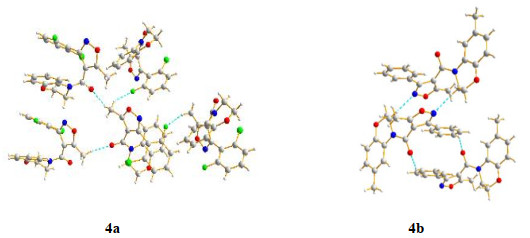
Hydrogen-bond interactions played a significant role in the crystal packing of 4a and 4b. Compound 4a formed crystal packing via hydrogen bonds C(10)–H(10A)···F(1) and C(11)–H(10A)···O(2), and the crystal packing of 4b was via the C(3)–H(3)···O(2) and C(12)–H(10B)···N(1) hydrogen bonds, as shown in Fig. 3. The presence of hydrogen bonds caused the target compounds to arrange in an ordered manner and form stable single crystal structures with high symmetry and regularity.
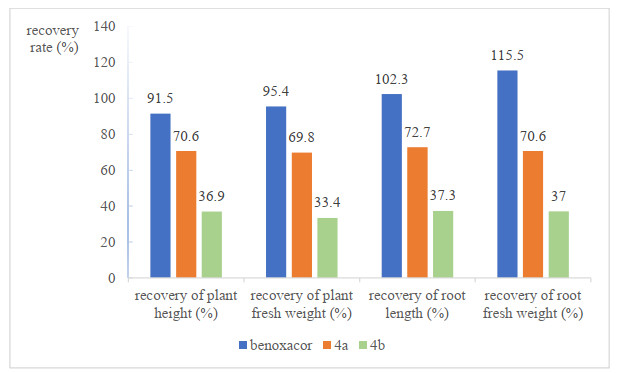
The safener activity of the title compounds was tested with benoxacor selected as the control and acetochlor as the herbicide[31-33]. The recovery rate of various growth indicators of maize was evaluated after being treated with 20 mg/kg acetochlor in soil (Fig. 4). Compounds 4a and 4b showed detoxification effect on maize and could restore the maize growth to some extent. The root fresh weight recovery rates of 4a, 4b and benoxacor are 70.6%, 37.0% and 115.5%, respectively. The root length recovery rate of compound 4a is 72.7%, however, that of 4b is much lower, with the value to be only 37.3%. Compound 4a has much better activity than 4b, possibly caused by the halogen substituents (R2 = Cl, R3 = F) on the phenyl in 4a. Halogen substitution usually enhances the bioactivity of compounds. Both title compounds show good safener activity, although they are not as active as benoxacor, indicating that the skeleton bears certain safener activity, and a new safener scaffold will be obtained with further structure modification.
Green, J. M.; Hazel, C. B.; Forney, D. R.; Pugh, L. M. New multiple-herbicide crop resistance and formulation technology to augment the utility of glyphosate. Pest Manag. Sci. 2008, 64, 332−339. doi: 10.1002/ps.1486
Riechers, D. E.; Kreuz, K.; Zhang, Q. Detoxification without intoxication: herbicide safeners activate plant defense gene expression. Plant Physiol. 2010, 153, 3−13. doi: 10.1104/pp.110.153601
Ye, F.; Zhai, Y.; Guo, K. L.; Liu, Y. X.; Li, N.; Gao, S.; Zhao, L. X.; Fu, Y. Safeners improve maize tolerance under herbicide toxicity stress by increasing the activity of enzymes in vivo. J. Agric. Food Chem. 2019, 6, 11568−11576.
John, D. S.; Hansjoachim, L.; Christopher, J. S.; Allison, N. R.; David, M. C. Environmental fate and effects of dichloroacetamide herbicide safeners: "inert" yet biologically active agrochemical ingredients. Environ. Sci. Technol. Lett. 2015, 2, 260−269. doi: 10.1021/acs.estlett.5b00220
Lucini, L.; Molinari, G. P. Detection of the herbicide fenoxaprop-P-ethyl, its agronomic safener isoxadifen ethyl and their metabolites residue in rice. Qual. Assur. Saf. Crop. Foods 2011, 3, 63−68. doi: 10.1111/j.1757-837X.2011.00094.x
Davies, J.; Caseley, J. C. Herbicide safeners: a review. J. Pestic. Sci. 1999, 55, 1043−1058. doi: 10.1002/(SICI)1096-9063(199911)55:11<1043::AID-PS60>3.0.CO;2-L
Sun, L. L.; Xu, H. L.; Su, W. C.; Xue, F.; An, S. H.; Lu, C. T.; Wu, R. H. The 633 expression of detoxification genes in two maize cultivars by interaction of 634 isoxadifen-ethyl and nicosulfuron. Plant Physiol. Bioch. 2018, 129, 101−108. doi: 10.1016/j.plaphy.2018.05.025
Lucini, L.; Molinari, G. P. Residues of the herbicide fenoxaprop-P-ethyl, its agronomic safener isoxadifen-ethyl and their metabolites in rice after field application. Pest Manag. Sci. 2010, 66, 621−626. doi: 10.1002/ps.1917
Behringer, C.; Bartsch, K.; Schaller, A. Safeners recruit multiple signaling pathways for the orchestrated induction of the cellular xenobiotic detoxification machinery in Arabidopsis. Plant Cell Environ. 2011, 34, 1970−1985. doi: 10.1111/j.1365-3040.2011.02392.x
Ilas, J.; Anderluh, P. S.; Dolenc, M. S. Recent advances in the synthesis of 2H-1, 4-benzoxazin-3-(4H)-ones and 3, 4-dihydro-2H-1, 4-benzoxazines. J. Cheminformatics 2005, 61, 7325−7348.
Feng, G.; Wu, J.; Dai, W. M. One-pot regioselective annulation toward 3, 4-dihydro-3-oxo-2H-1, 4-benzoxazine scaffolds under controlled microwave heating. Tetrahedron 2006, 62, 4635−4642. doi: 10.1016/j.tet.2005.12.059
Zhang, Y. Y.; Gao, S.; Liu, Y. X.; Wang, C.; Jiang, W.; Zhao, L. X.; Fu, Y.; Ye, F. Design, synthesis, and biological activity of novel diazabicyclo derivatives as safeners. J. Agric. Food Chem. 2020, 68, 3403−3414. doi: 10.1021/acs.jafc.9b07449
Fu, Y.; Zhang, S. Q.; Liu, Y. X.; Wang, J. Y.; Gao, S.; Zhao, L. X.; Ye, F. Design, synthesis, SAR and molecular docking of novel green niacin-triketone HPPD inhibitor. Ind. Crop. Prod. 2019, 137, 566−575. doi: 10.1016/j.indcrop.2019.05.070
Fu, Y.; Zhang, D.; Kang, T.; Guo, Y. Y.; Chen, W. G.; Gao, S.; Ye, F. Fragment splicing-based design, synthesis and safener activity of novel substituted phenyl oxazole derivatives. Bioorg. Med. Chem. Lett. 2019, 29, 570−576. doi: 10.1016/j.bmcl.2018.12.061
Guo, K. L.; Zhao, L. X.; Wang, Z. W.; Gao, Y. C.; Li, J. J.; Gao, S.; Fu, Y.; Ye, F. Design, synthesis, and bioevaluation of substituted phenyl isoxazole analogues as herbicide safeners. J. Agric. Food Chem. 2020, 68, 10550−10559. doi: 10.1021/acs.jafc.0c01867
Fu, Y.; Wang, M.; Zhao, L. X.; Zhang, S. Q., Liu, Y. X.; Guo, Y. Y.; Zhang, D.; Gao, S.; Ye, F. Design, synthesis, herbicidal activity and CoMFA of novel aryl-formyl piperidinone HPPD inhibitors. Pestic. Biochem. Phys. 2021, 171, 104811−23.
Gao, S.; Liu, Y. Y.; Jiang, J. Y.; Li, X. M.; Zhao, L. X.; Fu, Y.; Ye, F. Encapsulation of thiabendazole in hydroxypropyl-β-cyclodextrin nanofibers via polymer-free electrospinning and its characterization. Pest Manag. Sci. 2020, 76, 3264−3272. doi: 10.1002/ps.5885
Li, L.; Gao, S.; Liu, Y.; Liu, Y. L.; Li, P.; Ye, F.; Fu, Y. Cobalt(II) complex as a fluorescent sensing platform for the selective and sensitive detection of triketone HPPD inhibitors. J. Hazard. Mater. 2021, 404, 124015−10. doi: 10.1016/j.jhazmat.2020.124015
Fu, Y.; Wang, K.; Wang, P.; Kang, J. X.; Gao, S.; Zhao, L. X.; Ye, F. Design, synthesis and herbicidal activity evaluation of novel aryl-naphthyl methanone derivatives. Front. Chem. 2019, 7, 2−10. doi: 10.3389/fchem.2019.00002
Liu, X. H.; Zhai, Z. W.; Xu, X. Y.; Yang, M. Y.; Sun, Z. H.; Weng, J. Q.; Tan, C. X.; Chen, J. Facile and efficient synthesis and herbicidal activity determination of novel 1, 2, 4-triazolo[4, 3-a]pyridin-3(2H)-one derivatives via microwave irradiation. Bioorg. Med. Chem. Lett. 2015, 25, 5524−5528. doi: 10.1016/j.bmcl.2015.10.064
Mu, J. X.; Yang, M. Y.; Sun, Z. H.; Tan, C. X.; Weng, J. Q.; Wu, H. K.; Liu, X. H. Synthesis, crystal structure and DFT studies of 8-chloro-3-((3-chlorobenzyl)thio)-[1, 2, 4]triazolo[4, 3-a]pyridine. Crystals 2015, 5, 491−500. doi: 10.3390/cryst5040491
Fu, Y.; Zhang, D.; Zhang, S. Q.; Liu, Y. X.; Guo, Y. Y.; Wang, M. X.; Gao, S.; Zhao, L. X.; Ye, F. Discovery of N-aroyl diketone/triketone derivatives as novel 4-hydroxyphenylpyruvatedioxygenase inhibiting-based herbicides. J. Agric. Food Chem. 2019, 67, 11839−11847. doi: 10.1021/acs.jafc.9b01412
Ye, F.; Zhai, Y.; Kang, T.; Wu, S. L.; Li, J. J.; Gao, S.; Zhao, L. J.; Fu, Y. Rational design, synthesis and structure-activity relationship of novel substituted oxazole isoxazole carboxamides as herbicide safener. Pestic. Biochem. Phys. 2019, 157, 60−68. doi: 10.1016/j.pestbp.2019.03.003
Zhang, Y. Y.; Gao, S.; Hoang, M. T.; Wang, Z. W.; Ma, X.; Zhai, Y.; Li, N.; Zhao, L. X.; Fu, Y.; Ye, F. Protective efficacy of phenoxyacetyl oxazolidine derivatives as safeners against nicosulfuron toxicity in maize. Pest Manag. Sci. 2021, 77, 177−183. doi: 10.1002/ps.6005
Thomann, A.; Eberhard, J.; Allegretta, G.; Empting, M.; Hartmann, R. W. Mild and catalyst-free microwave-assisted synthesis of 4, 6-disubstituted 2-methylthiopyrimidines-exploiting tetrazole as an efficient leaving group. Synlett. 2015, 26, 2606−2610. doi: 10.1055/s-0035-1560577
Sheldrick, G. M. SHELXS-97, Program for X-ray Crystal Structure Solution. University of Göttingen, Göttingen, Germany 1997.
Sheldrick, G. M. SHELXL-97, Program for X-ray Crystal Structure Refinement. University of Göttingen, Göttingen, Germany 1997.
Scarponi, L.; Buono, D. D. Benoxacor induction of terbuthylazine detoxification in Zea mays and festuca arundinacea. J. Agric. Food Chem. 2005, 53, 2483−2488. doi: 10.1021/jf047948n
Kang, T.; Liu, C. G.; Wu, S. L.; Gao, S.; Ye, F.; Fu, Y. Microwave assistant synthesis and crystal structure of two substituted oxazole isoxazole carboxamides. Chin. J. Struct. Chem. 2020, 39, 1906−1911.
Swamy, G. Y.; Ravikumar, K.; Ramakrishna, K. V. Synthesis and crystal structure of bis[2-(4-methylphenyl)-1-phenethyl-4(1H)-quinazolinone] dichlorocopper(II). Polyhedron 2013, 49, 145−150. doi: 10.1016/j.poly.2012.10.002
Wang, Z. W.; Zhao, L. X.; Ma, P.; Ye, T.; Fu, Y.; Ye, F. Fragments recombination, design, synthesis, safener activity and QASR of novel substituted dichloroacetylphenyl sulfonamide derivatives. Pest Manag. Sci. 2021, 77, 1724−1738. doi: 10.1002/ps.6193
Kang, T.; Gao, S.; Zhao, L. X.; Zhai, Y.; Ye, F.; Fu, Y. Design, synthesis and SAR of novel 1, 3-disubstituted imidazolidine or hexahydropyrimidine derivatives as herbicide safeners. J. Agric. Food Chem. 2021, 69, 45−54. doi: 10.1021/acs.jafc.0c04436
Gao, S.; Jiang, J. Y.; Li, X. M.; Liu, Y. Y.; Zhao, L. X.; Fu, Y.; Ye, F. Enhanced physicochemical properties and herbicidal activity of an environment-friendly clathrate formed by β-cyclodextrin and herbicide cyanazine. J. Mol. Liq. 2020, 305, 112858−8. doi: 10.1016/j.molliq.2020.112858

Figure 3 Molecular packing diagram of 4a and 4b. Hydrogen bonds are described as dashed lines
Table 1. Selected Bond Lengths (Å) and Bond Angles (°) for the Crystals of 4a and 4b
| 4a | 4b | |||||||||
| Bond | Dist. | Bond | Dist. | Bond | Dist. | Bond | Dist. | |||
| C(1)–C(2) | 1.373(4) | C(12)–N(2) | 1.422(2) | C(1)–C(2) | 1.399(6) | C(12)–N(2) | 1.478(4) | |||
| C(1)–C(6) | 1.391(3) | C(12)–C(13) | 1.387(2) | C(1)–C(6) | 1.370(5) | C(12)–C(13) | 1.487(5) | |||
| C(1)–F(1) | 1.386(3) | C(12)–C(17) | 1.396(2) | C(2)–C(3) | 1.384(6) | C(13)–O(3) | 1.430(4) | |||
| C(2)–C(3) | 1.371(5) | C(13)–C(14) | 1.385(3) | C(3)–C(4) | 1.375(7) | C(14)–O(3) | 1.370(4) | |||
| C(3)–C(4) | 1.366(4) | C(14)–C(15) | 1.382(3) | C(4)–C(5) | 1.399(6) | C(14)–C(15) | 1.383(5) | |||
| C(4)–C(5) | 1.379(4) | C(15)–C(16) | 1.375(3) | C(5)–C(6) | 1.404(5) | C(14)–C(19) | 1.398(5) | |||
| C(5)–C(6) | 1.396(3) | C(16)–C(17) | 1.388(3) | C(6)–C(7) | 1.471(5) | C(15)–C(16) | 1.381(5) | |||
| C(5)–Cl(1) | 1.707(2) | C(17)–O(3) | 1.367(2) | C(7)–N(1) | 1.312(4) | C(16)–C(17) | 1.405(5) | |||
| C(6)–C(7) | 1.472(3) | C(18)–O(3) | 1.426(3) | C(7)–C(8) | 1.436(5) | C(17)–C(18) | 1.383(5) | |||
| C(8)–O(1) | 1.348(2) | C(18)–C(19) | 1.501(4) | C(8)–C(9) | 1.362(5) | C(17)–C(20) | 1.509(5) | |||
| C(8)–C(9) | 1.355(3) | C(19)–N(2) | 1.467(2) | C(9)–O(1) | 1.345(4) | C(18)–C(19) | 1.404(5) | |||
| C(9)–C(11) | 1.485(2) | N(1)–O(1) | 1.409(3) | C(9)–C(10) | 1.469(6) | C(19)–N(2) | 1.440(4) | |||
| C(11)–O(2) | 1.225(2) | C(7)–N(1) | 1.310(2) | C(11)–O(2) | 1.231(4) | N(1)–O(1) | 1.416(4) | |||
| C(11)–N(2) | 1.359(2) | C(7)–N(9) | 1.424(2) | C(11)–N(2) | 1.351(4) | |||||
| Angle | (°) | Angle | (°) | Angle | (°) | Angle | (°) | |||
| C(6)–C(1)–C(2) | 123.3(2) | O(2)–C(11)–C(9) | 119.58(16) | C(6)–C(1)–C(2) | 121.7(4) | C(18)–C(17)–C(16) | 118.0(3) | |||
| C(2)–C(1)–F(1) | 117.2(2) | N(2)–C(11)–C(9) | 118.32(16) | C(3)–C(2)–C(1) | 118.6(4) | C(18)–C(17)–C(20) | 121.0(4) | |||
| F(1)–C(1)–C(6) | 119.49(19) | C(13)–C(12)–C(17) | 118.32(16) | C(4)–C(3)–C(2) | 120.2(4) | C(16)–C(17)–C(20) | 121.1(3) | |||
| C(3)–C(2)–C(1) | 118.6(2) | C(13)–C(12)–N(2) | 123.14(16) | C(3)–C(4)–C(5) | 121.5(4) | C(17)–C(18)–C(19) | 122.3(3) | |||
| C(4)–C(3)–C(2) | 120.8(2) | C(17)–C(12)–N(2) | 118.28(15) | C(4)–C(5)–C(6) | 118.2(4) | C(14)–C(19)–C(18) | 118.3(3) | |||
| C(3)–C(4)–C(5) | 119.6(3) | C(14)–C(13)–C(12) | 121.22(17) | C(1)–C(6)–C(5) | 119.7(4) | C(14)–C(19)–N(2) | 119.1(3) | |||
| C(4)–C(5)–C(6) | 122.0(2) | C(15)–C(14)–C(13) | 119.53(19) | C(1)–C(6)–C(7) | 112.9(3) | C(18)–C(19)–N(2) | 122.5(3) | |||
| C(4)–C(5)–Cl(1) | 119.2(2) | C(16)–C(15)–C(14) | 120.24(19) | C(5)–C(6)–C(7) | 118.4(3) | C(7)–N(1)–O(1) | 105.9(3) | |||
| C(6)–C(5)–Cl(1) | 118.80(16) | C(15)–C(16)–C(17) | 120.17(19) | N(1)–C(7)–C(8) | 111.0(3) | C(11)–N(2)–C(19) | 123.8(3) | |||
| C(1)–C(6)–C(5) | 115.6(2) | O(3)–C(17)–C(16) | 116.09(17) | N(1)–C(7)–C(6) | 119.5(3) | C(11)–N(2)–C(12) | 122.7(3) | |||
| C(1)–C(6)–C(7) | 121.83(18) | O(3)–C(17)–C(12) | 123.44(17) | C(8)–C(7)–C(6) | 129.3(3) | C(19)–N(2)–C(12) | 112.6(3) | |||
| C(5)–C(6)–C(7) | 122.55(17) | C(16)–C(17)–C(12) | 120.37(18) | C(9)–C(8)–C(7) | 104.3(3) | C(9)–O(1)–N(1) | 108.8(3) | |||
| N(1)–C(7)–C(9) | 111.37(17) | O(3)–C(18)–C(19) | 112.1(2) | C(9)–C(8)–C(11) | 128.0(3) | C(14)–O(3)–C(13) | 115.1(3) | |||
| N(1)–C(7)–C(6) | 120.25(16) | N(2)–C(19)–C(18) | 107.60(17) | C(7)–C(8)–C(11) | 126.4(3) | N(2)–C(12)–C(13) | 100.3(3) | |||
| C(9)–C(7)–C(6) | 128.37(15) | C(7)–N(1)–O(1) | 105.45(16) | O(1)–C(9)–C(8) | 109.9(3) | O(3)–C(13)–C(12) | 104.2(3) | |||
| O(1)–C(8)–C(9) | 109.27(18) | C(11)–N(2)–C(12) | 127.09(14) | O(1)–C(9)–C(10) | 115.6(3) | O(3)–C(14)–N(2) | 101.6(3) | |||
| O(1)–C(8)–C(10) | 117.62(18) | C(11)–N(2)–C(19) | 118.85(15) | C(8)–C(9)–C(10) | 134.6(3) | O(3)–C(14)–C(16) | 108.4(3) | |||
| C(9)–C(8)–C(10) | 133.1(2) | C(12)–N(2)–C(19) | 113.99(14) | O(2)–C(11)–N(2) | 123.3(3) | N(2)–C(14)–C(16) | 113.1(3) | |||
| C(8)–C(9)–C(7) | 104.71(15) | C(8)–O(1)–N(1) | 109.19(14) | O(2)–C(11)–C(8) | 118.8(3) | O(3)–C(14)–C(15) | 110.2(3) | |||
| C(8)–C(9)–C(11) | 125.46(17) | C(17)–O(3)–C(18) | 116.17(15) | N(2)–C(11)–C(8) | 117.9(3) | N(2)–C(14)–C(15) | 111.1(3) | |||
| C(7)–C(9)–C(11) | 121.56(15) | N(2)–C(12)–C(13) | 110.7(3) | C(7)–N(1)–O(1) | 104.8(2) | |||||
| O(3)–C(13)–C(12) | 109.8(3) | C(11)–N(2)–C(12) | 126.2(3) | |||||||
| O(3)–C(14)–C(15) | 116.2(3) | C(11)–N(2)–C(14) | 122.3(2) | |||||||
| O(3)–C(14)–C(19) | 123.9(3) | C(12)–N(2)–C(14) | 110.7(3) | |||||||
| C(15)–C(14)–C(19) | 119.9(3) | C(9)–O(1)–N(1) | 109.6(2) | |||||||
| C(16)–C(15)–C(14) | 121.0(4) | C(13)–O(3)–C(14) | 107.4(3) | |||||||
| C(15)–C(16)–C(17) | 120.5(3) | |||||||||
 下载: 导出CSV
Table 2. Hydrogen Bond Parameters in the Structures of 4a and 4b
| D–H···A | d(D–H) | d(H···A) | d(D···A) | ∠DHA | |
| 4a | C(11)–H(10A)···O(2)a | 0.96 | 2.30 | 1.225(2) | 169 |
| C(10)–H(10A)···F(1)b | 0.96 | 2.60 | 1.386(3) | 143 | |
| 4b | C(3)–H(3)···O(2)c | 0.93 | 2.70 | 3.463(21) | 148 |
| C(12)–H(12B)···N(1)d | 0.97 | 2.65 | 3.4080(48) | 135 | |
| Symmetry codes: (a) x–0.5, 1.5–x, –z; (b) 1–x, 0.5+y, 0.5–z; (c) 1–x, 2–y, 2–z; (d) 1–x, 1–y, 1–z | |||||
下载: 导出CSV

 扫一扫看文章


扫一扫关注我们


 下载:
下载: