
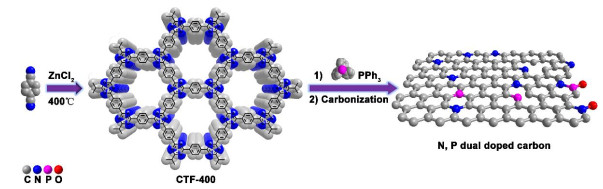
Figure 1.
Schematic illustration for the synthesis of CTF-400 and N, P dual-doped porous carbons from PPh3@CTF-400. Hydrogen atoms are omitted for simplicity


The electroreduction of CO2 into value-added chemicals using renewable electricity would be a promising way to alleviate the greenhouse effect and achieve a neutral carbon cycle[1-9]. Among the products of CO2 electroreduction reaction (CO2RR), CO is considered to be one of the most important industrial feedstocks, which has been widely used for the Fischer-Tropsch synthesis to produce hydrocarbon liquid fuels[10-13]. In the past decades, noble-metal (e.g., Au, Ag, and Pd) based catalysts and single-atom catalysts (SACs) (e.g., Ni–N–C and Co–N–C) have been successfully developed and widely used as highly active electrocatalysts for CO2RR to produce CO[14-23]. Nevertheless, the applications of noble-metal based catalysts are limited by their exorbitant prices, while in the case of SACs, it is difficult to fabricate SACs in large-scale manner with simple synthesis procedures[24-27]. Therefore, it is an urgent desire to develop efficient metal-free electrocatalysts such as non-metal doped carbon materials towards CO2RR. Recently, the metal-free porous carbons have drawn considerable attention because of their intrinsic features of low-cost, earth abundance, large surface area, excellent conductivity and stability in acidic and alkaline media in comparison to the metal-based electrocatalysts[28-31]. A variety of non-metal atoms (e.g., N, P, F, etc.) doped carbons are active in CO2RR for the production of CO[32-34]. The high CO2RR activity for these carbons is attributed to that the introduction of foreign atoms into the carbon skeleton could break the electroneu-trality of carbon matrix and induce the charged active sites[1, 29, 30, 35]. Compared with the single non-metal atom doping, dual-doped carbons usually achieve higher electrocatalytic activity owing to the increase of activated centers and the synergistic effect between the different dopants[30, 35]. Unfortunately, it still remains a significant challenge for the heteroatom doped carbons to achieve highly efficient CO2RR due to the lack of enough active sites to overcome the inert chemical bond of CO2 molecules and the competitive side reactions such as the hydrogen evolution reaction (HER).
As a common heteroatom, nitrogen (N) has been widely employed as dopant incorporated into carbon matrix[1, 29, 30, 32, 35-37] and the resulting N-doped carbons exhibited enhanced electrocatalytic activity due to the higher electronegativity of N with respect to C and the formation of positive charge density on the adjacent C[1, 29, 30, 35]. Unlike N, phosphorus (P) with lower electronegativity than C can modify the local charge of N-doped carbons to obtain an optimized charge-carrier concentration and create new active sites[30, 35, 38], which are considered as an ideal dopant together with N atom for the fabrication of dual-doped carbons. Regarding ORR, it has been demonstrated that the N and P dual-doped carbon materials present high activity and durability[39, 40]. Nevertheless, the CO2RR catalyzed by N, P dual-doped carbon materials has seldom been investigated[40, 41].
Covalent triazine frameworks (CTFs) constructed from the trimerization of aromatic nitriles are one class of porous conjugated polymers containing high N content[42-45], which have been identified as ideal precursors to prepare highly porous carbons[46]. Moreover, the highly porous structures in CTFs are beneficial for the introduction of triphenylphosphine (PPh3) into the pores as P source. In addition, the superior chemical and thermal stability of CTFs is beneficial to obtain high carbon yield.
In this work, PPh3 as phosphorus source was encapsulated into the pores of CTF-400 (Fig. 1), which was employed as precursors to fabricate N, P dual-doped porous carbons PCTF-X-Y, where X represents the carbonization temperature and Y is the mass ratio of CTF to PPh3. The N and P contents in the obtained materials can be adjusted by changing the mass ratio between CTF-400 and PPh3 as well as the carbonization temperature. Due to the high specific surface areas and the synergistic effect caused by the doped N and P in the graphitic networks, the resulting PCTF-1000-5 catalyst exhibited high CO selectivity with 84.3% faradaic efficiency (FE) at –0.7 V versus the reversible hydrogen electrode (vs. RHE, all potentials are with reference to the RHE), which is 1.5 times higher than that of mono N-doped CTF-1000 at the same potential. As far as we know, the high CO selectivity outperforms all previously reported N, P dual-doped CO2RR electrocatalysts in aqueous system[40] and most of metal-free carbons[12, 32-34, 37, 40, 41, 47-53]. Moreover, PCTF-1000-5 could maintain its initial activity over 16 h during the long-term electrolysis experiment.
The preparation of N, P dual-doped porous carbons is illustrated in Fig. 1. Typically, the porous covalent triazine framework, CTF-400, acted as nitrogen source and precursor was prepared from the trimerization of terephthalonitrile in the presence of molten ZnCl2 as Lewis catalyst and porogen[42, 46]. As measured by the inductively coupled plasma atomic emission spectrometry (ICP-AES), the content of Zn in CTF-400 is less than 0.23 wt%, suggesting that the residual ZnCl2 has been removed using diluted hydrochloric acid. The PPh3 was introduced into CTF-400 by a facile impregnation method, followed by carbonization to give N, P dual-doped porous carbons PCTF-X-Y (X = 600 ℃, 800 ℃ and 1000 ℃; Y = 5 and 1). When the mass ratios of CTF-400 to PPh3 are 5:1 and 1:1 (carbonization temperature is 1000 ℃), the corresponding samples were named as PCTF-1000-5 and PCTF-1000-1. For comparison, the N-doped carbon CTF-1000 was obtained by pyrolysis of CTF-400 at 1000 ℃. The samples carbonized at different temperature of 600, 800 and 1000 ℃ (the mass ratio of CTF-400 to PPh3 is 5:1) were denoted as PCTF-600-5, PCTF-800-5 and PCTF-1000-5, respectively. For N, P dual-doped carbon materials and CTF-1000, the N and P contents are summarized in Table S1 based on the elemental analysis (EA) and ICP-AES results. It can be observed that the contents of N and P in PCTF-1000-5 are 1.99 wt% and 0.46 wt%, respectively. The N and P contents decreased as the mass ratio of CTF-400 and PPh3 decreased at the same carbonization temperature, while with decreasing the carbonization temperature, the N and P contents increased under the same mass ratio between CTF-400 and PPh3.
The powder X-ray diffraction (PXRD) patterns of CTF-400 (Fig. S1) shows only an obvious broad peak at around 25° indexed to the (001) reflection of aromatic sheets. The N2 adsorption-desorption measurement of precursor CTF-400 was performed at 77 K (Fig. S2), which revealed that CTF-400 has a high Brunauer-Emmett-Teller (BET) surface area of 568 m2·g-1 and a large total pore volume of 0.32 cm3·g-1. The pore size distribution determined by nonlocal density functional theory (NL-DFT) method (Fig. S2 inset) revealed that the CTF-400 is mainly composed with micropores. The micropore of 1.2 nm matches well with the pore size of 11.55 Å measured from the model of CTF-400 simulated by Mercury software (Fig. S3a). Such porous architectures are highly accessible to PPh3 because the PPh3 (the longest edge is ~9.403 Å, Fig. S3b) is much smaller than the pore size of CTF-400. In addition, the sample CTF-400 has a high weight ratio of nitrogen (7.57 wt%), which is considered as the ideal precursor to fabricate porous nitrogen-rich carbons via thermal transformation. In order to encapsulate PPh3 into the porous framework of CTF-400, a facile impregnation method was employed and by adjusting the mass ratio of CTF-400 to PPh3 in this process, the heteroatom content can be easily tailored.
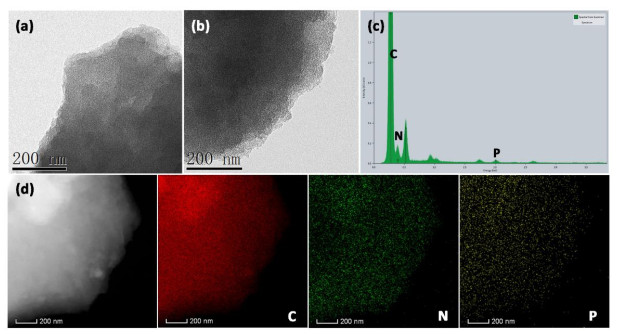
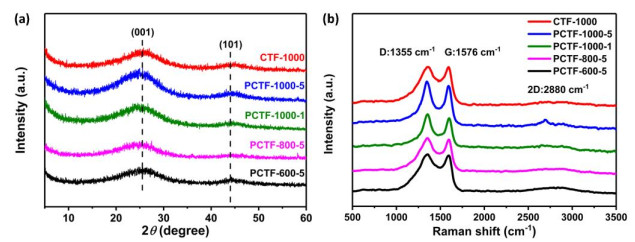
The morphology and structure of PCTF-1000-5 were firstly characterized by scanning electron microscopy (SEM). As depicted in Fig. S4, the PCTF-1000-5 presents the block-like morphology with random open pores stacked arbitrarily by the 2D graphene sheets. The transmission electron microscopy (TEM) images (Figs. 2a, b and Fig. S5a) exhibit that the as-prepared PCTF-1000-5 has similar morphology to CTF-1000, suggesting that the highly porous structure was remained after P doping. The energy dispersive X-ray spectroscopy (EDX) (Fig. 2c) manifests the presence of C, N and P elements in PCTF-1000-5, which agrees well with the EA and ICP-AES results (Table S1). The EDS elemental mappings reveal the uniform distribution of these elements within the entire framework (Fig. 2d). The powder X-ray diffraction (PXRD) patterns of all the obtained N, P dual-doped carbons and CTF-1000 (Fig. 3a) display two broad characteristic peaks at around 25° and 44°, which can be ascribed to the (001) and (101) reflections of graphitic carbon, respectively. The appearance of a weak peak at 44° suggested that a higher graphitic degree was obtained in these samples in comparison to precursor CTF-400. The graphitization degrees of all carbon-based materials were further confirmed by Raman spectroscopy. As shown in Fig. 3b, all the samples have typical D bands located at ca. 1355 cm-1 and G bands at ca. 1576 cm-1, corresponding to structure defects and the vibration of sp2-bonded carbon atoms, respectively[32, 40, 54, 55]. Compared with that of CTF-1000, the N, P dual-doped carbons showed larger values of ID/IG (Table S2), indicating the presence of more defects in the carbon lattice due to the introduction of P atoms[12, 56]. In addition, a broad weak peak at ca. 2880 cm-1 can be observed, suggesting the existence of graphitic layered structures in these samples[57, 58], which is beneficial for the electron transfer to active sites and substrates, thus improving the electrocatalytic activity.
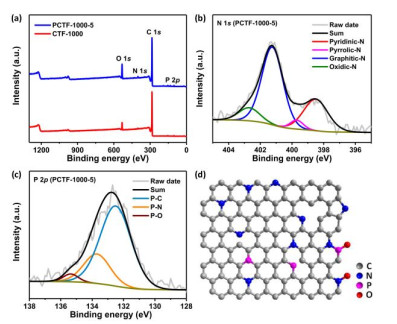
To manifest the local chemical environment of all the carbon samples, X-ray photoelectron spectroscopy (XPS) were recorded. The survey spectrum of CTF-1000 shows the presence of C, N and O atoms, while PCTF-1000-5 has a new weak peak positioned at ~133 eV corresponding to the P 2p (Fig. 4a)[33, 38, 45, 56], further confirming that the P species has been successfully introduced into the carbon skeleton. The result matches well with the ICP-AES (Table S1) and EDX results (Figs. 2c, d and Figs. S5b, c). Notably, the O signals in the samples may be originated from physical adsorption of small molecules (e.g., O2, CO2 and H2O) on porous carbons[39]. As shown in Fig. 4b, the high-resolution XPS spectrum for N 1s of PCTF-1000-5 can be fitted into four peaks assigned to the pyridinic-N (398.5 eV), pyrrolic-N (399.7 eV), graphitic-N (401.2 eV) and oxidic-N (402.7 eV), respectively[37, 40, 41, 47]. The P 2p XPS spectrum reveals three bonding configurations, corresponding to P–C (132.5 eV), P–N (133.7 eV) and P–O (135.0 eV), respectively (Fig. 4c)[40, 45, 56, 59]. The proposed structures of these types of N and P are displayed in Fig. 4d. As comparison, CTF-1000, PCTF-1000-1, PCTF-800-5 and PCTF-600-5 were also characterized by XPS. As depicted in Figs. S6 and S7, the types of N species and the bonding configurations of P element in these samples are similar with those in PCTF-1000-5. The contents of different types of N and P for the samples mentioned above are listed in Tables S3-6 and compared intuitively in Fig. S8. As can be seen from Figs. S8a, b, graphitic-N is the main type N for CTF-1000. Thus, in combining with the ICP-AES and Raman results, it can be concluded that the CTF-1000 retained major sp2 carbon skeleton. According to previous reports, the C atoms next to pyridinic-N are beneficial for enhancing the CO2RR activity[52, 55]. Nevertheless, CTF-1000 had the low pyridinic-N amount of 0.03 wt%, while the N, P dual-doped carbon PCTF-800-5-1 exhibited the highest pyridinic-N amount (0.97 wt%), followed by PCTF-1000-5 (0.55 wt%), PCTF-600-5 (0.46 wt%) and PCTF-1000-1 (0.46 wt%) (Table S5). In addition, the P–C bond is regarded to be in favor of CO2RR in reported P-doped carbons owing to its good CO2 activation and strong intermediate adsorption[32]. Therefore, the more P–C bonds in N, P dual-doped carbons may also improve the CO2RR activity. As shown in Table S6, the amounts of P–C bond in PCTF-1000-5, PCTF-1000-1, PCTF-800-5 and PCTF-600-5 are 0.33 wt%, 0.05 wt%, 0.31 wt% and 0.36 wt%, respectively. Here, it is speculated that the N and P owning different electronegativity doped in graphene sheet would activate the adjacent C to P atoms acting as active sites and the high total amount of pyridinic-N and P–C bond is conducive to electrocatalysis.
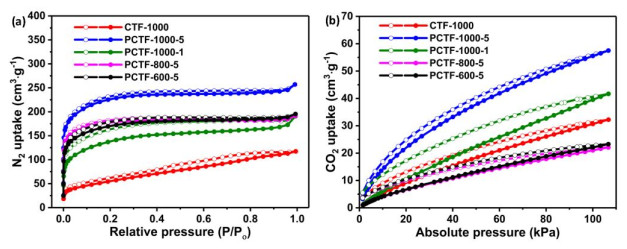
In order to determine the porosity and specific surface area of the samples, the nitrogen sorption isotherms were measured at 77 K and the results are shown in Fig. 5a. Compared with mono N-doped CTF-1000, the N, P dual-doped catalysts (PCTF-1000-5, PCTF-1000-1, PCTF-800-5 and PCTF-600-5) showed higher N2 adsorption capacity. As summarized in Table S7, the BET specific surface areas of PCTF-1000-5, PCTF-800-5 and PCTF-600-5 are 822, 666 and 615 m2·g-1, respectively, suggesting that the higher carbonization temperature leads to a larger BET specific surface area under the same mass ratio of CTF-400 to PPh3. The PCTF-1000-5 catalyst also exhibited a larger BET specific surface than that of PCTF-1000-1 (475 m2·g-1) and CTF-1000 (179 m2·g-1), which indicated that the large BET specific surface area was related to high N and P doping level at the same carbonization temperature. The pore size distributions calculated by the NL-DFT method (Fig. S9) demonstrated that the pore types of all samples are mainly micropores less than 2 nm in diameter. And the total pore volume of samples displayed a rise with the increased carbonization temperature under the same mass ratio of CTF-400 to PPh3 or the increased N and P doping level at the same carbonization temperature, which revealed a similar trend to BET specific surface area (Table S7). The high BET surface area and large pore volume could make more active sites highly accessible to substrates, thus improving the energy conversion efficiency. In addition, the highly porous structure is favorable for CO2 adsorption uptakes, and thereby the adsorption behavior of different samples also revealed the similar regularity to BET specific surface area. It is noteworthy that PCTF-1000-5 with the largest BET surface area exhibited the best CO2 adsorption capacity of 58 cm3·g-1 at 298 K (Fig. 5b), which manifested a strong CO2 affinity by the PCTF-1000-5 that would contribute to improving its CO2RR activity.
The CO2RR performances of all the N, P dual-doped carbons and CTF-1000 were conducted in a gas-tight H-type electrochemical cell using an electrolyte of 0.5 M KHCO3. Primarily, the linear sweep voltammetry (LSV) of PCTF-1000-5 was measured between 0 and –1.3 V vs. RHE in both N2 and CO2-saturated electrolytes (Fig. 6a). In CO2-saturated electrolyte, PCTF-1000-5 achieved a more positive onset potential and higher current density than those in N2-saturated electrolyte, indicating a favorable CO2 reactivity with the catalyst. As displayed in Fig. 6b, among all the N, P dual-doped samples, PCTF-1000-5 has the most positive onset potential of around –0.48 V vs. RHE and the highest current density of 21.7 mA·cm-2 at –1.3 V vs. RHE, strongly indicating that PCTF-1000-5 with the large surface areas, highly porous architectures and synergistic effect of N and P dopants has the best CO2RR activity. To further determine the selectivity of different catalysts in CO2RR, the reduction products and corresponding FE at various applied potentials were analyzed. Within the potential ranges from –0.6 to –0.9 V vs. RHE, CO and H2 were the main gas-phase products detected by gas chromatography (GC), and no liquid-phase product was found in 1H nuclear magnetic resonance (NMR) spectroscopy (Fig. S10). As shown in Figs. 6b, c, CTF-1000 displayed the larger current density and more positive onset potential when compared with N, P dual-doped electrocatalysts, but H2 was the major product for CTF-1000 during CO2RR. The large current density of CTF-1000 might be related to its high graphitization degree indicated by Raman analysis, while the poor CO selectivity is mainly caused by the low pyridinic-N amount in CTF-1000. It can be seen in Fig. 6c that the N, P dual-doped samples PCTF-1000-5, PCTF-800-5 and PCTF-1000-1 exhibited much better CO selectivity than pristine CTF-1000 over the whole applied potential range, which suggested that the doping of P atoms in the N-doped graphitic networks is beneficial for the conversion of CO2-to-CO. In addition, PCTF-1000-5 achieved higher CO selectivity (84.3%) than PCTF-1000-1 (78.4%), which can be attributed to its higher amount of pyridinic-N (0.55 wt%) and P-C bond (0.33 wt%) than PCTF-1000-1 (0.46 wt% for pyridinic-N; 0.05 wt% for P-C bond). PCTF-800-5 with the higher amount of pyridinic-N (0.97 wt%) and P-C bond (0.31 wt%) than PCTF-1000-1 also gained the higher CO selectivity (84.1%). It should be noted that PCTF-1000-5 with the smaller amount of pyridinic-N and P–C bond than PCTF-800-5 showed higher CO selectivity. This might result from the much higher surface areas of PCTF-1000-5 than PCTF-800-5, which is in favor of the exposure of more active sites and CO2 adsorption, thus improving the CO yield during CO2RR. For PCTF-1000-5, it achieved the best FECO of 84.3% at –0.7 V vs. RHE and gradually decreased with the increase of applied potentials, most likely because the potentials more negative than –0.7 V vs. RHE favored the competitive HER. Significantly, the optimal FECO of PCTF-1000-5 is superior to most of the previously reported metal-free carbon catalysts (Table S8). It can be also seen in Fig. 6c that PCTF-600-5 showed the worst CO selectivity among all the samples, most likely because the part framework of CTF-400 that is inactive for CO2RR (Fig. S11) was retained in PCTF-600-5. Long-term stability is another key parameter for a superior electrocatalyst. As shown in Fig. 6d, the electrochemical reduction of CO2 on PCTF-1000-5 was performed at the applied potential of –0.7 V vs. RHE. The total current density and FECO have no obvious loss during the entire process of electrolysis for 16 h.
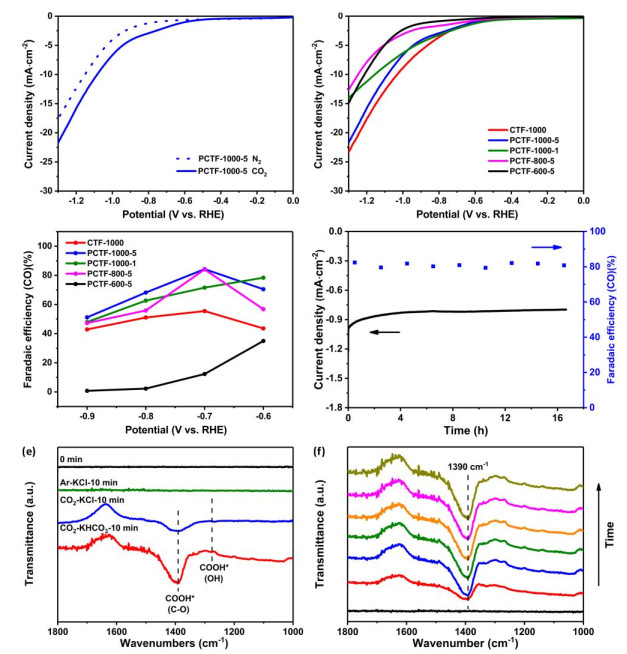
Operando attenuated total reflectance Fourier transform infrared spectroscopy (ATR-FTIR) was employed to explore the possible reaction intermediates during CO2RR and gain insights into the reaction pathways of CO2RR over PCTF-1000-5. As shown in Fig. 6e, at an applied potential of –0.7 V vs. RHE, the 1390 cm-1 peak associated with the C–O stretch of COOH*[60-62] can be seen clearly in the spectrum obtained in CO2-saturated 0.5 M KHCO3 and its intensity increased gradually with time and finally reached dynamic balance (Fig. 6f). In addition, a weak peak at 1275 cm-1 belonging to the OH-deformation of COOH*[60-62] was also observed. Thus, it is speculated that the formation of *COOH intermediate was the rate-determining step in the conversion of CO2 to CO for PCTF-1000-5.
In conclusion, we fabricated a series of N, P dual-doped porous carbons through a one-step carbonization process by using PPh3@covalent triazine framework composites as precursors. Among all the investigated catalysts, the resulting PCTF-1000-5 achieved the best CO selectivity with 84.3% Faradaic efficiency and favorable stability (over 16 h) for CO2 reduction, which are superior to the reported N, P dual-doped catalysts in aqueous media. The excellent performance of PCTF-1000-5 can be reasonably attributed to its high specific surface areas, highly porous architectures as well as the synergistic effect between N and P atoms. Operando ATR-FTIR demonstrated that the formation of COOH* intermediate was the rate-determining step in CO2-to-CO conversion. This work will further facilitate the rational design and cost-saved construction of efficient metal-free electrocatalysts for both energy storage and conversions.
Duan, X.; Xu, J.; Wei, Z.; Ma, J.; Guo, S.; Wang, S.; Liu, H.; Dou, S. Metal-free carbon materials for CO2 electrochemical reduction. Adv. Mater. 2017, 29, 1701784. doi: 10.1002/adma.201701784
Yi, J. D.; Xie, R.; Xie, Z. L.; Chai, G. L.; Liu, T. F.; Chen, R. P.; Huang, Y. B.; Cao, R. Highly selective CO2 electroreduction to CH4 by in situ generated Cu2O single-type sites on a conductive MOF: stabilizing key intermediates with hydrogen bonding. Angew. Chem. Int. Ed. 2020, 59, 23641–23648. doi: 10.1002/anie.202010601
Wu, Q.; Mao, M. J.; Wu, Q. J.; Liang, J.; Huang, Y. B.; Cao, R. Construction of donor-acceptor heterojunctions in covalent organic framework for enhanced CO2 electroreduction. Small 2020, 2004933.
Zhu, H. J.; Lu, M.; Wang, Y. R.; Yao, S. J.; Zhang, M.; Kan, Y. H.; Liu, J.; Chen, Y.; Li, S. L.; Lan, Y. Q. Efficient electron transmission in covalent organic framework nanosheets for highly active electrocatalytic carbon dioxide reduction. Nat. Commun. 2020, 11, 497. doi: 10.1038/s41467-019-14237-4
Ye, K.; Wang, G. X.; Bao, X. H. Electrodeposited Sn-based catalysts for CO2 electroreduction. Chin. J. Struct. Chem. 2020, 39, 206‒213.
Lu, M.; Zhang, M.; Liu, C. G.; Liu, J.; Shang, L. J.; Wang, M.; Chang, J. N.; Li, S. L.; Lan, Y. Q. Stable dioxin-linked metallophthalocyanine covalent organic frameworks (COFs) as photo-coupled electrocatalysts for CO2 reduction. Angew. Chem. Int. Ed. 2021, DOI: 10.1002/anie.202011722.
Huang, Q.; Li, Q.; Liu, J.; Wang, Y. R.; Wang, R.; Dong, L. Z.; Xia, Y. H.; Wang, J. L.; Lan, Y. Q. Disclosing CO2 activation mechanism by hydroxyl-induced crystalline structure transformation in electrocatalytic process. Matter 2019, 1, 1656‒1668. doi: 10.1016/j.matt.2019.07.003
Hou, S. S.; Xu, Z. T.; Zhang, Y. K.; Xie, K.; Gan, L. Z. Enhanced CO2 electrolysis with Mn-doped SrFeO3-delta cathode. Chin. J. Struct. Chem. 2020, 39, 1662‒1668.
Xu, Z. T.; Xie, K. Enhanced CO2 electrolysis with metal-oxide interface structures. Chin. J. Struct. Chem. 2021, 40, 31‒41.
Nielsen, D. U.; Hu, X. M.; Daasbjerg, K.; Skrydstrup, T. Chemically and electrochemically catalysed conversion of CO2 to CO with follow-up utilization to value-added chemicals. Nat. Catal. 2018, 1, 244‒254. doi: 10.1038/s41929-018-0051-3
Sheng, W. C.; Kattel, S.; Yao, S. Y.; Yan, B. H.; Liang, Z. X.; Hawxhurst, C. J.; Wu, Q. Y.; Chen, J. G. G. Electrochemical reduction of CO2 to synthesis gas with controlled CO/H2 ratios. Energy Environ. Sci. 2017, 10, 1180‒1185. doi: 10.1039/C7EE00071E
Wu, J. J.; Yadav, R. M.; Liu, M. J.; Sharma, P. P.; Tiwary, C. S.; Ma, L. L.; Zou, X. L.; Zhou, X. D.; Yakobson, B. I.; Lou, J.; Ajayan, P. M. Achieving highly efficient, selective, and stable CO2 reduction on nitrogen-doped carbon nanotubes. Acs Nano 2015, 9, 5364‒5371. doi: 10.1021/acsnano.5b01079
Long, C.; Li, X.; Guo, J.; Shi, Y. N.; Liu, S. Q.; Tang, Z. Y. Electrochemical reduction of CO2 over heterogeneous catalysts in aqueous solution: recent progress and perspectives. Small Methods 2019, 3, 1800369.
Zhang, M. D.; Si, D. H.; Yi, J. D.; Zhao, S. S.; Huang, Y. B.; Cao, R. Conductive phthalocyanine-based covalent organic framework for highly efficient electroreduction of carbon dioxide. Small 2020, 16, 2005254. doi: 10.1002/smll.202005254
Mezzavilla, S.; Horch, S.; Stephens, I. E. L.; Seger, B.; Chorkendorff, I. Structure sensitivity in the electrocatalytic reduction of CO2 with gold catalysts. Angew. Chem. Int. Ed. 2019, 58, 3774‒3778. doi: 10.1002/anie.201811422
Li, Y. F.; Chen, C.; Cao, R.; Pan, Z. W.; He, H.; Zhou, K. B. Dual-atom Ag2/graphene catalyst for efficient electroreduction of CO2 to CO. Appl. Catal. B-Environ. 2020, 268, 118747. doi: 10.1016/j.apcatb.2020.118747
Gao, D. F.; Zhou, H.; Cai, F.; Wang, J. G.; Wang, G. X.; Bao, X. H. Pd-containing nanostructures for electrochemical CO2 reduction reaction. ACS Catal. 2018, 8, 1510‒1519. doi: 10.1021/acscatal.7b03612
Wang, A.; Li, J.; Zhang, T. Heterogeneous single-atom catalysis. Nat. Rev. Chem. 2018, 2, 65‒81. doi: 10.1038/s41570-018-0010-1
Yang, H. B.; Hung, S. F.; Liu, S.; Yuan, K. D.; Miao, S.; Zhang, L. P.; Huang, X.; Wang, H. Y.; Cai, W. Z.; Chen, R.; Gao, J. J.; Yang, X. F.; Chen, W.; Huang, Y. Q.; Chen, H. M.; Li, C. M.; Zhang, T.; Liu, B. Atomically dispersed Ni(Ι) as the active site for electrochemical CO2 reduction. Nat. Energy 2018, 3, 140‒147. doi: 10.1038/s41560-017-0078-8
Hou, Y.; Chai, G. L.; Liang, Y. L.; Yi, J. D.; Zhang, T.; Zang, K. T.; Luo, J.; Xu, R.; Lin, H.; Zhang, S. Y.; Wang, H. M.; Huang, Y. B.; Cao, R. Unraveling the reactivity and selectivity of atomically isolated metal-nitrogen sites anchored on porphyrinic triazine frameworks for electroreduction of CO2. CCS Chem. 2019, 1, 384‒395. doi: 10.31635/ccschem.019.20190011
Zheng, T. T.; Jiang, K.; Ta, N.; Hu, Y. F.; Zeng, J.; Liu, J. Y.; Wang, H. T. Large-scale and highly selective CO2 electrocatalytic reduction on nickel single-atom catalyst. Joule 2019, 3, 265‒278. doi: 10.1016/j.joule.2018.10.015
Zhao, C.; Dai, X.; Yao, T.; Chen, W.; Wang, X.; Wang, J.; Yang, J.; Wei, S.; Wu, Y.; Li, Y. Ionic exchange of metal organic frameworks to access single nickel sites for efficient electroreduction of CO2. J. Am. Chem. Soc. 2017, 139, 8078‒8081. doi: 10.1021/jacs.7b02736
Jiao, L.; Yang, W.; Wan, G.; Zhang, R.; Zheng, X.; Zhou, H.; Yu, S. H.; Jiang, H. L. Single-atom electrocatalysts from multivariate metal-organic frameworks for highly selective reduction of CO2 at low pressures. Angew. Chem. Int. Ed. 2020, 59, 20589‒20595. doi: 10.1002/anie.202008787
Zhang, W. J.; Hu, Y.; Ma, L. B.; Zhu, G. Y.; Wang, Y. R.; Xue, X. L.; Chen, R. P.; Yang, S. Y.; Jin, Z. Progress and perspective of electrocatalytic CO2 reduction for renewable carbonaceous fuels and chemicals. Adv. Sci. 2018, 5, 1700275. doi: 10.1002/advs.201700275
Zhang, Q. Q.; Guan, J. Q. Single-atom catalysts for electrocatalytic applications. Adv. Funct. Mater. 2020, 30, 2000768. doi: 10.1002/adfm.202000768
Pan, Y.; Qian, Y.; Zheng, X.; Chu, S. Q.; Yang, Y.; Ding, C.; Wang, X.; Yu, S. H.; Jiang, H. L. Precise fabrication of single-atom alloy co-catalyst with optimal charge state for enhanced photocatalysis. Natl. Sci. Rev. 2021, 8, nwaa224. doi: 10.1093/nsr/nwaa224
Jiao, L.; Zhang, R.; Wan, G.; Yang, W.; Wan, X.; Zhou, H.; Shui, J.; Yu, S. H.; Jiang, H. L. Nanocasting SiO2 into metal-organic frameworks imparts dual protection to high-loading Fe single-atom electrocatalysts. Nat. Commun. 2020, 11, 2831. doi: 10.1038/s41467-020-16715-6
Benzigar, M. R.; Talapaneni, S. N.; Joseph, S.; Ramadass, K.; Singh, G.; Scaranto, J.; Ravon, U.; Al-Bahily, K.; Vinu, A. Recent advances in functionalized micro and mesoporous carbon materials: synthesis and applications. Chem. Soc. Rev. 2018, 47, 2680‒2721. doi: 10.1039/C7CS00787F
Paul, R.; Zhu, L.; Chen, H.; Qu, J.; Dai, L. M. Recent advances in carbon-based metal-free electrocatalysts. Adv. Mater. 2019, 31, 1806403. doi: 10.1002/adma.201806403
Liu, X.; Dai, L. M. Carbon-based metal-free catalysts. Nat. Rev. Mater. 2016, 1, 16064. doi: 10.1038/natrevmats.2016.64
You, S. J.; Ma, M.; Wang, W.; Qi, D. P.; Chen, X. D.; Qu, J. H.; Ren, N. Q. 3D Macroporous nitrogen-enriched graphitic carbon scaffold for efficient bioelectricity generation in microbial fuel Cells. Adv. Energy Mater. 2017, 7, 1601364. doi: 10.1002/aenm.201601364
Sharma, P. P.; Wu, J.; Yadav, R. M.; Liu, M.; Wright, C. J.; Tiwary, C. S.; Yakobson, B. I.; Lou, J.; Ajayan, P. M.; Zhou, X. D. Nitrogen-doped carbon nanotube arrays for high-efficiency electrochemical reduction of CO2: on the understanding of defects, defect density, and selectivity. Angew. Chem. Int. Ed. 2015, 54, 13701‒13705. doi: 10.1002/anie.201506062
Liu, T.; Ali, S.; Lian, Z.; Si, C.; Su, D. S.; Li, B. Phosphorus-doped onion-like carbon for CO2 electrochemical reduction: the decisive role of the bonding configuration of phosphorus. J. Mater. Chem. A 2018, 6, 19998‒20004. doi: 10.1039/C8TA06649C
Xie, J.; Zhao, X.; Wu, M.; Li, Q.; Wang, Y.; Yao, J. Metal-free fluorine-doped carbon electrocatalyst for CO2 reduction outcompeting hydrogen evolution. Angew. Chem. Int. Ed. 2018, 57, 9640‒9644. doi: 10.1002/anie.201802055
Hu, C. G.; Dai, L. M. Doping of carbon materials formetal-free electrocatalysis. Adv. Mater. 2019, 31, 1804672. doi: 10.1002/adma.201804672
Yang, W. G.; Gong, Z. W.; Chen, Y. N.; Chen, R. R.; Meng, D. L.; Cao, M. N. Nitrogen doped carbon as efficient catalyst toward oxygen reduction reaction. Chin. J. Struct. Chem. 2020, 39, 287‒293.
Cui, X.; Pan, Z.; Zhang, L.; Peng, H.; Zheng, G. Selective etching of nitrogen-doped carbon by steam for enhanced electrochemical CO2 reduction. Adv. Energy Mater. 2017, 7, 1701456. doi: 10.1002/aenm.201701456
Chen, Y. Z.; Wang, C.; Wu, Z. Y.; Xiong, Y.; Xu, Q.; Yu, S. H.; Jiang, H. L. From bimetallic metal-organic framework to porous carbon: high surface area and multicomponent active dopants for excellent electrocatalysis. Adv. Mater. 2015, 27, 5010‒5016. doi: 10.1002/adma.201502315
Zhu, L. W.; Wu, J.; Zhang, Q.; Li, X. K.; Li, Y. M.; Cao, X. B. Chemical-free fabrication of N, P dual-doped honeycomb-like carbon as an efficient electrocatalyst for oxygen reduction. J. Colloid Interface Sci. 2018, 510, 32‒38. doi: 10.1016/j.jcis.2017.08.078
Xue, X.; Yang, H.; Yang, T.; Yuan, P.; Li, Q.; Mu, S.; Zheng, X.; Chi, L.; Zhu, J.; Li, Y.; Zhang, J.; Xu, Q. N, P-coordinated fullerene-like carbon nanostructures with dual active centers toward high-efficient multi-functional electrocatalysis for CO2RR, ORR and Zn-air battery, J. Mater. Chem. A 2019, 7, 15271‒15277. doi: 10.1039/C9TA03828K
Chen, C.; Sun, X.; Yan, X.; Wu, Y.; Liu, H.; Zhu, Q.; Bediako, B. B. A.; Han, B. Boosting CO2 electroreduction on N, P-Co-doped carbon aerogels. Angew. Chem. Int. Ed. 2020, 59, 11123‒11129. doi: 10.1002/anie.202004226
Kuhn, P.; Antonietti, M.; Thomas, A. Porous, covalent triazine-based frameworks prepared by ionothermal synthesis. Angew. Chem. Int. Ed. 2008, 47, 3450‒3453. doi: 10.1002/anie.200705710
Zhao, Y. F.; Yao, K. X.; Teng, B. Y.; Zhang, T.; Han, Y. A perfluorinated covalent triazine-based framework for highly selective and water-tolerant CO2 capture. Energy Environ. Sci. 2013, 6, 3684‒3692. doi: 10.1039/c3ee42548g
Puthiaraj, P.; Lee, Y. R.; Zhang, S. Q.; Ahn, W. S. Triazine-based covalent organic polymers: design, synthesis and applications in heterogeneous catalysis. J. Mater. Chem. A 2016, 4, 16288‒16311. doi: 10.1039/C6TA06089G
Cheng, Z.; Fang, W.; Zhao, T. S.; Fang, S. Q.; Bi, J. H.; Liang, S. J.; Li, L. Y.; Yu, Y.; Wu, L. Efficient visible-light-driven photocatalytic hydrogen evolution on phosphorus-doped covalent triazine-based frameworks. ACS Appl. Mater. Interfaces 2018, 10, 41415‒41421. doi: 10.1021/acsami.8b16013
Hao, L.; Zhang, S. S.; Liu, R. J.; Ning, J.; Zhang, G. J.; Zhi, L. J. Bottom-up construction of triazine-based frameworks as metal-free electrocatalysts for oxygen reduction reaction. Adv. Mater. 2015, 27, 3190‒3195. doi: 10.1002/adma.201500863
Wu, J.; Liu, M.; Sharma, P. P.; Yadav, R. M.; Ma, L.; Yang, Y.; Zou, X.; Zhou, X. D.; Vajtai, R.; Yakobson, B. I.; Lou, J.; Ajayan, P. M. Incorporation of nitrogen defects for efficient reduction of CO2 via two-electron pathway on three-dimensional graphene foam. Nano Lett. 2016, 16, 466‒470. doi: 10.1021/acs.nanolett.5b04123
Xu, J.; Kan, Y.; Huang, R.; Zhang, B.; Wang, B.; Wu, K. H.; Lin, Y.; Sun, X.; Li, Q.; Centi, G.; Su, D. Revealing the origin of activity in nitrogen-doped nanocarbons towards electrocatalytic reduction of carbon dioxide. 2016, 9, 1085‒1089.
Wang, R.; Sun, X.; Ould-Chikh, S.; Osadchii, D.; Bai, F.; Kapteijn, F.; Gascon, J. Metal-organic-framework-mediated nitrogen-doped carbon for CO2 electrochemical reduction. ACS Appl. Mater. Interfaces 2018, 10, 14751‒14758. doi: 10.1021/acsami.8b02226
Lu, X.; Tan, T. H.; Ng, Y. H.; Amal, R. Highly selective and stable reduction of CO2 to CO by a graphitic carbon nitride/carbon nanotube composite electrocatalyst. Chem. Eur. J. 2016, 22, 11991‒11996. doi: 10.1002/chem.201601674
Zhu, Q.; Ma, J.; Kang, X.; Sun, X.; Hu, J.; Yang, G.; Han, B. Electrochemical reduction of CO2 to CO using graphene oxide/carbon nanotube electrode in ionic liquid/acetonitrile system. Sci. China Chem. 2016, 59, 551‒556. doi: 10.1007/s11426-016-5584-1
Li, W.; Seredych, M.; Rodriguez-Castellon, E.; Bandosz, T. J. Metal-free nanoporous carbon as a catalyst for electrochemical reduction of CO2 to CO and CH4. ChemSusChem. 2016, 9, 606‒616. doi: 10.1002/cssc.201501575
Ghausi, M. A.; Xie, J.; Li, Q.; Wang, X.; Yang, R.; Wu, M.; Wang, Y.; Dai, L. CO2 overall splitting by a bifunctional metal-free electrocatalyst. Angew. Chem. Int. Ed. 2018, 57, 13135‒13139. doi: 10.1002/anie.201807571
Wang, Y. S.; Chen, J. X.; Wang, G. X.; Li, Y.; Wen, Z. H. Perfluorinated covalent triazine framework derived hybrids for the highly selective electroconversion of carbon dioxide into methane. Angew. Chem. Int. Ed. 2018, 57, 13120‒13124. doi: 10.1002/anie.201807173
Kumar, B.; Asadi, M.; Pisasale, D.; Sinha-Ray, S.; Rosen, B. A.; Haasch, R.; Abiade, J.; Yarin, A. L.; Salehi-Khojin, A. Renewable and metal-free carbon nanofibre catalysts for carbon dioxide reduction. Nat. Commun. 2013, 4, 2819. doi: 10.1038/ncomms3819
Zhang, C.; Mahmood, N.; Yin, H.; Liu, F.; Hou, Y. Synthesis of phosphorus-doped graphene and its multifunctional applications for oxygen reduction reaction and lithium ion batteries. Adv. Mater. 2013, 25, 4932‒4937. doi: 10.1002/adma.201301870
Yi, J. D.; Xu, R.; Wu, Q.; Zhang, T.; Zang, K. T.; Luo, J.; Liang, Y. L.; Huang, Y. B.; Cao, R. Atomically dispersed iron-nitrogen active sites within porphyrinic triazine-based frameworks for oxygen reduction reaction in both alkaline and acidic media. ACS Energy Lett. 2018, 3, 883‒889. doi: 10.1021/acsenergylett.8b00245
Chen, Y.; Li, J.; Mei, T.; Hu, X. G.; Liu, D.; Wang, J.; Hao, M.; Li, J.; Wang, J.; Wang, X. Low-temperature and one-pot synthesis of sulfurized graphene nanosheets via in situ doping and their superior electrocatalytic activity for oxygen reduction reaction. J. Mater. Chem. A 2014, 2, 20714‒20722. doi: 10.1039/C4TA04938A
Fang, X. X.; Ma, L. B.; Liang, K.; Zhao, S. J.; Jiang, Y. F.; Ling, C.; Zhao, T.; Cheang, T. Y.; Xu, A. W. The doping of phosphorus atoms into graphitic carbon nitride for highly enhanced photocatalytic hydrogen evolution. J. Mater. Chem. A 2019, 7, 11506‒11512. doi: 10.1039/C9TA01646E
Deng, W.; Zhang, L.; Li, L.; Chen, S.; Hu, C.; Zhao, Z. J.; Wang, T.; Gong, J. Crucial role of surface hydroxyls on the activity and stability in electrochemical CO2 reduction. J. Am. Chem. Soc. 2019, 141, 2911‒2915. doi: 10.1021/jacs.8b13786
Firet, N. J.; Smith, W. A. Probing the reaction mechanism of CO2 electroreduction over Ag films via operando infrared spectroscopy. ACS Catal. 2017, 7, 606‒612. doi: 10.1021/acscatal.6b02382
Zhu, S.; Li, T.; Cai, W. B.; Shao, M. CO2 Electrochemical reduction as probed through infrared spectroscopy. ACS Energy Lett. 2019, 4, 682‒689. doi: 10.1021/acsenergylett.8b02525

Figure 1 Schematic illustration for the synthesis of CTF-400 and N, P dual-doped porous carbons from PPh3@CTF-400. Hydrogen atoms are omitted for simplicity

Figure 2 TEM images of (a) PCTF-1000-5 and (b) CTF-1000; (c) EDX profile of PCTF-1000-5 and (d) the corresponding C, N, and P EDS elemental mappings

Figure 3 (a) PXRD patterns and (b) Raman spectra for CTF-1000, PCTF-1000-5, PCTF-1000-1, PCTF-800-5 and PCTF-600-5

Figure 4 (a) XPS survey spectra of PCTF-1000-5 and CTF-1000. (b) High-resolution N 1s spectrum of PCTF-1000-5. (c) High-resolution P 2p spectrum of PCTF-1000-5. (d) Schematic of the proposed structure of N, P dual-doped carbon

Figure 5 (a) N2 adsorption-desorption isotherms and (b) CO2 adsorption-desorption isotherms of CTF-1000, PCTF-1000-5, PCTF-1000-1, PCTF-800-5 and PCTF-600-5

Figure 6 (a) LSV curves of PCTF-1000-5 in N2- and CO2-saturated 0.5 M KHCO3 electrolyte at a scan rate of 10 mV·s-1. (b) LSV curves of CTF-1000, PCTF-1000-5, PCTF-1000-1, PCTF-800-5 and PCTF-600-5 in CO2-saturated 0.5 M KHCO3 electrolyte at a scan rate of 10 mV·s-1. (c) FE for CO production of CTF-1000, PCTF-1000-5, PCTF-1000-1, PCTF-800-5 and PCTF-600-5 at different applied potentials. (d) Stability test (FE for CO and total current density) of PCTF-1000-5 at –0.7 V vs. RHE for 16 h. (e) Operando ATR-FTIR experiments was taken after 10 min at –0.7 V vs. RHE on the PCTF-1000-5. The green spectrum was taken in 0.1 M KCl saturated with Ar. The blue spectrum was taken in 0.1 M KCl saturated with CO2. The red spectrum was taken in 0.5 M KHCO3 saturated with CO2. (f) Operando ATR-FTIR of PCTF-1000-5 at –0.7 V vs. RHE in 0.5 M KHCO3 saturated with CO2

 扫一扫看文章


扫一扫关注我们
 DownLoad:
 下载:
下载:
 下载:
下载: