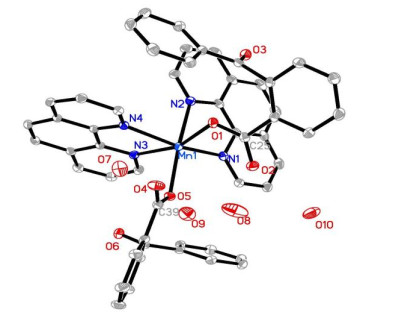
Figure 1.
Molecular structure of the title complex

Synthesis, Crystal Structure and Characterization of a New Manganese(II) Complex with o-Benzoylbenzoic Acid
Wei LI , Chang-Hong LI , Shui-Qi ZHOU , Yu-Lin LI , Yun-Fei KUANG


The design and synthesis of metal directed supramolecular frameworks have received much attention in coordination chemistry because of their interesting molecular topologies and tremendous potential applications in host-guest chemistry, catalysis, molecular selection, nonlinear optics, ion exchange and microelectronics[1]. Manganese plays an important role in the enzymatic catalysis of biochemistry, and the study of manganese complexes has aroused great interest. In addition, in order to synthesize molecular magnets, multi-nuclear magnetic exchange between manganese has also attracted people's attention[2]. Aromatic carboxylic acid complexes exhibit rich topology structure and high stability, which have captured the extensive interest of researchers due to their potential applications in many fields such as magnetism, catalyst and biology[3]. 2-Benzoylbenzoic acid is an important benzoic acid, which acts as a crucial role in medicine and dyestuff[4]. For instance, it is an major principal material of the anthraquinone dyestuff intermediate, which can be used to produce anthraquinone benzanthrone amino anthraquinone, etc[5]. As a rigid aromatic carboxylic acid ligand, 2-benzoylbenzoic acid can also be used in the design and construction of coordination compounds. However, it is rarely reported[6]. A new manganese(II) complex [Mn(C14H9O3)2(C12H8N2)2]·4H2O with o-benzoylbenzoic acid and 1, 10-phenanthroline (phen) as a ligand has been synthesized, and its structure was characterized by X-dif- fractometer. We also investigated its luminescent, magnetic and thermal stability properties. The result shows that 1 has one fluorescent emission band at around 424 nm. In addition, the magnetic behaviors of 1 are antiferromagnetism and it is stable under 383 K.
All reagents from commercial sources were of analytical grade and used without further purification. Crystal structure was determined on a Bruker SMART CCD 6000 single-crys- tal diffractometer. IR spectra were recorded on a Bruker Vector22 FT-IR spectrophotometer using KBr discs. Thermogravimetric analyses were performed on a simul- taneous SPRT-2 pyris1 thermal analyzer at a heating rate of 10 K/min. Magnetic measurements in the range of 300~2 K were performed on a MPMS-SQUID magnetometer at a field of 2 kOe on a crystalline sample in the temperature settle mode. The fluorescence for the powdered samples was measured on an RF-5301PC spectrofluorometer with a xenon arc lamp as the light source.
2 mmol of manganese sulfate (about 0.302 g), 3 mmol of o-benzoylbenzoic acid (about 0.720 g) and 3 mmol of phen (about 0.595 g) were added to 30 mL of acetonitrile-water solvent mixture (volume ratio: 5:3) by stirring at 343~353 K for about 4.0~5.0 h, and then mixed with pH being adjusted to 6.5~7.0 with dilute potassium hydroxide solution under stirring for about 23 h at 353 K. Afterwards, the resultant solution was filtrated, and the filtrate was kept untouched and evaporated slowly at room temperature. Yellow block-shaped single crystals suitable for X-ray diffraction analysis were obtained after one month in 46.5% yield based on phen. m.p.: 609~610 K. Anal. Calcd. (%) for C52H42MnN4O10: C, 66.60; H, 4.51; N, 5.97. Found (%): C, 66.40; H, 4.53; N, 5.60. Main IR (KBr, cm–1): IR (v/cm-1): 3410(w), 3055(w), 1662(vs), 1584(vs), 1560(vs), 1427(vs), 1381(vs), 1313(m), 1273(m), 1146(m), 1101(m), 95(vs), 851(vs), 767(m), 731(vs), 700(m), 671(w), 451(w).
A single crystal with dimensions of 0.24mm × 0.20mm × 0.18mm was put on a Bruker SMART APEX CCD diffractometer equipped with a graphite-monochromatic MoKa radiation (λ = 0.71073 Å) by using a φ-w scan mode at 100.03(18) K. A total of 23959 reflections were collected in the range of 1.5≤θ≤25.01°, of which 7763 were independent (Rint = 0.0433, Rsigma = 0.0436) and 6348 were observed (I > 2σ(I)). All data were corrected by Lp factors and empirical absorption. The structure was solved by direct methods and refined on F2 by full-matrix least-squares methods using the SHELX-2014 program package[7]. The final refinement including hydrogen atoms converged to R = 0.0404 and wR = 0.0956 (w = 1/[σ2(Fo2) + (0.0397P)2 + 2.1088P], where P = (Fo2 + 2Fc2)/3), (∆/σ)max = 0.000, S = 1.049, (∆ρ)max = 0.279 and (∆ρ)min = –0.364 e·Å–3.
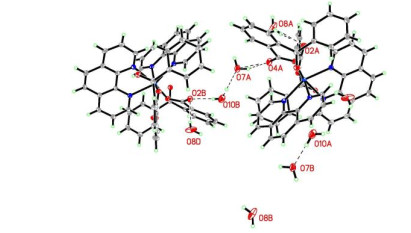
The crystal structure of the title complex is revealed in Fig. 1. Hydrogen bonding between adjacent molecules of the title complex is given in Fig. 2. Selected bond lengths and bond angles are shown in Table 1, and the hydrogen bond lengths and bond angles in Table 2.
 DownLoad:
CSV
DownLoad:
CSV
| Bond | Dist. | Bond | Dist. | Bond | Dist. | ||
| Mn(1)–O(1) | 2.143(1) | Mn(1)–O(5) | 2.143(1) | Mn(1)–N(1) | 2.239(2) | ||
| Mn(1)–N(2) | 2.361(2) | Mn(1)–N(3) | 2.344(2) | Mn(1)–N(4) | 2.244(2) | ||
| O(1)–C(25) | 1.270(2) | O(2)–C(25) | 1.243(2) | O(4)–C(39) | 1.245(2) | ||
| O(5)–C(39) | 1.264(2) | ||||||
| Angle | (°) | Angle | (°) | Angle | (°) | ||
| O(1)–Mn(1)–N(1) | 97.07(6) | O(1)–Mn(1)–N(2) | 82.18(6) | O(1)–Mn(1)–N(3) | 160.81(6) | ||
| O(1)–Mn(1)–N(4) | 93.48(6) | O(5)–Mn(1)–O(1) | 114.66(6) | O(5)–Mn(1)–N(1) | 91.54(6) | ||
| O(5)–Mn(1)–N(2) | 158.35(6) | O(5)–Mn(1)–N(3) | 81.59(6) | O(5)–Mn(1)–N(4) | 102.08(5) | ||
| N(1)–Mn(1)–N(2) | 72.14(6) | N(1)–Mn(1)–N(3) | 92.38(6) | N(1)–Mn(1)–N(4) | 157.45(7) | ||
| N(2)–Mn(1)–(3) | 84.91(6) | N(2)–Mn(1)–N(4) | 89.73(6) | N(3)–Mn(1)–N(4) | 72.27(6) |
DownLoad:
CSV
| D–H⋅⋅⋅A | d(D–H) | d(H⋅⋅⋅A) | d(D⋅⋅⋅A) | ∠DHA |
| O(8)–(8B)⋅⋅⋅O(2) | 0.81 | 2.07 | 2.841(2) | 159 |
| O(9)–H(9A)⋅⋅⋅O(3)a | 0.85 | 2.17 | 3.004(2) | 165 |
| O(7)–H(7A)⋅⋅⋅O(9) | 0.85 | 2.09 | 2.893(2) | 158 |
| O(7)–H(7B)⋅⋅⋅O(4) | 0.85 | 1.97 | 2.760(2) | 155 |
| O(10)–H(10A)⋅⋅⋅O(2) | 0.73 | 2.07 | 2.798(2) | 177 |
| O(10)–H(10B)⋅⋅⋅O(7)b | 0.85 | 2.06 | 2.892(3) | 165 |
| Symmetry codes: (a): 3/2–x, –1/2+y, 1/2–z; (b): –1/2+x, 1/2–y, –1/2+z | ||||
As shown in Fig. 1, the whole unit consists of one manganese ion, two o-benzoyl-benzoic acids, two phen molecules and four free water molecules. The central manganese ion is coordinated with two oxygen atoms from two o-benzoylbenzoic acid molecules and four nitrogen atoms from two phen molecules, giving an octahedral coordination geometry. In the MnN4O2 octahedron, the total bond angles of N(2)–Mn(1)–N(3), N(3)–Mn(1)–O(5), O(5)–Mn(1)–O(1) and O(1)–Mn(1)–N(2) are 84.91(6), 81.59(6), 114.66(6) and 82.18(6)º, respectively, with the total to be 363.34º which is close to 360.0º, indicating that N(2), N(3), O(5), O(1) and Mn(II) are almost coplanar, while N(1) and N(4) occupy the axial positions. The Mn–N bond lengths range from 2.239 to 2.344 Å, averaged by 2.322 Å and close to the similar coordination of Mn(phen)2(H2O)[C8H11O2(COO)]}·(ClO4)·H2O (Mn–N = 2.375 Å), Mn2(phen)2(p-CBA)4(H2O) (Mn–N = 2.276 Å) and Mn2(phen)2·(o-ABA)2·(H2O)2 (Mn–N = 2.261 Å)[8], which suggests that the complex is stably coordinated with the phen. The Mn–O bond lengths are 2.143 Å. In carboxyl group participating in coordination, the O(1)–C(25) bond in 1.270(2) Å is different from O(2)–C(25) being 1.243(5) Å (Δ = 0.027 Å, smaller than 0.03 Å), but the Mn–O(2) = 3.007 and Mn–O(4) = 2.999 Å are significantly greater than the mean value of 2.55 Å for Mn–O bond[9], indicating a monodentate coordination mode of o-benzoyl- benzoic acid after dissociating hydroxyl hydrogen atom. Another noticeable characteristic of the title complex lies in a large number of hydrogen bonding interactions, which exist between oxygen atoms in water connected with o-benzoyl- benzoic acid via their coordinated oxygen atoms: O(8)–(8B)⋅⋅⋅O(2) (2.841(2) Å, 159º), O(9)–H(9A)⋅⋅⋅O(3)a (3.004(2) Å, 165º) (symmetry codes: (a): 3/2–x, –1/2+y, 1/2–z), O(7)–H(7B)⋅⋅⋅O(4) (2.760(2) Å, 155º) and O(10)–H(10A)⋅⋅⋅O(2) (2.798(2) Å, 177º). Also, there are plenty of hydrogen bonds among water molecules: O(7)–H(7A)⋅⋅⋅O(9) (2.893(2) Å, 158º) and O(10)– H(10B)⋅⋅⋅O(7)b (2.892(3) Å, 164.7º) (symmetry codes: (b): –1/2+x, 1/2–y, –1/2+z). All hydrogen bonds contribute to the stability of the compoud[10].
The wide adsorption peak at about 3410 cm-1 is the characteristic peak of OH group of H2O[11]. Two strong peaks at 1662 and 1381 cm-1 could be assigned to the vas(coo-) and vs(coo-) stretching vibration of o-benzoylbenzoic acid ligand, with Δvcoo- = 281 cm-1 (Δvcoo- = vas(coo-) – vs(coo-)) greater than 200 cm-1, which indicates that carboxylic radicals in the o-benzoylbenzoic acid ligand coordinated with the manganese ions in a monodentate manner. The characteristic absorption peak of the phen ligand in complex has obvious shift from 1421, 853 and 739 cm-1 to 1427, 851 and 731 cm-1, respectively, thus revealing the coordination of nitrogen atoms in phen with the manganese(II). There are Mn–O and Mn–N characteristic absorption peaks at 671 and 451 cm-1[12]. The above analysis conforms to the crystal test results.
Fig. 3 shows the emission spectra, recorded in the range of 360~520 nm, of the title complex and free ligands in solid state at ambient temperature. As seen in Fig. 3, phen, o-benzoylbenzoic acid and the title complex display the characteristic emission peaks at 436, 422 and 424 nm, respectively. Compared with the free ligand and o-benzoyl- benzoic acid, the title complex has the same characteristic emission peak and similar figure, but its luminescence is relatively stronger, suggesting that this may be mainly ascribed to electronic transition of the intraligand o-benzoyl- benzoic acid[13].
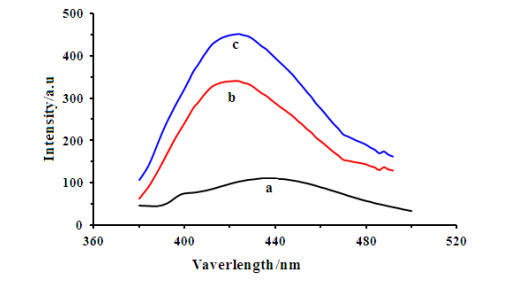
a: phen; b: o-benzoylbenzoic acid; c: the title complex
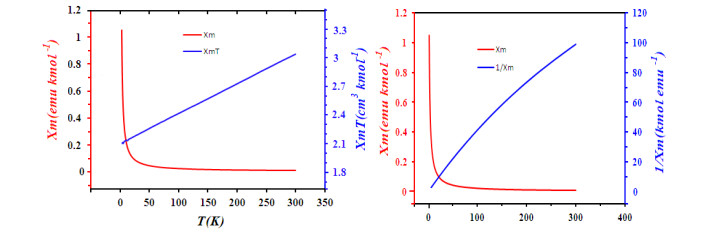
The temperature dependence of the magnetic susceptibility of 1 was investigated from 300 to 2 K with an applied magnetic field of 2 kOe. The Xm T vs. T and Xm vs. T curves are in Fig. 4. The maximum experimental value of Xm T is 3.03362 at 300 K, then the Xm T of 1 decreases with reducing the temperature, which indicates antiferromagnetic interaction in the complex[14]. When the temperature reaches 2 K, the Xm T value is 2.098. The linear regression equation is 1/Xm = 0.3411T + 3.3263 with a correlation coefficient of 0.9961. According to the Curie-Weiss law, from Xm = C/(T−θ), the Weiss constant θ can be obtained, C = 3.914 and θ = −87.088 K. These magnetic behaviors show that the title complex exhibits antiferromagnetism. In this work, the magnetic behavior is attributed to the interaction between manganese ions and free ligands[15].
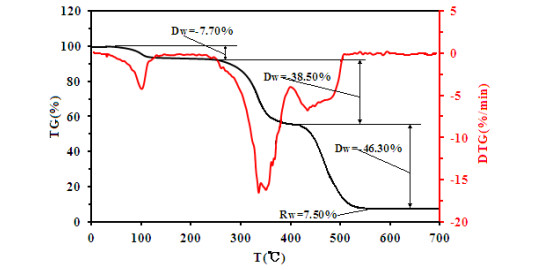
The thermogravimetric analysis (Fig. 5) of 1 demonstrates that the weight loss in air from room temperature to 973 K occurs mainly in 3 stages. The first one takes place from 373 to 383 K with the weight loss of 7.70%, corresponding to the release of free and coordinated water molecules (calcd.: 7.69%). At the same time, one thermal absorption peak of DTG appears at about 375 K, indicating the decomposition of free water molecules[16]. The second stage is found from 383 to 673 K with the weight loss of 38.50%, resulting from the departure of two phen molecules (calcd.: 38.43%). The second DTG thermal absorption peak is observed at about 609 K which is the melting point of the complex. During stage 3, the weight loss of 46.30% (theoretical value: 46.32%) presents at 673~833 K due to the loss of 28 carbon, 18 hydrogen and 5 oxygen atoms from two o-benzoylbenzoic acid molecule anions. The final product is manganese oxide, with the final residual rate to be 7.50% (calcd.: 7.56%).
(a) Khullar, S.; Mandal, S. K. Supramolecular assemblies of dimanganese subunits and water clusters organized by strong hydrogen bonding interactions: single crystal to single crystal transformation by thermal de-rehydration processes. Cryst. Growth Des. 2012, 12, 5329–5337. (b) Luo, M.; Frechette, J. Electrochemical stability of low-density carboxylic acid terminated monolayers. J. Phys. Chem. C 2010, 114, 20167–20172. (c) Mundle, S. O. C.; Kluger, R. Decarboxylation via addition of water to a carboxyl group: acid catalysis of pyrrole-2-carboxylic acid. J. Am. Chem. Soc. 2009, 131, 11674–11675. (d) He, H. Y.; Yuan, D. Q.; Ma, H. Q.; Sun, D. F.; Zhang, G. Q.; Zhou, H. C. Control over interpenetration in lanthanide-organic frameworks: synthetic strategy and gas-adsorption properties. Inorg. Chem. 2010, 49, 7605–7607.
(a) Alexandru, M. G.; Visinescu, D.; Shova, S.; Marius, A.; Francesc, L.; Miguel, J. Synthesis, crystal structures, and magnetic properties of two novel cyanido-bridged heterotrimetallic {(CuMnCrIII)-Mn-II-Cr-II} complexes. Inorg. Chem. 2017, 56, 2258–2269. (b) Li, Y.; Wen, B. S.; Zou, X. Z.; Huang, B.; Qiu, W. D.; Zhang, Z. M.; You, A.; Cheng, X. L. Syntheses, crystal structures, and magnetic properties of 0D tetranuclear nickel(II) coordination compound and 1D manganese(II) coordination polymer constructed from biphenyl tricarboxylic acid. Chin. J. Inorg. Chem. 2018, 34, 981–988. (c) Crowston, B. J.; Shipp, J. D.; Chekulaev, D.; Heteronuclear d-d and d-f Ru(II)/M complexes (M = Gd(III), Yb(III), Nd(III), Zn(II) or Mn(II)) of ligands combining phenanthroline and aminocarboxylate binding sites: combined relaxivity, cell imaging and photophysical studies. Dalton Trans. 2019, 48, 6132–6152. (d) Alexandru, M. G.; Visinescu, D.; Braun-Cula, B.; Lloret, F.; Julve, M. Synthesis, crystal structure and magnetic properties of three {(CrMn(II)-Mn(III} heterodimetallic complexes based on heteroleptic cyanido-bearing Cr(III) building blocks. Eur. J. Inorg. Chem. 2018, 3–4, 349–359. (e) Barmpa, A.; Frousiou, O.; Kalogiannis, S.; Perdih, F.; Turel, I.; Psomas, G. Manganese(II) complexes of the quinolone family member flumequine: structure, antimicrobial activity and affinity for albumins and calf-thymus DNA. Polyhedron 2018, 145, 166–175.
(a) Zhang, J. P.; Zhang, Y. B.; Lin, J. B.; Chen, X. M. Metal azolate frameworks: from crystal engineering to functional materials. Chem. Rev. 2012, 112, 1001–1033. (b) Guo, J.; Sun, D.; Zhang, L. L.; Yang, Q.; Zhao, X. L.; Sun, D. F. Cadmium-organic coordination polymers based on N-donor ligands and small anions: syntheses, crystal structures, and photoluminescent properties. Cryst. Growth Des. 2012, 12, 5649–5654. (c) Zeng, M. H.; Tan, Y. X.; He, Y. P.; Yin, Z.; Chen, Q.; Kurmoo, M. A. Porous 4-fold-interpenetrated chiral framework exhibiting vapochromism, single-crystal-to-single-crystal solvent exchange, gas sorption, and a poisoning effect. Inorg. Chem. 2013, 52, 2353–2360. (d) Fei, H. L.; Bresler, M. R.; Oliver, S. R. J. A new paradigm for anion trapping in high capacity and selectivity: crystal-to-crystal transformation of cationic materials. J. Am. Chem. Soc. 2011, 133, 11110–11113.
(a) Guan, L.; Zhou, Y. H.; Zhang, H. Syntheses and crystal structures of two 1D chain coordination polymers based on 2-benzoylbenzoic acid. Chin. J. Struct. Chem. 2010, 29, 690–695. (b) Caglar, S.; Demir, S. K. A crystallographic, spectroscopic, thermal, and DFT investigation of mixed ligand Cu(II) complexes of 2-benzoylbenzoate. Synth. React. Inorg. Met. Org. Chem. 2012, 42, 1449–1458.
(a) Zu, W. X. Inorganic compounds synthesis of the manual. Chemistry Industry Press. 1rd. 2006, 325–326. (b) Li, C. H.; Li, W.; Hu, B. N.; Hu, H. X. Synthesis, crystal structure, thermal stability properties of a new binuclear Cu(II) complex with 2-benzoylbenzoic acid as ligand. Chin. J. Struct. Chem. 2013, 32, 1264–1268. (c) Guan, L.; Zhou, Y. H.; Zhang, H. Syntheses and crystal structures of two 1D chain coordination polymers based on 2-benzoylbenzoic acid. Chin. J. Struct. Chem. 2010, 29, 693–695.
(a) Alexandru, M. G.; Visinescu, D.; Shova, S.; Marius, A.; Francesc, L.; Miguel, J. Synthesis, crystal structures, and magnetic properties of two novel cyanido-bridged heterotrimetallic {(CuMnCrIII)-Mn-II-Cr-II} complexes. Inorg. Chem. 2017, 56, 2258–2269. (b) Li, Y.; Wen, B. S.; Zou, X. Z.; Huang, B.; Qiu, W. D.; Zhang, Z. M.; You, A.; Cheng, X. L. Syntheses, crystal structures, and magnetic properties of 0D tetranuclear nickel(II) coordination compound and 1D manganese(II) coordination polymer constructed from biphenyl tricarboxylic acid. Chin. J. Inorg. Chem. 2018, 34, 981–988. (c) Crowston, B. J.; Shipp, J. D.; Chekulaev, D.; Heteronuclear d-d and d-f Ru(II)/M complexes (M = Gd(III), Yb(III), Nd(III), Zn(II) or Mn(II)) of ligands combining phenanthroline and aminocarboxylate binding sites: combined relaxivity, cell imaging and photophysical studies. Dalton Trans. 2019, 48, 6132–6152. (d) Alexandru, M. G.; Visinescu, D.; Braun-Cula, B.; Lloret, F.; Julve, M. Synthesis, crystal structure and magnetic properties of three {(CrMn(II)-Mn(III} heterodimetallic complexes based on heteroleptic cyanido-bearing Cr(III) building blocks. Eur. J. Inorg. Chem. 2018, 3–4, 349–359. (e) Barmpa, A; Frousiou, O.; Kalogiannis, S.; Perdih, F.; Turel, I.; Psomas, G. Manganese(II) complexes of the quinolone family member flumequine: structure, antimicrobial activity and affinity for albumins and calf-thymus DNA. Polyhedron 2018, 145, 166–175.
(a) Li, S. F.; Shen, Y. M.; Liu, D. B.; Fan, L. B.; Zhao, Y. P. Novel nanomaterials of 2-benzoylbenzoic acid anions intercalated magnesium aluminum layered double hydroxides for UV absorption properties. Sci. Adv. Mater. 2015, 7, 756–761. (b) Zhang, W. L.; Zhu, D. S. Novel diorganotin(IV) carboxylates based on 2-benzoylbenzoic acid: synthesis, characterization, molecular structures and luminescent activities. Mol. Cryst. Liq. Cryst. 2019, 1, 1–12. (c) Yang, Y. Q.; Li, Y. L. Synthesis, fluorescence and magnetic properties of a new europium(III) complex Eu(C14H9O3)2(C12H8N2)2NO3. Chin. J. Struct. Chem. 2018, 37, 1781–1785. (d) Li, W.; Li, C. H.; Yang, Y. Q.; Li, H. F. Crystal structure, electrochemical, fluorescent and magnetic properties of a new complex [Ag(2, 2΄-bipy)(C14H9O3)]·(C14H10O3). Chin. J. Struct. Chem. 2014, 33, 1593–1596.
Sheldrick, G. M. SHELXL-2014, Program for Crystal Structure Refinement. University of Gottingen, Gottingen, Germany 2014.
(a) Li, C. H.; Li, W.; Yang, Y. Q.; Liu, C. X. Synthesis, crystal structure and thermal stability of complex {Mn(phen)2(H2O)[C8H11O2(COO)]}·(ClO4)·H2O. Chin. J. Inorg. Chem. 2007, 23, 1671–1674. (b) Li, W.; Li, C. H.; Li, W.; Yang, Y. Q.; Kuang, Y. F. Hydrothermal synthesis, crystal structure and electrochemical properties of complex Mn2(phen)2(p-CBA)4(H2O). Chin. J. Struct. Chem. 2007, 26, 1057–1060. (c) Li, C. H.; Li, W.; Tan, X. W.; Li, Y. L. Hydrothermal synthesis, structure and thermal stability of binuclear manganese complex with o-acetamidobenzoic acid and 1, 10-phenanthroline. Chin. J. Inorg. Chem. 2010, 26, 1129–1132.
Hu, S. Z.; Zhou, Z. H.; Tsai, K. R. Average vander waals radii of atoms in crystals. Acta. Phys. -Chim. Sin. 2003, 19, 1073–1077.
Ning, Y. C. Structure Identification of Organic Compounds and Organic Spectroscopy. 2rd. Beijing, Science Press 2006, 332.
Chen, X. M.; Cai, J. W. Principle and Practice of Single Crystal Structural Analysis. 1st Ed. Beijing, Science press 2004.
Nakamota, K. Translated by Huang, D. R.; Wang, R. Q. Infrared and Raman Spectra of Inorganic and Coordination Compounds, 3rd edn. Beijing: Chemical Industry Press 1986.
(a) Liu, Y. Z.; Gao, H. Y.; Yi, X. G.; Li, D. P.; Li, Y. X. Crystal structures and DNA binding properties of 2-naphthoxyacetic acid Cu(II) complexes. Chin. J. Struct. Chem. 2019, 38, 1362–16369. (b) Fu, J. D.; Guo, J. K.; Wen, Y. H. Hydrothermal syntheses, crystal structures and luminescent properties of binuclear Mn(II) and Co(II) complexes assembled by 4-carboxymethoxy phenylacetic acid. Chin. J. Inorg. Chem. 2011, 27, 996–1000.
Wang, L. Y.; Liu, Z. L.; Zhang, C. X.; Liu, Z. Q.; Liao, D. Z.; Jiang, Z. H.; Yan, S. P. Syntheses, crystal and magnetic properties of free radical-Mn(II) chain complexes. Sci. in China B 2003, 33, 332–339.
(a) Gou, J. S.; Song, L. M.; Liu, H.; Shen, D. D.; Hu, W. X.; Wang, W. L.; Ren, X. Y.; Chang, J. M. Release profile of nitrogen during thermal treatment of waste wood packaging materials. J. Bioresour. Bioprod. 2019, 4, 51–59. (b) Tang, Q. H.; Fang, L.; Guo, W. J. Effects of bamboo fiber length and loading on mechanical, thermal and pulverization properties of phenolic foam composites. J. Bioresour. Bioprod. 2019, 4, 166–176. (c) Yang, R.; Zhou, X.; Luo, C. Q.; Wang, K. H. Modern Polymeric Testing Technology. 3rd edn. Beijing: Tsinghua University Press 2016, 167.

Figure 3 Luminescence property curves of the title complex and ligands
a: phen; b: o-benzoylbenzoic acid; c: the title complex

Figure 4 Temperature dependence of the magnetic susceptibility of the title complex in the form of (a) XmT vs. T, Xm vs. T; (b) 1/Xm vs. T, Xm vs. T
Table 1. Selected Bond Lengths (Å) and Bond Angles (°)
| Bond | Dist. | Bond | Dist. | Bond | Dist. | ||
| Mn(1)–O(1) | 2.143(1) | Mn(1)–O(5) | 2.143(1) | Mn(1)–N(1) | 2.239(2) | ||
| Mn(1)–N(2) | 2.361(2) | Mn(1)–N(3) | 2.344(2) | Mn(1)–N(4) | 2.244(2) | ||
| O(1)–C(25) | 1.270(2) | O(2)–C(25) | 1.243(2) | O(4)–C(39) | 1.245(2) | ||
| O(5)–C(39) | 1.264(2) | ||||||
| Angle | (°) | Angle | (°) | Angle | (°) | ||
| O(1)–Mn(1)–N(1) | 97.07(6) | O(1)–Mn(1)–N(2) | 82.18(6) | O(1)–Mn(1)–N(3) | 160.81(6) | ||
| O(1)–Mn(1)–N(4) | 93.48(6) | O(5)–Mn(1)–O(1) | 114.66(6) | O(5)–Mn(1)–N(1) | 91.54(6) | ||
| O(5)–Mn(1)–N(2) | 158.35(6) | O(5)–Mn(1)–N(3) | 81.59(6) | O(5)–Mn(1)–N(4) | 102.08(5) | ||
| N(1)–Mn(1)–N(2) | 72.14(6) | N(1)–Mn(1)–N(3) | 92.38(6) | N(1)–Mn(1)–N(4) | 157.45(7) | ||
| N(2)–Mn(1)–(3) | 84.91(6) | N(2)–Mn(1)–N(4) | 89.73(6) | N(3)–Mn(1)–N(4) | 72.27(6) |
 下载: 导出CSV
Table 2. Hydrogen Bond Lengths (Å) and Bond Angles (°)
| D–H⋅⋅⋅A | d(D–H) | d(H⋅⋅⋅A) | d(D⋅⋅⋅A) | ∠DHA |
| O(8)–(8B)⋅⋅⋅O(2) | 0.81 | 2.07 | 2.841(2) | 159 |
| O(9)–H(9A)⋅⋅⋅O(3)a | 0.85 | 2.17 | 3.004(2) | 165 |
| O(7)–H(7A)⋅⋅⋅O(9) | 0.85 | 2.09 | 2.893(2) | 158 |
| O(7)–H(7B)⋅⋅⋅O(4) | 0.85 | 1.97 | 2.760(2) | 155 |
| O(10)–H(10A)⋅⋅⋅O(2) | 0.73 | 2.07 | 2.798(2) | 177 |
| O(10)–H(10B)⋅⋅⋅O(7)b | 0.85 | 2.06 | 2.892(3) | 165 |
| Symmetry codes: (a): 3/2–x, –1/2+y, 1/2–z; (b): –1/2+x, 1/2–y, –1/2+z | ||||
下载: 导出CSV

 扫一扫看文章


扫一扫关注我们


 下载:
下载: