High-capacity Li-rich Mn-based Cathodes for Lithium-ion Batteries

Zu-Wei YIN Jun-Tao LI Ling HUANG Feng PAN Shi-Gang SUN

Citation:  Zu-Wei YIN, Jun-Tao LI, Ling HUANG, Feng PAN, Shi-Gang SUN. High-capacity Li-rich Mn-based Cathodes for Lithium-ion Batteries[J]. Chinese Journal of Structural Chemistry, 2020, 39(1): 20-25. doi: 10.14102/j.cnki.0254-5861.2011-2718 shu

High-capacity Li-rich Mn-based Cathodes for Lithium-ion Batteries

English

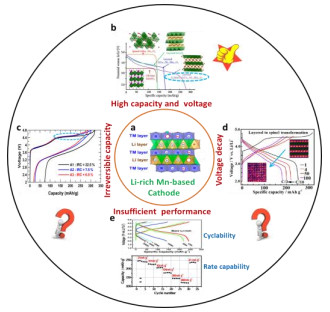
  • Recently, the low available specific capacity of traditional cathode materials such as LiCoO2, LiMn2O4, and LiFePO4 is becoming a bottleneck to the increase of energy densities of the lithium-ion batteries (LIBs) for electric vehicles and electricity grid. Layered Li-rich Mn-based oxide cathode (LMC) materials, a solid solution of Li2MnO3 and LiMO2 (M = Ni, Mn, Co), are considered as potential candidate cathodes for the next-generation LIBs due to its high specific capacity (> 250 mAh g-1), high average discharge voltage (> 3.5 V) and low cost[1, 2] (Fig. 1a and 1b). Nevertheless, commercial applications of Li-rich Mn-based cathode materials are challenged by three main drawbacks. First, a large irreversible capacity loss happens in the first charge-discharge process[3] (Fig. 1c). Second, significant voltage decay occurs during cycling[4] (Fig. 1d). Third, their cyclability and rate capability are not sufficient[5, 6] (Fig. 1e).

    Figure 1

    Figure 1.  (a) Structure units of Li-rich Mn-based cathodes (LMC); From ref. [1], copyright of ACS; (b) Capacity and operation voltage comparisons of the present common cathodes for LIBs; From ref. [2], copyright of ACS; (c) Charge-discharge curves showing the irreversible first-cycle charge-discharge process of LMC; From ref. [3], copyright of nature; (d) Charge-discharge curves at different cycle number showing the voltage decay of LMC; From ref. [4], copyright of ACS; (e) The poor cyclability and rate capability of bare LMC; From ref. [5, 6], copyright of Wiley

    To solve such problems, many researches have been done, including the mechanism study and attempt to improve the electrochemical performance. This article comprehensively presents the challenge and recent progress of high-capacity Li-rich Mn-based cathodes from a fundamental perspective and will also provide suggestions for future research of high-energy cathodes.

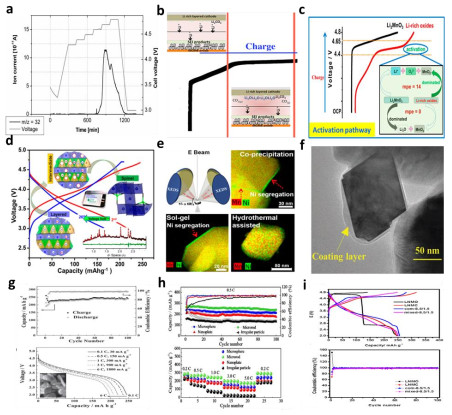
    Li2MnO3 activation is the key and most attractive reaction of Li-rich oxides in the first charge-discharge process, which is the origin of its extra-high capacity[30]. Many studies have been done to understand the activation process of Li2MnO3. Bruce's group firstly observed the O2 release during the first charge process, and proposed an O loss accompanied with Li+ extraction mechanism for Li2MnO3 activation[31] (Fig. 2a). Then they re-determined that the O2 release is from the electrolyte decomposition at high voltage after ten years[30]. Formation of localized electron holes on O atoms (O22-) was experimentally observed instead at the Li2MnO3 activation region, and ex-situ resonant inelastic X-ray scattering (RIXS) was used as detect tool; The O22- localized electron holes can reversibly redox during the charge-discharge process[30], and such a behavior was called as "oxygen redox". The reversible oxygen redox phenomenon was supported by Ceder's group using the first-principle calculations[7]. Afterwards, Chueh's group adopted ex-situ scanning transmission X-ray microscope (STXM) and obtained a coupling phenomenon between oxygen redox and transition metal cation migration[8]. However, the limitation of these results is that they are achieved using ex-situ methods[3, 8] or calculations[7]. While in-situ Raman was applied for Li2MnO3 activation study, entirely different Li2O evolution[9] (Fig. 2b) and O2-/O- redox observation were acquired[10]. Besides, Raman and RIXS (100 nm) can only obtain the surface information of Li-rich materials. To get the real-time bulk information during charge-discharge process, Sun's Group adopted in-situ X-ray diffraction (XRD) and electrochemical quartz crystal microbalance (EQCM) to investigate the first-cycle behavior of Li-rich oxides, which can get the bulk structure evolution and mass change[11, 12]. β-MnO2 product and phase transformation of β-MnO2 to layered Li0.9MnO2 were observed using in-situ XRD[11]. In-situ EQCM results demonstrate that both Li2O evolution and oxygen redox exist in bare Li2MnO3 and LMC materials, while Li2O evolution is dominated in bare Li2MnO3 and oxygen redox in LMC cathode[12] (Fig. 2c). This explains why the Li-rich material (0.5Li2MnO3·0.5LiNi0.3Co0.3Mn0.4O2) has a higher capacity than the mean value of Li2MnO3 and LiNi0.3Co0.3Mn0.4O2. However, the real species of Li2O and O22- were not observed using other direct tools. From above, there is still controversy about the first charge-discharge process of LMC cathodes. One possible reason for the inconsistency of different groups' work is the composition difference of LMC cathodes they used. And in-situ methods development, which can get both the surface and bulk information, is vital to unravel the internal first charge-discharge mechanism. This is further benefit to reduce the irreversible capacity in the first cycle.

    Figure 2

    Figure 2.  (a) Operando mass spectrometry showing the first-cycle oxygen release at high voltage; From ref. [31], copyright of Nature; (b) Scheme of the Li2O evolution during the first cycle; From ref. [9], copyright of ACS; (c) Scheme of different activation ways of bare Li2MnO3 (Li2O evolution domination) and Li2MnO3 component in LMC (oxygen redox domination); From ref. [12], copyright of ACS; (d) Scheme of the voltage decay mechanism showing metal cations migration for layered-to-spinel conversion; From ref. [1], copyright of ACS; (e) EDS mapping showing the different Mn/Ni distribution in Li-rich particles obtained by different synthesis methods; From ref. [16], copyright of ACS; (f) TEM image showing the guar gum (GG) binder coated on LMC particle; From ref. [19], copyright of RSC; copyright of ACS; (g) Cyclability and rate performance of crystal habit-tuned LMC nanoplates; SEM image of the LMC nanoplates is insert; From ref. [21], copyright of Wiley; (h) Structure-dependent cyclability and rate capability of LMC cathodes; From ref. [22], copyright of Elsevier; (i) Initial charge-discharge profiles and Coulombic efficiencies of Li-rich, spinel, Li-rich layered/spinel composite and physical mixture of Li-rich and spinel; From ref. [25], copyright of ACS

    The Li-rich cathodes suffer voltage decay during cycling, which means average discharge voltage decreases with the cycling number. The voltage decay mechanism was always attributed to layered-to-spinel phase transformation and migration of Mn and Li between transition metal layer and lithium layer[1, 4] (Fig. 2d), which are obtained using ex-situ transmission electron microscope (TEM) and neutron powder diffraction. Some more detailed work revealed that the layered-to-spinel phase transformation prefers to take place in lattice defect[13]; In-situ XRD and Mass spectroscopy (MS) results demonstrated that a low Co/Ni ratio LMC released no lattice oxygen at the first cycle, which leads to a milder voltage decay behavior[14]. Based on this mechanism, it is reasonable that doping and structure modulation can remit voltage decay, e.g. Al3+ doping[15] and metal ions distribution regulation[16] (Fig. 2e). The conventional oxides coatings, such as Al2O3, LiAlOx, ZrO2 and so on have been proved that they have little-to-zero effect on voltage decay mitigation[17]. Some functional coatings (e.g. LiFePO4[18]) partly suppress voltage decay, but the reason was ascribed to bulk metal ion doping of core Li-rich materials caused by surface modification. But when organic guar gum (GG), which only includes C, H, O elements and lack of metal ions, was applied as the binder of LMC cathode electrode, a coating layer on LMC particles was observed after cycling[19]. Such a coating layer is composed of GG and solid electrolyte interphase (SEI), leading to an abnormal voltage fade remission[19]. To the best of our knowledge, there are no reports that electrolyte decomposition produced SEI can induce bulk doping of particles[26, 27]. And it is infeasible that an organic GG binder can induce bulk doping. The extraordinary voltage decay mitigation by GG binder indicates an in-depth mechanism existing. But Sun's work doesn't reveal the specific role of water-soluble GG binder[19]. Further studies still need to be done to reveal the root origin of voltage decay, especially using in-situ methods, and strategies to eliminate voltage decay of LMC cathodes are urgent to develop.

    Li-rich cathode materials suffer capacity fade during cycling, and its rate capability is still not enough for commercial applications due to its structure instability, side reactions with electrolyte and low Li+ conductivity[20]. To improve the cyclability and rate capability of Li-rich materials, the most common methods were doping, surface modification, structure regulation and composition adjustment[20-25]. Doping and surface modifications always need to introduce inert metal ions or coatings, such as Mg2+, Ti3+, ZrO2, etc.[20, 28], which results in capacity decrease of Li-rich materials. In comparison, structure regulation and composition adjustment only simply require synthesis condition and raw materials ratio controlling, such as tuning the thermodynamic and kinetic conditions[29], optimizing the particle shape, particle size, crystal orientation, morphology and layered/spinel ratio, and so forth[21-25]. And such simple structure regulation and composition adjustment methods can improve the cyclability, rate capability, and initial Coulomb efficiency while keeping capacity[21-25].

    For example, Sun's group prepared crystal habittuned nanoplates with increased (010) nanoplate, which exhibit excellent cyclability and rate performance[21] (Fig. 2g); High rate-capability Li-rich cathodes with hierarchical micro/nanostructure were synthesized by solvothermal and coprecipitation methods[22]; The relationship between the morphologies and electrochemical properties were also revealed[23] (Fig. 2h). Layered/spinel composite materials with spinel Li4Mn5O12 and LiNi0.5Mn1.5O4 composition were obtained using one-step solvothermal and Pechini methods, respectively[24, 25]; The cyclability, rate capability and first-cycle Coulomb efficiency were improved in the same time, while the capacity was well kept, compared to the bare layered Li-rich cathodes[24, 25]. A comparison of bare Li-rich, spinel, Li-rich layered/spinel, physical mixture of Li-rich and spinel indicate the positive role of integrated spinel in electrochemical performance improvement (Fig. 2i).

    In summary, three main drawbacks hindering the commercial applications of Li-rich Mn-based cathode materials for LIBs were briefly reviewed. Based on the existing experimental and theoretical results, some solid conclusions and perspectives are as follows: 1) Developing in-situ research techniques, which can obtain both surface and bulk information, is vital to clarify the unclear first charge-discharge process and voltage fade mechanism, especially the origin of extra-high capacity of LMC cathodes and the function of organic coating layer on voltage decay mitigation; 2) The different compositions of Li-rich materials used in different groups' research may be part of the reason why different results were obtained, even using the same characterization method; It is urgent to build a quantitative composition-mechanism-performance relationship of Li-rich cathodes, which can guide the future research and applications; 3) Structure regulation and composition adjustment can provide a simple and valid way to achieve efficient cyclability, rate capability and the first-cycle Coulombic efficiency; Unclear first charge-discharge process and voltage decay are the present key issues hindering the applications of LMC cathodes; Overall, we believe Li-rich Mn-based cathodes will play a vital role in next-generation LIBs due to its unique advantages of high capacity, high operation voltage and low cost. And further studies need to be focused on the charge-discharge mechanism and elimination of voltage fade during cycling.


    1. [1]

      Mohanty, D.; Li, J.; Abraham, D. P.; Huq, A.; Payzant, E. A.; Wood III, D. L.; Daniel, C. Unraveling the voltage-fade mechanism in high-energy-density lithium-ion batteries: origin of the tetrahedral cations for spinel conversion. Chem. Mater. 2014, 26, 6272–6280. doi: 10.1021/cm5031415

    2. [2]

      Liu, C.; Neale, Z. G.; Cao, G. Understanding electrochemical potentials of cathode materials in rechargeable batteries. Mater. Today 2016, 19, 109–123. doi: 10.1016/j.mattod.2015.10.009

    3. [3]

      Shunmugasundaram, R.; Senthil Arumugam, R.; Dahn, J. R. High capacity Li-rich positive electrode materials with reduced first-cycle irreversible capacity loss. Chem. Mater. 2015, 27, 757–767. doi: 10.1021/cm504583y

    4. [4]

      Gu, M.; Belharouak, I.; Zheng, J.; Wu, H.; Xiao, J.; Genc, A.; Amine, A.; Thevuthasan, S.; Baer, D.; Zhang, J.; Browning, N. D.; Liu, J.; Wang, C. (2012). Formation of the spinel phase in the layered composite cathode used in Li-ion batteries. ACS Nano 2013, 7, 760–767. doi: 10.1021/nn305065u

    5. [5]

      Liu, W.; Oh, P.; Liu, X.; Myeong, S.; Cho, W., Cho, J. Countering voltage decay and capacity fading of lithium-rich cathode material at 60 ℃ by hybrid surface protection layers. Adv. Energy Mater. 2015, 5, 1500274. doi: 10.1002/aenm.201500274

    6. [6]

      Yu, X.; Lyu, Y.; Gu, L.; Wu, H.; Bak, S. M.; Zhou, Y.; Amine, K.; Ehrlich, S.; Li, H.; Nam, K.; Yang, X. Q. Understanding the rate capability of high-energy-density Li-rich layered Li1.2Ni0.15Co0.1Mn0.55O2 cathode materials. Adv. Energy Mater. 2014, 4, 1300950. doi: 10.1002/aenm.201300950

    7. [7]

      Seo, D. H.; Lee, J.; Urban, A.; Malik, R.; Kang, S.; Ceder, G. The structural and chemical origin of the oxygen redox activity in layered and cation-disordered Li-excess cathode materials. Nat. Chem. 2016, 8, 692–697. doi: 10.1038/nchem.2524

    8. [8]

      Gent, W. E.; Lim, K.; Liang, Y.; Li, Q.; Barnes, T.; Ahn, S. J.; Chueh, W. Coupling between oxygen redox and cation migration explains unusual electrochemistry in lithium-rich layered oxides. Nat. Commun. 2017, 8, 2091. doi: 10.1038/s41467-017-02041-x

    9. [9]

      Hy, S.; Felix, F.; Rick, J.; Su, W. N.; Hwang, B. J. Direct in situ observation of Li2O evolution on Li-rich high-capacity cathode material, Li[NixLi(1-2x)/3Mn(2-x)/3]O2 (0≤x≤0.5). J. Am. Chem. Soc. 2014, 136, 999–1007. doi: 10.1021/ja410137s

    10. [10]

      Li, X.; Qiao, Y.; Guo, S.; Xu, Z.; Zhu, H.; Zhang, X.; Yuan, Y.; He, P.; Ishida, M.; Zhou, H. Direct visualization of the reversible O2−/O redox process in Li-rich cathode materials. Adv. Mater. 2018, 30, 1705197. doi: 10.1002/adma.201705197

    11. [11]

      Shen, C. H.; Wang, Q.; Fu, F.; Huang, L.; Lin, Z.; Shen, S. Y.; Su, H.; Zheng, X.; Xu, B.; Li, J. T.; Sun, S. G. Facile synthesis of the Li-rich layered oxide Li1.23Ni0.09Co0.12Mn0.56O2 with superior lithium storage performance and new insights into structural transformation of the layered oxide material during charge–discharge cycle: in situ XRD characterization. ACS Appl. Mater. Inter. 2014, 6, 5516–5524. doi: 10.1021/am405844b

    12. [12]

      Yin, Z. W.; Peng, X. X.; Li, J. T.; Shen, C. H.; Deng, Y. P.; Wu, Z. G.; Zhang, T.; Zhang, Q.; Mo, Y.; Wang, K.; Huang, L.; Zheng, H.; Sun, S. G. Revealing of the activation pathway and cathode electrolyte interphase evolution of Li-Rich 0.5Li2MnO3·0.5LiNi0.3Co0.3Mn0.4O2 cathode by in situ electrochemical quartz crystal microbalance. ACS Appl. Mater. Inter. 2019, 11, 16214–16222. doi: 10.1021/acsami.9b02236

    13. [13]

      Shen, C. H.; Shen, S. Y.; Fu, F.; Shi, C. G.; Zhang, H. Y.; Pierre, M. J.; Su, H.; Wang, Q.; Xu, B.; Huang, L.; Li, J. T.; Sun. S. G. New insight into structural transformation in Li-rich layered oxide during the initial charging. J. Mater. Chem. A 2015, 3, 12220–12229. doi: 10.1039/C5TA01849H

    14. [14]

      Shen, S.; Hong, Y.; Zhu, F.; Cao, Z.; Li, Y.; Ke, F.; Fan, J.; Zhou, L.; Wu, L.; Dai, P.; Cai, M.; Huang, L.; Zhou, Z.; Li, J.; Wu, Q.; Sun. S. G. Tuning electrochemical properties of Li-rich layered oxide cathodes by adjusting Co/Ni ratios and mechanism investigation using in situ X-ray diffraction and online continuous flow differential electrochemical mass spectrometry. ACS Appl. Mater. Inter. 2018, 10, 12666–12677. doi: 10.1021/acsami.8b00919

    15. [15]

      Nayak, P. K.; Grinblat, J.; Levi, M.; Levi, E.; Kim, S.; Choi, J. W.; Aurbach, D. Al doping for mitigating the capacity fading and voltage decay of layered Li and Mn-rich cathodes for Li-Ion batteries. Adv. Energy Mater. 2016, 6, 1502398. doi: 10.1002/aenm.201502398

    16. [16]

      Zheng, J.; Gu, M.; Genc, A.; Xiao, J.; Xu, P.; Chen, X.; Zhu, Z.; Zhao, W.; Pullan, L.; Wang, C.; Zhang, J. G. Mitigating voltage fade in cathode materials by improving the atomic level uniformity of elemental distribution. Nano Lett. 2014, 14, 2628–2635 doi: 10.1021/nl500486y

    17. [17]

      Bloom, I.; Trahey, L.; Abouimrane, A.; Belharouak, I.; Zhang, X.; Wu, Q.; Lu, W.; Abraham, D.; Bettge, M.; Elam, J.; Meng, X.; Burrell, A.; Ban, C.; Tenent, R.; Nanda, J.; Dudney, N. Effect of interface modifications on voltage fade in 0.5Li2MnO3·0.5LiNi0.375Mn0.375Co0.25O2 cathode materials. J. Power Sources 2014, 249, 509–514. doi: 10.1016/j.jpowsour.2013.10.035

    18. [18]

      Zheng, F.; Yang, C.; Xiong, X.; Xiong, J.; Hu, R.; Chen, Y.; Liu, M. Nanoscale surface modification of lithium-rich layered-oxide composite cathodes for suppressing voltage fade. Angew. Chem. Int. Edit. 2015, 54, 13058–13062. doi: 10.1002/anie.201506408

    19. [19]

      Zhang, T.; Li, J. T.; Liu, J.; Deng, Y. P.; Wu, Z. G.; Yin, Z. W.; Guo, D.; Huang, L.; Sun, S. G. Suppressing the voltage-fading of layered lithium-rich cathode materials via an aqueous binder for Li-ion batteries. Chem. Commun. 2016, 52, 4683–4686. doi: 10.1039/C5CC10534J

    20. [20]

      Hu, S.; Pillai, A. S.; Liang, G.; Pang, W. K.; Wang, H.; Li, Q.; Guo, Z. Li-rich layered oxides and their practical challenges: recent progress and perspectives. Electrochem. Energy Rev. 2019, 1–35.

    21. [21]

      Wei, G. Z.; Lu, X.; Ke, F. S.; Huang, L.; Li, J. T.; Wang, Z. X.; Zhou, Z. Y.; Sun, S. G. Crystal habit-tuned nanoplate material of Li[Li1/3-2x/3NixMn2/3-x/3]O2 for high-rate performance lithium-ion batteries. Adv. Mater. 2010, 22, 4364–4367. doi: 10.1002/adma.201001578

    22. [22]

      Fu, F.; Deng, Y. P.; Shen, C. H.; Xu, G. L.; Peng, X. X.; Wang, Q.; Xu, Y.; Fang, J.; Huang, L.; Sun, S. G. A hierarchical micro/nanostructured 0.5Li2MnO3·0.5LiMn0.4Ni0.3Co0.3O2 material synthesized by solvothermal route as high rate cathode of lithium ion battery. Electrochem. Commun. 2014, 44, 54–58. doi: 10.1016/j.elecom.2014.04.013

    23. [23]

      Fu, F.; Yao, Y.; Wang, H.; Xu, G. L.; Amine, K.; Sun, S. G.; Shao, M. Structure dependent electrochemical performance of Li-rich layered oxides in lithium-ion batteries. Nano Energy 2017, 35, 370–378. doi: 10.1016/j.nanoen.2017.04.005

    24. [24]

      Deng, Y. P.; Fu, F.; Wu, Z. G.; Yin, Z. W.; Zhang, T.; Li, J. T.; Huang, L.; Sun, S. G.; Layered/spinel heterostructured Li-rich materials synthesized by a one-step solvothermal strategy with enhanced electrochemical performance for Li-ion batteries. J. Mater. Chem. A 2016, 4, 257–263. doi: 10.1039/C5TA06945A

    25. [25]

      Yin, Z. W.; Wu, Z. G.; Deng, Y. P.; Zhang, T.; Su, H.; Fang, J. C.; Xu, B.; Wang, J.; Li, J. T.; Huang, L.; Zhou, X.; Sun, S. G. A synergistic effect in a composite cathode consisting of spinel and layered structures to increase the electrochemical performance for Li-ion batteries. J. Phys. Chem. C 2016, 120, 25647–25656. doi: 10.1021/acs.jpcc.6b07169

    26. [26]

      Huang, W.; Xing, L.; Wang, Y.; Xu, M.; Li, W.; Xie, F.; Xia, S. 4-(Trifluoromethyl)-benzonitrile: a novel electrolyte additive for lithium nickel manganese oxide cathode of high voltage lithium ion battery. J. Power Sources 2014, 267, 560–565. doi: 10.1016/j.jpowsour.2014.05.124

    27. [27]

      Li, J.; Zhang, L.; Yu, L.; Fan, W.; Wang, Z.; Yang, X.; Lin, Y.; Xing, L.; Xu, M.; Li, W. Understanding interfacial properties between Li-rich layered oxide and electrolyte containing triethyl borate. J. Phys. Chem. C 2016, 120, 26899–26907. doi: 10.1021/acs.jpcc.6b09097

    28. [28]

      Kong, D.; Hu, J.; Chen, Z.; Song, K.; Li, C.; Weng, M.; Li, M.; Wang, R.; Liu, T.; Liu, J.; Zhang, M.; Xiao, Y.; Pan, F. Ti-Gradient doping to stabilize layered surface structure for high performance high-Ni oxide cathode of Li-ion battery. Adv. Energy Mater. 2019, 1901756.

    29. [29]

      Zheng, J.; Ye, Y.; Liu, T.; Xiao, Y.; Wang, C.; Wang, F.; Pan, F. Ni/Li disordering in layered transition metal oxide: electrochemical impact, origin, and control. Accounts Chem. Res. 2019, 52, 2201–2209. doi: 10.1021/acs.accounts.9b00033

    30. [30]

      Luo, K.; Roberts, M. R.; Hao, R.; Guerrini, N.; Pickup, D. M.; Liu, Y. S.; Edstrom, K.; Guo, J.; Chadwick, A. V.; Duda, L. C.; Bruce, P. G. Charge-compensation in 3d-transition-metal-oxide intercalation cathodes through the generation of localized electron holes on oxygen. Nat. Chem. 2016, 8, 684–691. doi: 10.1038/nchem.2471

    31. [31]

      Armstrong, A. R.; Holzapfel, M.; Novák, P.; Johnson, C. S.; Kang, S. H.; Thackeray, M. M.; Bruce, P. G. Demonstrating oxygen loss and associated structural reorganization in the lithium battery cathode Li[Ni0.2Li0.2Mn0.6]O2. J. Am. Chem. Soc. 2006, 128, 8694–8698. doi: 10.1021/ja062027+

  • Figure 1  (a) Structure units of Li-rich Mn-based cathodes (LMC); From ref. [1], copyright of ACS; (b) Capacity and operation voltage comparisons of the present common cathodes for LIBs; From ref. [2], copyright of ACS; (c) Charge-discharge curves showing the irreversible first-cycle charge-discharge process of LMC; From ref. [3], copyright of nature; (d) Charge-discharge curves at different cycle number showing the voltage decay of LMC; From ref. [4], copyright of ACS; (e) The poor cyclability and rate capability of bare LMC; From ref. [5, 6], copyright of Wiley

    Figure 2  (a) Operando mass spectrometry showing the first-cycle oxygen release at high voltage; From ref. [31], copyright of Nature; (b) Scheme of the Li2O evolution during the first cycle; From ref. [9], copyright of ACS; (c) Scheme of different activation ways of bare Li2MnO3 (Li2O evolution domination) and Li2MnO3 component in LMC (oxygen redox domination); From ref. [12], copyright of ACS; (d) Scheme of the voltage decay mechanism showing metal cations migration for layered-to-spinel conversion; From ref. [1], copyright of ACS; (e) EDS mapping showing the different Mn/Ni distribution in Li-rich particles obtained by different synthesis methods; From ref. [16], copyright of ACS; (f) TEM image showing the guar gum (GG) binder coated on LMC particle; From ref. [19], copyright of RSC; copyright of ACS; (g) Cyclability and rate performance of crystal habit-tuned LMC nanoplates; SEM image of the LMC nanoplates is insert; From ref. [21], copyright of Wiley; (h) Structure-dependent cyclability and rate capability of LMC cathodes; From ref. [22], copyright of Elsevier; (i) Initial charge-discharge profiles and Coulombic efficiencies of Li-rich, spinel, Li-rich layered/spinel composite and physical mixture of Li-rich and spinel; From ref. [25], copyright of ACS

  • 加载中
计量
  • PDF下载量:  17
  • 文章访问数:  2199
  • HTML全文浏览量:  187
文章相关
  • 发布日期:  2020-01-01
  • 收稿日期:  2019-12-25
  • 接受日期:  2019-12-26
通讯作者: 陈斌, bchen63@163.com
  • 1. 

    沈阳化工大学材料科学与工程学院 沈阳 110142

  1. 本站搜索
  2. 百度学术搜索
  3. 万方数据库搜索
  4. CNKI搜索

/

返回文章