
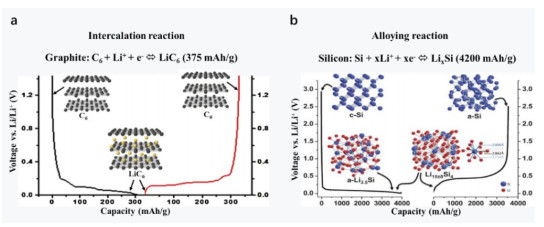
Figure 1.
Schemes of the intercalation chemistry and alloying chemistry. The structural transformations and voltage profiles of intercalation graphite (a) and alloying silicon (b)[15]


Since its appearance on the market in 1991, the lithium-ion battery (LIB) has been the major power source driving the rapid digitalization of our daily life[1-3]. Three scientists, John B. Goodenough, M. Stanley Whittingham and Akira Yoshino, won the 2019 Nobel Prize in chemistry for their outstanding contributions on lithium-ion batteries (LIBs). Established on their studies[5-7], the first generation of LIBs composed of graphite anodes and Li transition-metal oxide cathodes has been well developed over the past 30 years and dominates the current battery markets. However, these first-generation electrodes are all classified as intercalation materials, which can only provide limited space for the intercalation reaction of lithium ions and further limit the energy density below ~300 Wh/kg in practical use[8, 9]. To sustain the energy density demand significantly beyond 300 Wh/kg for electric vehicles[10, 11], the next generation of LIBs call for a paradigm shift from intercalation chemistry to alloying chemistry[12].
Silicon, as an alloying material with lithium, is among the most prominent anode materials for next-generation batteries. With Li ions alloying with silicon atoms, one silicon atom can host up to 4.4 Liions by alloying chemistry compared to each carbon just hosting 1/6 Li ions in graphite anodes by intercalation chemistry (Fig. 1a, 1b)[13-15]. This results in ultra-high theoretical capacity of silicon anode (4200 mAh·g-1), over 10 times higher than that of graphite anode (375 mAh·g-1)[13-17]. However, the increased capacity in alloying chemistry is accompanied with the substantial volumetric change. With > 300% volume expansion during lithiation, silicon anode experiences cracks and even pulveriza-tion during cycling, leading to repeated SEI formation and loss of electronic contact with both conductive materials and current collectors[17, 18]. Over the past decade, there have been significant efforts on Si material design to improve its cyclability.
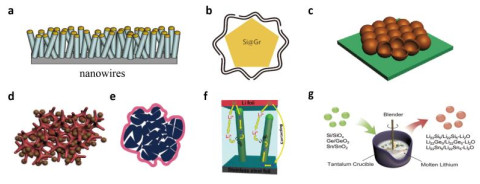
Currently, three classes of solutions focusing on the structural designs have been explored to address the cyclability issue of silicon anode: 1. Designs of nanostructured silicon anodes; 2. Development of advanced binders for silicon anodes; 3. Prelithiation of silicon anode to compensate the initial lithium loss. Our group alone has had 12 generations of nanostructure designs of silicon anodes[13, 19, 20]. Starting from shrinking silicon to nano-scale, pulverization of Si is avoided to be benefited from particle size below critical fracture size (Fig. 2a)[16, 21]. Then, nano-scale Si is encapsulated by a series of mechanical strong layers to stabilize the Si interface and reduce SEI repeating formation (Fig. 2b), moving from insulated SiO2[22] to conductive amorphous carbon[23], and graphene cage[24]. Meanwhile, internal void space is designed into the Si nanostructure to accommodate the volume change and further avoid SEI breaking at the interface (Fig. 2c)[25, 26]. Besides the nanostructure design, advanced binders are also developed to strongly bind Si particles together rather than relying on the weak van der Waals forces provided by the conventional poly-(vinylidene fluoride) binder (Fig. 2d, 2e), including conducting hydrogel framework[27] and self-healing coating[28]. Prelithiation, aimed at compensating the lithium loss in the first cycle caused by SEI formation, is important for the development of Si anodes (Fig. 2f, 2g). Two prelithiation approaches of electrochemical shorting[29, 30] and LixX prelithiation reagents[31, 32] are developed and successfully improve the 1st cycle CE from conventional 70~80% to 100%.
In summary, to overcome the energy density limit of intercalation chemistries, silicon anodes, with ultra-high theoretical capacity benefited from alloying mechanism, show outstanding potential to impel LIBs from intercalation to alloying chemistry. Though silicon anodes suffer from poor cyclability due to drastic volume expansion, tremendous efforts have been devoted to the issue and three classes of structure designs have been explored to com-prehensively improve the cyclability from different aspects. With cycle performance improvement to hundreds or even a thousand stable cycles, silicon opens up a bright future of next-generation high-energy density batteries and more future efforts are expected in low-cost and environmentally friendly large-scale production.
Armand, M.; Tarascon, J. M. Building better batteries. Nature 2008, 451, 652. doi: 10.1038/451652a
Evarts, E. E. To the limits of lithium. Nature 2015, 526, S93. doi: 10.1038/526S93a
Xu, K. Electrolytes and interphasial chemistry in Li ion devices. Energies 2010, 3, 135–154. doi: 10.3390/en3010135
Whittingham, M. S.; Panella, J. A. Formation of stoichiometric titanium disulfide. Mater. Res. Bull. 1981, 16, 37–45. doi: 10.1016/0025-5408(81)90175-6
Mizushima, K.; Jones, P. C.; Wiseman, P. J.; Goodenough, J. B. LixCoO2 (0 < x < 1): a new cathode material for batteries of high energy density. Mater. Res. Bull. 1980, 15, 783–789. doi: 10.1016/0025-5408(80)90012-4
Padhi, A. K.; Nanjundaswamy, K. S.; Goodenough, J. B. Phospho-olivines as positive-electrode materials for rechargeable lithium batteries. J. Electrochem. Soc. 1997, 144, 1188–1194. doi: 10.1149/1.1837571
Yoshino, A.; Sanechika, K.; Nakajima, T. U. S. Patent No. 4, 668, 595. Washington, DC: U. S. Patent and Trademark Office. 1987.
Goodenough, J. B.; Kim, Y. Challenges for rechargeable Li batteries. Chem. Mater. 2009, 22, 587–603.
Whittingham, M. S. Ultimate limits to intercalation reactions for lithium batteries. Chem. Rev. 2014, 114, 11414–11443. doi: 10.1021/cr5003003
Fan, X.; Chen, L.; Borodin, O.; Ji, X.; Chen, J.; Hou, S.; Amine, K. Non-flammable electrolyte enables Li-metal batteries with aggressive cathode chemistries. Nat. Nanotech. 2018, 13, 715. doi: 10.1038/s41565-018-0183-2
Liu, J.; Bao, Z.; Cui, Y.; Dufek, E. J.; Goodenough, J. B.; Khalifah, P.; Meng, Y. S. Pathways for practical high-energy long-cycling lithium metal batteries. Nat. Energy 2019, 4, 180–186. doi: 10.1038/s41560-019-0338-x
Yoo, H. D.; Markevich, E.; Salitra, G.; Sharon, D.; Aurbach, D. On the challenge of developing advanced technologies for electrochemical energy storage and conversion. Mater. Today 2014, 17, 110–121. doi: 10.1016/j.mattod.2014.02.014
Liu, Y.; Zhou, G.; Liu, K.; Cui, Y. Design of complex nanomaterials for energy storage: past success and future opportunity. Acc. Chem. Res. 2017, 50, 2895–2905. doi: 10.1021/acs.accounts.7b00450
Ma, D.; Cao, Z.; Hu, A. Si-based anode materials for Li-ion batteries: a mini review. Nano-Micro. Lett. 2014, 6, 347–358. doi: 10.1007/s40820-014-0008-2
Zamfir, M. R.; Nguyen, H. T.; Moyen, E.; Lee, Y. H.; Pribat, D. Silicon nanowires for Li-based battery anodes: a review. J. Mater. Chem. A 2013, 1, 9566–9586. doi: 10.1039/c3ta11714f
Chan, C. K.; Peng, H.; Liu, G.; McIlwrath, K.; Zhang, X. F.; Huggins, R. A.; Cui, Y. High-performance lithium battery anodes using silicon nanowires. Nat. Nanotech. 2008, 3, 31. doi: 10.1038/nnano.2007.411
Wu, H.; Cui, Y. Designing nanostructured Si anodes for high energy lithium ion batteries. Nano Today 2012, 7, 414–429. doi: 10.1016/j.nantod.2012.08.004
Su, X.; Wu, Q.; Li, J.; Xiao, X.; Lott, A.; Lu, W.; Wu, J. Silicon-based nanomaterials for lithium-ion batteries: a review. Adv. Energy Mater. 2014, 4, 1300882. doi: 10.1002/aenm.201300882
Wang, J.; Liao, L.; Li, Y.; Zhao, J.; Shi, F.; Yan, K.; Cui, Y. Shell-protective secondary silicon nanostructures as pressure-resistant high-volumetric-capacity anodes for lithium-ion batteries. Nano Lett. 2018, 18, 7060–7065. doi: 10.1021/acs.nanolett.8b03065
Wang, J.; Liao, L.; Lee, H. R.; Shi, F.; Huang, W.; Zhao, J.; Cui, Y. Surface-engineered mesoporous silicon microparticles as high-Coulombic-efficiency anodes for lithium-ion batteries. Nano Energy 2019, 61, 404–410. doi: 10.1016/j.nanoen.2019.04.070
Cui, L. F.; Ruffo, R.; Chan, C. K.; Peng, H.; Cui, Y. Crystalline-amorphous core-shell silicon nanowires for high capacity and high current battery electrodes. Nano Lett. 2008, 9, 491–495.
Wu, H.; Chan, G.; Choi, J. W.; Ryu, I.; Yao, Y.; McDowell, M. T.; Cui, Y. Stable cycling of double-walled silicon nanotube battery anodes through solid-electrolyte interphase control. Nature Nanotech. 2012, 7, 310. doi: 10.1038/nnano.2012.35
Liu, N.; Wu, H.; McDowell, M. T.; Yao, Y.; Wang, C.; Cui, Y. A yolk-shell design for stabilized and scalable Li-ion battery alloy anodes. Nano Lett. 2012, 12, 3315–3321. doi: 10.1021/nl3014814
Li, Y.; Yan, K.; Lee, H. W.; Lu, Z.; Liu, N.; Cui, Y. Growth of conformal graphene cages on micrometre-sized silicon particles as stable battery anodes. Nat. Energy 2016, 1, 15029. doi: 10.1038/nenergy.2015.29
Yao, Y.; McDowell, M. T.; Ryu, I.; Wu, H.; Liu, N.; Hu, L.; Cui, Y. Interconnected silicon hollow nanospheres for lithium-ion battery anodes with long cycle life. Nano Lett. 2011, 11, 2949–2954. doi: 10.1021/nl201470j
Lu, Z.; Liu, N.; Lee, H. W.; Zhao, J.; Li, W.; Li, Y.; Cui, Y. Nonfilling carbon coating of porous silicon micrometer-sized particles for high-performance lithium battery anodes. ACS Nano 2015, 9, 2540–2547. doi: 10.1021/nn505410q
Wu, H.; Yu, G.; Pan, L.; Liu, N.; McDowell, M. T.; Bao, Z.; Cui, Y. Stable Li-ion battery anodes by in-situ polymerization of conducting hydrogel to conformally coat silicon nanoparticles. Nat. Commun. 2013, 4, 1943. doi: 10.1038/ncomms2941
Wang, C.; Wu, H.; Chen, Z.; McDowell, M. T.; Cui, Y.; Bao, Z. Self-healing chemistry enables the stable operation of silicon microparticle anodes for high-energy lithium-ion batteries. Nat. Chem. 2013, 5, 1042. doi: 10.1038/nchem.1802
Liu, N.; Hu, L.; McDowell, M. T.; Jackson, A.; Cui, Y. Prelithiated silicon nanowires as an anode for lithium ion batteries. ACS Nano 2011, 5, 6487–6493. doi: 10.1021/nn2017167
Kim, H. J.; Choi, S.; Lee, S. J.; Seo, M. W.; Lee, J. G.; Deniz, E.; Choi, J. W. Controlled prelithiation of silicon monoxide for high performance lithium-ion rechargeable full cells. Nano Lett. 2015, 16, 282–288.
Zhao, J.; Lu, Z.; Liu, N.; Lee, H. W.; McDowell, M. T.; Cui, Y. Dry-air-stable lithium silicide-lithium oxide core–shell nanoparticles as high-capacity prelithiation reagents. Nat. Commun. 2014, 5, 5088. doi: 10.1038/ncomms6088
Zhao, J.; Sun, J.; Pei, A.; Zhou, G.; Yan, K.; Liu, Y.; Cui, Y. A general prelithiation approach for group IV elements and corresponding oxides. Energy Storage Mater. 2018, 10, 275–281. doi: 10.1016/j.ensm.2017.06.013

Figure 1 Schemes of the intercalation chemistry and alloying chemistry. The structural transformations and voltage profiles of intercalation graphite (a) and alloying silicon (b)[15]

Figure 2 Designs of nanostructured silicon: silicon size reduced to nano-scale (a)[16], silicon particle encapsulation (b)[24], and internal void space in designed structures (c)[25]. Advanced binders: hydrogel framework (d)[27] and self-healing coating (e)[28]. Prelithiation approaches: electrochemical method (f)[29] and LixX prelithiation reagents (g)[32]

 扫一扫看文章


扫一扫关注我们
 DownLoad:
 下载:
下载:
 下载:
下载: