
Table 1.
Selected Bond Lengths (Å) and Bond Angles (°) for Complex 1

One Novel Tetranuclear Copper Cluster by 2-(1H-Pyrazol-3-yl)pyridine: Synthesis, Structure and Properties
Mei ZHU , Wei-Nan XIE , Mai-E YANG , Feng-Zhen HUA , Guo-Ning ZHANG , Yu-Cheng WANG , Hong ZHAO


The programming of multinuclear metal clusters remained a charming research area in the matter of coordination and material chemistry[1]. This was mainly attributed to the engaging structure diversity and the proverbially application as functional materials in areas of catalysis, conductivity, porosity, luminescence, magnetism, spin-transition and non-linear optics[2-9]. Although the assembly of multinuclear metal clusters had made great progress in recent years, the enthusiasm for the construction of multinuclear metal clusters was not decreased. There were many restricted factors such as metal ions, nature of organic ligands, reaction temperature, pH value of the solution and so on[10-13]. In addition, hydrogen bonds and π-π stacking interactions all made great contributions to the construction of fascinating structures for multinuclear metal clusters by connecting low-dimensional motifs into higher-dimensional supramolecular frameworks[14]. Therefore, the self-assembly of multinuclear metal clusters was a long-term mission and still had many sealed challenges for us. Furthermore, how to design and select a multi-functional ligand was the core factor for the synthesis of various frameworks for multinuclear metal clusters.
In recent years, rare examples of copper(Ⅱ) complex with 2-(1H-pyrazol-3-yl)pyridine (HL) had been reported up to now[15-18], while multinuclear copper(Ⅱ) clusters with this ligand were not found in the record literature. HL had three underlying bonding sites consisting of three N atoms from pyrazole and pyridine rings when it was fully deprotonated. Consequently, the coordination modes of HL were diffusely studied as a multifunctional ligand. Meanwhile, copper (Ⅱ) complexes emitted strong attraction owing to the elastic coordination sphere of Cu (Ⅱ) ion and the universal applications of its conjugation in miscellaneous fields such as magnetism, biology and medicine[19-21].
Inspired by the above explored points to continue our recent research, 2-(1H-pyrazol-3-yl)pyridine (HL) was selected as a ligand to react with two metal salts, finally obtaining a novel tetranuclear copper cluster. Furthermore, the thermostability and solid state fluorescence properties were investigated.
All the chemicals and solvents were commercially available and used as received without further purification. Elemental analyses for carbon, hydrogen, and nitrogen atoms were carried out on a Perkin-Elmer 240C elemental analyzer. IR spectrum was performed on a Nicolet 5700 spectrophotometer in the range of 4000~400 cm-1 using KBr pellets. Thermo-gravimetric analysis (TGA) was measured on a Synchronous thermal analyzer under N2 atmosphere at a heating rate of 10 ℃/min. Luminescence spectrum was investigated with a Horiba Fluoromax-4 fluorescence spectrophotometer.
A mixture of HL (0.4 mmol, 0.0581 g), TbCl3·6H2O (0.2 mmol, 0.0747 g), CuI (0.1 mmol, 0.0191 g) and DMF (15 mL) was stirred in a 50 mL beaker for 15 min. And then triethylamine (28 μL) was dropwise added into the mixture. Finally, it was poured into a Teflon-lined stainless-steel autoclave (25 mL) and then heated at 160 ℃ for 48 h. The green block crystals were gathered after the final mixture was cooled to room temperature at rate of 10 ℃/h. Yield: 43% (based on HL). Anal. Calcd. (%) for C24H18ClCu2N9 (Mr = 595.01): C, 48.47; H, 3.03; N, 22.21. Found (%): C, 49.15; H, 3.36; N, 23.14. IR (KBr, cm-1): 3444 (s), 1663 (m), 1616 (s), 1598 (s), 1458 (m), 1430 (m), 1362 (m), 1159 (w), 1140 (m), 1088 (w), 758 (m), 716 (w), 702 (w), 641(w).
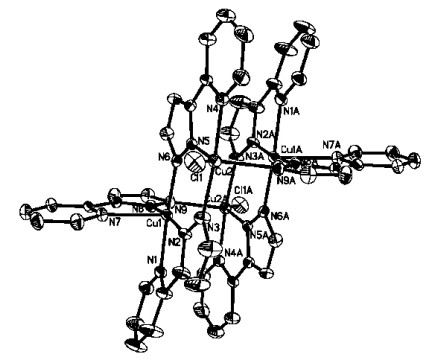
A green single crystal of complex 1 with about dimensions of 0.38mm × 0.32mm × 0.25mm was selected and glued to a glass fiber. The diffraction data were collected on Rigaku SCX with graphite-monochromatic Mo-Kα radiation (λ = 0.71073 Å) by using the ω-θ scan method in the range of 3.41≤θ≤26.37º at room temperature. A total of 9712 reflec-tions were collected, including 3017 independent ones (Rint = 0.0404). The structure was solved by direct methods and refined by full-matrix least-squares on F2 using SHELXL-2014[22]. The empirical absorption correction was applied with the program Bruker FRAMBO. All non-hydrogen atoms were refined anisotropically. All hydrogen atoms were positioned geometrically and refined as a riding model. Selected bond distances and bond angles of complex 1 are listed in Table 1. Hydrogen bond lengths and bond angles are given in Table 2.
 DownLoad:
CSV
DownLoad:
CSV
| Bond | Dist. | Bond | Dist. | |
| Cu(1)–N(1) | 2.081(4) | Cu(1)–N(2) | 1.974(4) | |
| Cu(1)–N(7) | 2.317(4) | Cu(1)–N(8) | 1.968(4) | |
| Cu(2)–N(3) | 1.961(5) | Cu(2)–N(4) | 2.052(5) | |
| Cu(2)–N(5) | 2.038(4) | Cu(1)–N(6) | 1.988(4) | |
| Cu(2)–N(9A) | 2.123(4) | Cu(2)–C(l1) | 2.3509(16) | |
| Angle | (°) | Angle | (°) | |
| N(1)–Cu(1)–N(7) | 84.46(16) | N(2)–Cu(1)–N(6) | 97.46(17) | |
| N(2)–Cu(1)–N(1) | 80.30(17) | N(2)–Cu(1)–N(7) | 104.86(16) | |
| N(3)–Cu(2)–N(4) | 174.02(19) | N(3)–Cu(2)–N(9A) | 95.50(19) | |
| N(3)–Cu(2)–N(5) | 95.90(18) | N(3)–Cu(2)–C(l1) | 92.05(13) | |
| N(4)–Cu(2)–C(l1) | 89.39(14) | N(4)–Cu(2)–N(9A) | 89.62(18) | |
| N(5)–Cu(2)–N(4) | 79.21(18) | N(5)–Cu(2)–N(9A) | 112.93(16) | |
| N(5)–Cu(2)–C(l1) | 138.14(12) | N(8)–Cu(1)–N(7) | 75.82(16) | |
| N(8)–Cu(1)–N(2) | 170.87(18) | N(8)–Cu(1)–N(6) | 91.39(17) | |
| N(8)–Cu(1)–N(1) | 90.74(17) | N(9A)–Cu(2)–C(l1) | 107.06(13) | |
| Symmetry code: A: –x, –y, –z | ||||
DownLoad:
CSV
| D–H...A | d(D–H) | d(H...A) | d(D...A) | ∠(DHA) |
| C(24)–H(24)...Cl(1)b | 0.93 | 2.85 | 3.609(6) | 140 |
| C(19)–H(19)...Cl(1)a | 0.93 | 2.87 | 3.649(9) | 142 |
| Symmetry codes: a: –x, –y, –z; b: x, y, z+1 | ||||
X-ray single-crystal diffraction confirmed complex 1 crystallized in triclinic system with P
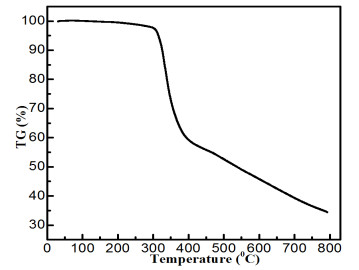
The thermal behavior of complex 1 was investigated by thermogravimetric analysis under a nitrogen atmosphere at a heating rate of 10 ℃/min from room temperature to 800 ℃. The TGA curve of complex 1 indicated no obvious weight loss from room temperature to 300 ℃. There was a platform below 300 ℃. After that, the framework started to collapse above 300 ℃, forecasted that 1 revealed fine thermostability.
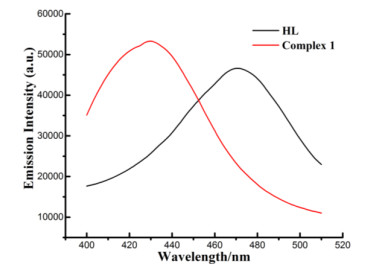
As displayed in Fig. 6, the fluorescence of complex 1 and the homologous free ligand HL was investigated in the solid state at room temperature. HL showed that the typical emission peak was 471 nm under 310 nm excitation, while a blue luminescent emission band for complex 1 was exhibited with the maximum at 430 nm upon 350 nm. It should be pointed out that complex 1 showed blue-shift by 41 nm and displayed stronger emission as compared to the HL ligand, which might be attributed to the large scope of conjugated system because the HL ligand was a π-conjugated organic molecule and the formation of cluster structure improved the intra-ligand π-π* transitions[29]. Furthermore, this pheno-menon might be briefly assigned to ligand-to-metal charge transfer (LMCT)[30].
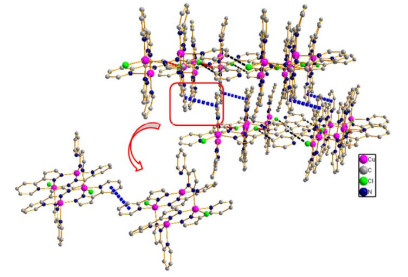
In summary, a novel tetranuclear copper cluster [Cu4(μ-L)6Cl2] was obtained via the reaction of 2-(1H-pyra-zol-3-yl) pyridine and metal salts under hydrothermal conditions and structurally characterized by IR, single-rystal X-ray diffraction and so on. In complex 1, the tetranuclear core structure was connected into a 2D network via plentiful weak non-classical C–H…Cl hydrogen bonds and further assembled into a 3D supramolecular network by week π-π stacking interaction between pyridine rings. Furthermore, complex 1 had excellent thermostability and stronger fluorescent emission as compared to the HL ligand.
Lu, Y. Z.; Chen, W. Sub-nanometre sized metal clusters: from synthetic challenges to the unique property discoveries. Chem. Soc. Rev. 2012, 41, 3594–3623. doi: 10.1039/c2cs15325d
Liu, L.; Peng, Y. F.; Lv, X. X.; Li, K.; Li, B. L.; Wu, B. Construction of three coordination polymers based on tetranuclear copper(Ⅱ) clusters: syntheses, structures and photocatalytic properties. CrystEngComm. 2016, 18, 2490–2499. doi: 10.1039/C5CE02492G
Burrows, A. D.; Mahon, M. F.; Sebestyen, V. M.; Lan, Y. H.; Powell, A. K. Synthesis, structures, and magnetic behavior of new anionic copper(Ⅱ) sulfate aggregates and chains. Inorg. Chem. 2012, 51, 10983–10989. doi: 10.1021/ic301478x
Zaworotko, M. J. Superstructural diversity in two dimensions: crystal engineering of laminated solids. Chem. Commun. 2001, 1, 1–9.
Eddaoudi, M.; Moler, D. B.; Li, H. L.; Chen, B. L.; Reineke, T. M.; O'Keeffe, M.; Yaghi, O. M. Modular chemistry: secondary building units as a basis for the design of highly porous and robust metalorganic carboxylate frameworks. Acc. Chem. Res. 2001, 34, 319–330. doi: 10.1021/ar000034b
Janiak, C. Engineering coordination polymers towards applications. Dalton Trans. 2003, 14, 2781–2804.
Braña, E.; Quiñone, D.; Martínez, S.; Grassi, J.; Carrera, I.; Torres, J.; González-Platas, J.; Seoane, G.; Kremer, C.; Mendoza, C. New polynuclear compounds based on N-benzyliminodipropionic acid: solution studies, synthesis, and X-ray crystal structures. J. Coord. Chem. 2016, 69, 3650–3663. doi: 10.1080/00958972.2016.1239086
Ben Salah, A. M.; Naïli, H.; Arczyn´ski, M.; Fitta, M. 0D and 1D copper(Ⅱ) coordination polymers based on 2-methyl-1H-imidazole: structural, vibrational and magnetic characterizations. J. Organomet. Chem. 2016, 805, 42–48. doi: 10.1016/j.jorganchem.2016.01.010
Zienkiewicz-Machnik, M.; Masternak, J.; Kazimierczuk, K.; Barszcz, B. Structural analysis and physico-chemical characterization of mononuclear manganese(Ⅱ) and polynuclear copper(Ⅱ) complexes with pyridine-based alcohol. J. Mol. Struct. 2016, 1126, 37–46. doi: 10.1016/j.molstruc.2016.01.082
Maity, D. K.; Bhattacharya, B.; Mondal, R.; Ghoshal, D. Five diverse bivalent metal coordination polymers based on benzene dicarboxylate and bent dipyridyl ligands: syntheses, structures, and photoluminescent properties. CrystEngComm. 2014, 16, 8896–8909. doi: 10.1039/C4CE00966E
Madhu, V.; Das, S. K. Neutral coordination polymers based on a metal-mono(dithiolene) complex: synthesis, crystal structure and supramolecular chemistry of [Zn(dmit)(4, 4΄-bpy)]n, [Zn(dmit)(4, 4΄-bpe)]n and [Zn(dmit)(bix)]n (4, 4΄-bpy = 4, 4΄-bipyridine, 4, 4΄-bpe = trans-1, 2-bis(4-pyridyl)ethene, bix = 1, 4-bis(imidazole-1-ylmethyl)-benzene). Dalton Trans. 2011, 40, 12901–12908. doi: 10.1039/c1dt10814j
Liu, G. X.; Xu, H.; Zhou, H.; Nishihara, S.; Ren, X. M. Temperature-induced assembly of MOF polymorphs: syntheses, structures and physical properties. CrystEngComm. 2012, 14, 1856–1864. doi: 10.1039/c1ce05369h
Fang, H. C.; Zhu, J. Q.; Zhou, L. J.; Jia, H. Y.; Li, S. S.; Gong, X.; Li, S. B.; Cai, Y. P.; Thallapally, P. K.; Liu, J.; Exarhos, G. J. pH-Dependent assembly and conversions of six cadmium(Ⅱ)-based coordination complexes. Cryst. Growth Des. 2010, 10, 3277–3284. doi: 10.1021/cg1004598
Tang, J.; Costa, J. S.; Golobicˇ, A.; Kozlevcˇar, B.; Robertazzi, A.; Vargiu, A. V.; Gamez, P.; Reedijk, J. Magnetic coupling between copper(Ⅱ) ions mediated by hydrogen-bonded (neutral) water molecules. Inorg. Chem. 2009, 48, 5473–5479. doi: 10.1021/ic900507w
Zou, R. Q.; Bu, X. H.; Du, M.; Sui, Y. X. A hydrogen-bonded 3D coordination network of CuⅡ nitrate with pyridine-2, 6-dicarboxylic acid and 3-(2-pyridyl)pyrazole: hydrothermal synthesis, characterization and crystal structure. J. Mol. Struct. 2004, 707, 11–15. doi: 10.1016/j.molstruc.2004.05.001
Fang, S. M.; Sañudo, E. C.; Hu, M.; Zhang, Q.; Zhou, L. M.; Liu, C. S. Copper(Ⅱ) complexes with cis-epoxysuccinate ligand: syntheses, crystal structures, and magnetic properties. Aust. J. Chem. 2011, 64, 217–226. doi: 10.1071/CH10371
Wei, P. H.; Wu, X. Y.; Fan, L. M.; Li, D. C.; Zhang, X. T.; Dou, J. M.; Liu, X. Z.; Shi, C. W. Hydrothermal synthesis and crystal structure of one novel 1-D copper(Ⅱ)-organic framework: {[Cu2(PP)2(CBPC)]2·7H2O}n. Chin. J. Struct. Chem. 2010, 12, 1774–1779.
Fan, L. M.; Li, D. C.; Wei, P. H.; Zhang, X. T.; Dou, J. M. Synthesis, structure, and magnetic property of one snake-shaped copper(Ⅱ)-organic compound: Cu[Cu2(PP)2](CBPC)2]·2(H2O). Chin. J. Struct. Chem. 2011, 10, 1381–1386.
Ardizzoia, G. A.; Brenna, S. Hydroxo-bridged copper(Ⅱ) cubane complexes, Coord. Chem. Rev. 2016, 311, 53–74. doi: 10.1016/j.ccr.2015.11.013
Bikas, R.; Hosseini-Monfared, H.; Korabik, M.; Krawczyk, M. S.; Lis, T. Synthesis, structure and magnetic properties of a 1D coordination polymer of Cu(Ⅱ) containing phenoxido and dicyanamido bridging groups. Polyhedron 2014, 81, 282–289. doi: 10.1016/j.poly.2014.06.024
Hickey, J. L.; Donnelly, P. S.; Diagnostic imaging of Alzheimer's disease with copper and technetium complexes. Coord. Chem. Rev. 2012, 256, 2367–2380. doi: 10.1016/j.ccr.2012.03.035
Sheldrick, G. M. Crystal structure refinement with SHELXL. Acta Crystallogr., Sect. C: Struct. Chem. 2015, 71, 3–8. doi: 10.1107/S2053229614024218
Isaac, J. A.; Mansour, A. T.; David, R.; Kochem, A.; Philouze, C.; Demeshko, S.; Meyer, F.; Réglier, M.; Simaan, A. J.; Caldarelli, S.; Yemloul, M.; Jamet, H.; Thibon-Pourret, A.; Belle, C. Tetranuclear and dinuclear phenoxido bridged copper complexes based on unsymmetrical thiosemicarbazone ligands. Dalton Trans. 2018, 47, 9665–9676. doi: 10.1039/C8DT02452A
Klingele (n´ee Hausmann), J.; Prikhod'ko, A. I.; Leibeling, G.; Demeshko, S.; Dechert, S.; Meyer, F. Pyrazolate-based copper(Ⅱ) and nickel(Ⅱ) [2 × 2] grid complexes: protonation-dependent self-assembly, structures and properties. Dalton Trans. 2007, 2003–2013.
Lv, X. X.; Shi, L. L.; Li, K.; Li, B. L.; Li, H. Y. An unusual porous cationic metal-organic framework based on a tetranuclear hydroxyl-copper(Ⅱ) cluster for fast and highly efficient dichromate trapping through a single-crystal to single-crystal process. Chem. Commun. 2017, 53, 1860–1867. doi: 10.1039/C6CC09676J
Ma, Y. S.; Yang, Z.; Cai, W. S.; Tang, X. Y.; Yuan, R. X. Assembly of 1-D and decanuclear cage compounds from copper halide, cyclohexenephosphonic acid, and 3-(2-pyridyl)pyrazole. J. Coord. Chem. 2015, 68, 1633–1643. doi: 10.1080/00958972.2015.1021342
Cheng, Z. Y.; Hu, H. P.; Yang, J. P.; Qiu, X. J.; Wang, C. X.; Ji, G. F. Synthesis, structure and DFT calculations of a novel copper(Ⅱ) complex based on tert-butyl 2-[N-(tert-butyloxycarbonylmethyl)-2-picolyamino]acetate. Chin. J. Struct. Chem. 2017, 36, 795–804.
Batool, S. S.; Gilani, S. R.; Tahir, M. N.; Harrison, W. T. A.; Mitu, L.; Mazharr, S. Synthesis and structural features of copper(Ⅱ) complexes of N, N, N΄, N΄-tetramethylethylenediamine with 2-chlorobenzoate1− and 2-hydroxybenzoate1−. J. Coord. Chem. 2018, 71, 2569–2583. doi: 10.1080/00958972.2018.1503653
Li, C. H.; Li, W.; Li, H. F.; Tan, X. W. Crystal structure, fluorescence and thermal stability properties of a dinuclear copper(Ⅱ) complex [Cu2(L)2(phen)2]·5H2O (H2L = bicycle[2.2. 1]hept-2-en-5, 6-dicarboxylic acid). Chin. J. Struct. Chem. 2015, 12, 1922–1926.
Cui, Y. J.; Yue, Y. F.; Qian, G. D.; Chen, B. L. Luminescent functional metal-organic frameworks. Chem. Rev. 2012, 112, 1126–1162. doi: 10.1021/cr200101d

Figure 1 ORTEP view of 1 showing atoms at 30% probability ellipsoids. Hydrogen atoms were omitted for clarity (Symmetry code: a: –x, –y, –z)

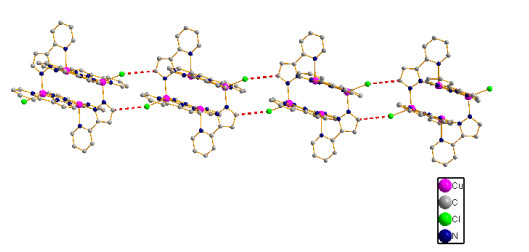
Figure 2 A one-dimensional chain structure for complex 1 by plentiful non-classical C(24)–H(24)…Clb hydrogen bonds (Symmetry code: b: x, y, z+1)

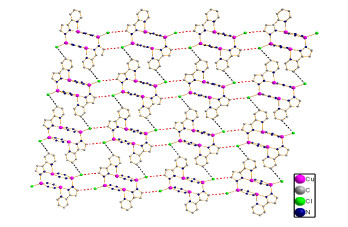
Figure 3 2D network of complex 1 assembled by C(19)-H(19)⋅⋅⋅Cla (symmetry code: a: –x, –y, –z)
Table 1. Selected Bond Lengths (Å) and Bond Angles (°) for Complex 1
| Bond | Dist. | Bond | Dist. | |
| Cu(1)–N(1) | 2.081(4) | Cu(1)–N(2) | 1.974(4) | |
| Cu(1)–N(7) | 2.317(4) | Cu(1)–N(8) | 1.968(4) | |
| Cu(2)–N(3) | 1.961(5) | Cu(2)–N(4) | 2.052(5) | |
| Cu(2)–N(5) | 2.038(4) | Cu(1)–N(6) | 1.988(4) | |
| Cu(2)–N(9A) | 2.123(4) | Cu(2)–C(l1) | 2.3509(16) | |
| Angle | (°) | Angle | (°) | |
| N(1)–Cu(1)–N(7) | 84.46(16) | N(2)–Cu(1)–N(6) | 97.46(17) | |
| N(2)–Cu(1)–N(1) | 80.30(17) | N(2)–Cu(1)–N(7) | 104.86(16) | |
| N(3)–Cu(2)–N(4) | 174.02(19) | N(3)–Cu(2)–N(9A) | 95.50(19) | |
| N(3)–Cu(2)–N(5) | 95.90(18) | N(3)–Cu(2)–C(l1) | 92.05(13) | |
| N(4)–Cu(2)–C(l1) | 89.39(14) | N(4)–Cu(2)–N(9A) | 89.62(18) | |
| N(5)–Cu(2)–N(4) | 79.21(18) | N(5)–Cu(2)–N(9A) | 112.93(16) | |
| N(5)–Cu(2)–C(l1) | 138.14(12) | N(8)–Cu(1)–N(7) | 75.82(16) | |
| N(8)–Cu(1)–N(2) | 170.87(18) | N(8)–Cu(1)–N(6) | 91.39(17) | |
| N(8)–Cu(1)–N(1) | 90.74(17) | N(9A)–Cu(2)–C(l1) | 107.06(13) | |
| Symmetry code: A: –x, –y, –z | ||||
 下载: 导出CSV
Table 2. Hydrogen Bond Lengths (Å) and Bond Angles (°) for Complex 1
| D–H...A | d(D–H) | d(H...A) | d(D...A) | ∠(DHA) |
| C(24)–H(24)...Cl(1)b | 0.93 | 2.85 | 3.609(6) | 140 |
| C(19)–H(19)...Cl(1)a | 0.93 | 2.87 | 3.649(9) | 142 |
| Symmetry codes: a: –x, –y, –z; b: x, y, z+1 | ||||
下载: 导出CSV

 扫一扫看文章


扫一扫关注我们


 下载:
下载: