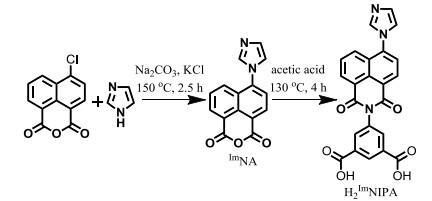
Scheme 1.
Synthetic procedure of H2ImNIPA

Two Novel Coordination Polymers with (6, 3) Topology Constructed by an Imidazole-containing Isophthalic Ligand: Syntheses, Structures and Luminescence Properties
Bin LI , Wang-Jian FANG , Shu-Qin LIU , He ZHAO , Jian-Jun ZHANG


Coordination polymers (CPs), also known as metal-organic frameworks (MOFs), have received considerable attention in the past 30 years due to their many potential applications in the fields of catalysis, chemical sensing, gas storage and separation, and derived functional materials[1-4]. Through precise regulation of ligands and proper selection of metal ions, CPs with different structures can be synthesized under suitable conditions through coordination bonds. Furthermore, many weak interactions such as π-π stacking interaction and hydrogen bonds have been proven to play a very important role in the self-assembly of CPs[5]. However, up to now precise design and synthesis of CPs with specific structures and desirable properties remain a great challenge[6-8].
So far, many studies have been carried out to construct CPs with isophthalic acid and its derivatives as ligands[9-12]. The ligands are characterized by their 120° angle between the two carboxylate functional groups and ideal for building either zero-dimensional (0D) metal-organic polyhedra or infinite poly-dimensional CPs. For example, a truncated cuboctahedron constructed from 12 {Cu2(CO2)4} paddle-wheel units was prepared by the reaction of Cu2+ and isophthalic ligand[9]. The work of our group also revealed that pentacarboxylic ligands based on isophthalic acid unit can be used to construct a series of 3D CPs, some of which can be used as highly selective and sensitive luminescent probes to detect nitroaromatics[10-12]. However, to the best of our knowledge, the assembly behavior of isophthalic ligands containing imidazole functional groups has not been reported.
In this paper, a new ligand, 5-(6-(1H-imidazol-1-yl)-1, 3-dioxo-1H-benzo[de]isoquinolin-2(3H)-yl) isophthalic acid (H2ImNIPA), was synthesized by introducing both imidazole and isophthalic units into the 1, 8-naphthalimide skeleton (Scheme 1). It should be noted that the existence of naphthalene ring can not only increase the possibility of π-π weak interaction due to its large conjugate plane, but also affect the luminescence property of the ligand itself or the subsequent CPs[13]. Two new 2D CPs with both (6, 3) honeycomb-type topology net based on the ligand, [Zn(ImNIPA)(DMSO)]n (1) and [Cd(ImNIPA)(DMSO)]n (2) (DMSO = dimethyl-sulfoxide), were prepared. Details of structures and properties are presented.
Solvents and reagents were commercially available and used without further purified. The IR spectra were recorded (400~4000 cm-1) from a Nicolet-20DXB spectrometer using KBr pellets. Thermogravimetric analyses (TGAs) were carried out on a TA-Q50 thermogravimetric analyzer under N2 atmosphere at the heating rate of 10 ℃/min. Elemental analyses (C, H, and N) were performed on a Vario EL III elemental analyzer. Powder X-ray diffraction patterns (PXRD) data were collected on a D/MAX-2400 X-ray Diffractometer with Cu-Kα radiation (λ = 1.54060 Å) at the scan rate of 5 °/min. NMR spectra were recorded at ambient temperature on a Bruker Avance II 500M spectrometer. The luminescence spectra were collected on a Hitachi F-7000 FL spectrophotometer.
ImNA (6-(1H-imidazol-1-yl)-1H, 3H-benzo[de]-isochromene-1, 3-dione) was obtained according to previous work with some modifications[14]. A mixture of 4-chloro-1, 8-naphthalic anhydride (11.6 g, 5 mmol), imidazole (5 g, 7.4 mmol), KCl (1 g, 1.4 mmol) and Na2CO3 (2 g, 1.9 mmol) in 45 mL DMF was heated at 150 oC for 2.5 h, then the mixture was cooled to room temperature. 90 mL ethanol was added into the above mixture and the solid was filtrated. The solid was ultrasonically washed with 10 mL H2O for 2 times. Finally the crystalline product ImNA was obtained by recrystallization from ethanol. Yield: 54%. Anal. Calcd. (%) for C15H8N2O3: C, 64.64; H, 3.07; N, 9.83. Found (%): C, 64.71; H, 3.02; N, 9.89. NMR (500 MHz, DMSO-d6): δH 8.63 (t, J = 7.5 Hz, 2H), 8.21 (d, J = 10.0 Hz, 1H), 8.03~7.95 (m, 2H), 7.77 (d, J = 2.2 Hz, 2H), 7.30 (s, 1H).
A mixture of ImNA (2.64 g, 1 mmol), 5-aminoisophthalic acid (1.81 g, 1 mmol) in 35 mL acetic acid was heated at 130 oC for 4 h, then the mixture was cooled to room temperature and filtrated. The obtained solid was ultrasonically washed with 30 mL ethanol for 2 times to obtain the target ligand H2ImNIPA. Yield: 54%. Anal. Calcd. (%) for C23H13N3O6: C, 64.64; H, 3.07; N, 9.83. Found (%): C, 64.71; H, 3.02; N, 9.89. 1H NMR (500 MHz, DMSO-d6) δ 13.47 (s, 2H), 8.61 (t, J = 8.0 Hz, 2H), 8.57 (s, 1H), 8.28 (s, 2H), 8.21 (s, 1H), 8.17 (d, J = 8.5 Hz, 1H), 7.99 (dd, J = 14.4, 7.5 Hz, 2H), 7.79 (s, 1H), 7.31 (s, 1H).
A mixture of Zn(NO3)2∙6H2O (18 mg, 0.06 mmol), H2ImNIPA (8.5 mg, 0.02 mmol), DMSO (3 mL), H2O (0.6 mL) and ethanol (0.75 mL) was sealed in a scintillation vial and heated to 85 oC for 24 h, and then cooled to room temperature. Colorless rhombus-shaped crystals of 1 were obtained (yield 51%, based on H2ImNIPA). Anal. Calcd. (%) for C25H17N3O7SZn: C, 52.78; H, 3.01; N, 7.39%. Found (%): C, 52.83; H, 3.09; N, 7.32%. IR (KBr pellet, cm-1): v (C–H) 3121 (m); v (C=O) 1710 (s); v (C=N) 1671 (s); v (C=C) 1610 (m), 1556 (s), 1506 (m), 1491 (w); vas/vs(COO-) 1591 (w), 1445 (m); v (C–N) 1369 (s); δ(C–H) 778 (s).
A mixture of Cd(NO3)2∙4H2O (18.5 mg, 0.06 mmol), H2ImNIPA (8.5 mg, 0.02 mmol), DMSO (3.5 mL), H2O (0.6 mL) and N, N-dimethylformamide (DMF, 1.5 mL) was sealed in a scintillation vial and heated to 85 oC for 20 h, and then cooled to room temperature. Colorless rhombus-shaped crystals were obtained (yield 58%, based on H2ImNIPA). Anal. Calcd. (%) for C25H17CdN3O7S: C, 48.75; H, 2.78; N, 6.82%. Found (%): C, 48.69; H, 2.83; N, 6.77%. IR (KBr pellet, cm-1): v(C–H) 3122 (m); v(C=O) 1711(s); v(C=N) 1670 (s); v(C=C) 1611 (m), 1557 (s), 1506 (m), 1491 (w); vas/vs(COO-) 1591 (w), 1446 (m); v(C–N) 1370 (s); δ(C–H) 778 (s).
Single crystals of 1 and 2 were mounted on glass fibers and intensity data were measured at 296(2) K on a Bruker SMART APEX II CCD area detector system. Data were corrected for absorption effects using the multi-scan technique (SADABS). Structure was solved and refined using the SHELXL-2014/7 software package[15]. All non-hydrogen atoms were refined anisotropically. The hydrogen atoms were included in the structural model as fixed atoms (using idealized sp2-hybridized geometry and C–H bond lengths of 0.95 Å) "riding" on their respective carbon atoms. Details of X-ray experiment and crystal data are summarized in Table 1. Selected bond lengths and bond angles are listed in Table 2 and 3.

 DownLoad:
CSV
DownLoad:
CSV
| 1 | 2 | |
| Empirical formula | C25H17N3O7SZn | C25H17CdN3O7S |
| Formula weight | 568.84 | 615.88 |
| Crystal system | Monoclinic | Monoclinic |
| Space group | P21/n | P21/n |
| Unit cell dimensions | ||
| a (Å) | 9.6312(9) | 9.6510(3) |
| b (Å) | 18.8280(14) | 17.0673(4) |
| c (Å) | 12.9317(12) | 14.0936(4) |
| α (°) | 90 | 90 |
| β (°) | 91.175(5) | 93.411(2) |
| γ (°) | 90 | 90 |
| V (Å3)/Z | 2344.5(4) /4 | 2317.34(11) /4 |
| μ (mm-1) | 1.190 | 1.087 |
| Dc (g/cm3) | 1.612 | 1.765 |
| θ range for data collection (°) | 1.911~24.999 | 1.876~24.998 |
| F(000) | 1160 | 1232 |
| Measured reflections | 8693 | 8937 |
| Independent reflections | 4101 | 4050 |
| Observed reflections (I > 2σ(I)) | 2127 | 3012 |
| Rint | 0.0690 | 0.0455 |
| Parameters refined | 344 | 334 |
| Goodness of fit on F2 | 1.001 | 1.071 |
| Ra/Rwb | 0.0692/0.1394 | 0.0489/0.0712 |
| Max/mean shift in the final cycle | 0.000/0.000 | 0.000/0.000 |
| aR = ∑(||Fo| – |Fc||)/∑|Fo|, bRw = {∑w[(Fo2 – Fc2)2]/∑w[(Fo2)2]}1/2, w = 1/[σ2(Fo2) + (aP)2 + bP], P = (Fo2 + 2Fc2)/3 1, a = 0.0983, b = 0.0000; 2, a = 0.0658, b = 0.8994 |
||
DownLoad:
CSV
| Bond | Dist. | Bond | Dist. | Bond | Dist. | ||
| Zn(1)–N(3) | 2.005(6) | Zn(1)–O(2A) | 1.913(5) | Zn(1)–O(4B) | 1.953(5) | ||
| Zn(1)–O(7) | 2.015(5) | ||||||
| Angle | (°) | Angle | (°) | Angle | (°) | ||
| O(2A)–Zn(1)–O(4B) | 115.4(2) | O(4B)–Zn(1)–N(3) | 103.1(2) | O(4B)–Zn(1)–O(7) | 116.0(2) | ||
| O(2A)–Zn(1)–N(3) | 126.9(3) | O(2A)–Zn(1)–O(7) | 102.0(2) | N(3)–Zn(1)–O(7) | 91.8(3) | ||
| Symmetry transformation: A: x+1, y, z+1; B: x+3/2, –y+1/2, z+1/2 | |||||||
DownLoad:
CSV
| Bond | Dist. | Bond | Dist. | Bond | Dist. | ||
| Cd(1)–N(3) | 2.214(5) | Cd(1)–O(7) | 2.279(4) | Cd(1)–O(2A) | 2.373(4) | ||
| Cd(1)–O(4B) | 2.217(4) | Cd(1)–O(1A) | 2.344(4) | Cd(1)–O(3B) | 2.612(4) | ||
| Angle | (°) | Angle | (°) | Angle | (°) | ||
| N(3)–Cd(1)–O(4B) | 134.78(17) | O(7)–Cd(1)–O(1A) | 84.97(15) | N(3)–Cd(1)–O(3B) | 84.03(16) | ||
| N(3)–Cd(1)–O(7) | 83.44(17) | N(3)–Cd(1)–O(2A) | 100.80(16) | O(4B)–Cd(1)–O(3B) | 53.33(13) | ||
| O(4B)–Cd(1)–O(7) | 103.11(15) | O(4B)–Cd(1)–O(2A) | 109.50(15) | O(7)–Cd(1)–O(3B) | 119.05(14) | ||
| N(3)–Cd(1)–O(1A) | 137.39(17) | O(7)–Cd(1)–O(2A) | 126.62(14) | O(1A)–Cd(1)–O(3B) | 136.52(14) | ||
| O(4B)–Cd(1)–O(1A) | 87.80(15) | O(1A)–Cd(1)–O(2A) | 56.13(13) | O(2A)–Cd(1)–O(3B) | 114.30(13) | ||
| Symmetry transformation: A: x–1, y, z–1; B: x–1.5, –y+0.5, z–0.5 | |||||||
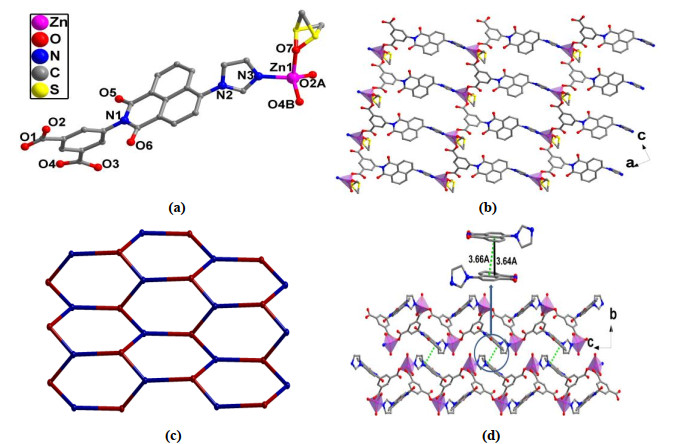
Compound 1 crystallizes in the monoclinic P21/n space group with the asymmetric unit comprised of one crystallographically independent ZnII ion, one ImNIPA2- ligand and one coordinated DMSO molecule. As shown in Fig. 1a, each ZnII ion is four-coordinated and displays a distorted tetrahedral geometry consisting of one N atom from the imidazole group and three O atoms, two of which are from two ImNIPA2- ligands and the other one from a DMSO molecule. The Zn–O bond lengths range from 1.924(8) to 2.001(8) Å and the Zn–N bond length is 2.013(9) Å, which are all close to the values found in other reported ZnII complexes[16, 17].
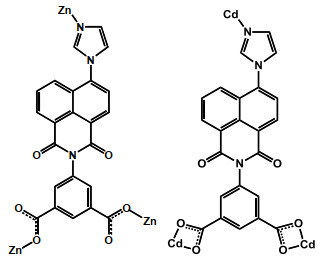
Each ligand is coordinated to three Zn ions and bears a μ3-κO1: κO1: κN1 coordination mode (Scheme 2). The ligand is severely distorted. 69.82° and 72.39° dihedral angles are observed between the naphthalene and benzene rings and the naphthalene and imidazole rings of the ligand, respectively.
Both the inorganic and organic nodes can be treated as 3-connected nodes, and the combination of them leads to a neutral 2D layer featuring a 3-connected net with (6, 3) honeycomb-type topology (Fig. 1b and 1c). The layers are packed along the b direction and the coordinated DMSO molecules are hung on the layer surface. Inside the layer, the nearest Zn···Zn separation is 9.84 Å (bridged by the carboxylate group). Due to the torsion of the ligand, the 2D net shows a wave-like structure motif. The neighboring layers are packed in such a close mode that offset face-to-face π-π interactions are formed between neighboring naphthalene rings from two layers with the ring-ring separation of 3.66 Å (Fig. 1d). Such strong π-π interactions connect the 2D coordination layers into a 3D supramolecular network.
2 also bears a 2D structure but based on 6-coordinated Cd2+ ions connected by the ImNIPA2- ligands. As shown in Fig. 2a, each CdII ion displays a distorted {NO5} triangular prism geometry with one N atom from the imidazole group of one ImNIPA2- ligand, four O atoms from two ImNIPA2- ligands, and one O atom from a DMSO molecule. The Cd–O lengths and O–Cd–O angles range from 2.217(4) to 2.612(4) Å and 53.33(13) to 136.52(14)°, respectively. In contrast, the Cd–N bond length is 2.214(5) Å and the N–Cd–O angles fall in the range of 83.44(17)~134.78(17)°. As shown in Scheme 2, each CdII atom is connected to three different ImNIPA2- ligands and exhibits a μ3-κO2: κO2: κN1 coordination mode.
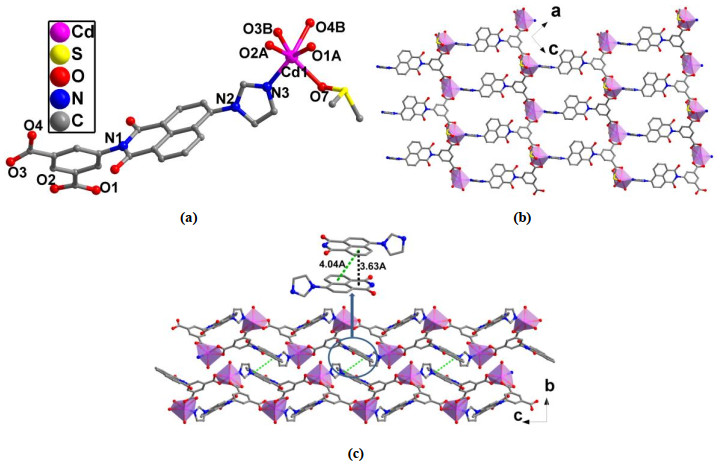
Similar to that in 1, both inorganic and organic nodes feature 3-connection motif and the resulted network bears a 2D (6, 3) honeycomb-type topology. The layers are extended along the ac plane (Fig. 2b). π-π interaction also plays an important role in stabilizing the structure of 2. Offset face-to-face π-π interaction between the naphthalene rings from two neighboring layers is observed. The corresponding ring-ring separation is 4.04 Å (Fig. 2c).
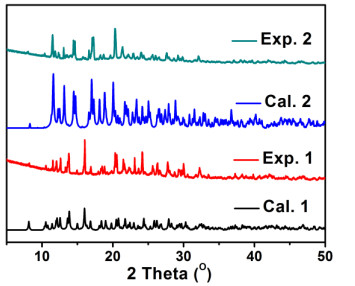
The phase purity of 1 and 2 was confirmed by powder X-ray diffraction (PXRD) at room temperature (Fig. 3). The peak positions of 1 and 2 are highly consistent with their corresponding simulated patterns, fully demonstrating the purity of their crystalline phases.
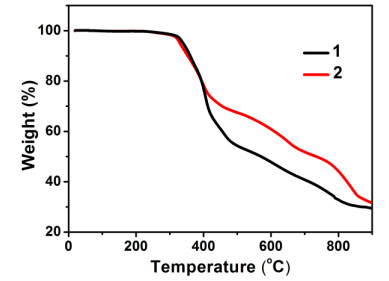
The thermogravimetric analysis (TGA) was carried out to investigate the thermal stability of the two compounds (Fig. 4). The results reveal that 1 and 2 are stable below 314 oC. Above this temperature, the material shows a striking weight loss, indicating complete decomposition of the compounds.
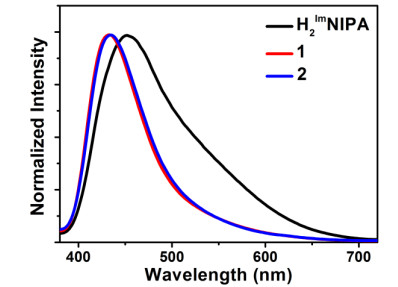
The luminescence properties of 1, 2 and ligand H2ImNIPA were investigated in the solid state at room temperature (Fig. 5). 1 exhibits a maximum emission peak at 432 nm upon excitation at 365 nm, and in the same condition the maximum emission peak at 435 nm is observed for 2. In contrast, H2ImNIPA bears maximum peak around 452 nm, which is redshift about 20 nm in comparison to those of 1 and 2. This shift of the emission peak may be ascribed to the combination effects of the coordination interactions of ImNIPA2- to metal ions and the deprotonation of H2ImNIPA ligand[12].
In summary, two novel coordination polymers based on a new ligand containing both imidazole and isophthalic units were synthesized under solvothermal conditions and characterized detailedly. Both compounds have 2D layer structures that feature (6, 3) honeycomb-type topology. In addition, the 2D layers are further extended into 3D supramolecular frameworks via π-π stacking interactions between the naphthalene rings from the adjacent 2D layers. The thermal-stability and luminescence properties of the compounds were studied. This work provides a good example for the design and synthesis of new CPs based on imidazolato/isophthalato functionalized ligand.
Sagara, Y.; Yamane, S.; Mitani, M.; Weder, C.; Kato, T. Mechanoresponsive luminescent molecular assemblies: an emerging class of materials. Adv. Mater. 2016, 28, 1073–1095. doi: 10.1002/adma.201502589
Zhao, H.; Ni, J.; Zhang, J. J.; Liu, S. Q.; Sun, Y. J.; Zhou, H.; Li, Y. Q.; Duan, C. Y. A trichromatic MOF composite for multidimensional ratiometric luminescent sensing. Chem. Sci. 2018, 9, 2918–2926. doi: 10.1039/C8SC00021B
Zhang, J. J.; Wojtas, L.; Larsen, R. W.; Eddaoudi, M.; Zaworotko, M. J. Temperature and concentration control over interpenetration in a polymorphic metal-organic material. J. Am. Chem. Soc. 2009, 131, 17040–17041. doi: 10.1021/ja906911q
Xia, Z. Q.; He, C.; Wang, X. G.; Duan, C. Y. Modifying electron transfer between photoredox and organocatalytic units via framework interpenetration for β-carbonyl functionalization. Nat. Commun. 2017, 8, 361. doi: 10.1038/s41467-017-00416-8
Liu, S. Q.; Li, X. J.; Di, L.; Ding, B. J.; Zhang, J. J. Interesting weak interactions in three silver coordination polymers based on tetrafluoro benzenedicarboxylate and benzonitrile ligands. Chin. J. Struct. Chem. 2013, 32, 969–974.
Li, Z. Y.; Zhang, J. J.; Liu, S. Q.; Zhang, H.; Sun, Y. J.; Liu, X. Y.; Zhai, B. Heterometallic hexanuclear [Ln4Cr2] cluster-based three-dimensional sulfate frameworks as a magnetic refrigerant and single molecular magnet. Cryst. Growth Des. 2018, 18, 7335–7342. doi: 10.1021/acs.cgd.8b00966
Wang, X. Y.; Li, G. T.; Sun, D. Y.; Zhang, Y.; Liu, D. X.; Xu, Z. L. A new luminescent Cd(II) coordination polymer constructed with 2-(carboxymethoxy)benzoic acid. Chin. J. Struct. Chem. 2018, 37, 1939–1944.
Feng, X.; Guo, N.; Chen, H. P.; Wang, H. L.; Yue, L. Y.; Chen, X.; Ng, S. W.; Liu, X. F.; Ma, L. F.; Wang, L. Y. A series of anionic host coordination polymers based on azoxybenzene carboxylate: structures, luminescence and magnetic properties. Dalton Trans. 2017, 46, 14192–14200. doi: 10.1039/C7DT02974H
Eddaoudi, M.; Kim, J.; Wachter, J. B.; Chae, H. K.; O'Keeffe, M.; Yaghi, O. M. Porous metal organic polyhedra: 25 Å cuboctahedron constructed from 12 Cu2(CO2)4 paddle-wheel building blocks. J. Am. Chem. Soc. 2001, 123, 4368–4369. doi: 10.1021/ja0104352
Dai, Y.; Zhang, J. J.; Liu, S. Q.; Zhou, H.; Sun, Y. J.; Pan, Y. Z.; Ni, J.; Yang, J. S. A trichromatic and white-light-emitting MOF composite for multi-dimensional and multi-response ratiometric luminescent sensing. Chem. -Eur. J. 2018, 24, 9555–9564. doi: 10.1002/chem.201801686
Dai, Y.; Zhou, H.; Song, X. D.; Zhang, J. J.; Hao, C.; Di, L.; Wang, Y. X.; Ni, J.; Wang, H. L. Two (5, 5)-connected isomeric frameworks as highly selective and sensitive photoluminescent probes of nitroaromatics. CrystEngComm. 2017, 19, 2786–2794. doi: 10.1039/C7CE00236J
Di, L.; Zhang, J. J.; Liu, S. Q.; Ni, J.; Zhou, H.; Sun, Y. J. Two dynamic, ABW-type metal organic frameworks built of pentacarboxylate and Zn2+ as photoluminescent probes of nitroaromatics. Cryst. Growth Des. 2016, 16, 4539–4546. doi: 10.1021/acs.cgd.6b00656
Reger, D. L.; Leitner, A. P.; Smith, M. D. Supramolecular metal-organic frameworks of s- and f‑block metals: impact of 1, 8-naphthalimide functional group. Cryst. Growth Des. 2016, 16, 527–536. doi: 10.1021/acs.cgd.5b01575
Peters, A. T.; Bide, M. J. Amino derivatives of 1, 8-naphthalic anhydride and derived dyes for synthetic-polymer fibers. Dyes Pigm. 1985, 6, 349–375. doi: 10.1016/0143-7208(85)85005-1
Sheldrick, G. M. SHELXL-2014/7: Program for the Solution of Crystal Structures. University of Göttingen, Göttingen 2014.
Yang, J. S.; Zhu, J.; Liu, R. B.; Hu, T.; Chang, Z. D.; Meng, C. G.; Zhang, J. J. Syntheses and characterization of four 2D metal-organic networks based on rigid imidazolate/carboxylate functionalized ligand-effect of the torsion of the ligands on crystal structures and properties. Inorg. Chim. Acta 2013, 394, 117–126. doi: 10.1016/j.ica.2012.07.031
Shi, Y.; Liu, X.; Shan, Y. Y.; Zhang, X.; Kong, W. B.; Lu, Y. N.; Tan, Z. D.; Li, X. L. Naked-eye repeatable off-on-off and on-off-on switching luminescence of copper(I)-1H-imidazo[4, 5-f][1, 10]phenanthroline complexes with reversible acid-base responses. Dalton Trans. 2019, 48, 2430–2441. doi: 10.1039/C8DT04538K

Figure 1 Structure of 1. (a) Coordination environment of the ZnII atom. Symmetry codes: A: x+1, y, z+1; B: x+3/2, –y+1/2, z+1/2. (b) 2D layer structure viewed along the b direction. (c) Topology of the 2D net. (d) Packing diagram viewed along the a direction. DMSO molecules are omitted for clarity. π-π interaction is represented as green dotted line

Figure 2 Structure of 2. (a) Coordination environment of the CdII ions. Symmetry codes: A: x–1, y, z–1; B: x–1.5, –y+0.5, z–0.5; (b) 2D layer structure viewed along the b direction. (c) Packing diagram viewed along the a direction. DMSO molecules are omitted for clarity. π-π interaction is represented as green dotted line

Figure 5 Luminescence emission spectra of 1, 2 and H2ImNIPA under the excitation of 365 nm
Table 1. Crystal Data Collection and Structure Refinement Parameters for the Compounds
| 1 | 2 | |
| Empirical formula | C25H17N3O7SZn | C25H17CdN3O7S |
| Formula weight | 568.84 | 615.88 |
| Crystal system | Monoclinic | Monoclinic |
| Space group | P21/n | P21/n |
| Unit cell dimensions | ||
| a (Å) | 9.6312(9) | 9.6510(3) |
| b (Å) | 18.8280(14) | 17.0673(4) |
| c (Å) | 12.9317(12) | 14.0936(4) |
| α (°) | 90 | 90 |
| β (°) | 91.175(5) | 93.411(2) |
| γ (°) | 90 | 90 |
| V (Å3)/Z | 2344.5(4) /4 | 2317.34(11) /4 |
| μ (mm-1) | 1.190 | 1.087 |
| Dc (g/cm3) | 1.612 | 1.765 |
| θ range for data collection (°) | 1.911~24.999 | 1.876~24.998 |
| F(000) | 1160 | 1232 |
| Measured reflections | 8693 | 8937 |
| Independent reflections | 4101 | 4050 |
| Observed reflections (I > 2σ(I)) | 2127 | 3012 |
| Rint | 0.0690 | 0.0455 |
| Parameters refined | 344 | 334 |
| Goodness of fit on F2 | 1.001 | 1.071 |
| Ra/Rwb | 0.0692/0.1394 | 0.0489/0.0712 |
| Max/mean shift in the final cycle | 0.000/0.000 | 0.000/0.000 |
| aR = ∑(||Fo| – |Fc||)/∑|Fo|, bRw = {∑w[(Fo2 – Fc2)2]/∑w[(Fo2)2]}1/2, w = 1/[σ2(Fo2) + (aP)2 + bP], P = (Fo2 + 2Fc2)/3 1, a = 0.0983, b = 0.0000; 2, a = 0.0658, b = 0.8994 |
||
 下载: 导出CSV
Table 2. Selected Bond Lengths (Å) and Bond Angles (°) for 1
| Bond | Dist. | Bond | Dist. | Bond | Dist. | ||
| Zn(1)–N(3) | 2.005(6) | Zn(1)–O(2A) | 1.913(5) | Zn(1)–O(4B) | 1.953(5) | ||
| Zn(1)–O(7) | 2.015(5) | ||||||
| Angle | (°) | Angle | (°) | Angle | (°) | ||
| O(2A)–Zn(1)–O(4B) | 115.4(2) | O(4B)–Zn(1)–N(3) | 103.1(2) | O(4B)–Zn(1)–O(7) | 116.0(2) | ||
| O(2A)–Zn(1)–N(3) | 126.9(3) | O(2A)–Zn(1)–O(7) | 102.0(2) | N(3)–Zn(1)–O(7) | 91.8(3) | ||
| Symmetry transformation: A: x+1, y, z+1; B: x+3/2, –y+1/2, z+1/2 | |||||||
下载: 导出CSV
Table 3. Selected Bond Lengths (Å) and Bond Angles (°) for 2
| Bond | Dist. | Bond | Dist. | Bond | Dist. | ||
| Cd(1)–N(3) | 2.214(5) | Cd(1)–O(7) | 2.279(4) | Cd(1)–O(2A) | 2.373(4) | ||
| Cd(1)–O(4B) | 2.217(4) | Cd(1)–O(1A) | 2.344(4) | Cd(1)–O(3B) | 2.612(4) | ||
| Angle | (°) | Angle | (°) | Angle | (°) | ||
| N(3)–Cd(1)–O(4B) | 134.78(17) | O(7)–Cd(1)–O(1A) | 84.97(15) | N(3)–Cd(1)–O(3B) | 84.03(16) | ||
| N(3)–Cd(1)–O(7) | 83.44(17) | N(3)–Cd(1)–O(2A) | 100.80(16) | O(4B)–Cd(1)–O(3B) | 53.33(13) | ||
| O(4B)–Cd(1)–O(7) | 103.11(15) | O(4B)–Cd(1)–O(2A) | 109.50(15) | O(7)–Cd(1)–O(3B) | 119.05(14) | ||
| N(3)–Cd(1)–O(1A) | 137.39(17) | O(7)–Cd(1)–O(2A) | 126.62(14) | O(1A)–Cd(1)–O(3B) | 136.52(14) | ||
| O(4B)–Cd(1)–O(1A) | 87.80(15) | O(1A)–Cd(1)–O(2A) | 56.13(13) | O(2A)–Cd(1)–O(3B) | 114.30(13) | ||
| Symmetry transformation: A: x–1, y, z–1; B: x–1.5, –y+0.5, z–0.5 | |||||||
下载: 导出CSV

 扫一扫看文章


扫一扫关注我们


 下载:
下载: