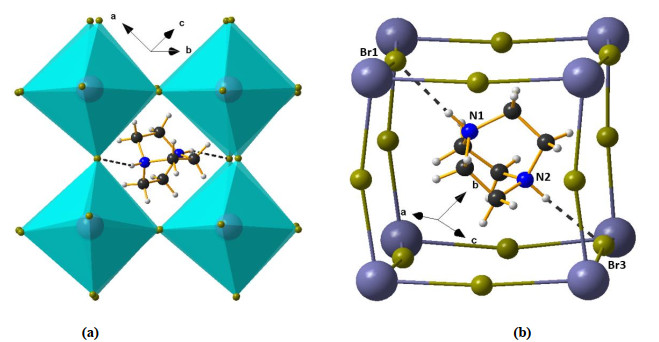
Figure 1.
3D framework structure of [C6H14N2]KBr3. Color codes: N, blue; C, black; H, white; K, blue gray; Br, dark yellow; KBr6 octahedra, turquoise. Hydrogen bonds are indicated by black dashed lines

Synthesis, Structure and Elastic Properties of a New Hybrid Perovskite Material: [C6H14N2]KBr3
Azeem Muhammad , Hong ZHANG , Li-Jun JI , Li-Yuan DONG , Pei-Xiang LU , Wei LI


Hybrid organic-inorganic perovskites (HOIPs) have been studied intensively in physics, chemistry, and materials science because of their rich physical properties[1-3], such as photovoltaic and optoelectronic[4], dielectricity[5], magnetism[6], ferroelectricity[7], ferroelasticity[8], and multiferroicity[9]. For example, semiconducting HOIPs (CH3NH3PbX3, X = I, Br, or Cl) have been recognized as promising light-harvesting materials for future high-performance and ultralow-cost-per-watt photovoltaic devices[10-12]. Over the past decade, great efforts have been made in developing new types of hybrid perovskite materials and exploring their unique functionalities. In addition, low-cost and simple one-pot synthesis, solution processability and ease for scale-up make them promising candidates in various fields. Nevertheless, halides based HOIPs are largely dominated by toxic lead compounds, while other halides have not been well explored until a recent study about the successful synthesis of a few hybrid perovskite chlorides using the organic diamine cation templates[13]. To further extend this possibility, a new HOIP bromide, [C6H14N2]KBr3, was synthesized and structurally characterized. The elastic properties and acoustic velocity behavior of this new HOIP were systematically studied via the density functional theory (DFT) calculations and further validated by recourse to nanoindentation.
All chemicals and solvents were of reagent grade and used as received. Infrared spectra were collected over the range of 4000~400 cm-1 on a Bruker VERTEX-70 ATR spectrometer. Elemental analysis of the sample was performed on a German Vario Micro cube Elementar instrument.
All chemicals and solvents used in this study were of reagent grade or higher purity, purchased from commercial vendors and used as received. Single crystals of [C6H14N2]KBr3 were prepared from stoichiometric 1:2:1 mixtures of aqueous solutions of potassium bromide (KBr), hydrobromic acid (HBr) and triethylenediamine hexahydrate C6H12N2⋅6H2O. The resulting colorless solution (PH = 1~2) was left in Petri dishes at 20 ℃ for several days, during which time faceted colorless blocks of the products grew. They were harvested by filtration and rinsed with acetone. The asymmetric unit can be observed in Fig. S1, while the purity of the compounds was confirmed by powder X-ray diffraction (Fig. S2), infrared spectra (Fig. S3) and elemental analysis. The elemental analysis for [C6H14N2]KBr3: calcd. (%) (Mr = 392.99): C, 18.34; N, 7.13; H, 3.59. Found (%): C, 18.31; N, 7.10; H, 3.409. FT-IR(KBr/cm–1) for [C6H14N2]KBr3: = 3448(s), 3005(vs), 2913(vs), 2881(vs), 2778(vs), 2706(vs), 2597(vs), 2569(vs), 2532(vs), 2458(s), 1637(w), 1470(m), 1436(s), 1410(s), 1384(vs), 1318(m), 1280(m), 1195(s), 1053(vs), 1002(w), 891(m), 852(m), 806(w), 793(w), 557(w), 409(w).
Single-crystal X-ray diffraction was executed on an Oxford Diffraction Rigaku XtaLAB miniTM diffractometer with graphite-monochromated Mo-Kα radiation (λ = 0.71073 Å) at 293 K under ambient pressure using an empirical absorption correction through CrysAlisPro (version 1.171.39.6a) software for data collection. The program Olex2-1.2 was employed as an interface to invoke program SHELXS and SHELXL executables, where direct methods were applied to resolve crystal structure in solution program SHELXS, and used full-matrix least squares on F2 to refine anisotropic atomic displacement parameters of all non-hydrogen atoms in refinement program SHELXL[14]. Eventually, a riding model was applied to refine hydrogen atoms of [C6H14 N2]2+ ligand.
Room temperature powder X-ray diffraction (PXRD) was carried out on apparatus (X´Pert PRO, PANalytical B. V.) with a Cu radiation (λ = 1.5418 Å, operating at 40 KV and 30 mA) for confirming the phase purity. The sample was prepared by fully grinding the single crystals and the diffraction data were collected in the range of 5~70o at a rate of 3°/min. The cell parameters were refined with the Le Bail method by using TOPAS-Academic v5 software (Fig. S2), and yielded a = 9.4756(1), b = 9.4756(1), c = 23.1371(2) Å, V = 1799.08(3) Å3 (Rp = 2.8%, Rwp = 3.7% and GOF = 1.141), which were consistent with the results of single crystal X-ray diffraction.
The first principles calculations were made to obtain the elastic anisotropy of material by using CASTEP, a total energy package based on plane-wave pseudo-potential density functional theory[15]. The functions developed in local density approximation (LDA)[16, 17] were used to indicate the exchange-correlation energy. Optimized ultrasoft pseudo-potentials[18] were adopted to model the effective interaction between the valance electrons and atomic cores, which allowed us to use a set of relatively small plane-wave basis without compromising the computational accuracy. The kinetic energy cut-off was set as 400 eV and Monkhorst-Pack[19], k-point mesh spanning was less than 0.04 Å-1.
Nanoindentation experiments were implemented at room temperature using a Hysitron Nanoindenter (Hysitron Corp. USA) with a pyramidal sharp Berkovich diamond indenter tip (end radius is 100 nm)[20]. The indenter sequentially recorded the load (P) and depth (h) under conditions of a loading and unloading rates of 0.5 mNs-1 and indenter tip was held for 10 s in the largest displacement 620 nm. A fused silica standard with an elastic modulus of 72 GPa and hardness of 9 GPa was adopted for calibration in the experiment. In addition, the elastic modulus of the diamond indenter (1141 GPa) and Poisson's ratio (0.07) were applied for calculation[21]. Individual untwined single crystals with fine (1-1-2) and (1-12) surfaces were faced-indexed via single-crystal X-ray diffraction. The data from the P-h curves of the sample were analyzed by using a standard Oliver-Pharr method[22].
[C6H14N2]KBr3 adopts a perovskite arrangement (in this case the crystal symmetry is trigonal; enantiomorphous space group P3121 (No. 152)), which is a chiral perovskite (Fig. 1a). The crystal chirality originates from a helical motif of the non-chiral structural units and the bulk sample must consist of an equal number of crystals of both chiralities (i.e. space groups P3121 and P3221). By using the Goldschmidt's Tolerance Factor concept we estimate tolerance factor (0.831) of [C6H14N2]KBr3 which is in good agreement with stable perovskite structure value (0.80~1.0)[23]. Crystal data of [C6H14N2]KBr3 are listed in Table S1: a = b = 9.4756(1) Å, c = 23.1371(2) Å, V = 1799.08(3) Å3, and Z = 6. In the structure (Fig. S1), two potassium and three bromine ions along with one "dabconium" dication (all atoms on general positions) build an asymmetric unit. The topology of the corner-sharing KBr6 octahedra is the same as that of ABO3 cubic perovskite (Fig. 1a), while the dabconium cation occupies the A cation site and bonds to the KBr3 network via hydrogen bonding (N(1)H···Br(1) = 2.3857 Å and N(2)H···Br(3) = 2.3863 Å, as shown in Fig. 1b, which is totally different from its chloride analogue [C6H14N2]KCl3 for which face-sharing undistorted KCl6 octahedra have strong hydrogen bonding (NH···Cl = 2.1419 Å) that connects the KCl3 network in three-dimensions[13]. The bridging angles at hydrogen bonded bromines (K(1)‒Br(1)‒ K(2) = 167.865° and K(1)‒Br(3)‒K(2) = 164.889°) for [C6H14N2]KBr3 are more than double to those (K‒Cl(1)‒K = 71.993° and K‒Cl(2)‒K = 72.788°) for [C6H14N2]KCl3, showing higher order of distortion in KBr6 octahedra, as compared to KCl6 octahedra.
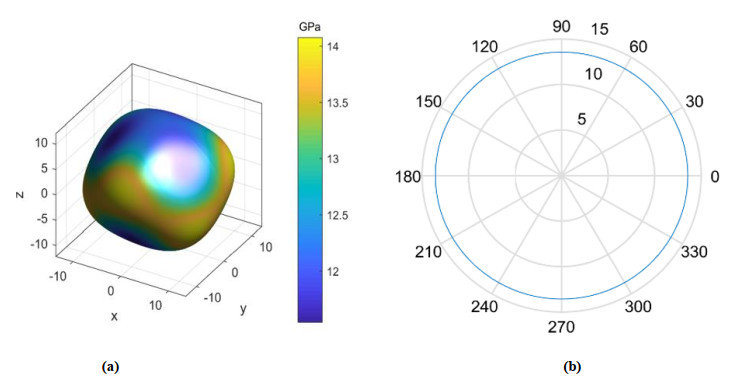
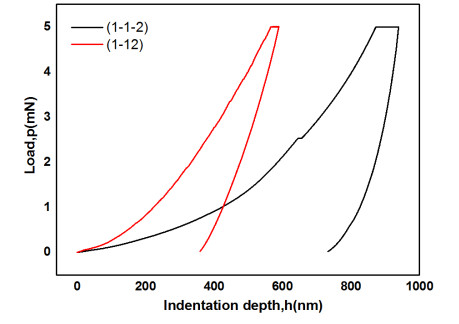
Mechanical properties of the material are crucial for successful technological applications. Particularly, their anisotropy is very important for evaluating the long term functioning reliability. To fully understand the mechanics of [C6H14N2]KBr3, we have performed comprehensive DFT calculations to obtain the full elastic constants of [C6H14N2]KBr3, which gave the extracted Young's moduli (E), Shear moduli (G), Poisson's ratios (ν), anisotropy indexes (A) and bulk moduli (B) (Table 1). Fig. 2 represents the E values graphically as 3D and sectional 2D diagrams, indicating the crystal is stiffest along < 03-1 > , which may be due to hydrogen bonding, as this direction is just normal to hydrogen bonding, but most complaint along < 011 > and this direction is just parallel to hydrogen bonding. The anisotropic index of elastic modulus[24] is AE = Emax/Emin = 14.08/11.54 = 1.22, which indicates a medium anisotropy in E. To testify the calculated values of E, we conducted nanoindentation experiments using single-crystals of [C6H14N2]KBr3. Representative load-indentation depth (P-h) curves obtained on the (1-12) and (1-1-2) faces are shown in Fig. 3 and Fig. S7. The experimental based values of E and H for (1-12) and (1-1-2) faces are 14.20(3), 13.80(7) GPa, and 0.96(6), 0.28(3) GPa, respectively, which may have attributed to the presence of hydrogen bonding[25-27]. The experimental values are in good agreement with DFT results E(1-12) = 11.72 GPa, E(1-1-2) = 12.37 GPa, indicating the validity of our first principles approach. The calculated anisotropy in E (AE = Emax/Emin) is 1.22, showing an insignificant anisotropy. The shear modulus, G (i.e. ratio of shear stress to shear strain), is a measure of the stiffness of a material or structure when subjected to (opposing) shear forces acting parallel to the surfaces. Variations of G, extracted from the DFT calculations, in a 3D and a 2D polar plots projected normal to the (100) plane, are displayed in Fig. S4a and Fig. S4b, respectively. The calculated anisotropy in G of [C6H14N2]KBr3 is the ratio of its maximum and minimum values as AG = Gmax/Gmin = 5.68/4.56 = 1.24, showing the same anisotropy as AE. The experimental E values are 29~37% larger than those from the widely used photovoltaic CH3NH3PbI3 (10.4~10.7 GPa) though the density of [C6H14N2]KBr3 is only about 52% of that of CH3NH3PbI3[28]. But the comparison of Emin (11.54 GPa) to Gmin (4.56) implies that [C6H14N2]KBr3 is more vulnerable to shearing. This observation is particularly important in the context of manufacturing, as it demands special attention for aspects such as shear-induced plasticity, amorphization and rapture[28]. Poisson's ratios (ν) are the ratio of transverse strains (ɛj) to the axial strains (ɛi), ν = –ɛj/ɛi. The graphical presentations as 3D and sectional 2D diagrams are given in Fig. S5a and Fig. S5b, respectively. The calculated values of ν ranges from 0.18 to 0.32, showing more flexible nature of [C6H14N2]KBr3, as compared to brittle (typically for brittle materials (ν > 0.26)[29]. The anisotropy index Aν = νmax/νmin = 1.77 is relatively higher than other two anisotropy indexes (AE and AG). The bulk modulus (B) (i.e. the inverse of compressibility) is a measure of volumetric elasticity and signifies the mechanical resistance of a material against volumetric changes (strains) under uniform hydrostatic pressure. Our DFT calculations for bulk modulus (B = 8.51 GPa) also reveal the soft nature[30] of [C6H14N2]KBr3, indicating higher volume compressibility under hydrostatic stress.

 DownLoad:
CSV
DownLoad:
CSV
| Properties | Quantities | [C6H14N2]KBr3 | ||
| Stiffness coefficient Cij (GPa) |
C11 | 16.2498 | ||
| C33 | 14.3127 | |||
| C44 | 4.8262 | |||
| C12 | 5.4112 | |||
| C13 | 4.8324 | |||
| C14 | 0.4694 | |||
| C15 | 0.0561 | |||
| Young's modulus E (GPa) |
Emax | E(03-1) = 14.0763 | ||
| Emin | E(011) = 11.5444 | |||
| Shear modulus G (GPa) |
Gmax | G(021) < -100 > = 5.6804 | ||
| Gmin | G(01-2) < -100 > = 4.5648 | |||
| Poisson's ratios ν |
νmax | ν < -100 > < 0-2-1 > = 0.3179 | ||
| νmin | ν < 214 > < -2-11 > = 0.1795 | |||
| Bulk modulus B (GPa) |
8.506 | |||
| Anisotropy measure | AE | 1.219 | ||
| AG | 1.244 | |||
| Aν | 1.771 |
The velocities of acoustic waves in solids are closely related to the elastic properties of the material. The general relation is:
|
|
where ρ is the density of material, u is the displacement (the small displacement of adjacent atoms), and Cijkl is the matrix of the elastic stiffness constants. Another equation (Christoffel's equation) relates acoustic velocities to crystallographic direction and elastic moduli as:
|
|
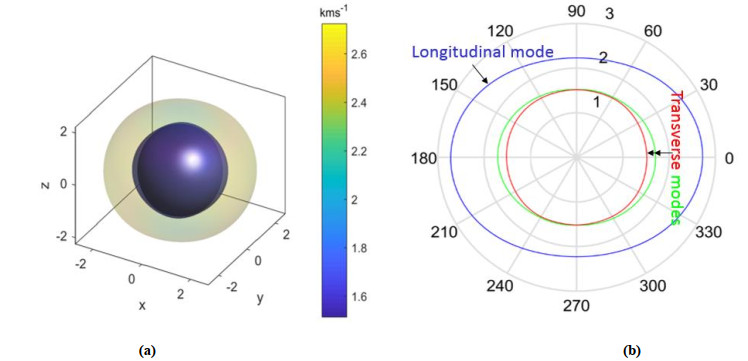
where v is the speed of acoustic velocity and Г is the Kelvin-Christoffel matrix. From these two relations, we can calculate the sound velocities in various crystallographic directions by using elastic stiffness constants Cijkl, but Christoffel's equation has three roots for sound velocities which correspond to a longitudinal and two transverse modes. Generally, the intensities of longitudinal wave peaks are greater than those of the transverse waves, and are directly related to the elastic moduli for different crystallographic directions[31]. A graphical representation of 'v' in all directions is given in Fig. 4a-b as 3D and sectional 2D diagrams. The calculated maximum and minimum speeds of longitudinal waves by DFT using Cijkl along < 03-1 > and < 011 > are vmax = 2.74 and vmin = 2.57 kms-1, respectively. The maximum speed along (03-1) plane indicates higher (maximum) value of elastic modulus (14.07 GPa). As in this direction the atoms are in dense connection mode while for (011) plane, they are not densely connected and the speed in this direction is minimum showing lower (minimum) value of elastic modulus (11.54 GPa).
 DownLoad:
CSV
DownLoad:
CSV
| Bond | Dist. | |
| K(1)–Br(1) | 3.4133(18) | |
| K(1)–Br(3) | 3.3704(15) | |
| K(1)–Br(2) | 3.3161(22) | |
| K(2)–Br(2) | 3.4444(18) | |
| Angle | (°) | |
| Br(1)–K(1)–Br(2) | 77.81(17) | |
| Br(2)–K(1)–Br(3) | 145.15(16) | |
| Br(1)–K(1)–Br(3) | 91.56(16) | |
| K(1)–Br(2)–K(2) | 87.00(15) |
In conclusion, a new hybrid organic-inorganic perovskite has been hydrothermally synthesized and structurally characterized. [C6H14N2]KBr3 crystallizes in the chiral trigonal space group P3121 with a good thermal stability up to 550 K. We have systematically explored the fundamental elastic properties of [C6H14N2]KBr3 via combined DFT calculations and nanoindentation experiments. The elastic moduli, shear moduli, Poisson's ratios and sound velocity properties along all crystallographic directions are thoroughly mapped through the full elastic coefficients. Moreover, our nanoindentation experiments are consistent with the theoretical results, indicating the reliability of our DFT calculations. Its higher stiffness and thermal stability as compared to the well-known photovoltaic CH3NH3PbI3 makes it a possible candidate for exploring optoelectronic properties.
Li, W.; Wang, Z.; Deschler, F.; Gao, S.; Friend, R. H.; Cheetham, A. K. Chemically diverse and multifunctional hybrid organic-inorganic perovskites. Nat. Rev. Mater. 2017, 2, 1-18.
Wei, W.; Li, W.; Butler, K. T.; Feng, G.; Howard, C. J.; Carpenter, M. A.; Lu, P.; Walsh, A.; Cheetham, A. K. An unusual phase transition driven by vibrational entropy changes in a hybrid organic-inorganic perovskite. Angew. Chem. Int. Ed. 2018, 57, 8932–8936. doi: 10.1002/anie.201803176
Szafrański, M.; Wei, W. J.; Wang, Z. M.; Li, W.; Katrusiak, A. Research update: tricritical point and large caloric effect in a hybrid organic-inorganic perovskite. APL Mater. 2018, 6, 1-10.
Stranks, S. D.; Snaith, H. J. Metal-halide perovskites for photovoltaic and light-emitting devices. Nat. Nanotechnol. 2015, 10, 391–402. doi: 10.1038/nnano.2015.90
Zhou, B.; Imai, Y.; Kobayashi, A.; Wang, Z. M.; Kobayashi, H. Giant dielectric anomaly of a metal-organic perovskite with four-membered ring ammonium cations. Angew. Chem. Int. Ed. 2011, 50, 11441–11445. doi: 10.1002/anie.201105111
Wang, X. Y.; Wang, Z. M.; Gao, S. Constructing magnetic molecular solids by employing three-atom ligands as bridges. Chem. Commun. 2008, 0, 281–294.
Hang, T.; Zhang, W.; Ye, H. Y.; Xiong, R. G. Metal-organic complex ferroelectrics. Chem. Soc. Rev. 2011, 40, 3577–3598. doi: 10.1039/c0cs00226g
Li, W.; Zhang, Z.; Bithell, E. G.; Batsanov, A. S.; Barton, P. T.; Saines, P. J.; Jain, P.; Howard, C. J.; Carpenter, M. A.; Cheetham, A. K. Ferroelasticity in a metal-organic framework perovskite; towards a new class of multiferroics. Acta Mater. 2013, 61, 4928–4938. doi: 10.1016/j.actamat.2013.04.054
Fu, D. W.; Zhang, W.; Cai, H. L.; Zhang, Y.; Ge, J. Z.; Xiong, R. G.; Huang, S. D.; Nakamura, T. A multiferroic perdeutero metal-organic framework. Angew. Chem. Int. Ed. 2011, 50, 11947–11951.
Saparov, B.; Mitzi, D. B. Organic-inorganic perovskites: structural versatility for functional materials design. Chem. Rev. 2016, 116, 4558–4596. doi: 10.1021/acs.chemrev.5b00715
Shanmuga Priya, S.; Rao, A.; Thirunavukkarasu, I.; Nayak, V. Solar pebble bed reactor for treatment of textile and petrochemical industrial wastewater. Int. J. Chem Tech. Res. 2016, 9, 261–270.
Weber, D. CH3NH3PbX3, a Pb(II)-system with cubic perovskite structure. Z. Naturforsch. B 1978, 33, 1443–1445. doi: 10.1515/znb-1978-1214
Paton, L. A.; Harrison, W. T. A. Structural diversity in non-layered hybrid perovskites of the RMCl3 family. Angew. Chem. Int. Ed. 2010, 49, 7684–7687. doi: 10.1002/anie.201003541
Sheldrick, G. M. SHELXT-integrated space-group and crystal-structure determination. Acta Crystallogr. A 2015, 71, 3–8. doi: 10.1107/S2053273314026370
Clark, S. J.; Segall, M. D.; Pickard, C. J.; Hasnip, P. J.; Probert, M. I. J.; Refson, K.; Payne, M. C. First principles methods using CASTEP. Z. Kristallogr. Cryst. Mater. 2005, 220, 567–570. doi: 10.1524/zkri.220.5.567.65075
Steinke, T. Tools for parallel quantum chemistry software. Mods. Meth. Algor. Quan. Chem. 2000, 3, 67–96.
Ceperley, D. M.; Alder, B. J. Ground state of the electron gas by a stochastic method. Phys. Rev. Lett. 1980, 45, 566–569. doi: 10.1103/PhysRevLett.45.566
Rappe, A. M.; Rabe, K. M.; Kaxiras, E.; Joannopoulos, J. D. Optimized Pseudopotentials. Phys. Rev. B 1990, 41, 1227–1230. doi: 10.1103/PhysRevB.41.1227
Zhang, X.; Liu, X.; Liang, G.; Li, R.; Xu, H.; Yan, B. Theoretical study on the low-lying excited states of the phosphorus monoiodide (PI) including the spin-orbit coupling. J. Quant. Spectrosc. Radiat. Transf. 2016, 168, 66–77. doi: 10.1016/j.jqsrt.2015.09.006
Qu, X. L.; Gui, D.; Zheng, X. L.; Li, R.; Han, H. L.; Li, X.; Li, P. Z. A Cd(II)-based metal-organic framework as a luminance sensor to nitrobenzene and Tb(III) ion. Dalton Trans. 2016, 45, 6983–6989. doi: 10.1039/C6DT00162A
Ramamurty, U.; Jang, J. I. Nanoindentation for probing the mechanical behavior of molecular crystals-a review of the technique and how to use it. CrystEngCom. 2014, 16, 12–23. doi: 10.1039/C3CE41266K
Zhang, Z.; Jiang, X.; Feng, G.; Lin, Z.; Hu, B.; Li, W. Mechanical properties and negative thermal expansion of a dense rare earth formate framework. J. Solid State Chem. 2016, 233, 289–293. doi: 10.1016/j.jssc.2015.10.043
Kieslich, G.; Sun, S.; Cheetham, A. K. An extended tolerance factor approach for organic-inorganic perovskites. Chem. Sci. 2015, 6, 3430–3433. doi: 10.1039/C5SC00961H
Ji, L. J.; Qin, Y.; Gui, D.; Li, W.; Li, Y.; Li, X.; Lu, P. Quantifying the exfoliation ease level of 2D materials via mechanical anisotropy. Chem. Mater. 2018, 30, 8732–8738.
Feng, G.; Gui, D.; Li, W. Structural and chemical bonding dependence of mechanical properties in a family of metal-formate coordination polymers. Cryst. Growth Des. 2018, 18, 4890–4895.
Feng, G.; Zhang, W. X.; Dong, L.; Li, W.; Cai, W.; Wei, W.; Ji, L. J.; Lin, Z.; Lu, P. Negative area compressibility of a hydrogen-bonded two-dimensional material. Chem. Sci. 2019, 10, 1309–1315.
Gui, D.; Ji, L. J.; Muhammad, A.; Li, W.; Cai, W.; Li, Y.; Li, X.; Wu, X.; Lu, P. Jahn-Teller effect on framework flexibility of hybrid organic-inorganic perovskites. J. Phys. Chem. Lett. 2018, 9, 751–755.
Dong, L.; Sun, S.; Deng, Z.; Li, W.; Wei, F.; Qi, Y.; Li, Y.; Li, X.; Lu, P. Elastic properties and thermal expansion of lead-free halide double perovskite Cs2AgBiBr6. Comput. Mater. Sci. 2018, 141, 49–58.
Azeem, M.; Asif, M.; Gui, D.; Dong, L.; Pei, C.; Lu, P.; Li, W. Elastic and hydrostatic behaviour of a zinc dietary supplement, zinc glycinate hydrate. RSC Adv. 2019, 9, 13153–13158.
Feng, G.; Qin, Y.; Ran, C.; Ji, L. J.; Dong, L.; Li, W. Structural evolution and photoluminescence properties of a 2D hybrid perovskite under pressure. APL Mater. 2018, 6, 1–7.
Angel, R. J.; Jackson, J. M.; Reichmann, H. J.; Speziale, S. Elasticity measurements on minerals: a review. Eur. J. Mineral. 2009, 21, 525–550.

Figure 1 3D framework structure of [C6H14N2]KBr3. Color codes: N, blue; C, black; H, white; K, blue gray; Br, dark yellow; KBr6 octahedra, turquoise. Hydrogen bonds are indicated by black dashed lines

Figure 2 Young's modulus (E) representation surfaces extracted from DFT calculations. (a) 3D surface, (b) 2D polar plots of E projected normal to the (100) plane

Figure 3 Representative load-indentation depth (P-h) curves for (1-1-2) and (1-12) oriented facets of [C6H14N2]KBr3 single crystal measured by a Berkovich tip

Figure 4 Acoustic velocity (v) representation surfaces extracted from DFT calculations. (a) 3D surface. (b) 2D polar plots of 'v' projected normal to (100) plane
Table 1. DFT Calculation Results for Elastic Constants, Young's Modulus, Shear Modulus, Poisson's Ratios, Bulk Modulus and Anisotropy Indexes
| Properties | Quantities | [C6H14N2]KBr3 | ||
| Stiffness coefficient Cij (GPa) |
C11 | 16.2498 | ||
| C33 | 14.3127 | |||
| C44 | 4.8262 | |||
| C12 | 5.4112 | |||
| C13 | 4.8324 | |||
| C14 | 0.4694 | |||
| C15 | 0.0561 | |||
| Young's modulus E (GPa) |
Emax | E(03-1) = 14.0763 | ||
| Emin | E(011) = 11.5444 | |||
| Shear modulus G (GPa) |
Gmax | G(021) < -100 > = 5.6804 | ||
| Gmin | G(01-2) < -100 > = 4.5648 | |||
| Poisson's ratios ν |
νmax | ν < -100 > < 0-2-1 > = 0.3179 | ||
| νmin | ν < 214 > < -2-11 > = 0.1795 | |||
| Bulk modulus B (GPa) |
8.506 | |||
| Anisotropy measure | AE | 1.219 | ||
| AG | 1.244 | |||
| Aν | 1.771 |
 下载: 导出CSV
Table 2. Select Bond Lengths (Å) and Bond Angles (°) for [C6H14N2]KBr3
| Bond | Dist. | |
| K(1)–Br(1) | 3.4133(18) | |
| K(1)–Br(3) | 3.3704(15) | |
| K(1)–Br(2) | 3.3161(22) | |
| K(2)–Br(2) | 3.4444(18) | |
| Angle | (°) | |
| Br(1)–K(1)–Br(2) | 77.81(17) | |
| Br(2)–K(1)–Br(3) | 145.15(16) | |
| Br(1)–K(1)–Br(3) | 91.56(16) | |
| K(1)–Br(2)–K(2) | 87.00(15) |
下载: 导出CSV

 扫一扫看文章


扫一扫关注我们
 下载:
下载: