Citation:
GONG Yilin, SHI Jiantao, WANG Yang, CHEN Ye, DING Shi, LIU Yang, LIU Ju. Synthesis and Antiproliferative Activity of Novel Indazole-Chalcone Hybrids[J]. Chinese Journal of Applied Chemistry,
2019, 36(9): 1015-1022.
doi:
10.11944/j.issn.1000-0518.2019.09.190045
Received Date:
21 February 2019 Accepted Date:
17 May 2019 Revised Date:
18 April 2019 Available Online:
10 September 2019
Fund Project:
Supported by the Shenyang Science & Technology Project(No.18-013-0-03), the Youth National Natural Science Foundation of China(No.21807055)
Abstract:
Nine novel indazole-chalcone hybrids(4a-4i) have been synthesized by condensation of substituted 4-(3-oxo-3-phenylprop-1-en-1-yl) benzoic acid with 4-morpholino-1H-indazol-3-amine prepared from 2, 6-difluorobenzonitrile by amination with morpholine and then cyclisation with hydrazine hydrate. Their chemical structures were confirmed by Fourier transform infrared spectrometer(FTIR), nuclear magnetic resonance spectroscopy(NMR), mass spectrometry(MS) and elemental analysis. Compounds(4a-4i) were screened for in vitro antiproliferative activities against human gastric cancer cell line(MKN45) and human lung adenocarcinoma cell line(A549). Most of the designed compounds were found to exhibit potential antiproliferative activities. Among them, compounds 4a and 4d exhibited remarkable inhibitory activity against MKN45 cell lines with IC50 value of 2.65 and 3.55 μmol/L, respectively, which were more potent than that of the positive control sorafenib(IC50=4.69 μmol/L).
In the past few decades, it has been found that compounds containing indazole structural units are an important class of heterocyclic compounds with broad pharmacological activities, such as anti-inflammatory, anti-microbial and anti-cancer activities[1-3]. Some indazole-based therapeutic agents have been approved for the treatment of cancers, for example, axtinib[4], linifanib[5], and pazopanib[6]. At the same time, chalcones are an important class of organic synthesis and drug synthesis intermediates due to their broad spectrum of biological activities including anticancer, antioxidant, anti-inflammatory and antiviral activities[7-12]. Previous research has not been fully considered to the compounds containing both chalcone and indazole units, which are often used as antitumor active compounds. We combined the chalcone with indazole by using the combination principles, and several fused heterocycle structures which showed excellent potencies were designed and synthesized in our laboratory[13-14]. In order to discover novel bio-activities compounds, we reported the synthesis of a series of substituted indazole-chalcone hybrids and evaluated for their in vitro antiproliferative activities against human gastric cancer cell line(MKN45) and human lung adenocarcinoma cell line(A549).
1.
Experimental
1.1
Apparatus and reagents
Unless specified otherwise, all starting materials and reagents were obtained from commercial suppliers without further purification. All melting points were taken on a Beijing Taike X-4 microscopy melting point apparatus and were uncorrected. Nuclear magnetic resonance spectroscopy(NMR) spectra were recorded on a Bruker Biospin 600 MHz or Bruker Biospin 300 MHz instrument(Bruker Bioscience, Billerica, MA) using tetramethylsilane(TMS) as the internal standard. IR spectra were recorded as KBr pellets on a PerkinElmer Spectrum one Fourier transform infrared spectrometer(FTIR)(Perkin-Elmer, MA). Mass spectrometry(MS) spectra were obtained on an 6460 QQQ mass spectrometer(Agilent, Palo Alto, CA) analysis system. Elemental analysis was carried out on a Carlo Erba 1108 analyser(Carlo Erba, Milan, Italy) and are found within the range of theoretical value.
1.2
Synthesis of indazole-chalcone hybrids
1.2.1
Synthesis of 2-fluoro-6-morphinylbenzonitrile(1)
To the suspension of 2, 6-difluorobenzonitrile(20.0 g, 144 mmol), K2CO3(40.0 g, 289 mmol) in dimethyl sulphoxide(80 mL), morpholine(13.2 g, 152 mmol) was added slowly. The mixture was heated at 90 ℃ for 3 h. After completion of the reaction as indicated by TLC, the reaction mixture was carefully poured into stirring water(500 mL), then filtered. The filter cake was washed with water, and dried to afford 18.0 g of 2-fluoro-6-morpholinobenzonitrile in 90.0% yield. mp 69~70 ℃; IR(KBr), σ/cm-1:3096, 2972, 2950, 2879, 2869, 2828, 2226(CN), 1605, 1567, 1474, 1447, 1373, 1257, 1230, 1159, 1114, 1082, 1058, 999, 927, 875, 798, 732, 690; MS(ESI)m/z(%):207.3[M+H]+; Anal. Calcd for C11H11FN2O(found)/%:C 64.07(63.99), H 5.38(5.42), N 13.58(13.63).
1.2.2
Synthesis of 3-amine-4-morpholino-1H-indazole(2)
A solution of 2-fluoro-6-morpholinobenzonitrile(15.0 g, 73 mmol) and hydrazine hydrate(80%, 50 mL) in N-Methyl pyrrolidone(50 mL) was heated at 70 ℃ for 25 h. After cooling to room temperature, the reaction mixture was carefully poured into cold water(400 mL), then filtered. The filter cake was washed with water, and dried to afford 14.50 g of 4-morpholino-1H-indazol-3-amine in 97.0% yield. mp 206~208 ℃; IR(KBr), σ/cm-1:3475, 3374, 3272, 2950, 2854, 2836, 1603, 1526, 1509, 1452, 1389, 1374, 1356, 1261, 1236, 1108, 1060, 1014, 921, 893, 751, 689; 1H NMR(600 MHz, CDCl3), δ:7.30~7.17(m, 1H, Ar—H), 7.00(d, J=8.4 Hz, 1H, Ar—H), 6.58(d, J=7.2 Hz, 1H, Ar—H), 6.00~5.00(br, 3H), 3.97~3.86(m, 4H, morpholine-H), 3.18~3.03(m, 4H, morpholine-H); MS(ESI)m/z(%):219.2[M+H]+; Anal. Calcd for C11H14N4O(found)/%:C 60.53(60.66), H 6.47(6.40), N 25.67(25.74).
1.2.3
General procedure for preparation of Chalcone-4-formic acid intermediate(3)
Sodium hydroxide solution(1.0 mol/L, 40 mL) was added slowly to a suspension of 4-formylbenzoic acid(3.0 g) and acetophenone(2.5 g) in methanol(150 mL) with stirred at room temperature for 12 h, the reaction mixture was carefully poured into water(100 mL), adjusted to pH 2~4 with hydrochloric acid(1.0 mol/L) and then filtered. The filter cake was washed with water to neutrality and dried to afford compound 3 as a white solid powder.
1.2.4
General procedure for preparation of target compounds(4a-4i)
A mixture of the 3-amino-4-morpholino-1H-indazole(2.0 mmol), substituted chalcone-4-carboxylic acid(2.4 mmol), 2-(7-oxobenzotriazole)-N, N, N′, N′-tetramethyluron hexafluorophosphate(HATU)(2.4 mmol) and triethylamine(TEA)(4.80 mmol) in 15 mL anhydrous N, N-dimethylformamide(DMF) was stirred at room temperature for 12 h. The reaction mixture was slowly added to potassium carbonate aqueous solution(20%, 100 mL), extracted by dichloromethane three times(50 mL×3), combined organic phase, which was washed three times with 20% aqueous potassium carbonate solution, the organic layer was washed two times with saturated saline, and dried over anhydrous sodium sulfate, then filtered and evaporated the dichloromethane under reduced-pressure to give crude product which was recrystallised from ethanol to give the target compounds.
1.3
In vitro antiproliferative activity test of target compounds on MKN45 and A549 cell lines
The A549 or MKN45 cancer cell lines were cultured in minimum essential medium(MEM) supplement with 10% fetal bovine serum(FBS). Approximate 4×10³ cells, suspended in MEM medium, were plated onto each well of a 96-well plate and incubated in 5% CO2 at 37 ℃ for 24 h. The tested compounds at the indicated final concentrations were added to the culture medium and the cell cultures were continued for 72 h. Fresh MTT was added to each well at a terminal concentration of 5 μg/mL, and incubated with cells at 37 ℃ for 4 h. The formazan crystals were dissolved in 100 mL DMSO each well, and the absorbency at 492 nm (for absorbance of MTT formazan) and 630 nm(for the reference wavelength) was measured with an ELISA reader. All compounds were tested three times in each of the cell lines. The results expressed as IC50(inhibitory concentration 50%) were the averages of three determinations and calculated by using the Bacus Laboratories Incorporated Slide Scanner(Bliss) software.
2.
Results and Discussion
2.1
Synthesis
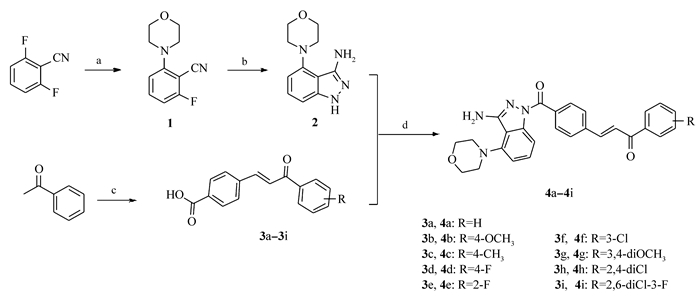
The synthetic methods for compounds 4a-4i are outlined in Scheme 1. The condensation of 2, 6-difluorobenzonitrile with morpholine in dimethyl sulfoxide afforded intermediate 2-fluoro-6-morphinylbenzonitrile(1) as white crystalline solid. The cyclisation of compound 1 with hydrazine hydrate in N-methylpyrrolidone at reflux for 23 h gave 3-amine-4-morpholino-1H-indazol(2). A series of substituted 4-(3-oxo-3-phenylprop-1-en-1-yl) benzoic acids(3) were synthesized by condensation of 4-formylbenzoic acid with different substituted acetophenone. The condensation of compound 2 with compound 3 in N, N-dimethylformamide afforded target compounds 4a-4i. Compounds 4a-4i were appropriately established by spectroscopic and analytical methods. All data were consistent with the structures of compounds 4a-4i, for example, IR shows the peak at about 1653 cm-1 results from the carbonyl stretching vibration of compound 4a. The 1H NMR spectrum for compound 4a exhibits a broad singlet at δ 6.07, corresponding to the NH2 proton at position 3 of indazole. In the mass spectrum of compound 4a, the peak appeared at m/z 475.2([M+Na]+, 100%), which is in accordance with its molecular formula. IR, 1H NMR, MS and elemental analyses of the target compounds confirmed their structural integrity. The existing chalcones in compounds 4a-4i could lead to E or Z isomeric forming. According to the reported motif of chalcones, the coupling constants of vinylic protons were observed for the E configuration(J > 15.00 Hz) and Z configuration(J < 12.00 Hz)[15-16]. The coupling constants(J≈15.6 Hz) of the vinylic system confirm the E-configuration for all synthesized compounds 4a-4i. For example, compound 4a showed a doublet peak at 7.83, which have coupling constant value 15.60 Hz corresponding to the E-configuration of chalcone. The E-configuration of compounds 4a-4i maybe due to the strong steric effects between the vinylic phenyl ring and the carbonyl group.
Scheme 1
Scheme 1.
Synthetic routes of the E-configuration of compounds 4a-4i
All the nine newly synthesized compounds(4a-4i) were screened for their in vitro antiproliferative activity by the MTT-based assay using sorafenib as a positive control. They were tested against two human cancer cell lines(MKN45 and A549). The results were expressed as IC50 values and summarized in Table 1. All the target compounds showed moderate-to-excellent antiproliferative activity against different cancer cells and some exhibited more or similar potent activities against certain cancer lines in comparison with sorafenib, indicating that the combination of indazole and chalcone moiety in one molecular maintained potent antiproliferative. More importantly, most of the compounds were more potent against MKN45 cell line than against A549 cell line(except for compounds 4f and 4i). The most promising compounds 4a and 4d exhibited more potent antiproliferative activity against A549 cell line than the positive control sorafenib with IC50 values of 2.65 and 3.55 μmol/L, respectively.
Table 1
Table 1.In vitro antiproliferative activity test of target compounds on MKN45 and A549 cell lines
a.IC50:concentration of the compound(μmol/L) producing 50% cell growth inhibition after 72 h of drug exposure, as determined by the MTT assay. Each experiment was carried out in triplicate; b.used as a positive control
3.
Conclusion
In summary, a series of novel indazole-chalcone hybrids were synthesized and investigated for their in vitro antiproliferative activity against two human cancer cell lines MKN45 and A549. Most compounds showed moderate-to-excellent activities against all cancer cell lines, indicating that the combination of indazole and chalcone moiety in one molecular maintained potent antiproliferative activities. The most two promising compounds 4a and 4d showed antiproliferative activities with IC50 values of 2.65 and 3.55 μmol/L against MKN45 cell lines, respectively. More importantly, it provided novel scaffolds for anticancer agents research. Further studies on structural optimization and biological activities about these derivatives are still underway in our laboratory and will be reported in the future.
[1]
Saczewski F, Kornicka A, Rybczynska A. 1-[(Imidazolidin-2-yl)imino]indazole. Highly alpha 2/I1 Selective Agonist:Synthesis, X-Ray Structure, and Biological Activity[J]. J Med Chem,
2008, 51(12):
3599-3608.
doi: 10.1021/jm800112s
[2]
Kim S H, Markovitz B, Trovato R. Discovery of a New HIV-1 Inhibitor Scaffold and Synthesis of Potential Prodrugs of Indazoles[J]. Bioorg Med Chem Lett,
2013, 23(10):
2888-2892.
doi: 10.1016/j.bmcl.2013.03.075
[3]
Sun Y, Shan Y, Li C. Discovery of Novel Anti-angiogenesis Agents. Part 8:Diaryl Thiourea Bearing 1H-Indazole-3-amine as Multi-target RTKs Inhibitors[J]. Eur J Med Chem,
2017, 141:
373-386.
doi: 10.1016/j.ejmech.2017.10.008
[4]
Schmidt A. Biologically Active Mesomeric Betaines and Alkaloids, Derived from 3-Hydroxypyridine, Pyridin-N-oxide, Nicotinic Acid and Picolinic Acid:Three Types of Conjugation and Their Consequences[J]. Curr Org Chem,
2004, 8(8):
653-670.
doi: 10.2174/1385272043370663
[5]
Liu Y M, Yang J S, Liu Q H. A New Alkaloid and Its Artificial Derivative with an Indazole Ring from Nigella glandulifera[J]. Chem Pharm Bull,
2004, 52(4):
454-455.
doi: 10.1248/cpb.52.454
[6]
Malik S, Cunheng H, Clardy J. Isolation and Structure Determination of Nigelicine, a Novel Alkaloid from the Seeds of Nigelia sativa[J]. Tetrahedron Lett,
1985, 26(23):
2759-2762.
doi: 10.1016/S0040-4039(00)94904-9
[7]
Modzelewska A, Pettit C, Achanta G. Anticancer Activities of Novel Chalcone and Bis-chalcone Derivatives[J]. Bioorg Med Chem,
2006, 14(10):
3491-3495.
doi: 10.1016/j.bmc.2006.01.003
[8]
Mourad M A, Abdelaziz M, Geld A R. Design, Synthesis and Anticancer Activity of Nitric Oxide Donating/Chalcone Hybrids[J]. Eur J Med Chem,
2012, 54:
907-913.
doi: 10.1016/j.ejmech.2012.05.030
[9]
Ding H G, Cai Z Q, Hou L. Synthesis and Evaluation of Some Novel 6-Substituted Quinazoline Derivatives as Antitumor Agents[J]. J Chem Soc Pak,
2019, 41(1):
186-190.
[10]
Gacche R N, Dhole N A, Kamble S G. In-vitro Evaluation of Selected Chalcones for Antioxidant Activity[J]. J Enzyme Inhib Med Chem,
2008, 23(1):
28-31.
doi: 10.1080/14756360701306370
[11]
Bekhit A A, Habib N S, Eldin A. Synthesis and Antimicrobial Evaluation of Chalcone and Syndrome Derivatives of 4(3H)-Quinazolinone[J]. Boll Chim Farm,
2001, 140(297):
2001.
[12]
Husain A, Rashid M, Mishra R. Bis-chalcones and Flavones:Synthesis and Antimicrobial Activity[J]. Acta Pol Pharm,
2013, 70(3):
443-449.
[13]
Liu J, Ge H G, Lu J F. Synthesis, Crystal Structure and Biological Activity of Diethyl-2-[5-(4-fluorophenyl)-7-(trifluoromethyl)pyrazolo[1, 5-a]pyrimidine-3-carboxamido]pentanedioate[J]. J Chem Res,
2015, 39(1):
4-6.
doi: 10.3184/174751915X14206280982837
[14]
Liu J, Zhang X W, Song D Z. Synthesis, Crystal Structure and Biological Activity of 5-(4-Fluorophenyl)-N, N-Dimethyl-7-(trifluoromethyl)pyrazolo[1, 5-a]pyrimidine-3-Carboxamide[J]. J Chem Res,
2016, 40(2):
107-109.
doi: 10.3184/174751916X14532123759818
[15]
Ferreira D, Roux D G. Novel Conversions and Coupling Reactions of Chalcones and Their Epoxides[J]. J Chem Soc, Perkin Trans 1,
1977, 2:
134-138.
[16]
Shankaraiah N, Nekkanti S, Brahma U R. Synthesis of Different Heterocycles-linked Chalcone Conjugates as Cytotoxic Agents and Tubulin Polymerization Inhibitors[J]. Bioorg Med Chem,
2017, 25(17):
4805-4816.
doi: 10.1016/j.bmc.2017.07.031
Scheme 1
Synthetic routes of the E-configuration of compounds 4a-4i
Table 1.In vitro antiproliferative activity test of target compounds on MKN45 and A549 cell lines
Compounds
(IC50±SD)/(μmol·L-1)a
MKN45
A549
4a
2.65±0.19
19.83±1.21
4b
6.36±0.43
15.48±0.76
4c
6.64±0.21
14.31±0.84
4d
3.55±0.15
12.79±1.01
4e
5.38±0.43
124.5±3.32
4f
16.52±1.47
10.62±0.38
4g
5.13±0.23
14.57±0.89
4h
7.81±0.55
21.68±1.36
4i
6.58±0.31
4.78±0.22
Sorafenibb
4.69±0.28
3.98±0.16
a.IC50:concentration of the compound(μmol/L) producing 50% cell growth inhibition after 72 h of drug exposure, as determined by the MTT assay. Each experiment was carried out in triplicate; b.used as a positive control


 下载:
下载:


 下载:
下载:


 下载:
下载:

