
Figure 1.
XRD pattern of AlH3·nEt2O at room temperature after storing for different period of time
a.1 day; b.4 days; c.8 days; d.12 days; e. 16 days; f.20 days

Stability of Aluminum Hydride Etherates and Its Solid-State Conversion to Alpha-Aluminum Hydride
Zhaoyang ZHU , Aifeng JIANG , Debin XIA , Ping WANG , Kaifeng LIN , Jizhuang FAN , Ruiqing FAN , Yulin YANG


AlH3 possesses volumetric hydrogen density that is more than twice of liquid hydrogen. Moreover, its gravimetric hydrogen density exceeds mass fraction 10%, which is much higher than that of other metal hydrides. Such high hydrogen content makes aluminum hydride compounds an excellent hydrogen storage medium[1-4].
Al2H6 is the most common AlH3 configuration that belongs to octahedron group and Al-H bonds stacked in different ways, thus AlH3 possesses seven different crystal forms, including α, α′, β, δ, ξ, θ and γ. Among them, α-AlH3 possesses excellent stability[5]. In 1947, Finholt et al[6] reported an organic method for the first time to prepare etherated complex of AlH3 by reacting between AlCl3 and LiH in ether solution. The specific reaction equation (1) is described as follows:
|
${\rm{AlC}}{{\rm{l}}_3} + 3{\rm{LiH}} \to {\rm{Al}}{{\rm{H}}_3} + 3{\rm{LiCl}} $ |
(1) |
What they obtained was an ethereal solution of AlH3, which was not stable. Based on the above method, Brower et al.[5] prepared AlH3 in ether solution by using LiAlH4 and AlCl3 as staring materials in 1976. The reaction principle is shown below (2)(3):
|
$3{{\mathop{\rm LiAlH}\nolimits} _4} + {\rm{AlC}}{{\rm{l}}_3} \to 4{\rm{Al}}{{\rm{H}}_3} \cdot n{\rm{E}}{{\rm{t}}_2}{\rm{O}} + 3{\rm{LiCl}} $ |
(2) |
|
$4{\rm{Al}}{{\rm{H}}_3} \cdot n{\rm{E}}{{\rm{t}}_2}{\rm{O}} \to 4{\rm{Al}}{{\rm{H}}_3} + n{\rm{E}}{{\rm{t}}_2}{\rm{O}} $ |
(3) |
Brower′s method for AlH3 preparation possesses the advantages of fast reaction, single crystal phase and good quality product. Some researchers tried to prepare AlH3 by using mechanical milling method[7-11], but AlH3 prepared by this method is prone to extremely unstable α′-AlH3. Saitoh et al.[12-13] studied the direct hydrogenation of metallic aluminum under high-temperature and high-pressure condition through hydrogen flow. Stable α-AIH3 can be obtained but the reaction condition was harsh. At present, the organic synthesis of α-AlH3 is still a research topic, during such synthesis process, aluminum hydride etherates(AlH3·nEt2O) would be formed as intermediate. Therefore, deetherification and crystal transformation are key steps to obtain α-AlH3. Nowadays, most literature reports on α-AlH3 in the literature are formed in toluene solution[14-17]. Obviously, the method of deetherification and crystal transformation used now is not ecofriendly, and the toxic toluene solvent is required in large quantities during the crystal phase transformation process[18]. Moreover, it needs to be emphasized that the effect of ether content in AlH3·nEt2O on crystal transformation has not been explored up to date. In view of these two points, it is worth investigating the stability of AlH3·nEt2O and developing new methods for the α-AlH3 preparation.
In this work, we have successfully improved the procedure for AlH3·nEt2O preparation in a safe and efficient way based on Brower′s method and prepared α-AlH3 based on AlH3·nEt2O in solid state form under non-toluene condition. The evolution of the AlH3·nEt2O during storage at room temperature was also investigated. The loss of ether in AlH3·nEt2O was characterized by TGA-DSC. The crystal phase of the obtained products was characterized by XRD, and the hydrogen content of the obtained AlH3 was determined by TGA-DSC. To the best of our knowledge, this is the first report on the effect of the ether content in AlH3·nEt2O on crystal transformation.
X-ray powder diffraction(XRD, PANalytical Empyrean); Thermal Gravimetric Analyzer and Differential Scanning Calorimetry(TGA-DSC, Thermo Fisher Escalab 250Xi); Scanning Electron Microscopy(SEM, Hitachi SU 8000HSD).
Lithium aluminium hydride and aluminium chloride were purchased from Sinopharm Chemical Reagent Co., Ltd(Analytical reagent). Ethyl ether was purchased from Shanghai Aladdin Bio-Chem Technology Co., LTD(Analytical reagent).
A certain concentration of LiAlH4 in ether solution and AlCl3 in ether solution was separately prepared. Then, the solution of AlCl3 in ether was dropwised to the solution of LiAlH4 in ether, keeping the molar ratio n(LiAlH4) to n(AlCl3) 4:1 at -10 ℃. After 10~15 min, LiCl was removed by filtration under low temperature to obtain the AlH3·nEt2O in diethyl ether solution. The solvent was removed by evaporation under reduced pressure before the solid product was heated up to 30 ℃. The obtained etherated product was dried under vacuum at 45 ℃ for 2 hours, and then rapidly grounded into powder in argon environment. After grinding, it was quickly transferred to a sample tube filled with argon. The AlH3·nEt2O sample was stored in argon atmosphere at room temperature for varying time between 1 and 20 days. Then the argon was removed via a vacuum pump. The tube was put into the oil at 94 ℃ for 15 min, then in argon atmosphere for 45 min. Finally, the product obtained in the tube is α-AlH3.
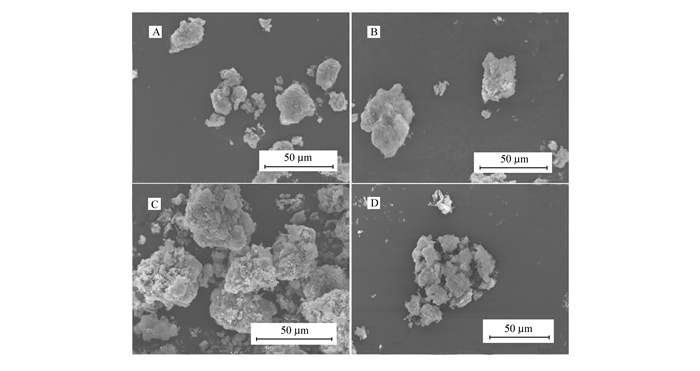
The XRD of AlH3·nEt2O after different storage time is shown in Fig. 1. The AlH3·nEt2O did not change much during the first 12 days of storage. After 20 days, XRD patterns ascribed to α′-AlH3 and γ-AlH3 could be observed. This is due to the slow deetherification of the etherate during storage, and some of AlH3·nEt2O formed less stable γ-AlH3 and α′-AlH3 during the deetherification process. SEM images further reveal the morphology changes of the AlH3·nEt2O. As shown in Fig. 2, the newly prepared AlH3·nEt2O exhibits an overall amorphous state, with most of the particle size distributed in the range of 30~50 μm. However, needle-like γ-AlH3 appeared after the ether complex was stored for 20 days. Moreover, the solid particles split into small particles with the size of 10~25 μm. This is because the AlH3·nEt2O undergoes deetherification process, which weakens the intermolecular interactions.
a.1 day; b.4 days; c.8 days; d.12 days; e. 16 days; f.20 days
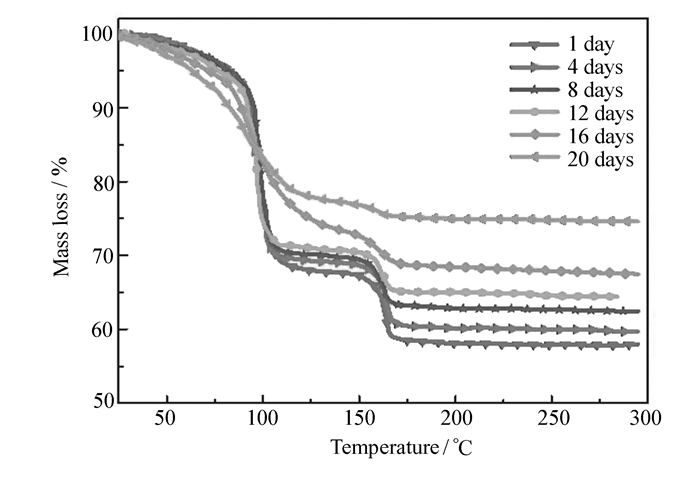
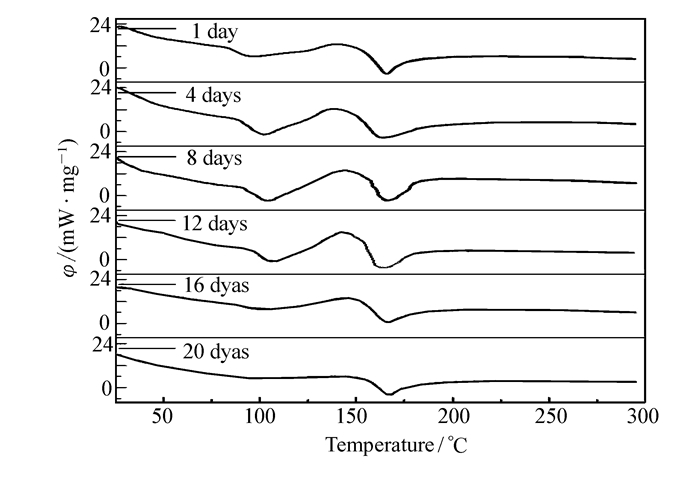
The self-deetherification from AlH3·nEt2O during storage is further confirmed by TGA(Fig. 3) and DSC(Fig. 4). There is a de-etherification process of the ether compound within 25~120 ℃, and a dehydrogenation process between 150 and 175 ℃. The ether removal rate is relatively slow within 12 days. However, as shown in Fig. 3, an obvious decrease in the ether content of AlH3·nEt2O was observed when the AlH3·nEt2O was stored longer than 12 days. With the increase of the preservation time of AlH3·nEt2O, the H% of its product α-AlH3 generated decreases correspondingly(see Table S1 in Supporting Information).
In order to get pure α-AlH3, the condition for crystal transformation with AlH3·nEt2O was first optimized based on the same AlH3·nEt2O. The XRD patterns of AlH3 obtained according to transmutation procedures described in the experimental section. The solid-state dynamic vacuum crystallization method at 94 ℃ for 15 min leads to a single crystal form of pure α -AlH3. The product obtained by vacuum crystallizing for less than 10 minutes and then transferred to normal argon atmosphere results in a mixture of α-AlH3 with a small amount of γ-AlH3, indicating that long time vacuum is good for deetherification and crystal transformation into pure α-AlH3.
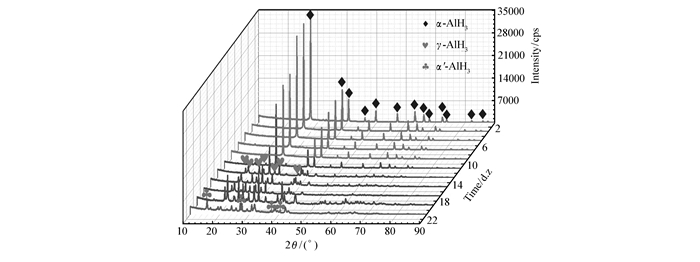
To investigate the effect of storage time for AlH3·nEt2O on the crystal transformation into α-AlH3, we carried out the XRD measurements(Fig. 5). Pure α-AlH3 could be obtained based on AlH3·nEt2O stored within 1~10 days. However, the diffraction peak intensity gradually decreases with increasing the storage time. After the AlH3·nEt2O stored for more than 11 days, small amount of γ-AlH3 could be formed after deetherification, which is probably due to the decomposition of AlH3·nEt2O during storage. In addition to α-AlH3 and γ-AlH3, α′-AlH3 crystal phase was also found after deetherification if AlH3·nEt2O was stored for 19 days. In addition, if AlH3·nEt2O was stored for more than 20 days, α-AlH3 was hardly found. We propose that α-AlH3 formation is strongly related to the state of AlH3·nEt2O. It is know that the interaction force between AlH3 and Et2O is weak. With the increase of storage time, part of the ether separates from AlH3, which is evidenced by the weight loss rate for AlH3·nEt2O before 100 ℃ as shown in Fig. 3. Thus we conclude that a high ratio ether in AlH3·nEt2O is favoring α-AlH3 formation. With the increase of the storage time, the content of ether in AlH3·nEt2O gradually decreased. The lower the ether content in AlH3·nEt2O is, the more likely to form less stable γ-AlH3 and α′-AlH3. To investigate the morphology of transcrystalline product based on AlH3·nEt2O stored for various time, we carried out SEM measurements. As shown in Fig. 6, within 8 days, only α-AlH3 could be obtained with a cubic shape and agglomeration phenomenon. After 12 days, crystal sizes are generally minimized to 1~2 μm.
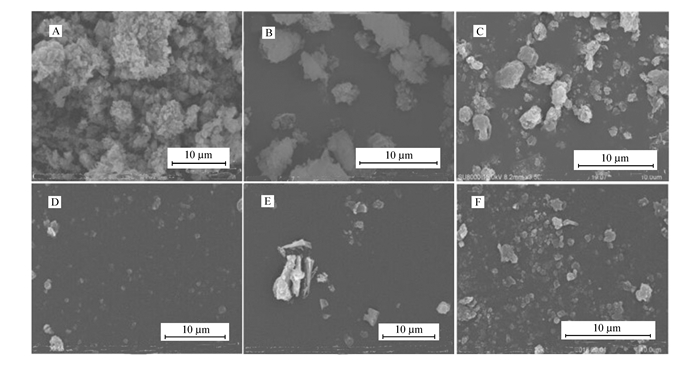
A.1 day; B.4 days; C.8 days; D.12 days; E.16 days; F.20 days.
To figure out whether the storage time of AlH3·nEt2O has influence on the hydrogen content of yield crystalline product, TGA measurement was employed. As shown in Fig. 7, the longer the storage time of AlH3·nEt2O is, the lower the hydrogen content of the product obtained by the transmutation is. The hydrogen content of the resulting product dropped rapidly if AlH3·nEt2O was stored for more than 12 days. As the storage time of AlH3·nEt2O extended to 20 days, the hydrogen content of the product decreased to 5.4%.
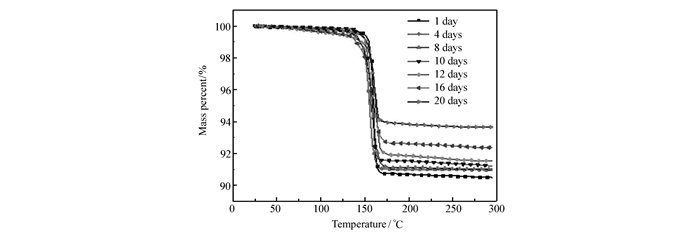
We prepared AlH3·nEt2O, which could be stored for more than 10 days, before it could be converted to high-quality α-AlH3.We have also found that the content of ether in AlH3·nEt2O decreased with the increase of storage time. Solid-phase vacuum method for converting AlH3·nEt2O to α-AlH3 was achieved, providing a possibility for large-scale α-AlH3 production. It is also found that the content of ether in AlH3·nEt2O has a significant effect on the purity and quality of the produced α-AlH3. The highest hydrogen content(9.2%) of α-AlH3 was obtained by dynamic vacuum crystallization at 94 ℃ for 15 min and argon atmosphere for 45 min.
Supporting information [H mass fraction of corresponding α-AlH3] can be downloaded freely from our website(http://yyhx.ciac.jl.cn/).
Graetz J, Reilly J J, Yartys V A. Aluminum Hydride as a Hydrogen and Energy Storage Material:Past, Present and Future[J]. J Alloys Compd, 2011, 509: S517-S528. doi: 10.1016/j.jallcom.2010.11.115
Duan C, Cao Y, Hu L. Synergistic Effect of TiF3 on the Dehydriding Property of α-AlH3 Nano-composite[J]. Mater Lett, 2019, 238(1): 254-257.
Wang L, Rawal A, Aguey-Zinsou K. Hydrogen Storage Properties of Nanoconfined Aluminium Hydride(AlH3)[J]. Chem Eng Sci, 2019, 194(2): 64-70.
Zheng J, Xiao X, He T. Enhanced Reversible Hydrogen Desorption Properties and Mechanism of Mg(BH4)2-AlH3-LiH Composite[J]. J Alloys Compd, 2018, 762(25): 548-554.
Brower F M, Matzek N E, Reigler P F. Preparation and Properties of Aluminum Hydride[J]. J Am Chem Soc, 1976, 98(9): 2450-2453. doi: 10.1021/ja00425a011
Finholt A E, Jr A C B, Schlesinger H I. Lithium Aluminum Hydride, Aluminum Hydride and Lithium Gallium Hydride, and Some of Their Applications in Organic and Inorganic Chemistry[J]. J Am Chem Soc, 1947, 69(5): 1199-1203. doi: 10.1021/ja01197a061
Long V D, Knight D A, Paskevicius M. Novel Methods for Synthesizing Halide-Free Alane Without the Formation of Adducts[J]. Appl Phys A, 2012, 107(1): 173-181. doi: 10.1007/s00339-012-6791-z
Nakagawa Y, Lee C, Matsui K. Doping effect of Nb Species on Hydrogen Desorption Properties of AlH3[J]. J Alloys Compd, 2018, 734(15): 55-59.
Duan C W, Hu L X, Dan X. Solid State Synthesis of Nano-sized AlH3 and Its Dehydriding Behaviour[J]. Green Chem, 2015, 17(6): 3466-3474. doi: 10.1039/C5GC00426H
Sartori S, Opalka S M, Løvvik O M. Experimental Studies of α-AlD3 and α'-AlD3 Versus First-Principles Modelling of the Alane Isomorphs[J]. J Mater Chem, 2008, 18(20): 2361-2370. doi: 10.1039/b718896j
Duan C W, Hu L X, Ma J L. Ionic Liquids as an Efficient Medium for the Mechanochemical Synthesis of α-AlH3 Nano-composites[J]. J Mater Chem A, 2018, 6(15): 6309-6318. doi: 10.1039/C8TA00533H
Saitoh H, Machida A, Katayama Y. Formation and Decomposition of AlH3 in the Aluminum-Hydrogen System[J]. Appl Phys Lett, 2008, 93(15): 151918. doi: 10.1063/1.3002374
Saitoh H, Okajima Y, Yoneda Y. Formation and Crystal Growth Process of AlH3 in Al-H System[J]. J Alloys Compd, 2010, 496(1/2): L25-L28.
刘海镇, 王新华, 刘永安. AlH3的制备及放氢特性[J]. 高等学校化学学报, 2013,34,(10): 2274-2278. doi: 10.7503/cjcu20130227LIU Haizhen, WANG Xinhua, LIU Yongan. Preparations and Dehydriding Properties of AlH3[J]. Chem J Chinese Uinv, 2013, 34(10): 2274-2278. doi: 10.7503/cjcu20130227
Xu B, Liu J P. Aluminum Hydride Polymorphs:Preparation, Characterization and Thermal Properties[J]. Adv Mater Res, 2013, 712-715: 333-336. doi: 10.4028/www.scientific.net/AMR.712-715.333
Bulychev B M, Verbetskii V N, Storozhenko P A. "Direct" Synthesis of Unsolvated aluminum Hydride Involving Lewis and Bronsted Acids[J]. Russ J Inorg Chem, 2008, 53(7): 1000-1005. doi: 10.1134/S0036023608070048
Bulychev B M, Storozhenko P A, Fokin V N. "One-Step" Synthesis of Nonsolvated Aluminum Hydride[J]. Russ Chem Bull, 2009, 58(9): 1817-1823. doi: 10.1007/s11172-009-0247-4
Xu B, Liu J, Wang X. Preparation and Thermal Properties of Aluminum Hydride Polymorphs[J]. Vacuum, 2014, 99: 127-134. doi: 10.1016/j.vacuum.2013.05.009

Figure 1 XRD pattern of AlH3·nEt2O at room temperature after storing for different period of time
a.1 day; b.4 days; c.8 days; d.12 days; e. 16 days; f.20 days

Figure 2 SEM images of fresh(A, B) AlH3·nEt2O, and AlH3·nEt2O stored for 20 days(C, D)

Figure 5 XRD patterns of the crystalline product based on AlH3·nEt2O with varying storage time at room temperature

Figure 6 SEM images of the crystalline product after preservation
A.1 day; B.4 days; C.8 days; D.12 days; E.16 days; F.20 days.

 扫一扫看文章


扫一扫关注我们
 下载:
下载:
 下载:
下载:


 下载:
下载: