Citation:
DA Zulin, ZHAO Yong, SHI Weidong. Facile Preparation of Bi4V2O11/Reduced Graphene Oxide Heterojunction Photocatalysts for the Degradation of Antibiotic Pollutants[J]. Chinese Journal of Applied Chemistry,
2018, 35(8): 946-955.
doi:
10.11944/j.issn.1000-0518.2018.08.180148
Received Date:
02 May 2017 Accepted Date:
26 May 2017 Revised Date:
24 May 2017 Available Online:
01 August 2018
Fund Project:
Supported by the National Natural Science Foundation of China(No.21477050, No.21522603, No.21706101), the Henry Fok Education Foundation(No.141068), the Six Talents Peak Project in Jiangsu Province(No.XCL-025), the Chinese-German Cooperation Research Project(No.GZ1091), the China Postdoctoral Foundation(No.2017M611731)
Abstract:
Designing and developing active, cost-effective and stable photocatalysts for the degradation of antibiotic pollutants are still an ongoing challenge. Herein, the fabrication of Bi4V2O11/reduced graphene oxide(BR) composite through a facile hydrothermal reaction, and the effective photocatalytic activity of BR composite towards the degradation of antibiotic pollutants under visible light are demonstrated. The active species of the photocatalytic system are proved to be h+ and·OH radicals by free radical trapping experiments. Based on the results, a reasonably reaction mechanism to explain the improved photocatalytic activity was also given. The introduction of reduced graphene oxide (rGO) can promote the effective separation of photo-generated electron-hole pairs of Bi4V2O11 materials, and ultimately increase its photocatalytic activity. As the results, the composite shows high activity and excellent stability towards the degradation of antibiotic pollutants. This method produces a high photocatalytic activity based on rGO support, providing a new avenue for designing excellent photocatalysts.
Recently, the rapid growth of the world economy has brought serious environmental pollution problems. In particular, the excessive use of antibiotics poses a great threat to the safety of humans and other living beings[1-2]. It is well-known that most antibiotics are structurally stable, which are difficult to decompose naturally. In order to solve such problems, many techniques have been applied to deal with the residual antibiotics in environment, such as physical adsorption, biodegradation, chemical precipitation and electrolysis. These techniques have achieved certain results and provided many possibilities in this field. However, they also suffer many disadvantages, such as high energy consumption, incomplete decomposition, and secondary pollution. Therefore, it is imperative to develop a green, efficient and energy-saving technology for the decomposition of antibiotic pollutants in environment. Photocatalysis possesses the advantages of low energy consumption, reaction completely, simple reaction device and pollution-free, and has been widely used in environmental purification and emerging energy-related fields[3-5]. When it comes to applications in treatment of antibiotic pollutants, photocatalytic method can gradually realize the mineralization of antibiotics until complete removal, which prevents secondary pollution. Therefore, the photocatalysis is considered as an ideal technique to solve the problem of residual antibiotic pollutants.
For photocatalytic process, the photocatalysts determine the total efficiency and become the most important factor for the development of current technology. Under the illumination, electrons of photocatalysts transport from the valence band to the conduction band. As the result, the hole is produced on the valence band, which then becomes the active site for antibiotic degradation. Inexpensive TiO2-based photocatalysts exhibit high degradation efficiency and excellent stability. However, the wide conduction band width, narrow absorption range and easy recombination of photo-generated electrons properties limit their large-scale applications. In this case, the development of more efficient photocatalysts is of great significance. Bi-based photocatalysts with rich reserves and non-toxic properties are widely used for constructing high performance photocatalytic devices. Most Bi-based materials have layered structure, which is considered beneficial for promoting the separation of photo-generated electrons and holes, leading to a high photocatalytic activity. Bi4V2O11 is one of the Bi-containing compounds. It has good dielectric ferroelectric and thermoelectric properties at room temperature[6]. From the structural point of view, the structure of Bi4V2O11 belongs to a stratified aurivillius-type compound. The internal structure has two layers(VO3.5-0.5), and is sandwiched between(Bi2O2)2+ layers. This structure enables the presence of oxygen vacancy, which is beneficial for polar response range. In addition, Bi4V2O11 has a narrow band gap(about 2.20 eV), and has strong light absorption capability for both ultraviolet and visible light with a wavelength less than 680 nm[6]. The Bi4V2O11 has the advantages of lower cost and easier preparation compared with many other materials. However, the Bi4V2O11 has the limitation that they tend to spontaneously aggregate due to their high surface energy, which leads to a significant loss of their activity. Moreover, as a single component, the photo-generated charge carriers of Bi4V2O11 tend to recombine with each other. Therefore, the optimization and stabilization of Bi4V2O11 are crucial aspects that must be taken into consideration during their synthesis from the view point of practical applications.
Recently, reduced graphene oxide(rGO) has attracted much interest for both academic and industry due to its unique physical and chemical structure and high catalytic performance[7-8]. The rGO with two-dimensional structure possesses large specific surface area, high flexibility and electrical conductivity. rGO has been highlighted as a support for photocatalysts as it provides many active sites and an improved electrical conductivity compared with other materials, and thus enhancing the photocatalytic activity. As an excellent reaction support, rGO can effectively minimize the aggregation of photocatalysts particles, provide an enhanced chemical bonding with semiconductor. The mechanism of photocatalytic performance enhancement of rGO can be contributed to the acceleration of photo-generated electron transfer from semiconductor to rGO, which suppresses the recombination of photo-generated carriers. In addition, the large surface area property of rGO also facilitates the adsorption of antibiotic pollutants. Therefore, the employment of rGO as a semiconductor composite substrate has acted as the thrust area of research.
In this paper, the Bi4V2O11/reduced graphene oxide(BR) composite was synthesized by a facile solvothermal method and used for high performance photocatalytic degradation of antibiotic pollutants. The structural characteristics of this composite were examined by powder X-ray diffraction (XRD), Raman spectroscopy, scanning electron microscopy(SEM), transmission electron microscopy(TEM) and UV-Vis diffuse reflectance(DRS) spectra measurements. The degradation experiments of antibiotic pollutants such as tetracycline hydrochloride(TC) were conducted under visible light. Based on the results, the reaction mechanism of photocatalytic process was also explored.
1.
Experimental
1.1
Materials and reagents
Graphite powder, sodium nitrate(NaNO3), concentrated sulfuric acid(H2SO4), potassium permanganate(K2MnO4), hydrogen peroxide(H2O2), hydrochloric acid(HCl), ammonium vanadate(NH4VO3), bismuth nitrate(Bi(NO3)3·5H2O), ethylene glycol(EG), urea and ammonia(NH3·H2O). All of used chemicals were of analytical grade and purchased from Aladdin′s Chemical Reagent Co., Ltd, and used without further purification.
1.2
Preparation of the photocatalysts
1.2.1
Preparation of GO
The graphene oxide(GO) was prepared by a modified Hummer′s method according to the literature[9].
1.2.2
Preparation of Bi4V2O11 microspheres
The amount of 30 mL ethylene glycol was added to the beaker, and then added 2.5 mmol Bi(NO3)3·5H2O into the solution. After the ultrasonic dispersion, 2.5 mmol NH4VO3 and 1.5 g urea were added into the beaker under stirring until the solution was orange. Then, the pH was adjusted to 7.5 by the dilute ammonia solution(14%), and the solution changed into bright yellow. Finally, the suspension was transferred into the reaction kettle, and reacted for 24 h in 180 ℃ oven. The Bi4V2O11 sample was obtained after washing and drying of sediment[6].
1.2.3
Preparation of Bi4V2O11/reduced graphene oxide(BR) composites
The Bi4V2O11/reduced graphene oxide(BR) photocatalysts were synthesized by a facile hydrothermal route[11]. Particularly, a 30 mL ethylene glycol solution containing 0.3 g GO mixed by ultrasonic for 5 h was added into 50 mL beaker. Subsequently, 2.5 mmol Bi(NO3)3·5H2O was dispersed in the GO solution, ultrasonic for 5 min. After that, 2.5 mmol NH4VO3 and urea were poured into the reaction mixture. After vigorous stirring for 30 min at indoor temperature, the pH of the mixture was regulated by slow titrating dilute ammonia solution(14%). Finally, the blackish green solution was transferred to 50 mL Teflon-lined stainless autoclave, and reacted in 180 ℃ oven for 24 h. After the reaction, the obtained BR samples were washed with absolute ethanol and deionized water, and finally dried 12 h at a 353 K oven for next use. For better identification, the obtained samples were marked separately as Bi4V2O11, BR-1% (the number represents the mass fraction of Bi4V2O11), BR-2%, BR-4%, BR-6%, BR-8%, and the Bi4V2O11 samples were prepared by a similar strategy, except for the ethylene glycol solution without GO.
1.3
Characterizations
D/MAX-2500 XRD(Rigaku, Japan) was used to describe the crystal of the samples with CuKα radiation(λ=0.154178 nm). The morphologies of the samples were determined by S-4800 model SEM(Hitachi, Japan). Tenai G2 F30 S-Twin TEM and high-resolution TEM(HRTEM)(FEI Co., America) was used to character the lattice structure at an accelerating voltage of 200 kV. The UV-Vis diffuse reflectance(DRS) spectra were measured by a UV-2450 model spectrophotometer(Shimadzu, BaSO4 as a reflectance standard, Japan). An CHI 660B electrochemical workstation(CHI Co., Shanghai) was used to character the photocurrent intensity of the samples in a three-electrode cell. The electron spin resonance(ESR) technology was used to describe the active species by an electron paramagnetic resonance(EPR) spectrometer(Bruker EPR A 300-10/12, dimethyl pyridine N-oxide(DMPO) as ·O2- and OH radical trapping agent, America).
1.4
Photocatalytic activity evaluation
The photocatalytic activity of Bi4V2O11 and BR samples with different contents of Bi4V2O11 was analyzed by degradation of TC solution(10 mg/L) under visible light irradiation. Specifically, an aqueous TC solution of 100 mL was added into a Pyrex photocatalytic reactor. Then 50 mg samples were dispersed in the solution, stirring for 60 min in darkness. After the solution reached the adsorption-desorption equilibrium, the reactor was illuminated by a 250 W Xe lamp with a 400 nm cut-off filter. During the photocatalytic reaction, water circulation control should be introduced to keep the reactor at room temperature. At 10 min time irradiation intervals, 5 mL reactor solutions was extracted by the sampling tube from the reactor, and centrifuged to remove the precipitate. Finally, the clear liquid was measured by a UV-Vis spectrophotometer(TU-1810, Pgeneral, Beijing) to corroborate the absorbance of TC at 357 nm, which is corresponding with the photocatalytic ability of the samples.
1.5
Photocatalytic recycle experiments
The photocatalytic stability of the photocatalysts was evaluated by degrading the TC solution under visible light irradiation. The BR-4% sample was chosen as the target sample for the best photocatalytic activity to evaluate the recycle experiments. In detail, the BR-4% sample was collected by centrifugal, washing and drying processes after completing one cycle test. The recycle experiments were carried out four times.
2.
Results and Discussion
2.1
XRD and Raman analysis
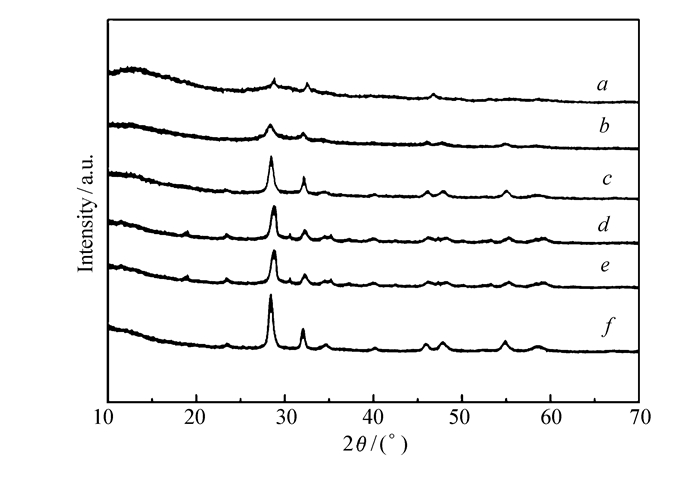
XRD was used to determine the structure and crystal of the prepared samples. As shown in Fig. 1, several characteristic peaks of Bi4V2O11 appear at 28.6°, 31.8° and 32.2°, which is readily indexed as the orthogonal Bi4V2O11 phase(JCPDS card No.80-0019), corresponding to the crystal surface of (113), (020) and (200), respectively[6]. The sharp diffraction peaks of Bi4V2O11 can be clearly assigned to the well crystalline of the as-prepared sample. In addition, the characteristic peaks of Bi4V2O11 over BR composites gradually become weak with the increasing amount of GO. However, the characteristic diffraction peaks of rGO at 2θ=11.2° disappear in Fig. 1 because of content of rGO is much less than that of Bi4V2O11.
图 1
图 1
XRD patterns of pure Bi4V2O11 and BR composites with different mass fraction of GO
Figure 1.
XRD patterns of pure Bi4V2O11 and BR composites with different mass fraction of GO
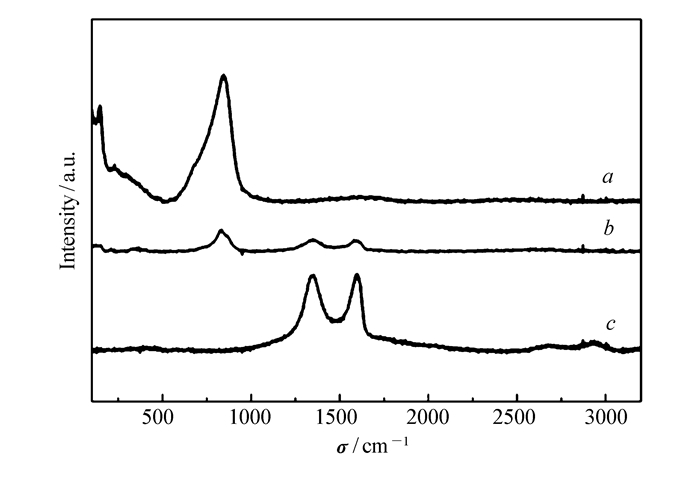
In order to further confirm the presence of rGO, the samples were characterized by Raman spectroscopy. The Raman spectra of GO, Bi4V2O11 and BR-4% composites were shown in Fig. 2. In this pattern, the interaction between Bi4V2O11 and rGO in the BR-4% nanocomposite were analyzed by studying the curve. It can be seen from Fig. 2 that the BR-4% sample shows two broad overlapping bands between 1345 and 1586 cm-1, which is correspond to the D and G bands of GO[12-14]. Among them, the D-band corresponds to the disordered band of structural defects generated during GO reduction, while the G-band corresponds to the sp2 carbon atoms and E2g first order phonon scattering of rGO. It is noted that the intensity ratio of D and G bands is an important indicator to measure local defects and sp2 hybridization of the graphite alkyl[15]. It can be seen from the figure that the intensity ratio of ID/IG is 0.99. After the solvothermal reaction, the ID/IG ratio increased from 0.99 to 1.14. The results indicate that GO is thermally reduced to rGO. In addition, BR-4% sample has three strong peaks at 144, 229 and 847 cm-1, corresponding to different vibrational modes of Bi4V2O11[6]. After compounding with rGO, the characteristic peak intensity of Bi4V2O11 decreased significantly. This further confirms that the BR sample consists of two components of rGO and Bi4V2O11.
图 2
图 2
Raman spectra of the synthesized Bi4V2O11 microspheres (a), BR-4% composites(b) and GO(c)
Figure 2.
Raman spectra of the synthesized Bi4V2O11 microspheres (a), BR-4% composites(b) and GO(c)
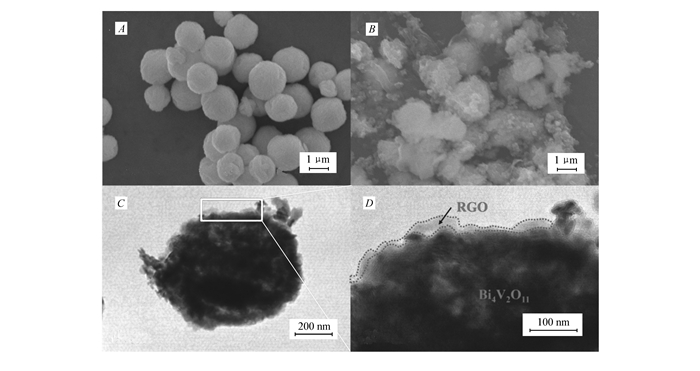
SEM and TEM images of Bi4V2O11 microsphere and BR-4% composites were shown in Fig. 3. It can be seen from Fig. 3A that Bi4V2O11 is a microsphere with a diameter of about 1 μm, and the microspheres are composed of nanoplates with a thickness of about 30 nm. These nanoplatelets are loosely arranged on the surface of the microspheres to form a porous surface[6]. After the introduction of rGO, the surface of Bi4V2O11 was coated with a membrane(Fig. 3B). To further explore the structure of rGO and Bi4V2O11, BR-4% was characterized by TEM(Fig. 3C and 3D). In particular, Fig. 3C is the overall transmission view of BR-4% sample, which can be analyzed after magnification(Fig. 3D). Bi4V2O11 is coated with a membrane(rGO)[16]. This result confirms that BR photocatalyst has been successfully prepared in this experiment.
图 3
图 3
SEM(A, B) and TEM(C, D) images of pure Bi4V2O11(A), BR-4%(B, C, D)
Figure 3.
SEM(A, B) and TEM(C, D) images of pure Bi4V2O11(A), BR-4%(B, C, D)
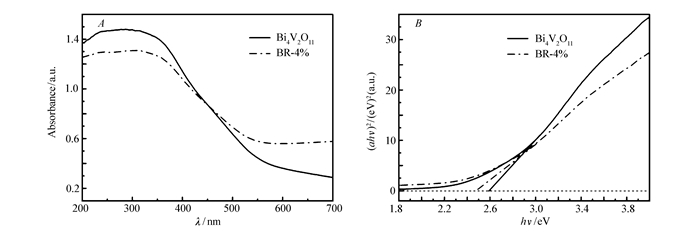
The light absorption characteristics of the Bi4V2O11 and BR-4% samples were investigated by UV-Vis DRS spectra. As shown in Fig. 4A, BR-4% sample has stronger light absorption than that of pure Bi4V2O11 in the visible region. This implies that after introduction of rGO, the visible light absorption intensity of the BR-4% photocatalyst is enhanced and more photons can be absorbed. In addition, the bandgap energy of BR-4% photocatalyst is calculated by the following formula[17-21]:
Among them, α, h, ν, Eg and A are absorption coefficient, Planck constant(eV·s), optical frequency(s-1), band gap energy(eV) and absorbance, respectively. n is determined by the convertible type of semiconductor materials(n=1, direct transitions). From Fig. 4B, the energy gap of Bi4V2O11 is 2.31 eV, and the energy gap of BR-4% is about 2.23 eV, which is smaller than that of the former. The results show that the introduction of rGO can make the band gap of BR-4% narrow so as to widen the light absorption range of the photocatalyst.
2.4
Photocurrent analysis
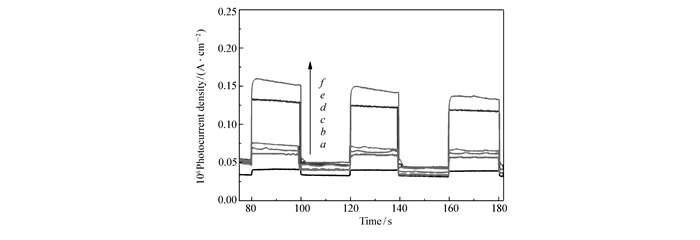
In order to further study the photo-electric properties of photocatalysts, the transient photo-response curves of several switching cycles of different samples were investigated in the light. Fig. 5 is the I-t plot of Bi4V2O11 and BR composites. The experimental results indicate that the photocurrent density of Bi4V2O11 samples is very low, while the photocurrent density of different BR samples is significantly enhanced after the combination of Bi4V2O11 and rGO. Therefore, the separation of the photo-generated carriers in BR samples was promoted by compositing with rGO.
图 5
图 5
Photocurrent response of the prepared samples
Figure 5.
Photocurrent response of the prepared samples
The photocatalytic activity of pure Bi4V2O11 and BR composites was investigated by degrading TC solution(10 mg/L) under visible light irradiation. As shown in Fig. 6A, the photocatalytic activity of pure Bi4V2O11 is lower than those of other BR composites(9.74%). This confirms that rGO in BR samples plays an important role in the activity of photocatalysts. When the amount of rGO introduced reaches 4%, the activity of BR composites begins to weaken. At the same time, the highest photocatalytic activity(72.4%) of the BR-4% sample after 60 min irradiation was observed. However, further increase in the amount of rGO leads to a drastic decrease in the photocatalytic activity. This is due to the introduction of too much rGO, which can bring about agglomeration of the photocatalyst, and ultimately lead to a decrease in the photocatalytic activity. Obviously, the best mass ratio of rGO and Bi4V2O11 is 4% in the reaction system. In order to explore the dynamics of the reaction, a pseudo first-order kinetic model[17, 22-27]was used to explain the experimental data:
$
\ln \left( {{c_0}/c} \right) = kt
$
图 6
图 6
(A)Photocatalytic activities and (B)pseudo-first order kinetic curves of TC degradation over pure Bi4V2O11 and BR composites with different contents of GO under visible light irradiation for 60 min; (C)experimental curves of stability of Bi4V2O11 and BR composite materials in visible light
Figure 6.
(A)Photocatalytic activities and (B)pseudo-first order kinetic curves of TC degradation over pure Bi4V2O11 and BR composites with different contents of GO under visible light irradiation for 60 min; (C)experimental curves of stability of Bi4V2O11 and BR composite materials in visible light
Where c is the TC solution concentration(mol/L), c0 is the concentration of the initial solution(mol/L), and k(min-1) is pseudo-first order rate constant. t is the reaction time(min). As shown in Fig. 6B, BR samples have a higher degradation rate for TC solution than that of pure Bi4V2O11. The photocatalytic stability of the photocatalysts was evaluated by cycling experiments with BR-4% sample as the target specimen and TC solution as the target pollutant. At the end of each experiment, the samples were recovered, and then were dried at 353 K in an oven, and used for the next cycle experiment. The experimental results are shown in Fig. 6C, the BR-4% sample still maintains high photocatalytic activity after four consecutive cycles of experiments. This implies that the BR heterojunction photocatalysts have a higher stability after the introduction of rGO.
2.6
Photocatalytic reaction mechanism
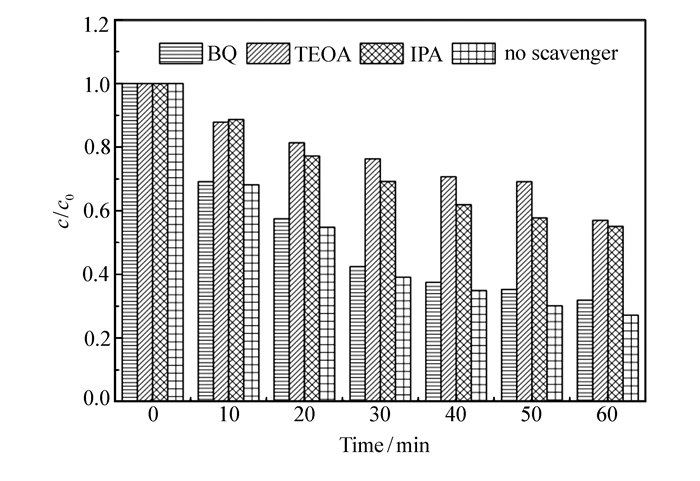
The active species of the BR system was explored by a capture experiment for TC degradation under visible light, and triethanolamine(TEOA), p-benzoquinone(BQ) and isopropanl(IPA) were used as the capture agents for h+, ·O2- and OH free radicals, respectively[18, 22]. As shown in Fig. 7, differences of capture agents have an important impact on the activity for BR-4% sample with an illumination time of 60 min. When TEOA was added to the solution, the degradation rate of TC solution on the sample was decreased to a minimum(40.8%). When BQ was added to the reaction solution, the degradation for TC solution is reduced to 68.9%. When IPA was added to the reaction, the photocatalytic activity for TC degradation is reduced to 43.7%, much lower than the photocatalytic efficiency without capture agent(72.4%). The above results indicate that h+ and OH are the main active species in the BR photocatalytic reaction system.
图 7
图 7
Capture tests of degrading TC solution containing different capture reagents of BR-4% under visible light irradiation
Figure 7.
Capture tests of degrading TC solution containing different capture reagents of BR-4% under visible light irradiation
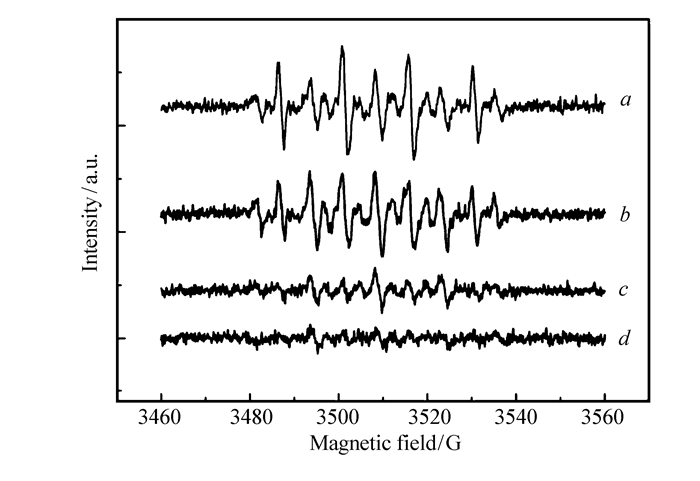
In addition, the active species(·OH radicals) of the BR photocatalytic system can be detected by ESR, and DMPO acts as a trapping agent[25, 27]. Fig. 8 shows ESR spectra of Bi4V2O11 and BR-4% samples under different conditions. The four characteristic peaks of ·OH radicals can be seen from Fig. 8. In addition, the signal intensity of the ·OH peak in the BR-4% sample light in the spectrum is significantly stronger than that in the dark condition, which means that the solar-light can promote a large amount of ·OH radical production in the photocatalytic system. Compared to pure Bi4V2O11, the BR-4% sample has a slightly stronger characteristic peak signal intensity in the light. This is due to the introduction of rGO which promotes the photo-generated charge separation of Bi4V2O11 in BR-4% composites. The separation of charge causes more photo-generated holes to react with water, and eventually produce more ·OH radicals. It is worth noting that there are still three faint peaks in the spectra obtained under dark conditions, which may be the peak of DMPO. Therefore, the result of ESR analysis shows that BR photocatalyst generates a large number of ·OH radicals after light irradiation.
图 8
图 8
Electron paramagnetic resonance spectra of OH radicals captured by DMPO reagent
Figure 8.
Electron paramagnetic resonance spectra of OH radicals captured by DMPO reagent
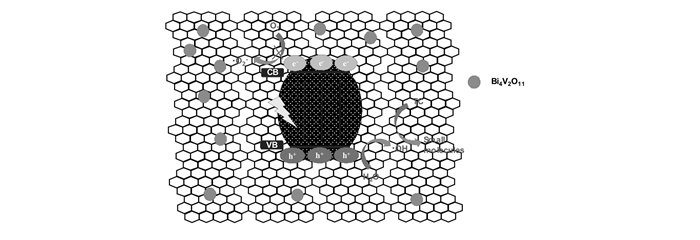
According to the above analysis, a possible electron transfer mechanism can be proposed in the photocatalytic reaction system. It is well known that Bi4V2O11 is a visible-light-driven semiconductor material, which can generate a large amount of photo-generated electrons and holes under visible light irradiation. When rGO is combined with Bi4V2O11, a heterojunction is formed. As shown in Fig. 9, the electron transfer process of this reaction system can be represented by the following path. Obviously, Bi4V2O11 produces a lot of photo-generated electron-hole pairs, and finally separation after being excited by light. Due to the conduction band position of Bi4V2O11 is approximately 0.5 V vs.NHE(normal hydrogen electrode), which is far below the potential of O2/·O2-(-0.33 V vs.NHE). Thus, there are no or less superoxide radicals(·O2-) for Bi4V2O11. However, the valence band of Bi4V2O11(2.81 V vs.NHE) is much lower than the potential of OH-/·OH(2.40 V vs.NHE). Therefore, the photogenerated holes in Bi4V2O11 can oxidize the adsorbed water or OH- to OH radicals[6, 28-29]. In the photocatalytic system, the introduction of rGO can promote the effective separation of photo-generated electron-hole pairs of Bi4V2O11materials, and ultimately increase its photocatalytic activity. The ·OH radicals, as a kind of strong oxidizing active species, can effectively decompose the organic contaminants such as TC into pollution-free small molecules[30-33]. Thus, it can be seen that BR composite photocatalysts have excellent application prospects in the field of environmental treatment because of their simple preparation methods, superior performance and non-polluting characteristics.
图 9
图 9
Photocatalytic reaction mechanism diagram of BR system
Figure 9.
Photocatalytic reaction mechanism diagram of BR system
Bi4V2O11/reduced graphene oxide(BR) composite photocatalyst was prepared by a facile solvothermal method. On this basis, the composition and structure of BR photocatalysts were characterized by XRD, Raman, SEM and TEM analysis. In addition, the optical properties and active species involved in the reaction of the samples were investigated by DRS and ESR characterization. Photocatalytic degradation and repeated experiments were performed on BR photocatalysts under visible light. The integration of rGO could promote the effective separation of photo-generated electron-hole pairs of Bi4V2O11 materials, which minimize the reaction barriers and thus form the superior photocatalytic performance. As a result, the as-prepared rGO/Bi4V2O11 exhibits an excellent photocatalytic activity under visible light. Possible photocatalytic reaction mechanism was proposed, which reasonably explained the reason for the improvement of the photocatalytic activity. The rGO/Bi4V2O11 combining the effective separation of photo-generated electron-hole property have potential for practical antibiotic pollutant degradation applications.
[1]
Zhang H J, Du G D, Lu W Q. Porous TiO2 Hollow Nanospheres:Synthesis, Characterization and Enhanced Photocatalytic Properties[J]. CrystEngComm,
2012, 14(10):
3793-3801.
doi: 10.1039/c2ce06731e
[2]
Han C, Wang Y D, Lei Y P. In situ Synthesis of Graphitic-C3N4 Nanosheet Hybridized N-Doped TiO2 Nanofibers for Efficient Photocatalytic H2 Production and Degradation[J]. Nano Res,
2015, 8(4):
1199-1209.
doi: 10.1007/s12274-014-0600-2
[3]
Shi R, Lin J, Wang Y J. Visible-Light Photocatalytic Degradation of BiTaO4 Photocatalyst and Mechanism of Photocorrosion Suppression[J]. J Phys Chem C,
2010, 114(14):
6472-6477.
doi: 10.1021/jp9101866
[4]
Zhang H J, Chen G, Li X. Electronic Structure and Water Splitting Under Visible Light Irradiation of BiTa1-xCuxO4(x=0.00~0.04) Photocatalysts[J]. Int J Hydrogen Energy,
2009, 34(9):
3631-3638.
doi: 10.1016/j.ijhydene.2009.02.053
[5]
Hao Y C, Dong X L, Zhai S R. Controllable Self-Assembly of a Novel Bi2MoO6-Based Hybrid Photocatalyst:Excellent Photocatalytic Activity Under UV, Visible and Near-infrared Irradiation[J]. Chem Commun,
2016, 52(39):
6525-6528.
doi: 10.1039/C6CC01303A
[6]
Chen X F, Liu J B, Wang H. One-Step Approach to Novel Bi4V2O11 Hierarchical Hollow Microspheres with High Visible-Light-Driven Photocatalytic Activities[J]. J Mater Chem A,
2013, 1(3):
877-883.
doi: 10.1039/C2TA00312K
[7]
Yang L X, Li Z Y, Jiang H M. Photoelectrocatalytic Oxidation of Bisphenol a Over Mesh of TiO2/Graphene/Cu2O[J]. Appl Catal B,
2016, 183:
75-85.
doi: 10.1016/j.apcatb.2015.10.023
[8]
Hummers W S, Offema R E. Preparation of Graphitic Oxide[J]. J Am Chem Soc,
1958, 80(6):
1339-1339.
doi: 10.1021/ja01539a017
[9]
Chen Y N, Egan G C, Wan1 J Y. Ultra-Fast Self-Assembly and Stabilization of Reactive Nanoparticles in Reduced Graphene Oxide Films[J]. Nat Commun,
2016, 7:
12332.
doi: 10.1038/ncomms12332
[10]
Zhang C M, Chen G, Li C M. In situ Fabrication of Bi2WO6/MoS2/RGO Heterojunction with Nanosized Interfacial Contact via Confined Space Effect Towards Enhanced Photocatalytic Properties[J]. ACS Sustainable Chem Eng,
2016, 4(11):
5936-5942.
doi: 10.1021/acssuschemeng.6b00640
[11]
Zhou M J, Li J Z, Ye Z F. Transfer Charge and Energy of Ag@CdSe QDs-rGO Core-Shell Plasmonic Photocatalyst for Enhanced Visible Light Photocatalytic Activity[J]. ACS Appl Mater Interfaces,
2015, 7(51):
28231-28243.
doi: 10.1021/acsami.5b06997
[12]
Meng F K, Li J T, Cushing S K. Solar Hydrogen Generation by Nanoscale p-n Junction of pType Molybdenum Disulfide/nType Nitrogen-Doped Reduced Graphene Oxide[J]. J Am Chem Soc,
2013, 135(28):
10286-10289.
doi: 10.1021/ja404851s
[13]
Jing L Q, Xu Y G, Huang S Q. Novel Magnetic CoFe2O4/Ag/Ag3VO4 Composites:Highly Efficient Visible Light Photocatalytic and Antibacterial Activity[J]. Appl Catal B,
2016, 199:
11-22.
doi: 10.1016/j.apcatb.2016.05.049
[14]
Zhao W, Guo Y, Faiz Y. Facile in situ Synthesis of Ag/AgVO3 One-Dimensional Hybrid Nanoribbons with Enhanced Performance of Plasmonic Visible-Light Photocatalysis[J]. Appl Catal B,
2015, 163:
288-297.
doi: 10.1016/j.apcatb.2014.08.015
[15]
Wang S M, Li D L, Sun C. Synthesis and Characterization of g-C3N4/Ag3VO4 Composites with Significantly Enhanced Visible-Light Photocatalytic Activity for Triphenylmethane Dye Degradation[J]. Appl Catal B,
2014, 144:
885-892.
doi: 10.1016/j.apcatb.2013.08.008
[16]
Zhang J F, Hu Y F, Jiang X L. Design of A Direct Z-Scheme Photocatalyst:Preparation and Characterization of Bi2O3/g-C3N4 with High Visible Light Activity[J]. J Hazard Mater,
2014, 280:
713-722.
doi: 10.1016/j.jhazmat.2014.08.055
[17]
Dong F, Zhao Z W, Sun Y J. An Advanced Semimetal-Organic Bi Spheres-gC3N4 Nanohybrid with SPR-Enhanced Visible-Light Photocatalytic Performance for NO Purification[J]. Environ Sci Technol,
2015, 49(20):
12432-12440.
doi: 10.1021/acs.est.5b03758
[18]
Wu X Q, Zhao J, Guo S J. Carbon Dots and BiVO4 Quantum Dots Composite for Overall Water Splitting via Two-Electron Pathway[J]. Nanoscale,
2016, 8(39):
17314-17321.
doi: 10.1039/C6NR05864G
[19]
Moniz S J, Shevlin S A, Martin D J. Visible-Light Driven Heterojunction Photocatalysts for Water Splitting-A Critical Review[J]. Energy Environ Sci,
2015, 8(3):
731-759.
doi: 10.1039/C4EE03271C
[20]
Mondal S, Appalakondaiah S, Vaitheeswaran G. High Pressure Structural, Electronic, and Optical Properties of Polymorphic InVO4 Phases[J]. J Appl Phys,
2016, 119(8):
085702.
doi: 10.1063/1.4942182
[21]
Ye L Q, Liu J Y, Gong C Q. Two Different Roles of Metallic Ag on Ag/AgX/BiOX(X=Cl, Br) Visible Light Photocatalysts:Surface Plasmon Resonance and Z-Scheme Rridge[J]. ACS Catal,
2012, 2(8):
1677-1683.
doi: 10.1021/cs300213m
[22]
Chen X J, Liu F L, Yan X D. Ag2Mo3O10 Nanorods Decorated with Ag2S Nanoparticles:Visible Light Photocatalytic Activity, Photostability, and Charge Transfer[J]. Chem-Eur J,
2015, 21(51):
18711-18716.
doi: 10.1002/chem.201503186
[23]
Lv J L, Dai K, Zhang J F. In situ Controllable Synthesis of Novel Surface Plasmon Resonance-Enhanced Ag2WO4/Ag/Bi2MoO6 Composite for Enhanced and Stable Visible Light Photocatalyst[J]. Appl Surf Sci,
2017, 391:
507-515.
doi: 10.1016/j.apsusc.2016.05.001
[24]
He M Q, Li W B, Xia J X. The Enhanced Visible Light Photocatalytic Activity of Yttrium-Doped BiOBr Synthesized via a Reactable Ionic Liquid[J]. Appl Surf Sci,
2015, 331:
170-178.
doi: 10.1016/j.apsusc.2014.12.141
[25]
Ding X, Zhao K, Zhang L Z. Enhanced Photocatalytic Removal of Sodium Pentachlorophenate with Self-Doped Bi2WO6 under Visible Light by Generating More Superoxide Ions[J]. Environ Sci Technol,
2014, 48(10):
5823-5831.
doi: 10.1021/es405714q
[26]
Li Z, Zhu L Y, Wu W. Highly Efficient Photocatalysis Toward Tetracycline under Simulated Solar-Light by Ag+-CDs-Bi2WO6:Synergistic Effects of Silver Ions and Carbon Dots[J]. Appl Catal B,
2016, 192:
277-285.
doi: 10.1016/j.apcatb.2016.03.045
[27]
Yoon H J, Choi Y I, Jang E S. Graphene, Charcoal, ZnO, and ZnS/BiOX(X=Cl, Br, and I) Hybrid Microspheres for Photocatalytic Simulated Real Mixed Dye Treatments[J]. J Ind Eng Chem,
2015, 32:
137-152.
doi: 10.1016/j.jiec.2015.08.010
[28]
He R G, Cao S W, Zhou P. Recent Advances in Visible Light Bi-Based Photocatalysts[J]. Chinese J Catal,
2014, 35(7):
989-1007.
doi: 10.1016/S1872-2067(14)60075-9
[29]
Kong J J, Rui Z B, Wang X Y. Visible-Light Decomposition of Gaseous Toluene over BiFeO3-(Bi/Fe)2O3 Heterojunctions with Enhanced Performance[J]. Chem Eng J,
2016, 302:
552-559.
doi: 10.1016/j.cej.2016.05.100
[30]
Ye L Q, Liu J Y, Jiang Z. Facets Coupling of BiOBr-g-C3N4 Composite Photocatalyst for Enhanced Visible-Light-Driven Photocatalytic Activity[J]. Appl Catal B,
2013, 142/143:
1-7.
doi: 10.1016/j.apcatb.2013.04.058
[31]
Mamba G, Mishra A K. Graphitic Carbon Nitride(g-C3N4) Nanocomposites:A New and Exciting Generation of Visible Light Driven Photocatalysts for Environmental Pollution Remediation[J]. Appl Catal B,
2016, 198:
347-377.
doi: 10.1016/j.apcatb.2016.05.052
[32]
Nell A, Getsoian A, Werner S. Preparation and Characterization of High-Surface-Area Bi(1-x)/3V1-xMoxO4 Catalysts[J]. Langmuir,
2014, 30(3):
873-880.
doi: 10.1021/la403646g
[33]
Pan Z H, Hisatomi T, Wang Q. Photocatalyst Sheets Composed of Particulate LaMg1/3Ta2/3O2N and Mo-Doped BiVO4 for Z-Scheme Water Splitting under Visible Light[J]. ACS Catal,
2016, 6(10):
7188-7196.
doi: 10.1021/acscatal.6b01561
Figure 1
XRD patterns of pure Bi4V2O11 and BR composites with different mass fraction of GO
Figure 6
(A)Photocatalytic activities and (B)pseudo-first order kinetic curves of TC degradation over pure Bi4V2O11 and BR composites with different contents of GO under visible light irradiation for 60 min; (C)experimental curves of stability of Bi4V2O11 and BR composite materials in visible light


 下载:
下载:


 下载:
下载:


 下载:
下载:

