

Citation:
WU Weiming, ZHANG Changsong, HOU Shaogang, YANG Shubin. Synthesis of MXenes and MXenes-containing Composites for Energy Storage and Conversions[J]. Chinese Journal of Applied Chemistry,
2018, 35(3): 317-327.
doi:
10.11944/j.issn.1000-0518.2018.03.170379

MXenes及MXenes复合材料的制备及其在能量存储与转换中的应用
English
Synthesis of MXenes and MXenes-containing Composites for Energy Storage and Conversions
Abstract:
This article reviews recent advances on the synthesis of novel two-dimensional(2D) transitional metal carbides and/or nitrides(MXenes), and their applications for electrochemical energy storage and conversions. These applications could be divided into three main categories:rechargeable batteries, supercapacitors, and electro-catalysis. In these applied aspects, 2D MXenes exhibit promising capabilities due to the unique 2D structure, metallic conductivity, hydrophilic surfaces and other merits. Their electrochemical properties could be enhanced further by strategies of intercalating, compositing, doping, assembling and so on. This provides an avenue to exploit, synthesize and apply novel type of MXenes and MXene-based materials for broad fields, such as electrochemical energy storage and conversions, electronics, and catalysts.
-
Key words:
- MXene
- / 2D structure
- / lithium ion batteries
- / supercapacitors
-
Since the emerging of graphene at 2004, great efforts have been devoted to the study of graphene and graphene-analogous materials due to the unique two-dimensional(2D) structure, flexibility and superior electrochemical performances for energy storage and conversions[1-5]. The latest exploited 2D transitional metal carbides and/or nitrides(MXenes) materials, where M represents early transitional metal and X represents carbon and/or nitrogen, were originally synthesized and investigated at 2011[6]. Analogous to graphene, 2D structured MXenes possess metal-like electrical conductivity, they provide pathways for electron transfer of electrochemical reactions; besides, the surfaces of 2D MXenes are hydrophilic other than the hydrophobic surfaces of graphene, favoring easy accessibility of ions to its surfaces; furthermore, unlike graphene or reduced graphene oxide(rGO), MXene nanosheets could also provide active sites or defects for intercalating of ions during electrochemical reactions, which would improve the capacity, capacitive performance or catalytic activity; at last, strong mechanical strength and good elasticity of MXenes are also the merits for using as electrode materials for rechargeable batteries or supercapacitors, which favors to accommodate the stress or strain during charging and/or discharging process.
Due to the advantages mentioned above, numerous efforts have been devoted to developing novel electrodes or electro-catalysts containing MXenes for batteries, supercapacitors, electro-catalysis, and so on. MXene materials display superior electrochemical performance. For instance, Ti3C2 MXenes delivered a capacity of 123.6 mA·h/g at 1C rate used as anode for lithium-ion batteries(LIBs)[7], Ti2C cathode displays superior capacity and cycling stability for Li-S batteries due to the strong interactions between S and Ti[8], and Ti3C2 depicts excellent volumetric capacitance of over 300 F/cm3 for supercapacitor[9].
More than 60 kinds of MAX materials are found up to now. It is obvious that over 60 kinds of MXenes could be synthesized from corresponding precursors, it is a great source of novel 2D materials. In this article, layered MXenes for energy storage and conversions, including their synthesis processes and electrochemical properties, are reviewed in detail. The exploitations and developments of MXenes are divided into three major categories based on their applications: rechargeable batteries, supercapacitors, and electro-catalysis. It would be useful for developing recently emerged MXene materials with broad applications in batteries, supercapacitors, fuel cells, and other related fields.
1. Synthesis of MXenes
In general, layered MXene materials were synthesized with acid extraction process by using MAX materials as starting materials[10-15], whereas MAX materials are a kind of layer-structured materials, in which the letter A stands for the elements of group AⅢ and AⅣ, M and X are the same as MXenes. With the acid extraction process, atoms A other than M and X are removed by acid and/or etchant, resulting in the formation of multilayered MXenes without destroying the layered structure of MAX materials. This process usually could be separated into two steps. The first step is the reaction of A atoms with acid and/or etchant, leading to the dissolution of A atoms; the second step is the reaction of surrounding molecular and/or ions, i.e., H2O, F- or Cl-, with outlayer atoms of M, forming Mn+1XnTx, in order to reduce the surface energy, where T represents terminated group, such as OH, F or Cl.
HF aqueous solution and mixed solution of HCl and fluoride salts are commonly used etchant to extract the element A. For example, Ti2CTx could be synthesized by immersing the MAX powers of Ti2AlC into 10% HF solutions for ca.10 h [10-11], Nb2CTx was fabricated by immersing Nb2AlC powders in 50% HF solution at 55 ℃ for about 48 h or 40 h[12, 15], and V2CTx MXene was fabricated by immersing V2AlC powders in a mixed solution containing 6 mol/L HCl and 1.2 mol/L NaF for 72 h at 90 ℃[16]. For HF acid, surface-terminated groups are usually OH and F, while for the mixed solution, partial terminated F are replaced by Cl groups. Besides commonly used etchants, NH4HF2 could also act as etchant [17-18]. For instance, Ti3C2Tx powders could be obtained by immersing Ti3AlC2 powders in 1 mol/L of NH4HF2 solution for 5 days [17], Ti3C2Tx could also be synthesized by a hydrothermal method with NH4HF2 as etchant, whereas the morphology, structure of which could be tailored by controlling the temperature, time and concentration[18].
For acid extraction process, treating time, the concentration of etchant and temperature must be treated carefully in order to synthesize pure MXenes. If treating time is too long and/or the concentration of etchant is too concentrated, atoms of M and/or X in MAX precursors could be removed as well, leading to complete dissolution of MAX starting materials, for instance, Ti2AlC could dissolve into 50% HF completely only for ca. 2 h[19], otherwise, atoms of A in MAX, such as Al atoms, could not be removed completely, resulting in the impurity of MAX in synthesized MXenes. In general, for Mn+1AXn, treating time or the concentration of the acid would grow with the increase of n values. As the stacked MXene nanosheets are linked by weak Van der Waals′ force, the obtained multilayered MXenes could be intercalated and/or delaminated into single or few-layer nanosheets by the subsequent chemical intercalating and/or ultrasonic exfoliation[3, 20].
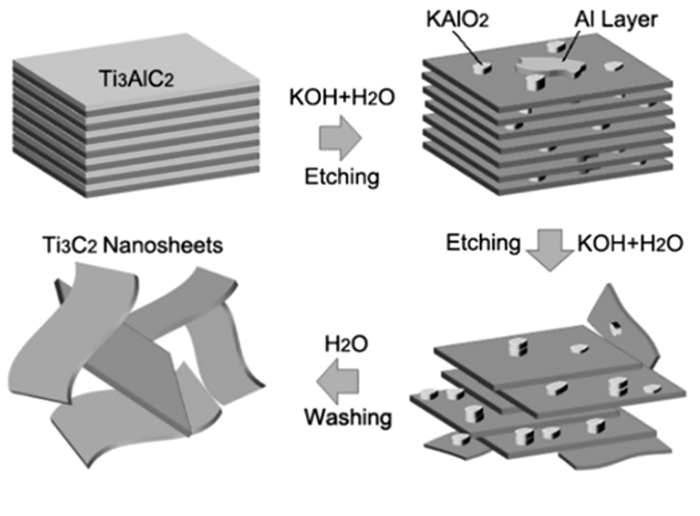
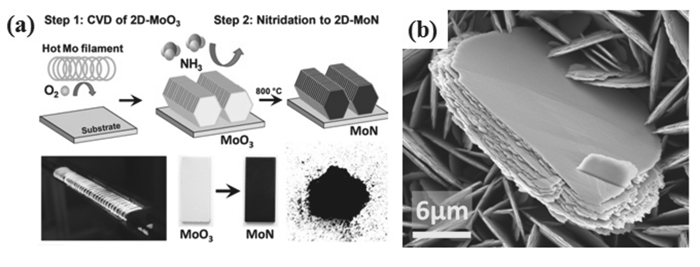
Despite of generally used acid extraction process, other two novel processes emerged without using poisonous fluorine-containing reagents. One is the base extraction process by using strong alkaline as etchant, and the other one is chemical synthesis process by utilizing high-temperature reaction between 2D precursors and active gases. For the former example, Ti3C2(OH)2 nanosheets could be synthesized by the reaction between Ti3AlC2 and KOH under 180 ℃ as described in Fig. 1. OH other than F functional groups were terminated the as-formed MXenes[21]. For the latter example, molybdenum nitride(MoN) nanosheets could be fabricated by the chemical reaction between 2D MoO3 and ammonia gas under high temperatures, whereas the 2D MoO3 nanosheets were synthesized through chemical vapor deposition(CVD) method. Schematic procedure and SEM image of as-obtained MoN nanosheets are depicted in Fig. 2[22]. These emerging approaches provide new fluorine-free approaches to fabricate different kind of MXenes, i.e., transitional metal nitrides and carbides with tailorable compositions.
图 1
图 2

2. Applications of MXenes
2.1 Applications of MXenes for rechargeable batteries
Analogous to graphene, MXenes nanosheets possess similar properties of 2D structure and high electrical conductivity. Besides, other properties, such as hydrophilic surface, accordion-like structure of layered MXenes, active sites for intercalating of Li+ or Na+, could also be exploited and utilized to enhance the performance for rechargeable batteries. Despite of the properties mentioned above, the drawbacks of MXenes, such as easy oxidation, should also be avoided or overcome. In recent years, MXenes, either stacked or delaminated, were studied extensively and intensively for their applications in rechargeable batteries, such as LIBs, NIBs and lithium-sulfur(Li-S) batteries[3, 10].
Ti3C2 MXene was predicted to be a promising anode for lithium(447.8 mA·h/g) and sodium(351.8 mA·h/g) storage by theoretical calculations[23-24]. With 2D structure and high electrical conductivity, MXene nanosheets deliver superior rate performance for LIBs or SIBs. For instance, Ti2C displays excellent rate performance as anode of LIBs[10]. The composite paper of Ti3C2Tx/CNT shows a capacity of 50 mA·h/g at 10 C as cathode of hybrid Mg2+/Li+ batteries, and displays superior charge-discharge cycling performance[25]. Layered Ti3C2 nanosheets intercalated by dimethyl sulfoxide deliver a capacity of 123.6 mA·h/g at 1C as an anode of LiBs[26].
Though high rate performance could be realized for pure MXenes, their lithium or sodium storage capacity was usually unsatisfied and desirable to be enhanced. One typical strategy is compositing metal oxide of high capacity with MXene nanosheets. Metal oxide could provide sufficient Li+ or Na+ ions reservoir. Conductive MXene could also serve as effective pathways for electron transfer in spite of the sites of ions′ intercalation. The interlayer spacing of layered MXene could also be enlarged as well. Furthermore, the volume expansion during charging process could be well accommodated by the 2D structure. These factors would result in enhanced performance for lithium or sodium storage.
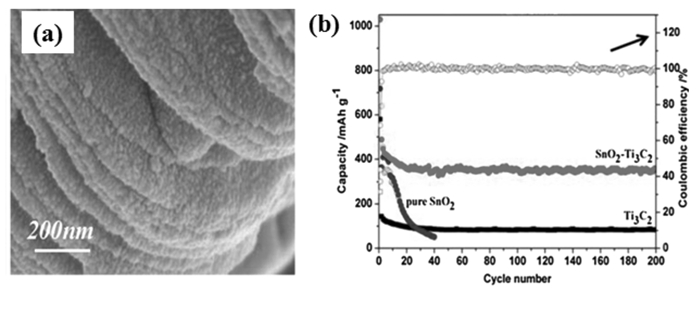
For instance, SnO2/Ti3C2 hybrid displays improved capacity and superior cycling performance than Ti3C2 MXene, whose SEM image and cycling performance for lithium storage were shown in Fig. 3[27]. Sb2O3-Ti3C2Tx hybrid exhibits an excellent rate performance and improved cycling stability for sodium ions batteries, a capacity of 295 mA·h/g at a high current density of 2 A/g was obtained[28]. For the composite of Nb2O5@Nb4C3Tx, advantages of internal conductivity of Nb4C3Tx, and high capacity of external Nb2O5 result in improved lithium storage for LIBs[29].
图 3

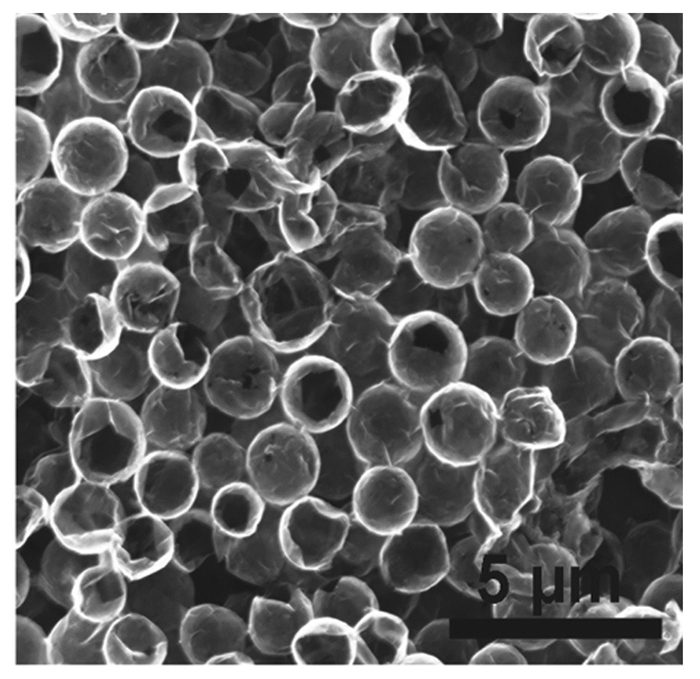
Like graphene or other 2D materials, 2D MXene nanosheets could also be used as building blocks to fabricate assemblies with different structures, in order to prevent the agglomeration of 2D nanosheets or achieve other aims. For example, free-standing, flexible and metallically conductive 3D macroporous MXene films could be synthesized by filtering mixed dispersion of PMMA sphere and 2D MXenes, and the subsequent annealing in argon atmosphere. Their microstructure is displayed in Fig. 4. The as-obtained films delivers more enhanced performance than multilayered MXenes and MXene/CNT hybrid for sodium storage[30]. Other novel structured assemblies of 2D MXene nanosheets could also be designed and made to further enhance the performance for lithium and/or sodium storages.
图 4

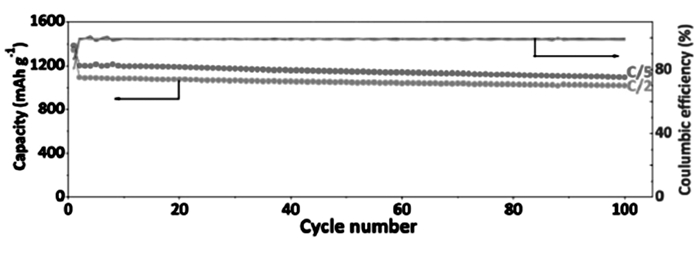
It is predicted that there are strong Coulombic interactions between Ti-based MXenes(TinXn-1) and Li2Sm by DFT(density functional method) calculations. The interactions could prevent sulfur of the cathode of Li-S batteries to be dissolved into the electrolyte[31]. With this guidance, Ti-based MXenes were utilized as effective sulfur host to alleviate the shuttle and/or dissolution of sulfur or polysulfides to the electrolyte, and improve the cycling performance of Li-S batteries [32-34]. For instance, by heat treating of sulfur nanoparticles attached on Ti2C nanosheets, the functional group of OH could be replaced by S species, resulting in the formation of Ti-S bonds at the surface of Ti2C nanosheets. The S/Ti2C composite displays excellent cycling performance as a cathode of Li-S batteries, as depicted in Fig. 5[32].
图 5

In spite of being used as cathode, 2D Ti-based nanosheets could be used as functional agents for the separator as well. For example, by decorating commercial "Celgard" separator with 2D Ti3C2Tx nanosheets, the soluble polysulfides could be confined efficiently, and result in anotable enhanced cyclability of Li-S batteries[35]. It provides another strategy to utilize the strong attraction between Ti-based MXenes and sulfur.
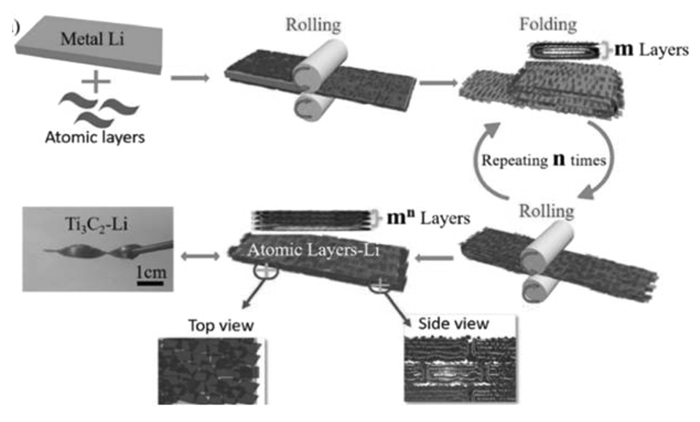
Despite flexibility and metallic conductivity, lithiophobic surfaces of 2D MXene nanosheets could also be fully employed to control the growth of lithium dendrites and accommodate the volume variation during charging and discharging process for the anode of Li-S batteries. For instance, flexible lamellar Ti3C2-lithium film fabricated by rolling and folding the mixture of atomic Ti3C2 nanosheets and metallic lithium repeatedly as schemed in Fig. 6, delivers excellent cycle stability, very low overpotential(32 mV at 1.0 mA/cm2) and high-rate performance as the anode of Li-S batteries[36]. It provides a novel avenue to prepare high-performance metallic anode for rechargeable lithium-based batteries.
图 6

Spontaneous oxidation usually occurred for Ti3C2Tx MXene nanosheets[37] leading to unstable structure or properties. It is favorable to prevent the nanosheets from oxidation. Carbon-plating is an effective method for achieving this aim. For example, carbon plated Ti3C2Tx(Ti3C2@C) nanosheets could provide stable structure and properties. The hierarchical MoS2/Ti3C2@C composite delivers high rate-performance and high cycling performance. A nearly 100% capacity retention was obtained even after 3000 charge-discharge cycles at 20 A/g for lithium storage[38]. It provides a novel and effective approach to protect the MXene nanosheets from oxidizing.
2.2 Applications of MXenes for supercapacitors
Due to the metallic conductivity, unique 2D structure and flexibility, MXenes were widely used and studied for supercapacitors, delivering a promising electrochemical performance [39-43]. For instance, as positive electrode of sodium-ion supercapacitor, layered V2C nanosheets display a capacitance of ~100 F/g at 0.2 mV/s[40]. The film of self-assembled delaminated Ti3C2(d-Ti3C2) nanoflakes exhibits high capacitance of 499 F/g, excellent cyclability and rate performance[39], and 2D Ti3C2Tx MXene displays more superior performance than reported carbon-based ones for coplanar microsupercapacitors [43]. The capacitive performances of MXenes were affected greatly by surface properties, interlayer spacing of layered MXenes, which could be varied by heat-treating, intercalating, doping, compositing and so on[11, 44]. Numerous efforts have been devoted to changing the properties of MXenes.
Removal of surface-terminated F and/or OH groups favors the accessibility of ions to the surface of MXenes resulting in the enhanced performance for supercapacitor. For instance, heat treatment of etched MXene materials in inert or reducing atmospheres would result in the removal of surface terminated F and OH groups, leaving more active sites for electrochemical reactions, while the original two-dimensional microstructure could also be retained. Therefore, significant improved capacitive performance was achieved[11, 44].
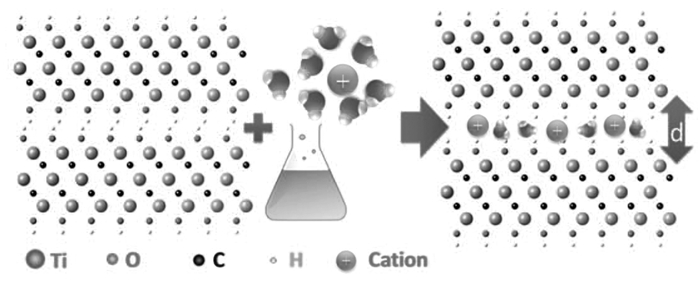
Intercalation of multilayered MXenes could lead to an increased interlayer spacing, or changed surface properties, which are helpful to the diffusion and the accessibility of ions of electrolyte to the surfaces of MXenes. As a result, . an enhanced performance of supercapacitors could be realized. In general, intercalation is favorable via the electrostatic interaction between negatively charged MXene surfaces and positively cations[9, 45-57]. For instance, Li+-intercalating could change surface properties and favors ions′ accessibility to the surfaces of few-layer Ti3C2Tx nanosheets[49]. Furthermore, interlayer spacing of layered MXenes could be enlarged by intercalation. For example, a variety of cations, including Na+, K+, NH4+, Mg2+, and Al3+, could be intercalated electrochemically into the interlayer space of multilayered Ti3C2Tx, resulting in enlarged interlayer spacing as illustrated in Fig. 7. Therefore, superior capacitance of excess of 300 F/cm3 was obtained for Ti3C2Tx electrode[9]. The interlayer spacing of stacked MXene nanosheets could also be tailored or tuned by the sizes of intercalating cations. For instance, the interlayer spacing of Li-intercalated Ti3C2Tx nanosheets could be further enlarged when Li+ ions were replaced by trimethylalkylammonium(TAA) cations[50]. Larger Sn4+ could readily intercalate into cetyltrimethylammonium cation(CTA+) pre-intercalated Ti3C2Tx MXenes, resulting in 177% increase of the interlayer spacing, and much more enhanced capacitance than CTA+ or Sn4+ intercalated ones for lithium-ion capacitors[51].
图 7

In spite of cations, polymers, such as polar polyfluorene derivatives(PFDs), polypyrrole(PPy), polyvinyl alcohol(PVA), polydiallyldimethylammonium(PDDA) chloride, could also be used to intercalate the layered MXenes[46, 52-53]. For instance, the interlayer distance between Ti3C2Tx layers could be increased by the intercalation of PPy, and the stacking of dense PPy was prevented as well. The free-standing PPy/Ti3C2 conductive hybrid film displays almost 100% capacitance retention in 20000 charging/discharging cycles and enhanced capacitance[53].
Except for intercalation, doping was an alternative strategy to enlarge the interlayer spacing of the layered MXenes. For instance, doping the multilayered Ti3C2Tx with nitrogen atoms could result in the increased interlayer spacing and 5 times increased capacitance [54]. Replacing the terminated groups with larger sized ones could also increase the interlayer spacing and favors the diffusion of ions. For example, terminated F groups of Ti2CTx MXene could be replaced partially by Cl groups by using mixed solution of HCl and LiF instead of HF as etchant. This leads to the increased interlayer spacing, and the enhanced performance for supercapacitors[58].
Decorating 2D MXene nanosheets with active materials, such as Nb2O5, MnOx and NiO, could improve the capacitive performance of MXenes. As the metallic conductivity of MXenes and high energy reservoir of active materials are both fully utilized[48, 55, 59], it is an important strategy to improve the capacitive performances. For instance, Nb2O5/carbon/Nb2CTx hybrid displays superior capacitance and good cycling stability. Stored charges of 330 C/g and 660 mF/cm2 were obtained, which are much higher than that of pure Nb2CTx electrode[55].
Compositing the MXene nanosheets with CNT or 2D graphene nanosheets could also enhance the capacitive performance by preventing the re-stacking of 2D MXene nanosheets, increasing interlayer spacing, and improving conductivity and microstructure[56-57, 60]. For example, capacitive performance of Ti3C2 was enhanced by compositing rGO nanosheets. A volumetric capacitance of 1040 F/cm3, and an ultrahigh volumetric energy density of 32.6 Wh/L were obtained for Ti3C2Tx/rGO hybrid[57].
2.3 Applications of MXenes for electro-catalysis
As a kind of newly arising material, MXenes were also developed and investigated as electro-catalysts for fuel cells, water electrolysis recently, due to the metallic conductivity, unique 2D structure, surface defects and other properties[61-65].
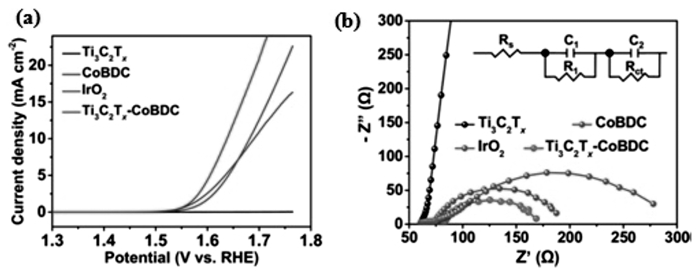
For example, both results of theoretical calculations and experiments indicate that MXenes, especially Mo2CTx systems, are active and stable catalysts for hydrogen evolution reaction(HER) in acidic media. Calculations depict that basal planes other than edge sizes of 2D Mo2CTx were active sites for HER[61]. Except for the intrinsic catalytic activity for HER, MXenes could be used as conductive supporters for catalysis like graphene nanosheets. Metallic conductivity of MXenes and superior catalytic performance could be both employed. For example, sandwich-like hybrid of CoBDC/Ti3C2/CoBDC(whereas BDC was the abbreviation for benzenedicarboxylate) exhibited excellent electro-catalytic activity for oxygen evolution reaction(OER) and oxygen reduction reaction(ORR), better than standard IrO2-based or the state-of-the-art transitional metal-based electro-catalysis, as displayed in the polarization profiles of Fig. 8a and the Nyquist plots of Fig. 8b[62]. The long-term catalytic stability for HER could also be enhanced by covering surfaces of 2D MXenes with carbon[38].
图 8
 图 8 OER polarization profiles of electrodes modified by Ti3C2Tx, CoBDC, IrO2, and Ti3C2Tx-CoBDC hybrid in N2-saturated 0.1 mol/L KOH with a scan rate of 1 mV /s(a); Nyquist plots of the electrodes modified by IrO2, Ti3C2Tx, CoBDC, and Ti3C2Tx-CoBDC(b)[62]Figure 8. OER polarization profiles of electrodes modified by Ti3C2Tx, CoBDC, IrO2, and Ti3C2Tx-CoBDC hybrid in N2-saturated 0.1 mol/L KOH with a scan rate of 1 mV /s(a); Nyquist plots of the electrodes modified by IrO2, Ti3C2Tx, CoBDC, and Ti3C2Tx-CoBDC(b)[62]
3. Conclusions and prospects
In summary, novel 2D MXenes could be synthesized by several processes. The advantages of unique 2D structure, metallic conductivity, hydrophilic surfaces, electrochemically active sites, strong mechanical strength and superior elasticity could be utilized sufficiently for energy storage and conversions, i.e. rechargeable batteries, supercapacitors, fuel cells and electro-catalysis, and deliver promising performances. By varying the synthetic process, modifying the surfaces through intercalating, compositing with other materials, or doping with heteroatoms, their electrochemical properties for energy storage and/or conversions would be improved further. MXene or MXene-based materials display superior capabilities for LIBs, Li-S batteries, supercapacitors, or electro-catalysis. However, spontaneous oxidation in air is a big problem of MXenes, which should be solved by future studies. With the rapid development of MXenes, more and more MXene and MXene-based materials would be exploited and developed, and more superior properties would be discovered and applied for energy storage and conversions.
-
-
[1]
Novoselov K S, Geim A K, Morozov S V. Electric Field Effect in Atomically Thin Carbon Films[J]. Science, 2004, 306(5696): 666-669. doi: 10.1126/science.1102896
-
[2]
Yoo E, Okata T, Akita T. Enhanced Electrocatalytic Activity of Pt Subnanoclusters on Graphene Nanosheet Surface[J]. Nano Lett, 2009, 9(6): 2255-2259. doi: 10.1021/nl900397t
-
[3]
Paek S M, Yoo E, Honma I. Enhanced Cyclic Performance and Lithiumstorage Capacity of SnO2/Graphene Nanoporous Electrodes with Three-Dimensionally Delaminated Flexible Structure[J]. Nano Lett, 2009, 9(1): 72-75. doi: 10.1021/nl802484w
-
[4]
Yang S, Feng X, Ivanovici S. Fabrication of Graphene-Encapsulated Oxide Nanoparticles:Towards High-Performance Anode Materials for Lithium Storage[J]. Angew Chem In Ed, 2010, 49(45): 8408-8411. doi: 10.1002/anie.201003485
-
[5]
武卫明, 张长松, 杨树斌. 石墨烯支撑三明治结构材料的可控合成及其在能量存储与转换中的应用[J]. 新型炭材料, 2017,32,(1): 1-14. WU Weiming, ZHANG Changsong, YANG Shubin. Controllable Synthesis of Sandwich-Like Graphene-Supported Structures for Energy Storage and Conversion[J]. New Carbon Mater, 2017, 32(1): 1-14.
-
[6]
Naguib M, Kurtoglu M, Presser V. Two-Dimensional Nanocrystals Produced by Exfoliation of Ti3AlC2[J]. Adv Mater, 2011, 23(37): 4248-4253. doi: 10.1002/adma.201102306
-
[7]
Sun D, Wang M, Li Z. Two-Dimensional Ti3C2 as Anode Material for Li-Ion Batteries[J]. Electrochem Commun, 2014, 47: 80-83. doi: 10.1016/j.elecom.2014.07.026
-
[8]
Liang X, Garsuch A, Nazar L F. Sulfur Cathodes Based on Conductive MXene Nanosheets for High-Performance Lithium-Sulfur Batteries[J]. Angew Chem Int Ed, 2015, 54(13): 3907-3911. doi: 10.1002/anie.201410174
-
[9]
Lukatskaya M R, Mashtalir O, Ren C E. Cation Intercalation and High Volumetric Capacitance of Two-Dimensional Titanium Carbide[J]. Science, 2013, 6153(6153): 1502-1505.
-
[10]
Come J, Naguib M, Rozier P. A Non-aqueous Asymmetric Cell with a Ti2C-based Two-dimensional Negative Electrode[J]. J Electrochem Soc, 2012, 159(8): A1368-A1373. doi: 10.1149/2.003208jes
-
[11]
Rakhi R B, Ahmed B, Hedhili M N. Effect of Postetch Annealing Gas Composition on the Structural and Electrochemical Properties of Ti2CTx MXene Electrodes for Supercapacitor Applications[J]. Chem Mater, 2015, 27(15): 5314-5323. doi: 10.1021/acs.chemmater.5b01623
-
[12]
Mashtalir O, Lukatskaya M R, Zhao M. Amine-Assisted Delamination of Nb2C MXene for Li-ion Energy Storage Devices[J]. Adv Mater, 2015, 27(23): 3501-3506. doi: 10.1002/adma.v27.23
-
[13]
Mashtalir O, Cook K M, Mochalin V N. Dye Adsorption and Decomposition on Two-dimensional Titanium Carbide in Aqueous Media[J]. J Mater Chem A, 2014, 2(35): 14334-14338. doi: 10.1039/C4TA02638A
-
[14]
Liu X, Wu J, He J. Electromagnetic Interference Shielding Effectiveness of Titanium Carbide Sheets[J]. Mater Lett, 2017, 205: 261-263. doi: 10.1016/j.matlet.2017.06.101
-
[15]
Kim S J, Naguib M, Zhao M. High Mass Loading, Binder-free MXene Anodes for High Areal Capacity Li-Ion Batteries[J]. Electrochim Acta, 2015, 163: 246-251. doi: 10.1016/j.electacta.2015.02.132
-
[16]
Zhang H, Wang L, Shen C. Synthesis of NaV6O15 Nanorods via Thermal Oxidation of Sodium-intercalated 2D V2CTx and Their Electrochemical Properties as Anode for Lithium-Ion Batteries[J]. Electrochim Acta, 2017, 248: 178-187. doi: 10.1016/j.electacta.2017.07.143
-
[17]
Karlsson L H, Birch J, Halim J. Atomically Resolved Structural and Chemical Investigation of Single MXene Sheets[J]. Nano Lett, 2015, 15(8): 4955-4960. doi: 10.1021/acs.nanolett.5b00737
-
[18]
Wang L, Zhang H, Wang B. Synthesis and Electrochemical Performance of Ti3C2Tx with Hydrothermal Process[J]. Electron Mater Lett, 2016, 12(5): 702-710. doi: 10.1007/s13391-016-6088-z
-
[19]
Naguib M, Mashtalir O, Carle J. Two-dimensional Transition Metal Carbides[J]. ACS Nano, 2012, 6(2): 1322-1331. doi: 10.1021/nn204153h
-
[20]
Naguib M, Unocic R R, Armstrong B L. Large-scale Delamination of Multi-layers Transition Metal Carbides and Carbonitrides "MXenes"[J]. Dalton Trans, 2015, 44(20): 9353-9358. doi: 10.1039/C5DT01247C
-
[21]
Li G, Tan L, Zhang Y. Highly Efficiently Delaminated Single-layered MXene Nanosheets with Large Lateral Size[J]. Langmuir, 2017, 33(36): 9000-9006. doi: 10.1021/acs.langmuir.7b01339
-
[22]
Joshi S, Wang Q, Puntambekar A. Facile Synthesis of Large Area Two-dimensional Layers of Transition-metal Nitride and Their Use as Insertion Electrodes[J]. ACS Energy Lett, 2017, 2(6): 1257-1262. doi: 10.1021/acsenergylett.7b00240
-
[23]
Tang Q, Zhou Z, Shen P. Are MXenes Promising Anode Materials for Li Ion Batteries? Computational Studies on Electronic Properties and Li Storage Capability of Ti3C2 and Ti3C2X2(X=F, OH) Monolayer[J]. J Am Chem Soc, 2012, 134(40): 16909-16916. doi: 10.1021/ja308463r
-
[24]
Er D, Li J, Naguib M. Ti3C2 MXene as A High Capacity Electrode Material for Metal(Li, Na, K, Ca) Ion Batteries[J]. ACS Appl Mater Interfaces, 2014, 6(14): 11173-11179. doi: 10.1021/am501144q
-
[25]
Byeon A, Zhao M, Ren C E. Two-dimensional Titanium Carbide MXene as a Cathode Material for Hybrid Magnesium/Lithium-Ion Batteries[J]. ACS Appl Mater Interfaces, 2017, 9(5): 4296-4300. doi: 10.1021/acsami.6b04198
-
[26]
Sun D, Wang M, Li Z. Two-dimensional Ti3C2 as Anode Material for Li-Ion Batteries[J]. Electrochem Commun, 2014, 47: 80-83. doi: 10.1016/j.elecom.2014.07.026
-
[27]
Wang F, Wang Z, Zhu J. Facile Synthesis SnO2 Nanoparticle-modified Ti3C2 MXene Nanocomposites for Enhanced Lithium Storage Application[J]. J Mater Sci, 2017, 52(7): 3556-3565. doi: 10.1007/s10853-016-0369-7
-
[28]
Guo X, Xie X, Choi S. Sb2O3/MXene(Ti3C2Tx) Hybrid Anode Materials with Enhanced Performance for Sodium-Ion Batteries[J]. J Mater Chem A, 2017, 5(24): 12445-12452. doi: 10.1039/C7TA02689G
-
[29]
Zhang C, Kim S J, Ghidiu M. Layered Orthorhombic Nb2O5@Nb4C3Tx and TiO2@Ti3C2Tx Hierarchical Composites for High Performance Li-Ion Batteries[J]. Adv Funct Mater, 2016, 26(23): 4143-4151. doi: 10.1002/adfm.v26.23
-
[30]
Zhao M, Xie X, Ren C R. Hollow MXene Spheres and 3D Macroporous MXene Frameworks for Na-Ion Storage[J]. Adv Mater, 2017, 29(37): 1702410-1702417. doi: 10.1002/adma.v29.37
-
[31]
Rao D, Zhang L, Wang Y. Mechanism on the Improved Performance of Lithium Sulfur Batteries with MXene-based Additives[J]. J Phys Chem C, 2017, 121(21): 11047-11054. doi: 10.1021/acs.jpcc.7b00492
-
[32]
Liang X, Garsuch A, Nazar L F. Sulfur Cathodes Based on Conductive MXene Nanosheets for High-performance Lithium-Sulfur Batteries[J]. Angew Chem Int Ed, 2015, 54(13): 3907-3911. doi: 10.1002/anie.201410174
-
[33]
Bao W, Xie X, Xu J. Confined Sulfur in 3D MXene/Reduced Graphene Oxide Hybrid Nanosheets for Lithium Sulfur Battery[J]. Chem Eur J, 2017, 23(51): 12613-12619. doi: 10.1002/chem.201702387
-
[34]
Liang X, Rangom Y, Kwok C Y. Interwoven MXene Nanosheet/Carbon-Nanotube Composites as Li-S Cathode Hosts[J]. Adv Mater, 2017, 29(3): 1603040-1603047. doi: 10.1002/adma.v29.3
-
[35]
Song J, Su D, Xie X. Immobilizing Polysulfides with MXene-functionalized Separators for Stable Lithium-sulfur Batteries[J]. ACS Appl Mater Interfaces, 2016, 8(43): 29427-29433. doi: 10.1021/acsami.6b09027
-
[36]
Li B, Zhang D, Liu Y. Flexible Ti3C2 MXene-lithium Film with Lamellar Structure for Ultrastable Metallic Lithium Anodes[J]. Nano Energy, 2017, 39: 654-661. doi: 10.1016/j.nanoen.2017.07.023
-
[37]
Zhang C J, Pinilla S, McEvoy N. Oxidation Stability of Colloidal Two-dimensional Titanium Carbides(MXenes)[J]. Chem Mater, 2017, 29(11): 4848-4856. doi: 10.1021/acs.chemmater.7b00745
-
[38]
Wu X, Wang Z, Yu M. Stabilizing the MXenes by Carbon Nanoplating for Developing Hierarchical Nanohybrids with Efficient Lithium Storage and Hydrogen Evolution Capability[J]. Adv Mater, 2017, 29(24): 1607017-1607025. doi: 10.1002/adma.201607017
-
[39]
Hu M, Li Z, Zhang H. Self-assembled Ti3C2Tx MXene Film with High Gravimetric Capacitance[J]. Chem Commun, 2015, 51(70): 13531-13533. doi: 10.1039/C5CC04722F
-
[40]
Dall'Agnese Y, Taberna P L, Gogotsi Y. Two-dimensional Vanadium Carbide(MXene) as Positive Electrode for Sodium-ion Capacitors[J]. J Phys Chem Lett, 2015, 6(12): 2305-2309. doi: 10.1021/acs.jpclett.5b00868
-
[41]
Wang X, Kajiyama S, Iinuma H. Pseudocapacitance of MXene Nanosheets for High-power Sodium-Ion Hybrid Capacitors[J]. Nature Commun, 2015, 6: 6544. doi: 10.1038/ncomms7544
-
[42]
Xu S, Wei G, Li J. Binder-free Ti3C2Tx MXene Electrode Film for Supercapacitor Produced by Electrophoretic Deposition Method[J]. Chem Eng J, 2017, 317: 1026-1036. doi: 10.1016/j.cej.2017.02.144
-
[43]
Kurra N, Ahmed B, Gogotsi Y. MXene-on-Paper Coplanar Microsupercapacitors[J]. Adv Energy Mater, 2016, 6(24): 1601372-1601380. doi: 10.1002/aenm.201601372
-
[44]
Li J, Yuan X, Lin C. Achieving High Pseudocapacitance of 2D Titanium Carbide(MXene) by Cation Intercalation and Surface Modification[J]. Adv Energy Mater, 2017, 7(15): 1602725-1602733. doi: 10.1002/aenm.201602725
-
[45]
Dall'Agnese Y, Lukatskay M R, Cook K M. High Capacitance of Surface-modified 2D Titanium Carbide in Acidic Electrolyte[J]. Electrochem Commun, 2014, 48: 118-122. doi: 10.1016/j.elecom.2014.09.002
-
[46]
Ling Z, Ren C E, Zhao M. Flexible and Conductive MXene Films and Nanocomposites with High Capacitance[J]. PNAS, 2014, 111(47): 16676-16681. doi: 10.1073/pnas.1414215111
-
[47]
Lin S, Zhang X. Two-dimensional Titanium Carbide Electrode with Large Mass Loading for Supercapacitor[J]. J Power Sources, 2015, 294: 354-359. doi: 10.1016/j.jpowsour.2015.06.082
-
[48]
Tian Y, Yang C, Que W. Flexible and Free-standing 2D Titanium Carbide Film Decorated with Manganese Oxide Nanoparticles as A High Volumetric Capacity Electrode for Supercapacitor[J]. J Power Sources, 2017, 359: 332-339. doi: 10.1016/j.jpowsour.2017.05.081
-
[49]
Wang H, Zhang J, Wu Y. Achieving High-rate Capacitance of Multi-layer Titanium Carbide(MXene) by Liquid-Phase Exfoliation Through Li-Intercalation[J]. Electrochem Commun, 2017, 81: 48-51. doi: 10.1016/j.elecom.2017.05.009
-
[50]
Ghidiu M, Kota S, Halim J. Alkylammonium Cation Intercalation into Ti3C2(MXene):Effects on Properties and Ion-Exchange Capacity Estimation[J]. Chem Mater, 2017, 29(3): 1099-1106. doi: 10.1021/acs.chemmater.6b04234
-
[51]
Luo J, Zhang W, Yuan H. Pillared Structure Design of MXene with Ultralarge Interlayer Spacing for High-performance Lithium-Ion Capacitors[J]. ACS Nano, 2017, 11(3): 2459-2469. doi: 10.1021/acsnano.6b07668
-
[52]
Boota M, Pasini M, Galeotti F. Interaction of Polar and Nonpolar Polyfluorenes with Layers of Two-dimensional Titanium Carbide(MXene):Intercalation and Pseudocapacitance[J]. Chem Mater, 2017, 29(7): 2731-2738. doi: 10.1021/acs.chemmater.6b03933
-
[53]
Zhu M, Huang Y, Deng Q. Highly Flexible, Freestanding Supercapacitor Electrode with Enhanced Performance Obtained by Hybridizing Polypyrrole Chains with MXene[J]. Adv Energy Mater, 2016, 6(21): 1600969-1600978. doi: 10.1002/aenm.201600969
-
[54]
Wen y, Rufford T E, Chen X. Nitrogen-doped Ti3C2Tx MXene Electrodes for High-performance Supercapacitors[J]. Nano Energy, 2017, 38: 368-376. doi: 10.1016/j.nanoen.2017.06.009
-
[55]
Zhang C, Beidaghi M, Naguib M. Synthesis and Charge Storage Properties of Hierarchical Niobium Pentoxide/Carbon/Niobium Carbide (MXene) Hybrid Materials[J]. Chem Mater, 2016, 28(11): 3937-3943. doi: 10.1021/acs.chemmater.6b01244
-
[56]
Xu S, Wei G, Li J. Flexible MXene-Graphene Electrodes with High Volumetric Capacitance for Integrated Co-Cathode Energy Conversion/Storage Devices[J]. J Mater Chem A, 2017, 5(33): 17442-17451. doi: 10.1039/C7TA05721K
-
[57]
Yan J, Ren Chang, Maleski K. Flexible MXene/Graphene Films for Ultrafast Supercapacitors with Outstanding Volumetric Capacitance[J]. Adv Funct Mater, 2017, 27(30): 1701264-1701274. doi: 10.1002/adfm.201701264
-
[58]
Kajiyama S, Szabova L, Iinuma H. Enhanced Li-Ion Accessibility in MXene Titanium Carbide by Steric Chloride Termination[J]. Adv Energy Mater, 2017, 7(9): 1601873-1601881. doi: 10.1002/aenm.201601873
-
[59]
Xia Q, Fu J, Yun J M. High Volumetric Energy Density Annealed-MXene Nickel Oxide/MXene Asymmetric Supercapacitor[J]. RSC Adv, 2017, 7: 11000-11011. doi: 10.1039/C6RA27880A
-
[60]
Lin S, Zhang X. Two-dimensional Titanium Carbide Electrode with Large Mass Loading for Supercapacitor[J]. J Power Sources, 2015, 294: 354-359. doi: 10.1016/j.jpowsour.2015.06.082
-
[61]
She Z W, Fredrickson K D, Anasori B. Two-dimensional Molybdenum Carbide(MXene) as an Efficient Electrocatalyst for Hydrogen Evolution[J]. ACS Energy Lett, 2016, 1(3): 589-594. doi: 10.1021/acsenergylett.6b00247
-
[62]
Zhao L, Dong B, Li S. Interdiffusion Reaction-assisted Hybridization of Two-dimensional Metal-Organic Frameworks and Ti3C2Tx Nanosheets for Electrocatalytic Oxygen Evolution[J]. ACS Nano, 2017, 11(6): 5800-5807. doi: 10.1021/acsnano.7b01409
-
[63]
Zhang Z, Li H, Zou G. Self-reduction Synthesis of New MXene/Ag Composites with Unexpected Electrocatalytic Activity[J]. ACS Sustainable Chem Eng, 2016, 4(12): 6763-6771. doi: 10.1021/acssuschemeng.6b01698
-
[64]
Shao M, Shao Y, Chai J. Synergistic Effect of 2D Ti2C and g-C3N4 for Efficient Photocatalytic Hydrogen Production[J]. J Mater Chem A, 2017, 5(32): 16748-16756. doi: 10.1039/C7TA04122E
-
[65]
Yang L, Kimmel Y C, Lu Q. Effect of Pretreatment Atmosphere on the Particle Size and Oxygen Reduction Activity of Low-loading Platinum Impregnated Titanium Carbide Powder Electrocatalysts[J]. J Power Sources, 2015, 287: 196-202. doi: 10.1016/j.jpowsour.2015.03.146
-
[1]
-
Figure 2 Schematic illustration of the synthesizing process for 2D MoN nanosheets(a); SEM image of as-obtained 2D MoN nanosheets(b)[22]
Figure 3 SEM image of SnO2 modified layered Ti3C2(a); cycling performance and the Coulombic efficiency of SnO2-Ti3C2, Ti3C2 and SnO2 at 100 mA/g(b)[27]
Figure 7 Schematic illustration of the intercalation of cations between Ti3C2Tx layers[9]
-

 下载:
下载:

 下载:
下载:


 扫一扫看文章
计量
- PDF下载量: 5
- 文章访问数: 797
- HTML全文浏览量: 88
 下载:
下载:

