Received Date:
02 July 2026 Revised Date:
22 September 2026 Available Online:
10 November 2026
Abstract:
Under ultra-high vacuum, surface synthesis of 2D conjugated metal-organic frameworks (MOFs) was carried out through molecular beam epitaxy (MBE) growth to address the challenge of traditional solvothermal methods in achieving large-scale, defect-free single-crystal synthesis. Here, we chose an iconic 2D conjugated MOF, Cu3(HOTP)2 (HOTP represents the deprotonated derivative of 2,3,6,7,10,11-hexahydroxytriphenylene), as a case study to investigate the diversified self-assembly of Cu atoms and HHTP ligands, as well as the synthesis mechanism of the MOF fragment on the surface with and without O2 annealing conditions by scanning tunneling microscopy. The results show that dumbbell-shaped [Cu(HOTP)2] complexes, the target fragment of MOFs, can be successfully generated in an O2 atmosphere, yet large-area extended MOFs remain elusive, highlighting oxidation and ligand deprotonation as two key factors that hinder the on-surface synthesis of Cu3(HOTP)2.
Metal-organic frameworks (MOFs) exhibit promising applications in gas separation, sensing, catalysis, and drug delivery thanks to their microporosity, highly ordered structures, and tunable local environments[1-4]. These unique structural features also render MOFs an ideal platform for investigating emergent physics. Their designable and diversified structures allow rational control of Coulombic and magnetic interactions among localized electrons as well as electron-phonon couplings, which are essential to exotic phenomena including superconductivity[5-7], quantum spin liquid[8], and topologically nontrivial bands[9-10]. However, in-depth exploration of these physical phenomena in MOFs has been lacking, mainly because traditional solvothermal synthesis cannot yield large, defect-free single crystals.
To this end, on-surface synthesis of MOFs in ultrahigh vacuum (UHV) by molecular beam epitaxy (MBE) offers a promising solution. The UHV environment excludes contaminants from the air and solutions, creating conditions for synthesizing high-quality single crystals. It is compatible with UHV characterization techniques, including scanning tunneling microscopy (STM) and angle-resolved photoemission spectroscopy (ARPES), which enable atomic-scale imaging of structures and the electronic density of states, as well as characterization of band structures. Previously, on-surface synthesis of MOFs has been achieved using nitrogen-coordinating ligands, e.g., 2,3,6,7,10,11-hexaaminotriphenylene (HATP)[11-13] and 9,10-dicyanoanthracene (DCA), enabling observation of strong correlation and Mott transition in an exemplary material, Cu2(DCA)3[14-15]. Nonetheless, MBE-based preparation of MOFs with oxygen-coordinating ligands, which are prevalent in solvothermal synthesis, has rarely been reported. Fundamental understanding of the mechanisms behind its difficulty is lacking.
Here, we choose Cu3(HOTP)2 (HOTP=2,3,6,7,10,11-hexaoxytriphenylene) as an example to study MBE synthesis of MOFs with phenol-based ligands. Cu3(HOTP)2 is a classic 2D conductive MOF that is traditionally synthesized by solvothermal methods[16-18] or by chemical vapor deposition[19]. It exhibits microporosity and a relatively high electrical conductivity of a single crystal at room temperature (σ=1.5 S·cm-1 at 295 K)[16], which can be harnessed for chemiresistive sensing[20] and photodetectors[21]. In this material, each Cu2+ binds to two deprotonated o-semiquinone-like moieties of HOTP3-. The planar [Cu(HOTP)2] secondary building units and trigonal tritopic ligands generate a layered structure where Cu2+ cations delineate a Kagome lattice and HOTP ligands form a honeycomb lattice. The highly ordered and symmetric structure and in-plane π-conjugation of Cu3(HOTP)2 make it a strongly correlated system with dispersive Kagome band structures (by density functional theory calculations[10]) and magnetic frustration[8]. As a result, it is a potential candidate that holds topological physics and quantum spin liquid states.
Previous studies have shown that 2,3,6,7,10,11-hexahydroxytriphenylene (HHTP) molecules on metal surfaces form various structures by either self-assembly or coordination with metal atoms from the substrate[22-25]. However, these efforts have not led to extended microporous frameworks, raising the concern of coordination difficulties of hydroxyl (—OH) based ligands with metal atoms. In this work, we report trials towards the MBE synthesis of Cu3(HOTP)2 by annealing thermally deposited HHTP molecules and Cu atoms on Ag(111) or Au(111) surfaces in UHV or a low-pressure O2 atmosphere. Subsequent STM characterization revealed diversified patterns, including self-assembly of HHTP with Cu adatoms and [Cu(HOTP)2] complexes, i.e., fragments of the target MOF, formed upon aerobic annealing. However, these trials did not yield large-scale extended networks of Cu3(HOTP)2. We attribute the incomplete MBE synthesis of this material to insufficient oxidation of Cu atoms and HHTP molecules as well as difficult deprotonation of hydroxyl groups, and propose several potential strategies to solve these problems.
1.
Experimental
The preparation process of the main reagents and samples used in the experiment is detailed in the Supporting information. Specifically, HHTP was synthesized based on literature procedures[26-27].
2.
Results and discussion
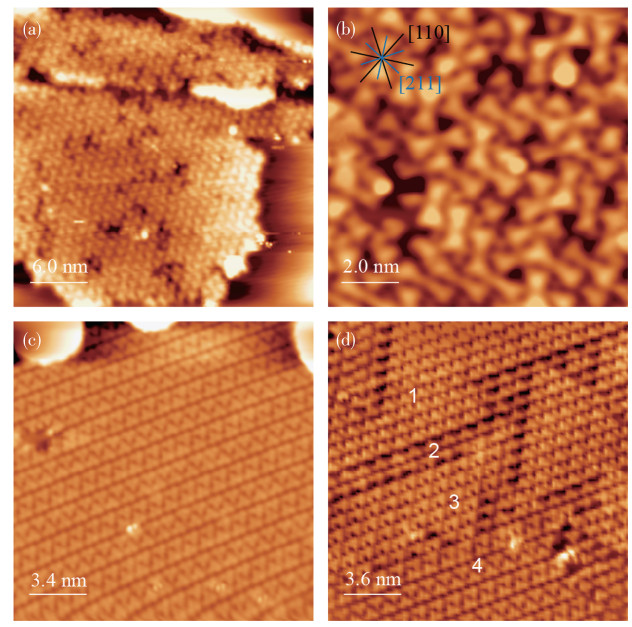
HHTP powder was prepared in an Al2O3 crucible, thermally evaporated in vacuum, and deposited onto the Ag(111) surface. HHTP molecules with a triangular shape pack closely in two opposite directions, regulated by the substrate (Fig.1a and 1b). Successive thermal deposition of Cu atoms led to the effect of annealing to some extent, inducing molecular self-assembly into two types of ordered patterns that coexist in the same area. In the first type, HHTP molecules closely pack in the same alignment with two opposite configurations, forming zip-like lattices (Fig.1c and region 4 in Fig.1d). In the second type, these molecules loosely pack with only one configuration, leaving pores filled by Cu atoms that do not bind to hydroxyl groups (regions 1 and 3 in Fig.1d). Boundaries between crystalline domains are mainly formed by HHTP molecules (region 2 in Fig.1d). Nonetheless, no target MOF pattern was found.
Figure 1
Figure 1.
(a) STM image of HHTP molecules adsorbed onto the Ag(111) surface kept at 77 K with the tip setpoint at 1 V and 100 pA in constant current mode; (b) Zoom-in image of triangular HHTP clusters adsorbed along two close-packed directions of Ag(111); (c) After depositing Cu atoms onto the Ag(111) surface, some areas of adsorbed HHTP molecules form into ordered patterns with long axes aligned in [211] directions of the substrate; (d) Molecules pack in four different structures
In panel d: in region 1, molecules assemble into a triangular pattern with Cu atoms space-filling in the middle; in region 2, boundaries are formed between two molecular alignments; in region 3, the same structure as in region 1 is formed but aligned in the opposite direction; in region 4, close-packed ordering of molecules is formed as in panel c.
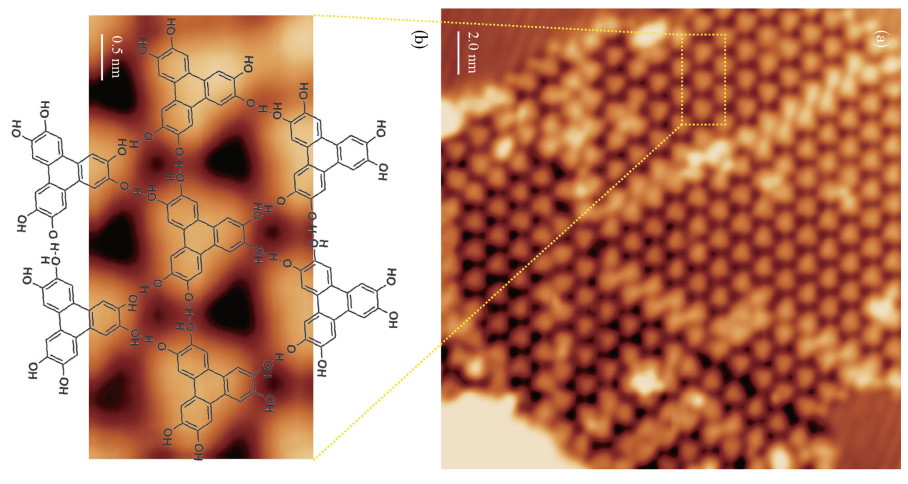
Considering that the synthesis of Cu3(HOTP)2 requires oxidation of both Cu atoms and HHTP molecules, we annealed the above sample in an O2 atmosphere at ca. 5×10⁻⁵ Pa and 200 ℃ for 10 min. Crystalline domains of HHTP molecules formed in some areas (Fig.2a). Within each domain, these molecules align in the same direction and form a hydrogen-bonded network: tunneling currents at the gaps between hydroxyl groups of adjacent molecules clearly depict the hydrogen-bond linkage (Fig.2b). The O2 annealing process may have induced partial deprotonation and oxidation of HHTP molecules, which could promote such network formation but are challenging to experimentally resolve. Boundaries between domains consist of two rows of molecules with head-to-head configurations. Such a pattern of HHTP molecules has been observed in earlier studies[24]. Several Cu adatoms appear at the periphery of domains, yet they do not coordinate to HHTP molecules, indicating that they are excluded from the HHTP-based domains during the crystallization process.
Figure 2
Figure 2.
(a) STM image of HHTP molecular well-ordered pattern on Ag(111) after annealing in the O2 environment with ca. 5×10⁻⁵ Pa at about 200 ℃ for 10 min; (b) Zoom-in STM image (0.2 V, 100 pA) of a rectangular region in dashed lines in panel a
Hydrogen-bond networks of HHTP molecular structures were overlaid onto STM images. Six bonds surrounding one molecule at the sites of hydroxyl groups are apparently displayed by the electron clouds. This figure shows one of the possible configurations of the hydrogen-bond networks, as the exact positions of hydrogen atoms cannot be well resolved and are likely to be disordered. No deprotonation nor oxidation was involved in this proposed structure.
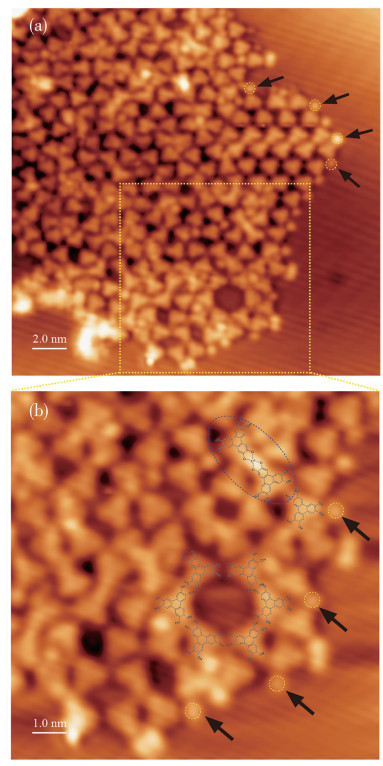
We further increased the coverage of Cu atoms and HHTP molecules onto the Ag(111) substrate and annealed them in the same oxidative conditions. Cu atoms disrupted the formation of crystalline HHTP domains, generating disordered and diversified structures (Fig.3a). Many HHTP molecules formed head-to-head pairs, and some individual HHTP molecules were surrounded by isolated Cu adatoms without coordination. Nonetheless, two types of MOF fragments were observed: a molecular hexagon composed of six HHTP molecules without Cu atoms, with structural models of HHTP molecules aligned in a hexagon and overlaid at corresponding sites; a dumbbell-shaped structural feature where two partially deprotonated HHTP molecules bind to one Cu atom, indicated by the dashed blue oval (Fig.3b). The latter confirms that O2 could oxidize Cu and HHTP, which in turn facilitates their coordination.
Figure 3
Figure 3.
(a) HHTP-Cu hybrid networks on Ag(111) after annealing in the O2 environment; (b) Zoom-in STM image of a rectangular region in dashed yellow lines in panel a
In panel a: dashed circles marked by black arrows point to the positions of surrounding Cu adatoms, which are inactive in coordinating with HHTP molecules.
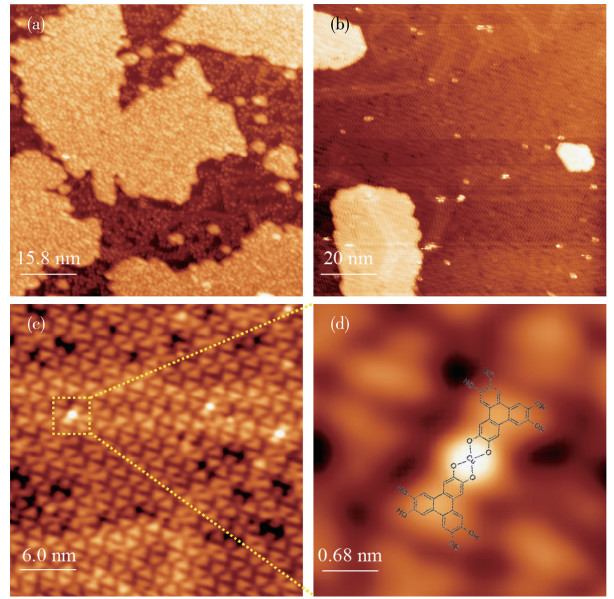
Anticipating that dense packing of Cu atoms and HHTP molecules could force the formation of ordered structures, we deposited 1.5 layers of Cu atoms onto the Au(111) substrate followed by the deposition of a monolayer of HHTP molecules. Cu atoms were well separated instead of forming clusters (Fig.4a), which is beneficial for them to react with molecules individually. To enhance the oxidation of both reactants, they were annealed in an O2 atmosphere at 200 ℃ for 10 min at a higher pressure (1×10⁻⁴ Pa). The annealing distributed HHTP molecules uniformly atop Cu/Au(111) (Fig.4b). Au(111) herringbone reconstruction patterns underneath were apparent in some areas. A higher density of the dumbbell-shaped [Cu(HOTP)2] structural units was observed (Fig.4c, 4d), demonstrating that this reaction condition promotes the formation of MOF fragments. However, there was still no porous honeycomb structure expected for Cu3(HOTP)2. Further annealing at a higher temperature (300 ℃) led to deteriorated molecular clusters instead of ordered networks, and further annealing at even higher O2 pressure was not conducted to protect the UHV chamber and related equipment.
Figure 4
Figure 4.
(a) Large-area scan image at 77 K of 1.5 monolayer Cu deposited onto Au(111); (b) HHTP molecular image with monolayer coverage onto Cu/Au(111) after subsequent annealing in vacuum; (c) New HHTP-Cu hybrid with head-to-head molecular alignments formed after post-annealing in an O2 environment with up to 1×10⁻⁴ Pa at about 200 ℃ for 10 min; (d) Zoom-in image of single dumbbell-shaped MOF fragment as highlighted by the yellow dashed square in panel c (inset in panel panel d: two HOTP molecules bridged by one Cu atom form the necessary element of MOF)
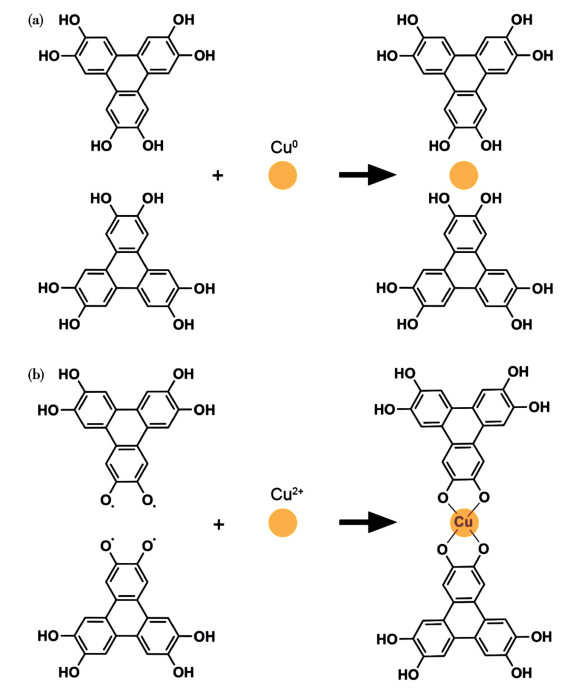
These observations indicate that annealing Cu atoms and HHTP molecules in an O2 atmosphere successfully generates [Cu(HOTP)2] complexes, i.e., fragments of the target MOF. However, the synthesis of a large-scale complete network remains elusive. In the typical solvothermal synthesis of Cu3(HOTP)2, Cu2+ cations and HHTP molecules react in weakly alkaline and aerobic solutions under relatively high temperatures (e.g., 80 ℃). These reaction conditions facilitate deprotonation and oxidation of HHTP that are essential for its coordination to Cu2+ and consecutive formation of the MOF. The hot solution environment also promotes the reaction through convection and thermal diffusion. These conditions are hardly met in the above on-surface synthesis of Cu3(HOTP)2. First, neither evaporated Cu atoms nor HHTP molecules are in the appropriate oxidation states. Although annealing them in an O2 atmosphere could induce oxidation, leading to the formation of [Cu(HOTP)2] complexes (Fig.5), our experiments showed that such oxidation took place rarely (Fig.3b, 4c, and 4d). This is likely due to the exceptionally low pressure of O2 (below 1×10⁻⁴ Pa) used during annealing as compared to that in ambient conditions (21 207 Pa). In addition, the Ag(111) substrate serves as a huge electron reservoir that might limit the oxidation of Cu and HHTP. Second, the lack of an alkaline environment and the insufficient reduction capability of Cu atoms prevent deprotonation of HHTP molecules. Third, the molecules and atoms adsorbed on Ag(111) can only move on the surface in the thermodynamic process upon annealing, which limits the degrees of freedom of their diffusion. These vital problems prevent the formation of Cu3(HOTP)2.
Figure 5
Figure 5.
(a) Molecular configurations of two HHTP molecules and one Cu atom forming a non-interacting metal-organic hybrid; (b) Pair of deprotonated HOTP molecules with O radicals coordinate with one Cu2+ atom, forming a dumbbell-shaped MOF fragment
The foregoing results highlight oxidation and ligand deprotonation as key factors for the on-surface synthesis of Cu3(HOTP)2. Instead of further improving the O2 pressure, it is more convenient to use pre-oxidized HHTP ligands and Cu sources. The former may be prepared by controlled three-electron oxidation of HHTP molecules. The latter may be provided by CuO, whose monolayer can be easily prepared by annealing Cu(111) substrates in an O2 atmosphere. CuO also serves as an insulating layer to block electron transfer from the metallic substrate to oxidized HHTP. It is superior to Cu2+-based coordination complexes as the latter introduce difficulty in optimizing annealing conditions and additional organic contaminants. Finally, the ligand deprotonation could be facilitated by using an alkaline atmosphere (e.g., NH3) for annealing or hydrogenation-catalytic substrates (e.g., Pt and Pd). Optimizing reactants, substrates, and annealing atmosphere along these lines could ultimately lead to the synthesis of Cu3(HOTP)2 and provide valuable guidance to the on-surface synthesis of other oxygen-coordinating MOFs.
Acknowledgments:
This work was supported by the Zhejiang Provincial Natural Science Foundation of China (No.XHD23B0301). We acknowledge the Instrumentation and Service Center for Physical Sciences at Westlake University for the facility support and technical assistance. Wang Shaoze thanks Dr. Hong Caiyun and Dr. Guan Jiaqi for helpful discussions.
Supporting information is available at http://www.wjhxxb.cn
[1]
PASCANU V, GONZÁLEZ MIERA G, INGE A K, MARTÍN-MATUTE B. Metal-organic frameworks as catalysts for organic synthesis: A critical perspective[J]. J. Am. Chem. Soc., 2019, 141(18): 7223-7234 doi: 10.1021/jacs.9b00733
[2]
KRENO L E, LEONG K, FARHA O K, ALLENDORF M, VAN DUYNE R P, HUPP J T. Metal-organic framework materials as chemical sensors[J]. Chem. Rev., 2012, 112: 1105-1125 doi: 10.1021/cr200324t
[3]
YAMABAYASHI T, ATZORI M, TESI L, COSQUER G, SANTANNI F, BOULON M E, MORRA E, BENCI S, TORRE R, CHIESA M, SORACE L, SESSOLI R, YAMASHITA M. Scaling up electronic spin qubits into a three-dimensional metal-organic framework[J]. J. Am. Chem. Soc., 2018, 140(38): 12090-12101 doi: 10.1021/jacs.8b06733
[4]
MALLAKPOUR S, NIKKHOO E, HUSSAIN C M. Application of MOF materials as drug delivery systems for cancer therapy and dermal treatment[J]. Coord. Chem. Rev., 2022, 451: 214262 doi: 10.1016/j.ccr.2021.214262
[5]
HUANG X, SHENG P, TU Z Y, ZHANG F J, WANG J H, GENG H, ZOU Y, DI C A, YI Y P, SUN Y M, XU W, ZHU D B. A two-dimensional π-d conjugated coordination polymer with extremely high electrical conductivity and ambipolar transport behavior[J]. Nat. Commun., 2015, 6: 7408 doi: 10.1038/ncomms8408
[6]
HUANG X, ZHANG S, LIU L Y, YU L, CHEN G F, XU W, ZHU D B. Superconductivity in a copper(Ⅱ)-based coordination polymer with perfect kagome structure[J]. Angew. Chem.—Int. Edit., 2018, 57(1): 146-150 doi: 10.1002/anie.201707568
[7]
PAN Z C, HUANG X, FAN Y L, WANG S Z, LIU Y Y, CONG X Z, ZHANG T S, QI S C, XING Y, ZHENG Y Q, LI J, ZHANG X M, XU W, SUN L, WANG J, DOU J H. Synthesis and structure of a non-van-der-Waals two-dimensional coordination polymer with superconductivity[J]. Nat. Commun., 2024, 15: 9342 doi: 10.1038/s41467-024-53786-1
[8]
MISUMI Y, YAMAGUCHI A, ZHANG Z Y, MATSUSHITA T, WADA N, TSUCHIIZU M, AWAGA K. Quantum spin liquid state in a two-dimensional semiconductive metal-organic framework[J]. J. Am. Chem. Soc., 2020, 142(39): 16513-16517 doi: 10.1021/jacs.0c05472
[9]
JIANG W, NI X J, LIU F. Exotic topological bands and quantum states in metal-organic and covalent-organic frameworks[J]. Acc. Chem. Res., 2021, 54(2): 416-426 doi: 10.1021/acs.accounts.0c00652
[10]
WU M H, WANG Z J, LIU J W, LI W B, FU H H, SUN L, LIU X, PAN M H, WENG H M, DINCĂ M. Conetronics in 2D metal-organic frameworks: Double/half Dirac cones and quantum anomalous Hall effect[J]. 2D Mater., 2017, 4(1): 015015 doi: 10.1088/2053-1583/4/1/015015
[11]
GU F B, SHU S S, PATRICK C E, CASTELL M R. Scanning tunneling microscopy of bimetallic Ni/Co-HITP metal-organic framework monolayers[J]. J. Phys. Chem. C, 2024, 128(41): 17797-17805 doi: 10.1021/acs.jpcc.4c06050
[12]
GAO Z A, GAO Y F, HUA M Q, LIU J, HUANG L, LIN N. Design and synthesis of a single-layer ferromagnetic metal-organic framework with topological nontrivial gaps[J]. J. Phys. Chem. C, 2020, 124(49): 27017-27023 doi: 10.1021/acs.jpcc.0c08140
[13]
GAO Z A, HSU C H, LIU J, CHUANG F C, ZHANG R, XIA B W, XU H, HUANG L, JIN Q, LIU P N, LIN N. Synthesis and characterization of a single-layer conjugated metal-organic structure featuring a non-trivial topological gap[J]. Nanoscale, 2019, 11(3): 878-881 doi: 10.1039/C8NR08477G
[14]
LOWE B, FIELD B, HELLERSTEDT J, CEDDIA J, NOURSE H L, POWELL B J, MEDHEKAR N V, SCHIFFRIN A. Local gate control of Mott metal-insulator transition in a 2D metal-organic framework[J]. Nat. Commun., 2024, 15: 3559 doi: 10.1038/s41467-024-47766-8
[15]
KUMAR D, HELLERSTEDT J, FIELD B, LOWE B, YIN Y F, MEDHEKAR N V, SCHIFFRIN A. Manifestation of strongly correlated electrons in a 2D Kagome metal-organic framework[J]. Adv. Funct. Mater., 2021, 31(48): 2106474 doi: 10.1002/adfm.202106474
[16]
DAY R W, BEDIAKO D K, REZAEE M, PARENT L R, SKORUPSKII G, ARGUILLA M Q, HENDON C H, STASSEN I, GIANNESCHI N C, KIM P, DINCĂ M. Single crystals of electrically conductive two-dimensional metal-organic frameworks: Structural and electrical transport properties[J]. ACS Cent. Sci., 2019, 5(12): 1959-1964 doi: 10.1021/acscentsci.9b01006
[17]
FAN Y L, GUO J K, YAO Z F, ZHANG Z H, ZHANG H Y, HUANG X, PAN Z C, YANG L M, MA C, WU X Y, LE K N, CHEN T Y, XU Z C, ZHANG L, CHEN H, ZHAO T Y, QIAO S, ZHANG T S, JI Q Q, ZHENG Y Q, SUN L, SKORUPSKII G, ARGUILLA M Q, YI Y P, HENDON C H, DINCĂ M, LI J, DOU J H. Programming stacking order in conducting van der Waals metal-organic frameworks through ligand aggregation[J]. Nat. Chem., 2026, 18: 1543-1552 doi: 10.1038/s41557-026-02180-z
[18]
CHEN H, ZHAO T Y, LI W S, HE L, GUO J K, YAO Z F, MA C, FAN Y L, JIANG B, ZHANG L, ZHANG H Y, LIU S Z, ZHANG Z Y, SUN L, YANG L M, BROZEK C K, ZHENG Y Q, LI J, CHEN T Y, SUN J L, DOU J H. Aligning chemical kinetics with crystallization enables millimeter-scale single crystals of conductive MOFs[J]. J. Am. Chem. Soc., 2026, 148(26): 27710-27721 doi: 10.1021/jacs.6c07951
[19]
DU X, ZHANG J N, WANG H L, HUANG Z H, GUO A K, ZHAO L, NIU Y, LI X L, WU B, LIU Y Q. Solid-solid interface growth of conductive metal-organic framework nanowire arrays and their supercapacitor application[J]. Mater. Chem. Front., 2020, 4(1): 243-251 doi: 10.1039/C9QM00527G
[20]
YAO M S, LV X J, FU Z H, LI W H, DENG W H, WU G D, XU G. Layer-by-layer assembled conductive metal-organic framework nanofilms for room-temperature chemiresistive sensing[J]. Angew. Chem.—Int. Edit., 2017, 56(52): 16510-16514 doi: 10.1002/anie.201709558
[21]
GAO S Y, HUANG Y, TAN J, XU J M, ZHAO L, ZHOU W, YANG Z H, SUN J, GONG H. Self-powered infrared photodetectors with ultra-high speed and detectivity based on amorphous Cu-based MOF films[J]. ACS Appl. Mater. Interfaces, 2023, 15(27): 32637-32646 doi: 10.1021/acsami.3c05121
[22]
ROCHEFORT A, VERNISSE L, GÓMEZ-HERRERO A C, SÁNCHEZ-SÁNCHEZ C, MARTÍN-GAGO J A, CHÉRIOUX F, CLAIR S, CORAUX J, MARTÍNEZ J I. Role of the structure and reactivity of Cu and Ag surfaces in the formation of a 2D metal-hexahydroxytriphenylene network[J]. J. Phys. Chem. C, 2021, 125(31): 17333-17341 doi: 10.1021/acs.jpcc.1c03976
[23]
GIOVANELLI L, OURDJINI O, ABEL M, PAWLAK R, FUJII J, PORTE L, THEMLIN J M, CLAIR S. Combined photoemission spectroscopy and scanning tunneling microscopy study of the sequential dehydrogenation of hexahydroxytriphenylene on Ag(111)[J]. J. Phys. Chem. C, 2014, 118(27): 14899-14904 doi: 10.1021/jp501849h
[24]
CORATGER R, CALMETTES B, ABEL M, PORTE L. STM observations of the first polymerization steps between hexahydroxy-tri-phenylene and benzene-di-boronic acid molecules[J]. Surf. Sci., 2011, 605(7/8): 831-837
[25]
LEE Y, JEONG C, BAEK S, KANG M J, CHANG M H, KIM Y H, KAHNG S J. Spin and stability of on-surface synthesized Ni-organic complexes on Au(111)[J]. Appl. Surf. Sci., 2026, 720: 165219 doi: 10.1016/j.apsusc.2025.165219
[26]
YEAP G Y, RAHIM M A, LIN C M, LIN H C, MAETA N, ITO M M. Synthesis and liquid crystalline studies of disc-shaped molecule on azo-bridged benzothiazolephenyl ethers[J]. J. Mol. Liq., 2016, 223: 734-740 doi: 10.1016/j.molliq.2016.08.110
[27]
WANG S, WANG A L, YANG C K, GAO R, LIU X, CHEN J, WANG Z N, ZENG Q H, LIU X F, ZHOU H H, ZHANG L Y. Six-arm star polymer based on discotic liquid crystal as high performance all-solid-state polymer electrolyte for lithium-ion batteries[J]. J. Power Sources, 2018, 395: 137-147 doi: 10.1016/j.jpowsour.2018.05.069
Figure 1
(a) STM image of HHTP molecules adsorbed onto the Ag(111) surface kept at 77 K with the tip setpoint at 1 V and 100 pA in constant current mode; (b) Zoom-in image of triangular HHTP clusters adsorbed along two close-packed directions of Ag(111); (c) After depositing Cu atoms onto the Ag(111) surface, some areas of adsorbed HHTP molecules form into ordered patterns with long axes aligned in [211] directions of the substrate; (d) Molecules pack in four different structures
In panel d: in region 1, molecules assemble into a triangular pattern with Cu atoms space-filling in the middle; in region 2, boundaries are formed between two molecular alignments; in region 3, the same structure as in region 1 is formed but aligned in the opposite direction; in region 4, close-packed ordering of molecules is formed as in panel c.
Figure 2
(a) STM image of HHTP molecular well-ordered pattern on Ag(111) after annealing in the O2 environment with ca. 5×10⁻⁵ Pa at about 200 ℃ for 10 min; (b) Zoom-in STM image (0.2 V, 100 pA) of a rectangular region in dashed lines in panel a
Hydrogen-bond networks of HHTP molecular structures were overlaid onto STM images. Six bonds surrounding one molecule at the sites of hydroxyl groups are apparently displayed by the electron clouds. This figure shows one of the possible configurations of the hydrogen-bond networks, as the exact positions of hydrogen atoms cannot be well resolved and are likely to be disordered. No deprotonation nor oxidation was involved in this proposed structure.
Figure 3
(a) HHTP-Cu hybrid networks on Ag(111) after annealing in the O2 environment; (b) Zoom-in STM image of a rectangular region in dashed yellow lines in panel a
In panel a: dashed circles marked by black arrows point to the positions of surrounding Cu adatoms, which are inactive in coordinating with HHTP molecules.
Figure 4
(a) Large-area scan image at 77 K of 1.5 monolayer Cu deposited onto Au(111); (b) HHTP molecular image with monolayer coverage onto Cu/Au(111) after subsequent annealing in vacuum; (c) New HHTP-Cu hybrid with head-to-head molecular alignments formed after post-annealing in an O2 environment with up to 1×10⁻⁴ Pa at about 200 ℃ for 10 min; (d) Zoom-in image of single dumbbell-shaped MOF fragment as highlighted by the yellow dashed square in panel c (inset in panel panel d: two HOTP molecules bridged by one Cu atom form the necessary element of MOF)
Figure 5
(a) Molecular configurations of two HHTP molecules and one Cu atom forming a non-interacting metal-organic hybrid; (b) Pair of deprotonated HOTP molecules with O radicals coordinate with one Cu2+ atom, forming a dumbbell-shaped MOF fragment


 下载:

 下载:


 下载:

