

Citation:
Jiaqi LI, Yeting WANG, Xin XIE, Ying WANG, Mo XIE, Yong CHEN. Metal-perturbed deep-blue multi-resonance thermally activated delayed fluorescence and phosphorescence dual emission in Au(Ⅰ) complexes[J]. Chinese Journal of Inorganic Chemistry,
2026, 42(11): 2399-2410.
doi:
10.11862/CJIC.20260209

金属微扰的深蓝光多重共振热活化延迟荧光/磷光双发射Au(Ⅰ)配合物
摘要:
合成了一类基于Au(Ⅰ)的多重共振热活化延迟荧光(MR-TADF)深蓝发射材料[(PzIPr)AuOBO和(SIPr)AuOBO],其延迟荧光寿命显著缩短,半高宽(FWHM)窄至40 nm。值得注意的是,在这些MR-TADF配合物中观察到了TADF和磷光的双发射。该类发光材料的光致发光量子产率(PLQY)高达0.99,这一结果归因于Au(Ⅰ)激活的三重态辐射转移途径。采用(PzIPr)AuOBO制备的溶液加工型深蓝色有机发光二极管(OLEDs)器件呈现出深蓝发射,CIE色坐标为(0.15,0.07),最大外量子效率(EQE)达到7.0%。
-
关键词:
- Au(Ⅰ) 配合物
- / 深蓝
- / 多重共振热活化延迟荧光
- / 双发射
English
Metal-perturbed deep-blue multi-resonance thermally activated delayed fluorescence and phosphorescence dual emission in Au(Ⅰ) complexes
Abstract:
We report a class of Au(Ⅰ)-based multi-resonance thermally activated delayed fluorescence (MR-TADF) emitters designed for deep blue emission [(PzIPr)AuOBO and (SIPr)AuOBO], which exhibited a substantially shortened delayed lifetime and a narrow full width at half maximum (FWHM=40 nm). Remarkably, dual emission from both TADF and phosphorescence was observed in these MR-TADF complexes. The photoluminescence quantum yield (PLQY) of the emitters reached up to 0.99, a result attributed to the Au(Ⅰ)-activated triplet radiative transfer pathway. Solution-processed organic light-emitting diode (OLED) devices fabricated with (PzIPr)AuOBO delivered deep blue emission with CIE coordinates of (0.15, 0.07) and a maximum external quantum efficiency (EQE) of 7.0%.
-
0. Introduction
Organic light-emitting diodes (OLEDs) have emerged as highly promising electroluminescent devices, demonstrating impressive performance in imaging clarity, response speed, and flexibility in display screens[1-4]. To date, red and green OLED devices have achieved remarkable progress in both luminescence efficiency and device stability[5-10], leading to their successful large-scale commercial production. Meanwhile, deep blue OLEDs have attracted increasing attention for various applications, including healthcare and communication, as well as for use as excitation sources for white-light and other visible emissions[11-15]. However, designing molecules that achieve deep blue emission is no trivial task. The short conjugation length and wide bandgap required for short-wavelength emission often lead to low efficiency[16-18]. Thermally activated delayed fluorescence (TADF) emitters rely on their characteristic reverse intersystem crossing (RISC) to theoretically achieve 100% internal quantum efficiency (IQE) by effectively harvesting both singlet and triplet excitons[18-32], making them promising candidates for efficient deep blue emitters[33-35]. In 2012, Adachi and colleagues reported a TADF emitter with an emission maximum (λem) at 421 nm, which achieved a photoluminescence quantum yield (PLQY) of 0.6[34]. Subsequently, in 2020, Lu et al. introduced a TADF emitter that attained a PLQY of 0.47 at 384 nm[36]. Nevertheless, the molecular design of TADF emitters typically leads to enhanced excited-state structural relaxation, resulting in broadened emission spectra with a full width at half maximum (FWHM) exceeding 80 nm. Moreover, intramolecular charge transfer (ICT) in TADF emitters often induces long-wavelength emission, posing additional challenges for the development of deep blue emitters.
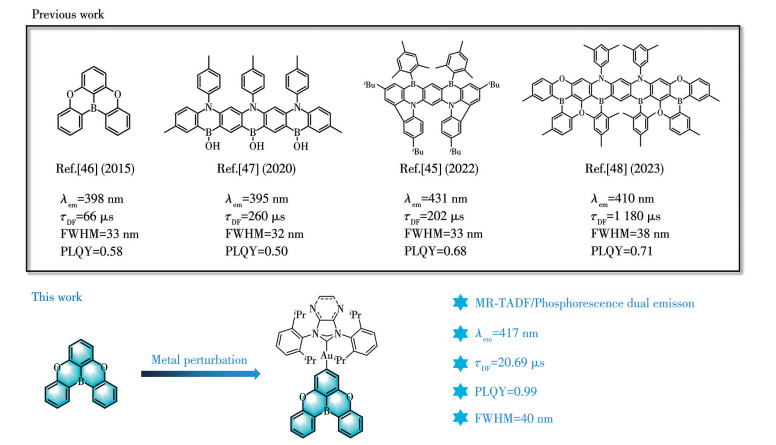
Multi-resonance TADF (MR-TADF) compounds are characterized by opposite resonance effects among doped atoms within polyaromatic molecules and exhibit minimal excited-state structural reorganization due to their rigid skeletons[36-45]. As a result, they achieve high PLQY while maintaining a narrow FWHM (typically <40 nm). Furthermore, the intramolecular short-range charge transfer (SRCT) characteristic of MR-TADF compounds[46-50] provides a promising pathway for developing highly efficient deep blue TADF emitters (Fig.1). However, the moderate singlet-triplet gap (ΔEST) in MR-TADF emitters limits the occurrence of fast RISC, leading to a long-delayed fluorescence lifetime (τDF). Such a long lifetime causes severe triplet exciton accumulation and annihilation, reducing PLQY—particularly in deep blue emitters with high-energy excited states. Various strategies have been employed to reduce the ΔEST of MR-TADF emitters, including embedding heavy atoms into the multiple resonance skeleton or attaching them to the periphery of the compound[51-52]. However, these attempts have led to varying degrees of spectral broadening. It remains highly significant to design deep blue MR-TADF emitters featuring high PLQYs, short lifetime, and good color purity.
Figure 1
In addition to MR-TADF molecular engineering, incorporating fluorescence-phosphorescence dual emission into a fluorescent emitter offers a viable route for triplet harvesting and high PLQY[53-54]. Heavy atoms are known to activate phosphorescence in fluorescent emitters[55-56]. However, phosphorescence is rarely explored in MR-TADF systems, presumably because dual emission would broaden the spectra, undermining their narrow-band feature. To address this, we propose a class of deep blue MR-TADF emitters designed for both high PLQY and short lifetime. (i) We select 5,9-dioxa-13b-boranaphtho[3,2,1-de]anthracene (OBO) as the MR-TADF emission component, as its TADF peak (λem=398 nm) lies close to its phosphorescence peak (λem=418 nm, 77 K)[57], which is expected to minimize spectral broadening from dual emission and thus preserve color purity. (ii) OBO itself shows moderate efficiency (PLQY=0.58) with a delayed fluorescence component of only 2.2%, suggesting that achieving dual emission could substantially boost its PLQY. Au(Ⅰ) is chosen to coordinate with OBO to obtain dual emission, which has a large spin-orbit coupling (SOC) constant. This coordination strategy has been shown not to cause a significant shift in the emission peak[44-45], allowing the resulting complexes to retain deep blue emission.
Based on the above considerations, we report two Au(Ⅰ)-based MR-TADF complexes (Fig.2). As expected, both complexes exhibited dual emission from TADF and phosphorescence at room temperature, yielding a high PLQY of up to 0.99, while maintaining deep blue narrow-band emission (λem=417 nm and FWHM=40 nm). The OLED devices fabricated via solution processing based on (PzIPr)AuOBO showed deep blue emission with CIE coordinates of (0.15, 0.07). The maximum external quantum efficiency (EQE) reached 7.0%, accompanied by negligible efficiency roll-off.
1. Experimental
1.1 Materials and measurements
All starting materials were purchased from commercial sources (Energy Chemical and Bidepharm) and used as received without further purification unless otherwise indicated. Solvents used for photophysical measurements were of HPLC grade. (SIPr)AuCl was purchased from commercial sources, and the synthesis of (PzIPr)AuCl has been reported elsewhere[58]. Synthetic routes for the additional ligands were provided in the Supporting information.
Figure 2
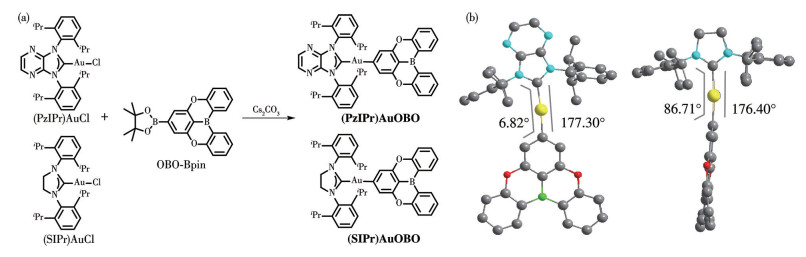
 Figure 2. (a) Synthesis diagrams and molecular structures of (PzIPr)AuOBO and (SIPr)AuOBO; (b) Crystal structures of (PzIPr)AuOBO (left) and (SIPr)AuOBO (right)
Hydrogen atoms and solvent molecules are omitted for clarity; Color code: Au, yellow; C, gray; N, blue; O, green; B, red.
UV-Vis absorption spectra were recorded on an Agilent 8453 UV-Vis spectrometer equipped with an Agilent 89090A thermostat (±0.1 ℃). Mass spectrometric simulations were carried out using the IsoPro v3.0 package. 1H and 13C NMR spectra were recorded in deuterated chloroform (CDCl3) and deuterated dichloromethane (CD2Cl2) on a Bruker 400/600 MHz FT-NMR spectrometer at room temperature. 1H NMR spectra were recorded on a Bruker-400 MHz instrument, and 13C NMR spectra were recorded on a Bruker-600 MHz instrument. Polymethyl methacrylate (PMMA)-doped films were prepared by dissolving the complex in toluene to form a 10-3 mol·L-1 solution, which was then diluted with a 10-3 mol·L-1 PMMA solution in toluene to obtain mixed solutions with the corresponding mass fractions of complex. The resulting solutions were uniformly spin-coated onto 1 cm×1 cm quartz substrates using a spin coater. Photoluminescence (PL) spectra and transient PL decay characteristics were measured by an FL980 spectrometer. The variable-temperature transient PL measurements were performed with the aid of a continuous flow cryostat. Absolute PLQYs were obtained using a Quantaurus-QY measurement system C13534. Elemental analyses were measured on a Vario Micro cube with CHN mode. Thermogravimetric analysis (TGA) was performed on a TGA-Q50 Instrument (TA Instruments, America) with a heating rate of 5 ℃·min-1 from 50 to 800 ℃ under a nitrogen atmosphere.
1.2 Synthesis of (PzIPr)AuOBO
Under a nitrogen atmosphere, OBO-Bpin (99 mg, 0.25 mmol), (PzIPr)AuCl (202.2 mg, 0.3 mmol), and Cs2CO3 (162.9 mg, 0.5 mmol) were mixed in anhydrous toluene (25 mL) and stirred at 60 ℃ for 24 h. The resulting mixture was filtered through a pad of Celite and washed with toluene. The filtrate was distilled off under reduced pressure. Recrystallization from CH2Cl2/hexane gave a pure product as a white solid (147.5 mg, yield: 65%). 1H NMR (400 MHz, CD2Cl2): δ 8.64-8.59 (m, 2H), 8.57 (s, 2H), 7.76-7.59 (m, 4H), 7.46 (dd, J=21.7, 8.2, 7H), 7.38-7.25 (m, 2H), 6.93 (s, 2H), 2.48 (hept, J=7.0, 4H), 1.46 (d, J=6.9, 13H), 1.16 (d, J=6.9, 13H). 13C NMR (101 MHz, CD2Cl2): δ 206.63, 178.80, 159.72, 154.75, 145.79, 140.42, 139.64, 133.53, 132.27, 130.48, 129.67, 123.73, 121.28, 118.33, 117.45, 28.69, 23.52, 22.73, 21.57, 13.05. MALDI-TOF-MS (matrix-assisted laser desorption/ionization time-of-flight mass spectrometry) m/z: Calcd. for C47H46AuBN4O2 [M+H]+ 906.338 1, Found: 906.337 4. Elemental analysis Calcd. (%) for C47H46AuBN4O2: C, 62.26; H, 5.11; N, 6.18; Found: C, 62.27; H, 5.27; N, 6.00.
1.3 Synthesis of (SIPr)AuOBO
Under a nitrogen atmosphere, OBO-Bpin (122.1 mg, 0.31 mmol), (SIPr)AuCl (230.2 mg, 0.37 mmol) and Cs2CO3 (200.9 mg, 0.62 mmol) were mixed in anhydrous toluene (25 mL) and stirred at 60 ℃ for 24 h. The resulting mixture was filtered through a pad of Celite and washed with toluene. The filtrate was distilled off under reduced pressure. Recrystallization from CH2Cl2/hexane gave a pure product as a white solid (153.9 mg, yield: 58%). 1H NMR (600 MHz, CDCl3): δ=8.60 (dd, J=7.7, 1.7, 2H), 7.61 (ddd, J=8.6, 7.0, 1.7, 2H), 7.44 (ddd, J=7.8, 4.1, 3.0, 4H), 7.30-7.27 (m, 7H), 6.95 (s, 2H), 4.08 (s, 4H), 3.20 (h, J=6.9, 4H), 1.56 (d, J=6.8, 12H), 1.41 (d, J=6.9, 12H). 13C NMR (151 MHz, CD2Cl2): δ 214.72, 181.58, 160.60, 155.52, 147.08, 134.74, 134.38, 133.05, 129.69, 129.49, 124.48, 124.27, 122.63, 122.07, 119.22, 118.33, 112.69, 29.21, 29.11, 28.99, 28.95, 25.11, 24.99, 23.93. MALDI-TOF-MS m/z: Calcd. for C45H48AuBN2O2 [M+H]+ 856.347 6, Found: 856.346 8. Elemental analysis Calcd.(%) for C45H48AuBN2O2: C, 63.09; H, 5.65; N, 3.27. Found: C, 63.16; H, 5.88; N, 3.14.
1.4 Single-crystal X-ray diffraction test
X-ray diffraction data were collected on a Rigaku XtaLAB Pro Kappa single-crystal system equipped with a Mo Kα source at 100 K. A suitable crystal was mounted on the diffractometer and cooled down under a nitrogen stream as soon as possible to protect it from desolvation. The CrysAlisPro program was employed for data processing. The structure was solved using the SHELXT 2014 program[59] and refined against F2 anisotropies for all non-hydrogen atoms by the full matrix least-squares method using the SHELXL 2016 program in an Olex2 GUI[60]. Platon program package[61] was employed for squeeze processing. The key crystallographic parameters are presented in Table 1. Furthermore, selected bond lengths and bond angles are given in Table S1 (Supporting information).
Table 1
 Table 1. X-ray crystallographic data of (PzIPr)AuOBO and (SIPr)AuOBO
 下载:
导出CSV
Parameter (PzIPr)AuOBO (SIPr)AuOBO Formula C47H46AuBN4O2 C45H48AuBN2O2 Formula weight 991.58 856.63 λ/nm 0.134 139 0.134 138 Crystal system Triclinic Monoclinic Space group P1 P21/c a/nm 1.071 02(12) 1.403 87(14) b/nm 1.447 23(17) 1.426 19(14) c/nm 1.554 43(18) 1.975 30(19) α/(°) 78.932(3) β/(°) 72.707(3) 101.105(3) γ/(°) 71.291(3) V/nm3 2.166 4(4) 3.880 9(7) Z 2 4 Dc/(g·cm-3) 1.520 1.466 μ/mm-1 5.352 5.077 F(000) 996 1 728.0 Crystal size/mm 0.24×0.21×0.21 0.24×0.12×0.08 θ range/(°) 3.63 to 57.12 2.79 to 57.08 Reflection collected 50 657 7 889 Independent reflection 8 846 (Rint=0.056 8) 7 889 (Rint=0.071 8) Completeness 99.5 99.5 Goodness-of-fit on F 2 1.069 1.076 Final R indices [I>2σ(I)] R1a=0.022 6, wR2b=0.057 5 R1a=0.032 7, wR2b=0.088 5 R indices (all data) R1a=0.024 3, wR2b=0.058 0 R1a=0.036 6, wR2b=0.091 3 Largest diff. peak and hole/(e·nm-3) 680 and -490 1 280 and -1 170 a R=∑(||Fo|-|Fc||)/∑|Fo|; b wR={∑w[(Fo2-Fc2)2]/∑w[(Fo2)2]}1/2. 1.5 Fabrication of OLED devices
The OLED devices were fabricated as follows: indium tin oxide (ITO) glass substrates were sequentially cleaned with detergent, deionized water, acetone, and ethanol, and then dried. The ITO surfaces were subsequently treated with oxygen plasma and UV-ozone to remove residual impurities and increase the ITO work function. A hole transport layer (poly(styrene sulfonic acid, PEDOT:PSS) and an emitting layer [9-(4-(tert-butyl)phenyl)-3,6-bis(triphenylsilyl)-9H-carbazole doped (CzSi) with a mass fraction of 10% of Au(Ⅰ) complexes] were then sequentially spin-coated onto the ITO surface. Finally, an electron transport layer (1,3,5-tri[(3-pyridyl)phen-3-yl]benzene, TmPyPB) and a metal electrode (Al) were deposited onto the ITO surface by thermal evaporation to complete device fabrication.
2. Results and discussion
2.1 Crystal structure
Single crystals of (PzIPr)AuOBO and (SIPr)AuOBO are grown by solvent diffusion between CH2Cl2 and n-pentane over several days. The single-crystal structures of the two complexes are shown in Fig.2b. The bond lengths of CNHC—Au and COBO—Au are quite close, both falling within the range of 0.202 3-0.204 0 nm. (PzIPr)AuOBO exhibits an approximately linear coplanar geometry, with a CNHC—Au—COBO bond angle of 177.30° and a dihedral angle of 6.815°. In contrast, the OBO and carbene ligand display a distinctly orthogonal orientation in (SIPr)AuOBO, with a CNHC—Au—COBO bond angle of 176.40° and a dihedral angle of 86.709°. The highly distorted structures of (SIPr)AuOBO prevent intermolecular π-π stacking, which can otherwise lead to a reduction in emission efficiency[62-63].
2.2 Electrochemical properties
The highest occupied molecular orbital (HOMO) and lowest unoccupied molecular orbital (LUMO) energy levels of the two complexes are estimated using cyclic voltammetry in CH2Cl2 (0.1 mol·L-1 nBu4NPF6) at room temperature (Fig.S2), and the relevant electrochemical data are summarized in Table S2. Carbene ligand modification does not significantly alter the emission properties of OBO, as the HOMO and LUMO levels are comparable in the two complexes. The redox features are attributed to the OBO moiety, based on their similarity to those of free OBO[64].
2.3 Photophysical properties
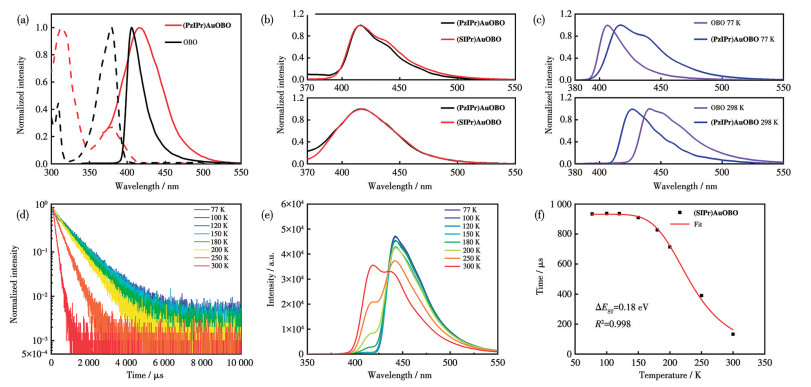
As shown in Fig.3a, the UV-Vis absorption and PL spectra of (PzIPr)AuOBO were first investigated in dilute toluene solution (10-5 mol·L-1) and compared with those of OBO (10-5 mol·L-1). The strong, featureless absorption bands observed for (PzIPr)AuOBO at 315 and 378 nm were assigned to the spin-allowed intraligand (IL) π-π* transition of the NHC ligand and the π-π* transition of OBO, respectively[58]. (PzIPr)AuOBO exhibited bright deep blue luminescence at 417 nm in dilute toluene solution, whereas the fluorescence emission maximum of OBO was observed at 398 nm. (PzIPr)AuOBO showed a ca. 19 nm redshift in emission versus OBO, matching reported values for heavy-atom-doped MR-TADF systems[44-45, 57]. To verify the influence of carbene ligand variation on the emission properties of the complexes, the emission spectra of (PzIPr)AuOBO and (SIPr)AuOBO in PMMA films (the mass fractions were 1% for the two complexes) and in acetonitrile (MeCN) solution (10-5 mol·L-1) at 298 K were recorded and compared (Fig.3b). The emission position of (SIPr)AuOBO in solution was essentially unchanged when PzIPr was replaced by the less electron-donating SIPr ligand, relative to the PzIPr analogue. In doped PMMA films with a complex content of 1% (mass fraction, the same below), both complexes exhibited essentially identical emission spectra, with the emission maximum still observed at 417 nm and an additional shoulder emerging at 438 nm. Both (PzIPr)AuOBO and (SIPr)AuOBO showed satisfactory color purity, with a FWHM as small as 40 nm. Furthermore, the absorption and emission spectra of the two complexes in various solvents of different polarities reveal little significant solvatochromic effect (Fig.S3 and S4), ruling out emission originating from ligand-to-ligand charge transfer (LLCT) excited states. The emission of two Au(Ⅰ) complexes was not correlated with the specific carbene ligand species. Instead, the emission primarily arose from the excited state of OBO. Both complexes exhibited small Stokes shifts (ca. 40 nm), indicative of weak excited-state structural relaxation, likely due to the rigid molecular backbones and steric bulk of the carbene substituents.
Figure 3
 Figure 3. (a) Normalized absorption in toluene (dash) and PL spectra (solid) of (PzIPr)AuOBO (red) and OBO (black) (λex=320 nm); (b) Normalized PL spectra of (PzIPr)AuOBO and (SIPr)AuOBO in MeCN (down) and in PMMA films (1%) (up); (c) Normalized PL (298 K) (down) and phosphorescence (77 K) (up) spectra of (PzIPr)AuOBO and OBO in PMMA films (1%); (d) Temperature-dependent transient PL spectra, (e) temperature-dependent steady-state emission spectra, and (f) Boltzmann-type equation fitting of the emission lifetimes of (SIPr)AuOBO in PMMA films (1%)
To elucidate the origin of the dual emission observed for (PzIPr)AuOBO and (SIPr)AuOBO in thin films at 298 K, the PL spectra of (PzIPr)AuOBO in a PMMA film (1%) at 77 K were further examined and compared with the phosphorescence spectra of OBO. The relevant results are summarized in Fig.3c. Upon cooling to 77 K with a gate delay of 0.5 ms to suppress short-lived fluorescence, the 417 nm peak vanished, while the 438 nm shoulder dominated the emission. The phosphorescence band of OBO at 77 K was similar in shape to the emission peak of (PzIPr)AuOBO. The latter was redshifted by 11 nm relative to the former, a shift that matches the heavy-atom-induced redshift noted earlier. These observations suggest that the 438 nm emission originates from the triplet ligand-centered (3LE) phosphorescence of OBO. To further verify this conjecture, temperature-dependent transient PL spectra and steady-state emission spectra of (PzIPr)AuOBO and (SIPr)AuOBO in PMMA films (1%) were measured (Fig.3d, 3e, S5, and S6). As shown in Fig.3e, during cooling from 300 to 77 K, the intensity of the emission at 417 nm gradually decreased, initially dominating the emission and eventually almost disappearing. This temperature dependence is consistent with TADF behavior[65]. Similar phenomena were observed in the corresponding transient PL spectra (Fig.3d), where the PL lifetime of the complexes at low temperature was approximately 30 times longer than that at room temperature. The temperature-dependent behavior in both transient PL and steady-state emission spectra reveals the TADF character of two Au(Ⅰ) complexes at 417 nm[66]. Remarkably, under each temperature condition, the PL lifetimes of two Au(Ⅰ) complexes obtained by monitoring at the fluorescence emission peak and at the phosphorescence emission peak were identical. This feature corresponds to the International Union of Pure and Applied Chemistry (IUPAC) definition of TADF[67] and has been noted in previous studies involving dual TADF and phosphorescence emission[68-69].
The temperature dependence of the emission lifetime between 300 and 77 K can be described using the Boltzmann equation for the TADF mechanism[65,70], where τT is the measured emission lifetime,
$ {\tau }_{{T}_{1}} $ $ {\tau }_{{S}_{1}} $ $ \tau_T=\frac{3+\exp \left(-\frac{\Delta E_{\mathrm{ST}}}{k_{\mathrm{B}} T}\right)}{\frac{3}{\tau_{T_1}}+\frac{1}{\tau_{S_1}} \exp \left(-\frac{\Delta E_{\mathrm{ST}}}{k_{\mathrm{B}} T}\right)} $ (1) By approximating the emission lifetimes measured at 77 K as the phosphorescence lifetimes, the ΔEST values are obtained through fitting with the above equation: 0.15 eV for (PzIPr)AuOBO (Fig.S7) and 0.18 eV for (SIPr)AuOBO (Fig.3f). These values are sufficiently small to allow RISC to proceed. The PL lifetimes recorded at room temperature were 23.19 μs for (PzIPr)AuOBO and 20.69 μs for (SIPr)AuOBO (Fig.S8), both well below the delayed fluorescence lifetime of OBO (τDF=66 μs) under the same conditions. The observed reduction in PL lifetimes compared to OBO suggests that enhancing the SOC effect through heavy-metal coordination, specifically with Au atoms, is effective in accelerating both intersystem crossing (ISC) and RISC. Remarkably, (PzIPr)AuOBO and (SIPr)AuOBO achieved highly satisfactory PLQY values of 0.77 and 0.99, respectively (Table 2). These results likely derive from the dual radiative decay channels of TADF and phosphorescence activated by the Au atom at room temperature.
Table 2
Table 2. Photophysical properties of OBO, (PzIPr)AuOBO, and (SIPr)AuOBO in toluene solution and PMMA films下载:
导出CSV
Emitter λabs/nma λem/nmb λem at 77 K/nm τDF/μsb PLQYb FWHM/nmb ΔEST/eV OBO[57] 378 398 428 66 0.58 33 0.18 (PzIPr)AuOBO 315/378 417/438 438 23.19 0.77 40 0.14c/0.15d (SIPr)AuOBO 315/378 417/438 438 20.69 0.99 40 0.14c/0.18d a Maximum absorption peak wavelength measured in toluene (10-5 mol·L-1) at 298 K; b Measured in a PMMA film (1%) at 298 K; c Energy gap between S1 and T1 states estimated from emission maximum at 77 K; d Obtained by fitting with the following Boltzmann equation. 2.4 Theoretical calculations
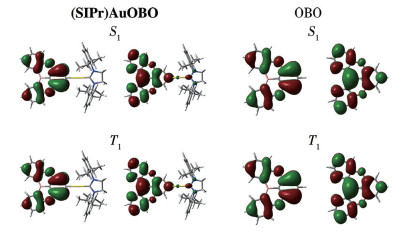
To gain a deeper understanding of the excited-state electronic structure and to verify the role of metal in the excited-state dynamics of the MR emitter OBO, the excited-state orbitals of OBO and (SIPr)AuOBO were investigated using time-dependent density functional theory (TD-DFT). The optimized excited-state structures of (SIPr)AuOBO and OBO reveal that the lowest singlet (S1) and lowest triplet (T1) excited-state orbitals of the complex were similar to those of OBO (Fig.4). Both excited states mainly originate from the HOMO→LUMO (S1: 99.0% for (SIPr)AuOBO and 98.7% for OBO; T1: 97.5% for (SIPr)AuOBO and 96.6% for OBO) transition, with the excited-state orbitals primarily localized on the OBO ligand. The Au5d orbitals show only minor involvement, which is consistent with the initial expectation. Notably, the ΔEST of the complex was significantly reduced compared to its parent precursor OBO (0.360→0.117), and the calculated radiative decay rate (kr) of T1→S0 was 1.13×10³ s-1. These results indicate that the participation of Au markedly accelerates both the ISC and RISC processes and successfully opens a phosphorescence emission pathway in the complex.
2.5 Device characterization
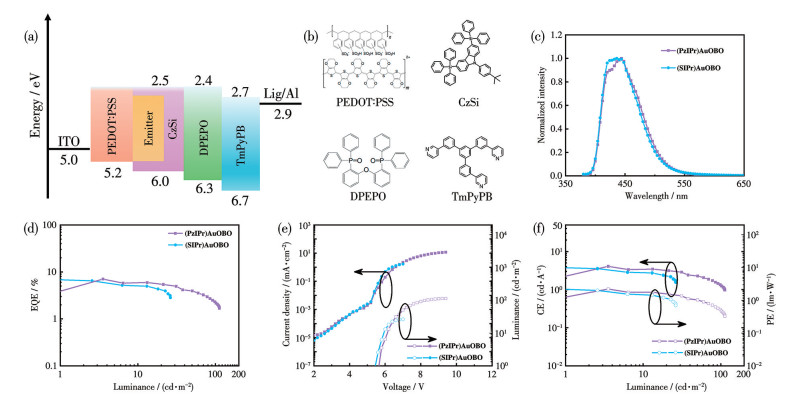
Given the high PLQY exhibited by (PzIPr)AuOBO and (SIPr)AuOBO in thin films, we expect to achieve high-performance OLEDs based on these Au(Ⅰ) complexes and therefore explore their electroluminescence (EL) properties in a range of host materials. The following host materials were initially selected: bis[2-(diphenylphosphino)phenyl] ether oxide (DPEPO), diphenyl [4-(triphenylsilyl)phenyl]phosphine oxide (TSPO1), CzSi, and 1,3-bis(N-carbazolyl)benzene (mCP). These materials are commonly used in deep blue OLEDs due to their high triplet state energy. To identify the most suitable host, the quantum yield of the host film was evaluated at a doping concentration of 5% of the complex, and the corresponding results are presented in Table S3. Notably, despite the highest PLQY (ca. 99%) of the (PzIPr)AuOBO-doped film with DPEPO as the host, the corresponding OLEDs fail to illuminate under all test conditions. This failure is attributed to the large hole injection barrier from poly(ethylenedioxythiophene): PEDOT:PSS to DPEPO and the poor hole transport capability of DPEPO. After screening the host material and doping concentration, the final device architecture is as follows: ITO/PEDOT:PSS (40 nm)/CzSi with a mass fraction of 10% complexes (35 nm)/DPEPO (5 nm)/TmPyPB (45 nm)/8-hydroxyquinolinato lithium (Liq, 1 nm)/Al (100 nm), as shown in Table S5 and S6, Fig.S9 and S10). The optimized structure and EL performance of the solution-processable OLEDs are shown in Fig.5, and other relevant parameters are summarized in Table 3. Both devices showed similar emission spectra. As observed in their PL spectra at the same doping concentration, they exhibited dual emission at 420 nm and 444/436 nm (Fig.5c), with the latter (444/436 nm) becoming the dominant emission. The CIE coordinates were (0.15, 0.07) and (0.15, 0.06) for (PzIPr)AuOBO and (SIPr)AuOBO. The maximum EQE was obtained from the (PzIPr)AuOBO-based device (Fig.5d), for which the current efficiency (CE) and power efficiency (PE) were recorded as 4.1 cd·A-1 and 2.2 lm·W-1, respectively, with a maximum luminance of 112.7 cd·m-2 (Fig.5e and 5f). Compared with other deep-blue OLED devices based on metal complexes, the performance of this device is considered satisfactory.
Figure 4
 Figure 4. HOMO (left) and LUMO (right) surfaces of (SIPr)AuOBO and OBO at the S1 and T1 states (surface isovalue=0.03 a.u.)
Figure 5
 Figure 5. (a) Device configuration; (b) Molecular structure of the materials used in the devices; (c) EL spectra, (d) EQE-luminescence curves, (e) current density-voltage and luminance-voltage curves, and (f) CE and PE curves of (PzIPr)AuOBO- and (SIPr)AuOBO-based devices
Table 3
Table 3. Device performance data of (PzIPr)AuOBO and (SIPr)AuOBO under optimal conditions with 10% complexes下载:
导出CSV
Complex Von/Va Maximum
EQE/%CE/
(cd·A-1)PE/
(lm·W-1)Luminance/
(cd·m-2)CIE
(L=100 cd·m-2)(SIPr)AuOBO 5.5 6.5 3.6 2.0 26.3 (0.15, 0.06) (PzIPr)AuOBO 5.7 7.0 4.1 2.2 112.7 (0.15, 0.07) a Von: turn-on voltage. 3. Conclusions
In summary, we report two deep blue Au(Ⅰ)-based MR-TADF emitters. Au coordination enhances spin-orbit coupling, substantially shortening the emission lifetime of the parent MR-TADF emitter while retaining its deep blue emission (λem=417 nm) and narrow bandwidth (FWHM=40 nm). Both complexes exhibit dual emission from MR-TADF and phosphorescence. The metal-activated radiative triplet pathway boosts the PLQY to as high as 0.99 for (SIPr)AuOBO. Solution-processed OLEDs based on (PzIPr)AuOBO achieved deep blue electroluminescence with a maximum EQE of 7.0%. This work provides a strategy for developing efficient deep blue emitters with high color purity.
Supporting information is available athttp://www.wjhxxb.cn
-
-
[1]
TANG C W, VANSLYKE S A. Organic electroluminescent diodes[J]. Appl. Phys. Lett., 1987, 51: 913-915 doi: 10.1063/1.98799
-
[2]
BALDO M A, O′BRIEN D F, YOU Y, SHOUSTIKOV A, SIBLEY S, THOMPSON M E, FORREST S R. Highly efficient phosphorescent emission from organic electroluminescent devices[J]. Nature, 1998, 395: 151-154 doi: 10.1038/25954
-
[3]
MÖLLER S, FORREST S R. Improved light out-coupling in organic light emitting diodes employing ordered microlens arrays[J]. J. Appl. Phys., 2002, 91: 3324-3327 doi: 10.1063/1.1435422
-
[4]
MURAWSKI C, LEO K, GATHER M C. Efficiency roll-off in organic light-emitting diodes[J]. Adv. Mater., 2013, 25: 6801-6827 doi: 10.1002/adma.201301603
-
[5]
LU X Y, HUANG T T, QU Y Q, WEI J B, WANG Y. Narrowband green OLEDs displaying high efficiency at ultra-high brightness based on multiple energy transfer pathways[J]. Adv. Opt. Mater., 2025, 13: e02280 doi: 10.1002/adom.202502280
-
[6]
FENG T T, NIE X W, LIU D H, WU L, LIU C Y, MU X L, XIN Z R, LIU B H, QI H X, ZHANG J S, LI W, SU S J, GE Z Y. Multiple resonance quasi-fluorescence from BN-doped aromatic compounds modified with “naphthalene” units approaches the BT. 2020 green light standard[J]. Angew. Chem.—Int. Edit., 2025, 64: e202415113 doi: 10.1002/anie.202415113
-
[7]
LIU Y Y, LU Z Q, YANG J J, MAO Z, YANG G X, ZHAO J, FENG H T, SU S J, CHI Z G. Asymmetric TADF emitters with 93% horizontal dipole orientation enable 20.1% EQE in deep-red OLEDs and spectral tunability to NIR[J]. Adv. Funct. Mater., 2026, 36: e29822 doi: 10.1002/adfm.202529822
-
[8]
TANG R, XU S, CHENG G, LOW K H, ZHANG D D, DUAN L, CHE C M. Highly stable and efficient copper(Ⅰ) sensitizer for narrowband red organic light-emitting diodes with an operational lifetime (LT95) of up to 3 689 h at 1 000 cd m-2[J]. Nat. Commun., 2025, 16: 7776 doi: 10.1038/s41467-025-62867-8
-
[9]
LIU X L, HUA L, LAI X Y, KIM J H, ZHU Q Y, LEE J Y, ZHU W G, WANG Y F. High-performance solution processable red TADF-OLED with external quantum efficiency exceeding 28% using a multi-resonance emitter host[J]. Adv. Mater., 2025, 37: 2500690 doi: 10.1002/adma.202500690
-
[10]
LIU J H, MIAO J S, DONG J J, CHEN Z X, HUANG Z Y, YANG C L. Increasing aromaticity in selenium-embedded hetero ring enables stable narrowband multi-resonance TADF emitter for long-lifetime pure-green OLEDs[J]. Adv. Mater., 2026, 38: e13987 doi: 10.1002/adma.202513987
-
[11]
CHO H H, CONGRAVE D G, GILLETT A J. Suppression of Dexter transfer by covalent encapsulation for efficient matrix-free narrowband deep blue hyperfluorescent OLEDs[J]. Nat. Mater., 2024, 23: 519-526 doi: 10.1038/s41563-024-01812-4
-
[12]
GOUSHI K, YOSHIDA K, SATO K, ADACHI C. Organic light-emitting diodes employing efficient reverse intersystem crossing for triplet-to-singlet state conversion[J]. Nat. Photonics, 2012, 6: 253-258 doi: 10.1038/nphoton.2012.31
-
[13]
GU J L, SHI W, ZHENG H X, CHEN G, WEI B, WONG W Y. The novel organic emitters for high-performance narrow-band deep blue OLEDs[J]. Top. Curr. Chem., 2023, 381: 26 doi: 10.1007/s41061-023-00436-7
-
[14]
FORREST S R, ARNESON C, ZHAO H N. Perspective: OLED displays singing with the blues[J]. Adv. Mater., 2026, 38: e19327 doi: 10.1002/adma.202519327
-
[15]
LIN H, YE Z Y, XIAN S J, CHEN Z X, MIAO J S, HUANG Z Y, ZHONG C, GONG S L, CAO X S, YANG C L. Deep-blue narrowband OLEDs achieve external quantum efficiency over 40% and blue index of 422 by synergistic π-extension and heavy-atom effect[J]. Adv. Mater., 2025, 37: 2502459 doi: 10.1002/adma.202502459
-
[16]
TANKELEVIČIŪTĖ E, SAMUEL I D W, ZYSMAN-COLMAN E. The blue problem: OLED stability and degradation mechanisms[J]. J. Phys. Chem. Lett., 2024, 15: 1034-1047 doi: 10.1021/acs.jpclett.3c03317
-
[17]
LEE J H, CHEN C H, LEE P H, LIN H Y, LEUNG M KIT, CHIU T L, LIN C F. Blue organic light-emitting diodes: Current status, challenges, and future outlook[J]. J. Mater. Chem. C, 2019, 7: 5874-5888 doi: 10.1039/C9TC00204A
-
[18]
ZHU M R, YANG C L. Blue fluorescent emitters: Design tactics and applications in organic light-emitting diodes[J]. Chem. Soc. Rev., 2013, 42: 4963 doi: 10.1039/c3cs35440g
-
[19]
ZHANG X, SONG X F, JIANG S, YAO Y G, CHANG X Y, GAO Y N, LI K, CHEN Y. Two-coordinate gold(Ⅰ) complex with rotational freedom: A platform integrating thermally activated delayed fluorescence, polymorphism, and linearly polarized luminescence[J]. Angew. Chem.—Int. Edit., 2025, 64: e202414892 doi: 10.1002/anie.202414892
-
[20]
YERSIN H, CZERWIENIEC R, SHAFIKOV M Z, SULEYMANOVA A F. TADF material design: Photophysical background and case studies focusing on CuⅠ and AgⅠ complexes[J]. ChemPhysChem, 2017, 18: 3508-3535 doi: 10.1002/cphc.201700872
-
[21]
DI D W, ROMANOV A S, YANG L, RICHTER J M, RIVETT J P H, JONES S, THOMAS T H, ABDI JALEBI M, FRIEND R H, LINNOLAHTI M, BOCHMANN M, CREDGINGTON D. High-performance light-emitting diodes based on carbene-metal-amides[J]. Science, 2017, 356: 159-163 doi: 10.1126/science.aah4345
-
[22]
TANG R, XU S, LAM T L, CHENG G, DU L L, WAN Q Y, YANG J, HUNG F F, LOW K H, PHILLIPS D L, CHE C M. Highly robust CuⅠ-TADF emitters for vacuum-deposited OLEDs with luminance up to 222 200 cd m-2 and device lifetimes (LT90) up to 1 300 hours at an initial luminance of 1 000 cd m-2[J]. Angew. Chem.—Int. Edit., 2022, 61: e202203982 doi: 10.1002/anie.202203982
-
[23]
HAMZE R, PELTIER J L, SYLVINSON D, JUNG M, CARDENAS J, HAIGES R, SOLEILHAVOUP M, JAZZAR R, DJUROVICH P I, BERTRAND G, THOMPSON M E. Eliminating nonradiative decay in Cu(Ⅰ) emitters: >99% quantum efficiency and microsecond lifetime[J]. Science, 2019, 363(6427): 601-606 doi: 10.1126/science.aav2865
-
[24]
UOYAMA H, GOUSHI K, SHIZU K, NOMURA H, ADACHI C. Highly efficient organic light-emitting diodes from delayed fluorescence[J]. Nature, 2012, 492: 234-238 doi: 10.1038/nature11687
-
[25]
BRYDEN M A, ZYSMAN-COLMAN E. Organic thermally activated delayed fluorescence (TADF) compounds used in photocatalysis[J]. Chem. Soc. Rev., 2021, 50: 7587-7680 doi: 10.1039/D1CS00198A
-
[26]
TO W P, CHENG G, TONG G S M, ZHOU D L, CHE C M. Recent advances in metal-TADF emitters and their application in organic light-emitting diodes[J]. Front. Chem., 2020, 8: 653 doi: 10.3389/fchem.2020.00653
-
[27]
LI K, CHEN Y, WANG J, YANG C L. Diverse emission properties of transition metal complexes beyond exclusive single phosphorescence and their wide applications[J]. Coord. Chem. Rev., 2021, 433: 213755 doi: 10.1016/j.ccr.2020.213755
-
[28]
LI T Y, ZHENG S J, DJUROVICH P I, THOMPSON M E. Two-coordinate thermally activated delayed fluorescence coinage metal complexes: Molecular design, photophysical characters, and device application[J]. Chem. Rev., 2024, 124: 4332-4392 doi: 10.1021/acs.chemrev.3c00761
-
[29]
TANG R, XU S, DU L L, HUNG F F, LAM T L, CHENG G, LOW K H, WAN Q Y, WU S P, CHEN Y, CHE C M. Au(Ⅰ)-TADF emitters for high efficiency full-color vacuum-deposited OLEDs and TADF-sensitized fluorescent OLEDs with ultrahigh brightness and prolonged operational lifetime[J]. Adv. Opt. Mater., 2023, 11: 2300950 doi: 10.1002/adom.202300950
-
[30]
YU F H, SONG X F, LIU G H, CHANG X Y, LI K, WANG Y, CUI G L, CHEN Y. Highly efficient Au(Ⅰ) alkynyl emitters: Thermally activated delayed fluorescence and solution-processed OLEDs[J]. Chem.—Eur. J., 2022, 28: e202202439 doi: 10.1002/chem.202202439
-
[31]
ZHANG X, SONG J X, CHANG X Y, LI K, CHEN Y. Thermally activated delayed fluorescent binuclear copper(Ⅰ) alkynyl complexes with cuprophilic interactions[J]. Chem.—Eur. J., 2024, 30: e202304224 doi: 10.1002/chem.202304224
-
[32]
XIONG J F, ZHANG Y, LUAN C Z, ZHANG Z H, CHANG X Y, XIE M, MIAO J S, LI K, CHEN Y. Synthesis, structures, photophysics, and electroluminescence of dinuclear carbene-Au(Ⅰ)-amide complexes featuring the through-space charge transfer excited state[J]. Inorg. Chem., 2025, 64: 13623-13634 doi: 10.1021/acs.inorgchem.5c00404
-
[33]
WANG H J, LIU Y, YU B Q, SONG S Q, ZHENG Y X, LIU K L, CHEN P K, WANG H L, JIANG J Z, LI T Y. A configurationally confined thermally activated delayed fluorescent two-coordinate CuⅠ complex for efficient blue electroluminescence[J]. Angew. Chem.—Int. Edit., 2023, 62: e202217195 doi: 10.1002/anie.202217195
-
[34]
ZHANG Q S, LI J, SHIZU K, HUANG S, HIRATA S, MIYAZAKI H, ADACHI C. Design of efficient thermally activated delayed fluorescence materials for pure blue organic light emitting diodes[J]. J. Am. Chem. Soc., 2012, 134: 14706-14709 doi: 10.1021/ja306538w
-
[35]
CONAGHAN P J, MATTHEWS C S B, CHOTARD F, JONES S T E, GREENHAM N C, BOCHMANN M, CREDGINGTON D, ROMANOV A S. Highly efficient blue organic light-emitting diodes based on carbene-metal-amides[J]. Nat. Commun., 2020, 11: 1758 doi: 10.1038/s41467-020-15369-8
-
[36]
LUO Y J, LI S B, ZHAO Y H, LI C, PANG Z G, HUANG Y, YANG M H, ZHOU L, ZHENG X J, PU X M, LU Z Y. An ultraviolet thermally activated delayed fluorescence OLED with total external quantum efficiency over 9%[J]. Adv. Mater., 2020, 32: 2001248 doi: 10.1002/adma.202001248
-
[37]
WEERASINGHE R W, SURESH S M, HALL D, MATULAITIS T, SLAWIN A M Z, WARRINER S, LEE Y T, CHAN C Y, TSUCHIYA Y, ZYSMAN-COLMAN E, ADACHI C. A boron, nitrogen, and oxygen doped π-extended helical pure blue multiresonant thermally activated delayed fluorescent emitter for organic light emitting diodes that shows fast kRISC without the use of heavy atoms[J]. Adv. Mater., 2024, 36: 2402289 doi: 10.1002/adma.202402289
-
[38]
HATAKEYAMA T, SHIREN K, NAKAJIMA K, NOMURA S, NAKATSUKA S, KINOSHITA K, NI J, ONO Y, IKUTA T. Ultrapure blue thermally activated delayed fluorescence molecules: Efficient HOMO-LUMO separation by the multiple resonance effect[J]. Adv. Mater., 2016, 28: 2777-2781 doi: 10.1002/adma.201505491
-
[39]
KONDO Y, YOSHIURA K, KITERA S, NISHI H, ODA S, GOTOH H, SASADA Y, YANAI M, HATAKEYAMA T. Narrowband deep-blue organic light-emitting diode featuring an organoboron-based emitter[J]. Nat. Photonics, 2019, 13: 678-682 doi: 10.1038/s41566-019-0476-5
-
[40]
PATIL V V, LEE H L, KIM I, LEE K H, CHUNG W J, KIM J, PARK S, CHOI H, SON W J, JEON S O, LEE J Y. Purely spin-vibronic coupling assisted triplet to singlet up-conversion for real deep blue organic light-emitting diodes with over 20% efficiency and y color coordinate of 0.05[J]. Adv. Sci., 2021, 8: 2101137 doi: 10.1002/advs.202101137
-
[41]
PARK I S, YANG M L, SHIBATA H, AMANOKURA N, YASUDA T. Achieving ultimate narrowband and ultrapure blue organic light-emitting diodes based on polycyclo-heteraborin multi-resonance delayed-fluorescence emitters[J]. Adv. Mater., 2022, 34: 2107951 doi: 10.1002/adma.202107951
-
[42]
YE Z Y, WU H, XU Y L, HUA T, CHEN G H, CHEN Z X, YIN X J, HUANG M L, XU K, SONG X F, HUANG Z Y, LV X L, MIAO J S, CAO X S, YANG C L. Deep-blue narrowband hetero[6]helicenes showing circularly polarized thermally activated delayed fluorescence toward high-performance OLEDs[J]. Adv. Mater., 2024, 36: 2308314 doi: 10.1002/adma.202308314
-
[43]
OCHI J, YAMASAKI Y, TANAKA K, KONDO Y, ISAYAMA K, ODA S, KONDO M, HATAKEYAMA T. Highly efficient multi-resonance thermally activated delayed fluorescence material toward a BT. 2020 deep-blue emitter[J]. Nat. Commun., 2024, 15: 2361 doi: 10.1038/s41467-024-46619-8
-
[44]
WANG J J, LI N Q, ZHONG C, MIAO J S, HUANG Z Y, YU M X, HU Y X, LUO S, ZOU Y, LI K, YANG C L. Metal-perturbed multiresonance TADF emitter enables high-efficiency and ultralow efficiency roll-off nonsensitized OLEDs with pure green gamut[J]. Adv. Mater., 2023, 35: 2208378 doi: 10.1002/adma.202208378
-
[45]
CAI S Y, TONG G S M, DU L L, SO G K M, HUNG F F, LAM T L, CHENG G, XIAO H, CHANG X, XU Z X, CHE C M. Gold(Ⅰ) multi-resonance thermally activated delayed fluorescent emitters for highly efficient ultrapure-green organic light-emitting diodes[J]. Angew. Chem.—Int. Edit., 2022, 61: e202213392 doi: 10.1002/anie.202213392
-
[46]
HIRAI H, NAKAJIMA K, NAKATSUKA S, SHIREN K, NI J, NOMURA S, IKUTA T, HATAKEYAMA T. One-step borylation of 1, 3-diaryloxybenzenes towards efficient materials for organic light-emitting diodes[J]. Angew. Chem.—Int. Edit., 2015, 54: 13581-13585 doi: 10.1002/anie.201506335
-
[47]
SURESH S M, DUDA E, HALL D, YAO Z, BAGNICH S, SLAWIN A M Z, BÄSSLER H, BELJONNE D, BUCK M, OLIVIER Y, KÖHLER A, ZYSMAN-COLMAN E. A deep blue B, N-doped heptacene emitter that shows both thermally activated delayed fluorescence and delayed fluorescence by triplet-triplet annihilation[J]. J. Am. Chem. Soc., 2020, 142: 6588-6599 doi: 10.1021/jacs.9b13704
-
[48]
MADAYANAD SURESH S, ZHANG L, HALL D, SI C, RICCI G, MATULAITIS T, SLAWIN A M Z, WARRINER S, OLIVIER Y, SAMUEL I D W, ZYSMAN-COLMAN E. A deep-blue-emitting heteroatom-doped MR-TADF nonacene for high-performance organic light-emitting diodes[J]. Angew. Chem., 2023, 62: e202215522 doi: 10.1002/anie.202215522
-
[49]
HAO J P, OCHI J, TANAKA K, MAMADA M, NAVEEN K R, KONDO Y, KONDO M, HATAKEYAMA T. Late-stage direct double borylation of B/N-based multi-resonance framework enables high-performance ultra-narrowband deep-blue organic light-emitting diodes[J]. Nat. Commun., 2025, 16: 8867 doi: 10.1038/s41467-025-63908-y
-
[50]
YUAN G, WANG Y C, ZHANG Z, LIU J Y, HE Y H, CHEN G W, LI Y Q, TANG J X. Complementarity fusion of boron-oxygen and carbazole blocks enables narrowband blue OLEDs with high performance[J]. Nat. Commun., 2025, 16: 10461 doi: 10.1038/s41467-025-65446-z
-
[51]
HU Y X, MIAO J S, HUA T, HUANG Z Y, QI Y Y, ZOU Y, QIU Y T, XIA H, LIU H, CAO X S, YANG C L. Efficient selenium-integrated TADF OLEDs with reduced roll-off[J]. Nat. Photonics, 2022, 16: 803-810 doi: 10.1038/s41566-022-01083-y
-
[52]
HU Y X, MIAO J S, ZHONG C, ZENG Y, GONG S L, CAO X S, ZHOU X, GU Y, YANG C L. Peripherally heavy-atom-decorated strategy towards high-performance pure green electroluminescence with external quantum efficiency over 40%[J]. Angew. Chem.—Int. Edit., 2023, 62: e202302478 doi: 10.1002/anie.202302478
-
[53]
BEHERA S K, PARK S Y, GIERSCHNER J. Dual emission: Classes, mechanisms, and conditions[J]. Angew. Chem.—Int. Edit., 2021, 60: 22624-22638 doi: 10.1002/anie.202009789
-
[54]
KUKHTA N A, BRYCE M R. Dual emission in purely organic materials for optoelectronic applications[J]. Mater. Horiz., 2021, 8: 33-55 doi: 10.1039/D0MH01316A
-
[55]
MA C S, CHAN C T L, KWOK W M, CHE C M. Ligand π-conjugation dictated intersystem crossing in phenyleneethynylene gold(Ⅰ) complexes[J]. Chem. Sci., 2012, 3: 1883-1892 doi: 10.1039/C2SC20038D
-
[56]
CHEN H, DENG Y H, ZHU X Y, WANG L, LV L, WU X X, LI Z J, SHI Q Q, PENG A D, PENG Q, SHUAI Z G, ZHAO Z J, CHEN H J, HUANG H. Toward achieving single-molecule white electroluminescence from dual emission of fluorescence and phosphorescence[J]. Chem. Mater., 2020, 32: 4038-4044 doi: 10.1021/acs.chemmater.0c00710
-
[57]
IKEDA N, ODA S, MATSUMOTO R, YOSHIOKA M, FUKUSHIMA D, YOSHIURA K, YASUDA N, HATAKEYAMA T. Solution-processable pure green thermally activated delayed fluorescence emitter based on the multiple resonance effect[J]. Adv. Mater., 2020, 32: 2004072 doi: 10.1002/adma.202004072
-
[58]
WANG H M J, VASAM C S, TSAI T Y R, CHEN S H, CHANG A H H, LIN I J B. Gold(Ⅰ) N-heterocyclic carbene and carbazolate complexes[J]. Organometallics, 2005, 24: 486-493 doi: 10.1021/om049221u
-
[59]
SHELDRICK G M. A short history of SHELX[J]. Acta Crystallogr. Sect. A—Found. Crystallogr., 2008, 64: 112-122 doi: 10.1107/S0108767307043930
-
[60]
DOLOMANOV O V, BOURHIS L J, GILDEA R J, HOWARD J A K, PUSCHMANN H. OLEX2: A complete structure solution, refinement and analysis program[J]. J. Appl. Crystallogr., 2009, 42: 339-341 doi: 10.1107/S0021889808042726
-
[61]
NEESE F, WENNMOHS F, HANSEN A, BECKER U. Efficient, approximate and parallel Hartree-Fock and hybrid DFT calculations. A “chain-of-spheres” algorithm for the Hartree-Fock exchange[J]. Chem. Phys., 2009, 356: 98-109 doi: 10.1016/j.chemphys.2008.10.036
-
[62]
MATSUI K, ODA S, YOSHIURA K, NAKAJIMA K, YASUDA N, HATAKEYAMA T. One-shot multiple borylation toward BN-doped nanographenes[J]. J. Am. Chem. Soc., 2018, 140: 1195-1198 doi: 10.1021/jacs.7b10578
-
[63]
ZHANG Y W, ZHANG D D, WEI J B, HONG X C, LU Y, HU D P, LI G M, LIU Z, CHEN Y, DUAN L. Achieving pure green electroluminescence with CIEy of 0.69 and EQE of 28.2% from an aza-fused multi-resonance emitter[J]. Angew. Chem.—Int. Edit., 2020, 59: 17499-17503 doi: 10.1002/anie.202008264
-
[64]
YU F H, JIN R, CHANG X Y, LI K, CUI G L, CHEN Y. Long-persistent circularly polarized luminescence from a host-guest system regulated by the multiple roles of a gold(Ⅰ)-carbene motif[J]. Angew. Chem.—Int. Edit., 2023, 62: e202312927 doi: 10.1002/anie.202312927
-
[65]
YERSIN H, RAUSCH A F, CZERWIENIEC R, HOFBECK T, FISCHER T. The triplet state of organo-transition metal compounds. Triplet harvesting and singlet harvesting for efficient OLEDs[J]. Coord. Chem. Rev., 2011, 255: 2622-2652 doi: 10.1016/j.ccr.2011.01.042
-
[66]
HOFBECK T, MONKOWIUS U, YERSIN H. Highly efficient luminescence of Cu(Ⅰ) compounds: Thermally activated delayed fluorescence combined with short-lived phosphorescence[J]. J. Am. Chem. Soc., 2015, 137: 399-404 doi: 10.1021/ja5109672
-
[67]
IUPAC. IUPAC compendium of chemical terminology[M/OL]. 5th ed. [S. l. ]: IUPAC, 2025.
https://goldbook.iupac.org . -
[68]
PANDER P, ZAYTSEV A V, SIL A, WILLIAMS J A G, LANOE P H, KOZHEVNIKOV V N, DIAS F B. The role of dinuclearity in promoting thermally activated delayed fluorescence (TADF) in cyclometallated, N^C^N-coordinated platinum(Ⅱ) complexes[J]. J. Mater. Chem. C, 2021, 9: 10276-10287 doi: 10.1039/D1TC02562G
-
[69]
PANDER P, DANIELS R, ZAYTSEV A V, HORN A, SIL A, PENFOLD T J, WILLIAMS J A G, KOZHEVNIKOV V N, DIAS F B. Exceptionally fast radiative decay of a dinuclear platinum complex through thermally activated delayed fluorescence[J]. Chem. Sci., 2021, 12: 6172-6180 doi: 10.1039/D1SC00160D
-
[70]
KIRCHHOFF J R, GAMACHE R E, BLASKIE M W, DEL PAGGIO A A, LENGEL R K, MCMILLIN D R. Temperature dependence of luminescence from Cu(NN)2+ systems in fluid solution. Evidence for the participation of two excited states[J]. Inorg. Chem., 1983, 22: 2381-2384
-
[1]
-

Figure 2 (a) Synthesis diagrams and molecular structures of (PzIPr)AuOBO and (SIPr)AuOBO; (b) Crystal structures of (PzIPr)AuOBO (left) and (SIPr)AuOBO (right)
Hydrogen atoms and solvent molecules are omitted for clarity; Color code: Au, yellow; C, gray; N, blue; O, green; B, red.
Figure 3 (a) Normalized absorption in toluene (dash) and PL spectra (solid) of (PzIPr)AuOBO (red) and OBO (black) (λex=320 nm); (b) Normalized PL spectra of (PzIPr)AuOBO and (SIPr)AuOBO in MeCN (down) and in PMMA films (1%) (up); (c) Normalized PL (298 K) (down) and phosphorescence (77 K) (up) spectra of (PzIPr)AuOBO and OBO in PMMA films (1%); (d) Temperature-dependent transient PL spectra, (e) temperature-dependent steady-state emission spectra, and (f) Boltzmann-type equation fitting of the emission lifetimes of (SIPr)AuOBO in PMMA films (1%)
Figure 4 HOMO (left) and LUMO (right) surfaces of (SIPr)AuOBO and OBO at the S1 and T1 states (surface isovalue=0.03 a.u.)
Figure 5 (a) Device configuration; (b) Molecular structure of the materials used in the devices; (c) EL spectra, (d) EQE-luminescence curves, (e) current density-voltage and luminance-voltage curves, and (f) CE and PE curves of (PzIPr)AuOBO- and (SIPr)AuOBO-based devices
Table 1. X-ray crystallographic data of (PzIPr)AuOBO and (SIPr)AuOBO
Parameter (PzIPr)AuOBO (SIPr)AuOBO Formula C47H46AuBN4O2 C45H48AuBN2O2 Formula weight 991.58 856.63 λ/nm 0.134 139 0.134 138 Crystal system Triclinic Monoclinic Space group P1 P21/c a/nm 1.071 02(12) 1.403 87(14) b/nm 1.447 23(17) 1.426 19(14) c/nm 1.554 43(18) 1.975 30(19) α/(°) 78.932(3) β/(°) 72.707(3) 101.105(3) γ/(°) 71.291(3) V/nm3 2.166 4(4) 3.880 9(7) Z 2 4 Dc/(g·cm-3) 1.520 1.466 μ/mm-1 5.352 5.077 F(000) 996 1 728.0 Crystal size/mm 0.24×0.21×0.21 0.24×0.12×0.08 θ range/(°) 3.63 to 57.12 2.79 to 57.08 Reflection collected 50 657 7 889 Independent reflection 8 846 (Rint=0.056 8) 7 889 (Rint=0.071 8) Completeness 99.5 99.5 Goodness-of-fit on F 2 1.069 1.076 Final R indices [I>2σ(I)] R1a=0.022 6, wR2b=0.057 5 R1a=0.032 7, wR2b=0.088 5 R indices (all data) R1a=0.024 3, wR2b=0.058 0 R1a=0.036 6, wR2b=0.091 3 Largest diff. peak and hole/(e·nm-3) 680 and -490 1 280 and -1 170 a R=∑(||Fo|-|Fc||)/∑|Fo|; b wR={∑w[(Fo2-Fc2)2]/∑w[(Fo2)2]}1/2.  下载: 导出CSV
Table 2. Photophysical properties of OBO, (PzIPr)AuOBO, and (SIPr)AuOBO in toluene solution and PMMA films
Emitter λabs/nma λem/nmb λem at 77 K/nm τDF/μsb PLQYb FWHM/nmb ΔEST/eV OBO[57] 378 398 428 66 0.58 33 0.18 (PzIPr)AuOBO 315/378 417/438 438 23.19 0.77 40 0.14c/0.15d (SIPr)AuOBO 315/378 417/438 438 20.69 0.99 40 0.14c/0.18d a Maximum absorption peak wavelength measured in toluene (10-5 mol·L-1) at 298 K; b Measured in a PMMA film (1%) at 298 K; c Energy gap between S1 and T1 states estimated from emission maximum at 77 K; d Obtained by fitting with the following Boltzmann equation.
下载: 导出CSV
Table 3. Device performance data of (PzIPr)AuOBO and (SIPr)AuOBO under optimal conditions with 10% complexes
Complex Von/Va Maximum
EQE/%CE/
(cd·A-1)PE/
(lm·W-1)Luminance/
(cd·m-2)CIE
(L=100 cd·m-2)(SIPr)AuOBO 5.5 6.5 3.6 2.0 26.3 (0.15, 0.06) (PzIPr)AuOBO 5.7 7.0 4.1 2.2 112.7 (0.15, 0.07) a Von: turn-on voltage.
下载: 导出CSV
-



 扫一扫看文章
计量
- PDF下载量: 0
- 文章访问数: 71
- HTML全文浏览量: 6
 下载:

