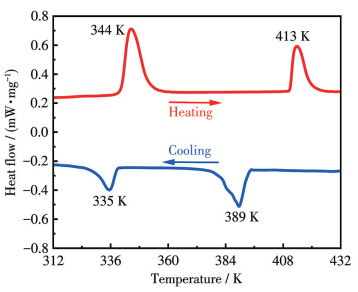
Figure 1.
DSC data of compound 1 from 312 to 432 K

A zero-dimensional manganese(Ⅱ)-based hybrid with high-temperature phase transitions and synergistic dielectric, magnetic and luminescent switching responses
Yue ZHUO , Zhihao LIU , Yixuan LIU , Caifu QIU , Haiquan YAO , Xin QIU , Yan PENG , Zhaobo HU


Multifunctional molecular materials with bistable switching behaviors have long been at the forefront of materials research, driven by their promising applications in next-generation information processing, high-density data storage, and related technologies, particularly in the current era of rapid information expansion[1-4]. Among the diverse candidates explored, organic-inorganic hybrid materials stand out owing to their structural diversity, facile self-assembly, and synthetic tunability[5-7]. Their structures can be readily modulated by external stimuli, including heat, light, electric fields, magnetic fields, and pressure, giving rise to switchable electronic, magnetic, and optical properties[8-12]. Nevertheless, the rational design of multifunctional materials that operate within a targeted temperature range and exhibit synergistic dielectric, magnetic, and luminescent responses remains a substantial challenge.
Low-dimensional hybrid metal halides of the general formula A2BX4 (A=organic ammonium cation, B=divalent metal ion, X=halide anion) have been widely investigated as a versatile platform for such functionalities[13-17]. In these systems, the organic moiety typically undergoes structural rearrangement in response to external stimuli, while the inorganic component governs the intrinsic physical properties. Notably, phase transitions near the switching temperature can induce abrupt changes in multiple physical channels[18-21]. Among this family, zero-dimensional (0D) compounds are particularly attractive due to their flexible and tunable structures, which provide an ideal playground for developing high-performance multifunctional materials[22-24]. Additionally, most of these materials are lead-free, further broadening their application potential. Mn2+ ions impart rich physical characteristics to the hybrids, including magnetism, luminescence, and dielectric switching. To date, it has been feasible to integrate two or even three functionalities into low-dimensional manganese-based halides that undergo structural phase transitions[25-26]. The photoluminescence in these compounds arises primarily from spin-orbit coupling of Mn2+, which induces significant mixing between the ground-state (t2g)3(eg)2 and excited-state (t2g)4(eg)1 configurations[27-30]. Meanwhile, the unpaired d electrons mediate magnetic interactions, and the switchable dielectric properties render them excellent candidates for dielectric switching devices[31-33]. Consequently, low-dimensional manganese-based halides offer a promising and feasible route toward multifunctional molecular materials. Despite our group′s previous success in developing a series of hybrid crystals that undergo first-order structural phase transitions and exhibit multiple synergistic switching responses[34-37], understanding of how to precisely control the phase-transition temperature in this system, as well as the underlying mechanisms by which the phase transition affects the magnetic, dielectric, and luminescent properties, remains limited.
Following this strategy, we successfully synthesized a 0D manganese-based hybrid (TMBE)2[MnBr4] (1) using (2-bromoethyl)trimethylammonium bromide ((TMBE)Br) and manganese bromide, which showed a high phase transition temperature of 413 K. Differential scanning calorimetry (DSC) and dielectric measurements reveal that 1 undergoes first-order phase transitions arising from order-disorder changes of TMBE+ cations. Compared with (TMCE)2[MnBr4] (TMCE+=(Et3NCH2Cl)+) that we previously reported[23], the Br-substituted 1 possesses a much higher phase transition temperature, owing to reinforced intermolecular noncovalent interactions and an elevated cation flipping energy barrier. Variable-temperature luminescence spectra reveal significant intensity changes near the phase transition temperature of 344 K, accompanied by obvious thermal hysteresis. 1 represents a rare example that integrates luminescent, dielectric, and magnetic synergistic switchable responses in a single-phase molecular material, indicating its great potential in multifunctional switching applications and offering an alternative approach for designing target-temperature multifunctional molecular materials.
All solvents and materials are commercially available and used without further purification. A Rigaku Synergy single-crystal diffractometer was used to obtain diffraction data via ω scan mode with Mo Kα radiation (λ=0.071 073 nm). The obtained diffraction data were directly analyzed using OLEX2 software, and structural refinement was further performed with the SHELXT program. The powder X-ray diffraction (PXRD) patterns of 1 were measured by the Rigaku D/MAX diffractometer with Cu Kα radiation (λ=0.154 nm), operating at 40 kV and 15 mA, over a 2θ range of 5°-50° at a scanning rate of 10 (°)·min-1. The experimental peak of the compound was consistent with the simulated peak, indicating that the compound is pure (Fig.S1, Supporting information). The thermogravimetric analysis (TGA) measurement of 1 was performed using a PerkinElmer TGA 8000. DSC measurement of 1 was carried out with a NETZSCH DSC 214 Polyma instrument. The heating/cooling process of the compound was carried out in a nitrogen environment at a rate of 20 K·min-1. The dielectric constant (ε=ε′-iε″) was measured using a TH2828A variable temperature dielectric meter. The test frequency was 10 kHz, and the applied voltage was 1.0 V. The magnetization rate of 1 was measured by the MPMS-XL7 SQUID magnetometer. The FLS-980 fluorescence spectrophotometer (Edinburgh Instruments, UK) was employed to measure the excitation spectra, emission spectra, fluorescence lifetimes, and quantum yield.
MnBr2·4H2O (2 mmol) and choline bromide (4 mmol) were weighed and dissolved in concentrated HBr (5 mL) solution. The mixture was then placed on a heating table (50 ℃) to evaporate and crystallize. Finally, greenish-yellow crystals were obtained after a week. Elemental analyses Calcd. for (C5NH13Br)2MnBr4(%): C, 16.95; H, 3.70; N, 3.95. Found(%): C, 16.93; H, 3.72; N, 3.91.
DSC was performed to characterize the reversible phase transitions of 1 (Fig.1). During the heating process, two endothermic peaks appeared at 344 and 413 K, while during cooling, two exothermic peaks appeared at 335 and 389 K. The nearly equal enthalpy changes in heating and cooling processes confirm the reversible nature of these phase transitions. Quantitative analysis of peak areas verifies two closely spaced structural phase transitions at 344 and 413 K. Accordingly, 1 experienced thermodynamically reversible phase transitions in the range of 310-430 K with thermal hysteresis widths of 9 and 24 K, respectively, characteristic of first-order transitions. The corresponding enthalpy changes (ΔH) were 1.849 and 3.934 kJ·mol-1, and entropy changes (ΔS) were 5.37 and 9.52 J·mol-1·K-1. Based on the Boltzmann equation ΔS=Rln N, the calculated values of N were 1.92 and 3.14, respectively, indicating increased structural disorder after phase transitions. Notably, compared with (TMCE)2[MnBr4], the maximum phase transition temperature increases from 364 to 413 K, corresponding to an increment of 49 K. TGA showed that 1 exhibited high thermal stability, with decomposition starting at approximately 487 K (Fig.S2).
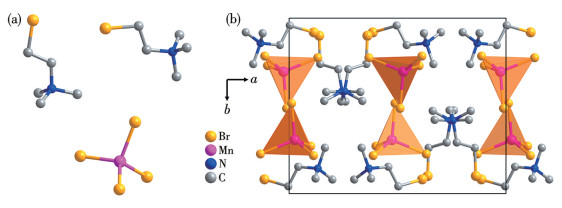
Single-crystal X-ray diffraction data were collected at 278 K because high-temperature data show severe degradation. 1 crystallizes in the orthorhombic crystal system with the Pca21 space group (Table S1). The asymmetric unit contains one [MnBr4]2- anion and two TMBE+ cations, all in well-ordered states (Fig.2a). The Mn—Br bond lengths range from 0.249 8 to 0.251 3 nm, and Br—Mn—Br bond angles vary from 107.43(8)° to 111.93(9)° (Table S2), indicating [MnBr4]2- tetrahedron is slightly distorted compared to the standard tetrahedron, which is also observed in (TMCE)2[MnBr4]. Similarly, the separated [MnBr4]2- anion together with the discrete organic TMBE+ cations also form a 0D structure, which is stabilized by interionic electrostatic interaction, C—H…Br and Br…Br interaction (Fig.2b and S3). However, as summarized in Table 1, 1 exhibits remarkably compressed interatomic distances relative to (TMCE)2[MnBr4]. Specifically, the nearest Mn…Mn distance, the shortest halogen distance, and the minimum C—H…Br bond length (C…Br) for 1 are 0.796, 0.379, and 0.283 nm, all shorter than those of (TMCE)2[MnBr4], whose corresponding structural parameters are 0.836, 0.403, and 0.293 nm, respectively. These structural variations primarily modulate intermolecular interactions, thereby inducing corresponding changes in phase transition behavior and physical properties. This phenomenon has not only been well documented in the literature but has also been confirmed by our subsequent experiments[38-41].
 下载:
导出CSV
| Parameter | (TMBE)2[MnBr4] | (TMCE)2[MnBr4] |
| d(Mn…Mnnearest) / nm | 0.795 54 | 0.863 35 |
| d(X…Brshortest)* / nm | 0.378 67 | 0.403 27 |
| d(C…Br) / nm | 0.283-0.291 | 0.293-0.327 |
| Effective volume / nm3 | 0.361 09 | 0.353 22 |
| dnorm | 0.496 4 | 0.529 4 |
| Tp, max / K | 413 | 364 |
| * X=Cl/Br. | ||
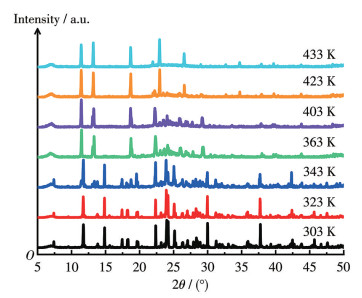
To further confirm the occurrence of a reversible phase transition in 1, the well-ground powder was used to determine the variable-temperature PXRD. As shown in Fig.3, the PXRD patterns of 1 did not change at 303 and 323 K, but when the temperature rose to 343 K, some changes were observed in the PXRD pattern. New diffraction peaks emerged at 11.42°, 13.04°, 13.36°, and 18.74°, indicating that a structural phase transition might be occurring at this point. At 363 K, the diffraction peaks at 13.8°, 14.84°, 17.42°, 18.08°, 19.54°, 23.9°, 25.04°, 29.96°, 35.88°, 37.7°, and 42.38° disappeared. When the temperature further increased to 403 K, no obvious changes occurred in the PXRD pattern, suggesting that the first structural phase transition was completed at 363 K. At 423 K, the two diffraction peaks near 13.26° merged into a single peak. Meanwhile, the intensities of the diffraction peaks between 20° and 30° diminished or even vanished, and new diffraction peaks emerged at 22.96° and 26.58°, showing that the PXRD pattern underwent a second transformation. With the temperature further rising, there were no additional changes observed in the PXRD pattern, indicating that compound 1 had completed its second transformation at 423 K. The emergence of new peaks, as well as the changes in the diffraction peaks, suggests that the structure of compound 1 has changed and confirms the thermal reversibility of the phase transition in 1. These observations are consistent with the results obtained from DSC measurements.
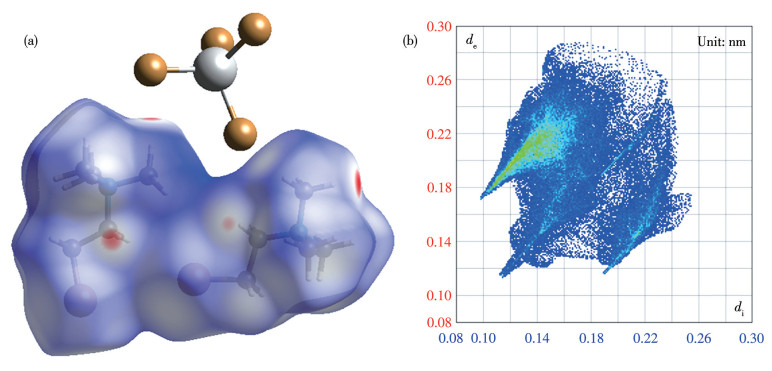
To reveal the effect of halogen substitution on intermolecular interactions, the Hirshfeld surface and 2D fingerprint plot were calculated using Crystal Explorer (Fig.4). The average dnorm value and effective volume of 1 are 0.496 4 and 0.361 09 nm3, respectively. Compared with (TMCE)2[MnBr4], whose dnorm value and effective volume are 0.529 4 and 0.353 22 nm3, the larger effective volume indicates enhanced steric effect, while the smaller dnorm value suggests stronger intermolecular interactions between organic cations and inorganic anions (Fig.S4 and Table 1). These interactions increase the energy barrier for phase transitions and thus elevate the phase transition temperature, which is consistent with DSC and dielectric measurements.
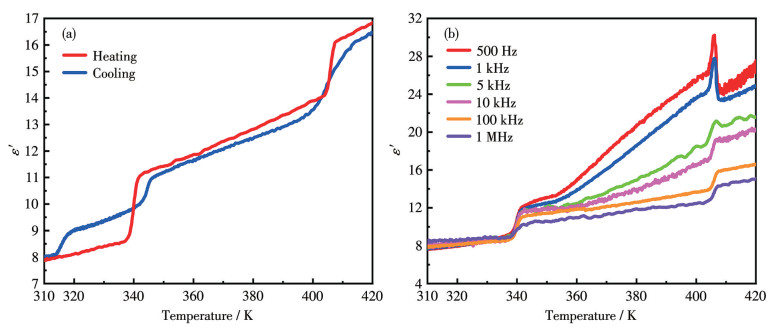
Temperature-dependent dielectric measurements were performed to characterize the phase transitions. At 100 kHz, the dielectric constant (ε′) showed a step-like anomaly near 340 K, increasing rapidly from 8.56 to 11.08 during heating. With further heating, ε′ gradually rose to 14.06 and then increased abruptly to 16.12 at approximately 406 K, finally reaching 17.03. During cooling, ε′ dropped sharply from 16.17 to 13.36 at 406 K, followed by minor anomalies at 344 and 316 K (Fig. 5a). These reversible dielectric anomalies were clearly observed, consistent with DSC results and confirming reversible phase transitions. Although we have not obtained a high-temperature single-crystal structure, we can infer from the previously reported Mn-based hybrid metal halides (e.g., (TMCE)2[MnBr4]) that the phase transitions may be related to the rearrangement and disorder of organic cations. Particularly, frequency-dependent measurements (0.5 kHz-1 MHz) in Fig. 5b showed that ε′ decreased with increasing frequency while the anomaly positions remained unchanged. With the substitution of Cl- with Br- in the (TMXE)+ cation, the temperature evolution of dielectric constants further verifies the structural origin of dielectric switching.
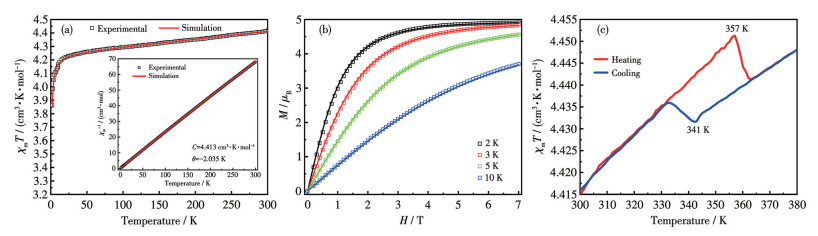
The magnetic properties of 1 were investigated using temperature-dependent magnetic susceptibility measured from 2 to 300 K under 1 000 Oe. The χmT value at 300 K was 4.417 cm3·mol-1·K, which slowly decreased to 4.204 cm3·mol-1·K at 15 K and then dropped rapidly to 3.862 cm3·mol-1·K at 2 K (Fig.6a). The slight decrease at low temperatures indicates weak antiferromagnetic interactions between Mn2+ ions. Fitting with the Curie-Weiss law gave 4.413 cm3·mol-1·K of C and -2.035 K of θ (Fig. 6a, inset). Field-dependent magnetization at 2-10 K reached 4.909μB at 7 T, nearly the theoretical saturation value of 5μB for Mn2+, which is attributed to zero-field splitting (ZFS) rather than significant antiferromagnetic coupling (Fig. 6b). Fitting using Eq.1 by the PHI program yielded 0.12 cm-1 of D, 2.001 of g, and 1.62×10⁻⁵ cm3·mol-1 of TIP (temperature-independent paramagnetism):
|
|
(1) |
where
Inset: temperature dependence of χm-1 for 1.
High-temperature magnetic susceptibility was further measured during heating and cooling (Fig.6c). The χmT value increased gradually to 4.451 cm3·mol-1·K at 357 K and then decreased abruptly to 4.441 cm3·mol-1·K during heating. During cooling, it decreased to 4.431 cm3·mol-1·K at 347 K and then increased abruptly to 4.436 cm3·mol-1·K. Similar to the thermally responsive magnetic switching observed in (TMCE)2[MnBr4], 1 exhibited comparable magnetic switching behavior, demonstrating magneto-structural coupling. The subtle χmT changes exclude spin-state transitions, and large Mn…Mn distances rule out strong magnetic coupling. Accordingly, the reversible magnetic switching originates from structural phase transitions, which induce subtle changes in Mn…Mn distances, Br—Mn—Br angles, and spatial reconstruction.
Compound 1 emitted intense green luminescence under UV irradiation (Fig.S5, inset). The excitation spectra showed four peaks at 278, 293, 364, and 377 nm, corresponding to 6A1(S)→4A2(F), 6A1(S)→4T1(F), 6A1(S)→4E(D), and 6A1(S)→4T2(D) transitions of Mn2+ [42-44]. A single emission peak at 514 nm was observed under different excitation wavelengths, which is similar to that of the Mn-based halides reported previously (Fig.7a). The CIE coordinates (0.190 9, 0.698 4) confirm the green emission (Fig.S5). In addition, the photoluminescence quantum yield (PLQY) of 1 was 27.71% under ambient conditions (Fig.S6), and its lower PLQY relative to (TMCE)2[MnBr4] originates from the shorter Mn…Mn distance (Table 1)[45]. The fluorescence lifetime was 0.234 ms at room temperature (Fig.7c).
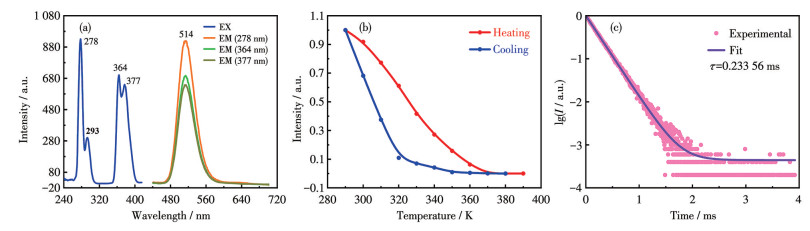
Variable-temperature luminescence was measured from 290 to 400 K (Fig.7b and S7). The emission intensity gradually decreased with increasing temperature and dropped rapidly near the phase transition temperature due to enhanced lattice vibration and non-radiative relaxation. The intensity recovered during cooling, demonstrating favorable thermal switching behavior. These results reveal that 1, designed by cation halogen substitution, possesses excellent synergistic dielectric, magnetic, and luminescent responses, with tri-functional behaviors identical to those of (TMCE)2[MnBr4].
In summary, a zero-dimensional organic-inorganic manganese-based hybrid (TMBE)2[MnBr4] with high-temperature phase transitions has been successfully constructed via halogen substitution of organic cations. Reversible order-disorder phase transitions are confirmed by DSC and dielectric measurements, with the highest transition temperature reaching 413 K. Hirshfeld surface analysis reveals that enhanced intermolecular interactions increase the phase transition energy barrier. (TMBE)2[MnBr4] exhibits integrated switchable dielectric, magnetic, and green luminescent responses synergistically triggered by structural phase transitions, which provides a new paradigm for the exploration of advanced multifunctional molecular materials.
WANG J, KONG M, SONG X J, JING Y, ZHAO Y, SONG Y. Synergetic spin-crossover and luminescent properties in a multifunctional 2D iron(Ⅱ) coordination polymer[J]. Inorg. Chem., 2022, 61(51): 20923-20930 doi: 10.1021/acs.inorgchem.2c03350
MA W, QIAN Q K, QAID M H, ZHAO S Y, LIANG D H, CAI W S, ZANG Z G. Water-molecule-induced reversible fluorescence in a one-dimensional Mn-based hybrid halide for anticounterfeiting and digital encryption-decryption[J]. Nano Lett., 2023, 23(19): 8932-8939 doi: 10.1021/acs.nanolett.3c02356
CHEN J H, LUO J B, PENG Q P, HE Z L, WEI J H, KUANG D B. Branched alkyl chains tunable organic-inorganic hybrid manganese halides for anti-counterfeiting, white light-emitting diode and X-ray imaging applications[J]. Angew. Chem.‒Int. Edit., 2025, 64: e202508536 doi: 10.1002/anie.202508536
CUI Y B, LIN J W, LIU K J, SHAO Y H, HAO R B, YAO R N, GUO Z N, ZHAO J, LIU Q L. Coordination-driven reversible thermochromic luminescence in a hybrid manganese halide for thermal sensing[J]. Adv. Opt. Mater., 2026, 14(2): e02522 doi: 10.1002/adom.202502522
TERI G, JIA Q Q, NI H F, WANG J Q, FU D W, GUO Q. Halogen engineering of organic-inorganic hybrid perovskites displaying nonlinear optical, fluorescence properties and phase transition[J]. Dalton Trans., 2023, 52(4): 1074-1081 doi: 10.1039/D2DT04014J
XU L J, LIN X, HE Q, WORKU M, MA B. Highly efficient eco-friendly X-ray scintillators based on an organic manganese halide[J]. Nat. Commun., 2020, 11(1): 4329 doi: 10.1038/s41467-020-18119-y
YU K J, WU Y C, YANG Y W, YE Q. Halogen substitution of aromatic cations for phase transition control and high-efficiency luminescence in 0D manganese-based hybrid perovskites[J]. Dalton Trans., 2026, 55(27): 10408-10413 doi: 10.1039/D6DT01114D
ZHANG W, XIONG R G. Ferroelectric metal-organic frameworks[J]. Chem. Rev., 2012, 112(2): 1163-1195 doi: 10.1021/cr200174w
LUN M M, NI H F, ZHANG Z X, LI J Y, JIA Q Q, ZHANG Y, ZHANG Y J, FU D W. Unusual thermal quenching of photoluminescence from an organic-inorganic hybrid [MnBr4]2--based halide mediated by crystalline-crystalline phase transition[J]. Angew. Chem.‒Int. Edit., 2024, 63(2): e202313590 doi: 10.1002/anie.202313590
GUO Q, ZHANG W Y, CHEN C, YE Q, FU D W. Red-light emission and dielectric reversible duple opto-electronic switches in a hybrid multifunctional material: (2-Methylimidazolium)MnCl3(H2O)[J]. J. Mater. Chem. C, 2017, 5(22): 5458-5464 doi: 10.1039/C7TC01520H
HU Z B, WANG C F, SHA T T, SHI C, YE L, YE H Y, SONG Y, YOU Y M, ZHANG Y. An effective strategy of introducing chirality to achieve multifunctionality in rare-earth double perovskite ferroelectrics[J]. Small Methods, 2022, 6(9): 2200421 doi: 10.1002/smtd.202200421
LIAO W Q, ZENG Y L, TANG Y Y, PENG H, LIU J C, XIONG R G. Multichannel control of multiferroicity in single-component homochiral organic crystals[J]. J. Am. Chem. Soc., 2021, 143(51): 21685-21693 doi: 10.1021/jacs.1c11000
ZHAO X H, HUANG X C, ZHANG S L, SHAO D, WEI H Y, WANG X Y. Cation-dependent magnetic ordering and room-temperature bistability in azido-bridged perovskite-type compounds[J]. J. Am. Chem. Soc., 2013, 135(43): 16006-16009 doi: 10.1021/ja407654n
DU S N, SU D, RUAN Z Y, ZHUO Y Q, DENG W, ZHANG W X, SUN Y, LIU J L, TONG M L. Reversible switchability of magnetic anisotropy and magnetodielectric effect induced by intermolecular motion[J]. Angew. Chem.‒Int. Edit., 2022, 61(35): e202204700 doi: 10.1002/anie.202204700
ZENG T, WANG T, ZENG G, MOU D, ZHU M, ZHANG D, GAO W, FANG Y, YU X. One-step synthesis of recyclable 0D hybrid Mn(Ⅱ)-based halide scintillator for X-ray imaging[J]. Laser Photon. Rev., 2025, 19(19): e00317 doi: 10.1002/lpor.202500317
WANG D D, DONG H M, ZHANG L L, WU D, REN L Y, ZHAO D X, WANG T, FENG M. Yellow-emitting organic-inorganic hybrid manganese halides realized by Br/Cl composition engineering[J]. Laser Photon. Rev., 2025, 19(11): 2401982 doi: 10.1002/lpor.202401982
LIU D X, YU Z H, CHEN X X, ZHANG W X, CHEN X M. Crystal structures and phase transitions in two new hybrid crystals: (Me3NCH2CH2X)4[Ni(NCS)6] (X=Cl and Br)[J]. Chin. Chem. Lett., 2023, 34(3): 107310 doi: 10.1016/j.cclet.2022.03.033
ZHANG T, DING K, LI J Y, DU G W, CHU L L, ZHANG Y, FU D W. Hydrogen-bonded engineering enhancing phase transition temperature in molecular perovskite ferroelastic[J]. Chin. J. Chem., 2022, 40(13): 1559-1565 doi: 10.1002/cjoc.202200089
YU X C, LIU Y, LIU Y Y, LI S K, TAN H B, LIU J Z, CHEN Z G. Solid-state reversible phase transition and photoluminescence properties of organic-inorganic hybrid halide: (BTPA)2MnBr4[J]. Inorg. Chem., 2024, 63(46): 21849-21855 doi: 10.1021/acs.inorgchem.4c02359
WANG Y X, CHEN L, XIE T, YU X, GUO C C, LIU D X, WANG G M. Phase-transition-induced photoluminescence change in two hybrid manganese halide crystals[J]. Inorg. Chem., 2025, 64(40): 20537-20545 doi: 10.1021/acs.inorgchem.5c04200
MA J, XU Q, YE L, WANG Q, GONG Z, SHI C, YE H, ZHANG Y. Structural phase transition and dielectric switching in an organic-inorganic hybrid rare-earth double perovskite-type compound: (DMP)2 LaRb(NO3)6 (DMP=N, N-dimethylpyrrolidinium cation)[J]. J. Rare Earths, 2022, 40(6): 937-941 doi: 10.1016/j.jre.2021.05.010
DONG G K, HU B, CHEN C, YU H L, HAN Q J, WU W Z. Two organic-inorganic hybrid manganese bromides with highly efficient emission toward white LEDs[J]. Inorg. Chem., 2024, 63(43): 20830-20839 doi: 10.1021/acs.inorgchem.4c03639
CHENG Y, RUAN H P, PENG Y, LI L H, XIE Z Q, LIU L, ZHANG S Y, YE H Y, HU Z B. Magnetic, dielectric and luminescence synergetic switchable effects in molecular material [Et3NCH2Cl]2[MnBr4] [J]. Chin. Chem. Lett., 2024, 35(4): 108554 doi: 10.1016/j.cclet.2023.108554
ZENG Y, HU C L, XU W J, ZENG T W, ZHU Z X, CHEN X X, LIU D X, CHEN Y J, ZHANG Y B, ZHANG W X, CHEN X M. An exceptional thermally induced four-state nonlinear optical switch arising from stepwise molecular dynamic changes in a new hybrid salt[J]. Angew. Chem.‒Int. Edit., 2022, 61(2): e202110082 doi: 10.1002/anie.202110082
HUANG B, WANG P, ZHANG W X, CHEN X M. Magnetic-dielectric bistabilities and magnetodielectric coupling effects in a new layered hybrid perovskite: (C6H5(CH2)4NH3)2[MnCl4][J]. Mater. Adv., 2022, 3(24): 9103-9110 doi: 10.1039/D2MA00963C
CHENG H M, HU X D, CAO C, XU H P, LIU X Y, LI X M, WANG H Y, HUANG K K, YANG W S, WANG D Y, XIE R G. Manganese-manganese distance modulation in zero-dimensional hybrid manganese halides using pyridine quaternary ammonium salts as templates[J]. Mater. Today Chem., 2024, 42: 102343 doi: 10.1016/j.mtchem.2024.102343
LUO C, LI J, ZHANG R, HAN P, LIU J, YANG B. Quantitative decoupling of strong Mn-Mn coupling on photoluminescence of zero-dimensional hybrid manganese chlorides single crystals[J]. Adv. Opt. Mater., 2024, 12(34): 2401591 doi: 10.1002/adom.202401591
HU Z B, LI L H, HAN Y, ZHANG J, LI J, CHEN Z, WU S, ZHANG Y, YE H Y, SONG Y. A new insight into the unique magneto-optical effect of layered perovskite (C6H5C2H3FNH3)2MnCl4[J]. Aggregate, 2023, 4(3): e294 doi: 10.1002/agt2.294
ZHUO F G, CHEN H Y, PENG G Q, LEI Y T, HUANG Q, JIN Z W, WANG Q. Multifunctional 0D manganese-based organic-inorganic hybrid halide for ultraviolets and X-ray detection[J]. Small, 2025, 21(16): 2411175 doi: 10.1002/smll.202411175
YU W Z, TANG Y, HAN C F, MIAO Z Z, SUN C X, XU L, WU G B, LIU Z, TAO Y, CHEN R F. Organic-inorganic hybrid manganese(Ⅱ) halides with reversible thermochromic luminescence for anti-counterfeiting and X-ray imaging[J]. Inorg. Chem., 2025, 64(22): 11032-11041 doi: 10.1021/acs.inorgchem.5c01148
WU L K, ZOU Q H, YAO H Q, YE H Y, LI J L. Zero-dimensional organic-inorganic hybrid manganese bromide with coexistence of dielectric-thermal double switches and efficient photoluminescence[J]. Dalton Trans., 2023, 52(33): 11558-11564 doi: 10.1039/D3DT01823G
XU C, ZHANG W Y, CHEN C, YE Q, FU D W. Fast and slow integrated single-molecule dual dielectric switch based on a crystal/flexible thin film[J]. J. Mater. Chem. C, 2017, 5(28): 6945-6953 doi: 10.1039/C7TC02087B
ZHENG H N, ZHANG R R, WU X, ZHANG Q H, WU Z Y, WONG W P D, CHEN J S, XU Q H, LOH K P. Strain-driven solid-solid crystal conversion in chiral hybrid pseudo-perovskites with paramagnetic-to-ferromagnetic transition[J]. J. Am. Chem. Soc., 2023, 145(6): 3569-3576 doi: 10.1021/jacs.2c12525
YAO H Q, DING Z, ZHANG S Y, WU Y F, QIU X, PENG Y, YE H Y, HU Z B. High temperature synergistic response of magnetism, dielectricity, and luminescence in a Mn(Ⅱ)-based molecular organic-inorganic hybrid[J]. CrystEngComm, 2024, 26(12): 1767-1772 doi: 10.1039/D3CE01278F
GUI L A, CHEN J, ZHANG Y F, LI L H, LI J R, HU Z B, ZHANG S Y, ZHANG J L, ZHANG Z Y, YE H Y, PENG Y, MA J, SONG Y. Room-temperature magnetocapacitance spanning 97 K hysteresis in molecular material[J]. Angew. Chem.‒Int. Edit., 2025, 64(8): e202416380 doi: 10.1002/anie.202416380
GUI L A, ZHANG Y F, PENG Y, HU Z B, SONG Y. Synergetic responses of multiple functions induced by phase transition in molecular materials[J]. Chem. Phys. Chem., 2024, 25(17): e202400297 doi: 10.1002/cphc.202400297
YAO H Q, LI L H, ZHANG S Y, PENG Y, LIU S J, WEN H R, ZHANG J, YE H Y, SONG Y, HU Z B. Near-room-temperature synergetic response of magnetism, dielectricity and luminescence based on (C5NH13Cl)2MnBr4[J]. Chem.‒Eur. J., 2023, 29(38): e202300598 doi: 10.1002/chem.202300598
GUAN M Y, BU R R, SONG H Z, XU C Y, WANG Y C, ZHANG Y, YIN H M. Study on the effect of different crystal forms of benzamide on the luminescence properties of Mn2+ in organic-inorganic hybrid metal halides[J]. Curr. Appl. Phys., 2025, 77: 116-122 doi: 10.1016/j.cap.2025.06.007
WEI W J, LI C, LI L S, TANG Y Z, JIANG X X, LIN Z S. Phase transition, optical and dielectric properties regulated by anion-substitution in a homologous series of 2D hybrid organic-inorganic perovskites[J]. J. Mater. Chem. C, 2019, 7(38): 11964-11971 doi: 10.1039/C9TC04479E
PENG H, LIU Y H, HUANG X Q, LIU Q, YU Z H, WANG Z X, LIAO W Q. Homochiral one-dimensional ABX3 lead halide perovskites with high-TC quadratic nonlinear optical and dielectric switchings[J]. Mater. Chem. Front., 2021, 5(12): 4756-4763 doi: 10.1039/D1QM00223F
HUA X N, LIAO W Q, TANG Y Y, LI P F, SHI P P, ZHAO D, XIONG R G. A room-temperature hybrid lead iodide perovskite ferroelectric[J]. J. Am. Chem. Soc., 2018, 140(38): 12296-12302 doi: 10.1021/jacs.8b08286
WEI Y L, JING J, SHI C, YE H Y, WANG Z X, ZHANG Y. High quantum yield and unusual photoluminescence behaviour in tetrahedral manganese(Ⅱ) based on hybrid compounds[J]. Inorg. Chem. Front., 2018, 5(10): 2615-2619 doi: 10.1039/C8QI00793D
LI R F, JIANG L L, ZOU Q H, BAI J L, WU L K, LI J R, LIAO J S. Highly luminescent and scintillating hybrid halide of (C13H25N)2 [MnBr4] enabled by rigid cation[J]. Molecules, 2025, 30(10): 2157 doi: 10.3390/molecules30102157
CHEN J, ZHANG Q, ZHENG F K, LIU Z F, WANG S H, WU A Q, GUO G C. Intense photo-and triboluminescence of three tetrahedral manganese(Ⅱ) dihalides with chelating bidentate phosphine oxide ligand[J]. Dalton Trans., 2015, 44(7): 3289-3294 doi: 10.1039/C4DT03694H
MAO L, GUO P, WANG S, CHEETHAM A K, SESHADRI R. Design principles for enhancing photoluminescence quantum yield in hybrid manganese bromides[J]. J. Am. Chem. Soc., 2020, 142(31): 13582-13589 doi: 10.1021/jacs.0c06039

Figure 2 Molecular structure of compound 1 at 278 K: (a) asymmetric structural unit; (b) packing diagram

Figure 5 (a) Dielectric curve of compound 1 at 100 kHz; (b) ε′ values of 1 at different frequencies

Figure 6 (a) Temperature dependence of χmT for compound 1; (b) Field dependence of the magnetization strength of 1; (c) Temperature dependence of χmT during heating/cooling
Inset: temperature dependence of χm-1 for 1.

Figure 7 (a) Excitation spectra and emission spectra of compound 1; (b) Temperature-dependent emission spectra of 1; (c) Fluorescence lifetime of 1
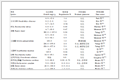
Table 1. Some parameters of (TMBE)2[MnBr4] (1) and (TMCE)2[MnBr4]
| Parameter | (TMBE)2[MnBr4] | (TMCE)2[MnBr4] |
| d(Mn…Mnnearest) / nm | 0.795 54 | 0.863 35 |
| d(X…Brshortest)* / nm | 0.378 67 | 0.403 27 |
| d(C…Br) / nm | 0.283-0.291 | 0.293-0.327 |
| Effective volume / nm3 | 0.361 09 | 0.353 22 |
| dnorm | 0.496 4 | 0.529 4 |
| Tp, max / K | 413 | 364 |
| * X=Cl/Br. | ||
 下载: 导出CSV

 扫一扫看文章


扫一扫关注我们


 下载: