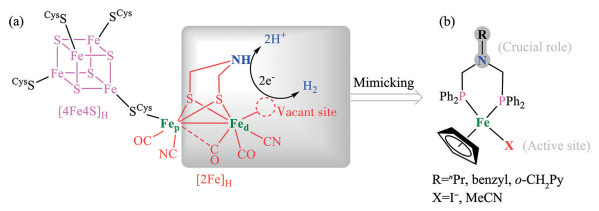
Scheme 1.
(a) Schematic representation of the H-cluster of [FeFe]-hydrogenase and (b) mimics of the distal iron (Fed) unit in diiron subsite ([2Fe]H)

Influence of the pendant amine base in iron complexes on the ligand exchange reaction and electrocatalytic activity for proton reduction
Mengdan YU , Hailong WANG , Mookan NATARAJAN , Kangyu LOU , Zhiyin XIAO , Chunxin LU , Wei ZHONG , Xiaoming LIU


The development of sustainable hydrogen energy hinges on efficient catalysts. Precious metal-based complexes are famous for their high efficiency, but their low abundances limit their broad applications. Therefore, catalysts based on rich abundant metals with low-cost, such as the first-row transition metals, are highly desired. Hydrogenases, classified as [FeFe]-, [NiFe]-, and [Fe]-hydrogenases, provide a biomimetic blueprint for reversible hydrogen catalysis[1-2]. Among them, [FeFe]-hydrogenase is remarkably efficient in the hydrogen evolution reaction, with high turnover frequencies (TOFs) of 6 000-9 000 s-1 under mild conditions[3]. Crystallographic and spectroscopic analyses reveal that the H-cluster of [FeFe]-hydrogenase consists of a [4Fe4S] cluster and a unique active site of the diiron centre (Scheme 1a)[4-5]. The active diiron unit ([2Fe]H) contains a bridging azadithiolate (adt), two cyanides, and three carbonyls. This finding has inspired strong and broad interest in developing iron-based catalysts from structural mimicking the [2Fe]H active site in the past two decades, and has advanced the chemistry of iron carbonyls[6-29].
Notably, the reverse redox reactions between protons and hydrogen are highly reliant on the distal iron (Fed) of the active [2Fe]H site. The Fed centre, featuring a vacant site, should manipulate binding with substrates to facilitate a process related to the formation of terminal hydride species or the heterolytic cleavage of hydrogen. Additionally, a unique semi-bridging CO group should be identified. Its coordination would be switched from the terminal mode to the bridging mode to adjust the basicity of iron centres[30]. Consequently, a bridging hydrido species could be avoided in the catalysis. By comprising terminal hydrido species, the thermodynamically favored bridging hydride intermediate is less active, generally resulting in a low efficiency for the diiron catalysts[31]. To this end, monoiron complexes should prevent the possibility of bridging hydrido intermediates. Some monoiron-based catalysts as mimics of the distal iron of the [2Fe]H site exhibited optimistic efficiency, as reported in the literature[32-36].
Specifically, the amine base in the azadithiolate skeleton is essential for the [2Fe]H site to functionally relay protons to and from the Fed centre[5]. The iron centre (s) is exactly a kinetically slow base and usually protonated/oxidized at a low oxidation state[37-38]. Hence, incorporating a positioned pendant amine in the ligand plays a pivotal role in the reactivity of mimic catalysts. Accordingly, to address this concern, a series of diphosphine ligands containing an internal amine group, typically azadiphosphine (PR′NRPR′), N,N-bis (diphosphamethyl)amine (PR′CNRCPR′), and 1,5-diaza-3,7-diphosphacyclooctane derivatives (P2R′N2R), as depicted in Scheme S1 (Supporting information), were decorated onto metal centre (s) to improve the catalytic efficiency[39-41]. Particularly, the diphosphine derivatives with the strong electron-donating effect of phosphorus and the unique steric effect of tertiary phosphine (s) could not only improve the basicity of the metal centre, which is favored in the formation of hydrido intermediates, but also stabilize the intermediates. For example, a half-sandwich cyclopentadienyl iron dicarbonyl ([FeCp(CO)2] (abbreviated as “Fp”; Cp=η5-cyclopentadienyl) is an active intermediate during the electrocatalytic proton reduction process, but facilely undergoes a dimerization reaction to form Fp2, inhibiting the catalytic efficacy[35, 42-43]. Nevertheless, introducing bulky substituent(s) in the cyclopentadienyl ligand, a strong σ-coordinator to the iron, prevents the spontaneous decomposition of Fp[44], whereas substitution of the CO group by a PR′NRPR′ ligand also inhibits the dimerization of the monoiron[45], even a P2R′N2R ligand employed in the cyclopentadienyl iron catalyst for either hydrogen evolution or hydrogen oxidation reactions[31, 46-53].
Our previous work has focused on iron-based catalysts (please refer to our recent reviews[7-8] and the literature cited in) and particularly cyclopentadienyl iron electrocatalysts, [FeCp(CO)2X] and [FeCp(PPhNRPPh)(CO)]I[43,45]. Cyclic voltammetry (CV) revealed two reduction events for [FeCp(CO)2X] (X=Cl, Br, I): a metal-centred Fe(Ⅱ)→Fe(Ⅰ) reduction, followed by a less straightforward process. This second reduction does not involve simple reduction of the 19-electron Fe(Ⅰ) species but rather its chemical coupling to form the Fp2 dimer, with loss of halide ligands. Similarly, [FeCp(PPhNRPPh)(CO)]I exhibit two reductive events, tentatively assigned as Fe(Ⅱ)→Fe(Ⅰ) and Fe(Ⅰ)→Fe(0). However, unlike the former, dimer formation is not observed. Instead, we confidently deduced the formation of a unique 17-electron Fe(Ⅰ) intermediate via chemical cleavage of a Fe—P bond in the 19-electron Fe(Ⅰ) species formed during the first reduction. Meaningfully, a valuably unsaturated penta-coordinate 17-electron Fe(Ⅰ) species containing a vacant coordination site is produced from the electron-chemical pathways[45].
To explore the effect of ligand modification on the catalytic efficacy of cyclopentadienyl iron electrocatalysts, herein, we synthesized a series of cyclopentadienyl iron(Ⅱ) complexes, [CpFe(Ln)I] (1a-1c: n=1-3), [CpFe(Ln)(NCMe)]I (2a-2c: n=1-3), and [CpFe(Ln) (NCMe)]PF6 (3a-3c: n=1-3) [Ln=PPhCNRCPPh, namely R-N(CH2P(Ph)2)2; n=1 (R=n-propyl), 2 (R=benzyl), 3 (R= o-CH2Py)], featuring a diphosphine ligand with a pendant amine (Scheme 1b), to mimic the distal iron(Ⅱ) centre in the [2Fe]H site. We chose PPhCNRCPPh ligands for their strong electron-donating ability and flexible scaffold, unlike the less-studied azadiphosphine (PR′NRPR′) derivatives, despite the extensive literature on P2R′N2R iron complexes[31, 46-53]. The substituents R at the pendant amines were varied to investigate how the basicity of the pendant amine, adjusted by R, influences the reactivity of iron catalysts. Additionally, the coordinated I- is reasonably active, suffers from ligand-exchange reactions, and is liberated from the one-electron reductive process, leading to the formation of a unique vacant site in the catalysis.
Chemicals purchased from commercial sources were used as received unless otherwise stated. The diphosphine ligands positioned with a pendant amine Ln were prepared by following the literature′s methods[54-55]. The precursor [FeCp(CO)2I] was prepared following previously reported protocols[43,56]. UV-Vis spectra of the complexes were collected on a Thermo EV201 spectrometer using a quartz cuvette (l=1 cm). Fourier-transform infrared (FTIR) spectra were collected on a Nicolet iS10 spectrometer with the samples in KBr pellets. Proton (1H), carbon (13C), phosphorus (31P), and fluorine (19F) NMR spectra were collected on a Varian 400-MR instrument with the samples dissolved in deuterated solvents (CDCl3 or CD3CN). HR-MS analysis was performed on an LCT Premier XE spectrometer in a MeCN solution.
Typically, a 100-mL flask was charged with the diphosphine ligand Ln (0.6 mmol) and [FeCp(CO)2I] (0.6 mmol) in 20 mL of toluene. After degassing via Schlenk techniques, the mixture was refluxed under argon at 110 ℃ for 2 h or until consumption of the ligand, monitored by thin-layer chromatography (TLC). The resulting precipitate was removed by centrifugation, and volatiles were removed under vacuum. The residue was purified by silica gel column chromatography (ethyl acetate/petroleum ether, 1∶5, V/V), affording a dark solid product (1a-1c). Structural characterizations for complexes 1a-1c were presented in Section Ⅰ of the Supporting information.
Generally, a flask (50 mL) was charged with the iron iodo complex (1a-1c), followed by the addition of MeCN (5 mL) under an open atmosphere. The mixture was ultrasonicated in Skymen JP-100S at ambient temperature for 5 min until complete dissolution of the iron complex. The solvolysis of 1a-1c in MeCN should be evidenced by a color change from dark to orange and determined by TLC. After the removal of the volatiles under vacuum, an orange solid (2a-2c) was obtained. Structural characterizations for complexes 2a-2c were presented in Section Ⅰ of the Supporting information.
In a typical procedure, a flask (50 mL) was charged with the iodide iron complex (2a-2c, 0.1 mmol) and ammonium hexafluorophosphate (NH4PF6, 0.081 g, 0.5 mmol), followed by the addition of methanol (3 mL). The mixture was stirred for 0.5 h at ambient temperature, leading to the precipitation of an orange solid (3a-3c), which was washed with water, methanol, and diethyl ether, respectively. Structural characterizations for complexes 3a-3c were presented in Section Ⅰ of the Supporting information.
Crystals of 1a-1c and 3a-3c suitable for X-ray diffraction analysis were obtained by layer-to-layer method of diffusion of diethyl ether into a solution of the complex in dichloromethane (DCM, 1a-1c) or MeCN (3a-3c) at 277 K. Selected crystals, coated by silicone grease, were mounted on a Bruker APEX-Ⅱ diffractometer, and the data were collected using a graphite-monochromated Mo Kα radiation (λ=0.071 073 nm). Using the Olex2 1.5 workstation, the crystallographic structures were solved with the SHELXT program using the Intrinsic Phasing method and refined with the SHELXL package using least-squares minimization. Hydrogen atoms were located geometrically. Crystallographic parameters, as well as the structural solutions and refinements for these iron complexes, are detailed in the Supporting information.
The conversion of 2a-2c to 1a-1c in chloroform was monitored by UV-Vis spectroscopy. Solutions of 2a-2c (2 mmol·L-1) were prepared by dissolving the corresponding iodo iron complexes (1a-1c, 0.006 mmol) in acetonitrile, removing the solvent, and redissolving the residue in 3 mL of chloroform. These chloroform solutions were incubated at 302 K, and their electronic absorption spectra were recorded using a Thermo EV201 spectrometer. The observed changes in the absorption bands indicated the transformation of 2a-2c to 1a-1c.
To confirm the transformation of the iodide iron complexes to the iodo iron complexes, the pyridyl derivative was selected for analysis by 1H NMR spectroscopy. A solution of 1c (8 mg, 0.01 mmol) in MeCN (5 mL) was sonicated for 5 min to ensure complete formation of 2c, which was determined by 1H NMR spectroscopy in CD3CN. The solvent was then evaporated and replaced with CDCl3. 1H NMR spectra were subsequently recorded at 5, 10, 15, 20, 30, and 60 min at 296 K. The appearance of chemical shifts characteristic of 1c demonstrated the conversion of 2c to 1c.
The redox behavior of iodo iron complexes (1a-1c) in THF, iodide iron complexes (2a-2c) in MeCN, and hexafluorophosphate iron complexes (3a-3c) in THF was investigated using CV with an Autolab potentiostat 128 N workstation and NOVA 1.10 electrochemical interface. Samples (3 mmol·L-1) were prepared with tetrabutylammonium tetrafluoroborate ((TBA)BF4) as a supporting electrolyte (0.2 mol·L-1 in THF and 0.1 mol·L-1 in MeCN). Measurements were performed in a custom-designed, air-tight three-neck cell with a glassy carbon disc working electrode (diameter: 1 mm), a platinum wire counter electrode, and an Ag/AgCl (CH) reference electrode. Unless otherwise stated, all CV measurements were conducted under a nitrogen atmosphere (99.999%) at 298 K with a scanning rate of 0.1 V·s-1. For proton reduction electrocatalysis, acetic acid (HAc) was added as a weak proton source via syringe to the working electrode compartment in stoichiometric amounts, followed by CV measurements. All potentials (E) are reported vs the ferrocenium/ferrocene (Fc+/Fc) couple.
The iron complexes (1a, 3a) in neutral and reduced states and the corresponding intermediates were fully optimized without any symmetry constraints using the B3LYP/genecp method. The LANL2DZ basis set, including the Hay-Wadt relativistic effective core potential (ECP), was used for iron and iodine; the 6-31G (d, p) basis set was used for the rest of the elements. Vibrational frequency calculations were performed at the same level of theory to confirm the stationary points as minima (zero imaginary frequency). All calculations were performed using the Gaussian 09 program. The calculated structures are detailed in Section Ⅲ of the Supporting information.
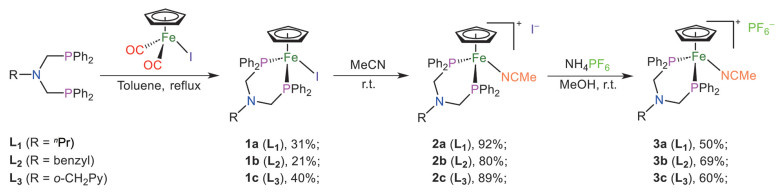
The iodo monoiron(Ⅱ) complexes, 1a-1c, were prepared by reacting the precursor [FeCp(CO)2I] with a diphosphine-positioned pendant base, PPhCNRCPPh, Scheme 2. The basicity of the pendant amine group in the ligand could be easily adjusted by the substituents, R=n-propyl, benzyl, and pyridin-2-ylmethyl (o-CH2Py), with the pyridine group set up to improve the electrocatalytic efficacy through a special concerted proton-coupled electron transfer (PCET) effect. The targeted 1a-1c, purified by silica-filled column chromatography, were afforded in low yields (21%-40%) due to the formation of monocarbonyl by-products as [FeCp(Ln)(CO)]I species[57]. They were highly stable in the solid state and weak polar solvents (THF or DCM) but active in polar solvents (MeCN or MeOH), as indicated by a colour change. Thus, complexes 2a-2c were synthesized from solvolysis of 1a-1c by MeCN, in turn, the substitution of the iodo ligand by MeCN with an iodide as counterion. Notably, dissolution of 2a-2c in DCM resulted in partial reversion to 1a-1c, as confirmed by TLC. Similar reversions were also observed during recrystallization attempts by diffusion of Et2O in a MeCN solution. Thereby, to maintain the coordinating MeCN, the iodide in 2a-2c was ion-exchanged with hexafluorophosphate (PF6-), resulting in complexes 3a-3c.
Spectroscopically, characteristic vibrations at ca. 2 260 cm-1 are identified for ν(C≡N) in 2a-2c and 3a-3c but are absent in the infrared spectra of the iodo complexes 1a-1c (Fig.S1-S3). This evidence should confirm whether MeCN is coordinated. The other strong vibrations, ca. 1 435 cm-1 for ν(P—Ph), 1 095 cm-1 for ν(P—C), and 695 cm-1 for ν(Ph—P—Ph), are assigned to the diphosphine scaffolds in all these monoiron(Ⅱ) complexes, whereas ca. 515 cm-1 for ν(Fe—P) verifies the phosphorus coordination to the iron centre. Additionally, the extra vibrations at ca. 840 cm-1 demonstrated the successful exchange of the PF6- anion. Notably, in the optical absorption spectra (Fig.S4), a coordinate of iodo vs MeCN, typically in the iron complexes 1a-1c and 3a-3c, caused distinguished absorption either for the charge transfer transitions between the ligand and the iron centre (300~550 nm) or for d-d forbidden transitions of the iron centre (550~700 nm), albeit the same absorption (ca. 247 nm) was observed for the π-π* transitions of the organic moieties in these iron complexes. Since the iodo ligand is recognized usually as a weak π-base, referred to as a weak-field ligand in the spectrochemical series giving rise to a low ligand-field splitting parameter (Δ), whereas the coordinate nitrogen in MeCN is a middle-field ligand with high ligand-field splitting, the ligand exchange of iodo by MeCN in 3a-3c leads to significant hypsochromic shifts in their ligand-to-metal charge transfer (LMCT) ranges in comparison to the iodo complexes (1a-1c), i.e., 445 and 493 nm, respectively. Simultaneously, the d-d forbidden transitions evidenced in 1a-1c are heavily inhibited, even invisible in 3a-3c and 2a-2c (Fig.S4 and S5). It seems the variably distal substituent R on the pendant amine does not prompt a prominent electronic effect in changing the absorption due to being far away from the iron centre.
Furthermore, the structures of all these iron complexes were characterized by various techniques such as 1H/13C/31P/19F NMR spectroscopy (Fig.S6-S26), high-resolution mass analysis (Fig.S27-S29), among which 1a-1c and 3a-3c were determined by single-crystal X-ray diffraction (vide infra). As summarised in Table 1, characteristic resonances for cyclopentadienyl (Cp) and methylene phosphorus (PCH2) groups were evidenced in their NMR spectra. Notably, the PCH2 groups of the PPhCNRCPPh skeleton equivalent in the free ligand became inequivalent in the iron complexes, whereas the six-membered chelated ring (P-C-N-C-P-Fe) suffers from strict rotational strain. Proton chemical shifts for the CH2 group of the substituents (RCH2, Table 1) are responsible for the electron-donating ability of R, to claim an ascending order as follows: o-CH2Py<benzyl< n-propyl. This order is consistent with the conjugate acid dissociation constant values of their corresponding amines, pKa, that is, 8.6 for pyridin-2-ylmethanamine (Py-CH2NH2)[58], 9.3 for benzylamine (BnNH2)[59], and 10.7 for n-propylamine (n-PrNH2)[60]. Only a single phosphorus resonance was signalled for all these iron complexes, indicative of their high purity without any isomer. It is noted that the 31P signals and the 1H signals of PCH2 were not seriously altered by the substituent R as far from the iron centre. However, this does not mean the pendant amine's affinity towards the metal should be completely ignored. It reports that a weak bond between a positioned amine and metal exists and plays crucial roles when labile coordination sites form[49], and herein it is also inspected. Evidently, the phosphorus resonances were broadly weak for the iodo complexes 1a-1c, but sharply strong for the rest with a MeCN coordinate (2a-2c and 3a-3c); a comparison on 31P NMR of 1c and 3c is presented in Fig.S30 for clarity. This phenomenon is coherent not only with the rotation of the PCNCP skeleton but also with the bond of the amine. The skeleton is relatively flexible with fast rotation in 1a-1c; therefore, the strong iodo coordination inhibits the amine′s affinity, and it becomes rigid with inhibited rotation in the case of a weak MeCN coordination. Furthermore, the MS analysis of 3c (Fig.S29) revealed that a strong cationic signal for the fragment with the loss of MeCN, [M-MeCN-PF6]+, was generated even in an atmosphere of MeCN. The loss of MeCN indicated an alternative coordination of the adjacent pyridine group, as viewed in Scheme S2. Collectively, the mentioned characterizations sufficiently confirmed the successful preparation of these iron complexes in high purity, and reinforced a not negligible affinity towards the metal centre of the pendant amine, whereby adjustment of its substituent.
 下载:
导出CSV
| Complex | Cp group | PPhCH2NRCH2PPh group | RCH2 group | ||||||
| δH | δC | δH (PCH2) | δC (PCH2) | δP (PPh2) | δH | δC | |||
| 1a | 4.09 | 76.84 | 3.58, 3.37 | 55.99 | 48.08, br. | 2.37 | 64.66 | ||
| 1b | 4.10 | 77.07 | 3.61, 3.37 | 55.17 | 49.19, br. | 3.54 | 67.36 | ||
| 1c | 4.11 | 76.97 | 3.65, 3.49 | 55.75 | 48.82, br. | 3.73 | 68.93 | ||
| 2a | 4.19 | 80.57 | 3.74, 2.68 | 56.36 | 53.09, s. | 2.44 | 64.51 | ||
| 2b | 4.19 | 80.67 | 3.73, 2.69 | 55.72 | 53.53, s. | 3.61 | 66.82 | ||
| 2c | 4.19 | 80.64 | 3.77, 2.81 | 55.88 | 53.26, s. | 3.83 | 71.47 | ||
| 3a | 4.19 | 80.64 | 3.74, 2.63 | 56.38 | 52.99, s. | 2.43 | 64.63 | ||
| 3b | 4.20 | 80.73 | 3.74, 2.64 | 55.77 | 53.44, s. | 3.59 | 66.85 | ||
| 3c | 4.22 | 80.62 | 3.76, 2.78 | 55.93 | 53.15, s. | 3.85 | 67.98 | ||
| * The data were collected in CDCl3 (1a-1c) or CD3CN (2a-2c and 3a-3c). The abbreviations δ are used for chemical shifts in parts per million (ppm), br. for broad peak, and s. for single sharp peak. | |||||||||
Crystals of 1a-1c and 3a-3c were obtained by a layer-to-layer method between two solvents, although 2a-2c were unsuccessful in returning to 1a-1c during recrystallization. Crystallographic parameters are tabulated in Table S1, and the ORTEP views of them are shown in Fig.1 and 2, respectively. The characterized bond lengths (nm) and bond angles (°) are selected as presented in Table S2 (For more details, please refer to Tables S3-S8). For all these complexes, each monoiron(Ⅱ) centre is commonly coordinated with one η5-cyclopentadienyl (Cp), one diphosphine (PPhCNRCPPh) ligand, one iodo for 1a-1c or one MeCN for 3a-3c, to adopt a “piano stool” geometry. In the crystalline state, all the six-membered chelate rings (P-C-N-C-P-Fe) have a chair conformation, and the pendant amines are favored opposite to the iron centre to release the ring strains (Fig.S31). Notably, the characterized distances between the Fe and amino-N range from 0.373 0 to 0.377 4 nm (Fe—Namino bond in Table S2). Since a typical Fe—H bond is 0.154 4 nm, and a N—H bond is 0.109 7 nm, compared to 0.094 nm for an H—H bond and over 0.24 nm for non-bonding H…H distances[49], the present Fe—Namino distances are suitable to form a unique Fe—H…H—N bond in the intermediates derived from the electrocatalytic hydrogen evolution (vide infra). The identical bite angles, ca. 92° for ∠P—Fe—P and ca. 112° for ∠C—N—C, are similar between them. Nevertheless, the coordinate bonds, especially the active site bonds, Fe—I and Fe—NCMe, should be altered by the substituents. Notably, the distances for both Fe—I and Fe—N bonds in the benzyl derivatives (1b and 3b) are the longest, and in contrast, those in the propyl derivatives (1a and 3a) are the shortest. Since the bond lengths are reliant on the reactivities of the complexes, these lengthened bond distances in the benzyl derivatives (1b, 2b, 3b) suggest unique activities compared to the others. It should also be noteworthy that the Fe—CCp bond distances are lengthened from the iodo complexes to the MeCN coordinates (Table S2), emphasizing a stronger covalent bond of iodo than MeCN ligand.
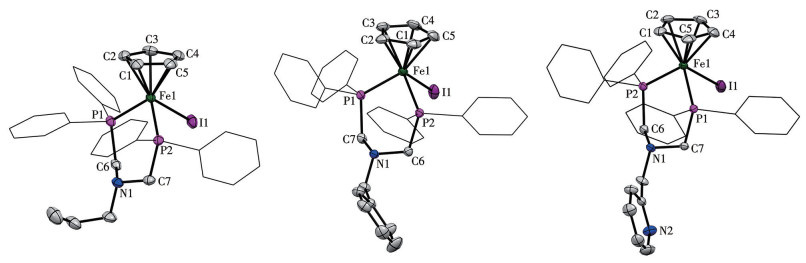
The phenyl group is viewed in a wireframe, and all hydrogen atoms are omitted for clarity.
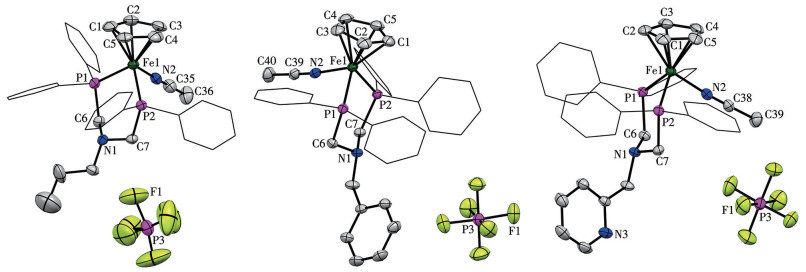
The phenyl group is viewed in a wireframe, and all hydrogen atoms are omitted for clarity.
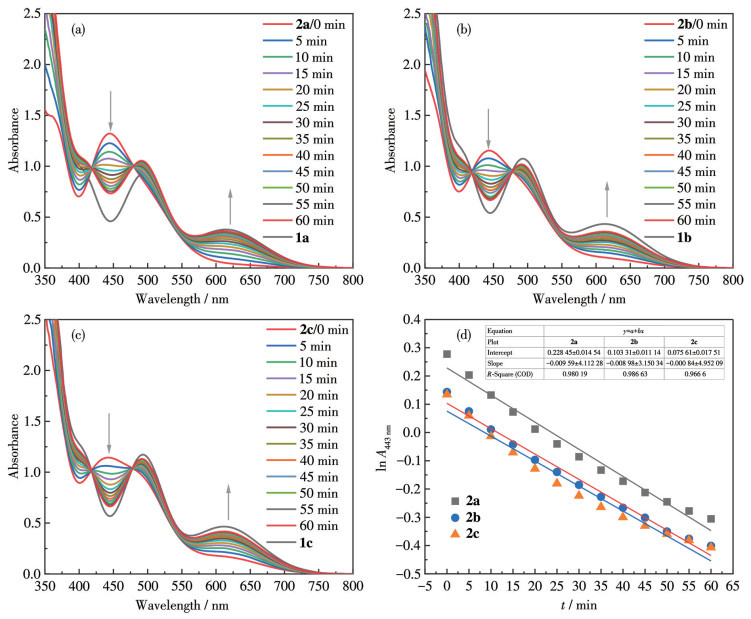
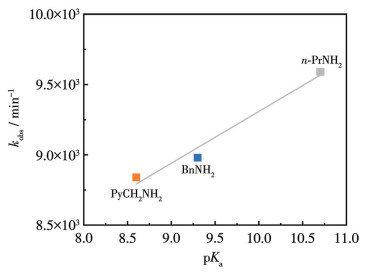
As mentioned above, the solvation of iodo complexes 1a-1c in MeCN afforded the iodides 2a-2c, whereas the recrystallization of 2a-2c led to the partial return to 1a-1c. To probe the reverse conversions (Scheme S3), 2a-2c were maintained in CHCl3, and the absorbance curves were detected by UV-Vis spectroscopy. As depicted in Fig.3a-3c, characteristic bands at ca. 615 nm were vigorously hyperchromic within 1 h, confirming the formation of iodo complexes 1a-1c. Similar conversion was also evidenced in NMR spectroscopy (Fig.S32). Furthermore, the kinetics of the returns to 1a-1c were obtained from linear fitting of natural logarithms of the absorbances (ln A443 nm) against time (Fig. 3d), demonstrating a first-order model for the reactions. The respective observed rate constant (kobs) was obtained as 9.59×10⁻³ min-1 for 2a, 8.98×10⁻³ min-1 for 2b, and 8.84×10⁻³ min-1 for 2c. Notably, a linear relationship was further established by fitting the kobs against the pKa of the pendant amine, which was adjusted by the substituent (Fig.4). The correlation indicates regulation of the iodide-based ligand-exchange reaction by the substituents for this type of iron complexes. The results indicate that the substituents manipulate the pendant amines′ affinity towards the metal and would manipulate the reactivities of these iron complexes, including coordination, active site formation, redox, and electrocatalysis on proton reduction.
Pearson correlation coefficient (r)=0.99.
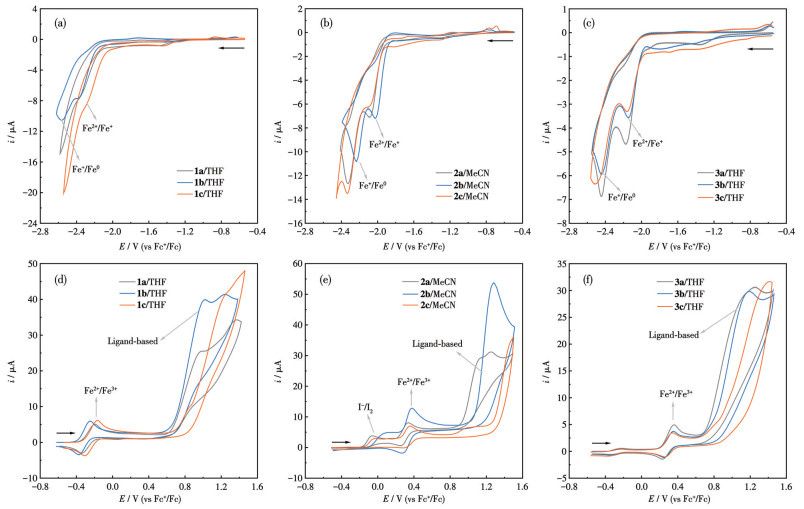
The redox properties of these iron complexes were investigated by CV methods, with 1a-1c and 3a-3c in THF solution but 2a-2c in MeCN, preventing their return to iodo complexes. As depicted in Fig.5, two reductive events were observed for all these complexes. By comparison to the potentials as presented in Table 2 for the precursor [FeCp(CO)2I][43] and the azadiphosphine complexes [FeCp(PPhNRPPh)(CO)]I[45], the events could be randomly assigned to two respective one-electron processes, Fe(Ⅱ)→Fe(Ⅰ) and Fe(Ⅰ)→Fe(0). Moreover, their irreversible behaviors reminded us that some chemical processes should be involved in the reductions. An electrochemical-chemical-electrochemical (ECE) process is reasonably recommended for their electrochemical reductions, supported by the DFT calculations (vide infra). It is noticed that the redox potentials for 1a-1c are more negative than those of the other iron complexes (2a-2c and 3a-3c) due to the strong covalent bonding of iodo. The free iodides in 2a-2c were readily recognized from the emergence events for I- oxidation (from -0.09 to -0.03 V, Table 2). Subsequently, a quasi-reversible event was distinguished for the Fe(Ⅱ)/Fe(Ⅲ) redox couple, ca. -0.25 V for 1a-1c, and ca. 0.3 V for 2a-2c and 3a-3c. Notably, the ratio between the cathodic peak of the Fe(Ⅱ)/Fe(Ⅰ) event (ip, red) and the anodic peak of the Fe(Ⅱ)/Fe(Ⅲ) couple (ip, ox) was calculated to be near 1 (Table S9), to verify the respective one-electron assignment for the two events[7,10,61]; thereby, the processes with powerful currents over 0.6 V should correspond to ligand-based oxidative events with multiple electron transfer.
 下载:
导出CSV
| Complex | Ep, red / V (Fe2+→Fe+) | Ep, red / V (Fe+→Fe0) | Ep, ox / V (I-→I0) | E1/2, ox / V (Fe2+→Fe3+) | Ref. |
| 1aa | -2.38 | -2.58 | -0.26 | This work | |
| 1ba | -2.38 | -2.56 | -0.31 | This work | |
| 1ca | -2.33 | -2.53 | -0.24 | This work | |
| 2ab | -2.09 | -2.33 | -0.06 | 0.30 | This work |
| 2bb | -2.03 | -2.23 | -0.09 | 0.32 | This work |
| 2cb | -2.08 | -2.33 | -0.03 | 0.32 | This work |
| 3aa | -2.17 | -2.45 | 0.29 | This work | |
| 3ba | -2.14 | -2.45 | 0.30 | This work | |
| 3ca | -2.15 | -2.49 | 0.30 | This work | |
| [FeCp(PPhNRPPh)(CO)]I (R=cyclohexyl)b | -1.93 | -2.39 | 0.06 | 0.41 | [45] |
| [FeCp(PPhNRPPh)(CO)]I (R=phenyl)b | -1.86 | -2.17, -2.31 | 0.07 | 0.40 | [45] |
| [FeCp(PPhNRPPh)(CO)]I (R=benzyl)b | -1.90 | -2.17 | 0.04 | 0.41 | [45] |
| [FeCp(CO)2I]b | -1.30 | -2.0 | [43] | ||
| a CV curves were collected in 0.2 mol·L-1 TBABF4/THF; b CV curves were collected in 0.1 mol·L-1 TBABF4/MeCN. | |||||
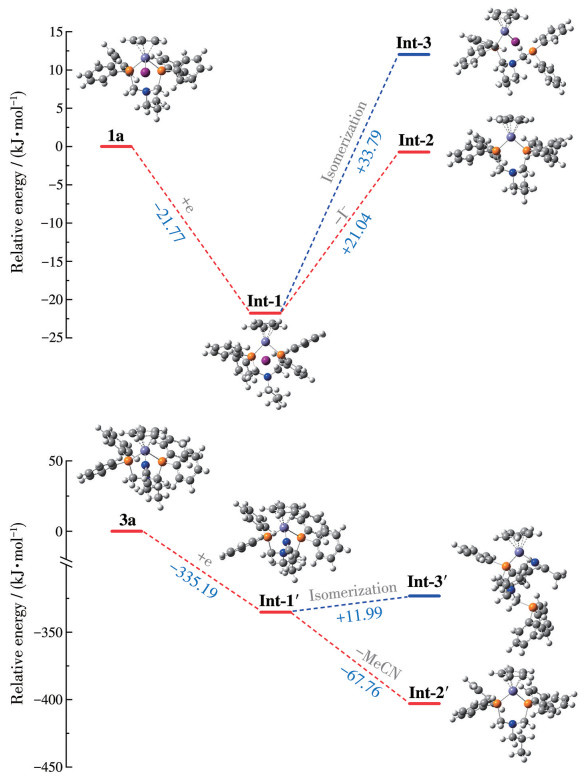
DFT calculations were further carried out to mechanistically deduce the chemical reactions of iron(Ⅰ) (19e-species) produced from the one-electron reduction of these iron(Ⅱ) complexes (18e-species). Three pathways could be involved for the 19e-species, specifically: (ⅰ) a dissociation of the labile coordinated X (I-/MeCN)[42-43], (ⅱ) an isomerization reaction of cleaving of one of the two Fe-P bonds in the diphosphine chelate[45], and (ⅲ) a dimerization reaction as reported for the Fp- anion to Fp2[42-43]. The pathway ⅲ would be firstly ruled out since no dimer species was evidenced due to the steric effect of tertiary phosphines[45]. The other two pathways (ⅰ and ⅱ) were compared by DFT calculations. The relative free energy initiated from 1a and 3a is diagrammed in Fig.6 (please refer to the Supporting information for details). It should be noteworthy that the pathway ⅰ for dissociation of X (I- for 1a, and MeCN for 3a) is more favored than the isomeric pathway ⅱ with one Fe—P bond cleaving, albeit the latter is adopted in the PPhNRPPh chelate monoiron(Ⅱ) carbonyl complexes, [FeCp(PPhNRPPh)(CO)]I[45]. This is attributed not only to the aid of a pendant amine with enhanced affinity towards the metal, but also to a favored six-membered ring for the PPhCNRCPPh ligand rather than a tense four-membered ring for the PPhNRPPh ligand[45,62]. Particularly, a resultant 17e-species (Int-2 and Int-2′) with a unique vacancy coordination site is highly desired to further be involved in the catalytic process[6,44,47].
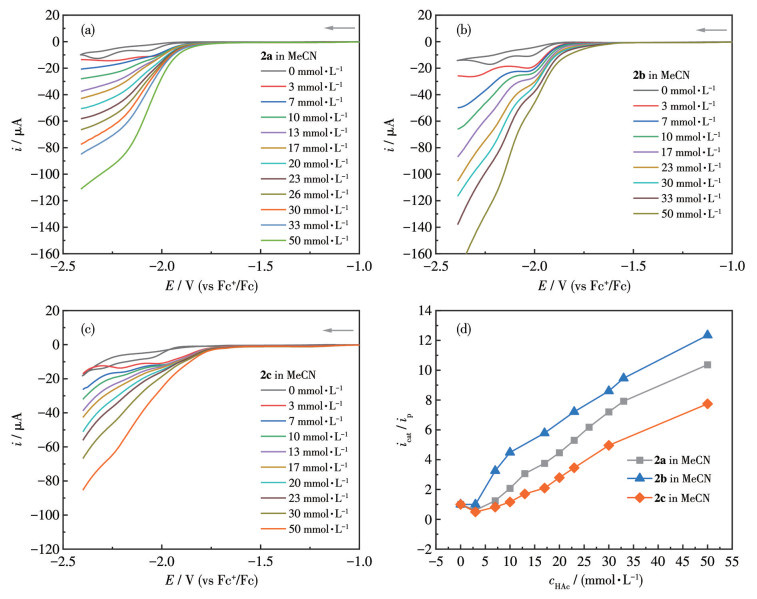
The electrocatalytic proton reduction activities of nine iron complexes were investigated using HAc as a proton source. As depicted in Fig.7a-7c, upon the addition of HAc, distinctive increments in cathodic currents for the last reductive event were observed for the iodide complexes (2a-2c), indicative of significant electrocatalysis. A differentiation in their efficacy emerged in Fig.7d, correlative of the pendant amines' basicity. Principally, these amines facilitate proton transfer to and from the iron centre, and proton reduction is proposed to occur at the vacant site generated by the reduction of the mono-iron(Ⅱ) complex, leading to a hydride intermediate. Generally, a weaker amine with less affinity towards the iron centre affords greater hydride stability[31]; thereby, the benzyl derivative (2b) shows higher activity than the propyl derivative (2a), consistent with their respective pKa values (9.3 vs 10.7). The pyridyl derivative (2c) exhibited unusually low activity despite its lower pKa (8.6), plausibly due to the formation of an intensive intramolecular hydrogen bond (Scheme S4) that inhibits proton transfer. This is consistent with previous reports of inefficient hydrogen exchange in iron and nickel catalysts containing 1,5-diaza-3,7-diphosphacyclooctane ligands (P2R′N2R), where hydrogens are immobilized by two amino nitrogens from the formation of H-bonds to hinder the catalysis[63-64]. Nevertheless, the catalytic potentials are shifted to less negativity, reflecting the pendant base′s positive electrostatic catalysis with a proton-coupled electron transfer (PCET) effect. Considering that the ohmic potential drop (ΔEohm=iR) is compensated, the PCET should be even more pronounced. Similar trends were observed for the hexafluorophosphate complexes (3a-3c, Fig.S33), although the low conductivity of THF hinders the performance. Deservedly, the activities of iodo complexes (1a-1c, Fig.S34) were seriously inhibited due to iodo ligand occupancy.
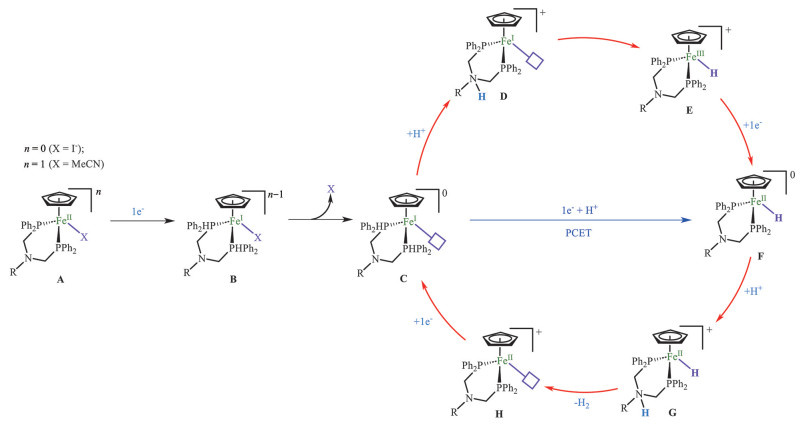
To integrate the observed reduction behaviours and the electrocatalytic proton reduction activities of these iron complexes as well as the DFT calculations, a mechanistic scenario is proposed (Scheme 3). Firstly, electrochemical one-electron reduction of iron(Ⅱ) complexes, coupled with chemical dissociation of the labile ligand X (I- or MeCN), generates the active iron(Ⅰ) 17e-species (C) containing a vacant free site. The pendant amine′s basicity, as well as its affinity towards the iron centre, adjusted by the substituent R, modulates the protons to and from the metal to result in pivotal terminal hydrides (E, F). In particular, a proton relay of the pendant amine is cherished for the catalytic process to produce a unique species (G) characterized by a weak Fe—H…H—N bond to further release dihydrogen. Positive shifts in catalytic potentials reflect an alternative PCET pathway mediated by the pendant amine[7,45].
In summary, nine cyclopentadienyl monoiron(Ⅱ) complexes featuring a PPhCNRCPPh ligand and an active ligand X (I-/MeCN), specifically, the iodo complexes 1a-1c, iodide complexes 2a-2c, and hexafluorophosphate complexes 3a-3c were synthesized as models of the distal iron(Ⅱ) centre in the [2Fe]H site. The substituents R (n-propyl, benzyl, pyridin-2-ylmethyl) were varied to modulate pendant amines' basicity and their affinity towards the metal. These iron(Ⅱ) complexes were spectroscopically characterized, among which 1a-1c and 3a-3c were crystallographically determined. UV-Vis spectroscopic probing of the conversions of 2a-2c to 1a-1c via iodo-ligand exchanges revealed a linear correlation of the rate constants with the pKa values of pendant amines, elucidating a well-defined dependence on the substituent R for regulating the activities of the complexes. Cyclic voltametric studies uncovered the redox and electrocatalytic proton reduction activity of all complexes. Two respective one-electron reductions, Fe(Ⅱ)→Fe(Ⅰ) and Fe(Ⅰ)→Fe(0), along with a quasi-reversible oxidation for Fe(Ⅱ)→Fe(Ⅲ), were observed for all these complexes. DFT calculations supported that the liberation of the active X coordinate, rather than a chemical Fe—P bond cleavage pathway, is thermodynamically favoured during the first reduction process, resulting in a valuable vacancy site. Their electrocatalytic activities towards proton reduction (source of HAc) varied with the substituents R, with weaker pendant amine basicity correlating to higher activity. However, the pyridyl derivative showed lower activity due to a plausible intramolecular hydrogen bond hindering proton relay. This study provides not only a mechanistic understanding of the electrochemical and electrocatalytic behaviour of these cyclopentadienyl iron(Ⅱ) complexes chelating a PPhCNRCPPh ligand, but also the crucial roles of the substituent positioned on the pendant amine.
LUBITZ W, OGATA H, RÜDIGER O, REIJERSE E. Hydrogenases[J]. Chem. Rev., 2014, 114(8): 4081-4148 doi: 10.1021/cr4005814
CRACKNELL J A, VINCENT K A, ARMSTRONG F A. Enzymes as working or inspirational electrocatalysts for fuel cells and electrolysis[J]. Chem. Rev., 2008, 108(7): 2439-2461 doi: 10.1021/cr0680639
FREY M. Hydrogenases: Hydrogen-activating enzymes[J]. ChemBioChem, 2002, 3(2-3): 153-160
BRITT R D, RAUCHFUSS T B, RAO G. The H-cluster of [FeFe] hydrogenases: Its enzymatic synthesis and parallel inorganic semisynthesis[J]. Accounts Chem. Res., 2024, 57(14): 1941-1950 doi: 10.1021/acs.accounts.4c00231
BERGGREN G, ADAMSKA A, LAMBERTZ C, SIMMONS T R, ESSELBORN J, ATTA M, GAMBARELLI S, MOUESCA J M, REIJERSE E, LUBITZ W, HAPPE T, ARTERO V, FONTECAVE M. Biomimetic assembly and activation of [FeFe]-hydrogenases[J]. Nature, 2013, 499(7456): 66-69 doi: 10.1038/nature12239
YU M D, CUI C G, MOOKAN N, XIAO Z Y, ZHONG W. A rotational isomerization of diiron complexes of ferrole type involved in the catalytic hydroboration of aldehydes under mild conditions[J]. J. Mol. Struct., 2024, 1296: 136840 doi: 10.1016/j.molstruc.2023.136840
XIAO Z Y, ZHONG W, LIU X M. Recent developments in electrochemical investigations into iron carbonyl complexes relevant to the iron centres of hydrogenases[J]. Dalton Trans., 2022, 51(1): 40-47 doi: 10.1039/D1DT02705K
JIANG X J, XIAO Z Y, ZHONG W, LIU X M. Brief survey of diiron and monoiron carbonyl complexes and their potentials as CO-releasing molecules (CORMs)[J]. Coord. Chem. Rev., 2021, 429: 213634 doi: 10.1016/j.ccr.2020.213634
ZHONG W, XIAO Z Y, QIAN G F, LIU X M. The influence of a peripheral functional group of diiron hexacarbonyl complexes on their electrochemistry and electrocatalytic reduction of proton[J]. Electrochim. Acta, 2017, 247: 779-786 doi: 10.1016/j.electacta.2017.07.072
XIAO Z Y, WEI Z H, LONG L, WANG Y L, EVANS D J, LIU X M. Diiron carbonyl complexes possessing a {Fe(Ⅱ)Fe(Ⅱ)} core: Synthesis, characterisation, and electrochemical investigation[J]. Dalton Trans., 2011, 40(16): 4291-4299 doi: 10.1039/c0dt01465f
SCHILTER D, CAMARA J M, HUYNH M T, HAMMES-SCHIFFER S, RAUCHFUSS T B. Hydrogenase enzymes and their synthetic models: The role of metal hydrides[J]. Chem. Rev., 2016, 116(15): 8693-8749 doi: 10.1021/acs.chemrev.6b00180
LI Y L, RAUCHFUSS T B. Synthesis of diiron(Ⅰ) dithiolato carbonyl complexes[J]. Chem. Rev., 2016, 116(12): 7043-7077 doi: 10.1021/acs.chemrev.5b00669
KLEINHAUS J T, WITTKAMP F, YADAV S, SIEGMUND D, APFEL U P. [FeFe]-hydrogenases: Maturation and reactivity of enzymatic systems and overview of biomimetic models[J]. Chem. Soc. Rev., 2021, 50(3): 1668-1784 doi: 10.1039/D0CS01089H
ARRIGONI F, de GIOIA L, ELLEOUET C, PÉTILLON F Y, SCHOLLHAMMER P, TALARMIN J, ZAMPELLA G. Normal vs. inverted ordering of reduction potentials in [FeFe]-hydrogenases biomimetics: Effect of the dithiolate bulk[J]. Chem.‒Eur. J., 2023, 29(38): e202300569 doi: 10.1002/chem.202300569
KUMAR P, TYAGI V P, GHOSH M. Exploring the multifarious role of the ligand in electrocatalytic hydrogen evolution reaction pathways[J]. Chem.‒Eur. J., 2023, 29(71): e202302195 doi: 10.1002/chem.202302195
LIU X F, WANG S J, ZHAO P H. Di-iron dithiolato complexes with 3-bromothiophene moiety: Preparation, structures, and electrochemistry[J]. J. Mol. Struct., 2023, 1294: 136454 doi: 10.1016/j.molstruc.2023.136454
LÜ S, BAI S F, GAO X P, WANG Y L, LI Q L. Aminodiphosphine substituted 2Fe2Se complex as new precursor to single and double butterfly Fe/Se models related to FeFe hydrogenase models[J]. J. Mol. Struct., 2023, 1290: 135939 doi: 10.1016/j.molstruc.2023.135939
BASMA I, ABUL-FUTOUH H, ABAALKHAIL S J, LIEBING P, WEIGAND W. FeFe-hydrogenase H-cluster mimics mediated by ferrocenyl hetaryl thioketone derivatives[J]. J. Mol. Struct., 2024, 1295: 136630 doi: 10.1016/j.molstruc.2023.136630
GAO X P, LI S X, HU K, DENG C L, BAI S F, WANG Y L, XIE H T, LU S, LI Y L, LI Q L. Diiron azadithiolate models with bulky bridgehead moiety: Synthesis, structure and electrochemistry[J]. J. Mol. Struct., 2024, 1306: 137881 doi: 10.1016/j.molstruc.2024.137881
GAO Y, JIN B, ZHANG J L, JING X B, ZHAO P H. Tertiary phosphine-supported diiron model complexes relevant to FeFe-hydrogenases[J]. Appl. Organomet. Chem., 2024, 38(9): e7608 doi: 10.1002/aoc.7608
王瑞隆, 毛近隆, 靳国霞, 马建平, 王海英, 秦洁. 2-氰基苯甲基铁氢化酶的制备、表征及光催化产氢性能[J]. 无机化学学报, 2026, 42(4): 817-825WANG R L, MAO J L, JIN G X, MA J P, WANG H Y, QIN J. 2-Cyanobenzyl-substituted FeFe-hydrogenase compounds: Preparation, characterization, and photocatalytic H2-production performance[J]. Chinese J. Inorg. Chem., 2026, 42(4): 817-825
姜成玉, 刘旭锋. 含噻唑基团二铁配合物的合成、表征、电催化质子还原与抗菌活性[J]. 无机化学学报, 2026, 42(2): 355-364JIANG C Y, LIU X F. Synthesis, structural characterization, electrocatalytic proton reduction, and fungicidal activity of thiazole-containing di-iron complexes[J]. Chinese J. Inorg. Chem., 2026, 42(2): 355-364
朱霖洁, 刘旭锋. 两个含氨基膦配体的二铁配合物的合成、表征与电催化产氢活性[J]. 无机化学学报, 2025, 41(5): 939-947ZHU L J, LIU X F. Synthesis, characterization and electrocatalytic hydrogen evolution of two di-iron complexes containing a phosphine ligand with a pendant amine[J]. Chinese J. Inorg. Chem., 2025, 41(5): 939-947
陆立行, 刘少贤, 徐鉴, 金梓琪, 程炯佳, 赵继阳, 王付波, 王海英. 含[FeFe]氢化酶基元的化合物及其光催化制氢性能[J]. 无机化学学报, 2025, 41(12): 2584-2590LU L X, LIU S X, XU J, JIN Z Q, CHENG J J, ZHAO J Y, WANG F B, WANG H Y. FeFe-hydrogenase-containing compound and its photocatalytic H2-production performance[J]. Chinese J. Inorg. Chem., 2025, 41(12): 2584-2590
刘旭锋, 王少杰, 赵培华. 二铁六羰基配合物与胺基双膦的配体取代合成氢化酶相关的二铁胺基膦配合物[J]. 无机化学学报, 2025, 41(9): 1851-1858LIU X F, WANG S J, ZHAO P H. Ligand substitution of diiron hexacarbonyl complex with aminodiphosphine to prepare diiron aminophosphine complexes relevant to FeFe-hydrogenases[J]. Chinese J. Inorg. Chem., 2025, 41(9): 1851-1858
KIM C A, WU J, ZHU J, LI H, KE Z. Computational modeling and experimental approaches for understanding the mechanisms of FeFe-hydrogenase[J]. Adv. Sci., 2025, 12(21): 2408297 doi: 10.1002/advs.202408297
MANDAL S K, RAY S, CHOUDHURY J. The key role of proton-responsive groups in electrochemical hydrogen evolution reaction[J]. ChemCatChem, 2024, 16(23): e202401149 doi: 10.1002/cctc.202401149
HOGARTH G. An unexpected leading role for Fe2(CO)6(μ-pdt) in our understanding of FeFe-H2ases and the search for clean hydrogen production[J]. Coord. Chem. Rev., 2023, 490: 215174 doi: 10.1016/j.ccr.2023.215174
AGARWAL T, KUMAR N, RITU, KAUR-GHUMAAN S. Homogeneous HER electrocatalysis using monothiolate ligand-based {FeS} complexes: A review[J]. Electrochim. Acta, 2024, 507: 144852 doi: 10.1016/j.electacta.2024.144852
CHEAH M H, TARD C, BORG S J, LIU X M, IBRAHIM S K, PICKETT C J, BEST S P. Modeling [Fe-Fe] hydrogenase: Evidence for bridging carbonyl and distal iron coordination vacancy in an electrocatalytically competent proton reduction by an iron thiolate assembly that operates through Fe(0)-Fe(Ⅱ) levels[J]. J. Am. Chem. Soc., 2007, 129(36): 11085-11092 doi: 10.1021/ja071331f
WEBER K, WEYHERMUELLER T, BILL E, ERDEM O F, LUBITZ W. Design and characterization of phosphine iron hydrides: Toward hydrogen-producing catalysts[J]. Inorg. Chem., 2015, 54(14): 6928-6937 doi: 10.1021/acs.inorgchem.5b00911
BEYLER M, EZZAHER S, KARNAHL M, SANTONI M P, LOMOTH R, OTT S. Pentacoordinate iron complexes as functional models of the distal iron in [FeFe] hydrogenases[J]. Chem. Commun., 2011, 47(42): 11662-11664 doi: 10.1039/c1cc14449a
ORTHABER A, KARNAHL M, TSCHIERLEI S, STREICH D, STEIN M, OTT S. Coordination and conformational isomers in mononuclear iron complexes with pertinence to the [FeFe] hydrogenase active site[J]. Dalton Trans., 2014, 43(11): 4537-4549 doi: 10.1039/C3DT53268B
ROY S, MAZINANI S K S, GROY T L, GAN L, TARAKESHWAR P, MUJICA V, JONES A K. Catalytic hydrogen evolution by Fe(Ⅱ) carbonyls featuring a dithiolate and a chelating phosphine[J]. Inorg. Chem., 2014, 53(17): 8919-8929 doi: 10.1021/ic5012988
AGARWAL T, KAUR-GHUMAAN S. HER catalysed by iron complexes without a Fe2S2 core: A review[J]. Coord. Chem. Rev., 2019, 397: 188-219 doi: 10.1016/j.ccr.2019.06.019
HUANG D Y, HE B, ZHAO Y P, LIU M Q, WANG L K. Homogeneous electrocatalytic hydrogen evolution by a N2P2Fe(Ⅱ) complex: Structural characterization of iron-hydride intermediate[J]. J. Mol. Struct., 2025, 1325: 141021 doi: 10.1016/j.molstruc.2024.141021
KRAMARZ K W, NORTON J R. Slow proton-transfer reactions in organometallic and bioinorganic chemistry[C]//KARLIN K D. Progress in inorganic chemistry: Vol. 42. New York: John Wiley & Sons, 1994: 1-65
RAUCHFUSS T B. Diiron azadithiolates as models for the [FeFe]-hydrogenase active site and paradigm for the role of the second coordination sphere[J]. Accounts Chem. Res., 2015, 48(7): 2107-2116 doi: 10.1021/acs.accounts.5b00177
BULLOCK R M, HELM M L. Molecular electrocatalysts for oxidation of hydrogen using earth-abundant metals: Shoving protons around with proton relays[J]. Accounts Chem. Res., 2015, 48(7): 2017-2026 doi: 10.1021/acs.accounts.5b00069
WIEDNER E S, APPEL A M, RAUGEI S, SHAW W J, BULLOCK R M. Molecular catalysts with diphosphine ligands containing pendant amines[J]. Chem. Rev., 2022, 122(14): 12427-12474 doi: 10.1021/acs.chemrev.1c01001
ELVERS B J, FISCHER C, SCHULZKE C. Dynamics and coordination of a P2N2 ligand-From twisted conformation to chelation[J]. Chem.‒Eur. J., 2024, 30(24): e202304103 doi: 10.1002/chem.202304103
ARTERO V, FONTECAVE M. Hydrogen evolution catalyzed by {CpFe(CO)2}-based complexes[J]. C. R. Chim., 2008, 11(8): 926-931 doi: 10.1016/j.crci.2008.03.006
RONG B Y, ZHONG W, GU E X, LONG L, SONG L J, LIU X M. Probing the electron transfer mechanism of the half-sandwich iron(Ⅱ)-carbonyl complexes and their catalysis on proton reduction[J]. Electrochim. Acta, 2018, 283: 27-35 doi: 10.1016/j.electacta.2018.06.144
HEMMING E B, CHAN B, TURNER P, CORCILIUS L, PRICE J R, GARDINER M G, MASTERS A F, MASCHMEYER T. [Fe(C5Ar5)(CO)2Br] complexes as hydrogenase mimics for the catalytic hydrogen evolution reaction[J]. Appl. Catal. B‒Environ., 2018, 223: 234-241 doi: 10.1016/j.apcatb.2017.04.053
NATARAJAN M, LI X M, ZHONG W, WANG W, XIAO Z Y, JIANG X J, LU C X, LIU X M. Three half-sandwiched iron(Ⅱ) monocarbonyl complexes with PNP ligands: Their chemistry upon reduction and catalysis on proton reduction[J]. Electrochim. Acta, 2022, 433: 141207 doi: 10.1016/j.electacta.2022.141207
LIU T B, CHEN S T, O'HAGAN M J, DUBOIS M R, BULLOCK R M, DUBOIS D L. Synthesis, characterization, and reactivity of Fe complexes containing cyclic diazadiphosphine ligands: The role of the pendant base in heterolytic cleavage of H2[J]. J. Am. Chem. Soc., 2012, 134(14): 6257-6272 doi: 10.1021/ja211193j
LIU T B, DUBOIS D L, BULLOCK R M. An iron complex with pendent amines as a molecular electrocatalyst for oxidation of hydrogen[J]. Nat. Chem., 2013, 5(3): 228-233 doi: 10.1038/nchem.1571
DARMON J M, RAUGEI S, LIU T, HULLEY E B, WEISS C J, BULLOCK R M, HELM M L. Iron complexes for the electrocatalytic oxidation of hydrogen: Tuning primary and secondary coordination spheres[J]. ACS Catal., 2014, 4(4): 1246-1260 doi: 10.1021/cs500290w
LIU T B, WANG X P, HOFFMANN C, DUBOIS D L, BULLOCK R M. Heterolytic cleavage of hydrogen by an iron hydrogenase model: An Fe—H…H—N dihydrogen bond characterized by neutron diffraction[J]. Angew. Chem.‒Int. Edit., 2014, 53(21): 5300-5304 doi: 10.1002/anie.201402090
DARMON J M, KUMAR N, HULLEY E B, WEISS C J, RAUGEI S, BULLOCK R M, HELM M L. Increasing the rate of hydrogen oxidation without increasing the overpotential: A bio-inspired iron molecular electrocatalyst with an outer coordination sphere proton relay[J]. Chem. Sci., 2015, 6(5): 2737-2745 doi: 10.1039/C5SC00398A
LIU T B, LIAO Q, O'HAGAN M, HULLEY E B, DUBOIS D L, BULLOCK R M. Iron complexes bearing diphosphine ligands with positioned pendant amines as electrocatalysts for the oxidation of H2[J]. Organometallics, 2015, 34(12): 2747-2764 doi: 10.1021/om501289f
RAWAT K S, MAHATA A, PATHAK B. Catalytic hydrogenation of CO2 by Fe complexes containing pendant amines: Role of water and base[J]. J. Phys. Chem. C, 2016, 120(47): 26652-26662 doi: 10.1021/acs.jpcc.6b09333
KUMAR N, DARMON J M, WEISS C J, HELM M L, RAUGEI S, BULLOCK R M. Outer coordination sphere proton relay base and proximity effects on hydrogen oxidation with iron electrocatalysts[J]. Organometallics, 2019, 38(6): 1391-1396 doi: 10.1021/acs.organomet.8b00805
WILLOCQ C, VIDICK D, TINANT B, DELCORTE A, BERTRAND P, DEVILLERS M, HERMANS S. Anchoring of Ru-Pt and Ru-Au clusters onto a phosphane-functionalized carbon support[J]. Eur. J. Inorg. Chem., 2011(30): 4721-4729
LIU Y, LI J Y, BAI Y, PENG J J. Highly active cobalt complex catalysts used for alkene hydrosilylation[J]. Appl. Organomet. Chem., 2021, 35(9): e6315 doi: 10.1002/aoc.6315
JIANG X J, CHEN L M, WANG X, LONG L, XIAO Z Y, LIU X M. Photoinduced carbon monoxide release from half-sandwich iron(Ⅱ) carbonyl complexes by visible irradiation: Kinetic analysis and mechanistic investigation[J]. Chem.‒Eur. J., 2015, 21(37): 13065-13072 doi: 10.1002/chem.201501348
VAN RIJN J A, GOURE E, SIEGLER M A, SPEK A L, DRENT E, BOUWMAN E. The intriguing substitution behavior of CO with bidentate phosphine ligands induced by a gem-dialkyl effect[J]. J. Organomet. Chem., 2011, 696(9): 1899-1903 doi: 10.1016/j.jorganchem.2010.12.024
MILLETTI F, STORCHI L, GORACCI L, BENDELS S, WAGNER B, KANSY M, CRUCIANI G. Extending pKa prediction accuracy: High-throughput pKa measurements to understand pKa modulation of new chemical series[J]. Eur. J. Med. Chem., 2010, 45(9): 4270-4279 doi: 10.1016/j.ejmech.2010.06.026
MCSKIMMING A, SHRESTHA S, BHADBHADE M M, THORDARSON P, COLBRAN S B. Macrocyclic bis(phenanthroline-pyrrole): A convenient one-pot synthesis, structure(s), spectroscopic, and redox properties, and the binding of amine guests, protons, and lanthanide ions[J]. Chem.‒Asian J., 2014, 9(1): 136-145 doi: 10.1002/asia.201301053
MAO C, WANG Z, JI P, CHENG J P. Is amine a stronger base in ionic liquid than in common molecular solvent? An accurate basicity scale of amines[J]. J. Org. Chem., 2015, 80(16): 8384-8389 doi: 10.1021/acs.joc.5b01200
ZENG X H, LI Z M, XIAO Z Y, WANG Y W, LIU X M. Using pendant ferrocenyl group(s) as an intramolecular standard to probe the reduction of diiron hexacarbonyl model complexes for the sub-unit of FeFe-hydrogenase[J]. Electrochem. Commun., 2010, 12(3): 342-345 doi: 10.1016/j.elecom.2009.12.023
LI Y, HOU Z G, XIAO Z Y, LU C X, JIN J, HE Y, JIN J, SUNTHARALINGAM K. Modulating the anticancer activity of square-planar platinum(Ⅱ) complex by its chelated diphosphine[J]. Appl. Organomet. Chem., 2025, 39(2): e7803 doi: 10.1002/aoc.7803
JACOBSEN G M, SHOEMAKER R K, MCNEVIN M J, DUBOIS M R, DUBOIS D L. Syntheses and structural characterizations of iron(Ⅱ) complexes containing cyclic diphosphine ligands with positioned pendant nitrogen bases[J]. Organometallics, 2007, 26(20): 5003-5009 doi: 10.1021/om700601h
WILSON A D, SHOEMAKER R K, MIEDANER A, MUCKERMAN J T, DUBOIS D L, DUBOIS M R. Nature of hydrogen interactions with Ni(Ⅱ) complexes containing cyclic phosphine ligands with pendant nitrogen bases[J]. Proc. Natl. Acad. Sci. U. S. A., 2007, 104(17): 6951-6956 doi: 10.1073/pnas.0608928104

Scheme 1 (a) Schematic representation of the H-cluster of [FeFe]-hydrogenase and (b) mimics of the distal iron (Fed) unit in diiron subsite ([2Fe]H)

Scheme 2 Synthetic route of the iron complexes chelating a diphosphine with a positioned pendant amine

Figure 1 ORTEP diagrams of 1a (left), 1b (middle), and 1c (right) with thermal ellipsoids at 30% probability
The phenyl group is viewed in a wireframe, and all hydrogen atoms are omitted for clarity.

Figure 2 ORTEP diagrams of 3a (left), 3b (middle), and 3c (right) with thermal ellipsoids at 30% probability
The phenyl group is viewed in a wireframe, and all hydrogen atoms are omitted for clarity.

Figure 3 (a-c) UV-Vis spectroscopic monitoring of the transformation from 2a-2c to 1a-1c and (d) the linear fitting plots of ln A443 nm vs t (conditions: 2 mmol·L-1, CHCl3, 302 K)

Figure 4 Linear relationship between the rate constant (kobs) and the pKa of the corresponding amine
Pearson correlation coefficient (r)=0.99.

Figure 5 CV investigation of the reduction (a-c) and oxidation (d-f) of the iron complexes (concentration: 3 mmol·L-1)

Figure 6 Relative free energy diagram for the plausible intermediates derived from the reduction of the half-sandwiched iron(Ⅱ) complexes 1a (top) and 3a (bottom)

Figure 7 CV curves of 2a-2c (a-c) in 0.1 mol·L-1 TBABF4/MeCN upon the addition of HAc with different concentrations, and the plot of icat/ip against the HAc concentration (d)

Scheme 3 Mechanistic insight into the reaction pathways possibly involved in the electrochemical reductions and electrocatalytic proton reductions for the iron complexes
Table 1. Selective NMR data for all the iron complexes*
| Complex | Cp group | PPhCH2NRCH2PPh group | RCH2 group | ||||||
| δH | δC | δH (PCH2) | δC (PCH2) | δP (PPh2) | δH | δC | |||
| 1a | 4.09 | 76.84 | 3.58, 3.37 | 55.99 | 48.08, br. | 2.37 | 64.66 | ||
| 1b | 4.10 | 77.07 | 3.61, 3.37 | 55.17 | 49.19, br. | 3.54 | 67.36 | ||
| 1c | 4.11 | 76.97 | 3.65, 3.49 | 55.75 | 48.82, br. | 3.73 | 68.93 | ||
| 2a | 4.19 | 80.57 | 3.74, 2.68 | 56.36 | 53.09, s. | 2.44 | 64.51 | ||
| 2b | 4.19 | 80.67 | 3.73, 2.69 | 55.72 | 53.53, s. | 3.61 | 66.82 | ||
| 2c | 4.19 | 80.64 | 3.77, 2.81 | 55.88 | 53.26, s. | 3.83 | 71.47 | ||
| 3a | 4.19 | 80.64 | 3.74, 2.63 | 56.38 | 52.99, s. | 2.43 | 64.63 | ||
| 3b | 4.20 | 80.73 | 3.74, 2.64 | 55.77 | 53.44, s. | 3.59 | 66.85 | ||
| 3c | 4.22 | 80.62 | 3.76, 2.78 | 55.93 | 53.15, s. | 3.85 | 67.98 | ||
| * The data were collected in CDCl3 (1a-1c) or CD3CN (2a-2c and 3a-3c). The abbreviations δ are used for chemical shifts in parts per million (ppm), br. for broad peak, and s. for single sharp peak. | |||||||||
 下载: 导出CSV
Table 2. CV potentials (E) and the assignments for half-sandwiched iron(Ⅱ) complexes
| Complex | Ep, red / V (Fe2+→Fe+) | Ep, red / V (Fe+→Fe0) | Ep, ox / V (I-→I0) | E1/2, ox / V (Fe2+→Fe3+) | Ref. |
| 1aa | -2.38 | -2.58 | -0.26 | This work | |
| 1ba | -2.38 | -2.56 | -0.31 | This work | |
| 1ca | -2.33 | -2.53 | -0.24 | This work | |
| 2ab | -2.09 | -2.33 | -0.06 | 0.30 | This work |
| 2bb | -2.03 | -2.23 | -0.09 | 0.32 | This work |
| 2cb | -2.08 | -2.33 | -0.03 | 0.32 | This work |
| 3aa | -2.17 | -2.45 | 0.29 | This work | |
| 3ba | -2.14 | -2.45 | 0.30 | This work | |
| 3ca | -2.15 | -2.49 | 0.30 | This work | |
| [FeCp(PPhNRPPh)(CO)]I (R=cyclohexyl)b | -1.93 | -2.39 | 0.06 | 0.41 | [45] |
| [FeCp(PPhNRPPh)(CO)]I (R=phenyl)b | -1.86 | -2.17, -2.31 | 0.07 | 0.40 | [45] |
| [FeCp(PPhNRPPh)(CO)]I (R=benzyl)b | -1.90 | -2.17 | 0.04 | 0.41 | [45] |
| [FeCp(CO)2I]b | -1.30 | -2.0 | [43] | ||
| a CV curves were collected in 0.2 mol·L-1 TBABF4/THF; b CV curves were collected in 0.1 mol·L-1 TBABF4/MeCN. | |||||
下载: 导出CSV

 扫一扫看文章


扫一扫关注我们
 下载: