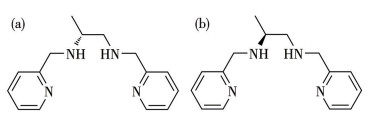
Scheme 1.
Chiral ligands (a) L-R and (b) L-S used in the synthesis

Comparison of homochiral and racemic polymorphs of a spin-crossover iron(Ⅱ) complex
Jingsong WANG , Luyao WANG , Jiesheng HU , Yuxiao CHEN , Kaige GAO , Zishuo YAO , Jun TAO


Spin-crossover (SCO) molecular materials typically comprise first-row transition metal complexes whose d-electron configurations can reversibly interconvert between high-spin (HS) and low-spin (LS) states in response to external stimuli such as temperature[1-7], light irradiation[8-9], or pressure[10-11]. This stimulus-responsive behavior has garnered considerable attention for its potential applications in information storage, molecular switches, and sensory devices. Various transition-metal ions, particularly Mn(Ⅲ)[12], Fe(Ⅱ)[13-18], Fe(Ⅲ)[19-21], Co(Ⅱ)[22-26], Co(Ⅲ)[27], and Ni(Ⅱ)[28], frequently serve as the central coordinating metals in SCO architectures. Among these, Fe(Ⅱ) centers have been the most extensively investigated, as their spin transitions are usually accompanied by pronounced alterations in both optical and magnetic properties. Consequently, a vast array of Fe(Ⅱ)-based SCO complexes has been developed over the past several decades[29-30].
Recent advancements have shown that the SCO phenomenon can be coupled with secondary functionalities, paving the way for multifunctional switchable materials. Such materials are typically engineered by integrating rationally designed SCO building blocks with distinct functional components, thereby imparting supplementary characteristics such as luminescence[31-32], chirality[33-34], electrical conductivity[35], or polarity[36]. Among these multifarious systems, chiral SCO materials have emerged as particularly compelling. The introduction of chirality can dictate molecular packing and finely modulate intermolecular interactions[37-38], thereby offering a highly effective strategy for precisely tuning SCO behavior. In our previous study, we found that, in the single-crystal state, the enantiopure compounds [Fe(L′-RR)(NCSe)2] and [Fe(L′-SS)(NCSe)2] (L′-RR=(1R,2R)-N1,N2-bis(pyridin-2-ylmethyl)cyclohexane-1,2-diamine, L′-SS=(1S,2S)-N1,N2-bis(pyridin-2-ylmethyl)cyclohexane-1,2-diamine) undergo a one-step SCO transition at 146 K, whereas the corresponding racemic compound, rac-[Fe(L′)(NCSe)2] (where L′ is an equimolar mixture of L′-RR and L′-SS) remains in the high-spin state throughout the investigated temperature range[39]. Similar observations have also been reported in other studies, in which racemic ligands tend to alter T1/2 or even stabilize the high-spin state over the entire measured temperature range[33-34]. Nevertheless, despite these observations, the manner in which chirality affects molecular packing and, in turn, governs SCO behavior remains insufficiently understood.
To address this issue, we investigate the SCO and structural behaviors of a new pair of chiral Fe(Ⅱ) complexes, [Fe(L-R)(NCS)2] (1-R; L-R=(R)-N1,N2-bis(pyridin-2-ylmethyl)propane-1,2-diamine) and its enantiomer [Fe(L-S)(NCS)2] (1-S; L-S=(S)-N1,N2-bis(pyridin-2-ylmethyl)propane-1,2-diamine), together with their racemic analogue [Fe(L)(NCS)2] (1-rac; where L is an equimolar mixture of L-R and L-S). In this system, chirality is manifested not only at the discrete molecular level but also translates structurally into the extended crystal packing arrangement. While the enantiopure 1-R and 1-S undergo a complete one-step SCO transition, the racemic 1-rac remains in the high-spin state. This work introduces a novel chiral ligand design, elucidates the direct propagation of molecular chirality into macroscopic crystal packing, and underscores the pivotal role of stereochemistry in modulating SCO dynamics, thereby expanding the repertoire of multifunctional switchable materials.
All chemical reagents were purchased from commercial sources and used as received without further purification. Powder X-ray diffraction (PXRD) data were collected at room temperature using a Shimadzu XRD-6000 diffractometer (Cu Kα radiation, λ=0.154 056 nm). Elemental analyses for C, H, and N were performed using a EUROVECTOR EA3000 elemental analyzer. Fourier-transform infrared (FTIR) spectra were recorded on a Bruker ALPHA FT-IR spectrometer in the range of 4 000-400 cm-1. Variable-temperature magnetic susceptibility measurements were performed on a Quantum Design MPMS XL-7 magnetometer over the temperature range of 10-300 K at a sweep rate of 10 K·min-1. Differential scanning calorimetry (DSC) measurements were performed on a PerkinElmer DSC 8000 instrument under a nitrogen atmosphere at a heating rate of 10 K·min-1. Single-crystal X-ray diffraction (SCXRD) data were collected at 293 and 90 K on a Rigaku Oxford XtaLAB PRO diffractometer (Mo Kα radiation, λ=0.071 073 nm). Circular dichroism (CD) spectra were recorded on a BioLogic MOS-450 spectropolarimeter using either methanolic solutions of the crystals or KBr pellets.
The chiral ligands L-R and L-S were synthesized following a reported procedure. Briefly, a Schiff base was first obtained by heating a mixture of (R)-propane-1,2-diamine and picolinaldehyde under reflux at 80 ℃ under a nitrogen atmosphere. Subsequent reduction of the C=N bonds in the Schiff base with NaBH4 afforded the target ligand L-R (Scheme 1a)[40-42]. Using the same method with (S)-propane-1,2-diamine as the starting material yielded the enantiomeric ligand L-S (Scheme 1b).
Single crystals of 1-R and 1-S were grown by the liquid-liquid diffusion method. In a typical procedure, an aqueous solution (1.50 mL) containing FeSO4·7H2O (0.05 mmol) and ascorbic acid (5.00 mg) was placed at the bottom of a test tube. A buffer layer of a water-methanol mixture (1∶1, V/V) was carefully layered on top, followed by a methanol solution (2.00 mL) of the corresponding chiral ligand (L-R or L-S, 0.05 mmol) and KSCN (0.10 mmol) as the top layer. The tube was sealed and left undisturbed for 15 d, yielding pale-green crystals. The PXRD pattern is presented in Fig.S1a (Supporting information). Comparison with the simulated pattern from the single-crystal structure confirms the phase purity of the as-synthesized sample, with no detectable impurities. For 1-R, yield: ca. 40% (based on FeSO4·7H2O). Elemental analysis Calcd. for C17H20FeN6S2(%): C, 47.67; H, 4.71; N, 19.62. Found(%): C, 47.40; H, 4.29; N, 19.09. FTIR (KBr pellet, cm-1): 761, 876, 943, 1 047, 1 090, 1 157, 1 365, 1 604, 2 073, 2 359, 2 972, 3 235. For 1-S, yield: ca. 40% (based on FeSO4·7H2O). Elemental analysis Calcd. for C17H20FeN6S2(%): C, 47.67; H, 4.71; N, 19.62. Found(%): C, 47.99; H, 4.18; N, 19.33. FTIR (KBr pellet, cm-1): 7 61, 876, 943, 1 047, 1 090, 1 157, 1 365, 1 604, 2 073, 2 359, 2 972, 3 235.
The racemic complex 1-rac was prepared using a procedure analogous to that for 1-R and 1-S, with the sole modification that the top methanolic layer contained a 1∶1 mixture of L-R and L-S (0.025 mmol each). After standing sealed for 15 d, pale-green crystals of 1-rac were obtained. Subsequent PXRD analysis and its agreement with the simulated pattern confirmed the phase purity of the synthesized sample (Fig.S1a). Yield: ca. 50% (based on FeSO4·7H2O). Elemental analysis Calcd. for C17H20FeN6S2(%): C, 47.67; H, 4.71; N, 19.62. Found(%): C, 48.20; H, 4.36; N, 19.67. FTIR (KBr pellet, cm-1): 765, 877, 943, 1 049, 1 088, 1 157, 1 354, 1 603, 2 071, 2 359, 2 966, 3 228.
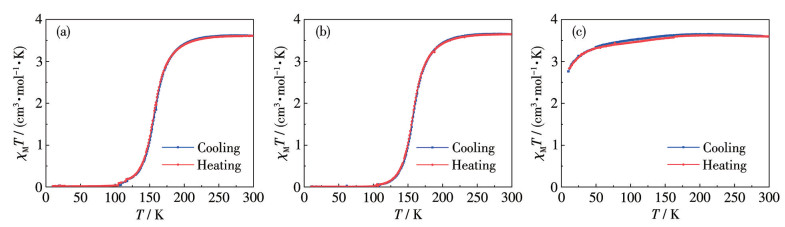
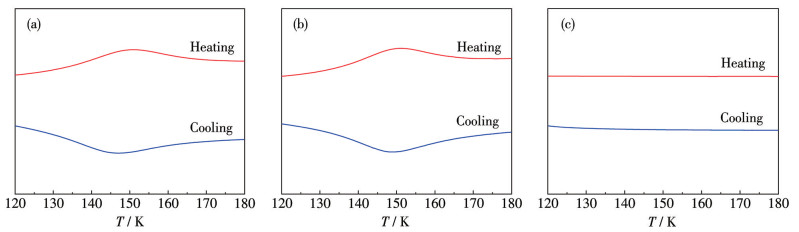
Fig.S2 shows optical microscopy images of single crystals of 1-R and 1-S recorded at 90 and 293 K. Both crystals appeared orange-yellow at 90 K and pale green at 293 K. This thermochromic behavior suggests the occurrence of an SCO transition, as color changes are characteristic signatures of this phenomenon. The temperature-dependent magnetic susceptibility measurements of the three complexes were therefore carried out, and the results are shown in Fig. 1. For complex 1-R, the χmT value at 300 K was 3.6 cm3·K·mol-1, indicating that the Fe(Ⅱ) ions are in the HS state. Upon cooling, the value decreased only slightly above 200 K and then dropped abruptly, reaching approximately 0 cm3·K·mol-1 at 100 K. These results demonstrate that complex 1-R undergoes a complete one-step SCO transition with a T1/2 of 158 K. The transition was fully reversible upon warming, with no detectable thermal hysteresis. Complex 1-S exhibited an identical magnetic profile and also underwent a complete one-step SCO transition. The SCO behavior of 1-R and 1-S was further confirmed by DSC analysis; the exothermic and endothermic peaks observed during the cooling and heating cycles, respectively, agreed well with the SCO temperatures obtained from the magnetic measurements (Fig. 2a and 2b). In contrast, the racemic complex 1-rac did not exhibit SCO behavior and remained in the HS state throughout the investigated temperature range. Its χmT value was 3.6 cm3·K·mol-1 at 200 K and remained essentially constant upon cooling until it decreased rapidly below 30 K, which is attributed to zero-field splitting (ZFS) of the HS Fe(Ⅱ) ions[43]. Similarly, DSC analysis revealed no detectable endothermic or exothermic signals for 1-rac (Fig. 2c). In summary, the pure enantiomers 1-R and 1-S display identical magnetic behavior, featuring a complete one-step SCO transition, whereas the racemic complex 1-rac remains trapped in the HS state.
SCXRD data were collected for all three complexes to elucidate the influence of ligand chirality on their packing modes. The molecular structures of 1-R and 1-S are shown in Fig. 3a and 3b, respectively. In both complexes, the Fe(Ⅱ) center is coordinated by four nitrogen atoms from the tetradentate chiral ligand and two nitrogen atoms from the anionic NCS- ligands in cis positions, giving a distorted octahedral coordination geometry. The methyl substituent on the diamine backbone is disordered over two carbon sites with equal occupancy (50:50), but this disorder does not affect the overall molecular chirality. When viewed along the molecular axis, the L-R ligand adopts a clockwise helical twist upon coordination, whereas the L-S ligand exhibits a counterclockwise twist. Accordingly, the resulting complexes inherit the chirality of the parent ligands (Fig. 3c and 3d). This type of ligand twisting, which gives rise to chiral complexes, has also been observed in related SCO complexes containing acyclic tetradentate N-donor ligands[44]. Because 1-R and 1-S are constructed from enantiopure ligands, they crystallize in the chiral space groups P41212 and P43212, respectively, both of which belong to the tetragonal crystal system. In contrast, the racemic complex 1-rac, owing to the presence of both enantiomeric ligands, generates a glide-plane symmetry element in the crystal and therefore crystallizes in the achiral space group Aea2 (Table 1). Because all of the scissor-like polar molecules are aligned uniaxially within the crystal lattice, complex 1-rac exhibits spontaneous polarization along the crystallographic c-axis.
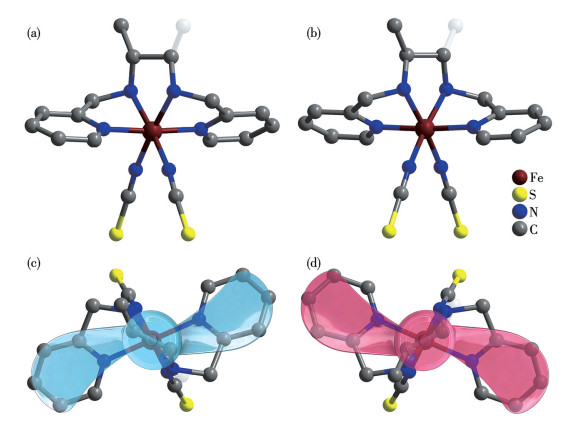
The methyl substituent on the diamine backbone is disordered over two carbon sites with equal occupancies (50∶50);
For clarity, one of the disordered positions has been depicted with reduced opacity.
 下载:
导出CSV
| Parameter | 1-R | 1-S | 1-rac | ||
| Temperature / K | 90 | 293 | 90 | 293 | 293 |
| Formula | C17H20FeN6S2 | C17H20FeN6S2 | C17H20FeN6S2 | ||
| Formula weight | 428.36 | 428.36 | 428.36 | ||
| Crystal system | Tetragonal | Tetragonal | Orthorhombic | ||
| Space group | P41212 | P43212 | Aea2 | ||
| a / nm | 0.881 03(6) | 0.895 28(6) | 0.881 08(6) | 0.895 96(6) | 1.356 13(15) |
| b / nm | 0.881 03(6) | 0.895 28(6) | 0.881 08(6) | 0.895 96(6) | 1.424 44(16) |
| c / nm | 2.444 0(3) | 2.567 4(3) | 2.441 3(2) | 2.559 5(3) | 1.058 66(11) |
| V / nm3 | 1.897 1(3) | 2.057 8(4) | 1.895 2(3) | 2.054 6(4) | 2.045 0(4) |
| Z | 4 | 4 | 4 | 4 | 4 |
| Dc / (g·cm-3) | 1.500 | 1.383 | 1.501 | 1.385 | 1.391 |
| μ / mm-1 | 1.029 | 0.948 | 1.030 | 0.950 | 0.954 |
| F(000) | 888.0 | 888.0 | 888.0 | 888.0 | 888.0 |
| Rint | 0.112 1 | 0.102 7 | 0.086 3 | 0.113 6 | 0.071 8 |
| R1 [I > 2σ(I)] | 0.071 3 | 0.061 0 | 0.054 5 | 0.056 8 | 0.060 8 |
| wR2 (all data) | 0.174 0 | 0.165 4 | 0.110 1 | 0.149 7 | 0.173 8 |
| Flack | 0.00(4) | 0.01(4) | -0.03(4) | 0.06(5) | 0.08(3) |
To further verify the SCO behavior of these materials, we compared their single-crystal structures at high and low temperatures. Although the space groups of 1-R, 1-S, and 1-rac remain unchanged upon cooling, pronounced variations in coordination bond lengths and bond angles are observed for 1-R and 1-S. For 1-R, the average Fe—N bond length at 293 K is relatively long (0.217 9 nm), whereas it shortens to 0.198 4 nm at 90 K, consistent with the Fe(Ⅱ) ion being in the HS and LS states, respectively. The average Fe—N bond length change for 1-R is approximately 0.019 5 nm; a similar change of 0.019 3 nm is observed for 1-S. This significant contraction upon cooling further confirms the temperature-induced SCO in both enantiomers, as a pronounced change in the average Fe—N bond length is a key signature of SCO in Fe(Ⅱ) complexes[45]. In addition to the bond-length changes, the octahedral distortion also increases with temperature. The octahedral distortion parameter ∑, defined as the sum of the deviations of the N—Fe—N angles from 90°, was calculated using the angles listed in Table S2[46]. For 1-R, ∑ is 56.805° at 90 K and 84.633° at 293 K; for 1-S, the corresponding values are 53.933° and 87.251°. The Fe—N(NCS-)—C angle is 166.8(7)° at 90 K and 161.0(6)° at 293 K for 1-R, and 167.7(5)° and 161.2(6)° for 1-S.
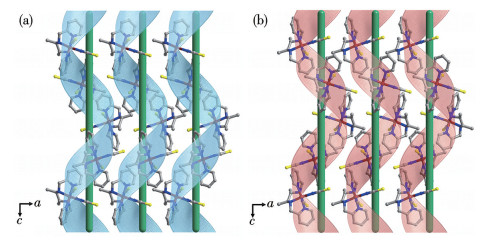
As discussed above, upon coordination of the chiral ligands, the chiral information is transferred from the ligands to the corresponding Fe(Ⅱ) complexes. During crystallization, these complexes are further assembled into the solid-state structure through Namine—H…S hydrogen bonds and additional van der Waals interactions. Fig.S3 depicts the Namine—H…S hydrogen bonds in the structures of 1-R and 1-S using dashed lines[47-50]. Through these hydrogen-bonding interactions, the complexes are further linked into helical supramolecular architectures within the crystal lattice. The molecular packing of 1-R is shown in Fig. 4a, where a blue ribbon highlights the helical pathway. Fig. 4b shows the packing of 1-S, with a pink ribbon illustrating the corresponding helical arrangement. In 1-R, the molecules pack into a clockwise helix along the c-axis (viewed from top to bottom), whereas in 1-S, they adopt a counterclockwise helical arrangement. In both structures, the original packing can be regenerated by a 90° rotation combined with translations of 1/4 and 3/4 along the crystallographic c-axis, in agreement with the symmetry operations of the P41212 and P43212 space groups.
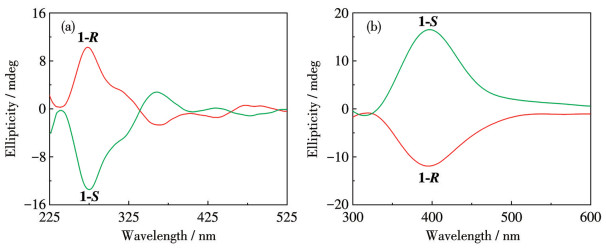
To further confirm their chiral nature, CD spectra were measured. The solution CD spectra of 1-R and 1-S in methanol were perfect mirror images of each other (Fig. 5a), confirming that the two complexes are molecular enantiomers. Moreover, the solid-state CD spectra recorded from KBr pellets (Fig. 5b) also displayed mirror-image signals, demonstrating that the molecular chirality is retained upon crystallization and faithfully translated into the crystalline packing arrangement. This result is fully consistent with the chiral space groups determined by SCXRD.
In 1-R and 1-S, although the molecular handedness is opposite, the local coordination environments around the Fe(Ⅱ) centers are essentially identical, leading to equivalent magnetic properties. In contrast, intermolecular interactions appear to be stronger in 1-rac (Fig.S4), as supported by its smaller unit-cell volume. As listed in Table 1, at 293 K the unit-cell volume of 1-rac is 2.045 0(4) nm3, which is significantly smaller than 2.057 8(4) nm3 of 1-R and 2.054 6(4) nm3 of 1-S. A similar contraction of the unit-cell volume in racemic complexes has also been observed in other reported chiral SCO systems. For example, the cell volume of rac-[Fe(L′)(NCSe)2], previously mentioned, is 2.263 9(3) nm3. This value is smaller than those of the HS complexes [Fe(L′-RR)(NCSe)2] [2.322 9(2) nm3] and [Fe(L′-SS)(NCSe)2] [2.322 4(3) nm3][39]. We therefore propose that the enhanced intermolecular interactions in 1-rac hinder the occurrence of spin crossover, thereby stabilizing the high-spin state.
In summary, a pair of enantiopure chiral spin-crossover complexes, 1-R and 1-S, together with their racemic analogue 1-rac, were successfully synthesized. In these materials, chirality is effectively transferred from the ligands to the coordination complexes and further propagated throughout the entire single-crystal structure. As a result, the complex molecules in 1-R and 1-S crystallize into quadruple-helical architectures with opposite handedness, corresponding to the chiral space groups P41212 and P43212, respectively. The magnetic behaviors of 1-R and 1-S were identical, both exhibiting a complete, one-step SCO, while the racemic complex 1-rac remained locked in the high-spin state over the measured temperature range. This distinct magnetic response is closely associated with the different packing modes imposed by molecular chirality. Overall, this work introduces a new chiral ligand, investigates the transfer of chirality from the molecule to the crystal structure, and further expands the family of chiral spin-crossover systems.
YAO N T, ZHAO L, SUN H Y, YI C, GUAN Y H, LI Y M, OSHIO H, MENG Y S, LIU T. Simultaneous photo-induced magnetic and dielectric switching in an iron(Ⅱ)-based spin-crossover Hofmann-type metal-organic framework[J]. Angew. Chem.‒Int. Edit., 2022, 61: e202208208 doi: 10.1002/anie.202208208
YAO Z S, TANG Z, TAO J. Bistable molecular materials with dynamic structures[J]. Chem. Commun., 2020, 56: 2071-2086 doi: 10.1039/C9CC09238B
DENG Y F, WANG Y N, ZHAO X H, ZHANG Y Z. Desolvation-solvation-induced reversible on-off switching of two memory channels in a cobalt(Ⅱ) coordination polymer: Overlay of spin crossover and structural phase transition[J]. CCS Chem., 2022, 4: 3064-3075 doi: 10.31635/ccschem.021.202101407
YANG G, RUAN Z Y, CHEN Y C, LIAO P Y, WU S G, NI Z P, TONG M L. Halogen-driven single-crystal to single-crystal transformation engineering the cluster-based spin crossover frameworks[J]. Angew. Chem.‒Int. Edit., 2025, 64: e202414330 doi: 10.1002/anie.202414330
LI X, ZHANG D, QIAN Y Q, LIU W X, MATHONIÈRE C, CLÉRAC R, BAO X. Chemical manipulation of the spin-crossover dynamics through judicious metal-ion dilution[J]. J. Am. Chem. Soc., 2023, 145: 9564-9570 doi: 10.1021/jacs.2c13697
WU Y Y, XU G Y, YAN Z H, ZHOU X Y, YANG F L, DAI J W, WU S Q, LI Z Y, SATO O. Altered mode of structural changes in solid solutions leading to dual modulation: Spin transition temperatures and steps[J]. J. Am. Chem. Soc., 2025, 147: 14401-14410 doi: 10.1021/jacs.5c00712
XIONG X, LIU Y Y, LI S, XUE A Q, WANG J, ZHANG C, ZHU W H, SUN H L. The exploration and analysis of the magnetic relaxation behavior in three isostructural cyano-bridged 3d-4f linear heterotrinuclear compounds[J]. Inorganics, 2018, 6: 36 doi: 10.3390/inorganics6020036
LI X F, ZHOU R H, LIU Q, XIAO J Y, ZHAO L, LIU T, MENG Y S. Realizing the multi-step spin crossover in two-dimensional cyano-bridged {WⅤFeⅡ} assemblies[J]. Cryst. Growth Des., 2025, 25: 2631-2638 doi: 10.1021/acs.cgd.5c00118
WANG H Y, GE J Y, HUA C, JIAO C Q, WU Y, LEONG C F, D′ALESSANDRO D M, LIU T, ZUO J L. Photo- and electronically switchable spin-crossover iron(Ⅱ) metal-organic frameworks based on a tetrathiafulvalene ligand[J]. Angew. Chem.‒Int. Edit., 2017, 56: 5465-5470 doi: 10.1002/anie.201611824
LI Y, KONG Q R, GUO Y, TANG Z. Thermal hysteresis induced by external pressure in a 3D Hofmann-type SCO-MOF[J]. Dalton Trans., 2021, 50: 1384-1389 doi: 10.1039/D0DT03796F
WU M L, LIANG J H, CHEN Y R, CHEN K, RUAN Z Y, WU S G, CAI W Z, TONG M L. Spin-state switching driven by divergent structural evolutions in a 3D spin-crossover material[J]. Chin. J. Struct. Chem., 2026, 45(8): 100941
KAZAKOVA A V, TIUNOVA A V, KORCHAGIN D V, SHILOV G V, YAGUBSKII E B, ZVEREV V N, YANG S C, LIN J Y, LEE J F, MAXIMOVA O V, VASILIEV A N. The first conducting spin-crossover compound combining a MnⅢ cation complex with electroactive TCNQ demonstrating an abrupt spin transition with a hysteresis of 50 K[J]. Chem.‒Eur. J., 2019, 25: 10204-10213 doi: 10.1002/chem.201901792
CHEN D Y, YI C, LI X F, ZHOU R H, ZHANG L Y, CAI R, MENG Y S, LIU T. A mononuclear iron(Ⅱ) complex constructed using a complementary ligand pair exhibits intrinsic luminescence-spin-crossover coupling[J]. Dalton Trans., 2025, 54: 2908-2915 doi: 10.1039/D4DT03177F
ZHAO X H, SHAO D, CHEN J T, GAN D X, YANG J, ZHANG Y Z. A trinuclear {Fe2ⅢFeⅡ} complex involving both spin and non-spin transitions exhibits three-step and wide thermal hysteresis[J]. Sci. China Chem., 2022, 65: 532-538 doi: 10.1007/s11426-021-1153-0
LI L, LUO J P, LI X F, SHAO Z, CHEN D Y, SHI Q, ZHAO L, MENG Y S, LIU T. Construction of SCO-active Fe(Ⅱ) mononuclear complexes from chiral pybox-type ligands[J]. Inorg. Chem. Commun., 2025, 177: 114382 doi: 10.1016/j.inoche.2025.114382
YI C, CHEN D Y, ZHANG S H, CAI R, DUAN C Y, MENG Y S, LIU T. Spin-modulated near-infrared-Ⅰ emission in a xanthene-decorated Fe(Ⅱ) spin-crossover complex[J]. Sci. China Chem., 2025, 68: 2987-2994 doi: 10.1007/s11426-024-2454-8
WU S G, BALA S, RUAN Z Y, HUANG G Z, NI Z P, TONG M L. Four-step spin-crossover in an oxamide-decorated metal-organic framework[J]. Chin. Chem. Lett., 2022, 33: 1381-1384 doi: 10.1016/j.cclet.2021.08.012
陶建清, 顾志国, 王天维, 左景林. 自旋交叉配合物[Fe(mtt)(phen)(NCS)2]·py的合成和磁性研究[J]. 无机化学学报, 2005, 21: 1471-1474TAO J Q, GU Z G, WANG T W, ZUO J L. The synthesis and magnetic study of spin crossover complex [Fe(mtt)(phen)(NCS)2]·py[J]. Chinese J. Inorg. Chem., 2005, 21: 1471-1474
BOONPRAB T, LEE S J, TELFER S G, MURRAY K S, PHONSRI W, CHASTANET G, COLLET E, TRZOP E, JAMESON G N L, HARDING P, HARDING D J. The first observation of hidden hysteresis in an iron(Ⅲ) spin-crossover complex[J]. Angew. Chem.‒Int. Edit., 2019, 58: 11811-11815 doi: 10.1002/anie.201907619
CHEN L W, ZHU H, ZHOU H W, ZHANG H Z, ZHAO S Z, LI Y H, WANG S. Halogen-driven spin dynamics: Exploring correlation of cooperativity and spin crossover in solid-state mononuclear Fe(Ⅲ) Schiff-base complexes[J]. Inorg. Chem., 2025, 64: 7203-7213 doi: 10.1021/acs.inorgchem.5c00885
WU J F, LI M T, YANG Q Q, ZHANG B L, TANG J K. Two-step spin transition around room temperature in a FeⅢ complex[J]. Dalton Trans., 2025, 54: 1231-1238 doi: 10.1039/D4DT02736A
SUN Y C, CHEN F L, WANG K J, ZHAO Y, WEI H Y, WANG X Y. Hysteretic spin crossover with high transition temperatures in two cobalt(Ⅱ) complexes[J]. Inorg. Chem., 2023, 62: 14863-14872 doi: 10.1021/acs.inorgchem.3c01188
NÖßLER M, HUNGER D, NEUMAN N I, REIMANN M, REICHERT F, WINKLER M, KLEIN J, BENS T, SUNTRUP L, DEMESHKO S, STUBBE J, KAUPP M, van SLAGEREN J, SARKAR B. Fluorinated click-derived tripodal ligands drive spin crossover in both iron(Ⅱ) and cobalt(Ⅱ) complexes[J]. Dalton Trans., 2022, 51: 10507-10517 doi: 10.1039/D2DT01005D
SHAO D, SHI L, YIN L, WANG B L, WANG Z X, ZHANG Y Q, WANG X Y. Reversible on-off switching of both spin crossover and single-molecule magnet behaviours via a crystal-to-crystal transformation[J]. Chem. Sci., 2018, 9: 7986-7991 doi: 10.1039/C8SC02774A
SHI L, KOBYLARCZYK J, DZIEDZIC-KOCUREK K, STANEK J J, SIEKLUCKA B, PODGAJNY R. Site selectivity for the spin states and spin crossover in undecanuclear heterometallic cyanido-bridged clusters[J]. Inorg. Chem., 2023, 62: 7032-7044 doi: 10.1021/acs.inorgchem.3c00325
SUN X P, LI J J, LI Y, LI Y X, GAO Z T, TANG Z, MA P T, WANG J P, NIU J Y. Polyoxometalate anion-induced on-off spin-crossover property in two isomeric cobalt(Ⅱ) complexes with proton conductivity[J]. Inorg. Chem., 2025, 64: 7846-7850 doi: 10.1021/acs.inorgchem.5c00639
KLIE R F, ZHENG J C, ZHU Y, VARELA M, WU J, LEIGHTON C. Direct measurement of the low-temperature spin-state transition in LaCoO3[J]. Phys. Rev. Lett., 2007, 99: 047203 doi: 10.1103/PhysRevLett.99.047203
KYODEN Y, HOMMA Y, ISHIDA T. High-spin and incomplete spin-crossover polymorphs in doubly chelated [Ni(L)2Br2] (L=tert-butyl 5-phenyl-2-pyridyl nitroxide)[J]. Inorg. Chem., 2019, 58: 10743-10755 doi: 10.1021/acs.inorgchem.9b00885
SUN X P, TANG Z, YAO Z S, TAO J. A homochiral 3D framework of mechanically interlocked 1D loops with solvent-dependent spin-state switching behaviors[J]. Chem. Commun., 2020, 56: 133-136 doi: 10.1039/C9CC09063K
TATSUMI S, NODA H, UMEDA M, KAGOTANI T, SUGIMOTO K, KURODA-SOWA T, TAMAYOSE S, HORII Y, SUZUKI H. Spin-crossover transitions of solid solutions of FeⅡ complexes with fluorine-and chlorine-substituted Schiff-base ligands, Hqsal5F and Hqsal5Cl[J]. Inorg. Chem., 2025, 64: 4973-4982 doi: 10.1021/acs.inorgchem.4c04959
LI Y, JAVED M K, WU S Q, SULAIMAN A, WU Y Y, LI Z Y, SATO O, BU X H. Aggregation-induced emission meets magnetic bistability: Synergy between spin crossover and fluorescence in iron(Ⅱ) complexes[J]. Chin. Chem. Lett., 2023, 34: 107492 doi: 10.1016/j.cclet.2022.05.006
WANG C F, LI R F, CHEN X Y, WEI R J, ZHENG L S, TAO J. Synergetic spin crossover and fluorescence in one-dimensional hybrid complexes[J]. Angew. Chem.‒Int. Edit., 2015, 54: 1574-1577 doi: 10.1002/anie.201410454
ZHAO X H, DENG Y F, XI J, HUANG J Q, ZHANG Y Z. Supramolecular spring-like Fe(Ⅱ) spin-crossover complexes experiencing giant and anisotropic thermal expansion across two distinct temperature regimes[J]. Angew. Chem.‒Int. Edit., 2025, 64: e202414826 doi: 10.1002/anie.202414826
任冬红, 刘志明, 孙晓利, 顾玲, 邱丹, 顾志国, 李在均. 手性自旋转换铁(Ⅱ)席夫碱配合物的合成、结构及其磁性研究[J]. 无机化学学报, 2015, 31: 536-542REN D H, LIU Z M, SUN X L, GU L, QIU D, GU Z G, LI Z J. Syntheses, structures and magnetic properties of homochiral spin-crossover iron(Ⅱ) Schiff-base complexes[J]. Chinese J. Inorg. Chem., 2015, 31: 536-542
PHAN H, BENJAMIN S M, STEVEN E, BROOKS J S, SHATRUK M. Photomagnetic response in highly conductive iron(Ⅱ) spin-crossover complexes with TCNQ radicals[J]. Angew. Chem.‒Int. Edit., 2015, 54: 823-827 doi: 10.1002/anie.201408680
LIU C D, WU S Q, GAO K G, HU J S, LI Y, WANG L Y, XIONG Y, TAO J, YAO Z S. Large polarization change induced by spin crossover-driven Fe(Ⅱ) ion shuttling within a tripodal ligand[J]. J. Am. Chem. Soc., 2025, 147: 2871-2879 doi: 10.1021/jacs.4c16750
FLOOD J P, WALLIS M J, TADROS J, NAKASHIMA Y, FANNA D J, ALDRICH-WRIGHT J R, LINDOY L F, HAYAMI S, LI F. Robust and high-temperature spin crossover controlled via the self-assembly of chiral and racemic polymorphs in triazolylimine [Fe2L3](BF4)4 helicates[J]. Inorg. Chem., 2025, 64: 8100-8108 doi: 10.1021/acs.inorgchem.5c00186
SEKIMOTO Y, KARIM M R, SAIGO N, OHTANI R, NAKAMURA M, HAYAMI S. Crystal structures and spin-crossover behavior of iron(Ⅱ) complexes with chiral and racemic ligands[J]. Eur. J. Inorg. Chem., 2017: 1049-1053
MA T T, SUN X P, YAO Z S, TAO J. Homochiral versus racemic polymorphs of spin-crossover iron(Ⅱ) complexes with reversible LIESST effect[J]. Inorg. Chem. Front., 2020, 7: 1196-1204 doi: 10.1039/C9QI01590F
MICHELSEN K. A double-bridged binuclear chromium(Ⅲ) complex with 1,6-bis(2′-pyridyl)-2,5-diazahexane. Preparation, resolution and stereochemistry of the di-μ-hydroxobis[{1,6-bis-(2′-pyridyl)-2,5-diazahexane} chromium(Ⅲ)] ion[J]. Acta Chem. Scand. A, 1977, 31: 429-436
GOODWIN H A, LIONS F. Quadridentate chelate compounds[J]. J. Am. Chem. Soc., 1960, 82: 5013-5023 doi: 10.1021/ja01504a001
TRETBAR M, STARK C B W. Large-scale synthesis of symmetric tetramine ligands by using a modular double reductive amination approach[J]. Eur. J. Org. Chem., 2017: 6942-6946
MALIK S, BRANDÃO P, BENMANSOUR S, GÓMEZ-GARCÍA C J, SAHA A. Modulation of the spin crossover behaviour in four manganese(Ⅲ) complexes through cation-anion interactions[J]. Dalton Trans., 2025, 54: 6645-6652 doi: 10.1039/D5DT00238A
LAI F, ZOU Q H, XU J, QI D F, MOLNÁR G, BAO X. Molecular and crystal engineering of spin crossover in iron(Ⅱ) complexes with acyclic tetradentate N-donor ligands[J]. Coord. Chem. Rev., 2026, 560: 217836 doi: 10.1016/j.ccr.2026.217836
WEN W, LIU Q, ZHANG S H, YAO N T, OSHIO H, MENG Y S, LIU T. Spin-crossover tuned rotation of pyrazolyl rings in a 2D iron(Ⅱ) complex towards synergetic magnetic and dielectric transitions[J]. Angew. Chem.‒Int. Edit., 2022, 61: e202208886 doi: 10.1002/anie.202208886
KETKAEW R, TANTIRUNGROTECHAI Y, HARDING P, CHASTANET G, GUIONNEAU P, MARCHIVIE M, HARDING D J. OctaDist: A tool for calculating distortion parameters in spin crossover and coordination complexes[J]. Dalton Trans., 2021, 50: 1086-1096 doi: 10.1039/D0DT03988H
MAYNARD A T, COVELL D G. Reactivity of zinc finger cores: Analysis of protein packing and electrostatic screening[J]. J. Am. Chem. Soc., 2001, 123: 1047-1058 doi: 10.1021/ja0011616
UEYAMA N, OKAMURA T, NAKAMURA A. Structure and properties of molybdenum(Ⅳ, Ⅴ) arenethiolates with a neighboring amide group. Significant contribution of NH…S hydrogen bond to the positive shift of redox potential of Mo(Ⅴ)/Mo(Ⅳ)[J]. J. Am. Chem. Soc., 1992, 114: 8129-8137 doi: 10.1021/ja00047a022
UEYAMA N, NISHIKAWA N, YAMADA Y, OKAMURA T, OKA S, SAKURAI H, NAKAMURA A. Synthesis and properties of octaethylporphinato(arenethiolato)iron(Ⅲ) complexes with intramolecular NH…S hydrogen bond: Chemical function of the hydrogen bond [J]. Inorg. Chem., 1998, 37: 2415-2421 doi: 10.1021/ic971140l
BABA K, OKAMURA T, SUZUKI C, YAMAMOTO H, YAMAMOTO T, OHAMA M, UEYAMA N. O-atom-transfer oxidation of [molybdenum(Ⅳ) oxo{3,6-(acylamino)2-1,2-benzenedithiolato}2]2- promoted by intramolecular NH…S hydrogen bonds[J]. Inorg. Chem., 2006, 45: 894-901 doi: 10.1021/ic051493h

Figure 1 Temperature-dependent magnetic susceptibilities of (a) 1-R, (b) 1-S, and (c) 1-rac

Figure 3 Asymmetric units of (a) 1-R and (b) 1-S; Asymmetric units of (c) 1-R and (d) 1-S viewed from a different perspective
The methyl substituent on the diamine backbone is disordered over two carbon sites with equal occupancies (50∶50);
For clarity, one of the disordered positions has been depicted with reduced opacity.

Figure 5 CD spectra of the 1-R and 1-S enantiomers in (a) methanol solution as well as in (b) KBr pellets
Table 1. Crystallographic data of 1-R, 1-S, and 1-rac
| Parameter | 1-R | 1-S | 1-rac | ||
| Temperature / K | 90 | 293 | 90 | 293 | 293 |
| Formula | C17H20FeN6S2 | C17H20FeN6S2 | C17H20FeN6S2 | ||
| Formula weight | 428.36 | 428.36 | 428.36 | ||
| Crystal system | Tetragonal | Tetragonal | Orthorhombic | ||
| Space group | P41212 | P43212 | Aea2 | ||
| a / nm | 0.881 03(6) | 0.895 28(6) | 0.881 08(6) | 0.895 96(6) | 1.356 13(15) |
| b / nm | 0.881 03(6) | 0.895 28(6) | 0.881 08(6) | 0.895 96(6) | 1.424 44(16) |
| c / nm | 2.444 0(3) | 2.567 4(3) | 2.441 3(2) | 2.559 5(3) | 1.058 66(11) |
| V / nm3 | 1.897 1(3) | 2.057 8(4) | 1.895 2(3) | 2.054 6(4) | 2.045 0(4) |
| Z | 4 | 4 | 4 | 4 | 4 |
| Dc / (g·cm-3) | 1.500 | 1.383 | 1.501 | 1.385 | 1.391 |
| μ / mm-1 | 1.029 | 0.948 | 1.030 | 0.950 | 0.954 |
| F(000) | 888.0 | 888.0 | 888.0 | 888.0 | 888.0 |
| Rint | 0.112 1 | 0.102 7 | 0.086 3 | 0.113 6 | 0.071 8 |
| R1 [I > 2σ(I)] | 0.071 3 | 0.061 0 | 0.054 5 | 0.056 8 | 0.060 8 |
| wR2 (all data) | 0.174 0 | 0.165 4 | 0.110 1 | 0.149 7 | 0.173 8 |
| Flack | 0.00(4) | 0.01(4) | -0.03(4) | 0.06(5) | 0.08(3) |
 下载: 导出CSV

 扫一扫看文章


扫一扫关注我们


 下载: