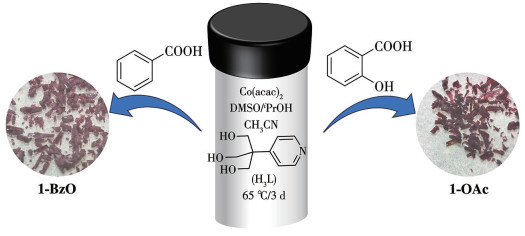
Figure 1.
Crystal morphology and schematic synthesis process of 1-BzO and 1-OAc under an optical microscope

Two Anderson-type cobalt clusters: Synthesis and electrocatalytic hydrogen evolution performance in neutral electrolyte
Qingyu JU , Shuang PENG , Shijia CHEN , Rongzhi SUN , Shoutian ZHENG , Pingwei CAI , Xinxiong LI


The escalating energy crisis and the environmental consequences of fossil fuel consumption have catalyzed an urgent pursuit of sustainable energy alternatives. Hydrogen, characterized by its extraordinary gravimetric energy density and zero-emission combustion, stands out as a paramount energy carrier, with electrochemical water splitting representing a highly promising pathway for green hydrogen production. While platinum-group materials (e.g., Pt/C) remain the benchmark electrocatalysts for the hydrogen evolution reaction (HER) due to their near-zero overpotential and optimal reaction kinetics[1-4], their scarcity and high cost severely impede large-scale commercialization. Consequently, the rational design of earth-abundant, non-noble-metal electrocatalysts, such as iron-, nickel-, and molybdenum-based systems, has emerged as a focal point in energy materials research[5-13].
Among these candidates, cobalt-based materials have attracted profound interest owing to their natural abundance, cost-effectiveness, and intrinsically favorable catalytic activities. However, the majority of highly active cobalt-based HER catalysts operate optimally only in harshly acidic or alkaline media, conditions that inevitably provoke severe corrosion of device components and limit practical applicability[14-15]. Operating in neutral electrolytes mitigates these issues and broadens the scope of application; yet, it introduces a formidable scientific challenge. Compared to extreme pH environments, the kinetics of water dissociation and proton reduction in neutral electrolytes are notoriously sluggish. Overcoming this kinetic bottleneck imposes stringent requirements on catalyst design, necessitating precise control over the active sites to achieve high efficiency.
The Anderson-type clusters represent a unique class of planar metal clusters, conventionally constructed from heterometallic polyoxometalate (POM) building blocks. Owing to their versatile redox chemistry, tunable charge distributions, and robust thermal and photochemical stabilities[16-19], Anderson-type POMs have emerged as highly attractive platforms across diverse fields, ranging from catalysis[20-23] and sensors[24-27] to medicine[28-31]. However, despite these extensive applications, the in-situ synthesis of homometallic Anderson cluster-organic frameworks remains remarkably scarce[32-33]. Furthermore, while a few previous studies have successfully constructed extended architectures utilizing Anderson-type cobalt clusters as secondary building units, these investigations have been primarily confined to exploring their intriguing magnetic properties[34]. Consequently, the electrocatalytic potential of these structurally precise, homometallic planar clusters remains fundamentally underexplored, presenting a significant opportunity for advanced catalyst design.
Herein, we report the rational design and synthesis of two novel 1D architectures based on homometallic Anderson-type cobalt clusters, [Co7(L)2(acac)4(BzO)4(iPrO)2][Co(acac)2]·8CH3CN (1-BzO) and [Co7(L)2(acac)4(OAc)4(MeO)2][Co(acac)2]·9CH3CN (1-OAc), (H3L=2-(hydroxymethyl)-2-(pyridin-4-yl)propane-1,3-diol, acac-=acetylacetonate, BzOH=benzoic acid). Their precise structural configurations were unambiguously determined via single-crystal X-ray diffraction (SCXRD) and corroborated by comprehensive spectroscopic and thermal analyses. Crucially, by systematically evaluating their electrocatalytic HER performance in neutral electrolyte, we demonstrate that subtle variations in the peripheral ligands profoundly dictate their catalytic efficacy, offering a new paradigm for optimizing cluster-based electrocatalysts.
Cobalt acetylacetonate (Co(acac)2, ≥99.0%), BzOH (C7H6O2, ≥99.0%), salicylic acid (C7H6O3, ≥99.0%), dimethyl sulfoxide (DMSO, ≥99.0%), acetonitrile (CH3CN, ≥99.0%), and isopropyl alcohol (iPrOH, ≥99.0%) are all analytical grade purchased from Sinopharm Chemical Reagent. H3L was synthesized based on the literature method[35]. Freshly deionized water was used throughout all the experiments.
As shown in Fig.1, a mixture of Co(acac)2 (0.257 g), BzOH (0.015 g), and H3L (0.134 g) was mixed with CH3CN (5.0 mL) and iPrOH (1.0 mL) in a 20 mL vial. The mixture was stirred for 1 h and then heated at 65 ℃ for 3 d. After cooling to room temperature, pink block crystals were obtained. Yield based on Co: 64%.
As shown in Fig.1, a mixture of Co(acac)2 (0.257 g), salicylic acid (0.017 g), and H3L (0.134 g) was mixed with CH3CN (5.0 mL) and DMSO (1.0 mL) in a 20 mL vial. The mixture was stirred for 1 h and then heated at 65 ℃ for 3 d. After cooling to room temperature, pink block crystals were obtained. Yield based on Co: 47%.
Powder X-ray diffraction (PXRD) patterns were recorded on a Rigaku DMAX 2500 diffractometer at 40 kV and 15 mA using Cu Kα radiation (λ=0.154 056 nm), and the step size was 0.02°, and the 2θ range was from 5° to 50°. The simulated PXRD data were calculated by Mercury Software. Infrared spectra (IR) were performed on an Opus Vetex 70 FT-IR infrared spectrophotometer in the range of 400-4 000 cm-1. UV-Vis absorption spectrum was performed on a SHIMADZU UV-2600 UV-visible spectrophotometer by using the BaSO4 as the blank. Thermogravimetric (TG) analysis was performed on a TGA/DSC 3+ simultaneous thermal analyzer under an argon protective atmosphere, with a heating rate of 10 ℃·min-1 and a temperature range of 30-800 ℃. The elemental valence state analysis of the samples was conducted on an ESCALAB 250 X-ray photoelectron spectrometer, using a monochromatized Al Kα radiation (λ=0.835 7 nm) source with a pass energy of 20 eV and a power of 200 W. Elemental analyses for C, H, and N of compounds were performed on a Vario EL Ⅲ elemental analyzer.
The SCXRD data of 1-BzO were collected on the Bruker APEX Ⅱ CCD diffractometer, using Mo Kα radiation with λ=0.071 073 nm, under nitrogen atmosphere, while the SCXRD data of 1-OAc were collected on the Rigaku XtaLAB Synergy Custom diffractometer, using Cu Kα radiation with λ=0.154 184 nm, under nitrogen atmosphere. The crystal structures were solved by the direct method and refined by the full-matrix least-squares method on F 2, according to SHELXL-2014 and Olex2[36-37]. The residual electron densities that could not be reasonably modeled as solvent or cations were removed by applying the function in PLATON. The final formula was determined by combining results from elemental and thermogravimetric analysis.
Electrochemical measurements were performed in the standard three-electrode system of the Zennium-pro (Germany Zahner Instrument) electrochemical workstation. All the electrochemical tests were carried out at room temperature. Graphite rod and Ag/AgCl electrodes were employed as the counter electrode (CE) and reference electrode (RE), respectively. A homogeneous aqueous solution of catalyst ink was formed by slowly adding 5 mg of catalyst (1-BzO and 1-OAc), 30 μL of Nafion solution (10%, DuPont, Wilmington, Delaware, USA), and 300 μL of water/isopropanol (1∶1, V/V) with mixing by ultrasonic for 1 h. The carbon cloth (CC) was first deglazed by sonication in acetone solution and then carefully washed with 0.5 mol·L-1 HCl in an ultrasonic bath for 20 min to remove the surface oxidation layer. A working electrode was made by dropping catalyst ink on the CC. The catalyst loading on the CC was about 0.5 mg·cm-2.
The catalysis of HER was performed in a 0.1 mol·L-1 phosphate-buffered saline (pH=7.4). In this article, iR compensation was not applied. All the potentials measured (E) were calibrated to the relative reversible hydrogen electrode potentials (ERHE) according to the equation: ERHE=E+EAg/AgCl+0.059 2pH, where EAg/AgCl is the relative Ag/AgCl electrode potential. In particular, the cyclic voltammetry (CV) tests were first performed at a scan rate of 100 mV·s-1 for 20 cycles to attain a stable state. Then, linear sweep voltammetry (LSV) curves of HER were recorded at a scan rate of 5 mV·s-1. The Tafel plots were graphed using the Tafel equation, η10=blg|j|+a, in which η10 is the overpotential at a current density of 10 mA·cm-2, b is the Tafel slope, j is the current density, and a is a constant. To evaluate the electrochemically active surface area (ECSA), CV was performed between -0.6 and -0.7 V to measure the double-layer capacitance (Cdl). The specific value of ECSA was determined by the following equation: ECSA=Cdl/Cs, where Cs (40 μF·cm-2) is the areal specific capacitance. Electrochemical impedance spectroscopy (EIS) was measured within a frequency scan range from 0.1 Hz to 100 kHz. At last, the electrode stability was tested by the chronopotentiometry (CP) test.
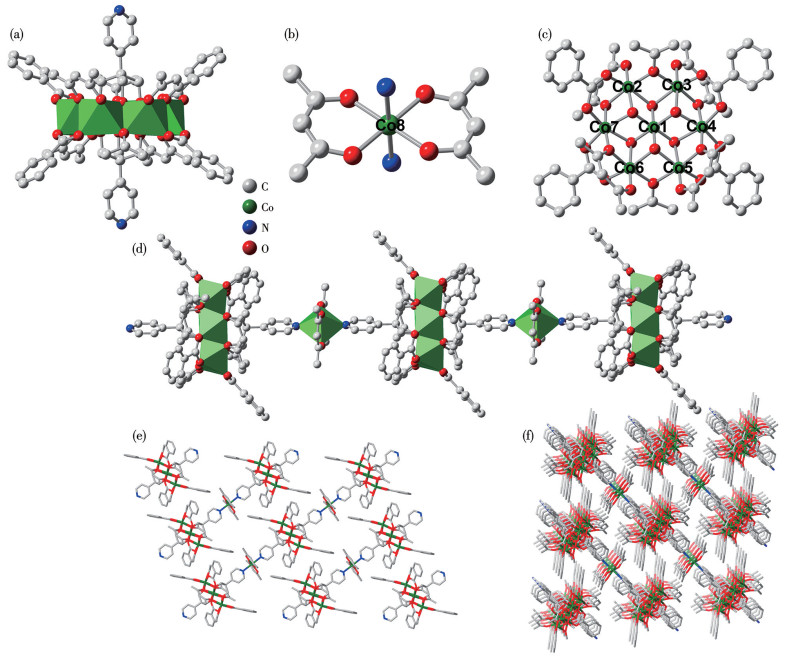
SCXRD analysis reveals that 1-BzO crystallizes in the triclinic space group of P1 (Table S1, Supporting information). The structural framework is constructed from secondary building units comprising two distinct components: an Anderson-type cobalt cluster and a mononuclear cobalt center coordinated by two acac- ligands (Fig.2a and 2b). In the Anderson cobalt cluster, all cobalt ions adopt a six-coordinated octahedral geometry. For the Co1 ion, six μ4-O are coordinated around it. Two benzoate ions, two μ4-O, and two acac- groups are coordinated around the Co4 and Co7 ions. And the remaining four cobalt ions (Co2, Co3, Co5, and Co6) have the same coordination mode, with one benzoate ion, two μ4-O, one acac- group ligand, and one isopropoxide (iPrO-) ligand coordinated around them (Fig.2c). The three hydroxyl oxygens of the ligands coordinate with the Co7 cluster and the N atom at the pyridine end coordinates with the mononuclear cobalt ion, which forms a 1D chain (Fig.2d). These 1D chains can form a 2D layered structure in the ab plane (Fig.2e), and further stack along the c-axis direction to form a three-dimensional supramolecular framework structure (Fig.2f).
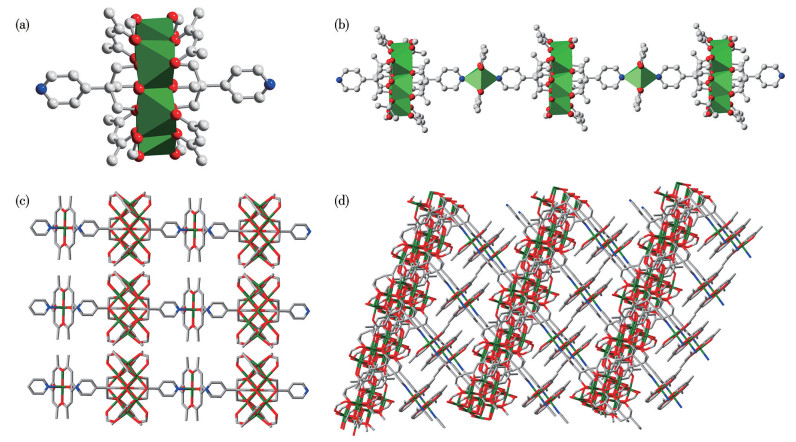
Moreover, SCXRD analysis shows that 1-OAc crystallizes in the monoclinic space group of C2/m. The structure of 1-OAc features an analogous Anderson-type cobalt core (Fig.3a), where benzoate ligands at the Co4 and Co7 sites are replaced by acetate ligands. Notably, two methoxide ligands act as μ2-bridging ligands, one connecting Co2 and Co3, and the other connecting Co5 and Co6. Similar to 1-BzO, the N atom at the pyridine of the Co7 clusters could coordinate with Co(acac)2, thereby forming a 1D chain (Fig. 3b). However, unlike 1-BzO, the 1D chain lies in the bc plane (Fig. 3c) and then forms a 3D supramolecular structure (Fig.3d).
Notably, neither methanol nor acetic acid was added as a starting material in the synthesis process. However, previous studies have shown that the methoxide ions and acetate ligands may be derived from the in-situ oxidative degradation of acac- and dimethyl sulphoxide[38-39]. Salicylic acid may act as a reducing agent in the starting materials for 1-OAc. In a control experiment without the addition of salicylic acid, no crystals were obtained, and the solution turned green. This phenomenon indicates the excessive generation of Co3+ ions, suggesting that the system was heavily oxidized.
In addition, to determine the purity of 1-BzO and 1-OAc, PXRD tests were conducted. The experimental PXRD patterns are consistent with the simulated patterns derived from single-crystal structures, demonstrating the high phase purity of the 1-BzO and 1-OAc crystals and stability in a neutral electrolyte (Fig.S1). However, the samples could be dissolved in KOH solution (pH=14) and H2SO4 solution (pH=1). To further support the single-crystal structural analysis, IR, UV-Vis, and TG tests were performed. The IR spectra of 1-BzO and 1-OAc were remarkably similar (Fig.S2). The absorption peak at 2 918 cm-1 is assigned to the C—H stretching vibration of the methyl groups from the acac- ligands. The peak at 2 862 cm-1 is attributed to the C—H stretching vibration of the methylene groups in the H3L and acac- ligands. Peaks at 1 691, 1 550, 1 509, and 1 392 cm-1 correspond to the skeletal stretching vibrations of the pyridine or benzene rings. The strong peak at 1 253 cm-1 is assigned to the C—O stretching vibration of the acac- ligands, while the peak at 1 069 cm-1 is attributed to the C—O stretching vibration of the H3L ligand. Additionally, the peaks at 769 and 673 cm-1 are assigned to the out-of-plane C—H bending vibrations of the pyridine ring.
The TG curves indicate that the compound primarily underwent a five-step weight loss process during heating (Fig.S3). For 1-BzO, the first continuous weight loss occurred between 30 and 240 ℃, with a weight loss ratio of about 14.1%, corresponding to the removal of solvent molecules in the structure. The framework began to collapse gradually when the temperature exceeded 240 ℃. Combined with elemental analysis (Table S2), the solvent molecules lost in the first decomposition stage can be identified as eight CH3CN molecules. Similarly, for 1-OAc, the first weight loss step spanned from 30 to 330 ℃ with a weight loss of about 17.1%. Similarly, combined with elemental analysis (Table S2), the solvent molecules lost in the first-stage weight loss include nine CH3CN solvent molecules. The structural collapse also initiated once the temperature rose above 330 ℃.
The UV-Vis spectra of 1-BzO and 1-OAc exhibited similar features (Fig.S4), both showing a broad absorption band around 350 nm, which is assigned to the ligand-to-metal charge transfer (LMCT). Additionally, the broad absorption peak near 550 nm is attributed to the d-d transitions of the cobalt ions. Consequently, all results confirm the successful synthesis of the two crystals. XPS analysis reveals a Co2+/Co3+ ratio of 3∶1 (Fig.S5). Since the molecular formula of 1-BzO or 1-OAc contains eight Co atoms in total, two of them are trivalent and the remaining six are divalent. Combined with bond valence sum (BVS) calculations[40], it is proposed that within the Co7 cluster, the central Co atom and the N-coordinated Co atom are Co3+, while all other Co atoms are Co2+ (Table S3). This result is inconsistent with those reported in previous literature[34], which may be caused by the different coordination abilities of pyridine N atoms and saturated N atoms.
It′s well known that cobalt clusters may exhibit excellent electrocatalytic properties due to the unique electronic structure and synergistic effects between adjacent Co atoms[41-42]. Therefore, in view of the stability of the two crystals in neutral solutions, the neutral electrolytic HER tests of the two crystals were investigated.
To comprehensively evaluate the intrinsic electrocatalytic HER performance of the synthesized clusters, electrochemical measurements were conducted in a neutral electrolyte system using a standard three-electrode configuration. The polarization curves for both the 1-OAc and 1-BzO catalysts were recorded utilizing LSV at a slow and steady sweep rate of 5 mV·s-1 to minimize capacitive current contributions and accurately capture the Faradaic processes (Fig. 4a). A direct comparison of the resulting voltammograms reveals that the 1-OAc electrocatalyst exhibited a significantly lower overpotential and a much steeper cathodic current response than its 1-BzO counterpart across the entire applied potential window. This distinct behavior unequivocally indicates the markedly superior intrinsic catalytic activity of 1-OAc. The superiority is initially evidenced by its notably more positive onset potential, which suggests a lower kinetic energy barrier for initiating the dissociation of water molecules in the neutral electrolyte. As shown quantitatively in Fig. 4b, 1-OAc required a remarkably low overpotential of only 303 mV to drive a benchmark current density of 10 mA· cm-2, a critical metric relevant to practical solar-to-fuel conversion efficiencies. This performance gap widens significantly at higher current demands. 1-OAc achieved 20 and 50 mA·cm-2 at overpotentials of 366 and 499 mV, respectively. In stark contrast, the 1-BzO catalyst necessitates substantially higher overpotentials of 518 and 700 mV to reach the same respective current densities. Considering that both clusters share identical heptanuclear cobalt skeletons, this striking disparity powerfully underscores the critical role of peripheral ligand engineering; the in-situ generated acetate ligands in 1-OAc likely provide a highly favorable microenvironment for intermediate adsorption.
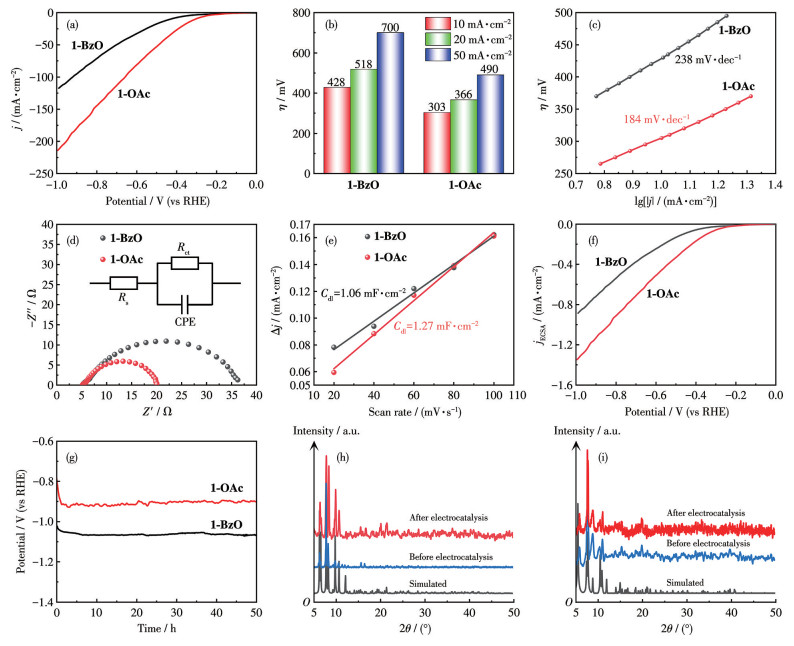
Inset: equivalent circuit diagram, where Rs is the solution resistance, Rct is the charge transfer resistance, and CPE is the constant phase element.
To gain deeper insight into the reaction kinetics of the two catalysts in a neutral electrolyte, Tafel curves were plotted according to the LSV curves. As shown in Fig. 4c, the 1-OAc catalyst exhibited a significantly lower Tafel slope of 184 mV·dec-1 compared to the 238 mV·dec-1 observed for 1-BzO. Furthermore, EIS was conducted to probe the charge-transfer dynamics at the catalyst-electrolyte interface (Fig. 4d). The Nyquist plots reveal that the Rct for 1-OAc was markedly smaller than that of 1-BzO (15.1 Ω vs 31.4 Ω), thereby facilitating a far superior electron-transfer rate during the electrocatalytic process.
To elucidate whether this enhanced activity originates from an increase in accessible active sites, the Cdl was evaluated (Fig. 4e and S6). The 1-OAc catalyst demonstrated a large Cdl value of 1.27 mF·cm-2. In comparison, 1-BzO exhibited a Cdl value of 1.06 mF·cm-2. Subsequently, the normalized active areas of the catalysts are also calculated, which were 26.50 and 31.75 cm-2 for 1-BzO and 1-OAc, respectively. Finally, to verify the intrinsic catalytic capability independent of surface area effects, the LSV curves were normalized against their respective electrochemical surface area (ECSA, Fig. 4f). The ECSA-normalized LSV curves definitively confirm that 1-OAc possesses inherently superior intrinsic activity toward neutral HER compared to its 1-BzO counterpart.
Beyond evaluating initial activity, long-term durability is a critical metric for practical electrocatalysts. CP measurements were conducted to assess the operational stability of both clusters (Fig. 4g). Remarkably, the 1-OAc catalyst exhibited no apparent degradation in HER performance over a continuous 50 h durability test at a constant current density of 10 mA·cm-2, verifying its exceptional robustness. The 1-BzO catalyst similarly maintained stable operation under identical conditions. Furthermore, post-catalytic PXRD patterns for both materials perfectly match their pristine states (Fig. 4h and 4i), unequivocally demonstrating that the structural and compositional integrity of both homometallic frameworks is preserved during prolonged electrocatalytic cycling.
Considering the crucial role of ligand hydrophilicity and steric hindrance in shaping the microenvironment around active sites, the acetate and methoxide ligands in 1-OAc offer greater hydrophilicity and smaller steric bulk compared to the benzoate and iPrO ligands in 1-BzO, and these two factors synergistically contribute to the superior HER performance of 1-OAc[43-44]. On the one hand, the more hydrophilic ligands facilitate the construction of a water-rich interfacial microenvironment around the active sites, promoting the transport and adsorption of water molecules toward the active centers under neutral conditions and thereby accelerating the water dissociation step in the Volmer process. On the other hand, the smaller steric profile of the methoxide minimizes the spatial shielding of the metal active centers, allowing reactive substrates to access the active sites more freely and reducing the steric barriers during adsorption. In contrast, the bulky phenyl-containing benzoate and branched iPrO- ligands in 1-BzO are inherently more hydrophobic and sterically demanding, simultaneously impeding water molecule transport and blocking access to the active centers, resulting in dual limitations in both mass transfer and adsorption. Consequently, 1-OAc exhibited a significantly lower overpotential and enhanced HER catalytic activity compared to 1-BzO.
In summary, we have successfully designed and synthesized two novel homometallic Anderson-type heptanuclear cobalt clusters, 1-BzO and 1-OAc, via a facile solvothermal approach. Despite possessing identical Co7 structural skeletons, the systematic substitution of peripheral ligands exerts a profound influence on their electrocatalytic behavior. Electrochemical evaluations reveal that 1-OAc exhibited significantly enhanced catalytic activity for the HER in neutral electrolyte, achieving a benchmark current density of 10 mA·cm-2 at a notably low overpotential of 303 mV, alongside a Tafel slope of 184 mV·dec-1. Furthermore, 1-OAc demonstrated excellent long-term durability, maintaining robust operation for over 50 h without structural or performance degradation. This work not only introduces a unique class of planar Anderson-type clusters but also provides crucial molecular-level insights into how ligand engineering can optimize the HER performance of transition metal clusters.
LIU Y, LIU P, CAI Y Y, ZHU M H, DOU N, ZHANG L, MEN Y L, PAN Y X. Platinum/(carbon-nanotube) electrocatalyst boosts hydrogen evolution reaction in acidic, neutral and alkaline solutions[J]. Small, 2025, 21(9): 2411181 doi: 10.1002/smll.202411181
CHEN J Y, ALIASGAR M, ZAMUDIO F B, ZHANG T Y, ZHAO Y L, LIAN X, WEN L, YANG H Z, SUN W P, KOZLOV S M. Diversity of platinum-sites at platinum/fullerene interface accelerates alkaline hydrogen evolution[J]. Nat. Commun., 2023, 14(1): 1711 doi: 10.1038/s41467-023-37404-0
ZHANG E H, HONG W, ZHOU X Y, GUO X X, XIE F F, WEI Y H, YAO S S, YANG D J, SUN J, LU Y. Electrolytic hydrogen production using platinum nanoparticles supported on bamboo-derived carbon with microcapsules for enhanced stability[J]. Appl. Surf. Sci., 2025: 164064
MASUBUCHI T, RUBLEV P, HAN Y L, PEREZ J P L, BOEBINGER M, HWANG S, SARAVANAN L, BELNAP D M, ALEXANDROVA A N, ANDERSON S L. Highly active hydrogen evolution reaction (HER) catalysts formed by energetic Ptn cluster deposition: Deposition dynamics and the HER mechanism[J]. J. Am. Chem. Soc., 2025, 147(52): 48192-48208 doi: 10.1021/jacs.5c16035
HE Q, ZHOU Y Z, MOU L H, WU C Q, LIU D B, GE B H, JIANG J, SONG L. Iron-doped ruthenium with a good interfacial environment achieving superior hydrogen evolution activity under alkaline conditions[J]. Energy Environ. Sci., 2025, 18(4): 1984-1991 doi: 10.1039/D4EE05356G
XIN Y M, HUA Q Q, LI C J, ZHU H D, GAO L G, REN X F, YANG P X, LIU A M. Enhancing electrochemical performance and corrosion resistance of nickel-based catalysts in seawater electrolysis: Focusing on OER and HER[J]. J. Mater. Chem. A, 2024, 12(35): 23147-23178 doi: 10.1039/D4TA03393K
QIAN G F, WANG Y P, LI L C, LU M S, CHEN C Z, MIN D Y, WEI Z X, TSIAKARAS P. Strategies for tuning tensile strain and localized electrons in a Mo-doped nicocu alloy for enhancing ampere-level current density HER performance[J]. Adv. Funct. Mater., 2024, 34(40): 2404055 doi: 10.1002/adfm.202404055
DUBEY S K, PAL S, BISWAS B, CHATTERJEE A, PATRA K, MONDAL R, PATRA A S, MAJEE M C, SAMANTA S, ROY P. Solvothermal synthesis of a Fe14 cluster with electrocatalytic HER activity under heterogenous condition[J]. Int. J. Hydrog. Energy, 2025, 136: 40-48 doi: 10.1016/j.ijhydene.2025.05.039
GAUTAM J, CHANDA D, MESHESHA M M, JANG S G, YANG B L. Heterointerface of vanadium telluride and zinc iron telluride nanosheets for highly efficient hydrogen production via water and urea electrolysis[J]. Chem. Eng. J., 2023, 467: 143535 doi: 10.1016/j.cej.2023.143535
XUE H Y, YANG T Q, ZHANG Z M, ZHANG Y X, GENG Z H, HE Y. Stimulate the hidden catalysis potential and exposure of nickel site in NiSe@CNTs result in ultra-high HER/OER activity and stability[J]. Appl. Catal. B‒Environ., 2023, 330: 122641 doi: 10.1016/j.apcatb.2023.122641
WEI Y H, HUANG H C, GAO F, JIANG G. 2d transitional-metal nickel compounds monolayer: Highly efficient multifunctional electrocatalysts for the HER, OER and ORR[J]. Int. J. Hydrog. Energy, 2023, 48(11): 4242-4252 doi: 10.1016/j.ijhydene.2022.10.250
申晴晴, 杜向博文, 钱凯成, 金智康, 方政, 韦童, 李仁宏. 自支撑Cu/α-FeOOH/泡沫镍复合催化剂氧化甲醇耦合电解水高效制氢[J]. 无机化学学报, 2024, 40(10): 1953-1964SHEN Q Q, DU-XIANG B W, QIAN K C, JIN Z K, FANG Z, WEI T, LI R H. Self-supported Cu/α-FeOOH/nickel foam composite catalyst for efficient hydrogen production by methanol oxidation coupled with water electrolysis[J]. Chinese J. Inorg. Chem., 2024, 40(10): 1953-1964
曾传旺, 李潇潇, 曾金明, 刘超, 赖嘉俊, 漆小鹏. 氧空位和磷掺杂协同增强铁钴基材料电解水催化性能[J]. 无机化学学报, 2023, 39(2): 202-210ZENG C W, LI X X, ZENG J M, LIU C, LAI J J, QI X P. Synergistic enhancement of electrocatalytic water splitting performance of iron-cobalt-based materials by oxygen vacancies and phosphorus doping[J]. Chinese J. Inorg. Chem., 2023, 39(2): 202-210
MUHYUDDIN M, PIANTA N, TRINDELL J A, RUFFO R, SANTORO C, KOPER M T. Cation effects on the hydrogen evolution reaction by catalysts based on cobalt complexes in alkaline electrolytes[J]. Electrochim. Acta, 2025: 146684
ZHANG J T, CHENG C Q, XIAO L Y, HAN C Y, ZHAO X R, YIN P F, DONG C K, LIU H, DU X W, YANG J. Construction of Co-Se-W at interfaces of phase-mixed cobalt selenide via spontaneous phase transition for platinum-like hydrogen evolution activity and long-term durability in alkaline and acidic media[J]. Adv. Mater., 2024, 36(28): 2401880 doi: 10.1002/adma.202401880
MACDONELL A, JOHNSON N A, SURMAN A J, CRONIN L. Configurable nanosized metal oxide oligomers via precise "click" coupling control of hybrid polyoxometalates[J]. J. Am. Chem. Soc., 2015, 137(17): 5662-5665 doi: 10.1021/jacs.5b02466
ANDERSON J S. Constitution of the poly-acids[J]. Nature, 1937, 140(3550): 850-850
EVANS H T. The crystal structures of ammonium and potassium molybdotellurates[J]. J. Am. Chem. Soc., 1948, 70(3): 1291-1292 doi: 10.1021/ja01183a521
BLAZEVIC A, ROMPEL A. The Anderson-Evans polyoxometalate: From inorganic building blocks via hybrid organic-inorganic structures to tomorrows "bio-pom"[J]. Coord. Chem. Rev., 2016, 307: 42-64 doi: 10.1016/j.ccr.2015.07.001
WEI N X, XU W B, LI S J, SHI J Y. Sustainable depolymerization of lignin into aromatic compounds using amphiphilic Anderson-type polyoxometalate catalysts[J]. Int. J. Biol. Macromol., 2024, 277: 133257 doi: 10.1016/j.ijbiomac.2024.133257
LIU Q, CHEN Z H Y, SHABBIR H, DUAN J D, BI W T, LU Z Y, SCHWEITZER N, ALAYOGLU S, GOSWAMI S, CHAPMAN K W. Presentation of gas-phase-reactant-accessible single-rhodium-atom catalysts for CO oxidation, via MOF confinement of an Anderson polyoxometalate[J]. J. Mater. Chem. A, 2022, 10(35): 18226-18234 doi: 10.1039/D2TA03975C
LIU Q, SU T, ZHANG H W, LIAO W P, REN W Z, ZHU Z G, YANG K X, LEN C, YU J, ZHAO D Y. Development of TiO2 catalyst based on Anderson-polyoxometalates for efficient visible-light-driven photocatalytic oxidative desulfurization[J]. Fuel, 2023, 333: 126286 doi: 10.1016/j.fuel.2022.126286
李梦洋, 徐昊, 牛中豪, 宫春华, 钟为慧, 谢景力. 含甲基紫精单元的多酸杂化材料对β-氨基醇的高效催化合成[J]. 无机化学学报, 2025, 41(7): 1294-1300LI M Y, XU H, NIU Z H, GONG C H, ZHONG W H, XIE J L. Efficient catalytic synthesis of β-amino alcohols by polyoxometalate hybrid materials containing methyl viologen units[J]. Chinese J. Inorg. Chem., 2025, 41(7): 1294-1300
TONG N, WANG X, ZHAO X Y, ZHANG W, ZHU Y S. Construction of anderson-type polyoxometalate-based complexes involving in situ ligand transformation with capacitive and electrochemical sensing performances[J]. Inorg. Chim. Acta, 2024, 562: 121901 doi: 10.1016/j.ica.2023.121901
ZHANG Y C, CHEN Y Z, CHANG Z H, LIU Q Q, WANG X L. Metal-directed two new Anderson-type polyoxometalate-based metal-organic complexes with different electrocatalytic sensing performance[J]. Polyhedron, 2022, 221: 115874 doi: 10.1016/j.poly.2022.115874
SUN F Z, YANG Y H, LIU T, YANG M L, YING J. Three Anderson-type polyoxometalate-based compounds with dual functions of supercapacitors and trace Cr(Ⅵ)-sensitive detection[J]. J. Mol. Struct., 2025: 143122
应俊, 张宝月, 田爱香. 三核和四核金属-有机簇修饰的四个多酸化合物的结构、选择性光催化和汞离子传感性能[J]. 无机化学学报, 2020, 36(10): 1831-1844YING J, ZHANG B Y, TIAN A X. Structures, selective photocatalysis and mercury ion sensing properties of four polyoxometalate compounds modified by trinuclear and tetranuclear metal-organic clusters[J]. Chinese J. Inorg. Chem., 2020, 36(10): 1831-1844
LENTINK S, SALAZAR MARCANO D E, MOUSSAWI M A, PARAC-VOGT T N. Exploiting interactions between polyoxometalates and proteins for applications in (bio)chemistry and medicine[J]. Angew. Chem.‒Int. Edit., 2023, 135(31): e202303817 doi: 10.1002/ange.202303817
YU H, HONISCH C, CAMMELLI F, FRIGO M, RUZZA P, COCETTA V, MONTOPOLI M, BONCHIO M, CARRARO M. Polyoxometalates-peptides conjugates for cancer cell targeting: A structural investigation[C]//CDCO2023-XLI Convegno Nazionale della Divisione di Chimica Organica della Società Chimica Italiana. [S. l.]: [s. n.] 2023: 165
AHMADI M, SADEGHI F, SOLTANABADI A, SADEGHI-ALIABADI H, ROSTAMI M. Multifunctional estrone-polyoxometalate-F16 hybrid conjugate: A synergistic targeting approach against breast cancer cells[J]. ACS Appl. Bio Mater., 2025, 8(10): 8940-8958 doi: 10.1021/acsabm.5c01114
杨勇. 包封多酸化合物的固体脂质纳米粒的合成及生物活性研究[J]. 无机化学学报, 2006, 22(3): 507-510YANG Y. Synthesis and biological activity of solid lipid nanoparticles encapsulating polyoxometalate compounds[J]. Chinese J. Inorg. Chem., 2006, 22(3): 507-510
WU P F, WANG Y, HUANG B, XIAO Z C. Anderson-type polyoxometalates: From structures to functions[J]. Nanoscale, 2021, 13(15): 7119-7133 doi: 10.1039/D1NR00397F
LIN Y J, ZENG Q X, SHEN X M, ZHENG S T, LI X X. Construction of metal cluster-based materials directed by a bifunctional pyridyl tripodal alcohol ligand according to hard and soft acid-base theory[J]. Chin. J. Struct. Chem., 2025, 44(10): 100702
QIN B W, HUANG K C, ZHANG Y, ZHOU L, CUI Z, ZHANG K, ZHANG X Y, ZHANG J P. Diverse structures based on a heptanuclear cobalt cluster with 0D to 3D metal-organic frameworks: Magnetism and application in batteries[J]. Chem. Eur. J., 2018, 24(8): 1962-1970 doi: 10.1002/chem.201705023
MENOZZI D, BIAVARDI E, MASSERA C, SCHMIDTCHEN F P, CORNIA A, DALCANALE E. Thermodynamics of host-guest interactions between methylpyridinium salts and phosphonate cavitands[J]. Supramol. Chem., 2010, 22(11/12): 768-775
SHELDRICK G M. Crystal structure refinement with SHELXL[J]. Acta Crystallogr. Sect. C, 2015, C71(1): 3-8
SHELDRICK G M. A short history of SHELX[J]. Acta Crystallogr. Sect. A, 2008, A64(1): 112-122
KOGA T, HARA T. The oxidation of acetylacetone in the presence of cobaltous ions[J]. Bull. Chem. Soc. Jpn., 1966, 39(4): 664-672 doi: 10.1246/bcsj.39.664
YANG Q, SHENG M, LI X Y, TUCKER C, CÉSPEDES S V, WEBB N J, WHITEKER G T, YU J. Potential explosion hazards associated with the autocatalytic thermal decomposition of dimethyl sulfoxide and its mixtures[J]. Org. Process Res. Dev., 2020, 24(6): 916-939 doi: 10.1021/acs.oprd.0c00159
BROWN I T, SHANNON R. Empirical bond-strength-bond-length curves for oxides[J]. Acta Crystallogr. Sect. A, 1973, A29(3): 266-282
CHATTERJEE A, MONDAL P, CHAKRABORTY P, MANDAL S, RIZZOLI C, GÓMEZ-GARCÍA C J, ADHIKARY B, SENAPATI D, DEY S K. Unveiling synergistic effectiveness of strategically designed cobalt clusters for efficient water electrolysis[J]. ACS Catal., 2025, 15(3): 2472-2483 doi: 10.1021/acscatal.4c06466
ZHOU Y Q, ZHANG L F, SUO H L, HUA W B, INDRIS S, LEI Y J, LAI W H, WANG Y X, HU Z, LIU H K. Atomic cobalt vacancy-cluster enabling optimized electronic structure for efficient water splitting[J]. Adv. Funct. Mater., 2021, 31(26): 2101797 doi: 10.1002/adfm.202101797
KONG X D, ZHU J C, XU Z F, GENG Z G. Fundamentals and challenges of ligand modification in heterogeneous electrocatalysis[J]. Angew. Chem., 2025, 137(1): e202417562 doi: 10.1002/ange.202417562
ZHOU Z, PEI Z X, WEI L, ZHAO S L, JIAN X, CHEN Y. Electrocatalytic hydrogen evolution under neutral pH conditions: Current understandings, recent advances, and future prospects[J]. Energy Environ. Sci., 2020, 13(10): 3185-3206 doi: 10.1039/D0EE01856B

Figure 1 Crystal morphology and schematic synthesis process of 1-BzO and 1-OAc under an optical microscope

Figure 2 1-BzO: (a) 0D structure; (b) mononuclear cobalt ion coordinated by an acac- group; (c) Anderson-type cobalt cluster; (d) 1D, (e) 2D, and (f) 3D structures

Figure 4 (a) LSV curves, (b) overpotentials, (c) Tafel slopes, (d) EIS, (e) Cdl fitting curves, (f) LSV curves normalized by ECSA, and (g) CP curves of 1-BzO and 1-OAc; PXRD patterns of (h) 1-BzO and (i) 1-OAc before and after electrocatalysis
Inset: equivalent circuit diagram, where Rs is the solution resistance, Rct is the charge transfer resistance, and CPE is the constant phase element.

 扫一扫看文章


扫一扫关注我们
 下载:
 下载:

 下载: