Table 1.
Selected crystallographic data for complexes 1 and 2


The rational design of titanium dioxide (TiO2)-based photocatalysts is a research interest in the field of energy and environmental catalysis[1-3]. Doping TiO2 with transition metals can not only modify its band structure and expand the spectral absorption range, but also introduce transition metals as active sites for photocatalysis, thereby enhancing the photocatalytic performance of TiO2 materials[4-7]. However, these transition-metal-ion-doped TiO2 materials have defects in imprecise structural information at the atomic level, such as uneven sizes, unclear inorganic-organic interface information, and uncertain surface composition. These defects may greatly limit the deeper research on such promising photocatalytic materials, particularly in terms of elucidating the catalytic reaction mechanisms, performing rational surface and interface modification, and establishing the structure-activity relationships[8-9].
Crystalline heterometallic titanium clusters (TCs) with well-defined structural information have attracted great attention in recent years[10-16]. Due to their precise atomic positional information, clear ligand-cluster core binding modes, and tunable cluster core sizes, TCs can serve as ideal structural and reactivity models for in-depth investigations of TiO2-based materials. The advantage of atomically precise structural information can not only facilitate the elucidation of their structure-activity relationships but also offer the possibility for expanding their functional applications[10, 17-20]. Moreover, TCs exhibit good photocatalytic properties such as photocatalytic degradation and photocatalytic decomposition of water[21]. To date, a great number of heterometallic TCs have been synthesized and investigated. As is well known, the divalent Mn2+ ions can act as the active centers for photocatalysis and are readily oxidized to trivalent Mn3+ species during the photocatalytic process, thus facilitating the electron transfer required for the photocatalytic reduction reaction. To date, a variety of heterometallic Mn/Ti clusters have been reported, while the research on the application of heterometallic Mn/Ti clusters in the photocatalytic CO2 reduction reactions (CO2RR) remains scarce[22-27]. In a rare case, Zhang et al reported a Ti4Mn3-cluster which showed high efficiency for the photocatalytic conversion of CO2 into CO, and also revealed that the undercoordinated active Mn sites can not only decrease the energy barrier but also possess a moderate adsorption strength of CO*, leading to the accelerated charge separation kinetics and enhanced CO2 photoreduction activity[28]. Then, aiming for high efficiency of TCs for photocatalytic CO2RR, it is worthy to design and synthesizing heterometallic Mn/Ti clusters, especially in which the Mn sites are promised to be undercoordinated or weakly coordinated by solvent molecules. This is because the easy formation of unsaturated coordinated Mn centers is conducive to the enhancement of photocatalytic efficiency.
Based on the aforementioned background, salicylic acid (H2Sal) was chosen as the ligand for the construction of TCs. H2Sal is a moderately strong acid with appropriate steric hindrance, which has been demonstrated to be a promising ligand for the fabrication of TCs. Meanwhile, Ti(OiPr)4 was employed as the titanium source, and Mn(CH3COO)2·4H2O was utilized as the precursor for introducing Mn2+ ions. Here we have successfully synthesized two heterometallic salicylate Mn/Ti clusters formulated as [Ti3Mn2(Sal)8(Phen)(CH3CN)(H2O)] (1) and [Ti4Mn4(Sal)12(CH3CN)2]·(CH3CN)4 (2). The crystal structures of the samples were determined by single-crystal X-ray diffraction, while their phase purities were characterized via powder X-ray diffraction (PXRD). Furthermore, the CO2RR performance of the prepared samples was systematically investigated.
All chemical reagents employed are of analytical reagent (AR) grade and utilized without further purification. Fourier-transform infrared (FTIR) spectra were recorded on a Perkin-Elmer Spectrum 100 spectrometer. PXRD analyses were carried out at ambient temperature on a Rigaku D/Max-2500 diffractometer with Cu Kα radiation (λ=0.154 2 nm), covering a 2θ range of 5° to 50°, and the X-ray tube was operated at a voltage of 40 kV and a current of 100 mA. Solid-state UV-visible diffuse reflectance spectra (UV-Vis DRS) were acquired using a TU-1901 spectrophotometer over a scanning wavelength range of 250-800 nm.
First, a mixture of Mn(CH3COO)2·4H2O (0.3 mmol, 0.074 g), H2Sal (1.5 mmol, 0.207 g), Phen (0.20 mmol, 0.090 g), and acetonitrile (8 mL) was placed in a 15 mL Teflon liner. The above mixture was stirred for 10 min, then Ti(OiPr)4 (0.67 mmol, 0.2 mL) was added dropwise to the above mixture. Finally, the Teflon liner was heated to 120 ℃ and held for 72 h. After cooling to room temperature, red crystals were obtained and then washed thoroughly with acetonitrile. The yield (0.170 g) was 48% based on Ti(OiPr)4. Elemental analysis Calcd. (Found) for C70H45Mn2N3O25Ti3(%): C, 53.16 (53.11); H, 2.87 (2.94); N, 2.66 (2.49). IR (KBr, pellet, cm-1): 3 412(m), 3 066 (w), 1 601 (s), 1 586 (s), 1 550(s), 1 459 (s), 1 364(s), 1 234 (s), 1 143 (s), 1 033 (m), 893 (m), 841 (s), 760(m), 678 (m).
First, a mixture of Mn(CH3COO)2·4H2O (0.3 mmol, 0.074 g), H2Sal (1.5 mmol, 0.207 g), and acetonitrile (8 mL) was placed in a 15 mL Teflon liner. The above mixture was stirred for 10 min, then Ti(OiPr)4 (0.67 mmol, 0.2 mL) was added dropwise to the above mixture. Finally, the Teflon liner was heated to 120 ℃ and held for 72 h. After cooling to room temperature, red crystals were obtained and then washed thoroughly with acetonitrile. The yield (0.098 g) was 57% based on Mn(CH3COO)2·4H2O. Elemental analysis Calcd. (Found) for C96H66Mn4N6O36Ti4(%): C, 50.33 (50.25); H, 2.90 (2.78); N, 3.67 (3.72). IR (KBr, pellet, cm-1): 3 067 (w), 2 928 (w), 1 625 (w), 1 601 (s), 1 546 (s), 1 642 (s), 1 361 (s), 1 237 (s), 1 146 (s), 1 033 (m), 893 (m), 848(s), 760 (m), 675 (m).
Single-crystal X-ray diffraction data for complexes 1 and 2 were collected on a Bruker APEX Ⅱ CCD diffractometer, with the radiation source being graphite-monochromatized Mo Kα radiation (λ=0.071 073 nm), and the data collection strategy employing multi-scan techniques. The crystal structures were solved via direct methods and subsequently refined using the full-matrix least-squares method, with all calculations performed with the SHELXTL-2014 software package. Anisotropic refinement was applied to all non-hydrogen atoms, whereas H atoms were generated geometrically, fixed at idealized positions bonded to the parent atoms, and assigned fixed isotropic thermal parameters. The presence of disordered C atoms in the butyl substituents led to the appearance of several relatively large residual electron density peaks in the vicinity of these C atoms within the crystal structures. Key crystallographic parameters, along with selected bond lengths and bond angles, are summarized in Table 1 and 2, respectively.
 下载:
导出CSV
下载:
导出CSV
| Parameter | 1 | 2 |
| Formula | C70H45Mn2N3O25Ti3 | C96H66Mn4N6O36Ti4 |
| Formula weight | 1 581.67 | 2 290.90 |
| T / K | 293 | 293 |
| Crystal system | Triclinic | Monoclinic |
| Space group | P1 | C2/c |
| a / nm | 1.273 17(9) | 2.068 3(10) |
| b / nm | 1.489 77(10) | 1.468 5(7) |
| c / nm | 1.897 07(14) | 3.191 9(14) |
| α / (°) | 99.182(4) | |
| β / (°) | 93.280(4) | 97.407(8) |
| γ / (°) | 109.447(4) | |
| V / nm3 | 3.325 9(4) | 9.614(8) |
| Z | 2 | 4 |
| Dc / (g·cm-3) | 1.579 | 1.583 |
| μ / mm-1 | 0.801 | 0.913 |
| F(000) | 1 604.0 | 4 640.0 |
| Collected reflection | 128 548 | 36 896 |
| Rint | 20 507(0.071 0) | 12 923(0.034 5) |
| Completeness / % | 99.9 | 99.5 |
| GOF on F 2 | 1.054 | 1.046 |
| R1a, wR2b [I > 2(I)] | 0.044 7, 0.119 8 | 0.045 8, 0.118 1 |
| R1a, wR2b (all data) | 0.066 2, 0.132 4 | 0.075 8, 0.135 4 |
| a R1=∑||Fo|-|Fc||/∑|Fo|; b wR2={∑[w(Fo2-Fc2)2]/∑[w(Fo2)2]}1/2. | ||
下载:
导出CSV
| 1 | |||||
| Ti1—O7 | 0.203 56(15) | Ti2—O16 | 0.182 29(15) | Mn1—O13 | 0.213 00(16) |
| Ti1—O8 | 0.185 15(17) | Ti2—O17 | 0.183 31(15) | Mn1—O21 | 0.226 54(17) |
| Ti1—O9 | 0.186 30(18) | Ti3—O1 | 0.201 93(14) | Mn2—N1 | 0.229 15(18) |
| Ti1—O10 | 0.186 64(16) | Ti3—O2 | 0.187 47(14) | Mn2—N2 | 0.232 3(2) |
| Ti1—O11 | 0.202 67(17) | Ti3—O3 | 0.184 47(15) | Mn2—O20 | 0.212 28(16) |
| Ti2—O14 | 0.201 99(15) | Mn1—N3 | 0.221 5(2) | Mn2—O22 | 0.213 93(16) |
| Ti2—O15 | 0.197 02(14) | Mn1—O6 | 0.240 47(14) | Mn2—O23 | 0.211 47(15) |
| O8—Ti1—O7 | 84.09(7) | O15—Ti2—O19 | 83.38(6) | O13—Mn1—O6 | 142.00(6) |
| O8—Ti1—O9 | 97.57(8) | O16—Ti2—O17 | 103.42(7) | O25—Mn1—O21 | 94.37(6) |
| O8—Ti1—O10 | 92.92(8) | O1—Ti3—O5 | 81.37(6) | N1—Mn2—N2 | 72.17(7) |
| O8—Ti1—O11 | 96.17(8) | O2—Ti3—O6 | 96.34(6) | O20—Mn2—O22 | 97.45(7) |
| O14—Ti2—O19 | 85.28(6) | O3—Ti3—O4 | 94.42(8) | O22—Mn2—N1 | 86.60(7) |
| O15—Ti2—O14 | 86.62(6) | N3—Mn1—O6 | 95.16(8) | O22—Mn2—N2 | 158.42(6) |
| O15—Ti2—O18 | 89.30(6) | O13—Mn1—N3 | 91.24(7) | O23—Mn2—O22 | 96.76(6) |
| 2 | |||||
| Ti1—O1 | 0.184 50(19) | Ti2—O5 | 0.202 4(2) | Mn1—O9 | 0.216 28(19) |
| Ti1—O2 | 0.210 3(2) | Ti2—O6 | 0.185 8(2) | Mn2—N1 | 0.224 9(3) |
| Ti1—O10 | 0.198 14(19) | Ti2—O7 | 0.184 7(2) | Mn2—O3i | 0.213 3(2) |
| Ti1—O14 | 0.194 89(18) | Ti2—O8 | 0.207 63(18) | Mn2—O4i | 0.223 9(2) |
| Ti1—O15 | 0.184 9(2) | Mn1—O2 | 0.216 40(19) | Mn2—O13 | 0.209 1(2) |
| Ti1—O18 | 0.198 47(18) | Mn1—O8 | 0.239 62(19) | Mn2—O17 | 0.210 31(19) |
| O1—Ti1—O2 | 82.99(7) | O6—Ti2—O11 | 95.98(8) | O9—Mn1—O16i | 96.36(7) |
| O1—Ti1—O10 | 90.50(8) | O6—Ti2—O12 | 97.29(9) | N1—Mn2—O5i | 87.66(10) |
| O1—Ti1—O14 | 93.19(8) | O7—Ti2—O5 | 94.35(10) | O3A—Mn2—O4i | 94.91(8) |
| O1—Ti1—O15 | 100.56(8) | O2—Mn1—O8 | 102.55(6) | O13—Mn2—O17 | 94.60(8) |
| O5—Ti2—O8 | 84.08(7) | O2—Mn1—O16i | 103.25(6) | O17—Mn2—N1 | 83.36(10) |
| O6—Ti2—O5 | 84.60(9) | O2—Mn1—O18 | 68.43(6) | O13—Mn2—O4i | 96.66(8) |
| Symmetry code: ⅰ -x+1, y, -z+3/2 for complex 2. | |||||
Electrochemical measurements were implemented on a CHI 660E electrochemical workstation based on a standard three-electrode configuration under ambient conditions. For electrode preparation, 5 mg of the thoroughly ground sample was uniformly coated onto an indium tin oxide (ITO) glass slide, which served as the working electrode[17]. A platinum plate was used as the auxiliary electrode, while an Ag/AgCl electrode acted as the reference electrode. A 0.2 mol·L-1 aqueous solution of sodium sulfate (Na2SO4) was selected as the electrolyte. Electrochemical impedance spectroscopy (EIS) measurements were conducted on complexes 1 and 2 using a standard three-electrode photoelectrochemical cell under a bias potential of 0.2 V, and the frequency was set in the range of 10-2 to 105 Hz. Photocurrent measurements were conducted with a 300 W xenon lamp as the full-spectrum light source, positioned 20 cm away from the surface of the ITO electrode. Throughout the photocurrent tests, an applied potential of 0.25 V was maintained, and the light irradiation was switched on and off at 10 s intervals.
The photocatalytic reduction of CO2 was carried out in a sealed gas-circulation system manufactured by Aulight Co. A total of 20 mg of the photocatalyst was dispersed into a mixed solvent consisting of 10 mL H2O and 40 mL N,N-dimethylformamide, with the addition of 5 mL triethanolamine (TEOA) serving as the electron donor and 20 mg [Ru(bpy)3]Cl2·6H2O as photosensitizer. The reaction temperature was stabilized at 280 K via a circulating cooling water system. Following complete dispersion of the photocatalyst in the solution, the resulting suspension was subjected to irradiation under a 300 W xenon lamp. The gaseous products (CO and CH4) generated during the photocatalytic reaction were analyzed in real time using an online gas chromatograph (GC-7920A, Aulight Co.), which was equipped with a TDX-01 column, a flame ionization detector (FID), and nitrogen as the carrier gas.
Single-crystal X-ray diffraction analysis reveals that complex 1 crystallizes in the triclinic system, space group P1. There are three Ti4+ ions, two Mn2+ ions, eight Sal2- anions, one Phen molecule, one CH3CN molecule, and one H2O molecule in an asymmetric unit (Fig. 1a). All the Sal2- anions present μ2-η1∶η1∶η1 coordination mode. All the Ti4+ ions show the same octahedral [TiO6] coordination environments, and the coordinated O atoms are from the ligand salicylates. Interestingly, the two Mn2+ ions adopt different coordinated modes. The atom Mn1 presents a pentagonal bipyramid of [MnO6N] coordination environments in which one O atom is from the coordinated water molecule and the N atom is from acetonitrile. However, Mn2 shows a six-coordinated mode of [MnO4N2] in which the four coordinated O atoms are from ligand Sal2- anions, and the two N atoms are from one ligand Phen. The average bond length of Ti—O is 0.194 5 nm. While the average bond lengths of Mn—O and Mn—N are 0.218 8 and 0.227 7 nm, respectively. The bond lengths of Ti—O, Mn—O, and Mn—N are consistent with those in the literature[28-29]. Ti1, Ti3, Mn1, and Mn2 are linked via a vertex-sharing mode. While the atom Ti2 is not directly connected to the above four metal atoms via vertex-sharing or edge- sharing mode (Fig. 1b), the packing structure is demonstrated in Fig. 1c. Notably, the coordinated molecular CH3CN of Mn1 may be easily left when facing other strongly coordinated molecules due to its weak bond[28, 30].
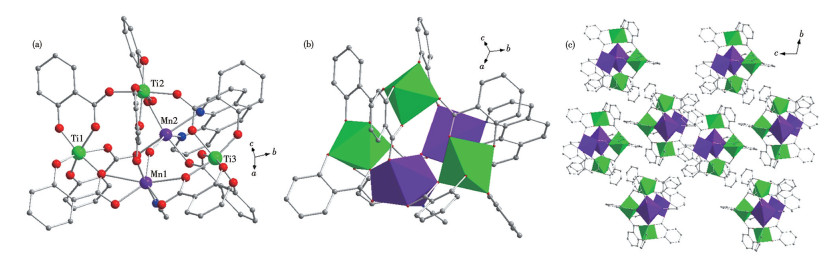
Atomic code: green, Ti; pink, Mn; red, O; blue, N; grey, C. Other atoms are omitted for clarity.
Single-crystal X-ray diffraction analysis reveals that complex 2 crystallizes in the monoclinic system, space group C2/c. There are four Ti4+ ions, four Mn2+ ions, twelve Sal2- anions, two coordinated CH3CN molecules, and four free solvent acetonitrile molecules in the structure (Fig. 2a). Complex 2 exhibits central symmetry. Similar to 1, all the Sal2- anions in 2 present μ2-η1∶η1∶η1 coordination mode. As well, all the Ti4+ ions show the same octahedral [TiO6] coordination environments, and the coordinated oxygen atoms are from ligand Sal2- anions. The four Mn2+ ions adopt different coordinated modes. Mn1 and Mn1A present octahedral [MnO6] coordination environments in which the O atoms are from ligand Sal2- anions. However, Mn2 and Mn2A show a six-coordinated mode of [MnO5N] in which the five coordinated O atoms are from ligand Sal2- anions, and the N atom is from one ligand CH3CN. The average bond length of Ti—O is 0.195 1 nm. While the average bond lengths of Mn—O and Mn—N are 0.219 3 and 0.224 9 nm, respectively, which are consistent with those in 1. Ti1, Mn1, Ti1A, and Mn1A are linked via edge-sharing modes. While the atoms Mn2A and Ti2, Ti2 and Mn1 are connected via a vertex-sharing mode, respectively (Fig. 2b). The packing structure is demonstrated in Fig. 2c. Compared to 1, in the structure of 2, the Mn2 and Mn2A are coordinated by CH3CN, which should also easily leave when facing other strongly coordinated molecules due to its weak bond.
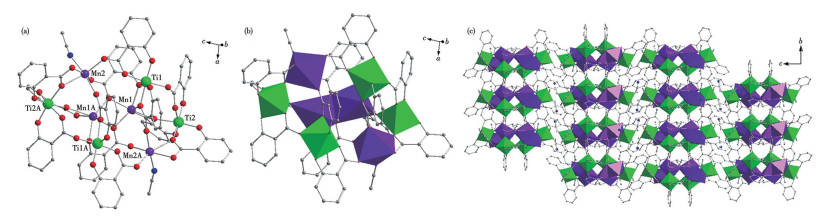
Atomic code: green, Ti; pink, Mn; red, O; blue, N; grey, C. Other atoms are omitted for clarification.
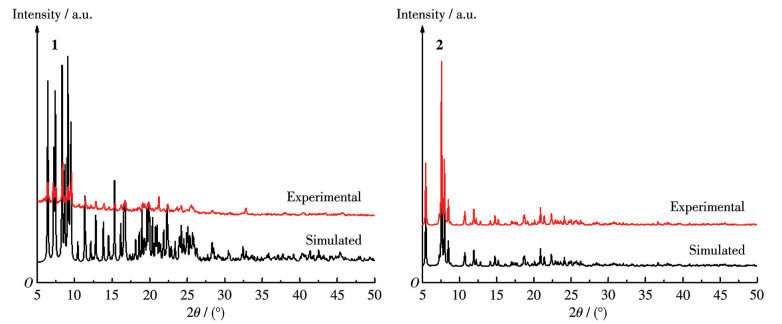
It is crucial to verify the phase purity of complexes 1 and 2, which thus prompted the performance of PXRD measurements under ambient temperature conditions. As illustrated in Fig. 3, the experimentally obtained PXRD patterns exhibited a high degree of consistency with the simulated patterns derived from single-crystal X-ray diffraction data, thereby validating the phase purity of both complexes 1 and 2. It should be pointed out that the observed discrepancy in peak intensity between the simulated and experimental patterns is primarily attributable to the particle size distribution of the powder samples and the randomness of crystal orientation during the PXRD analysis process[17].
Light absorption capacity and band gap energy are crucial parameters governing the performance of photocatalysts. In the present work, UV-Vis DRS measurements were performed on complexes 1 and 2 in the solid state at ambient temperature. As illustrated in Fig. 4a and 4b, both complexes 1 and 2 exhibited UV absorption in the wavelength range of 250-600 nm. This absorption phenomenon can be attributed to the combined contributions of aromatic ligands, titanium cores, and the incorporated Mn2+ ions. According to Fig. 4c and 4d, the optical band gaps of complexes 1 and 2 were calculated to be 1.93 and 2.15 eV, respectively, using the Kubelka-Munk function[31]. This result confirms that both complexes possess semiconductor-like behaviors. Notably, the band gaps of complexes 1 and 2 were significantly narrower than that of TiO2 (3.2 eV), which is presumably due to the introduction of dye-functionalized ligands and foreign metal ions.
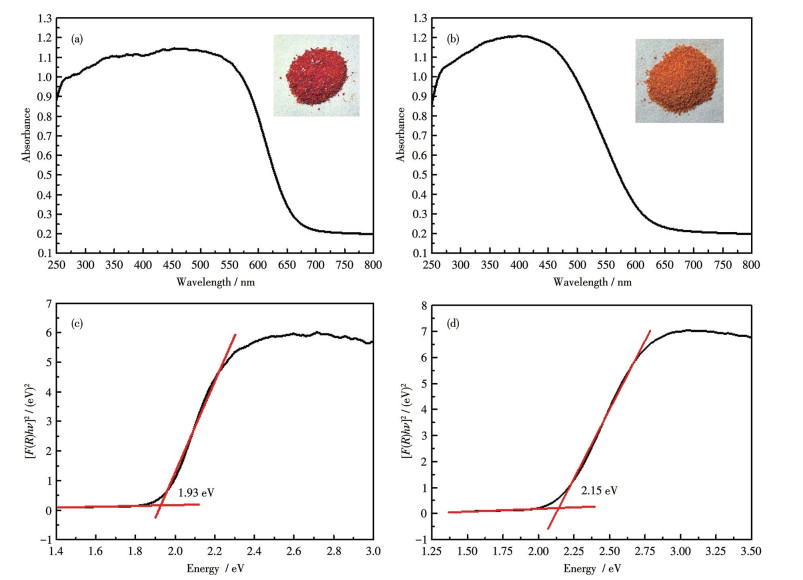
Inset: the morphologies and colors of 1 and 2.
The as-prepared complexes 1 and 2 are semiconductor materials with promising photoelectric properties that are worthy to be investigated. As illustrated in Fig. 5a, the on-off illumination cycles of the photocurrent responses for complexes 1 and 2 revealed rapid generation and decay of photocurrents, with the corresponding photocurrent densities of 0.305 and 0.367 μA·cm-2, respectively. The EIS results demonstrated that the two complexes exhibited nearly identical charge transfer resistances (Fig. 5b), which can be attributed to their analogous ligand configurations. Mott-Schottky measurements were carried out at frequencies of 300, 500, and 1 000 Hz. As presented in Fig. 5c and 5d, the lowest unoccupied molecular orbital (LUMO) energies of complexes 1 and 2 were determined to be -0.83 and -0.73 eV, respectively. Combining the determined band gap values with the LUMO, the highest occupied molecular orbital (HOMO) energies were determined to be 1.10 and 1.42 eV for 1 and 2, respectively. Notably, the LUMO positions of both complexes are more negative than the potential thresholds required for the reduction of CO2 to various carbonaceous products, which indicates that complexes 1 and 2 hold great potential as photocatalysts for CO2RR.
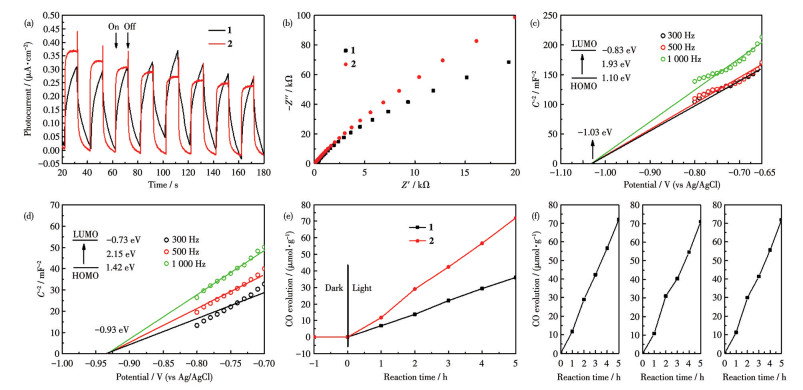
Both complexes 1 and 2 were employed as photocatalysts for the CO2RR under UV-Vis light irradiation. As illustrated in Fig. 5e, both complexes exhibited evident photocatalytic activity toward CO2RR, with CO being the sole gaseous product. Specifically, the CO evolution rates of complexes 1 and 2 were determined to be 7.21 and 14.39 μmol·g-1·h-1, respectively. No other gaseous by-products were detected in the gas phase, demonstrating the high selectivity of complexes 1 and 2 for CO generation during photocatalytic CO2RR. The higher CO2RR activity of 2 than 1 should be ascribed to the more active sites of Mn ions, especially those Mn ions coordinated by CH3CN, which could easily leave during CO2RR progress. Given that complexes 1 and 2 share the identical multidentate Sal2- ligand, they are expected to exhibit comparable photocatalytic stability. Thus, complex 2 was selected as a representative to evaluate the photocatalytic stability. As illustrated in Fig. 5f, complex 2 demonstrated excellent photocatalytic stability, enabling reuse for at least three consecutive cycles without significant degradation in catalytic activity. This stability is primarily attributed to the robust structural integrity afforded by the protective multidentate Sal2- anions ligands within the complex framework.
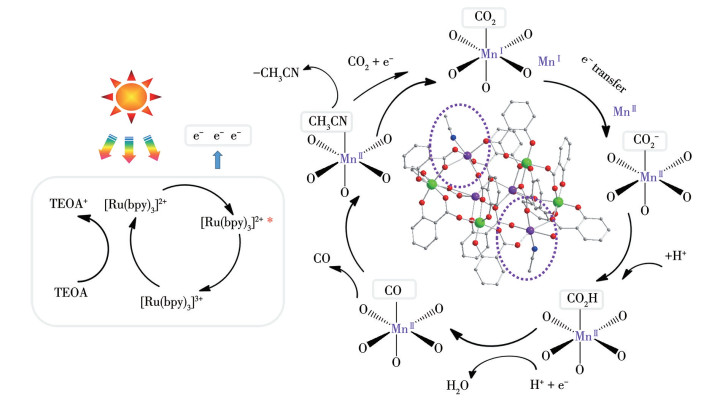
Based on the photoelectric property analyses of complexes 1 and 2, combined with the literature-reported photocatalytic CO2RR mechanisms of analogous clusters[28, 30], a plausible CO2RR mechanism for complexes 1 and 2 is proposed herein (Fig. 6). Upon visible light irradiation, the excited photosensitizer [Ru(bpy)3]2+ produces photogenerated electrons, which are subsequently transferred to the Mn active sites. With the dissociation of the coordinated CH3CN ligand, CO2 molecules are adsorbed onto the exposed Mn active centers, where they accept an electron to form the *CO2- intermediate. This intermediate then undergoes protonation to yield the *COOH species, which is further converted to CO with the assistance of additional protons and electrons from the reaction system. Finally, the oxidized photosensitizer [Ru(bpy)3]3+ is reductively quenched by TEOA, thereby completing the entire photocatalytic CO2RR cycle.
In summary, two heterometallic Mn/Ti TCs have been successfully fabricated via a straightforward and universal synthetic strategy, which is anticipated to enrich the structural diversity and quantity of TCs-based materials. Both complexes exhibited characteristic absorption bands of transition metal ions in the visible light region. Furthermore, complexes 1 and 2 possess photocatalytic CO2RR activity, with prominent selectivity toward CO as the target product. This work is not only conducive to advancing the synthetic research on TCs but also lays a foundation for the exploration of TCs as promising photocatalysts for CO2RR.
FUJISHIMA A, HONDA K. Electrochemical photolysis of water at a semiconductor electrode[J]. Nature, 1972, 238(5358): 37-38 doi: 10.1038/238037a0
WANG J Q, WANG Z H, WANG W, WANG Y, HU X L, LIU J X, GONG X Z, MIAO W L, DING L L, LI X B, TANG J G. Synthesis, modification and application of titanium dioxide nanoparticles: A review[J]. Nanoscale, 2022, 14(18): 6709-6734 doi: 10.1039/D1NR08349J
GUPTA S M. TRIPATHI M. A review of TiO2 nanoparticles[J]. Chin. Sci. Bull., 2011, 56(16): 1639-1657 doi: 10.1007/s11434-011-4476-1
LAN Y C, XIE Y Z, CHEN J X, HU Z F, CUI D H. Selective photocatalytic CO2 reduction on copper-titanium dioxide: A study of the relationship between CO production and H2 suppression[J]. Chem. Commun., 2019, 55(56): 8068-8071 doi: 10.1039/C9CC02891A
LIU B, CHEN H M, LIU C, ANDREWS S C, HAHN C, YANG P. Large-scale synthesis of transition-metal-doped TiO2 nanowires with controllable overpotential[J]. J Am. Chem. Soc., 2013, 135(27): 9995-9998 doi: 10.1021/ja403761s
ZHANG D N, CHEN J H, XIANG Q J, LI Y X, LIU M Z, LIAO Y L. Transition-metal-ion (Fe, Co, Cr, Mn, etc.) doping of TiO2 nanotubes: A general approach[J]. Inorg. Chem., 2019, 58(19): 12511-12515 doi: 10.1021/acs.inorgchem.9b01889
NAIR P S, RAHMAN H, JOSEPH J A, NORBERT A, SHAJI S, TRIPATHI S, JHA S N, PHILIP R R. Band gap engineering of TiO2 by Mn doping and the effect of p-TNT: Mn/n-MnO2 heterojunction on photocatalytic applications[J]. Appl. Phys. A‒Mater. Sci. Process., 2022, 128(12): 1089 doi: 10.1007/s00339-022-06246-w
FANG W H, ZHANG L, ZHANG J. A 3.6 nm Ti52-oxo nanocluster with precise atomic structure[J]. J. Am. Chem. Soc., 2016, 138(24): 7480-7483 doi: 10.1021/jacs.6b03489
高美艳, 张磊, 张健. 晶态钛氧簇合物的制备与性能研究进展[J]. 科学通报2018, 63(26): 2731-2744GAO M Y, ZHANG L, ZHANG J. Preparation and properties of polyoxo-titanium clusters[J]. Chin. Sci. Bull., 2018, 63(26): 2731-2744
FAN X, YUAN F R, LI D J, CHEN S, CHENG Z B, ZHANG Z J, XIANG S C, ZANG S Q, ZHANG J, ZHANG L. Threefold collaborative stabilization of Ag14-nanorods by hydrophobic Ti16-oxo clusters and alkynes: Designable assembly and solid-state optical-limiting application[J]. Angew. Chem.‒Int. Edit., 2021, 60(23): 12949-12954 doi: 10.1002/anie.202101664
FU H, ZHOU S Y, FAN X, ZHANG L, ZHANG J. Assembly and packing models of [Ti6Co12] ring based on the titanium-capped cobalt clathrochelates[J]. Chin. Chem. Lett., 2021, 32(2): 923-925 doi: 10.1016/j.cclet.2020.04.004
LIU X X, WANG Z R, CHEN G H, LI Q H, TAO J, ZHANG L. Cu4Ti4-oxo clusters functionalized by in situ-generated 2, 2′-biphenolate ligands from the oxidative coupling of phenols[J]. Dalton Trans., 2023, 52(7): 1857-1860 doi: 10.1039/D2DT03756D
LIU Y J, FANG W H, ZHANG L, ZHANG J. Recent advances in heterometallic polyoxotitanium clusters[J]. Coord. Chem. Rev., 2020, 404: 213099 doi: 10.1016/j.ccr.2019.213099
WANG C, LU Y J, RAO M Y, CHEN N, WANG S J, KONG F G. Co-crystal of Ti4Ni2 and Ti8Ni4 clusters with enhanced photochemical properties[J]. CrystEngComm., 2021, 23(24): 4402-4407 doi: 10.1039/D1CE00369K
YU Y Z, GUO Y, ZHANG Y R, LIU M M, FENG Y R, GENG C H, ZHANG X M. A series of silver doped butterfly-like Ti8Ag2 clusters with two Ag ions panelled on a Ti8 surface[J]. Dalton Trans., 2019, 48(35): 13423-13429 doi: 10.1039/C9DT02508A
WANG D X, SAID A, LIU Y S, NIU H H, LIU C Y, WANG G, LI Z Y, TUNG C H, WANG Y F. Cr-Ti mixed oxide molecular cages: Synthesis, structure, photoresponse, and photocatalytic properties[J]. Inorg. Chem., 2022, 61(37): 14887-14898 doi: 10.1021/acs.inorgchem.2c02605
郁有祝, 张艳茹, 郭玉华, 周忠源, 巫婧, 张姝晗, 陈阳, 董要栋. 水杨醛肟和乙酰氧肟酸钛氧簇合物的合成及光电性质[J]. 无机化学学报, 2023, 39(11): 2231-2239YU Y Y, ZHANG Y Y, GUO Y H, ZHOU Z Y, WU J, ZHANG S H, CHEN Y, DONG Y D. Syntheses and photoelectric properties of titanium oxo clusters assembled by salicylaldoxime and acetohydroxamic acid[J]. Chinese J. Inorg. Chem., 2023, 39(11): 2231-2239
郁有祝, 张艳茹, 郭玉华, 周忠源, 杨立国, 李嘉琳, 方黎月, 乔宽宽. 吡啶-2-甲醛肟钛氧簇合物的合成、结构调控及光电性质[J]. 无机化学学报, 2022, 38(11): 2299-2307YU Y Y, ZHANG Y Y, GUO Y H, ZHOU Z Y, YANG L G, LI J L, FANG L Y, QIAO K K. Preparation, syntheses, structure-regulation and photoelectric properties of 2-pyridinecarbaldehyde oxime assembled titanium oxo clusters[J]. Chinese J. Inorg. Chem., 2022, 38(11): 2299-2307
GUO Y H, YU Y Z, SHEN Y H, YANG L G, LIU N N, ZHOU Z Y, NIU Y S. "Three-in-one" structural-building-mode-based Ti16-type titanium oxo cluster entirely protected by the ligands benzoate and salicylhydroxamate[J]. Inorg. Chem., 2022, 61(23): 8685-8693 doi: 10.1021/acs.inorgchem.2c00327
FANG W H, ZHANG L, ZHANG J. Synthetic strategies, diverse structures and tuneable properties of polyoxo-titanium clusters[J]. Chem. Soc. Rev., 2018, 47(2): 404-421 doi: 10.1039/C7CS00511C
WANG C, LIU C, LI L J, SUN Z M. Synthesis, crystal structures, and photochemical properties of a family of heterometallic titanium oxo clusters[J]. Inorg. Chem., 2019, 58(9): 6312-6319 doi: 10.1021/acs.inorgchem.9b00508
MANSOOR M A, MAZHAR M, MCKEE V, ARIFIN Z. Mn2O3-4TiO2 semiconducting composite thin films for photo-electrochemical water splitting[J]. Polyhedron, 2014, 75: 135-140 doi: 10.1016/j.poly.2014.03.018
YANG S, SU H C, HOU J L, LUO W, ZOU D H, ZHU Q Y, DAI J. The effects of transition-metal doping and chromophore anchoring on the photocurrent response of titanium-oxo-clusters[J]. Dalton Trans., 2017, 46(29): 9639-9645 doi: 10.1039/C7DT01603D
LI N, MATTHEWS P D, LEUNG J J, KING T C, WOOD P T, LUO H K, WRIGHT D S. Synthesis, structure and properties of the manganese-doped polyoxotitanate cage [Ti18MnO30(OEt)20(MnPhen)3] (Phen=1, 10-phenanthroline)[J]. Dalton Trans., 2015, 44(44): 19090-19096 doi: 10.1039/C5DT03617H
CHEN Y, JARZEMBSKA K N, TRZOP E, ZHANG L, COPPENS P. How does substitutional doping affect visible light absorption in a series of homodisperse Ti11 polyoxotitanate nanoparticles?[J]. Chem. Eur. J., 2015, 21(32): 11538-11544 doi: 10.1002/chem.201500961
CHEN Y, SOKOLOW J D, TRZOP E, COPPENS P. A manganese-doped polymeric framework of polyoxotitanate nanoclusters with a narrow band gap[J]. Dalton Trans., 2013, 42(43): 15285-15287 doi: 10.1039/c3dt52218k
LV Y, CHENG J, MATTHEWS P D, HOLGADO J P, WILLKOMM J, LESKES M, STEINER A, FENSKE D, KING T C, WOOD P T, GAN L, LAMBERT R M, WRIGHT D S. A study of the optical properties of metal-doped polyoxotitanium cages and the relationship to metal-doped titania[J]. Dalton Trans., 2014, 43(23): 8679-8689 doi: 10.1039/c4dt00555d
WU X, LI Q H, ZUO S E, LI Y, YI X D, YUAN L B, ZHENG L R, ZHANG J, DONG J C, WANG S B, ZHANG H B, ZHANG J. Bioinspired polyoxo-titanium cluster for greatly enhanced solar-driven CO2 reduction[J]. Nano Lett., 2023, 23(24): 11562-11568 doi: 10.1021/acs.nanolett.3c03304
ESLAVA S, MCPARTLIN M, THOMSON R I, RAWSON J M, WRIGHT D S. Single-source materials for metal-doped titanium oxide: Syntheses, structures, and properties of a series of heterometallic transition-metal titanium oxo cages[J]. Inorg. Chem., 2010, 49(24): 11532-11540 doi: 10.1021/ic101687m
CHEN W P, BAI K P, LV M T, NI S, HUANG C, YANG Q Y, ZHENG Y Z. Porous 3d-4f coordination clusters for selective visible-light photocatalytic CO2 reduction to CO[J]. Angew. Chem.‒Int. Edit., 2025, 64: e202424805 doi: 10.1002/anie.202424805
TAUC J. Absorption edge and internal electric fields in amorphous semiconductors[J]. Mater. Res. Bull., 1970, 5: 721-729 doi: 10.1016/0025-5408(70)90112-1

Figure 1 Crystal structure (a), polyhedral view (b), and packing diagram (c) for 1
Atomic code: green, Ti; pink, Mn; red, O; blue, N; grey, C. Other atoms are omitted for clarity.

Figure 2 Crystal structure (a), polyhedral view (b), and packing diagram (c) for 2
Atomic code: green, Ti; pink, Mn; red, O; blue, N; grey, C. Other atoms are omitted for clarification.

Figure 4 Solid-state UV-Vis DRS for (a) 1 and (b) 2; Band gaps for (c) 1 and (d) 2
Inset: the morphologies and colors of 1 and 2.

Figure 5 (a) Photocurrent responses of 1 and 2 under on/off cycle irradiation; (b) Nyquist plots for 1 and 2; Mott-Schottky plots for (c) 1 and (d) 2 in 0.2 mol·L-1 Na2SO4 aqueous solution (inset: the energy diagram of the HOMO and LUMO levels); (e) Photocatalytic CO2 activity of 1 and 2 under UV-Vis light illumination; (f) Recyclability test of 2
Table 1. Selected crystallographic data for complexes 1 and 2
| Parameter | 1 | 2 |
| Formula | C70H45Mn2N3O25Ti3 | C96H66Mn4N6O36Ti4 |
| Formula weight | 1 581.67 | 2 290.90 |
| T / K | 293 | 293 |
| Crystal system | Triclinic | Monoclinic |
| Space group | P1 | C2/c |
| a / nm | 1.273 17(9) | 2.068 3(10) |
| b / nm | 1.489 77(10) | 1.468 5(7) |
| c / nm | 1.897 07(14) | 3.191 9(14) |
| α / (°) | 99.182(4) | |
| β / (°) | 93.280(4) | 97.407(8) |
| γ / (°) | 109.447(4) | |
| V / nm3 | 3.325 9(4) | 9.614(8) |
| Z | 2 | 4 |
| Dc / (g·cm-3) | 1.579 | 1.583 |
| μ / mm-1 | 0.801 | 0.913 |
| F(000) | 1 604.0 | 4 640.0 |
| Collected reflection | 128 548 | 36 896 |
| Rint | 20 507(0.071 0) | 12 923(0.034 5) |
| Completeness / % | 99.9 | 99.5 |
| GOF on F 2 | 1.054 | 1.046 |
| R1a, wR2b [I > 2(I)] | 0.044 7, 0.119 8 | 0.045 8, 0.118 1 |
| R1a, wR2b (all data) | 0.066 2, 0.132 4 | 0.075 8, 0.135 4 |
| a R1=∑||Fo|-|Fc||/∑|Fo|; b wR2={∑[w(Fo2-Fc2)2]/∑[w(Fo2)2]}1/2. | ||
 下载: 导出CSV
Table 2. Selected bond lengths (nm) and angles (°) in complexes 1 and 2
| 1 | |||||
| Ti1—O7 | 0.203 56(15) | Ti2—O16 | 0.182 29(15) | Mn1—O13 | 0.213 00(16) |
| Ti1—O8 | 0.185 15(17) | Ti2—O17 | 0.183 31(15) | Mn1—O21 | 0.226 54(17) |
| Ti1—O9 | 0.186 30(18) | Ti3—O1 | 0.201 93(14) | Mn2—N1 | 0.229 15(18) |
| Ti1—O10 | 0.186 64(16) | Ti3—O2 | 0.187 47(14) | Mn2—N2 | 0.232 3(2) |
| Ti1—O11 | 0.202 67(17) | Ti3—O3 | 0.184 47(15) | Mn2—O20 | 0.212 28(16) |
| Ti2—O14 | 0.201 99(15) | Mn1—N3 | 0.221 5(2) | Mn2—O22 | 0.213 93(16) |
| Ti2—O15 | 0.197 02(14) | Mn1—O6 | 0.240 47(14) | Mn2—O23 | 0.211 47(15) |
| O8—Ti1—O7 | 84.09(7) | O15—Ti2—O19 | 83.38(6) | O13—Mn1—O6 | 142.00(6) |
| O8—Ti1—O9 | 97.57(8) | O16—Ti2—O17 | 103.42(7) | O25—Mn1—O21 | 94.37(6) |
| O8—Ti1—O10 | 92.92(8) | O1—Ti3—O5 | 81.37(6) | N1—Mn2—N2 | 72.17(7) |
| O8—Ti1—O11 | 96.17(8) | O2—Ti3—O6 | 96.34(6) | O20—Mn2—O22 | 97.45(7) |
| O14—Ti2—O19 | 85.28(6) | O3—Ti3—O4 | 94.42(8) | O22—Mn2—N1 | 86.60(7) |
| O15—Ti2—O14 | 86.62(6) | N3—Mn1—O6 | 95.16(8) | O22—Mn2—N2 | 158.42(6) |
| O15—Ti2—O18 | 89.30(6) | O13—Mn1—N3 | 91.24(7) | O23—Mn2—O22 | 96.76(6) |
| 2 | |||||
| Ti1—O1 | 0.184 50(19) | Ti2—O5 | 0.202 4(2) | Mn1—O9 | 0.216 28(19) |
| Ti1—O2 | 0.210 3(2) | Ti2—O6 | 0.185 8(2) | Mn2—N1 | 0.224 9(3) |
| Ti1—O10 | 0.198 14(19) | Ti2—O7 | 0.184 7(2) | Mn2—O3i | 0.213 3(2) |
| Ti1—O14 | 0.194 89(18) | Ti2—O8 | 0.207 63(18) | Mn2—O4i | 0.223 9(2) |
| Ti1—O15 | 0.184 9(2) | Mn1—O2 | 0.216 40(19) | Mn2—O13 | 0.209 1(2) |
| Ti1—O18 | 0.198 47(18) | Mn1—O8 | 0.239 62(19) | Mn2—O17 | 0.210 31(19) |
| O1—Ti1—O2 | 82.99(7) | O6—Ti2—O11 | 95.98(8) | O9—Mn1—O16i | 96.36(7) |
| O1—Ti1—O10 | 90.50(8) | O6—Ti2—O12 | 97.29(9) | N1—Mn2—O5i | 87.66(10) |
| O1—Ti1—O14 | 93.19(8) | O7—Ti2—O5 | 94.35(10) | O3A—Mn2—O4i | 94.91(8) |
| O1—Ti1—O15 | 100.56(8) | O2—Mn1—O8 | 102.55(6) | O13—Mn2—O17 | 94.60(8) |
| O5—Ti2—O8 | 84.08(7) | O2—Mn1—O16i | 103.25(6) | O17—Mn2—N1 | 83.36(10) |
| O6—Ti2—O5 | 84.60(9) | O2—Mn1—O18 | 68.43(6) | O13—Mn2—O4i | 96.66(8) |
| Symmetry code: ⅰ -x+1, y, -z+3/2 for complex 2. | |||||
下载: 导出CSV

 扫一扫看文章


扫一扫关注我们