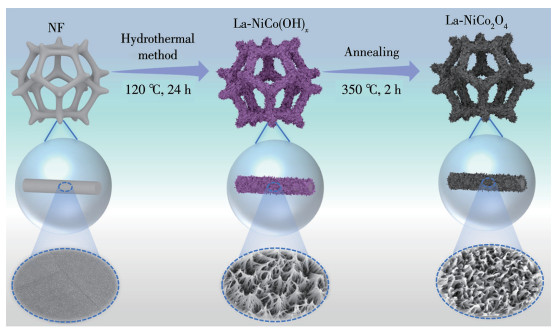
Scheme 1.
Synthesis process of La-NiCo2O4

Ultrafine seagrass-shaped La-doped NiCo2O4 composite: Hydrothermal-calcination preparation and oxygen evolution reaction performance
Tongtong CHEN , Peng ZHAO , Shijia KANG , Huanhuan YU , Baolin ZHU , Shoumin ZHANG


Electrochemical water splitting is a sustainable strategy for hydrogen production[1-2]. The development of electrocatalysts for the oxygen evolution reaction (OER) is critical for reducing the high overpotential in water electrolysis due to its slow kinetics. Improving the overall energy conversion efficiency is vital to accelerate the large-scale adoption of water electrolysis for hydrogen production[3-4]. Transition metal oxides (TMOs) are extensively studied as electrocatalysts for the OER process due to their low cost, abundant availability, and ease of integration, which have made them attractive candidates for sustainable electrochemical energy applications[5]. Current studies show that iron, nickel, and cobalt compounds possess excellent catalytic activity in the OER owing to their unique electronic structures and electronic properties[6-7]. Among these materials, Ni-based and Co-based systems have drawn particular interest for their superior catalytic performance. However, the relatively low electrical conductivity, limited number of active sites, and poor long-term stability in OER result in sluggish electrocatalytic efficiency.
Bimetallic oxides (ABOx, A and B represent metal atoms) exhibit distinct synergistic effects due to their oxygen-bridged A—O—B structural units. This unique A—O—B configuration offers several advantages, including heterointerfaces formed by the coordination geometries of A and B, as well as charge redistribution and localization induced by oxygen-bridge electron transfer[8-12]. For example, Li et al. obtained Co2MnO4 by a hydrothermal-calcination process and evaluated it as an OER catalyst. The study indicates pronounced metal-oxygen electronic interaction and charge redistribution, with increased electron transfer from Mn to lattice O. It strengthened Mn—O bonding, rationalizing the synergistic stability/activity associated with oxygen-bridged Co/Mn—O frameworks[11]. Wang et al. fabricated NiCo2O4 nanosheets on nickel foam (NF) via electrochemical co-deposition followed by thermal annealing. They demonstrate electron delocalization across the Ni—O—Co lattice and propose a covalent Ni→O→Co charge-transfer network that polarizes bridging oxygen and stabilizes the Co active center[12-14]. Liu et al. constructed NiO/NiCo2O4 heterojunction nanoarrays on NF via a hydrothermal growth plus heat-treatment strategy. The results reveal interface-triggered charge transfer between the two oxide domains, which accelerates interfacial electron transport and enhances electrocatalytic kinetics[13]. Within the realm of bimetallic oxides, nickel-cobalt spinel (NiCo2O4) has undergone extensive research in electrocatalysis. However, pure NiCo2O4 exhibits restricted charge transfer efficiency and slow reaction kinetics. This is because in a single Ni—O—Co structural unit, the bimetallic sites are typically in a thermodynamically stable state, lacking the ability for dynamic surface reconstruction or phase transition, thus inhibiting effective electron transport and leading to slow electron transfer kinetics[14]. To break the inherent limitations on electronic and structural transport within rigid bimetallic frameworks, modification strategies including heterostructure construction[15-17], morphology control[18-20], and cationic doping[21-22] have been widely employed to tailor the chemical microenvironments of Ni—O—Co units. As an efficient approach to achieve synergistic stability of Ni/Co bimetallic sites, through ion doping, the introduction of metal cations can alter the local coordination environment of Ni/Co sites, adjust the splitting of d-orbital energy levels, and thereby optimize the local structure and electronic environment[23]. Furthermore, doped ions can regulate charge distribution through a charge compensation mechanism, affecting the oxidation states of Ni/Co (for instance, the introduction of low-valent cations may promote the conversion of some Co3+ to Co2+), which optimizes electron delocalization, enhances the covalency of M—O (M is the metal) bonds, and improves overall structural stability. Doping cations can also modify the formation energy of oxygen vacancies (OV) by controlling OV generation, thus balancing structural stability with reaction activity[24]. Collectively, the relative positions of the d-band centers of Ni and Co can be adjusted by doping with metal cations, which can optimize the charge transfer behavior of Ni and Co to form a more stable electron pairing state, and then optimize the OER performance through the electron synergistic effect.
Due to the arrangement and partial filling of 4f electrons, rare-earth metal ion doping provides unique advantages for improving the thermodynamic and electrochemical stability of NiCo2O4. First, the limited hybridization between the 4f orbitals of rare-earth elements and the 3d orbitals of transition metals enables the adjustment of the d-band center position in Ni/Co, thereby optimizing the intermediate adsorption energy and enhancing charge transfer efficiency during the OER process[25]. Second, the high electronegativity of rare-earth ions can enhance the polarization of oxygen ligands, indirectly strengthening the Ni—O—Co bond, inhibiting oxygen loss, suppressing OV aggregation, and enhancing M—O covalency[26]. Moreover, rare-earth ions themselves can serve as Lewis acid sites, synergistically promoting the adsorption/activation of reactants with transition metal sites[27].
In this work, a series of rare-earth-doped NiCo2O4 electrocatalysts was synthesized via a two-step hydrothermal-annealing process, with La3+, Er3+, and Gd3+ introduced individually as dopants. These seagrass-shaped composites were directly grown on NF substrates without the use of binders. Among them, La3+ doped NiCo2O4 (La-NiCo2O4) was systematically investigated with varying La3+ doping concentrations to optimize its OER performance. The in situ grown seagrass-shaped NiCo2O4 composite facilitates electronic-structure regulation during electrolysis. Specifically, La3+ incorporation creates new chemical bonds and introduces OV, and the resulting bond/defect modulation accelerates electron-transfer kinetics, thereby improving OER performance. Notably, the La-NiCo2O4-1 catalyst demonstrates outstanding OER activity, achieving an overpotential of 283 mV at a current density of 10 mA·cm-2 in 1 mol·L-1 KOH, along with excellent long-term operational stability exceeding 75 h at different current densities. This study illustrates a viable approach to constructing robust transition-metal electrocatalysts through lattice modulation and rare-earth incorporation, offering meaningful guidance for the rational development of high-efficiency OER catalytic materials.
All reagents were of analytical grade and employed as received, without additional purification. Ni(NO3)2·6H2O was purchased from Tianjin Damao Chemical Reagent Partnership Enterprise (Limited Partnership); Co(NO3)2·6H2O, La(NO3)3·6H2O, and urea were purchased from Aladdin Chemical Reagent Co., Ltd.
Rare-earth element-doped NiCo2O4 materials were synthesized via the hydrothermal-calcination method. A typical procedure of La-NiCo2O4-1 was described as follows: first, NF substrates (1 cm×1 cm) were precleaned by sequential ultrasonic treatment in absolute ethanol, deionized (DI) water, and a 3.0 mol·L-1 hydrochloric acid (HCl) solution, each for 15 min, to remove surface oxides and contaminants. Subsequently, 1.25 mmol of Ni(NO3)2·6H2O, 2.5 mmol of Co(NO3)2·6H2O, 0.250 mmol of La(NO3)3·6H2O, and 4.5 mmol of urea were dissolved in 13 mL of DI water to form a homogeneous precursor solution. The pretreated NF was placed in the as-prepared mixed solution, which was then sealed in a 20 mL Teflon-lined stainless-steel autoclave for hydrothermal treatment for 24 h at 120 ℃. After the vessel was cooled naturally to room temperature, the obtained solid was repeatedly washed with DI water to eliminate residual ionic species and dried at 45 ℃ overnight. The dried precursor was subsequently calcined in air at 350 ℃ for 2 h with a ramp rate of 5 ℃·min-1, affording crystalline La-NiCo2O4-1. The La3+ content in the above precursor solution was adjusted to 0.125 and 0.375 mmol to synthesize comparative samples La-NiCo2O4-0 and La-NiCo2O4-2, respectively. The nominal La, Ni, and Co molar ratios are shown in Table S1. In addition, La was replaced by other rare-earth cations (Gd and Er: 0.25 mmol Gd(NO3)3·6H2O and 0.25 mmol Er(NO3)3·6H2O), and the same protocol was followed to obtain the corresponding control samples Gd-NiCo2O4 and Er-NiCo2O4. Without the addition of rare-earth cations, pure NiCo2O4 was prepared by the same procedure.
Phase composition and crystallographic features of the as-prepared catalysts were examined by a powder X-ray diffractometer (Rigaku Ultima IV, 40 kV, 150 mA, Cu Kα, λ=0.154 056 nm, 2θ=10°-90°) together with Fourier-transform infrared (FTIR) spectroscopy (Nicolet iS50). Morphology and microstructural details were inspected using scanning electron microscopy (SEM, FEI Apreo S LoVac) and transmission electron microscopy (TEM, JEOL JEM-F200, 200 kV). Elemental chemical environments and valence information were analyzed by X-ray photoelectron spectroscopy (XPS, Axis Ultra DLD). In situ Raman spectra were collected on a Horiba LabRAM HR Evolution confocal Raman microscope equipped with a Syncerity OE detector.
Electrochemical testing was conducted using a Zahner Zennium workstation in 1.0 mol·L-1 KOH with a standard three-electrode configuration. In the electrochemical measurement system, a platinum electrode was adopted as the counter electrode, an Ag/AgCl electrode functioned as the reference electrode, and the sample immobilized on NF was employed as the working electrode. The potential (E′) related to the Ag/AgCl electrode was converted into the potential (E) related to the reversible hydrogen electrode (RHE) via E=E′+0.197+0.059pH. OER activity was examined by cyclic voltammetry (CV) and linear sweep voltammetry (LSV). Kinetic parameters were extracted from Tafel plots based on η=a+blg j, where η is the OER overpotential, j denotes the current density, a represents the Tafel constant, and b represents the Tafel slope. Electrochemical impedance spectroscopy (EIS) was performed over 0.1-100 kHz to probe interfacial charge-transfer processes. The electrochemically active surface area (ECSA) of electrocatalysts was tested from capacitive CV responses, and long-term stability was assessed by chronoamperometry (i-t) test.
The procedures for the catalyst preparation are illustrated in Scheme 1. To comprehensively understand the structural evolution induced by rare-earth element doping in NiCo2O4, X-ray diffraction (XRD) analysis was performed on both La-doped NiCo2O4 samples with varying La doping contents and NiCo2O4 samples doped with different rare-earth ions (La3+, Er3+, and Gd3+). As shown in Fig. 1a, the XRD pattern of NiCo2O4 exhibited well-defined diffraction peaks corresponding to the cubic spinel structure of NiCo2O4 (PDF No.73-1702), with major reflections located at 2θ=31.1°, 36.7°, 59.1°, and 65.0°, indexed to the (220), (311), (511), and (440) planes, respectively[28-29]. After introducing La3+, the absence of impurity peaks in any of the La-containing compounds confirmed the successful formation of single-phase spinel structures and the effective incorporation of La3+ ions into the host lattice. Notably, a slight but consistent leftward shift in the diffraction peaks was observed. This systematic shift can be attributed to the partial substitution of smaller Ni2+/Co3+ ions by larger La3+ ions, which would lead to expansion of the lattice parameters. In spinel NiCo2O4, the spinel oxide (AB2O4) framework with Ni/Co mainly occupying octahedral B sites provides sufficient compositional and valence tolerance for partial substitution by La3+. Owing to its large ionic radius and high valence, La3+ can be incorporated into or near the octahedral sublattice, generating La—O—M (M=Ni, Co) units that induce lattice strain and charge redistribution[30]. Moreover, the La-NiCo2O4-1 samples also displayed slight peak broadening and intensity attenuation, suggesting a reduction in crystallinity and an increase in structural disorder. As shown in Fig.S1-S3, the peak shift and broadening results could also be detected in other samples. With increasing doping concentration and the ionic radius enlarging (La3+ > Gd3+ > Er3+ in ionic radius), the peak shift was more significantly obvious. As a result, the lattice strain and charge redistribution might promote the creation of OV as an efficient charge-compensation pathway to accelerate electron transfer. FTIR spectra of different catalysts were employed to probe the surface functional groups and coordination molecules (Fig. 1b). For NiCo2O4, the peaks at about 640 and 550 cm-1 can be related to the M—O bond of NiCo2O4. After La3+ incorporation, the peaks of La-NiCo2O4-1 at approximately 640 and 550 cm-1 exhibited slight red-shifting and broadening. This observation was consistent with the XRD results, indicating that the incorporation of La3+ causes lattice distortion and may promote OV formation. The spectral signature of functional groups introduced by the introduction of La3+ was not observed. This absence can be attributed to the closed-shell structure of La3+, which requires high-energy electronic transitions. The —OH/H—O—H features were weak for both samples, implying limited surface hydroxyls/adsorbed water after heat treatment[31]. As evidenced by the peak shifts in both techniques, the results demonstrated that the incorporation of La3+ preserved the spinel skeleton while tuning M—O bonding and defect states, which is expected to benefit electrochemical activity.
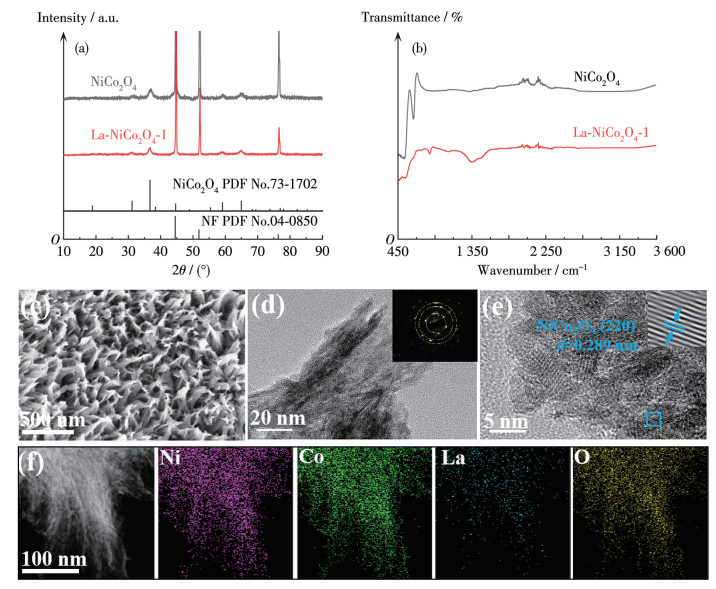
The surface morphologies of the as-prepared electrodes were systematically examined by SEM. As shown in Fig. 1c, La-NiCo2O4-1 grew uniformly on the NF (Fig.S4) substrate, forming a vertically aligned, seagrass-like nanoarray with a relatively loose packing density. In contrast, as shown in Fig.S5, pristine NiCo2O4 exhibited a denser and more disordered seagrass architecture. Notably, the incorporation of La3+ does not induce an obvious morphological transition at the microscale (Fig.S6 and S7), suggesting that the La3+ effect is primarily associated with lattice/electronic modulation rather than a drastic reshaping of the framework. For the other rare-earth doped samples, Gd-NiCo2O4 retained a needle-like morphology, where densely packed nanoneedles radiated outward from the NF surface (Fig.S8), while Er-NiCo2O4 also presented a seagrass-like structure (Fig.S9). In comparison, the more loosely packed seagrass array of La-NiCo2O4 is expected to expose abundant edge sites and to facilitate electrolyte permeation, thereby improving reactant accessibility and ion/electron transport, which is favorable for electrochemical reactions[32]. TEM further confirmed the seagrass-like morphology of La-NiCo2O4-1 (Fig. 1d). The corresponding selected area electron diffraction (SAED) pattern displayed distinct diffraction spots that can be indexed to the spinel NiCo2O4 phase, further confirming the crystalline nature of La-NiCo2O4-1. Specifically, the SAED pattern of La-NiCo2O4-1 exhibited diffraction rings indexed to the cubic spinel NiCo2O4, with the (220), (422), and (442) planes clearly shown. Compared with the undoped NiCo2O4, the diffraction spots of La-doped samples were slightly shifted outward relative to those of NiCo2O4, which can be attributed to lattice expansion induced by La incorporation. High-resolution transmission electron microscopy (HRTEM) revealed well-resolved lattice fringes with an interplanar spacing of 0.289 nm, which can be indexed to the (220) planes of the spinel NiCo2O4 phase (Fig. 1e)[33-34]. The elemental composition was evaluated by energy-dispersive X-ray spectroscopy (EDS). As summarized in Fig.S10 and Table S2, the content of La was 8.37% relative to that of Co, in good agreement with the nominal precursor ratio. Elemental mappings of Ni, Co, La, and O (Fig. 1f) indicated a spatially uniform distribution across the nanoarray. Likewise, the mapping results for Gd-NiCo2O4 and Er-NiCo2O4 (Figs.S8 and S9) confirmed the homogeneous distribution of all constituent elements within the corresponding architectures.
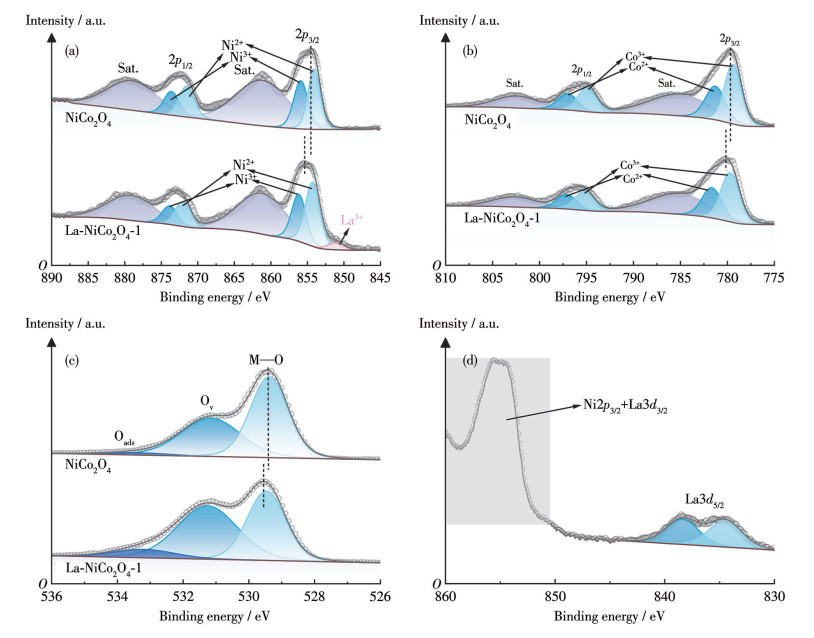
The elemental composition and electronic structure of NiCo2O4 and La-NiCo2O4-1 were systematically tested by XPS. Compared with NiCo2O4 (Fig.S11), the survey spectra confirm the presence of Ni, Co, O, and La elements in La-NiCo2O4-1 (Fig.S12). In the high-resolution Ni2p spectrum (Fig. 2a), the peaks of Ni2p3/2 and Ni2p1/2 were detected at 854.2 and 872.1 eV, respectively, together with the detection of two shake-up satellite peaks at 861.2 and 879.1 eV, indicating the existence of Ni2+. At 856.1 and 873.8 eV, the peaks for Ni3+ were also observed[35]. It was noted that the Ni2p envelope of La-NiCo2O4-1 showed a slight shift toward high binding energy relative to NiCo2O4. Considering the partial overlap between Ni2+ and Ni3+ components, this result was taken as semi-quantitative evidence of electronic modulation rather than definitive proof of exact valence-state shifts. The result suggests the electronic coupling between the 4f orbitals of La3+ and the 3d orbitals of Ni2+, which can adjust the d-band center of Ni2+, consequently accelerating the electron transfer kinetics. Similarly, the Co2p spectra (Fig. 2b) showed the coexistence of Co2+ and Co3+, with spin-orbit doublets at 779.7 eV/781.6 eV and 795.2 eV/797.1 eV, corresponding to Co3+ and Co2+, respectively[36]. In addition, the weak shake-up satellite features appearing at 785.1 and 802.6 eV further supported the presence of Co2+. A positive shift of the Co3+2p3/2 peak was also observed in the spectrum of La-NiCo2O4-1. These shifts in binding energy suggest electron redistribution resulting from the incorporation of La3+, leading to strong electronic interactions between La and the Ni/Co centers. The interactions can modulate the d-band structure and promote the formation of La—O—M bonds, thereby enhancing electron transfer kinetics during electrocatalysis. In the O1s spectra (Fig. 2c), the O1s peaks were deconvoluted into three peaks. The first one located at 529.4 eV can be attributed to lattice oxygen (M—O). And the peak at 531.2 eV is the characteristic peak of OV or defective oxygen (O′v). The peak at 533.5 eV represents the H—O—H bond of the surface-adsorbed species. Compared with pristine NiCo2O4, the increased peak area of defective oxygen indicates that the incorporation of La3+ induces lattice distortion. This distortion improves electron delocalization, which suppresses the aggregation of OV. Consequently, it indirectly strengthens the Ni—O—Co bonds and promotes the formation of La—O—M bonds. The enhanced covalency of these La—O—M bonds subsequently facilitates electron transport. The substantial shifts in Ni2p, Co2p, and O1s spectra indirectly confirm that the incorporation of La3+ not only alters the electronic environment of Ni2+ and Co3+ to construct La—O—M units but also effectively induces abundant OV, thereby enhancing electron transfer behavior and promoting the intrinsic OER catalytic performance. In addition, as shown in Figs.S13-S16, the Gd- and Er-doped samples also exhibited discernible binding-energy shifts in the XPS spectra. However, the magnitudes of these shifts were smaller than those observed for the La3+-doped sample. These findings indicate that the incorporation of Gd3+ and Er3+ results in weaker structural-electronic coupling compared to that induced by La3+, leading to a more limited enhancement in reaction kinetics and interfacial charge-transfer processes.
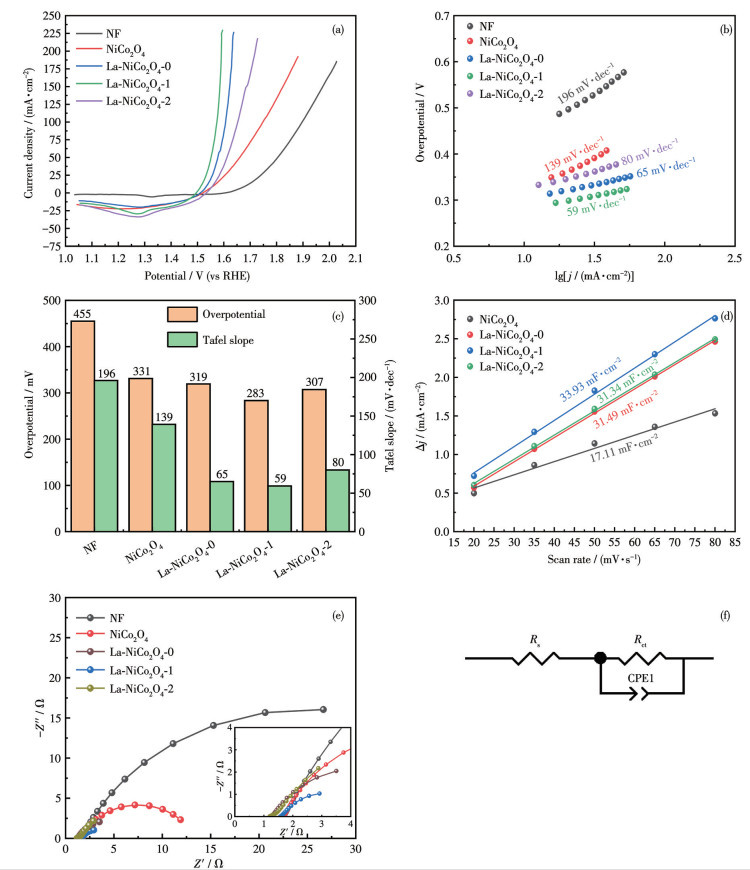
The OER electrocatalytic activities of NiCo2O4 and a series of La-NiCo2O4 samples with varying La contents were systematically evaluated using LSV in 1 mol·L-1 KOH. As illustrated in Fig. 3a, pristine NF and NiCo2O4 required relatively high overpotentials of 455 and 331 mV at a current density of 10 mA·cm-2, respectively. Notably, the La-NiCo2O4-1 achieved the lowest overpotential of 283 mV, indicating an optimal balance between defect engineering and electronic structure modulation. Samples with lower (La-NiCo2O4-0) or higher (La-NiCo2O4-2) doping levels showed comparatively diminished activity in Fig. 3a, which should be attributable to an insufficient number of active defect sites or excessive La-induced aggregation that blocked active surface area. Moreover, as the potential became more positive, La-NiCo2O4-1 exhibited a markedly steeper rise in current density than the remaining catalysts. This behavior was further corroborated by the Tafel slopes presented in Fig. 3b. La-NiCo2O4-1 exhibited a relatively small Tafel slope. The Tafel slopes of NF, NiCo2O4, La-NiCo2O4-0, La-NiCo2O4-1, and La-NiCo2O4-2 were 196, 139, 65, 59, and 80 mV·dec-1, respectively. The summary of overpotential and Tafel slope is shown in Fig. 3c. The results indicated a rapid increase in current density and rapid OER kinetics of La-NiCo2O4-1. In addition, to explore the inherent capacity of the catalyst in alkaline media, CV curves were recorded within the non-faradaic window of 0-0.1 V (vs RHE) at scan rates ranging from 20 to 80 mV·s-1 (Fig.S17). As shown in Fig. 3d and 3e, the double-layer capacitance (Cdl=33.93 mF·cm-2) of La-NiCo2O4-1 was bigger than that of La-NiCo2O4-0 (31.49 mF·cm-2) and La-NiCo2O4-2 (31.34 mF·cm-2). A bigger Cdl value indicates a higher electrochemical double-layer capacitance with larger ECSA. As demonstrated in Fig. 3e and Table 1, the semicircular diameter of La-NiCo2O4-1 was much lower than that of La-NiCo2O4-0 (5.88 Ω) and La-NiCo2O4-2 (6.84 Ω), indicating La-NiCo2O4-1 possessed the fastest electron transport. Fig. 3f shows the fitting circuit diagram. To further optimize the catalytic performance, we systematically investigated the effect of rare-earth element doping concentration. Rare-earth-doped NiCo2O4 (Gd-NiCo2O4 and Er-NiCo2O4) were synthesized and evaluated in 1 mol·L-1 KOH using a standard three-electrode system. In contrast, as shown in Fig.S18, all rare-earth-doped samples exhibited markedly improved OER performance, indicating the significant catalytic enhancement imparted by rare-earth ion incorporation. In terms of overpotential (in ascending order), the catalysts ranked as La-NiCo2O4-1 < Gd-NiCo2O4 < Er-NiCo2O4 < NiCo2O4, confirming the superior activity of the rare-earth-doped samples over the pristine NiCo2O4. Fig.S19 presents the Tafel slope, which was obtained through a linear fitting process. La-NiCo2O4-1 exhibited a notably low Tafel slope of 59 mV·dec-1, while the corresponding values were 139, 88, and 129 mV·dec-1 for NiCo2O4, Gd-NiCo2O4, and Er-NiCo2O4, respectively. This substantial decrease clearly signified enhanced reaction kinetics and improved electron transfer processes, suggesting that the incorporation of La3+ effectively reduces the OER energy barrier and accelerates water dissociation[37]. As shown in Fig.S20 and S21, La-NiCo2O4-1 revealed the highest Cdl value (33.93 mF·cm-2), followed by Gd-NiCo2O4 (21.38 mF·cm-2), Er-NiCo2O4 (19.44 mF·cm-2), and NiCo2O4 (17.11 mF·cm-2), indicating that La-NiCo2O4-1 possessed the highest electrochemically active surface area. To further assess the site-normalized OER activity, the apparent turnover frequency (TOF) of La-NiCo2O4-1 was estimated. The apparent TOF was 0.030 6 s-1 at 10 mA·cm-2, indicating favorable OER kinetics. Detailed calculation procedures, assumptions, and discussions regarding the estimation of active site density were provided in the Supporting information. According to the results of the EIS analysis, La-NiCo2O4-1 had a lower charge transfer resistance (Rct=2.60 Ω) than that of NF (46.91 Ω), NiCo2O4 (11.61 Ω), Gd-NiCo2O4 (6.84 Ω), and Er-NiCo2O4 (13.92 Ω), as shown in Fig. 3e and Fig.S22. The impedance response suggests a small interfacial charge-transfer barrier. This observation aligned well with the polarization trends obtained from LSV. Combined with XRD, TEM, and XPS analyses, the superior performance of La-NiCo2O4 can be mainly attributed to more efficient charge redistribution. Under the same coordination environment, La3+ possesses a substantially larger effective ionic radius compared to Gd3+ and Er3+, resulting in greater local size mismatch. This mismatch induces stronger lattice distortion and promotes defect formation, which in turn leads to the strongest structure-electronic coupling within this electronic environment. As a result, the electronic states of Ni/Co are optimized, facilitating faster interfacial electron transfer and ultimately accelerating OER kinetic process[38].

 下载:
导出CSV
| Material | Rs / Ωa | Rct / Ω |
| NF | 1.70 | 46.91 |
| NiCo2O4 | 1.68 | 11.61 |
| La-NiCo2O4-1 | 1.57 | 2.60 |
| La-NiCo2O4-0 | 1.31 | 5.88 |
| La-NiCo2O4-2 | 1.21 | 6.84 |
| aRs: solution resistance. | ||
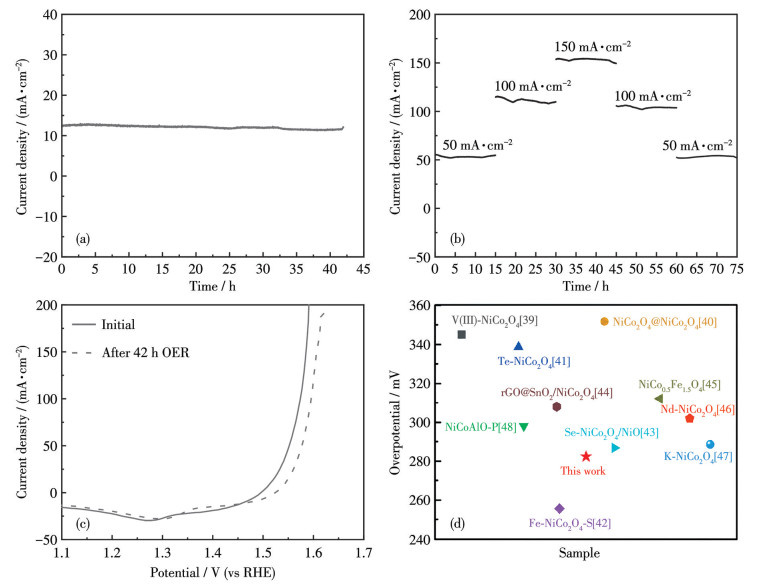
As shown in Fig. 4a, the durability of La-NiCo2O4-1 was evaluated in 1.0 mol·L-1 KOH at a constant potential with an initial current density of 10 mA·cm-2 for 42 h by an i-t test, during which only a slight decay was observed. Moreover, the multiple current steps of i-t tests showed that the current density rapidly leveled out and remained stable during every 15 h test, at constant potentials with a current density change of 50→100→150→100→50 mA·cm-2 in Fig. 4b. The finding demonstrates that La-NiCo2O4-1 possessed a definite period of durability. As shown in Fig.S23, compared with the fresh electrode, the post-OER sample still showed a relatively small charge-transfer resistance, although a slight increase in Rct was observed after the long-term test, which can be attributed to partial surface deactivation and catalyst detachment during prolonged anodic polarization. As shown in Fig. 4c, the catalyst retained approximately 87.5% of its initial activity after 42 h of OER operation, indicating moderate stability. The superior OER durability of La-NiCo2O4-1 is mainly attributed to the formation of robust La—O—M coordination units within the spinel framework. These stable oxygen-bridged linkages reinforce the local metal-oxygen network and provide an "electronic anchoring" effect, enabling a sustained charge redistribution that stabilizes the Ni/Co redox couple and maintains a more reliable electron-transport pathway during prolonged anodic polarization. To benchmark the OER performance of La-NiCo2O4-1, a comparative analysis was conducted against recently reported electrocatalysts[39-48]. As summarized in Fig. 4d, our catalyst exhibits superior OER activity with a low overpotential at a current density of 10 mA·cm-2, underscoring its potential for practical OER applications.
Beyond outstanding OER activity, durability is essential for the electrode materials. Therefore, XRD, FTIR, SEM, TEM, and XPS measurements were employed to explore the structure of La-NiCo2O4-1 after 75 h of OER to investigate the stability of La-NiCo2O4-1 in 1 mol·L-1 KOH electrolyte under operational conditions. As shown in Fig. 5a, compared with fresh samples, the used La-NiCo2O4-1 showed no pronounced shift in peak positions after the OER process, whereas the diffraction intensities decreased, which can be attributed to partial catalyst detachment during electrochemical operation. Meanwhile, the observed broadening of diffraction peaks for the used La-NiCo2O4-1 indicates lattice expansion and the introduction of strain. This is consistent with the partial substitution of smaller octahedral Ni/Co ions by larger La3+ while maintaining the spinel structure. Similar behavior was reported in La/Mn-doped cobalt spinels, in which a distorted yet structurally stable lattice under OER conditions is directly associated with enhanced long-term durability[30].
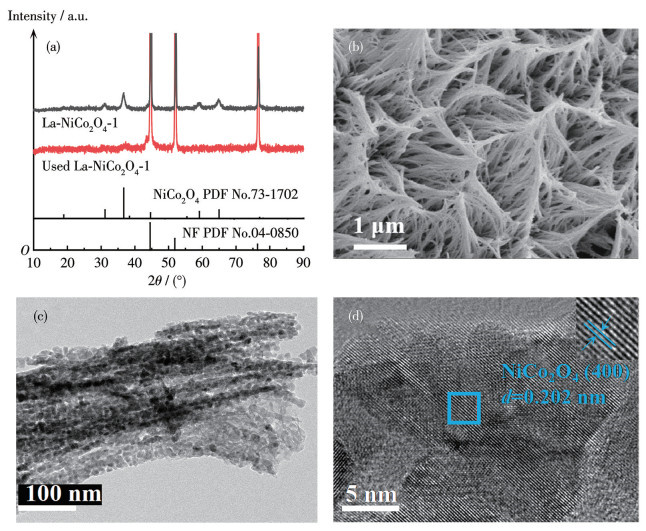
Compared with fresh La-NiCo2O4-1, in the FTIR spectra (Fig.S24), the absorption peaks corresponding to the stretching vibrations of Ni—O and Co—O remained clearly visible at 620 and 705 cm-1 of used La-NiCo2O4-1, indicating that the spinel structure is well preserved during 75 h of electrochemical operation. There were weak absorptions in the range of 1 044-1 384 cm-1, which can be attributed to A—O—B/M—O—H bridging bonds and residual nitrate or carbonate species, and the band at ca. 1 609 cm-1 corresponding to O—H stretching vibrations was significantly enhanced, confirming higher surface hydroxyl coverage after electrochemical cycling[31]. After the 75 h OER test, it could be found that the morphology of La-NiCo2O4-1 was not obviously changed (Fig. 5b-5d and S25). Besides, as seen in Fig.S26, Ni, Co, O, and La elements were still detected in the XPS spectra, further suggesting their good stability. Furthermore, compared with fresh La-NiCo2O4-1 in Fig. 2, the Ni2p and Co2p XPS spectra of used La-NiCo2O4-1 collected after 75 h of OER revealed that the relative fractions of Ni3+ and Co2+ increased markedly after the reaction. As shown in Fig.S26, the observed shifts in Ni2p and Co2p binding energies further evidenced a redistribution of electron density and an adjustment of the Ni2+/Ni3+ and Co2+/Co3+ ratios, where optimized high-valence 3d centers and controlled La-O-Ni/Co species simultaneously boosted OER activity[26]. According to the above characterization results, La-NiCo2O4-1 is an efficient OER electrode material accompanied by credible durability in an alkaline environment.
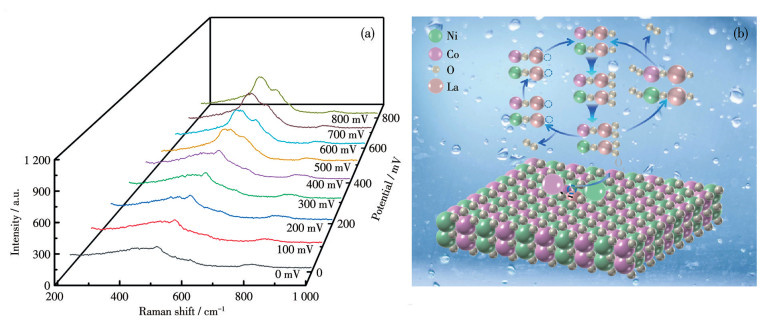
To provide direct experimental evidence for the potential-induced surface evolution of La-NiCo2O4-1, in situ Raman spectroscopy was performed under different applied potentials in 1.0 mol·L-1 KOH. As shown in Fig. 6a, La-NiCo2O4-1 exhibited broad Raman signals in the range of 400-560 cm-1 at open circuit potential (OCP) and low applied potentials, which can be assigned to the M—O lattice vibrations of the spinel NiCo2O4 framework. With increasing applied potential, the Raman response in the 450-560 cm-1 region gradually became stronger and broader, indicating the oxidation of surface Ni/Co sites and the formation of Ni/Co oxyhydroxide-like species under anodic polarization. This potential-dependent spectral evolution demonstrates that the initial spinel surface undergoes dynamic reconstruction into an oxyhydroxide-like active layer during OER. Combining the HRTEM and XPS data, it can be concluded that La3+ mainly modulates the local coordination and electronic environment of Ni/Co sites rather than forming a separate La oxide phase. Thus, there was no La—O Raman band observed. The weak broad feature around 780-830 cm-1 might be associated with high-valence M—O related vibrations. Therefore, the in situ Raman results suggest the formation of reconstructed Ni/Co oxyhydroxide-like active species, which is consistent with the proposed adsorbate evolution mechanism (AEM) pathway. Based on the in situ Raman results and the above electrochemical-structural characterizations, the OER process of La-NiCo2O4-1 is proposed within the conventional AEM[49-50]. First, the induced La3+ endows the La-NiCo2O4-1 system with redistribution and defect-related oxygen environments, increasing the local polarity. The interfacial charge transfer is facilitated, thereby providing many more electronically tuned adsorption sites for oxygenated intermediates[51]. As shown in Fig. 6b, the stable La—O—M bonding and charge transport existed in La-NiCo2O4-1, which were proved by the above characterizations. It can be concluded that La-containing spinel oxides can retain long-term anodic durability during which the dopant-stabilized lattice chemistry can suppress degradation under harsh OER conditions. The robustness against over-oxidation/dissolution during prolonged polarization can also be improved. Then, the La-NiCo2O4 undergoes dynamic surface reconstruction into an (oxy)hydroxide-like catalytic layer (Eq.1)[14]. Second, the high-valence La-doped Ni/Co (La-Ni/Co) sites in octahedral coordination within this reconstructed surface region are the catalytically relevant centers. On the reconstructed La-Ni/Co sites, the OER typically begins via hydroxide adsorption (Eq.2, where * is the radical species)[52]. This step generates surface-bound hydroxyl intermediates (*OH) and constitutes the first electron-transfer event. The adsorbed *OH undergoes deprotonation to yield surface oxo species (*O). This step is kinetically important because it involves strengthening the M—O bond and reorganizing the local coordination environment. An increased fraction of defect-related oxygen can tune M—O covalency and lower the energetic cost for *OH→*O conversion (Eq. 3)[52]. Fourth, O—O coupling proceeds by nucleophilic attack of hydroxide on the surface *O. And the hydroperoxo intermediate (*OOH) is produced (Eq.4). Finally, oxygen is released, and the catalytic site is regenerated (Eq.5)[52].
|
|
(1) |
|
|
(2) |
|
|
(3) |
|
|
(4) |
|
|
(5) |
In summary, the OER performance of NiCo2O4 electrocatalysts modified with rare-earth element dopants through a hydrothermal calcination process was systematically investigated. Among the tested rare-earth ions doped NiCo2O4 catalysts, La-NiCo2O4-1 demonstrated the highest effectiveness by delivering superior electrocatalytic activity with an overpotential of 283 mV at 10 mA·cm-2, a low Tafel slope of 59 mV·dec-1, and a minimal Rct of 2.60 Ω. Furthermore, La-NiCo2O4 demonstrated excellent electrochemical durability, maintaining stable activity for 75 h in 1 mol·L-1 KOH solution at different voltage levels. The excellent OER performance is attributed to the altered Ni/Co electronic configuration resulting from La3+ incorporation, which induces lattice distortion and facilitates charge transfer behaviour in OER. These results highlight the critical role of both dopant identity and concentration in tuning the catalytic activity of spinel oxides, offering valuable insights for the rational design of high-performance OER electrocatalysts.
LI X, ZHAO L L, YU J Y, LIU X Y, ZHANG X L, LIU H, ZHOU W J. Water splitting: From electrode to green energy system[J]. Nano-Micro Lett., 2020, 12(1): 131 doi: 10.1007/s40820-020-00469-3
QIAN Q Z, ZHU Y, AHMAD N, FENG Y F, ZHANG H K, CHENG M Y, LIU H H, XIAO C, ZHANG G Q, XIE Y. Recent advancements in electrochemical hydrogen production via hybrid water splitting[J]. Adv. Mater., 2024, 36(4): e2306108 doi: 10.1002/adma.202306108
TRIPATHI P, VERMA A K, SINHA A S K, SINGH S. Cutting-edge OER electrocatalysts for sustainable seawater electrolysis: Progress, obstacles, and future prospects[J]. Energy Fuels, 2025, 39(5): 2348-2380 doi: 10.1021/acs.energyfuels.4c04519
LI S F, LIU Z H, WANG F F, YUAN F F, NI Y H. Ce-doped FeNi-layered double hydroxide nanosheets grown on an open-framework nickel phosphate nanorod array for oxygen evolution reaction[J]. ACS Appl. Energy Mater., 2021, 4(11): 12836-12847 doi: 10.1021/acsaem.1c02531
WEN N, JIAO X L, XIA Y G, CHEN D R. Electrocatalysts for the oxygen evolution reaction: Mechanism, innovative strategies, and beyond[J]. Mater. Chem. Front., 2023, 7(20): 4833-4864 doi: 10.1039/D3QM00423F
MITTAL S, KAMARAJ B, YADAV S, TRIVEDI P, MINJ N C, SENGENI A. Eccentric corrosion-induced formation of γ-NiFeOOH and γ-NiCoOOH on NiFeCo alloy for enhanced OER[J]. ACS Appl. Mater. Interfaces, 2025, 17(23): 33878-33888 doi: 10.1021/acsami.5c03007
XIE R J, HU X C, SHI Y N, NIE Z W, ZHANG N, TRAVERSA E, YU Y, YANG N. Enhanced oxygen evolution activity of CoO-La0.7Sr0.3MnO3-δ heterostructured thin film[J]. ACS Appl. Energy Mater., 2020, 3(8): 7988-7996 doi: 10.1021/acsaem.0c01335
YU T H, GAO P, DU H, DONG L. Interfacial Co—O—Fe bonding in novel amorphous NiCo-ZIF@MIL-100 as efficient active sites enabling electrocatalytic water oxidation[J]. J. Mater. Chem. A, 2024, 12(21): 12712-12720 doi: 10.1039/D4TA00696H
SUN J P, REN G M, QIN S Y, ZHAO Z, LI Z Z, ZHANG Z S, LI C H, MENG X C. Reconstruction Co—O—Mo in amorphous-crystalline MoOx/Co(OH)2 interface for industry-level active and stable electrocatalytic seawater hydrogen evolution[J]. Nano Energy, 2024, 121: 109246 doi: 10.1016/j.nanoen.2023.109246
SUN Y M, WANG J R, XI S B, SHEN J J, LUO S Z, GE J J, SUN S N, CHEN Y B, HANNA J V, LI S Z, WANG X, XU Z C J. Navigating surface reconstruction of spinel oxides for electrochemical water oxidation[J]. Nat. Commun., 2023, 14(1): 2467 doi: 10.1038/s41467-023-38017-3
LI A L, KONG S, GUO C X, OOKA H, ADACHI K, HASHIZUME D, JIANG Q K, HAN H X, XIAO J P, NAKAMURA R. Enhancing the stability of cobalt spinel oxide towards sustainable oxygen evolution in acid[J]. Nat. Catal., 2022, 5(2): 109-118 doi: 10.1038/s41929-021-00732-9
WANG Z H, WANG X R, JIA B Q, ZUO Y L, ZHOU L, YAN Z N, ZHU Z Y, XIAO Y H, ZHANG Y F, YANG Y F, CHEN X, LIU L Z, ZHAO X. Spin-state engineering of octahedral Co via tetrahedral Ni in NiCo2O4 for electrocatalytic glucose oxidation to formate[J]. J. Energy Chem., 2026, 112: 605-617 doi: 10.1016/j.jechem.2025.08.072
LIU G Q, CHENG Y W, QIU M Q, LI C C, BAO A Y, SUN Z T, YANG C Z, LIU D M. Facilitating interface charge transfer via constructing NiO/NiCo2O4 heterostructure for oxygen evolution reaction under alkaline conditions[J]. J. Colloid Interface Sci., 2023, 643: 214-222 doi: 10.1016/j.jcis.2023.04.026
GAO L K, CUI X, SEWELL C D, LI J, LIN Z Q. Recent advances in activating surface reconstruction for the high-efficiency oxygen evolution reaction[J]. Chem. Soc. Rev., 2021, 50(15): 8428-8469 doi: 10.1039/D0CS00962H
ZHENG J J, XIA J S, LIU J Y, HAO W J, BI Q Y, FAN J C, LI G S. Self-supported hybrid chiral MoS2@NiCo2O4 heterostructure on a carbon cloth for efficient oxygen evolution[J]. ACS Appl. Energy Mater., 2025, 8(9): 5989-6000 doi: 10.1021/acsaem.5c00395
ZHANG Z M, LIANG X L, LI J F, QIAN J M, LIU Y G, YANG S L, WANG Y, GAO D Q, XUE D S. Interfacial engineering of NiO/NiCo2O4 porous nanofibers as efficient bifunctional catalysts for rechargeable zinc-air batteries[J]. ACS Appl. Mater. Interfaces, 2020, 12(19): 21661-21669 doi: 10.1021/acsami.0c03672
SHUWANTO H, LIE J, ABDULLAH H, PASARIBU S P, MASMUR I, TIFFANY, NUR N S, KASTARIO. Seaweed-like structure of a NiCo2O4/NiFe2O4/C nanoelectrocatalyst: An effective strategy for boosting overall water splitting[J]. ACS Appl. Energy Mater., 2025, 8(7): 4321-4330 doi: 10.1021/acsaem.4c03261
DEVAGUPTAPU S V, HWANG S, KARAKALOS S, ZHAO S, GUPTA S, SU D, XU H, WU G. Morphology control of carbon-free spinel NiCo2O4 catalysts for enhanced bifunctional oxygen reduction and evolution in alkaline media[J]. ACS Appl. Mater. Interfaces, 2017, 9(51): 44567-44578 doi: 10.1021/acsami.7b16389
TODOROKI N, NAGASAWA K, ENJOJI H, MITSUSHIMA S. Suppression of catalyst layer detachment by interfacial microstructural modulation of the NiCo2O4/Ni oxygen evolution electrode for renewable energy-powered alkaline water electrolysis[J]. ACS Appl. Mater. Interfaces, 2023, 15(20): 24399-24407 doi: 10.1021/acsami.3c01572
KUMAR L, CHAUHAN M, BORUAH P K, DAS M R, HASHMI S A, DEKA S. Coral-shaped bifunctional NiCo2O4 nanostructure: A material for highly efficient electrochemical charge storage and electrocatalytic oxygen evolution reaction[J]. ACS Appl. Energy Mater., 2020, 3(7): 6793-6804 doi: 10.1021/acsaem.0c00909
TAO Y H, JIANG W D, WANG H, HAO W J, BI Q Y, LIU X J, FAN J C, LI G S. Tuning electronic structure of hedgehog-like nickel cobaltite via molybdenum-doping for enhanced electrocatalytic oxygen evolution catalysis[J]. J. Colloid Interface Sci., 2024, 657: 921-930 doi: 10.1016/j.jcis.2023.12.048
YANG M Q, ZHOU K L, ZHAO W, WANG C, CHEN G, WANG R Z. Synergistic assistance of Ir clusters and NiCo2O4 nanosheets interfaces in direct O—O coupling for high-efficiency alkaline oxygen evolution[J]. ACS Appl. Mater. Interfaces, 2024, 16(27): 34840-34849 doi: 10.1021/acsami.4c02837
ZHAO H Y, ZHU L, YIN J, JIN J, DU X, TAN L, PENG Y, XI P X, YAN C H. Stabilizing lattice oxygen through Mn doping in NiCo2O4-δ spinel electrocatalysts for efficient and durable acid oxygen evolution[J]. Angew. Chem. -Int. Edit., 2024, 63(20): e202402171 doi: 10.1002/anie.202402171
ZHENG J X, PENG X F, XU Z, GONG J B, WANG Z. Cationic defect engineering in spinel NiCo2O4 for enhanced electrocatalytic oxygen evolution[J]. ACS Catal., 2022, 12(16): 10245-10254 doi: 10.1021/acscatal.2c01825
WU Y X, CHANG Y, SU Y Q, JIA J C. Spinel NiCo2O4@CeO2-x/NF with abundant oxygen vacancies and heterogeneous interfaces for efficient polyethylene terephthalate electrocatalytic conversion[J]. Electrochim. Acta, 2026, 550: 148072 doi: 10.1016/j.electacta.2025.148072
XU S Y, ZHANG P, ZHAO R, WOOK BAE J, LI H, YONG LEE J, YOO P J. Engineered oxidation states in NiCo2O4@CeO2 nanourchin architectures with abundant oxygen vacancies for enhanced oxygen evolution reaction performance[J]. Chem. Eng. J., 2024, 482: 148787 doi: 10.1016/j.cej.2024.148787
LI L, LI Q L, YANG D L, HAN M J. When rare-earth elements meet oxygen evolution reaction: Recent progress and perspective[J]. J. Alloy. Compd., 2025, 1038: 182935 doi: 10.1016/j.jallcom.2025.182935
ZHOU Y, LI J, XIONG G Q, HE X J, HUANG Z Y, WANG Y. Synthesis of NiCo2O4 nanostructures with different morphologies for supercapacitor[J]. Synth. Met., 2021, 282: 116954 doi: 10.1016/j.synthmet.2021.116954
CHEN X, XIE R, LI H, JABER F, MUSHARAVATI F, ZALNEZHAD E, BAE S, HUI K S, HUI K N. Supercapacitor performance of porous nickel cobaltite nanosheets[J]. Sci. Rep., 2020, 10(1): 18956 doi: 10.1038/s41598-020-75946-1
CHONG L N, GAO G P, WEN J G, LI H X, XU H P, GREEN Z, SUGAR J D, KROPF A J, XU W Q, LIN X M, XU H, WANG L W, LIU D J. La- and Mn-doped cobalt spinel oxygen evolution catalyst for proton exchange membrane electrolysis[J]. Science, 2023, 380(6645): 609-616 doi: 10.1126/science.ade1499
PATEL A, PATEL S K, SINGH R S, PATEL R P, SHANTE N K. Facile binder-free hydrothermal synthesis of NiCo2O4 using different reagents: A study as efficient supercapacitor electrode[J]. Sci. Rep., 2025, 15(1): 37806 doi: 10.1038/s41598-025-21751-7
KAVINKUMAR T, NAVEENKUMAR T R, THIRUMURUGAN A. Construction of structurally engineered NiCo2O4 nanostructures as a bifunctional electrocatalyst for high-performance overall water splitting[J]. Inorg. Chem. Commun., 2024, 165: 112582 doi: 10.1016/j.inoche.2024.112582
NIU J R, LIU H B, ZHANG Y Y, WANG X, HAN J, YUE Z H, DUAN E H. NiCo2O4 spinel for efficient toluene oxidation: The effect of crystal plane and solvent[J]. Chemosphere, 2020, 259: 127427 doi: 10.1016/j.chemosphere.2020.127427
SARKAR S, CHAUBEY P, SHARMA P K. Inverse spinel Fe-NiCo2O4/NiO nanocomposite supported on defect-rich P-rGO sheets for enhanced OER activity[J]. J. Alloy. Compd., 2025, 1010: 177856 doi: 10.1016/j.jallcom.2024.177856
GROSVENOR A P, BIESINGER M C, SMART R S C, MCINTYRE N S. New interpretations of XPS spectra of nickel metal and oxides[J]. Surf. Sci., 2006, 600(9): 1771-1779 doi: 10.1016/j.susc.2006.01.041
ZHANG Y N, SHI W P, BO L L, SHEN Y X, JI X C, XIA L C, GUAN X L, WANG Y X, TONG J H. Electrospinning construction of heterostructural Co3W3C/CoP nanoparticles embedded in N, P-doped hierarchically porous carbon fibers as excellent multifunctional electrocatalyst for Zn-air batteries and water splitting[J]. Chem. Eng. J., 2022, 431: 134188 doi: 10.1016/j.cej.2021.134188
SUN F X, ZHU S, LIU Z X, LIU C, JIANG K Z, ZHANG Y Y, CHEN B, ZHENG S J. Data-driven design of metal oxide electrocatalysts with low Tafel slope in oxygen evolution reaction[J]. J. Alloy. Compd., 2025, 1031: 180964 doi: 10.1016/j.jallcom.2025.180964
KUZNETSOV D A, HAN B H, YU Y, RAO R R, HWANG J, ROMÁN-LESHKOV Y, SHAO-HORN Y. Tuning redox transitions via inductive effect in metal oxides and complexes, and implications in oxygen electrocatalysis[J]. Joule, 2018, 2(2): 225-244 doi: 10.1016/j.joule.2017.11.014
WANG X Z, ZHOU Y, LUO J B, SUN F C, ZHANG J. Synthesis of V-doped urchin-like NiCo2O4 with rich oxygen vacancies for electrocatalytic oxygen evolution reactions[J]. Electrochim. Acta, 2022, 406: 139800 doi: 10.1016/j.electacta.2021.139800
ZHAO J, CHEN F W, ZHAO X Y, WANG X J, LI Y P, LI F T. Self-composition of hierarchical core-shell-structured NiCo2O4@NiCo2O4 microspheres with oxygen vacancies for efficient oxygen evolution electrocatalysis[J]. Energy Fuels, 2023, 37(23): 18111-18119 doi: 10.1021/acs.energyfuels.3c02331
LI S F, LI X, YAN D. Tellurium-induced defect engineering for boosting the oxygen evolution reaction of spinel oxide[J]. Chem. Commun., 2023, 59(57): 8834-8837 doi: 10.1039/D3CC01879B
FU X B, YU J, LI H, ZHANG Y X, PAN S C, FU Y S, LI B. Fe ion doping as an effective strategy to enhance oxygen evolution reaction activity in NiCo2O4[J]. J. Power Sources, 2025, 630: 236159 doi: 10.1016/j.jpowsour.2024.236159
KALE V N, MAIYALAGAN T. Selenium-enriched hollow NiCo2O4/NiO heterostructured nanocages as an efficient electrocatalyst for oxygen evolution reaction[J]. Nanoscale, 2024, 16(22): 10789-10800 doi: 10.1039/D4NR01144A
CHANDRASEKAR S, NIVETHA A, SENTHAMIL C, HEMALATHA J, LIU B, PRABHA I. Novel rGO/PAAQ/HTs reinforced SnO2@NiCo2O4 as effective catalyst for photodegradation, electrochemical evaluation, biomedical and phytoscreening effects [J]. J. Inorg. Organomet. Polym. Mater., 2025, 35(6): 4736-4763 doi: 10.1007/s10904-024-03554-x
ROY S, ROY S. Activating cobalt inverse spinel oxides via Fe substitution for enhanced water splitting reaction[J]. Sustain. Energy Fuels, 2024, 8(17): 3854-3864 doi: 10.1039/D4SE00468J
LI T, BO L L, GUAN X L, JIANG K, LIU Y Q, TONG J H. A Nd-doped NiCo spinel dual functional catalyst for both oxygen reduction reactions and oxygen evolution reactions: Enhanced activity through surface reconstruction [J]. J. Colloid Interface Sci., 2025, 691: 137411 doi: 10.1016/j.jcis.2025.137411
KIM N W, YU H, OH J. Mesoporous K-doped NiCo2O4 derived from a Prussian blue analog: High-yielding synthesis and assessment as oxygen evolution reaction catalyst[J]. RSC Adv., 2022, 12(20): 12371-12376 doi: 10.1039/D2RA01235A
GUI T Y, WU Z H, LI J X, QIAO Z Y, ZHENG Z T, ZHAO L C, FENG Y H, SHAKIR I, WU Y H, FENG L G, LIU X J. Transition metal phosphides for seawater electrolysis: Dynamic reconstruction, synergistic mechanisms and design paradigms[J]. Adv. Funct. Mater., 2026, 36: e202526293
GUI T Y, WANG Y C, LI J X, QIAO Z Y, WU Z H, SHENG Y W, ZHUO L C, WU Y H, SHAKIR I, WU X J, FENG L G, SUN X P, LIU X J. Machine-learning-driven design of dynamically adaptive MOF catalysts: Structural evolution mechanisms and industrial translation pathways in seawater electrolysis[J]. Adv. Energy Mater., 2026, 16(15): e202506002
WANG X, HU J R, LU T Y, WANG H Y, SUN D M, TANG Y W, LI H, FU G T. Importing atomic rare-earth sites to activate lattice oxygen of spinel oxides for electrocatalytic oxygen evolution[J]. Angew. Chem. -Int. Edit., 2025, 64(3): e202415306 doi: 10.1002/anie.202415306
LI J T. Oxygen evolution reaction in energy conversion and storage: Design strategies under and beyond the energy scaling relationship[J]. Nano-Micro Lett., 2022, 14(1): 112 doi: 10.1007/s40820-022-00857-x
SON Y J, KAWASHIMA K, MÁRQUEZ R A, SMITH L A, CHUKWUNEKE C E, MULLINS C B. Key concepts for understanding alkaline oxygen evolution reaction at the atomic/molecular scale[J]. Curr. Opin. Electrochem., 2023, 39: 101298 doi: 10.1016/j.coelec.2023.101298

Figure 1 (a) XRD patterns and (b) FTIR spectra of NiCo2O4 and La-NiCo2O4-1; (c) SEM image, (d) TEM image (inset: the corresponding SAED pattern), (e) HRTEM image, and (f) EDS elemental mappings (Scale bar: 100 nm) of La-NiCo2O4-1

Figure 2 (a) Ni2p, (b) Co2p, and (c) O1s XPS spectra of NiCo2O4 and La-NiCo2O4-1; (d) La3d XPS spectrum of La-NiCo2O4-1

Figure 3 (a) LSV curves, (b) Tafel plots, (c) overpotentials and Tafel slope histograms, (d) estimation of Cdl by plotting of current densities as a function of scanning rates, and (e) Nyquist plots of the samples (inset: high frequency region magnified image); (f) Fitting circuit diagram of EIS

Figure 4 (a) i-t curves at current densities of 10 mA·cm-2 for 42 h, (b) multi-step i-t plots for 75 h, and (c) LSV curves before and after the 42 h OER test of La-NiCo2O4-1; (d) Comparison of the overpotentials of La-NiCo2O4-1 and reported NiCo-based catalysts toward OER

Figure 5 (a) XRD patterns of La-NiCo2O4-1 before and after 75 h OER test; (b) SEM, (c) TEM, and (d) HRTEM images of La-NiCo2O4-1 after OER test

Figure 6 (a) In situ Raman spectra of La-NiCo2O4-1 under different applied potentials; (b) Proposed OER mechanism of La-NiCo2O4-1
Table 1. Fitting results of the EIS
| Material | Rs / Ωa | Rct / Ω |
| NF | 1.70 | 46.91 |
| NiCo2O4 | 1.68 | 11.61 |
| La-NiCo2O4-1 | 1.57 | 2.60 |
| La-NiCo2O4-0 | 1.31 | 5.88 |
| La-NiCo2O4-2 | 1.21 | 6.84 |
| aRs: solution resistance. | ||
 下载: 导出CSV

 扫一扫看文章


扫一扫关注我们
