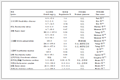
Table 1.
Crystal data and structure refinements for assemblies 1-3

Synthesis and crystal structure of three cucurbit[6]uril-cadmium supramolecular assemblies
Wenya DING , Fangfei XU , Jiayu GU , Xinran CHEN , Kai CHEN


As the fourth-generation macrocycles after crown ether, cyclodextrin, and calixarene, cucurbit[n]urils (Q[n]s, n=5-8, 10) family is a class of pumpkin-shaped molecules constructed from n glycoluril units bridged by 2n methylene groups[1-5]. Due to the presence of a rigid hydrophobic cavity and two carbonyl-fringed polar portals, Q[n]s display high affinity for specific guest molecules, especially positively charged organic molecules, and encapsulate them into the cavity of Q[n]s to form diverse supramolecular host-guest complexes through host-guest, charge-dipole, and hydrogen-bonding interactions[6]. Hence, since the determination of the crystal structure of the first member Q[6], Q[n]s have been extensively investigated as the host molecules to fabricate various host-guest complexes for different applications: catalysis, molecular recognition, drug delivery, and so on[7-16]. On the other hand, the abundant lone pair electrons on the carbonyl groups of the two portals allow Q[n]s to act as σ-donors to coordinate with metal cations to form coordination complexes or polymers[17-22]. According to previous studies, Q[n]s possess higher affinity towards alkali and alkaline-earth metal cations but much lower affinity towards transition and lanthanide metal cations[23]. Thus, Q[n]s could connect with alkali and alkaline-earth metals through direct coordination, while transition and lanthanide metals generally bind with Q[n]s in the form of hydrated cations via supramolecular interactions[17-18]. Furthermore, theoretical calculations on Q[n]s indicate that the outer surface of Q[n]s is somewhat electrostatically positive, making it a potential site to interact with electrostatic or anionic species to form supramolecular assemblies[24]. In the past decade, numerous studies have demonstrated that diverse species, such as Q[n]s, aromatic molecules, calixarenes, inorganic complex ions, and polyoxometalates, can form a variety of supramolecular assemblies with Q[n]s via outer-surface interactions[24-29]. Among these species, aromatic carboxylate molecules can not only form diverse noncovalent interactions, including hydrogen bonds, C—H…π and π…π interactions, but also act as a second ligand to coordinate with the metal cations to form high-dimensional coordination polymers[30-37]. For example, Zhang and co-workers separately employed a carboxylate ligand containing a disulfide bond (5, 5′-dithiobis(2-nitrobenzoic acid), H2DTNB), and an amide linkage (bis(3, 5-dicarboxyphenyl)terephthalamide, H4BDTA) to react with Q[6] under hydrothermal conditions to afford two supramolecular assemblies and 2D coordination polymers[32, 36].
In consideration of the practical reaction conditions and the high reactivity of the disulfide bond, the carboxylate ligand H2DTNB can break the disulfide bond and transform into other ligands to generate more diverse structures with Q[n]s. In this work, we employed H2DTNB as the second ligand to react with Q[6] and Cd(NO3)2, affording three novel supramolecular assemblies. Single-crystal diffraction (SC-XRD) determination revealed that the ligand H2DTNB is just deprotonated in the form of HDTNB- to interact with [Cd(H2O)4(Q[6])]2+ cations to form supramolecular framework in assembly [Cd(H2O)4(Q[6])](HDTNB)2·3H2O (1), but transforms into 5, 5′-thiobis(2-nitrobenzoic acid) (H2TNB) and 2-nitro-5-sulfobenzoic acid (H2NSB) in the form of TNB2- anion and [Cd(H2O)5(NSB)] complex under different conditions to interact with Q[6]/ [Cd(H2O)]2+ and Q[6] to afford different supramolecular architecture: [Cd(H2O)6]2(TNB)2·Q[6]·4H2O (2) and [Cd(H2O)5(NSB)]2·Q[6] (3). Structural analysis revealed that the outer-surface interactions between Q[6] and these carboxylate ligands play a vital role in the formation of these three supramolecular assemblies.
The initial cadmium nitrate tetrahydrate (Cd(NO3)2·4H2O), ammonium hydroxide (NH3·H2O, 28%-30%, aq), and ligand H2DTNB were commercially purchased at least reagent grade and used directly as received without further purification. Q[6]·10H2O was synthesized according to previously reported methods[38]. Powder X-ray diffraction (PXRD) data were collected at room temperature on bulk samples with Cu Kα radiation (λ=0.154 059 nm, U=45 kV, I=40 mA, 2θ=5°-50°) on a Bruker D8 Advance X-ray diffractometer. FTIR spectrum was recorded by a Fourier transform infrared spectrometer (IS5, Thermo Fisher USA). Elemental analyses for C, H, and N were performed on a Perkin-Elmer 240C Elemental Analyzer.
A mixture of Q[6]·10H2O (15 mg, 0.012 5 mmol), H2DTNB (9.9 mg, 0.025 mmol), and Cd(NO3)2·4H2O (30.8 mg, 0.1 mmol) in deionized water (5 mL) was sealed in a Teflon-lined stainless steel vessel and reacted in an oven at 120 ℃ for 8 h and then 90 ℃ for 8 h. After cooling to room temperature, pale yellow crystals of assembly 1 were collected with a yield of ca. 30%. Anal. Calcd. for C64H64CdN28O35S4(%): C, 37.94; H, 3.18; N, 19.36; S, 6.33. Found(%): C, 37.46; H, 4.39; N, 19.62; S, 6.43. IR (KBr pellet, cm-1) 3 482 (m, br), 1 736 (m), 1 601 (m), 1 557 (m), 1 516 (s), 1 475 (m), 1 423 (w), 1 378 (s), 1 339 (w), 1 290 (w), 1 231 (w), 1 193 (w), 1 147 (w), 970 (w), 874 (m), 802 (m), 758 (m).
A mixture of Q[6]·10H2O (15 mg, 0.012 5 mmol), H2DTNB (9.9 mg, 0.025 mmol), ammonium hydroxide (NH3·H2O, 0.5 mL) and Cd(NO3)2·4H2O (30.8 mg, 0.1 mmol) in deionized water (5 mL) was sealed in a Teflon-lined stainless steel vessel and then reacted in an oven at 120 ℃ for 6 h. After cooling to room temperature, yellow crystals of assembly 2 could be obtained with a yield of about 15%. Anal. Calcd. for C64H80Cd2N28O44S2(%): C, 34.40; H, 3.61; N, 17.55; S, 2.87. Found(%): C, 34.62; H, 3.81; N, 17.89; S, 3.03. IR (KBr pellet, cm-1): 3 478 (m, br), 1 737 (m), 1 667 (m), 1 562 (m), 1 517 (s), 1 472 (m), 1 380 (w), 1 337 (s), 1 239 (w), 1 190 (m), 1 150 (m), 966 (m), 874 (m), 802 (m), 761 (m).
A mixture of Q[6]·10H2O (15 mg, 0.012 5 mmol), H2DTNB (14.8 mg, 0.037 5 mmol), and Cd(NO3)2·4H2O (60.2 mg, 0.20 mmol) in deionized water (5 mL) was sealed in a Teflon-lined stainless steel vessel and then reacted in an oven at 160 ℃ for 6 h. After cooling to room temperature, yellowish green crystals of assembly 3 were collected with a yield of ca. 45%. Anal. Calcd. for C50H64Cd2N26O36S2(%): C, 31.70; H, 3.41; N, 19.23; S, 3.39. Found(%): C, 31.49; H, 3.96; N, 18.92; S, 3.12. IR (KBr pellet, cm-1): 3 469 (m, br), 1 741 (m), 1 472 (m), 1 419 (m), 1 378 (s), 1 327 (m), 1 237 (w), 1 190 (s), 1 147 (w), 963 (w), 801 (m), 759 (m).
SC-XRD data of supramolecular assemblies 1-3 were collected on a Bruker D8 Venture diffractometer with graphite-monochromated Mo Kα radiation (λ=0.071 073 nm). The integration of diffraction data and intensity corrections for the Lorentz and polarization effects was performed by using the SAINT program[39]. Semi-empirical absorption corrections were applied using the SADABS program[40]. The structures were solved by direct methods with SHELXT-2018, expanded by subsequent Fourier-difference synthesis, and all the non-hydrogen atoms were refined anisotropically on F2 using the full-matrix least-squares technique using the SHELXL-2018 crystallographic software package[41-42]. The free water molecules in the unit cell have been taken into account using the SQUEEZE option of the PLATON program[43]. The squeezed water molecules are 3, 4, and 0 for assemblies 1-3, respectively. Other hydrogen atoms were introduced at the calculated positions. The reported refinements are of the guest-free structures obtained by the SQUEEZE routine. The details of crystal parameters, data collection, and refinements are listed in Table 1, and the selected bond lengths and angles are given in Table S1 (Supporting information).
 下载:
导出CSV
下载:
导出CSV
| Parameter | 1 | 2 | 3 |
| Chemical formula | C64H64CdN28O35S4 | C64H80Cd2N28O44S2 | C50H64Cd2N26O36S2 |
| Formula weight | 2 026.03 | 2 234.43 | 1 894.19 |
| T / K | 296(2) | 296(2) | 296(2) |
| Crystal system | Monoclinic | Monoclinic | Triclinic |
| Space group | C2/m | C2/m | P1 |
| a / nm | 1.255 07(10) | 1.512 0(5) | 1.195 87(14) |
| b / nm | 3.049 5(2) | 1.984 4(7) | 1.247 43(15) |
| c / nm | 1.059 97(8) | 1.680 3(6) | 1.289 58(15) |
| α / (°) | 94.325(3) | ||
| β / (°) | 99.594 0(10) | 104.341(10) | 98.633(3) |
| γ / (°) | 94.677(3) | ||
| Volume / nm3 | 4.000 1(5) | 4.884(3) | 1.888 1(4) |
| Z | 2 | 2 | 1 |
| Dc / (g·cm-3) | 1.637 | 1.470 | 1.666 |
| μ / mm-1 | 0.483 | 0.575 | 0.727 |
| F(000) | 2 012 | 2 200 | 962 |
| Reflection collected | 17 350 | 16 229 | 13 368 |
| Independent reflection | 4 754 | 5 708 | 8 478 |
| Data, Nres, Npara | 4 754, 71, 316 | 5 708, 54, 321 | 8 478, 0, 533 |
| GOF | 0.981 | 1.076 | 1.031 |
| R1b, wR2c [I > 2σ(I)] | 0.086 9, 0.260 1 | 0.070 7, 0.203 4 | 0.051 3, 0.148 9 |
| R1, wR2 (all data) | 0.097 2, 0.271 3 | 0.091 3, 0.216 4 | 0.069 2, 0.159 9 |
| a Nres=number of restraints, Npar=number of parameters; b R1=∑||Fo|-|Fc||/∑|Fo|; c wR2={∑[w(Fo2-Fc2)2/(Fo2)2]}1/2, where w=1/[∑2(Fo2)+(aP)2+bP], P=(Fo2+2Fc2)/3. | |||
According to the results of SC-XRD measurement, supramolecular assembly 1 crystallizes in the monoclinic C2/m space group, and the asymmetric unit consists of one-quarter of a [Cd(H2O)4(Q[6])]·(HDTNB)2 unit. As shown in Fig.1a, the central metal ion Cd1 is disordered into four positions, each with a site occupancy of 0.25, and adopts a distorted octahedral coordination geometry surrounded by two carbonyl oxygen atoms (O1, O3) from one Q[6] molecule and four coordinated water molecules (O1W, O2W, O2W#1, O3W). In structure of assembly 1, merely one Q[6] molecules and one Cd2+ cation coordinate to each other, forming simple coordination complexes [Cd(H2O)4(Q[6])]2+ (Fig.1b). Among these complexes, the hydrogen bonds (O…O 0.276 5, 0.283 5, 0.293 2 nm) between the coordinated water molecules and the carbonyl groups of Q[6]s join them into 1D supramolecular chains (Fig.1b and S1a), which is further assembled by π…π interactions (0.322 7 nm) between the carbonyl groups of adjacent Q[6] molecules into cationic 2D supramolecular layers (Fig.1b and S1a). To maintain the charge balance, the carboxylate ligands (H2DTNB) are partially deprotonated in the form of HDTNB- anion and interact with each other through the O—H…O/C—H…O hydrogen bonds (H…O 0.259 0 nm, O…O 0.245 8 nm) and π…π interactions (0.375 1 nm) to form 2D anionic supramolecular layers (Fig.S1b). Meanwhile, depart from the electrostatic interactions between the cationic Q[6]-Cd layers and HDTNB- layers, numerous noncovalent interactions including the C—H…O hydrogen bonds (H…O 0.237 9-0.257 8 nm) between the methylene/methyne groups of Q[6] and the nitro/carboxylate oxygen atoms of HDTNB-, and C—H…π interactions (0.2981 nm) between the methylene groups of Q[6] and benzene rings of HDTNB- (Fig.1c), contribute to the formation of the final 3D supramolecular framework (Fig.1d, S1c, and S1d).
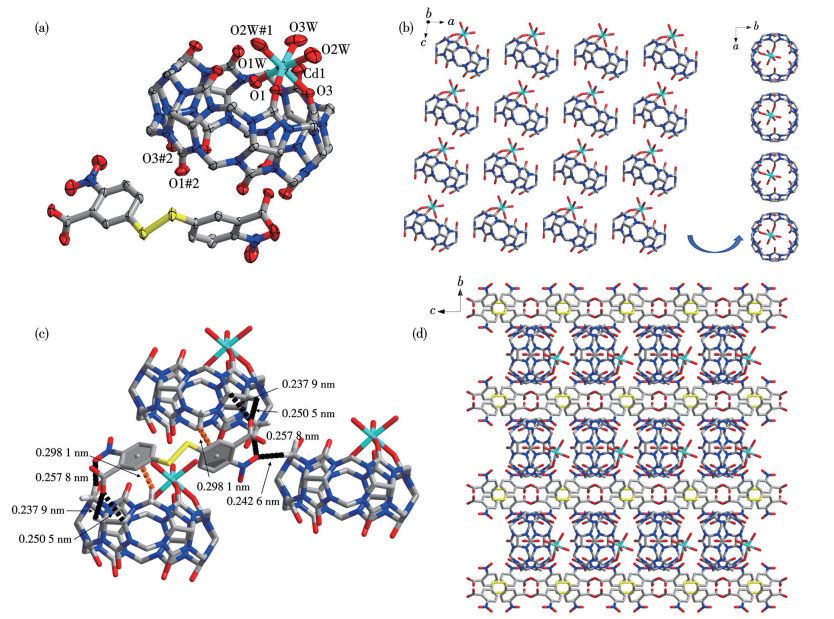
For clarity, the hydrogen atoms are omitted, and the disordered atoms Cd1/water molecules are presented partially; Symmetry codes: #1: 1-x, y, -z; #2: 1-x, y, 1-z.
SC-XRD analysis demonstrated that assembly 2 crystallizes in the monoclinic system with the space group of C2/m and the asymmetric unit contains half of a Cd2+ cation, half of a ligand TNB2-, one-quarter of a Q[6] molecule, and three coordinated water molecules. As exhibited in Fig.2a, the metal ion Cd1 was coordinated with six water molecules (O1W, O1W#1, O2W, O3W, O4W, O5W) in a slightly distorted octahedral geometry. The formed [Cd(H2O)6]2+ cations are located above the center of the two portal of Q[6] molecules to generate capsule-like supramolecular complexes via the hydrogen bonds (O…O 0.260 2, 0.273 0, 0.303 1, 0.309 6 nm) between the coordinated water molecules and carbonyl groups of Q[6] molecules (Fig.2b), which further interact with each other through the π…π interactions (0.339 5 nm) between the carbonyl groups of adjacent Q[6] molecules to afford 2D supramolecular layers (Fig.2b and S2a). On the other hand, the reactant ligand H2DTNB transforms into the sulfide product in the anionic form of TNB2- to maintain the charge balance and interact with each other through C—H…O hydrogen bonds (H…O 0.266 4 nm) and π…π interactions (0.358 6 nm) to form 1D supramolecular chains (Fig.S2b). Similar to assembly 1, electrostatic interactions, O—H…O hydrogen bonds (O…O 0.274 0, 0.308 1, 0.328 1 nm) between the nitro/carboxylate groups of TNB2- and the coordinated water moelcules, and the C—H…π interactions (0.279 2 nm) between the methylene groups of Q[6] and benzene rings of TNB2- all contribute to the formation of the final 3D supramolecular architecture of assembly 2 (Fig.2c, 2d, S2c, and S2d).
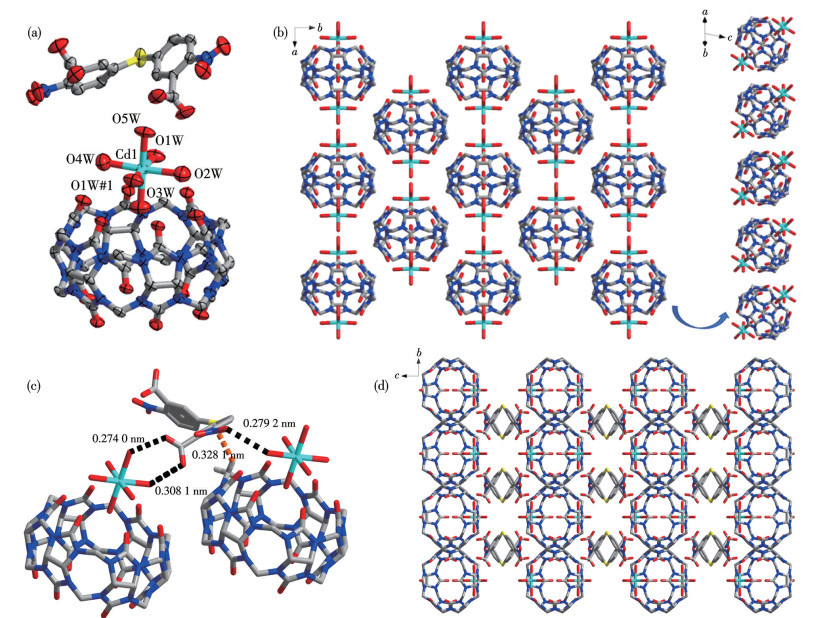
The hydrogen atoms are omitted for clarity; Symmetry code: #1: x, -y+1, z.
SC-XRD experimental results revealed that assembly 3 crystallizes in the triclinic P1 space group, and the asymmetric unit is comprised of one Cd2+ cation, one NSB2- ligand, half of a Q[6] molecule, and five coordinated water molecules. Under the hydrothermal conditions, the disulfide linkage in the raw ligand H2DTNB is broken and oxidized into the sulfonate ligand NSB2-. As shown in Fig.3a, the metal ion Cd1 adopts a slightly distorted six-coordinated octahedral geometry to coordinate with one carboxylate oxygen atom (O13) from NSB2- and five coordinated water molecules (O1W, O2W, O3W, O4W, O5W) to form [Cd(H2O)5(NSB)], which interacts with each other via π…π interactions (0.368 3 nm) between the benzene rings of NSB2- and hydrogen bonds (O…O 0.279 8, 0.279 9 nm) between the carboxylate groups of NSB2- and coordinated water molecules to give 1D Cd-NSB supramolecular chains (Fig.S3a). Moreover, Q[6] molecules are assembled by C—H…O hydrogen bonds (H…O 0.259 7 nm) between the methylene group and carbonyl groups from neighbouring Q[6] molecules, and the π…π interactions (0.366 5 nm) between the carbonyl groups of adjacent Q[6] molecules (Fig.S3b) into 3D supramolecular framework (Fig.3b). Meanwhile, the Cd-NSB chains filled in the pores of 3D Q[6] framework via the C—H…O hydrogen bonds (H…O 0.231 0, 0.245 1, 0.250 0 nm; O…O 0.268 3, 0.274 6, 0.275 6, 0.276 8, 0.281 2, 0.316 8, 0.332 9 nm) between the nitro/sulfonate groups of NSB2- and the methylene/methyne groups of Q[6]s, O—H…O hydrogen bonds (O…O 0.268 3, 0.274 6, 0.275 6, 0.276 8, 0.281 2, 0.316 8, 0.332 9 nm) between the coordinated water molecules and carbonyl groups of Q[6]s, the π…π interactions (0.339 5 nm) between the carbonyl groups of Q[6] and the benzene rings of NSB2- (Fig.3c), generating the final 3D supramolecular framework (Fig.3d, S3c, and S3d).
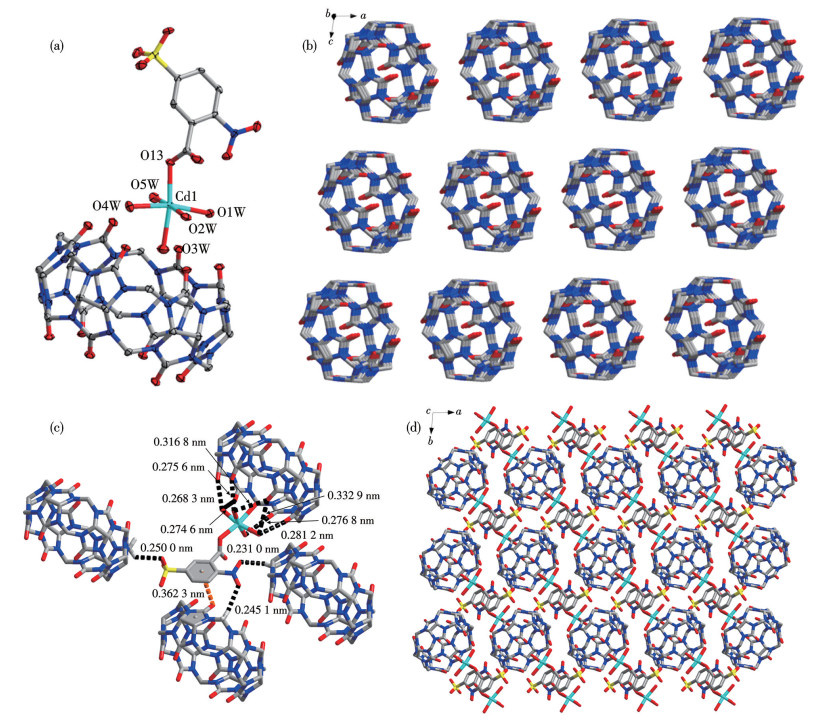
The hydrogen atoms are omitted for clarity.
As mentioned above, supramolecular assemblies 1-3 displayed significantly distinct frameworks. Due to the unique property of the disulfide bond, the ligand H2DTNB transforms into TNB2- or NSB2- under different reaction conditions to generate distinct interactions between these ligands. In assembly 1, the interactions between HDTNB- afford 2D supramolecular layers, while the interactions between TNB2- in assembly 2 give 1D supramolecular chains, and neither HDTNB- nor TNB2- are coordinated to Cd2+. However, in assembly 3, it may be due to the presence of sulfonate groups that result in the coordination between the carboxylate groups of NSB2- with Cd2+, and the interactions between the obtained complexes [Cd(H2O)5(NSB)] generate 1D supramolecular NSB-Cd chains. Meanwhile, the organic ligands HDTNB-, TNB2-, and complex [Cd(H2O)5(NSB)] also induce significantly different interactions with Q[6] molecules and finally produce the markedly distinct architectures of assemblies 1-3. Furthermore, in order to examine the phase purity and the structural consistency of these prepared assemblies with the crystal structure, PXRD measurements were performed at room temperature. As shown in Fig.S4, the experimental PXRD patterns matched well with the simulated ones obtained from the SC-XRD data, which clearly demonstrated that the prepared crystal samples of assemblies 1-3 are a pure phase with the same crystal structure as that described above.
In this work, the reactions between H2DTNB, Q[6], and Cd(NO3)2 afforded three novel supramolecular assemblies 1-3 under different conditions, and the structures of these assemblies were determined by using SC-XRD and PXRD. In assembly 1, ligand H2DTNB is partially deprotonated to form 2D HDTNB- supramolecular layers and interacts with [Cd(H2O)4 (Q[6])]2+ supramolecular layers to form the final 3D supramolecular structure. However, the ligand H2DTNB in assemblies 2 and 3 is completely deprotonated and transformed into TNB2- and NSB2-, respectively. In assembly 2, the formed ligand TNB2- interacts with each other to form 1D supramolecular chains and further assembles with Q[6] and [Cd(H2O)6]2+ to afford the final 3D supramolecular framework. In assembly 3, the transformed ligand NSB2- coordinates with Cd2+ to form complex [Cd(H2O)5(NSB)], which interacts with each other to give 1D supramolecular chains and Q[6] to afford the final 3D supramolecular architecture. The outer-surface interactions between Q[6] and the ligands played a crucial role in the formation of all three assemblies.
LIU Z C, NALLURI S K M, STODDART J F. Surveying macrocyclic chemistry: From flexible crown ethers to rigid cyclophanes[J]. Chem. Soc. Rev., 2017, 46(9): 2459-2478 doi: 10.1039/C7CS00185A
XIA D Y, WANG P, JI X F, KHASHAB N M, SESSLER J L, HUANG F H. Functional supramolecular polymeric networks: The marriage of covalent polymers and macrocycle-based host-guest interactions[J]. Chem. Rev., 2020, 120(13): 6070-6123 doi: 10.1021/acs.chemrev.9b00839
LEE J W, SAMAL S, SELVAPALAM N, KIM H J, KIM K. Cucurbituril homologues and derivatives: New opportunities in supramolecular chemistry[J]. Accounts Chem. Res., 2003, 36(8): 621-630 doi: 10.1021/ar020254k
LAGONA J, MUKHOPADHYAY P, CHAKRABARTI S, ISAACS L. The cucurbit[n]uril family[J]. Angew. Chem. ‒Int. Edit., 2005, 44(31): 4844-4870 doi: 10.1002/anie.200460675
ISAACS L. Cucurbit[n]urils: From mechanism to structure and function[J]. Chem. Commun., 2009, (6): 619-629 doi: 10.1039/B814897J
MASSON E, LING X X, JOSEPH R, KYEREMEH-MENSAH L, LU X Y. Cucurbituril chemistry: A tale of supramolecular success[J]. RSC Adv., 2012, 2(4): 1213-1247 doi: 10.1039/C1RA00768H
FREEMAN W A, MOCK W L, SHIH N Y. Cucurbituril[J]. J. Am. Chem. Soc., 1981, 103(24): 7367-7369 doi: 10.1021/ja00414a070
MACARTNEY D H. Encapsulation of drug molecules by cucurbiturils: Effects on their chemical properties in aqueous solution[J]. Isr. J. Chem., 2011, 51(5/6): 600-615
LIU Y L, YANG H, WANG Z Q, ZHANG X. Cucurbit[8]uril-based supramolecular polymers[J]. Chem. ‒Asian J., 2013, 8(8): 1626-1632 doi: 10.1002/asia.201300151
KAIFER A E. Toward reversible control of cucurbit[n]uril complexes[J]. Accounts Chem. Res., 2014, 47(7): 2160-2167 doi: 10.1021/ar5001204
PAZOS E, NOVO P, PEINADOR C, KAIFER A E, GARCÍA M D. Cucurbit[8]uril (CB[8])-based supramolecular switches[J]. Angew. Chem. ‒Int. Edit., 2019, 58(2): 403-416 doi: 10.1002/anie.201806575
AMBROSE B, KATHIRESAN M. Viologen-cucurbit[n]uril supramolecular interactions: A comprehensive overview[J]. Chem. Commun., 2025, 61(67): 12467-12490 doi: 10.1039/D5CC03120F
ASSAFA K I, NAU W M. Cucurbiturils: From synthesis to high-affinity binding and catalysis[J]. Chem. Soc. Rev., 2015, 44(2): 394-418 doi: 10.1039/C4CS00273C
TANG B H, ZHAO J T, XU J F, ZHANG X. Cucurbit[n]urils for supramolecular catalysis[J]. Chem. ‒Eur. J., 2020, 26(67): 15446-15460 doi: 10.1002/chem.202003897
BARROW S J, KASERA S, ROWLAND M J, DEL BARRIO J, SCHERMAN O A. Cucurbituril-based molecular recognition[J]. Chem. Rev., 2015, 115(22): 12320-12406 doi: 10.1021/acs.chemrev.5b00341
URBACH A R, RAMALINGAM V. Molecular recognition of amino acids, peptides, and proteins by cucurbit[n]uril receptors[J]. Isr. J. Chem., 2011, 51(5/6): 664-678
NI X L, XIAO X, CONG H, LIANG L L, CHENG K, CHENG X J, JI N N, ZHU Q J, XUE S F, TAO Z. Cucurbit[n]uril-based coordination chemistry: From simple coordination complexes to novel poly-dimensional coordination polymers[J]. Chem. Soc. Rev., 2013, 42(24): 9480-9508 doi: 10.1039/c3cs60261c
LÜ J, LIN J X, CAO M N, CAO R. Cucurbituril: A promising organic building block for the design of coordination compounds and beyond[J]. Coord. Chem. Rev., 2013, 257(7/8): 1334-1356
NI X L, XUE S F, TAO Z, ZHU Q J, LINDOY L F, WEI G. Advances in the lanthanide metallosupramolecular chemistry of the cucurbit[n]urils[J]. Coord. Chem. Rev., 2015, 287: 89-113 doi: 10.1016/j.ccr.2014.12.018
CONG H, ZHU Q J, XUE S F, TAO Z, WEI G. Direct coordination of metal ions to cucurbit[n]urils[J]. Chin. Sci. Bull., 2010, 55(32): 3633-3640 doi: 10.1007/s11434-010-4146-8
SOKOLOV M N, DYBTSEV D N, FEDIN V P. Supramolecular compounds of cucurbituril with molybdenum and tungsten chalcogenide cluster aqua complexes[J]. Russ. Chem. Bull., 2003, 52(5): 1041-1060 doi: 10.1023/A:1024771902420
GAO R H, HUANG Y, CHEN K, TAO Z. Cucurbit[n]uril/metal ion complex-based frameworks and their potential applications[J]. Coord. Chem. Rev., 2021, 437: 213741 doi: 10.1016/j.ccr.2020.213741
ZHANG S, GRIMM L, MISKOLCZY Z, BICZÓK L, BIEDERMANN F, NAU W M. Binding affinities of cucurbit[n]urils with cations[J]. Chem. Commun., 2019, 55(94): 14131-14134 doi: 10.1039/C9CC07687E
NI X L, XIAO X, CONG H, ZHU Q J, XUE S F, TAO Z. Self-assemblies based on the "outer-surface interactions" of cucurbit[n]urils: New opportunities for supramolecular architectures and materials[J]. Accounts Chem. Res., 2014, 47(4): 1386-1395 doi: 10.1021/ar5000133
ZHU Q J, XUE S F, TAO Z. Supramolecular coordination polymers based on the outer-surface interaction of cucurbit[n]urils[J]. Prog. Chem., 2015, 27(6): 625-632
CHEN K, HUA Z Y, ZHAO J L, REDSHAW C, TAO Z. Construction of cucurbit[n]uril-based supramolecular frameworks via host-guest inclusion and functional properties thereof[J]. Inorg. Chem. Front., 2022, 9(12): 2753-2809 doi: 10.1039/D2QI00513A
HUANG Y, GAO R H, LIU M, CHEN L X, NI X L, XIAO X, CONG H, ZHU Q J, CHEN K, TAO Z. Cucurbit[n]uril-based supramolecular frameworks assembled through outer-surface interactions[J]. Angew. Chem. ‒Int. Edit., 2021, 133(28): 15294-15319 doi: 10.1002/ange.202002666
ZHANG X D, CHEN K, SUN W Y. Potential applications of cucurbit[n]urils and their derivatives in the capture of hazardous chemicals[J]. Chem. ‒Eur. J., 2021, 27(16): 5107-5119 doi: 10.1002/chem.202004711
TIAN F Y, CHENG R X, ZHAO H J, LI C J, CHEN K. Enhanced ternary composite system potassium-cucurbit[6]uril-ruthenium metal-support interactions in a heterogeneous system to facilitate photocatalytic nitrogen activation[J]. Small Methods, 2025, 36(7/8): 224-234
THUÉRY P. Coordination polymers and frameworks in uranyl ion complexes with sulfonates and cucurbit[6]uril[J]. Cryst. Growth Des., 2011, 11(2): 5702-5711
CHEN K, KANG Y S, ZHAO Y, YANG J M, LU Y, SUN W Y. Cucurbit[6]uril-based supramolecular assemblies: Possible application in radioactive cesium cation capture[J]. J. Am. Chem. Soc., 2014, 136(48): 16744-16747 doi: 10.1021/ja5098836
ZHANG X D, ZHAO Y, CHEN K, WANG P, KANG Y S, WU H, SUN W Y. Cucurbit[6]uril-based multifunctional supramolecular assemblies: Synthesis, removal of Ba and fluorescence sensing of Fe[J]. Dalton Trans., 2018, 47(11): 3958-3964 doi: 10.1039/C8DT00182K
KOVALENKO E A, NAUMOV D Y, FEDIN V P. Coordination networks and supramolecular assemblies based on barium cation complexes with cucurbit[6]uril[J]. Polyhedron, 2018, 144: 158-165 doi: 10.1016/j.poly.2018.01.021
SUN J P, GUO P P, LIU M, LI H. A novel cucurbit[6]uril-based supramolecular coordination assembly as a multi-responsive luminescent sensor for Fe3+, Cr2O72- and isoquinoline antibiotics in aqueous medium[J]. J. Mater. Chem. C, 2019, 7(29): 8992-8999 doi: 10.1039/C9TC02666E
AN S W, MEI L, HU K Q, ZHANG Z H, XIA C Q, CHAI Z F, SHI W Q. Noncomplexed cucurbituril-mediated structural evolution of layered uranyl terephthalate compounds[J]. Inorg. Chem., 2020, 59(1): 943-955 doi: 10.1021/acs.inorgchem.9b03215
ZHANG X D, FANG F, HUANG M Y, CHEN K. Construction of cucurbit[6]uril-based coordination polymers incorporating multiaromatic ligands with amide linkages and their iodine adsorption properties[J]. Cryst. Growth Des., 2024, 24(11): 4322-4332 doi: 10.1021/acs.cgd.3c01389
CAO J, GU J Y, DING W Y, CHEN X R, HUA Z Y, CHEN K. Carboxylate ligand-directed synthesis of cucurbit[5]uril-based coordination polymers for the detection of norfloxacin[J]. Dalton Trans., 2025, 54(40): 15197-15205 doi: 10.1039/D5DT01769F
KIM J, JUNG I S, KIM S Y, LEE E, KANG J K, SAKAMOTO S, YAMAGUCHI K, KIM K. New cucurbituril homologues: Syntheses, isolation, characterization, and X-ray crystal structures of cucurbit[n]uril (n=5, 7, and 8)[J]. J. Am. Chem. Soc., 2000, 122(3): 540-541 doi: 10.1021/ja993376p
SAINT. Program for data extraction and reduction[CP]. Bruker AXS, Inc, Madison, WI, 2001.
SHELDRICK G M. SADABS, Program for empirical adsorption correction of area detector data[CP]. University of Göttingen, Germany, 2003.
SHELDRICK G M. SHELXT-2018, Program for the crystal structure solution[CP]. University of Göttingen, Germany, 2018.
SHELDRICK G M. SHELXL-2018, Program for the crystal structure refinement[CP]. University of Göttingen, Germany, 2018.

Figure 1 (a) Coordination environment of Cd2+ in assembly 1 with the ellipsoids drawn at the 50% probability level; (b) Structure of the 2D supramolecular Q[6]-; Cd layer; (c) Noncovalent interactions among ligand HDTNB- and the outer surfaces of Q[6] molecules; (d) Structure of the 3D Q[6]-; Cd-; HDTNB supramolecular framework
For clarity, the hydrogen atoms are omitted, and the disordered atoms Cd1/water molecules are presented partially; Symmetry codes: #1: 1-x, y, -z; #2: 1-x, y, 1-z.

Figure 2 Coordination environment of Cd2+ in assembly 2 with the ellipsoids drawn at the 50% probability level; (b) Structure of the 2D supramolecular Q[6]-; Cd layer; (c) Noncovalent interactions among ligand TNB2-, Cd(H2O)6]2+, and Q[6]; (d) Structure of the final 3D framework of assembly 2
The hydrogen atoms are omitted for clarity; Symmetry code: #1: x, -y+1, z.

Figure 3 (a) Coordination environment of Cd2+ in assembly 3 with the ellipsoids drawn at the 50% probability level; (b) Structure of the 3D supramolecular framework constructed from Q[6] molecules; (c) Noncovalent interactions between complex [Cd(H2O)5(NSB)] and Q[6]; (d) Structure of the final 3D framework
The hydrogen atoms are omitted for clarity.
Table 1. Crystal data and structure refinements for assemblies 1-3
| Parameter | 1 | 2 | 3 |
| Chemical formula | C64H64CdN28O35S4 | C64H80Cd2N28O44S2 | C50H64Cd2N26O36S2 |
| Formula weight | 2 026.03 | 2 234.43 | 1 894.19 |
| T / K | 296(2) | 296(2) | 296(2) |
| Crystal system | Monoclinic | Monoclinic | Triclinic |
| Space group | C2/m | C2/m | P1 |
| a / nm | 1.255 07(10) | 1.512 0(5) | 1.195 87(14) |
| b / nm | 3.049 5(2) | 1.984 4(7) | 1.247 43(15) |
| c / nm | 1.059 97(8) | 1.680 3(6) | 1.289 58(15) |
| α / (°) | 94.325(3) | ||
| β / (°) | 99.594 0(10) | 104.341(10) | 98.633(3) |
| γ / (°) | 94.677(3) | ||
| Volume / nm3 | 4.000 1(5) | 4.884(3) | 1.888 1(4) |
| Z | 2 | 2 | 1 |
| Dc / (g·cm-3) | 1.637 | 1.470 | 1.666 |
| μ / mm-1 | 0.483 | 0.575 | 0.727 |
| F(000) | 2 012 | 2 200 | 962 |
| Reflection collected | 17 350 | 16 229 | 13 368 |
| Independent reflection | 4 754 | 5 708 | 8 478 |
| Data, Nres, Npara | 4 754, 71, 316 | 5 708, 54, 321 | 8 478, 0, 533 |
| GOF | 0.981 | 1.076 | 1.031 |
| R1b, wR2c [I > 2σ(I)] | 0.086 9, 0.260 1 | 0.070 7, 0.203 4 | 0.051 3, 0.148 9 |
| R1, wR2 (all data) | 0.097 2, 0.271 3 | 0.091 3, 0.216 4 | 0.069 2, 0.159 9 |
| a Nres=number of restraints, Npar=number of parameters; b R1=∑||Fo|-|Fc||/∑|Fo|; c wR2={∑[w(Fo2-Fc2)2/(Fo2)2]}1/2, where w=1/[∑2(Fo2)+(aP)2+bP], P=(Fo2+2Fc2)/3. | |||
 下载: 导出CSV

 扫一扫看文章


扫一扫关注我们
 下载:
下载: