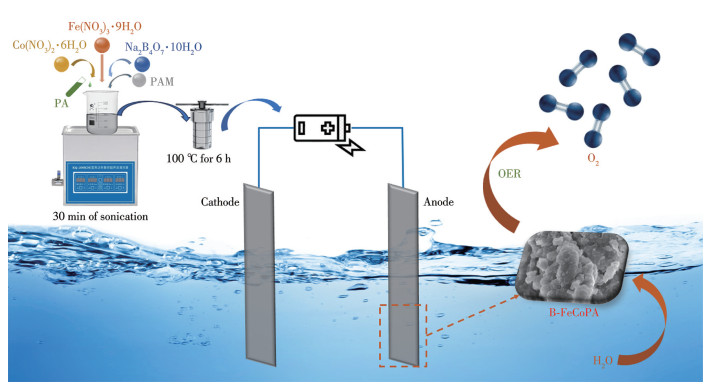
Scheme 1.
Schematic illustration of the preparation process of B-FeCoPA and the OER mechanism

B-doped FeCo phytate complex as an efficient electrocatalyst for oxygen evolution reaction
Haoying ZHAI , Jing WEI , Wenjie LIAO , Jiarui HUANG , Yangli EQI , Weimin GUO , Wenjun ZHOU


The overuse of fossil fuels has triggered a global energy crisis and environmental pollution, driving worldwide consensus on carbon neutrality. Hydrogen energy, with its zero-carbon emissions and high energy density, is recognized as an ideal energy carrier for future sustainable societies. Electrocatalytic water splitting is acknowledged as a green hydrogen-production technology, consisting of two half-reactions: the hydrogen evolution reaction (HER) at the cathode and the oxygen evolution reaction (OER) at the anode[1-2]. Compared to HER, OER involves a more complex multi-electron transfer process and exhibits slower kinetics, which limits the overall energy efficiency of the water electrolysis system[3]. Currently, precious metal-based oxides such as IrO2 and RuO2 are regarded as efficient commercial OER catalysts, which can significantly reduce kinetic energy barriers, thereby lowering the overpotential and improving the energy conversion efficiency. However, their scarcity and high cost severely hinder their large-scale utilization in industrial scenarios[4-5]. Therefore, there is an urgent need to develop cost-effective, efficient, and durable non-precious-based electrocatalysts for OER.
To date, considerable research has focused on transition metal-based electrocatalysts, especially those based on iron-group metals (Fe, Co, Ni), owing to their unique outer electronic structures and tunable properties[6-8]. Among these, bimetallic-based catalysts (such as FeCo-, FeNi-, and CoNi-based) have demonstrated improved OER activity compared to their monometallic counterparts, which can be attributed to the distinct geometric, electronic, and synergistic effects between the binary active metal sites[9-12]. However, many bimetallic electrocatalysts are prone to self-aggregation and structural degradation during electrocatalytic processes, leading to surface passivation, reduced active-site availability, and compromised electrical conductivity, ultimately impairing OER performance[13-14]. To overcome the aforementioned problems, metal coordination complexes assembled from metal and organic ligands (particularly those derived from eco-friendly, low-cost, and readily available natural organic ligands) have garnered significant attention in the OER field due to their straightforward synthesis, unsaturated coordination structure, and high specific surface areas[15-16]. Phytic acid (PA), a natural organic phosphorus compound derived from plant seeds and grains, exhibits strong metal-chelating ability owing to its six negatively charged phosphate groups, facilitating the formation of coordination complexes (M-PA)[17-19]. These M-PA complexes display low toxicity, structural tunability, and good biocompatibility, making them promising for diverse applications, including flame-retardant materials, energy-storage systems, and biomedical devices[20-22]. For instance, Feng et al. synthesized PA-FeCo bimetallic metal-organic gels derived from PA and mixed transition metal ions (Fe3+ and Co2+), and the corresponding aerogels are further partially reduced with NaBH4, which showed electrocatalytic OER performance with the low overpotential of 257 mV at the current density of 20 mA·cm-2 and a small Tafel slope of 36 mV·dec-1 [23]. However, when employed as OER electrocatalysts, M-PA materials suffer from unsatisfactory performance due to inherent limitations such as poor electrical conductivity and inadequate exposure of active sites[24]. Instead, introducing heteroatoms (such as B, N, P, and S) into electrocatalysts can effectively modulate the electronic structure, increase the exposure of active edge sites, and change the adsorption free energy of intermediates (O* and OH*), thus promoting the electron transfer and significantly enhancing OER performance[6, 25-27]. Notably, boron exhibits an intermediate electronegativity (Pauling scale: 2.04) between that of metals and non-metals, which enables the formation of diverse bonding configurations such as M—B and B—O. Furthermore, its electron-deficient character promotes electron withdrawal from neighboring metal atoms, resulting in an elevated oxidation state of the metal centers. This electronic redistribution induces lattice distortion and generates additional active sites, thereby enhancing OER activity[6].
Inspired by the aforementioned aspects, boron-doped FeCo phytate (B-FeCoPA) materials as an OER electrocatalyst were synthesized using a facile hydrothermal method. Compared with other comparative materials, boron doping in the B-FeCoPA catalyst induces a synergistic interaction among B, Fe, and Co species. This interaction effectively modulates the electronic structure and introduces defects, thereby promoting electron delocalization and charge transport, which collectively enhance the OER activity. The as-prepared B-FeCoPA nanosheets exhibit good electrocatalytic OER performance in 1.0 mol·L-1 KOH solution, offering a promising strategy for developing cost-effective and efficient energy storage and conversion materials (Scheme 1).
Cobalt nitrate hexahydrate (Co(NO3)2·6H2O), iron nitrate hexahydrate (Fe(NO3)3·9H2O), polyacrylamide (PAM), sodium phytate (C6H6Na12O24P6, NaPA), sodium tetraborate decahydrate (Na2B4O7·10H2O), anhydrous ethanol, and isopropyl alcohol were purchased from Chengdu Chron Chemicals Co., Ltd. Potassium hydroxide (KOH) was purchased from Chengdu Jinshan Chemical Reagent Co., Ltd. All the above-mentioned chemicals were of analytical grade and used without further purification. 20% Pt/C, Nafion solution (5%, D520, DuPont), and carbon paper were purchased from Shanghai Hesen Electric Co., Ltd. Ultra-pure (UP) water (18.25 MΩ·cm, 25 ℃) used throughout the experiments was prepared with UPT-Ⅱ-20T ultra-pure water machine (Sichuan ULUPURE Ultra-pure Technology Co., Ltd.).
B-FeCoPA and comparative materials were synthesized via a hydrothermal method. Typically, 0.084 5 g Fe(NO3)3·9H2O, 0.236 6 g Co(NO3)2·6H2O, 0.197 6 g Na2B4O7·10H2O, and 0.243 1 g PAM at a molar ratio of 2∶8∶5∶5 were dissolved in 17 mL of UP water. 8 mL of a 0.1 mol·L-1 NaPA solution was then added, and the mixture was ultrasonicated for 30 min. The resulting solution was transferred into a Teflon-lined autoclave and heated at 100 ℃ for 6 h. After cooling, the precipitate was collected and washed several times with UP water. And the as-prepared B-FeCoPA materials were dried at 50 ℃. Comparative materials (FeCoPA, B-CoPA, and B-FePA) were synthesized following the same procedure without adding the corresponding elemental precursors.
The morphology of the materials was examined using a field-emission scanning electron microscope (SEM, Regulus 8100, 5.0 kV) with an energy-dispersive X-ray spectrometer (20 kV). The crystal structure and phase composition were characterized by X-ray diffractometer (DX-2700) using Cu Kα radiation with the scanning range of 10°-70° (λ=0.154 06 nm, a working voltage of 40 kV, and a working current of 30 mA). The surface chemical composition and elemental valence states were analyzed by X-ray photoelectron spectrometer (Escalab 250Xi, Al Kα, 1 486.6 eV). The Functional groups and chemical bonds were identified using a Fourier transform infrared spectrometer (WQF-510A, KBr pellets). The elemental composition of the as-synthesized materials was quantitatively analyzed by inductively coupled plasma optical emission spectroscopy (ICP-OES, Agilent 730). The Brunauer-Emmett-Teller (BET) surface areas were evaluated by an Autosorb iQ2 surface area analyzer (USA) based on N2 adsorption-desorption isotherms at 77.35 K. The pore-size distributions were obtained from Barrett-Joyner-Halenda (BJH) analysis.
Electrochemical measurements were systematically conducted on a CHI660E electrochemical workstation (Shanghai Chenhua Instrument Co., Ltd., China) to evaluate the conductive behavior of the synthesized materials. A standard three-electrode configuration was employed in 1.0 mol·L-1 KOH electrolyte, comprising a Pt foil counter electrode, a HgO/Hg reference electrode, and a B-FeCoPA-modified glassy carbon working electrode (0.07 cm2). The working electrode was prepared by dispersing 4.0 mg of B-FeCoPA in a homogeneous mixture of 375 μL UP water, 125 μL isopropanol, and 10 μL Nafion solution (5%). A uniform ink was obtained after a 30 min ultrasonic treatment. Then, 4 μL of the resulting ink was drop-cast onto a pre- polished glassy carbon electrode and dried under ambient conditions to obtain the B-FeCoPA working electrode.
The measured potential (E) related to the Hg/HgO electrode was converted into the potential (E0) relative to the reversible hydrogen electrode (RHE) via the following equation:
|
|
(1) |
The overpotential η (V) was calculated using the following equation:
|
|
(2) |
Linear sweep voltammetry (LSV) was conducted at a scan rate of 50 mV·s-1 within a potential range of 0.92-1.72 V (vs RHE). The Tafel slopes were obtained from linear fitting of the polarization curves using the Tafel equation: η=a+blg j, where η, a, b, and j denote the overpotential, Tafel intercept, Tafel slope, and current density, respectively. Cyclic voltammetry (CV) was performed between 0.35 and 0.45 V (vs Hg/HgO) at scan rates of 2, 5, 10, 20, 50, and 100 mV·s-1. The electrochemically active surface area (ESCA) was calculated based on the capacitive current measured at 0.365 V. Electrochemical impedance spectroscopy (EIS) measurements were performed to assess the conductive properties and electron transfer kinetics of the synthesized electrocatalysts. The tests were carried out at an initial potential of 0.65 V (vs Hg/HgO) over a frequency range of 0.01 Hz to 100 kHz with an amplitude of 5 mV. Chronoamperometry was performed to estimate catalyst stability at a constant current density of 10 mA·cm-2. Energy consumption was evaluated in a two-electrode setup using 20% Pt/C as the cathode and B-FeCoPA-modified carbon paper as the anode in 6.0 mol·L-1 KOH at 70 ℃. Partial polarization curves were corrected for an ohmic drop according to Ecor=Emea-iRs, where Ecor denotes the iR-corrected potential, Emea represents the measured potential, and Rs is the equivalent series resistance derived from the EIS.
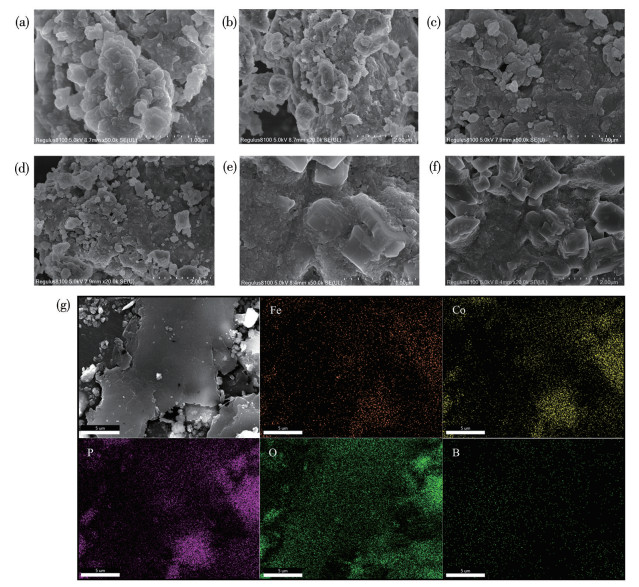
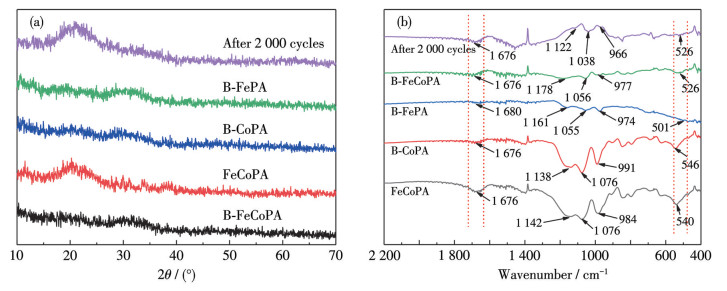
The morphology of B-FeCoPA and the comparative materials was analyzed by SEM. FeCoPA materials were composed of closely packed nanosheets (Fig.1a and 1b). In contrast, the B-FeCoPA nanosheets (Fig.1c and 1d) exhibited obviously reduced nanosheet dimensions, increased irregular rough surfaces, and a porous architecture. These structural characteristics promote the exposure of active sites, improve electrolyte accessibility, facilitate mass transport, and consequently enhance OER activity[28-30]. Energy-dispersive X-ray (EDS) mapping patterns (Fig.1g) demonstrated the distribution of Fe, Co, P, O, and B elements throughout B-FeCoPA, confirming the successful B incorporation. This B doping effectively modulates the electronic structure, promoting charge and mass transfer and thereby enhancing the OER catalytic activity[31-32]. Powder X-ray diffraction (PXRD) analysis was performed to characterize the crystal structures of B-FePA, B-CoPA, FeCoPA, and B-FeCoPA. As illustrated in Fig.2a, all materials exhibited broad and weak diffraction peaks at around 20°, confirming their low crystallinity and predominantly amorphous nature. This structural feature facilitates the exposure of more active sites and accelerates mass transfer during catalysis[29-30].
FTIR spectroscopy was employed to analyse the chemical bonding and functional groups of the synthesized materials (Fig.2b). For B-FeCoPA, the peaks near 977, 1 056, and 1 178 cm-1 are attributed to the stretching vibrations of P—O, P—O—C, and P=O bonds, respectively, indicating the existence of PA[19, 33-34]. The peak at approximately 1 676 cm-1 is assigned to the bending vibration of the P—O—H bond[17, 19]. And the peak near 519 cm-1 corresponds to the stretching vibration of P—O—M, suggesting the coordination interaction between the Fe3+/Co2+ and PA[18, 35]. Compared with B-FePA, B-CoPA, and FeCoPA, all the absorption peaks of B-FeCoPA had slight shifts, further illustrating the interaction between Fe3+/Co2+ and PA[23]. In addition, the stretching vibration peak of P—O—M at 542 cm-1 was red-shifted to 526 cm-1, indicating the increased coordination interaction between metal ions and PA[18, 23]. The N2 adsorption-desorption isotherm method was performed to estimate the specific surface area and pore size distribution of FeCoPA and B-FeCoPA. As detailed in Fig.S1a (Supporting information), both FeCoPA and B-FeCoPA indicated the typical type Ⅳ curve with H3 hysteresis loops at high relative pressure, confirming their mesoporous characteristics[36-37]. And B-FeCoPA exhibited a larger specific surface area (11 m2·g-1) compared to that of FeCoPA (4 m2·g-1), further verifying that boron doping effectively modulates the geometric configuration and electronic structure of B-FeCoPA. BJH analysis of the pore size distribution (Fig.S1b) revealed an identical average pore diameter of 3.84 nm for both FeCoPA and B-FeCoPA. In contrast, their pore volumes differed significantly, with values of 0.013 cm3·g-1 for FeCoPA and 0.042 cm3·g-1 for B-FeCoPA, respectively. The above results demonstrate that the densely stacked nanosheet architecture may account for the relatively modest specific surface area of B-FeCoPA. Moreover, the significantly larger pore volume at an identical pore size implies higher porosity, which not only provides abundant active sites but also establishes efficient mass transport channels. This enhanced structure promotes full contact between the electrolyte and the active centers, thereby significantly improving the electrocatalytic performance[30].
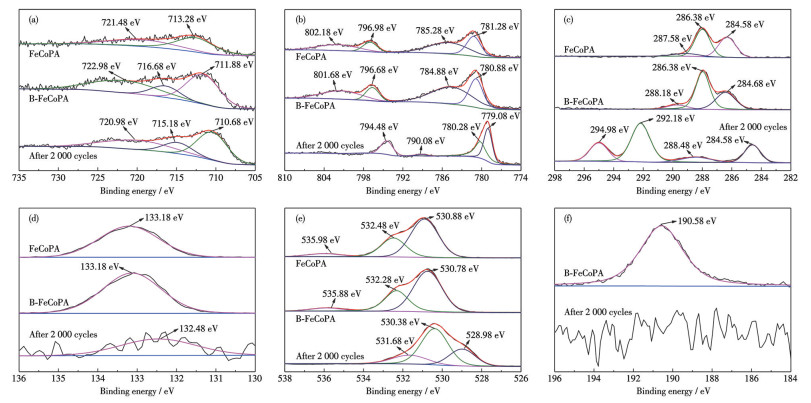
X-ray photoelectron spectroscopy (XPS) analysis was carried out to gain insight into the surface chemical composition and electronic interaction. As illustrated in Fig.S2, the XPS survey spectrum confirmed the presence of Fe, Co, C, P, and O elements in the FeCoPA catalyst, whereas the spectrum of B-FeCoPA additionally showed a distinct boron signal, confirming the successful incorporation of B into the catalyst. The high-resolution Fe2p spectra for FeCoPA and B-FeCoPA showed different characteristic peaks (Fig.3a). For FeCoPA, the peaks located at 713.28 and 721.48 eV are assigned to Fe2p3/2 and Fe2p1/2, corresponding to Fe3+ and Fe2+, respectively[15, 38]. While the Fe2p spectrum of B-FeCoPA can be devolved into three peaks with the binding energies of 711.88, 716.68, and 722.98 eV, where the peaks at 711.88 and 722.98 eV are attributed to Fe2p3/2 and Fe2p1/2, respectively, and the peak at 716.68 eV is ascribed to the shake-up satellite peak, implying the presence of Fe3+ [15, 39-40]. As shown in the Co2p XPS spectrum of B-FeCoPA (Fig.3b), the binding energies at 780.88 and 796.68 eV belong to Co2p3/2 and Co2p1/2, respectively, and the binding energies of 784.88 and 801.68 eV correspond to the satellite peaks of Co2p3/2 and Co2p1/2, respectively, suggesting that the Co element exists in the form of Co2+ [38]. It is noteworthy that the peaks of Co2p in B-FeCoPA shifted to the lower regions compared with FeCoPA, revealing that the electronic structure of FeCoPA is regulated by the incorporation of B[15, 40]. In contrast, the peaks of Fe2p shifted to high regions. This might be due to Fe3+ with a stable half-filled (3d5) electronic configuration and the high electronegativity of B (2.04), which enables B to easily absorb electrons from Fe3+, resulting in a further increase in the effective positive charge of Fe[6, 41-42]. The C1s spectra of FeCoPA and B-FeCoPA can be fitted to three similar characteristic peaks (Fig.3c). For B-FeCoPA, the peaks at 284.68, 286.38, and 288.18 eV are ascribed to C—C, C—O, and C=O, respectively[15, 17, 38]. The high-resolution P2p spectra of FeCoPA and B-FeCoPA (Fig.3d) displayed characteristic peaks at 133.18 eV, corresponding to the P—O bonds in the PA structure[34, 43]. For the O1s spectra of FeCoPA and B-FeCoPA (Fig.3e), the peaks at approximately 530.78 and 532.28 eV correspond to the M—O and P—O/C—O bonds, respectively[44-47]. The peak at around 535.88 eV corresponds to chemisorbed oxygen and/or water[48-49]. In the B1s spectra (Fig.3f), the peak at 190.58 eV belongs to B—O bonds[50-51], signifying that B atoms successfully entered the amorphous structure of B-FeCoPA. Furthermore, ICP-OES analysis determined the elemental composition (mass fraction, %) of the catalyst as Fe (3.27%), Co (11.96%), P (12.84%), and B (0.16%). Even at this trace content, B incorporation can effectively tune both the material′s geometric structure and the local electronic environment of Fe/Co active centers, thus improving the OER performance[52].
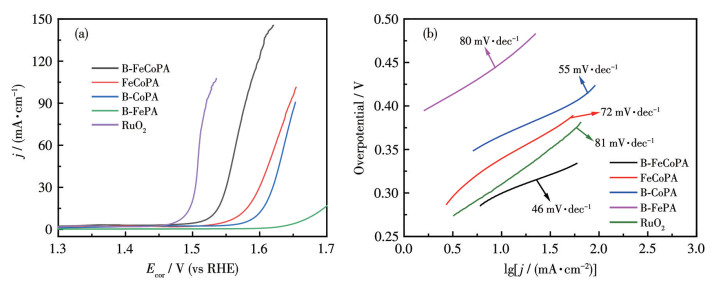
The electrocatalytic OER performance of B-FeCoPA and comparative materials was evaluated using linear scanning voltammetry (LSV) in 1.0 mol·L-1 KOH electrolyte. Current density represents a critical metric for assessing the effectiveness of electrocatalysts for OER. As shown in Fig.4a and Fig.S3, the current density of B-FeCoPA at 1.62 V (vs RHE) was 145 mA·cm-2, which was obviously superior to those of comparative materials (the current densities of FeCoPA, B-CoPA, and B-FePA were 101, 91, and 22 mA·cm-2 at 1.65, 1.65, and 1.71 V, respectively). The overpotentials of B-FeCoPA at current densities of 10, 50, and 100 mA·cm-2 were 299, 330, and 354 mV, respectively. In contrast, FeCoPA required significantly higher overpotentials of 339, 386, and 423 to reach the same current densities, demonstrating its substantially inferior electrocatalytic performance. These comparative results indicate that the synergistic interactions among several elements induced by boron incorporation effectively modulate the electronic environment of Fe and Co centers, facilitate electron/ion transfer, and consequently enhance the OER performance of B-FeCoPA[37]. Tafel analysis was carried out to elucidate the reaction mechanism and kinetics of the redox process, and also served as a useful criterion for evaluating and comparing the electrocatalytic OER performance of B-FeCoPA with other materials[19]. As shown in Fig.4b, B-FeCoPA exhibited a Tafel slope of 46 mV·dec-1, significantly lower than those of FeCoPA (72 mV·dec-1), B-CoPA (55 mV·dec-1), and B-FePA (80 mV·dec-1), implying the favorable OER kinetics of B-FeCoPA, and further confirming that the synergistic interaction among B, Fe, and Co, enabled by boron incorporation, facilitates charge transfer and promotes the water oxidation reaction[53]. Additionally, B-FeCoPA demonstrated a lower overpotential and a smaller Tafel slope compared to some recently reported FeCo-based electrocatalysts (Table S1), also showing the good OER catalytic activity of B-FeCoPA. Obviously, the introduction of B effectively modulates the electronic structure of the Fe/Co active centers, which facilitates electron transfer and lowers the adsorption energy for O* and OH* intermediates, thereby accelerating the reaction kinetics in the OER[41, 52, 54].
To further investigate the charge transfer kinetics during the OER process, the EIS study of B-FeCoPA and other contrasting materials was performed. The Nyquist plots (Fig.5a) reveal that B-FeCoPA exhibited a smaller semicircle diameter and lower charge-transfer resistance (Rct) (Fig.5b) compared to the comparative catalysts, corroborating its superior electron transport capability under electrocatalytic conditions[55]. Similarly, the ECSA, which is proportional to the double-layer capacitance (Cdl), serves as a key parameter for evaluating the intrinsic electrocatalytic activity[56-57]. The Cdl values of electrocatalysts were determined by linearly fitting the CV curves at various scan rates (Fig.S4a-S4d). As shown in Fig.5c, the Cdl of B-FeCoPA (52.2 mF·cm-2) was larger than those of FeCoPA (36.2 mF·cm-2), B-CoPA (16.5 mF·cm-2), and B-FePA (1.4 mF·cm-2). The results further confirm that the larger ECSA of B-FeCoPA contributes to increased exposure of active sites and promotes ion/electron transport across the electrode-electrolyte interface, consequently enhancing the overall reaction kinetics[58]. The turnover frequency (TOF) was calculated to assess the intrinsic catalytic activity of B-FeCoPA. As summarized in Table S2, the TOF values for both Fe- and Co-related active sites in B-FeCoPA significantly surpassed those in FeCoPA, confirming the enhanced intrinsic activity of the boron-doped catalyst. Furthermore, contact angle measurements were conducted to evaluate the surface wettability of the electrodes. As shown in Fig.S5, both sheet-like materials B-FeCoPA and FeCoPA showed relatively low contact angles, indicating hydrophilic surfaces. Notably, B-FeCoPA exhibited enhanced hydrophilicity with a contact angle of 11.8°, significantly lower than that of FeCoPA (25.5°). This improved wettability promotes more full contact between the catalyst and electrolyte, facilitating rapid charge transfer and thereby enhancing the OER catalytic performance[40]. Stability serves as a critical indicator for assessing the overall catalytic performance of electrocatalysts. The durability of B-FeCoPA was evaluated by chronopotentiometry at 10 mA·cm-2 for 10 h (Fig. 5d). The potential remained stable around 1.52 V (vs RHE), demonstrating good operational stability. This stability can be attributed to the structural reinforcement effect induced by B incorporation. Specifically, the formation of shorter and higher-energy B—O bonds (vs P—O bonds) likely rearranges the amorphous network, thereby enhancing the overall cohesion and structural integrity of B-FeCoPA under operating conditions. The stability was further verified in a practical electrode configuration. B-FeCoPA dispersed on carbon fiber paper (CFP) maintained a constant potential over a 24-h test (Fig.S6), confirming that the durability imparted by B doping is maintained across different electrode architectures.
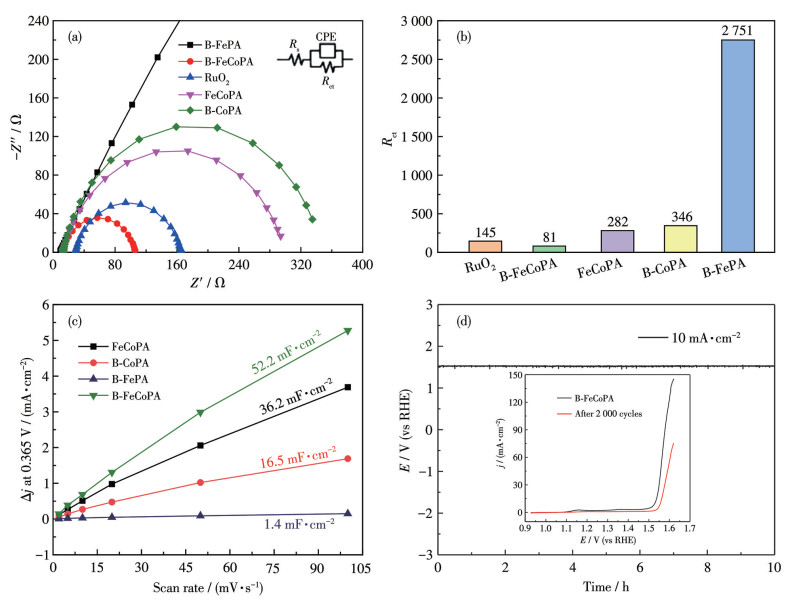
It is well-established that the OER electrocatalyst morphology can undergo significant morphological and structural changes during extended cycling. Accordingly, post-cycling characterization of B-FeCoPA was performed after 2000 cycles to evaluate the stability and structural evolution. As shown in Fig.1e and 1f, after cycling, B-FeCoPA exhibited distinct changes in surface morphology compared to its pre-cycled state. Following 2 000 cycles, the structure of B-FeCoPA underwent collapse, and the nanosheets became more compact. This degradation likely results from the cleavage of specific chemical bonds, which reduces inter-nanosheet voids, diminishes active-site exposure, and impedes electron transport. And the stretching vibration peak near 1 122 cm-1 in FTIR spectra, corresponding to PO43-, showed significantly attenuated (Fig.2b). This indicates the breakage of phosphate bonds after 2 000 cycles, likely resulting from nanosheet agglomeration[23]. The XPS survey spectrum of B-FeCoPA after 2 000 cycles (Fig.S2) revealed only Fe, Co, C, and O signals, with the characteristic peaks of B and P largely absent. This confirms the cleavage of B—O and partial P—O bonds during cycling, accompanied by the dissolution of B and P species into the electrolyte, ultimately leading to performance degradation. Furthermore, distinct binding-energy shifts across all spectra indicate that bond cleavage induces electron redistribution within the material. Notably, the Fe2p and Co2p peaks shifted toward lower binding energies after cycling, suggesting the formation of higher-valent metal species and transformation of metal oxides[16, 46, 58-60]. Consequently, the OER activity declined significantly after 2 000 cycles and a 24-h chronopotentiometry test at 10 mA·cm-2 (insets in Fig.5d and S6), attributable to bond cleavage, structural degradation, and the formation of less-active metal oxides[50]. These observations clearly illustrate that B-FeCoPA, as a pre-catalyst, undergoes substantial surface reconstruction under the OER process. Additionally, the accumulation of oxygen bubbles on the electrode surface during OER impedes sufficient contact between the catalyst and the electrolyte, further hindering electron transfer and reaction kinetics.
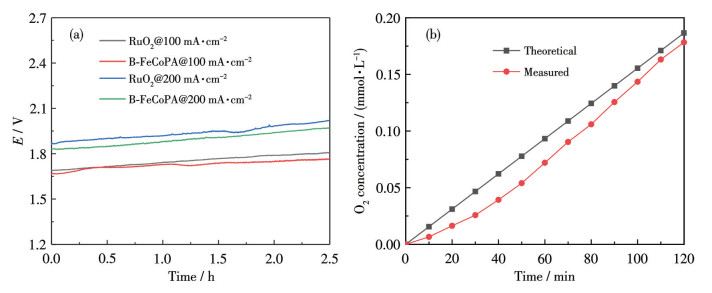
A two-electrode configuration was employed to simulate the OER process at 70 ℃ in 6.0 mol·L-1 KOH electrolyte. A prolonged stability test conducted over 10 000 s at current densities of 100 and 200 mA·cm-2 (Fig.6a and Table S3) demonstrated that B-FeCoPA exhibited superior suitability for commercial alkaline water electrolysis compared to RuO2. To elucidate the oxygen generation capacity of B-FeCoPA, the Faradaic efficiency of B-FeCoPA was measured via chronopotentiometry at a constant current of 10 mA (Fig.6b). After 120 min, the Faradaic efficiency for oxygen evolution reached approximately 96%, demonstrating outstanding OER electrocatalytic properties and a high energy conversion rate.
The B-FeCoPA electrocatalyst was successfully synthesized via a straightforward one-step hydrothermal method. This low-cost, durable, and easily synthesized catalyst exhibited good electrocatalytic performance for OER, achieving a low overpotential of 299 mV and a Tafel slope of 46 mV·dec-1 at a current density of 10 mA·cm-2. The as-synthesized B-FeCoPA material showed a large electrochemically active surface area and rapid electron transfer capability. Furthermore, in a two-electrode configuration, B-FeCoPA demonstrated a lower bias voltage, reduced energy loss, and a Faradaic oxygen evolution efficiency approaching the theoretical value. This work thus offers a promising strategy for the rational design of cost-effective and highly efficient electrocatalysts for OER.
SUN Q, SUN Y X, DONG Y, ZHONG H, ZENG H B. 2D CaWO4 nanosheets derived from scheelite minerals for enhanced electrocatalysis in oxygen evolution reaction[J]. Sci. China Chem., 2025, 68(5): 2170-2177 doi: 10.1007/s11426-024-2389-9
ZHONG H Y, ZHANG Q, YU J C, ZHANG X, WU C, MA Y F, AN H, WANG H, ZHANG J, WANG X P, XUE J M. Fundamental understanding of structural reconstruction behaviors in oxygen evolution reaction electrocatalysts[J]. Adv. Energy Mater., 2023, 13(31): 2301391 doi: 10.1002/aenm.202301391
NGUYEN Q T, NAKATE U T, GHULE B G, PARK S, CHOI J, PARK J H, PARK J R, JANG J H, KIM D W, PARK S. Ag-Bi2O3-nanostructured composite electrodes toward catalyzing oxygen evolution reaction: Exploring oxygen evolution reaction kinetics in composites from doping to establishing a heterojunction[J]. ACS Appl. Mater. Interfaces, 2025, 17(8): 12307-12316 doi: 10.1021/acsami.4c22156
CHEN F, ZHANG X H, JIA B N, ZHANG C L, WU G, YUAN Y Z, MA Y R, LI Y Z, YU J K, GUAN X N, HAO J B. TM-N4 doped in 4, 6, 8-biphenylene as an efficient trifunctional electrocatalyst for oxygen reduction reaction, oxygen evolution reaction and hydrogen evolution reaction[J]. Appl. Surf. Sci., 2025, 687: 162279 doi: 10.1016/j.apsusc.2024.162279
ZHENG R B, ZHU L L, LI C D, WU Z Q, HUANG Y N, YANG J, WEI R H, ZHU X B, SUN Y P. Ball milling as an effective method for improving oxygen evolution reaction electrocatalyst Ca3Co4O9[J]. Electroanal. Chem., 2023, 931: 117182 doi: 10.1016/j.jelechem.2023.117182
MA H, WU X W, FU X L, PENG Z J. Novel B-doped FeNi/C alloy nanofibers electrocatalyst for efficient oxygen evolution reaction from water splitting[J]. Mater. Chem. Phys., 2024, 313: 128701 doi: 10.1016/j.matchemphys.2023.128701
LIU T W, XU C C, GUO Y, LI P Z, YUAN S L, LIN M. Gold-doped cobalt-nickel sulfide nanosheets for oxygen evolution reaction[J]. ACS Appl. Nano Mater., 2024, 7(8): 9062-9067 doi: 10.1021/acsanm.4c00516
SHUAI C, MO Z L, NIU X H, YAO W T, CUI Y Z, HU S Y, ZOU P C, ZHANG H, FAN H J, YANG C. Tip-enhanced electric field: A new mechanism promoting mass transfer in oxygen evolution reactions[J]. Adv. Mater., 2021, 33(9): 2007377 doi: 10.1002/adma.202007377
LIU J J, HE T, WANG Q C, ZHOU Z X, ZHANG Y Q, WU H Q, LI Q, ZHENG J, SUN Z F, LEI Y P, MA J M, ZHANG Y. Confining ultrasmall bimetal alloys in porous N-carbon as scalable and sustainable electrocatalysts for rechargeable Zn-air batteries[J]. J. Mater. Chem. A, 2019, 7: 12451-12456 doi: 10.1039/C9TA02264C
XIE D Y, YU D S, HAO Y N, HAN S L, LI G H, WU X L, HU F, LI L L, CHEN H Y, LIAO Y F, PENG S J. Dual-active sites engineering of N-doped hollow carbon nanocubes confining bimetal alloys as bifunctional oxygen electrocatalysts for flexible metal-air batteries[J]. Small, 2021, 17(10): 2007239 doi: 10.1002/smll.202007239
SALMAN M, QIN H L, ZOU Y M, JI Z Y, ZHOU H, SHEN X P, ZHOU H B, ZHU G X, SUBRAMANIAN P, YUAN A H. In-situ decoration of NiCo-thiophene based metal-organic framework on nickel foam as an efficient electrocatalyst for oxygen evolution reaction[J]. J. Power Sources, 2025, 629: 235942 doi: 10.1016/j.jpowsour.2024.235942
LI Y W, WU Y H, LI T T, YAO Y, CAI H T, GAO J K, QIAN G D. Amorphous engineering of scalable metal-organic framework-derived electrocatalyst for highly efficient oxygen evolution reaction[J]. Small, 2024, 20(28): 2311356 doi: 10.1002/smll.202311356
JIANG J, ZHOU X L, LV H G, YU H Q, YU Y. Bimetallic-based electrocatalysts for oxygen evolution reaction[J]. Adv. Funct. Mater., 2023, 33(10): 2212160 doi: 10.1002/adfm.202212160
ZHENG X R, CAO Y H, LIU D Y, CAI M, DING J, LIU X R, WANG J H, HU W B, ZHONG C. Bimetallic metal-organic-framework/ reduced graphene oxide composite as bifunctional electrocatalyst for rechargeable Zn-air batteries[J]. ACS Appl. Mater. Interfaces, 2019, 11(17): 15662-15669 doi: 10.1021/acsami.9b02859
ZHOU G Y, MA Y R, GU C J, YANG J, PANG H, LI J, XU L, TANG Y W. Fe incorporation-induced electronic modification of Co-tannic acid complex nanoflowers for high-performance water oxidation[J]. Inorg. Chem. Front., 2022, 9(6): 1091-1099 doi: 10.1039/D1QI01630J
ZHANG Y J, GAO T T, JIN Z Y, CHEN X J, XIAO D. A robust water oxidation electrocatalyst from amorphous cobalt-iron bimetallic phytate nanostructures[J]. J. Mater. Chem. A, 2016, 4(41): 15888-15895 doi: 10.1039/C6TA05322J
YANG D, CHEN M M, YANG J H. Porous dehydroxyl cobalt phytate as electrocatalyst for high-efficiency water oxidation[J]. Appl. Surf. Sci., 2023, 609: 155405 doi: 10.1016/j.apsusc.2022.155405
QI J, CHEN Q Z, GAO Y, ZHAO Y J, GAO S B, SHANGGUAN E B, CHEN M X. Lewis acid sites in hollow cobalt phytate micropolyhedra promote the electrocatalytic water oxidation[J]. ChemSusChem, 2025, 18(6): e202401932 doi: 10.1002/cssc.202401932
LI P, ZHAO S E, HUANG Y Q, HUANG Q H, XI B J, AN X G, XIONG S L. Corrosion resistant multilayered electrode comprising Ni3N nanoarray overcoated with NiFe-phytate complex for boosted oxygen evolution in seawater electrolysis[J]. Adv. Energy Mater., 2024, 14(8): 2303360 doi: 10.1002/aenm.202303360
KANG M M, HE X H, CUI J, WANG J L, HU W, ZHU L X, SHAO Z B. Aldehyde-free and bio-based durable coatings for cellulose fabrics with high flame retardancy, antibacteria and well wearing performance[J]. Int. J. Biol. Macromol., 2024, 258: 128744 doi: 10.1016/j.ijbiomac.2023.128744
AI Y, YOU Y X, WEI F C, JIANG X L, HAN ZL, CUI J, LUO H, LI Y C, XU Z X, XU S Q, YANG J, BAO Q Y, JING C B, FU J W, CHENG J G, LIU S H. Hollow bio-derived polymer nanospheres with ordered mesopores for sodium-ion battery[J]. Nano‒Micro Lett., 2020, 12(1): 31
KOSHENSKOVA K A, MAKARENKO N V, DOLGUSHIN F M, YAMBULATOV D S, BEKKER O B, FEDIN M V, DEMENTEV S A, KRUMKACHEVA O A, EREMENKO I L, LUTSENKO I A. Green-ligand in metallodrugs design-Cu(Ⅱ) complex with phytic acid: Synthetic approach, EPR-spectroscopy, and antimycobacterial activity[J]. Molecules, 2025, 30(2): 313 doi: 10.3390/molecules30020313
FENG X Y, XIAO Y L, HUANG H H, WANG Q S, WU J Y, KE Z F, TONG Y X, ZHANG J Y. Phytic acid-based FeCo bimetallic metal-organic gels for electrocatalytic oxygen evolution reaction[J]. Chem. ‒Asian J., 2021, 16(20): 3213-3220 doi: 10.1002/asia.202100700
ZHOU W, HUANG D D, WU Y P, ZHAO J, WU T, ZHANG J, LI D S, SUN C H, FENG P Y, BU X H. Stable hierarchical bimetal-organic nanostructures as high performance electrocatalysts for the oxygen evolution reaction[J]. Angew. Chem. ‒Int. Edit., 2019, 58(13): 4227-4231 doi: 10.1002/anie.201813634
LU J T, WANG S Q, DING C F, LV W, ZENG Y, LIU N, WANG H Q, MENG Q, LIU Q Y. Metal organic frameworks derived CoSe2@N-Doped-carbon-nanorodsas highly efficient electrocatalysts for oxygen evolution reaction[J]. J. Alloy. Compd., 2019, 778: 134-140 doi: 10.1016/j.jallcom.2018.11.159
QU G X, WU T L, YU Y N, WANG Z K, ZHOU Y, TANG Z D, YUE Q. Rational design of phosphorus-doped cobalt sulfides electrocatalysts for hydrogen evolution[J]. Nano Res., 2019, 12(12): 2960-2965 doi: 10.1007/s12274-019-2538-x
WANG T Y, NAM G, JIN Y, WANG X Y, REN P J, KIM M G, LIANG J S, WEN X D, JANG H, HAN J T, HUANG Y H, LI Q, CHO J. NiFe (oxy) hydroxides derived from NiFe disulfides as an efficient oxygen evolution catalyst for rechargeable Zn-air batteries: The effect of surface S residues[J]. Adv. Mater., 2018, 30(27): 1800757 doi: 10.1002/adma.201800757
XIE W S, DENG W, HU J B, GAI Y P, LI X, ZHANG J J, LONG D W, QIAO S L, JIANG F. Construction of bimetallic FeCo-SA/DABCO nanosheets by modulating the electronic structure for improved electrocatalytic oxygen evolution[J]. CrystEngComm, 2022, 24(35): 6239-6250 doi: 10.1039/D2CE01055K
LI H X, ZHANG C Y, XIANG W J, AMIN M A, NA J, WANG S P, YU J X, YAMAUCHI Y. Efficient electrocatalysis for oxygen evolution: W-doped NiFe nanosheets with oxygen vacancies constructed by facile electrodeposition and corrosion[J]. Chem. Eng. J., 2023, 452: 139104 doi: 10.1016/j.cej.2022.139104
GUAN Z, CHEN H Z, CHEN B, KONG L C, SHI Z, ZHONG Y, LI W J, QIAN W C, ZHANG R, WU J, FU Z G. Interfacial electron modulation of FeCo LDH@CoS heterojunction for efficient oxygen evolution reaction[J]. J. Environ. Chem. Eng., 2025, 13: 118407 doi: 10.1016/j.jece.2025.118407
ZHANG L, XU Q L, CHEN M S, ZHANG Y C, ZHOU Y T, HU G Z, GARCIA H. Self-optimizing metal-free porous reactors with dynamic active sites unlock record oxygen reduction activity[J]. Energy Environ. Sci., 2026, 19(2): 702-717 doi: 10.1039/D5EE03645C
XU Q L, ZHANG L, LIU C L, ZHAO X, ZHANG Y C, ZHOU Y T, GARCIA H. Interfacial electron flow in a Fe2P@NPC(core)/NiCo LDH (shell) heterostructure enables site-specific electronic-state modulation for bifunctional oxygen electrocatalysis[J]. Appl. Catal. B‒Environ. Energy, 2026, 285: 126290
SONG Y Y, SHI W J, LI N N, LI Q Y, WANG X A, ZHANG X Y, HUANG M H, ZHANG L X. A Ni(OH)2 nanosheet array modified with Fe-phytate complex layer as a corrosion resistant catalyst for seawater electrolysis at ampere-level current density[J]. Green Chem., 2025, 27(2): 464 doi: 10.1039/D4GC04713C
YANG Y T, LI J X, QIAO W, YANG H, HUANG Y Q, LI F L, YU Y, FANG J Y, LI P. Defect-rich birnessite ultrathin nanosheet array armed with Fe-phytate complex enables boosted and long-lasting seawater oxidation at industrial-level current density[J]. ACS Catal., 2025, 15(9): 6954-6968 doi: 10.1021/acscatal.5c00581
HUANG Y Y, JIAN Y P, LI L H, LI D, FANG Z Y, DONG W X, LU Y H, LUO B F, CHEN R J, YANG Y C, CHEN M, SHI W D. A NIR-responsive phytic-acid nickel biomimetic complex anchored on carbon nitride for highly efficient solar hydrogen production[J]. Angew. Chem. ‒Int. Edit., 2021, 60(10): 5245-5249 doi: 10.1002/anie.202014317
JIA Y, LI Y N, WANG Z M, LI F M, JIN P J, LI S N, CHEN Y. Porous cobalt carbonate hydroxide nanospheres towards oxygen evolution reaction[J]. Chem. Eng. J., 2021, 417: 128066 doi: 10.1016/j.cej.2020.128066
HUANG G Q, ZHAO L, YUAN S S, LI N, JING S B. Iron doped mesoporous cobalt phosphide with optimized electronic structure for enhanced hydrogen evolution[J]. Int. J. Hydrog. Energy, 2022, 47(33): 14767-14776 doi: 10.1016/j.ijhydene.2022.02.223
ZHAO M, GUO T L, QIAN W, WANG Z, ZHAO X, WEN L L, HE D P. Fe-incorporated cobalt-based metal-organic framework ultrathin nanosheets for electrocatalytic oxygen evolution[J]. Chem. Eng. J., 2021, 422: 130055 doi: 10.1016/j.cej.2021.130055
YUE H H, ZHANG W L, YU B, HU Y, LU Y J, CHEN Y F, YANG D X. Three-dimensional porous cobalt ferrite and carbon nanorod hybrid network as highly efficient electrocatalyst for oxygen evolution reaction[J]. J. Mater. Sci., 2020, 55(25): 11489-11500 doi: 10.1007/s10853-020-04718-z
ZHAO T, ZHONG D Z, HAO G Y, ZHAO Q. Vacancy engineering and hydrophilic construction of CoFe-MOF for boosting water splitting by in situ phytic acid treatment[J]. Appl. Surf. Sci., 2023, 607: 155079 doi: 10.1016/j.apsusc.2022.155079
CHEN L H, KE Q, LEI X L. Boron doping boosts the catalytic activity of Pd single-atom catalyst for the oxygen evolution reaction of lithium peroxide[J]. J. Energy Storage, 2025, 111: 115433 doi: 10.1016/j.est.2025.115433
KIM C, KIM S H, LEE S, KWON I, KIM S H, KIM S, SEOK C, PARK Y S, KIM Y. Boosting overall water splitting by incorporating sulfur into NiFe (oxy) hydroxide[J]. J. Energy Chem., 2022, 64: 364-371 doi: 10.1016/j.jechem.2021.04.067
JIN X H, YUAN W Y, FENG L R, ZHANG J C, BAI J Y, WANG D, GUO X H. N, S, P-tridoped coal-derived hierarchically porous carbon aerogel for high-performance supercapacitors[J]. J. Phys. Chem. C, 2024, 128(16): 6581-6589 doi: 10.1021/acs.jpcc.4c00667
WANWONG S, SANGKHUN W, JIAMBOONSRI P. Electrospun cyclodextrin/poly (L-lactic acid) nanofibers for efficient air filter: Their PM and VOC removal efficiency and triboelectric outputs[J]. Polymers, 2023, 15(3): 722 doi: 10.3390/polym15030722
TARTOUR A R, SANAD M M S, EL-HALLAG I S, MOHARRAM Y I. Novel mixed heterovalent (Mo/Co)Ox-zerovalent Cu system as bi-functional electrocatalyst for overall water splitting[J]. Sci. Rep., 2024, 14: 4601 doi: 10.1038/s41598-024-54934-9
GAO T T, WU S W, LI X Q, LIN C H, YUE Q, TANG X M, YU S M, XIAO D. Phytic acid assisted ultra-fast in situ construction of Ni foam-supported amorphous Ni-Fe phytates to enhance catalytic performance for the oxygen evolution reaction[J]. Inorg. Chem. Front., 2022, 9(14): 3598-3608 doi: 10.1039/D2QI00924B
ZHAO H J, LI P W, SHAO D M, ZHANG R Z, WANG S Q, ZHU Z Q, ZHAO C H. Phytic acid-derived Co2-xNixP2O7-C/RGO and its superior OER electrocatalytic performance[J]. Int. J. Hydrog. Energy, 2018, 44(2): 844-852
ZHOU X Y, LI H C, YANG J. Biomass-derived activated carbon materials with plentiful heteroatoms for high-performance electrochemical capacitor electrodes[J]. J. Energy Chem., 2016, 25(1): 35-40 doi: 10.1016/j.jechem.2015.11.008
LI C L, YAO W, XING S Y, WANG J L, SUN M M, ZHAO Y Y, BI J T, JI Z Y. pH-Responsive titanate sensor for direct determination of molar Na+ concentrations through ion exchange: Model development and applications[J]. Measurement, 2025, 251: 117268 doi: 10.1016/j.measurement.2025.117268
SHUANG C, MO Z L, NIU X H, DU Y X, GAO Q Q, LIU J J, LIU N J, GUO R B. Dual-metal CoNi nanoparticles in B-doped carbon layers as efficient and durable electrocatalyst for oxygen evolution reaction[J]. Appl. Surf. Sci., 2020, 532: 147381 doi: 10.1016/j.apsusc.2020.147381
LI R Y, XIE Q Q, LI Z J, ZHANG R L, YANG Y Q, LIU X H. Synthesis of histidine, serine and folic acid-functionalized and boron and iron-doped graphene quantum dot with excellent optical behavior and peroxidase-like activity for colorimetric and fluorescence detection of H2O2 in food[J]. Spectroc. Acta Pt. A‒Molec. Biomolec. Spectr., 2025, 324: 124950 doi: 10.1016/j.saa.2024.124950
CHENG Z F, PI Y C, SHAO Q, HUANG X Q. Boron-doped amorphous iridium oxide with ultrahigh mass activity for acidic oxygen evolution reaction[J]. Sci. China Mater., 2021, 64(12): 2958-2966 doi: 10.1007/s40843-021-1687-5
翟好英, 邹自力, 李明宇, 张理元, 周文俊. 硼、磷共掺杂铁钴双金属材料的制备及其电催化析氧性能[J]. 无机化学学报, 2023, 39(4): 627-636ZHAI H Y, ZOU Z L, LI M Y, ZHANG L Y, ZHOU W J. Synthesis of boron and phosphorus co-doped Fe-Co bimetallic materials for electrocatalytic oxygen evolution[J]. Chinese J. Inorg. Chem., 2023, 39(4): 627-636
GUO Y, YUAN P, ZHANG J, HU Y, AMIINU I S, WANG X, ZHOU J G, XIA H C, SONG Z B, XU Q, MU S C. Carbon nanosheets containing discrete Co-Nx-By-C active sites for efficient oxygen electrocatalysis and rechargeable Zn-air batteries[J]. ACS Nano, 2018, 12(2): 1894-1901 doi: 10.1021/acsnano.7b08721
WANG K T, ZHOU J, FU L, KANG Y Q, ZHOU Z L, CHENG Y H, WU K, YAMAUCHI Y. Plasma-induced oxygen defect engineering in perovskite oxide for boosting oxygen evolution reaction[J]. Small, 2024, 20(48): 2404239 doi: 10.1002/smll.202404239
KARMAKAR A, KUNDU S. A concise perspective on the effect of interpreting the double layer capacitance data over the intrinsic evaluation parameters in oxygen evolution reaction[J]. Mater. Today Energy, 2023, 33: 101259 doi: 10.1016/j.mtener.2023.101259
LI B, LIU W K, LIU Y N, FENG J X, SUN X Z, CHEN J, MA L S, LUO W. Cucurbit[6]uril induced cation accumulation to engineer interfacial water for boosting alkaline HER[J]. Appl. Catal. B‒Environ. Energy, 2026, 380: 125754
ZHOU S F, WANG J T, LI J, FAN L Y, LIU Z, SHI J W, CAI W W. Surface-growing organophosphorus layer on layered double hydroxides enables boosted and durable electrochemical freshwater/seawater oxidation[J]. Appl. Catal. B‒Environ. Energy, 2023, 332: 122749
GHOBASHY M M, SHARSHIR A I, ZAGHLOOL R A, MOHAMED F. Investigating the impact of electron beam irradiation on electrical, magnetic, and optical properties of XLPE/Co3O4 nanocomposites[J]. Sci. Rep., 2024, 14(1): 4829
LEE H, CHA J, CHA S G, KONG T H, PARK N, KWON S, KIM H J, KWON Y. Foreign cation-promoted active species formation enables efficient electrochemical glycerol valorization[J]. Chem. Commun., 2025, 61(44): 8011-8014

Scheme 1 Schematic illustration of the preparation process of B-FeCoPA and the OER mechanism

Figure 1 SEM images of FeCoPA (a, b), B-FeCoPA before (c, d) and after (e, f) 2 000 cycles, and EDS elemental mapping images of B-FeCoPA (g)

Figure 5 (a) Nyquist plots (Inset: the equivalent circuit) and (b) Rct values of the samples; (c) Estimation of the Cdl by plotting the current density differences at 0.365 V (vs RHE) against the scan rates; (d) V-t curve of B-FeCoPA (Inset: LSV curves before and after 2 000 cycles)

 扫一扫看文章


扫一扫关注我们
 下载:
下载:
 下载:
下载:


 下载:
下载: