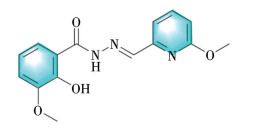
Scheme 1.
Structure of HL

Design, synthesis, DNA interaction, and dual catalytic properties of tetranuclear holmium (Ho) complex
Xiaofen GUAN , Liuqing KANG , Yingyue ZHANG , Linjing XUE , Xinyu LI , Wenmin WANG


In recent years, polynuclear Ln(Ⅲ)-based complexes have attracted growing attention from researchers due to their unique physical properties and remarkable application potential in some fields such as catalysis[1-3], magnetism[4-7], gas storage and separation[8-9]. With the depth of research on these complexes, the design and synthesis of such complexes have gradually emerged as a research hotspot in this field[10-12]. Owing to the high coordination numbers, variable coordination environments, and distinctive coordination kinetic characteristics of lanthanide elements, polynuclear Ln(Ⅲ)-based complexes tend to form abundant and intriguing molecular topological structures. These exceptional structural features, coupled with their versatile functional prospects, have positioned this class of complexes as a topic of intense interest[13-14]. Meanwhile, given the central role of DNA as the carrier of genetic information in organisms, investigating the interaction between Ln(Ⅲ)-based complexes and DNA has emerged as a pivotal research direction for the development of anticancer, antiviral, and antibacterial agents[15-17]. In-depth elucidation of the underlying interaction mechanisms is expected to facilitate the creation of a new generation of clinical therapeutic drugs, thereby providing novel strategies for addressing major diseases such as cancer and viral infections[18-19].
Over the past few years, the excessive emission of CO2 has triggered a series of severe environmental issues. Converting CO2 into cyclic carbonates constitutes a carbon reduction technology with both environmental and economic benefits[20-21]. However, this reaction requires the synergistic catalysis of multiple active sites, and traditional catalysts are difficult to meet the requirements of green and sustainable development[22]. Therefore, the development of catalytic systems with high catalytic activity and excellent recyclability under mild conditions is imperative[23-25]. Based on the established catalytic mechanisms, Lewis acid sites are the key to driving CO2 activation, a characteristic that renders polynuclear Ln(Ⅲ)-based complexes promising catalytic materials[26]. In addition, polynuclear Ln(Ⅲ)-based complexes also exhibit excellent catalytic performance in the Knoevenagel condensation reaction, which is attributed to the synergistic effect between their highly unsaturated Lewis-acidic rare-earth metal ion centers and Lewis-basic pyridyl groups[27-28]. Meanwhile, the Knoevenagel condensation reaction has been extensively applied in diverse fields, including pharmaceutical synthesis, the essence and flavor industry, as well as materials science[29-30]. In summary, the research on the catalytic performance of Ln(Ⅲ)-based complexes opens up new avenues for the development of highly efficient and green catalytic reaction systems.
With the continuous development and application of polynuclear Ln(Ⅲ)-based complexes, their advantages in various fields have gradually become apparent. Based on previous studies on the synthesis of rare earth metal ion complexes, we successfully synthesized complex 1 using Schiff base ligands HL (Scheme 1). The general formula is [Ho4(L)2(dbm)6(CH3O)4] (1). Subsequent studies analyzed its structure, DNA interaction, and catalytic property.
Ho(dbm)3·6H2O (0.05 mmol), HL (0.05 mmol), NaOH (0.05 mmol), CH3OH (0.015 mL), and CH2Cl2 (5 mL) were placed in a 20 mL vial, stirred at room temperature for 30 min, the vial was then sealed and heated at 70 ℃ for 48 h, followed by cooling to room temperature. The precipitated solid was washed with ethanol three times and dried to obtain yellow block crystals. The synthetic routes of HL and complex 1 are shown in Scheme S1 and S2 (Supporting information). The details of the materials and testing methods are in the Supporting information. The experimental details for the CO2 cycloaddition with epoxides and the Knoevenagel condensation reaction are also provided in the Supporting information.
Yield: 50% (based on Ho). Anal. Calcd. for C124H106Ho4N6O24(%): C, 54.67; H, 3.92; N, 3.09. Found(%): C, 54.61; H, 3.87; N, 3.08. IR (cm-1, Fig.S1): 3 059(w), 1 598(s), 1 554(s), 1 516(s), 1 476(s), 1 458(m), 1 401(s), 1 310(m), 1 234(m), 1 180(w), 1 070(m), 1 026(w), 941(w), 848(w), 810(m), 747(m), 725(m), 688(m), 648(s), 610(s), 522(s), 409(s).
Single-crystal X-ray diffraction data for complex 1 were collected using a computer-controlled Rigaku Saturn CCD area detector diffractometer equipped with confocal monochromated Mo Kα radiation, employing the ω-φ scan technique (λ=0.071 073 nm). The structure was solved and refined via the SHELXS-2016 and SHELXL-2016 programs using a full-matrix least-squares method based on F 2, with all non-hydrogen atoms acquiring anisotropic thermal parameters. Due to immediate measurement after isolation from the solution, the crystals contained some disordered solvent molecules. Table 1 covers crystal parameters, data collection, and refinement details for complex 1.

 下载:
导出CSV
下载:
导出CSV
| Parameter | 1 | Parameter | 1 | |
| Formula | C124H106Ho4N6O24 | Dc / (g·cm-3) | 1.643 | |
| Formula weight | 2 723.86 | μ / mm-1 | 2.920 | |
| T / K | 150.0 | θ range / (°) | 2.127-26.439 | |
| Crystal system | Monoclinic | F(000) | 2704.0 | |
| Space group | P21/c | Reflection collected | 190 817 | |
| a / nm | 1.504 55(6) | Unique reflection | 11 299 | |
| b / nm | 1.480 57(6) | Rint | 0.111 1 | |
| c / nm | 2.475 02(7) | GOF (F 2) | 1.060 | |
| β / (°) | 92.992 8(13) | R1, wR2 [I>2σ(I)] | 0.059 2, 0.150 3 | |
| V / nm3 | 5.505 8(3) | R1, wR2 (all data) | 0.074 7, 0.164 1 | |
| Z | 2 |
Complex 1 crystallizes in the monoclinic system P21/c space group with Z=2. Complex 1, which is described in Fig.1, contains four independent Ho3+ ions, two L- ligands, six dbm- ions, and four CH3O- ions. The coordination environment of Ho3+ is shown in Fig.S2. The central Ho3+ (Ho1) ion is eight-coordinated (Fig.S3), coordinated by two nitrogen atoms (N1 and N2) from two L- ligands [Ho1—N1 0.248 3(7) nm, Ho1—N2 0.268 1(7) nm] and six oxygen atoms from one L- ligand (O2), two dbm- ions (O5, O6, O7, O8), and one CH3O- ion (O11), with the Ho—O distances ranging from 0.224 1(5) to 0.239 2(5) nm. The central Ho3+ (Ho2) ion is also in an eight-coordinated configuration (Fig.S3), which is coordinated by eight oxygen atoms from one dbm- ion (O9 and O10), two L- ligands (O3, O3a, O2, O4a), and two CH3O- ions (O11 and O12). In the same way as Ho1 and Ho2, Ho1a and Ho2a also adopt an eight-coordinated structure, in which the distance of Ho—O varies from 0.227 3(5) to 0.246 8(5) nm. The coordination mode of L- ligand and dbm- ion in complex 1 is shown in Fig.S4. Each L- ligand is associated with three Ho3+ ions [Ho1—N1 0.268 1(7) nm, Ho1—N2 0.248 3(7) nm, Ho1—O2 0.239 2(5) nm, Ho2—O2 0.235 5(5) nm, Ho2—O3 0.230 0(4) nm, Ho2a—O3 0.234 0(4) nm, Ho2a—O4 0.250 6(6) nm, N1—Ho1—N2 63.6(2)°, O2—Ho1—N2 63.33(19)°, Ho1—O2—Ho2 105.90(19)°, O2—Ho2—O3 76.10(18)°, Ho2—O3—Ho2a 109.9(2)°). In addition, the dbm- ion adopts a bidentate chelation mode to connect each central Ho3+ ion. These bond distances and bond angles are comparable to those of the already reported Ln4 complexes[31-33]. The important bond lengths and bond angles are listed in Table S1.
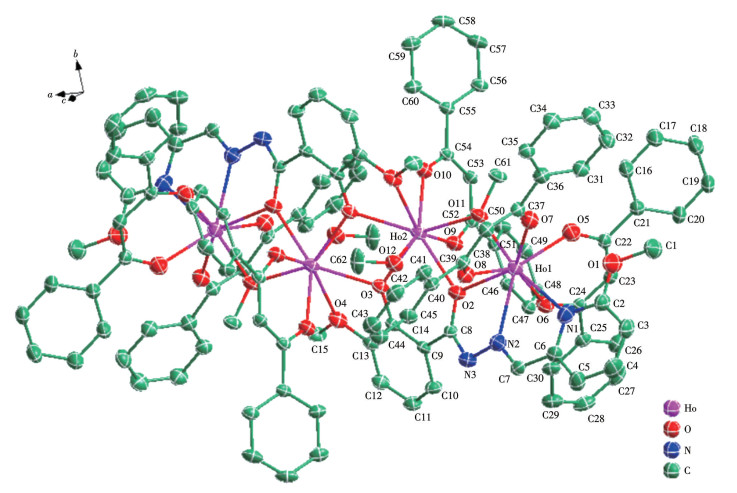
Hydrogen atoms have been omitted for clarity.
To determine the phase purity of complex 1, powder X-ray diffraction (PXRD) analysis was performed on a single-crystal sample of complex 1 at room temperature. As shown in Fig.S5, the PXRD data from experimental tests were carefully compared with the theoretical values calculated by simulating the single-crystal structures. The analysis showed that the positions of the main peaks in the experimental data set were basically consistent with those of the simulated PXRD pattern, indicating that complex 1 has high phase purity.
The thermogravimetric analysis (TGA) of complex 1 within the temperature range of 25 to 800 ℃ is shown in Fig.S6. The TGA curve of complex 1 remained essentially unchanged at temperatures from 25 to 260 ℃. A weight loss of 43.7% was observed in the temperature range of 260 to 610 ℃, compared with a theoretical weight loss of 51.1%, which indicates the loss of two L- ligands and four CH3O- ions. Subsequently, the molecular structure decomposed gradually with the increase in temperature. The excellent thermal stability provides a solid foundation for its subsequent applications, including DNA interaction, catalytic conversion of CO2, and catalysis of the Knoevenagel condensation.
UV spectroscopy is a simple and universal method for studying the interaction mechanism between a compound and DNA. The conjugated double bonds formed by pyrimidine and purine bases in DNA molecules endow it with strong UV absorption in a range of 200-290 nm[34]. Therefore, changes in the peak position before and after the compound binds to DNA can reveal the binding mode of the compound to DNA. As shown in Fig.2, after the interaction between complex 1 (or HL) with CT-DNA, the UV absorption spectra of the complex-CT-DNA systems and the ligand-CT-DNA systems exhibited redshifts compared to that of pure CT-DNA. As the concentration of CT-DNA increased, the redshift magnitude became more pronounced; notably, the redshift intensity was 1>HL. Additionally, a hypochromic effect was observed. This is because complex 1 intercalates between DNA base pairs through intercalation, leading to local extension of the DNA double helix structure and disruption or reorganization of the π-π* conjugated system of base pairs[35]. At this point, the electron cloud distribution of the conjugated double bonds in the bases is altered, reducing the energy required for electron transitions and shifting the absorption peak to longer wavelengths (red shift). The above results indicate that both HL and complex 1 can bind to DNA through intercalation, with complex 1 exhibiting a stronger binding affinity to DNA than HL.
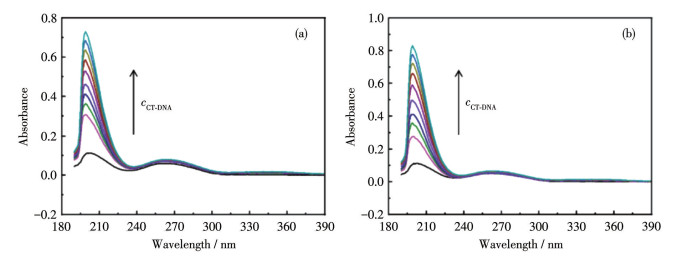
c1=cHL=1.7×10⁻² mmol·L-1.
Ethidium bromide (EB) exhibits fluorescent emission upon binding to DNA. Utilizing this characteristic, the interaction mechanism between a compound and DNA can be investigated. Through fluorescence spectroscopy experiments, the binding constant between the two substances can be calculated, which in turn enables the determination of the magnitude of the interaction force between them. The relationship between the fluorescence intensities of the EB-DNA system is described by the Stern-Volmer equation, which is formulated as: I0/I=1+Ksvr. I0 corresponds to the original fluorescence intensity of the EB-DNA mixture before any extra compound is added, and I stands for the fluorescence intensity that is obtained after introducing the compound with diverse concentrations. The concentration ratio of the compound to DNA is represented by the variable r. The linear Stern-Volmer quenching constant, denoted as Ksv, can be derived from the slope of the linear graph plotted between I0/I and r. This constant quantifies the binding capability of the compound to DNA, where a greater Ksv value corresponds to a more robust binding affinity[36-37].
In accordance with the aforementioned theoretical analysis, EB-DNA fluorescence experiments were carried out to investigate the binding capacity of complex 1 (or HL) with DNA. As shown in Fig.3a and 3b, the uppermost curve represented the fluorescence emission of the EB-DNA composite in the absence of complex 1 and HL. As the concentrations of complex 1 and HL gradually increased, the fluorescence intensity decreased stepwise. The foregoing results implied that EB, which was intercalated between DNA base pairs, was substituted by complex 1 and HL, resulting in the generation of a new system composed of CT-DNA and the compound. Additionally, by analyzing the data in Fig.3c and 3d, the Ksv values of complex 1 and HL were determined to be 4.86 and 2.97, respectively. These values clearly indicate that the binding strength follows the order of complex 1>HL. This data demonstrates that the interaction strength between complex 1 and DNA is higher than that of ligand HL. Compared with the analogous Ln(Ⅲ)-based complexes reported in the literature, the Ksv of 1 in this study was higher, and its value exceeded the Ksv range of some reported Ln(Ⅲ)-based complexes (Table S2), which indicates that 1 has a stronger binding affinity with DNA. This result is consistent with the UV spectroscopy result, indicating that synergistic effects occur between the rare earth metals and the ligands after the formation of the complex[38].
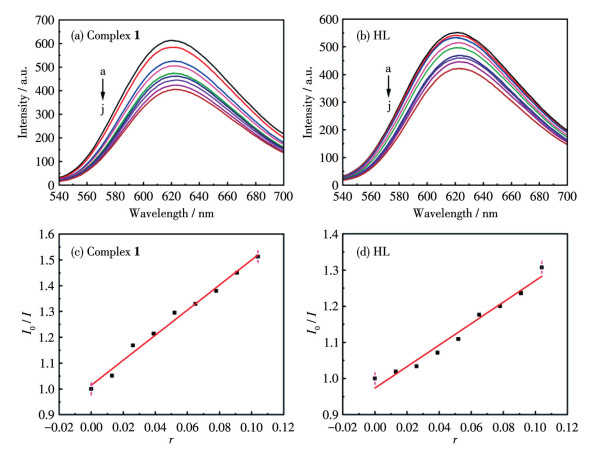
r=ccompound/cDNA; from a to j: r=0, 0.013, 0.026, 0.039, 0.052, 0.065, 0.078, 0.091, 0.104, respectively.
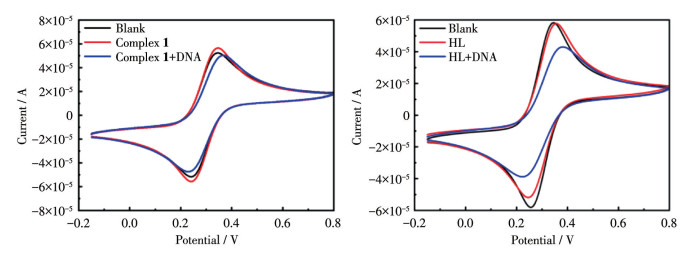
Cyclic voltammetry (CV) analysis is a powerful electrochemical technique that enables the exploration of interactions between a compound and biological molecules[39]. As shown in Fig.4, the anodic peak potential (Epa) and the cathodic peak potential (Epc) of complex 1 were 0.346 0 and 0.240 0 V, respectively. Correspondingly, the equation potential of complex 1 was 0.293 0 V. After adding DNA, the Epa and the Epc of complex 1 were 0.368 0 and 0.230 0 V. The equation potential was 0.299 0 V. Similarly, the equation potential of HL was 0.300 5 V before adding DNA. After adding DNA, the equation potential of HL shifted to 0.302 5 V. The equation potential of complex 1 and HL has shifted positively after the addition of DNA, indicating that complex 1 (HL) has undergone intercalation with DNA[40-41]. Notably, the interaction between complex 1 and DNA is stronger than that between HL and DNA. The above results also indicate a synergistic effect between the rare-earth metals and the ligands, which strengthens the interaction between complex 1 and DNA. Moreover, the conclusions derived from the CV showed a high degree of consistency with UV and fluorescence spectroscopy data. Significantly, the three methodologies not only mutually corroborate one another but also provide cross-validation for the proposed binding mechanism, thereby reinforcing the scientific rigor and reliability of the overall findings.
The cycloaddition reaction of epoxides with CO2 can be utilized to prepare cyclic carbonates, and the products can be used as polycarbonate monomers, secondary batteries, and chemical power source electrolytes[42-43]. Therefore, we explored the catalytic performance of complex 1 in the cycloaddition reaction of epoxides with CO2.
As shown in Table S3, to determine the optimal reaction conditions, the effects of parameters such as reaction temperature, duration, and co-catalyst dosage on the catalytic performance of complex 1 were systematically investigated. First of all, the reaction temperature is one of the important factors that cannot be ignored. Therefore, we explored the role of temperature in this catalytic activity and executed catalytic cycloaddition reactions at different temperatures each in turn (Table S3, entries 1-6). As the reaction temperature was raised from 30 to 70 ℃, the yield of the target product increased from 32% to 95%. It follows that the reaction temperature will enhance the catalytic performance. This is because elevated temperature accelerates the interaction between catalytically active sites and reactants, thus boosting catalytic performance. However, upon further elevating the temperature to 80 ℃, the yield stabilized at 95%. It can be seen from this that further heating is of no benefit to the improvement of the catalytic effect. Meanwhile, given that the energy consumption required for heating will increase accordingly, 60 ℃ was ultimately determined as the optimal temperature for this reaction. What′s more, reaction time is also a key influencing factor. When the reaction proceeded for a duration of 8-10 h, the product yield exhibited an elevation, varying in a range of 95%-96%. Consequently, a reaction duration of 10 h was selected as the optimum (Table S3, entries 7-8). Last but not least, the dosage of the catalyst constitutes another pivotal factor. With the amounts of co-catalyst tetrabutylammonium bromide (TBAB) set at 0.5, 1, 2, and 3 mmol, the yields of the intended target product stood at 53%, 82%, 96%, and 96% in turn (Table S3, entries 8-11). Drawing on the current data, 2 mmol stood as the optimum dosage for the co-catalyst. A synergistic catalytic effect between complex 1 and the co-catalyst is evident from the fact that their individual use as catalysts yields less than 1% and 25% of the target product, respectively (Table S3, entries 12-13). In contrast, under the optimal conditions, equivalent dosages of Ho(NO3)3·6H2O and HoCl3·6H2O as catalysts resulted in target product yields of 39% and 40%, respectively (Table S3, entries 14-15).
Subsequently, the generality of complex 1 toward other epoxides was systematically investigated. Under the optimized reaction conditions, complex 1 was utilized to mediate the cycloaddition reactions between CO2 and nine distinct epoxides; the associated experimental findings are detailed in Table 2. As documented in previous studies, both a reduced steric hindrance and an electron-withdrawing property are conducive to enhancing catalytic activity. Notably, the experimental findings of the present work have further confirmed these conclusions[44-45]. As indicated in Table 2 (entries 1-3), the yield of the target product showed a gradual decline as the steric hindrance of the substituted chain increased. Likewise, 1 exhibited considerable catalytic activity for epoxy bromopropane and 2-oxiranemethanol (Table 2, entries 4 and 5), which can be attributed to the strong electron-withdrawing effects of the Br and O atoms. 1 exhibited relatively low catalytic activity for 2-phenyloxirane (Table 2, entry 6) due to the presence of an electron-donating group. Specifically, the high electronegativity of the oxygen atom causes the carbon atoms in the epoxide ring to become more positively charged, thereby promoting ring-opening (Table 2, entries 7-8). As demonstrated in entry 9, the yield was remarkably low with the steric hindrance on the carbon atoms of the oxirane ring restricting the nucleophilic attack of Br-, leading to a significant reduction in the ring-opening step. Notably, the catalytic conversion efficiency of complex 1 was comparable to the levels reported to date, and the reaction conditions required for it were mild[46].
下载:
导出CSV
 |
|||
| Entry | Substrate | Product | Yield / % |
| 1 |  |
 |
89 |
| 2 |  |
 |
87 |
| 3 |  |
 |
81 |
| 4 |  |
 |
91 |
| 5 |  |
 |
89 |
| 6 |  |
 |
86 |
| 7 |  |
 |
88 |
| 8 |  |
 |
86 |
| 9 |  |
 |
30 |
| *The reaction involved 5 mmol of epoxides and 100 kPa of CO2; complex 1 was added at a dosage of 0.5% (molar fraction), along with 2 mmol of TBAB and a reaction time of 10 h; significantly, it was conducted without any solvent; the product was separated by column chromatography. | |||
Based on the research findings regarding the cycloaddition reaction between CO2 and epoxides, it is evident that the ring-opening stage of epoxides constitutes the rate-controlling step of the cycloaddition reaction[47]. The metal center of complex 1 exhibits a propensity to function as Lewis acidic sites, enabling it to form M—O bonds with the oxygen atom. Thereby, a metal-epoxide is generated, facilitating the activation of the epoxide. Subsequently, the Br- anion attacks the carbon atom, which has relatively less steric hindrance on the epoxide, inducing the ring-opening of the epoxide. Thereafter, CO2 inserts into the Ho—O bond formed between the Ho3+ ion and the epoxide. Subsequently, the negatively charged O atom assaults the C—Br bond, initiating the cyclization process. Concurrently, the catalyst undergoes regeneration. The possible mechanism of the cycloaddition reaction is shown in Fig.S7.
Based on recent literature[48] and the unique structural features of complex 1 in this study, it is expected to be an excellent catalytic candidate for the Knoevenagel condensation reaction, which is about its abundant Lewis acid active sites on the surface, with specific results in Table S4. When it comes to building carbon-carbon double bonds during organic synthesis, the Knoevenagel condensation stands out as an important method. Experiments concerning 1 dosage showed that the yield rose sharply from 1% to 98% with increasing catalyst loading, verifying that 1 dosage is a key determinant of the product yield (Table S4, entries 1-6). When the reaction time was extended from 4 to 10 h, the yield increased from 74% to 92%, representing an 18% improvement in yield (Table S4, entries 7-10). Temperature studies revealed the yield increased from 72% to 99% as the temperature rose from 40 to 60 ℃, with no further improvement at 70 ℃, identifying 60 ℃ as optimal (Table S4, entries 11-13). Next, we tested the catalytic efficiencies of 1 in different solvents. The results showed that when the solvents were DMSO, DMF, MeOH, and EtOH, the yields of the target product ranged from 91% to 99% (Table S4, entries 13-16). Consequently, EtOH was recognized as the top-performing solvent. Comparative experiments showed that lower solvent polarity reduced yield. Compared to equal amounts of Ho(NO3)3·6H2O and HoCl3·6H2O (Yield: 29% and 31%, respectively; Table S4, entries 17-18), complex 1 demonstrated superior catalysis. The optimal reaction conditions were determined as 10 mmol benzaldehyde, 20 mmol malononitrile, 0.5% (n/n) complex 1, 60 ℃, and 6 h.
To systematically investigate the catalytic activity and substrate selectivity of complex 1 in the Knoevenagel condensation, the study explored its universality through substrate expansion experiments. These experiments used a series of aldehyde derivatives as substrates under optimized reaction conditions. When the hydrogen atoms on the benzaldehyde ring were replaced by electron-withdrawing groups (—F, —Br, and —NO2), the reaction system achieved nearly complete conversion under the optimized reaction conditions. This result indicates that electron-withdrawing groups such as —F, —Br, and —NO2 can significantly enhance the reactivity of the reaction system through electronic effects and accelerate the reaction process (Table 3, entries 1-3). When the substrates (aldehyde derivatives) bear electron-donating groups, the reaction performance showed significant steric hindrance dependence: the yield of the target product generally decreases as the molecular size of the substituent increases. Among them, small-sized electron-donating substituents such as methyl have little impact on the reaction. However, due to the steric hindrance effect, large-sized electron-donating substituents hinder the effective contact and interaction between reactants, resulting in the reduction of reaction efficiency (Table 3, entries 4-7).
下载:
导出CSV
 |
|||
| Entry | Substrate | Product | Yield / % |
| 1 |  |
 |
99 |
| 2 |  |
 |
99 |
| 3 |  |
 |
98 |
| 4 |  |
 |
97 |
| 5 |  |
 |
95 |
| 6 |  |
 |
89 |
| 7 |  |
 |
75 |
| *The reaction, which involved 0.5% of complex 1, 20 mmol of benzaldehyde, 10 mmol of malononitrile, and 5 mL of ethanol, was carried out at 60 ℃ for 6 h; the product was separated by column chromatography. | |||
Complex 1 exhibits excellent performance in the Knoevenagel condensation, and its catalytic mechanism can be summarized as shown in Fig.S8[49]. At the initial stage of the reaction, the formyl oxygen atom interacts with the Lewis acidic Ho3+ ion through weak van der Waals forces, driving the polarization of the aldehyde molecule and its adsorption on the active site of the metal. Meanwhile, the hydrogen atom on the methylene carbon in the malononitrile molecule contacts the Lewis acidic active site, thereby generating an imine intermediate. Finally, through an intramolecular rearrangement reaction, the target product 2-benzylidenemalononitrile is generated, with the simultaneous release of one water molecule and the complex 1 catalyst, thus completing the catalytic cycle.
In addition to possessing high catalytic activity, the recyclable catalytic performance of heterogeneous catalysts is also an indispensable key factor for practical applications. As shown in Fig.S9a, the yield of the product decreased only slightly after three catalytic cycling experiments. Furthermore, PXRD tests were carried out on the newly synthesized catalyst and the samples after three cycles, respectively. As shown in Fig.S9b, comparative analysis of the patterns revealed that the PXRD pattern of complex 1 after three cycles was nearly identical to that of the original sample in terms of peak positions, confirming that complex 1 still maintained the integrity of its framework after three catalytic cycles. The filtrate after the reaction was collected for inductively coupled plasma mass spectrometry (ICP-MS) analysis, and as shown in Table S5, the leakage amount of Ho3+ after catalysis was only 0.18%, which further proved that complex 1 could maintain good stability after the catalytic reaction. All the above experimental results confirm that complex 1 exhibits excellent recyclability.
In brief, a rare-earth complex 1, namely [Ho4(L)2(dbm)6(CH3O)4], was synthesized. X-ray structural analysis revealed that complex 1 is tetranuclear. A systematic investigation into the structures of complex 1 and its interactions with DNA strongly indicated that the complex binds to CT-DNA via an intercalation mechanism, which provides valuable insights into the study of complex-DNA interactions. Additionally, the complex exhibits excellent catalytic activity: results show that complex 1, as a heterogeneous catalyst, can catalyze the cycloaddition reaction of epoxides with CO2 and the Knoevenagel condensation. This serves as a useful reference for the rational design of multifunctional polynuclear Ln(Ⅲ)-based complexes.
CHEN H, ZHANG Z, LV H, LIU S, ZHANG X. Investigation on the catalytic behavior of a novel thulium-organic framework with a planar tetranuclear {Tm4} cluster as the active center for chemical CO2 fixation[J]. Dalton Trans., 2022, 51(2): 532-540 doi: 10.1039/D1DT03646G
SUN Y, LIU G, XIONG G, XU G W. Two novel tetranuclear Yb(Ⅲ)-based compounds for highly efficient conversion of CO2 to cyclic carbonates[J]. CrystEngComm, 2025, 27(14): 2148-2153 doi: 10.1039/D4CE00662C
WANG Z F, FEI Y, QIN A, ZHANG S H, ZHANG X T. Robust fluorine-decorated {Yb4}-organic framework for C2H6 capture and efficient catalytic performance on CO2-epoxide cycloaddition[J]. ACS Appl. Mater. Interfaces, 2025, 17(20): 29788-29798 doi: 10.1021/acsami.5c07205
WANG W M, HAN T L, SHAO Y L, QIAO X Y, WU Z L, WANG Q L, SHI P F, GAO H L, CUI J Z. Butterfly-shaped tetranuclear Ln4 clusters showing magnetic refrigeration and single molecule-magnet behavior[J]. New J. Chem., 2018, 42(18): 14949-14955 doi: 10.1039/C8NJ02479K
PAJEROWSKI D M, LI Q, HYUN J, DENNIS C L, PHELAN D, YAN P F, CHEN P, LI G M. Chloride-bridged, defect-dicubane {Ln4} core clusters: Syntheses, crystal structures and magnetic properties[J]. Dalton Trans., 2014, 43(31): 11973-11980 doi: 10.1039/C4DT01329H
FUNAKOSHI N, WAKIZAKA M, WAN Q, SHEN Y B, ZHANG H T, ITO H S, IGUCHI H, ISHIKAWA R, HORII Y, BREEDLOVE B K, TAKAISHI A, YAMASHITA M. Distinctive magnetic relaxation behavior of Ln(Ⅲ) single-molecule magnets with a conducting organic π donor system[J]. Cryst. Growth Des., 2025, 25(8): 2650-2656 doi: 10.1021/acs.cgd.5c00120
LIAO P Y, LI Z, HUANG J R, LU W, LIU J C, LIU Z W, WANG J, TONG M L. On-demand vitrification of multicomponent lanthanide complexes for magnetism and up-conversion emission[J]. J. Am. Chem. Soc., 2025, 147(46): 42766-42776
LIU C M, HAO X, HU Z B, WEN H R. Solvent-dependent Ln(Ⅲ) clusters assembled by immobilization of CO2 in air: Zero-field single-molecule magnets and magnetic refrigerant materials[J]. Dalton Trans., 2025, 54(1): 96-107 doi: 10.1039/D4DT02310B
NATH J K, BORAH R. A lanthanide cluster formed by fixing atmospheric CO2 to carbonate: A molecular magnetic refrigerant and photoluminescent material[J]. J. Chem. Sci., 2023, 135(3): 58 doi: 10.1007/s12039-023-02176-z
LI X Z, TIAN C B, SUN Q F. Coordination-directed self-assembly of functional polynuclear lanthanide supramolecular architectures[J]. Chem. Rev., 2022, 122(6): 6374-6458 doi: 10.1021/acs.chemrev.1c00602
AGUILÀ D, ROUBEAU O, AROMÍ G. Designed polynuclear lanthanide complexes for quantum information processing[J]. Dalton Trans., 2021, 50(35): 12045-12057 doi: 10.1039/D1DT01862K
GUPTA R, GOYAL H, GUPTA R. Lanthanide-based metallogels with tunable luminescence: Nanomolar detection of a nerve agent simulant and anticounterfeiting applications[J]. J. Mater. Chem. C, 2025, 13(22): 11084-11095 doi: 10.1039/D5TC00739A
ZHENG K T, MA P T. Recent advances in lanthanide-based POMs for photoluminescent applications[J]. Dalton Trans., 2024, 53(9): 3949-3958 doi: 10.1039/D3DT03999D
ZHANG H, LIU G Y, DIAO X H, YASEEN M, CHEN Z, GAO Y Y, WANG H, QI C S, LI W. A series of isostructural Ln-based coordination polymers: Crystal structure, luminescence sensing and color tuning[J]. J. Solid State Chem., 2023, 324: 124114 doi: 10.1016/j.jssc.2023.124114
PASWAN S, JAISWAL N, URVASHI, NATH A, KUMAR M, MISHRA D, YADAV N. Emerging trends and structure-activity insights of Schiff base-lanthanide complexes as antibacterial agents[J]. RSC Adv., 2026, 16(4): 3478-3508 doi: 10.1039/D5RA08181E
STASZAK K, RZELEWSKA-PIEKUT M, REGEL-ROSOCKA M. Role of noble and rare earth metals in bioactive materials for medical applications in tissue engineering[J]. RSC Adv., 2025, 15(48): 40709-40729 doi: 10.1039/D5RA04036A
ZHAO L, HAN Y, GUO G, BAI H, WANG Z X, JING H W, SONG G Y, WANG Z Y, LI J Y, LI J. Application of three Ln(Ⅲ)-coordination polymers in fields of luminescence, antibacteria and detection of Fe3+ and 4-nitrophenol[J]. J. Rare Earths, 2023, 41(9): 1392-1397 doi: 10.1016/j.jre.2022.08.018
MISRA S N, GAGNANI M A, SHUKLA R S. Biological and clinical aspects of lanthanide coordination compounds[J]. Bioinorg. Chem. Appl., 2004, 2(3/4): 155
ZHANG Y H, LI X S, LI K S, WANG L, LUO X, ZHANG Y, SUN N, ZHU M C. DNA binding studies and in-vitro anticancer studies of novel lanthanide complexes[J]. Int. J. Biol. Macromol., 2024, 279: 135048 doi: 10.1016/j.ijbiomac.2024.135048
HUANG J B, HU B, MENG J S, MENG T, LIU W X, GUAN Y T, JIN L ZHANG X C. Highly efficient sustainable strategies toward carbon-neutral energy production[J]. Energy Environ. Sci., 2024, 17(3): 1007-1045 doi: 10.1039/D3EE03363E
KUMARI S, GUSAIN M, LAMBA B Y, KUMAR S. A critical review on recent advancements in metal-organic frameworks for CO2 capture, storage and utilization[J]. J. Mater. Chem. A, 2025, 13: 21352-21388 doi: 10.1039/D5TA02338F
WEI R Z, ZHAO T, XU H, GAO J K. Recent advances and challenges of metal-organic frameworks for CO2 capture[J]. Dalton Trans., 2025, 54: 8385-8391 doi: 10.1039/D5DT00204D
DING M, FLAIG R W, JIANG H L, YAGHI O M. Carbon capture and conversion using metal-organic frameworks and MOF-based materials[J]. Chem. Soc. Rev., 2019, 48(10): 2783-2828 doi: 10.1039/C8CS00829A
DAS P, MANDAL S K. Unprecedented high temperature CO2 selectivity and effective chemical fixation by a copper-based undulated metal-organic framework[J]. ACS Appl. Mater. Interfaces, 2020, 12(33): 37137-37146 doi: 10.1021/acsami.0c09024
LV H X, CHEN H T, HU T P, ZHANG X T. Nanocage-based {Ln2Tm2}-organic framework for efficiently catalyzing the cycloaddition reaction of CO2 with epoxides and Knoevenagel condensation[J]. Inorg. Chem. Front., 2022, 9(22): 5788-5798 doi: 10.1039/D2QI01271E
CHUGHTAI A H, AHMAD N. YOUNUS H A, LAYPKOV A, VERPOORT F. Metal-organic frameworks: Versatile heterogeneous catalysts for efficient catalytic organic transformations[J]. Chem. Soc. Rev., 2015, 44(19): 6804-6849 doi: 10.1039/C4CS00395K
DAS R, MANNA S S, PATHAK B, NAGARAJA C M. Strategic design of Mg-centered porphyrin metal-organic framework for efficient visible light-promoted fixation of CO2 under ambient conditions: Combined experimental and theoretical investigation[J]. ACS Appl. Mater. Interfaces, 2022, 14(29): 33285-33296 doi: 10.1021/acsami.2c07969
ZHANG K L, TANG J L, JIA B W, GUO Z Q, YAN R, LI B F, CHEN J L, YANG C B, QIAO N, WANG W M. A novel Eu8 cluster for efficiently catalyzing CO2 cycloaddition and Knoevenagel condensation[J]. J. Mol. Struct., 2025, 1321(3): 140033
ZHANG T, ZHANG, Z G, CHEN H T, ZHANG X T, LI Q L. Catalytic investigation of CO2 chemical fixation and the Knoevenagel condensation reaction for a TmⅢ-organic framework. Cryst. Growth Des., 2021, 22(1): 304-312
SAHOO R, MONDAL S, CHAND S, DAS M C. Highly robust metal-organic framework for efficiently catalyzing Knoevenagel condensation and the Strecker reaction under solvent-free conditions. Inorg. Chem. 2023, 62(32): 12989-13000 doi: 10.1021/acs.inorgchem.3c01767
XU J, SU W P, HONG M C. A series of lanthanide secondary building units based metal-organic frameworks constructed by organic pyridine-2, 6-dicarboxylate and inorganic sulfate[J]. Cryst. Growth Des., 2011, 11(1): 337-346 doi: 10.1021/cg101343k
SHI P F, CHEN Z, XIONG G, SHEN B, SUN J Z, CHENG P, ZHAO B. Structures, luminescence, and magnetic properties of several three-dimensional lanthanide-organic frameworks comprising 4-carboxyphenoxy acetic acid[J]. Cryst. Growth Des., 2012, 12(11): 5203-5210 doi: 10.1021/cg300277m
PENG J M, YU Q X, ZHU Z H, LIU Z Y, LU X L, ZOU H H, LIANG F P. Two diamond-shaped Dy4 complexes caused by different topological connections: Structure and magnetism[J]. Cryst. Growth Des., 2021, 21(11): 6056-6063 doi: 10.1021/acs.cgd.1c01094
WANG Y, TAYLOR J S, GROSS M L. Isolation and mass spectrometric characterization of dimeric adenine photoproducts in oligodeoxynucleotides[J]. Chem. Res. Toxicol., 2001, 14(6): 738-745 doi: 10.1021/tx010009u
孙银霞, 李春宇, 杨成娟, 赵亚元, 郭建强, 俞彬. 两个Schiff碱铜配合物的合成、晶体结构、光谱性质及取代基效应[J]. 无机化学学报, 2016, 32(2): 327-335SUN Y X, LI C Y, YANG C J, ZHAO Y Y, GUO J Q, YU B. Two Cu(Ⅱ) complexes with Schiff base ligands: Syntheses, crystal structures, spectroscopic properties, and substituent effect[J]. Chinese J. Inorg. Chem., 2016, 32(2): 327-335
闫金龙, 吴伟娜, 王元. 一例简单的席夫碱探针对次氯酸根的荧光开启识别及生物成像应用[J]. 无机化学学报, 2024, 40(9): 1653-1660YAN J L, WU W N, WANG Y. Simple Schiff base probe for the fluorescent turn-on detection of hypochlorite and its biological imaging application[J]. Chinese J. Inorg. Chem., 2024, 40(9): 1653-1660
王海堂, 凌妍妮, 马夏清, 陈雨鑫, 张瑞, 王可怡, 张莹, 王文敏. 两例Ln3Ⅲ配合物的构筑、晶体结构及生物活性[J]. 无机化学学报, 2024, 40(8): 1474-1482WANG H T, LING Y N, MA X Q, CHEN Y X, ZHANG R, WANG K Y, ZHANG Y, WANG W M. Construction, crystal structures, and biological activities of two Ln3Ⅲ complexes[J]. Chinese J. Inorg. Chem., 2024, 40(8): 1474-1482
KUMAR R R, RAMESH R. Synthesis, molecular structure and electrochemical properties of nickel(Ⅱ) benzhydrazone complexes: Influence of ligand substitution on DNA/protein interaction, antioxidant activity and cytotoxicity[J]. RSC Adv., 2015, 5(123): 101932-101948 doi: 10.1039/C5RA19530F
SRINIVASAN S, ANNARAJ J, ATHAPPAN P R. Spectral and redox studies on mixed ligand complexes of cobalt(Ⅲ) phenanthroline/bipyridyl and benzoylhydrazones, their DNA binding and antimicrobial activity[J]. J. Inorg. Biochem., 2005, 99(3): 876-882 doi: 10.1016/j.jinorgbio.2005.01.002
LEONE A M, TIBODEAU J D, BULL S H, FELDBERG S W, THORP H H, MURRAY R W. Ion atmosphere relaxation and percolative electron transfer in Co bipyridine DNA molten salts[J]. J. Am. Chem. Soc., 2003, 125(22): 6784-6790 doi: 10.1021/ja0348795
张莹越, 康柳青, 杨雅婷, 关晓芬, 王文敏. 基于多齿席夫碱配体构筑的Gd2配合物的晶体结构及抗菌活性[J]. 无机化学学报, 2025, 41(9): 1867-1877ZHANG Y Y, KANG L Q, YANG Y T, GUAN X F, WANG W M. Crystal structure and antibacterial activity of two Gd2 complexes based on polydentate Schiff-base ligands[J]. Chinese J. Inorg. Chem., 2025, 41(9): 1867-1877
GARAI A, GOSWAM A, BIRADHA K. In situ conversion of a MOG to a crystalline MOF: A case study on solvent-dependent gelation and crystallization[J]. Chem. Commun., 2022, 58(81): 11414-11417 doi: 10.1039/D2CC04724A
KAMAKURAA Y, YASUDA S, HOSOKAWA N, NISHIOKA S, HONGO S, YOKOI T, MAEDA K. Selective CO2-to-Formate conversion driven by visible light over a precious-metal-free nonporous coordination polymer[J]. ACS Catal., 2022, 12(16): 10172-10178 doi: 10.1021/acscatal.2c02177
ZHANG T, CHEN H T, LIU S R, LU H X, ZHANG X T, LI Q L. Highly robust {Ln4}-organic frameworks (Ln=Ho, Yb) for excellent catalytic performance on cycloaddition reaction of epoxides with CO2 and Knoevenagel condensation[J]. ACS Catal., 2021, 11(24): 14916-14925 doi: 10.1021/acscatal.1c04260
王文敏, 乔娜, 董汕汕, 陈英, 辛晓艳, 杨国利, 方明. 四核钬配合物的结构、慢磁驰豫行为及CO2催化转化性质[J]. 无机化学学报, 2023, 39(5): 917-927WANG W M, QIAO N, DONG S S, CHEN Y, XIN X Y, YANG G L, FANG M. Crystal structure, slow magnetic relaxation behavior and conversion CO2 of a tetranuclear Ho(Ⅲ)-based complex[J]. Chinese J. Inorg. Chem., 2023, 39(5): 917-927
LIU S, HU T, YANG K, ZHANG X. Robust {Cd4}-organic framework for efficiently catalyzing CO2 cycloaddition and Knoevenagel condensation[J]. Cryst. Growth Des., 2023, 23(5): 3320-3329 doi: 10.1021/acs.cgd.2c01472
GUAN X F, LIU Y, CHEN W H, YANG Y T, XI L H, ZHANG X G, CHEN W Y, WANG W M. Two Yb4 clusters enable efficient catalysis in CO2 cycloaddition and Knoevenagel condensation reactions[J]. J. Mol. Struct., 2025, 1345: 143044 doi: 10.1016/j.molstruc.2025.143044
LIU S R, CHEN H T, FAN L M, ZHANG X T. Highly robust {In2}-organic framework for efficiently catalyzing CO2 cycloaddition and Knoevenagel condensation[J]. Inorg. Chem., 2023, 62(8): 3562-3572 doi: 10.1021/acs.inorgchem.2c04130
GUAN X F, TANG J L, YAN R, GUO Z Q, JIA B W, QIAO N, HOU Y L, WANG W M. Two rhombic-shaped Ln4 clusters for efficiently catalyzing CO2 cycloaddition and Knoevenagel condensation[J]. J. Organomet. Chem., 2024, 1021: 123355 doi: 10.1016/j.jorganchem.2024.123355

Figure 1 Molecular structure for complex 1 with ellipsoids being drawn at a 30% probability level
Hydrogen atoms have been omitted for clarity.

Figure 2 UV spectra for the interaction between 1 (a)/HL (b) and CT-DNA
c1=cHL=1.7×10⁻² mmol·L-1.

Figure 3 Fluorescence spectra of EB-DNA (cDNA=4.2 μmol·L-1) system in the presence of 1 and HL with different concentrations (a, b) and corresponding Stern-Volmer plots (c, d)
r=ccompound/cDNA; from a to j: r=0, 0.013, 0.026, 0.039, 0.052, 0.065, 0.078, 0.091, 0.104, respectively.

Figure 4 CV curves for the interaction between 1 (1.7×10⁻² mmol·L-1)/HL (1.7×10⁻² mmol·L-1) and CT-DNA
Table 1. Crystallographic data and structure refinements for complex 1
| Parameter | 1 | Parameter | 1 | |
| Formula | C124H106Ho4N6O24 | Dc / (g·cm-3) | 1.643 | |
| Formula weight | 2 723.86 | μ / mm-1 | 2.920 | |
| T / K | 150.0 | θ range / (°) | 2.127-26.439 | |
| Crystal system | Monoclinic | F(000) | 2704.0 | |
| Space group | P21/c | Reflection collected | 190 817 | |
| a / nm | 1.504 55(6) | Unique reflection | 11 299 | |
| b / nm | 1.480 57(6) | Rint | 0.111 1 | |
| c / nm | 2.475 02(7) | GOF (F 2) | 1.060 | |
| β / (°) | 92.992 8(13) | R1, wR2 [I>2σ(I)] | 0.059 2, 0.150 3 | |
| V / nm3 | 5.505 8(3) | R1, wR2 (all data) | 0.074 7, 0.164 1 | |
| Z | 2 |
 下载: 导出CSV
Table 2. Various epoxides participate in the cycloaddition reaction with CO2 under optimized conditions*
|
|||
| Entry | Substrate | Product | Yield / % |
| 1 | |
|
89 |
| 2 | |
|
87 |
| 3 | |
|
81 |
| 4 | |
|
91 |
| 5 | |
|
89 |
| 6 | |
|
86 |
| 7 | |
|
88 |
| 8 | |
|
86 |
| 9 | |
|
30 |
| *The reaction involved 5 mmol of epoxides and 100 kPa of CO2; complex 1 was added at a dosage of 0.5% (molar fraction), along with 2 mmol of TBAB and a reaction time of 10 h; significantly, it was conducted without any solvent; the product was separated by column chromatography. | |||
下载: 导出CSV
Table 3. Knoevenagel condensation of aldehyde derivatives and malononitrile under optimized conditions*
|
|||
| Entry | Substrate | Product | Yield / % |
| 1 | |
|
99 |
| 2 | |
|
99 |
| 3 | |
|
98 |
| 4 | |
|
97 |
| 5 | |
|
95 |
| 6 | |
|
89 |
| 7 | |
|
75 |
| *The reaction, which involved 0.5% of complex 1, 20 mmol of benzaldehyde, 10 mmol of malononitrile, and 5 mL of ethanol, was carried out at 60 ℃ for 6 h; the product was separated by column chromatography. | |||
下载: 导出CSV

 扫一扫看文章


扫一扫关注我们

 下载:
下载: