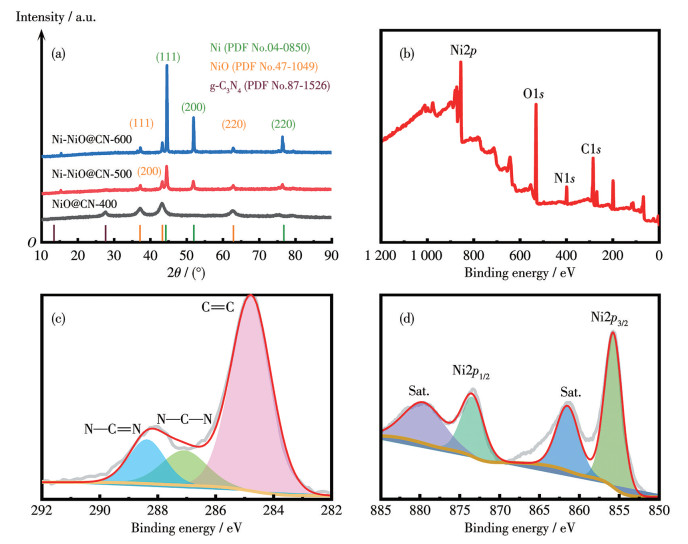
Figure 1.
(a) XRD patterns of NiO@CN-400, Ni-NiO@CN-500, and Ni-NiO@CN-600; (b) Survey, (c) C1s, and (d) Ni2p XPS spectra of Ni-NiO@CN-500

Ni-NiO@g-C3N4: Fabrication and performance for electrocatalytic methanol oxidation
Na WU , Xue ZHANG , Wenyan NIU , Yujuan ZHANG , Tuoping HU


Direct methanol (CH3OH) fuel cells (DMFCs) have demonstrated significant application potential in the fields of portable power sources and electric vehicles due to their high energy conversion efficiency and low pollution emission characteristics[1-4]. The anodic methanol oxidation reaction (MOR), as the core process in DMFCs, has kinetic performance that directly affects the device′s overall efficiency. Therefore, developing a catalyst that combines high activity, low cost, and resistance to carbon monoxide (CO) poisoning has become a key scientific issue[5-6]. At present, the mainstream MOR electrocatalysts are primarily based on precious metals such as platinum (Pt)[7], palladium (Pd)[8], and ruthenium (Ru)[9-10], and their composite materials. However, their high cost, resource scarcity, and severe CO poisoning effect have seriously restricted their commercial application[11-12]. Against this backdrop, transition metal-based catalysts represented by nickel (Ni), cobalt (Co), copper (Cu), and iron (Fe) have gradually become research hotspots due to their cost advantages and potential for resistance to CO poisoning[13-16]. Ni-based materials have attracted much attention owing to their abundant reserves and considerable catalytic activity[17-18].
Traditional nano-powder MOR catalysts are mostly loaded on carbon-based carriers (such as porous carbon, carbon nanotubes, graphene oxide, etc.). The weak interaction between carbon materials and metals limits electron transport at the interface[19-21]. Nitrogen (N) doping can effectively enhance chemical coupling between the carrier and the metal, improve the charge transfer efficiency, and stabilize the active components[22]. Compared with the post-treatment doping process, N-rich precursors can directly construct carbon matrices with high nitrogen doping levels.
Graphitized carbon nitride (g-C3N4, named as CN), as a typical N-rich carbon material, with its two-dimensional layered structure[23-24], excellent thermal stability, and unique N-C-N heterocyclic system, can not only serve as a nitrogen source precursor but also anchor metal nanostructures through coordination, providing an ideal platform for the construction of efficient metal/CN composite catalysts[25-26]. However, the electron transport bottleneck, arising from the insufficient intrinsic conductivity of CN, remains a key factor limiting its electrocatalytic performance. This limitation prompted researchers to explore synergistic optimization strategies within M-C-N (M: metal) composite systems[27-29].
In response to the above challenges, a composite (Ni-NiO@CN) comprising Ni and NiO anchored on CN was fabricated via a two-step hydrothermal and calcination process. Among them, the Ni-NiO heterojunction serves as the active center. Meanwhile, CN not only acts as a N-rich carrier to promote electron delocalization and transport, but also effectively encapsulates the active components in its two-dimensional network structure to prevent agglomeration. The electrochemical results indicated that the mass activity of the Ni-NiO@CN-500 catalyst prepared at 500 ℃ in alkaline methanol solution reached 164 mA·cm-2 at 1.67 V (vs RHE). Meanwhile, it demonstrated excellent stability at high current density. More importantly, under CO saturation, its activity could still be maintained at 94.5% of the initial level. The characteristics of low cost, high activity, and strong resistance to CO poisoning make Ni-NiO@CN-500 a promising MOR electrocatalytic material.
Melamine (C3H6N6), hydrochloric acid (HCl), urea (CO(NH2)2), and nickel chloride hexahydrate (NiCl2·6H2O) are all analytical grades and were purchased from Sinopharm Group Chemical Reagent Co., Ltd. The other reagents were used directly. Carbon cloth (CC, 0.32 mm) was purchased from Shanghai Hesen Electric Co., Ltd., China.
The method reported in the literature[30] was slightly improved, and two-dimensional CN nanosheets were successfully prepared. At room temperature, 2 g of C3H6N6 and 2 g of CO(NH2)2 were ground into fine powder, dissolved in water (50 mL), and then ultrasonicated for 30 min. Subsequently, dilute HCl was slowly added to adjust the pH of the mixed solution to 4-5. The mixture was heated at a constant temperature of 60 ℃ until all the water had evaporated entirely. The obtained precursor was then transferred to a porcelain boat, which was placed in a muffle furnace, calcinated at 550 ℃, and kept for 3 h to obtain CN nanosheets.
20 mg CN, 2 mmol NiCl2·6H2O, and 6 mmol CO(NH2)2 were dissolved in water (15 mL). After magnetic stirring at room temperature for 30 min, the resulting mixture was put into a 25 mL reactor and reacted at 100 ℃ for 18 h. After natural cooling to 25 ℃, the product was thoroughly washed with deionized water, freeze-dried, and then pyrolyzed at a gradient temperature (400, 500, and 600 ℃) for 2 h in a N2 atmosphere to prepare the composites. The resulting composites (400, 500, and 600 ℃) were denoted as NiO/@CN-400, Ni-NiO@CN-500, and Ni-NiO@CN-600, respectively.
5 mg of the powder catalyst was dispersed in a mixed solution of CH3OH and deionized water (50 μL, 2∶3, V/V) to form a slurry, which was evenly coated on the surface of CC (0.5 cm×0.5 cm). After drying at 60 ℃, the working electrode was obtained. Similarly, the Pt/C electrode was also prepared using the method described above.
X-ray diffraction (XRD) tests were performed using a Bruker D8 X-ray diffractometer with Mo Kα radiation (λ=0.071 076 nm) operating at 50 kV and 30 mA. The diffraction patterns were recorded in a 2θ range of 10°-90° with a scanning rate of 2 (°)·min-1. The microscopic morphology of the samples was analyzed by a transmission electron microscope (TEM, FEI Talos F200X) operating at an acceleration voltage of 200 kV and a field-emission scanning electron microscope (SEM, Hitachi S4800), equipped with a field emission gun and energy-dispersive X-ray spectroscopy (EDS) for elemental analysis. The VG ESCALAB MKII X-ray photoelectron spectrometer was used to obtain X-ray photoelectron spectroscopy (XPS) data based on the Al Kα (1 486.6 eV).
All electrochemical tests were conducted using a three-electrode system based on the CHI660E electrochemical workstation. The working electrode, counter electrode, and reference electrode were selected as the prepared catalysts, a piece of stainless steel (4 cm×3 cm), and a saturated calomel electrode (SCE), respectively. The electrolyte system was a 1.0 mol·L-1 KOH solution or a mixed 1.0 mol·L-1 KOH+1.0 mol·L-1 CH3OH solution. Cyclic voltammetry (CV) tests were conducted in the potential range of 1.07 to 1.67 V (vs RHE). In the frequency range of 0.01 Hz to 100 kHz, electrochemical impedance spectroscopy (EIS) was performed at a voltage amplitude of 5 mV. The long-term stability of the MOR catalyst was tested by continuously monitoring the current response in a mixed solution of 1.0 mol·L-1 KOH and 1.0 mol·L-1 CH3OH at 1.67 V (vs RHE) using the chronoamperometry (CA) method.
The crystal phase structure of the sample was analyzed using XRD. As shown in Fig.S1 (Supporting information), the characteristic diffraction peaks at 12.8° and 27.3° correspond to the (100) and (002) crystal planes of g-C3N4 (PDF No.87-1526), respectively, confirming the successful synthesis of CN. As summarized in Fig.1a, the peaks of the (111), (200), and (220) crystal planes of the rhombic NiO (PDF No.47-1049) were situated at 37.2°, 43.3°, and 62.9°, respectively. The peaks of the (111), (200), and (220) crystal planes of the face-centered cubic structure Ni (PDF No.04-0850) were situated at 44.5°, 51.8°, and 76.4°, respectively. The peak of NiO@CN-400 at 27.4° is attributed to the standard peak of the g-C3N4 (002) crystal plane. The peak of Ni-NiO@CN-500 around 15° is the thermally expanded shifted peak of the in-plane ordered (100) peak of g-C3N4 (13.1°). At 500 ℃, interlayer expansion occurs, which results in the enlargement of the lattice parameter, leading to a shift of the peak position toward higher angles. XRD patterns showed that in the 2θ range of 43°-45°, the sample at 400 ℃ exhibited only a single diffraction peak, which corresponds to the (200) crystal plane of NiO (PDF No.47-1049). In contrast, Ni-NiO@CN-500 and Ni-NiO@CN-600 showed obvious double peaks (43.3°, 44.5°) in this region, which are assigned to the (200) crystal plane of NiO (PDF No.47-1049) and the (111) crystal plane of metal Ni (PDF No.04-0850), respectively. This directly confirms that high-temperature calcination promotes the in-situ reduction of part of NiO to metal Ni by the CN support. It is worth noting that as the pyrolysis temperature rose from 400 to 600 ℃, the intensities of each characteristic diffraction peak gradually increased, referring to the fact that the crystallinity of the sample increased with rising temperature.
XPS was used to characterize the surface chemical composition and valence states of elements in samples. The survey XPS spectrum of Ni-NiO@CN-500 consists of C1s, O1s, N1s, and Ni2p (Fig.1b). As exhibited in Fig.1c, the characteristic peaks at 284.7, 287.1, and 288.5 eV correspond respectively to graphite carbon (C=C), N—C—N bond, and N—C=N bond[31]. The peaks of Ni2+2p1/2 and Ni2+2p3/2 were situated at 873.4 and 855.8 eV, respectively, while the satellite peaks of Ni were at 879.9 and 861.6 eV (Fig.1d). The spin-orbit splitting energy of 17.6 eV (873.4 to 855.8 eV) between two Ni2p peaks indicates the formation of the Ni(OH)2 phase, confirming that the Ni element in the composite is dominant in the form of Ni2+ [32-33].
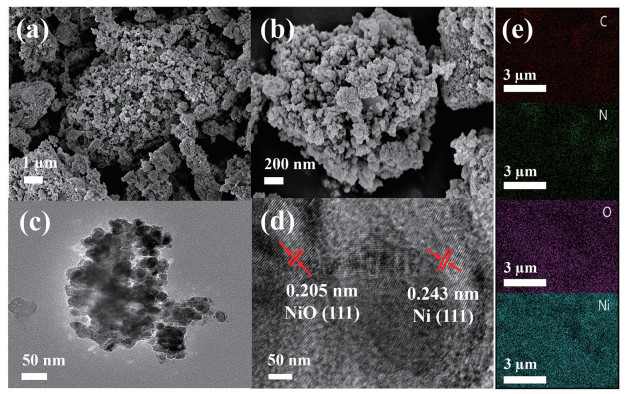
SEM and TEM were used to characterize the microstructure of Ni-NiO@CN-500. As shown in Fig.2a and 2b, Ni-NiO@CN-500 was a bulk structure composed of nanoparticle packing. Furthermore, as shown in Fig.2c, the interior of the Ni-NiO@CN-500 nano- sheets was composed of Ni-NiO nanocrystalline particles stacked together. As illustrated in Fig.2d, the lattice spacings of 0.205 and 0.243 nm belong to the crystal planes of NiO (111) and Ni (111), respectively, which are consistent with the XRD results, indicating the successful fabrication of the composite. In the EDS images (Fig.2e), the C, N, O, and Ni elements were uniformly distributed, and the atomic ratio of C, N, O, and Ni was 21.57∶7.65∶29.62∶41.16 (Fig.S2).
The influence of CH3OH concentration gradient (0.2-2.0 mol·L-1) on the activity of Ni-NiO@CN-500 for MOR was systematically studied in 1.0 mol·L-1 KOH solution. With the increase of CH3OH concentration, the current density of MOR significantly increased (Fig.S3). Still, the increase slowed down when the concentration exceeded 1.0 mol·L-1, which is ascribed to the increased ionic conduction resistance of the electrolyte caused by high-concentration CH3OH.
To further study the influence of KOH concentration on the performance of MOR, as shown in Fig.S4, the current density gradually rose with the increase of KOH concentration, which is attributed to the fact that the rise of KOH concentration enhances the electrical conductivity of the solution.
As shown in Fig.3a, in the KOH solution (1.0 mol·L-1), the CV curves of all samples presented the Ni2+/Ni3+ redox pairs at a scan rate of 50 mV·s-1 [34]. Considering the area surrounded by the CV curves, the order was Ni-NiO@CN-500 > Ni-NiO@CN-600 > NiO@CN-400, which indicates that Ni-NiO@CN-500 showed the largest specific capacitance[5]. Meanwhile, the data in Table S1 show that both the anode peak current density (jpa) and the cathode peak current density (jpc) of Ni-NiO@CN-500 were superior to those of the control samples, which confirms that it had the optimal electrocatalytic activity. Furthermore, the redox peak potential difference [ΔEp=0.24 V (vs RHE)] of Ni-NiO@CN-500 exceeded that of NiO@CN-400 (0.17 V) and Ni-NiO@CN-600 (0.21 V), which indicates that its electron transfer kinetic rate is the fastest. The initial oxidation potential [1.35 V (vs RHE)] of Ni-NiO@CN-500 was lower than that of NiO@CN-400 [1.36 V (vs RHE)] and Ni-NiO@CN-600 [1.40 V (vs RHE)], further confirming that it had the fastest MOR kinetic rate.
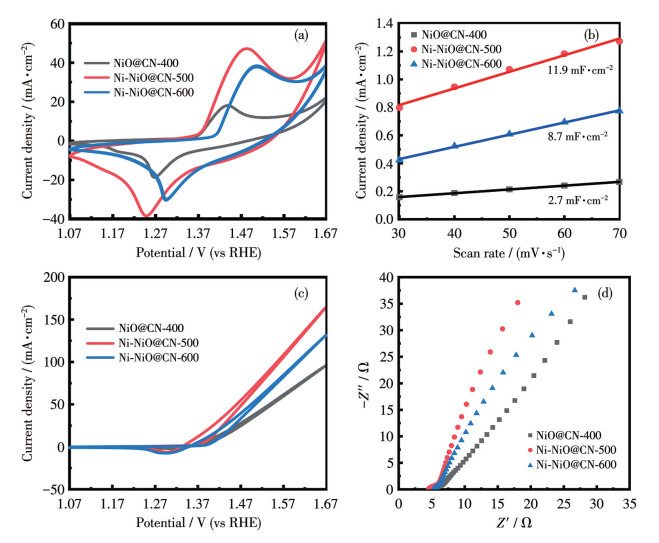
In the non-Faraday potential range of 1.11-1.17 V (vs RHE) and 1.0 mol·L-1 KOH solution, CV tests were measured to obtain the sample′s electrochemically active surface area (ECSA) (Fig.S5). Based on the relationship between the scanning rate (v) and the current density (j), the double-layer capacitance (Cdl) values were calculated to be 2.7 mF·cm-2 (NiO@CN-400), 11.9 mF·cm-2 (Ni-NiO@CN-500), and 8.7 mF·cm-2 (Ni-NiO@CN-600). According to the linear relationship between ECSA and Cdl, the ECSA values were 67.5 cm2 (NiO@CN-400), 297.5 cm2 (Ni-NiO@CN-500), and 217.5 cm2 (Ni-NiO@CN-600), which indicated that Ni-NiO@CN-500 had the optimal MOR catalytic activity (Fig.3b). In the mixed electrolyte of 1.0 mol·L-1 KOH+1.0 mol·L-1 CH3OH solution, the activity (164 mA·cm-2) of Ni-NiO@CN-500 for MOR exceeded that of NiO@CN-400 (96 mA·cm-2) and Ni-NiO@CN-600 (131 mA·cm-2) (Fig.3c). This activity difference perfectly agreed with the ECSA trend measured in the CH3OH-free alkaline electrolyte system. The dual experimental evidence jointly confirmed that Ni-NiO@ CN-500 was the optimal MOR electrocatalyst.
As shown in Fig.3d, the Nyquist curves of all samples had similar characteristics. The solution resistance (Rs) of Ni-NiO@CN-500 was significantly inferior to that of NiO@CN-400 and Ni-NiO@CN-600 in the high-frequency region, indicating that it had a lower interfacial contact resistance[35]. The Warburg impedance of Ni-NiO@CN-500 was significantly inferior to that of the control samples in the low-frequency region, reflecting the minimal ion diffusion resistance[36]. Combining high-frequency/low-frequency region characteristics, Ni-NiO@CN-500 exhibited optimal MOR electrocatalytic activity.
A comparative experimental analysis was conducted to explore the MOR activity of Ni-NiO@CN-500. In 1.0 mol·L-1 KOH solution, the CV curve of the composite showed typical Ni2+/Ni3+ redox peak characteristics (Fig.4a). When 1.0 mol·L-1 CH3OH was introduced into the system, the anode current density value increased significantly, confirming that the MOR was dominant on the Ni-NiO@CN-500 surface (Fig.4a). As shown in Fig.S6, the Ni-NiO@CN-500 for the MOR in alkaline solution was much better than that of the Pt/C catalyst. According to literature report[5], the electrocatalytic process of MOR on Ni-based catalysts follows the following three-step reaction mechanism, among which the NiOOH species have the dual functions of adsorption sites and active species for CH3OH oxidation.
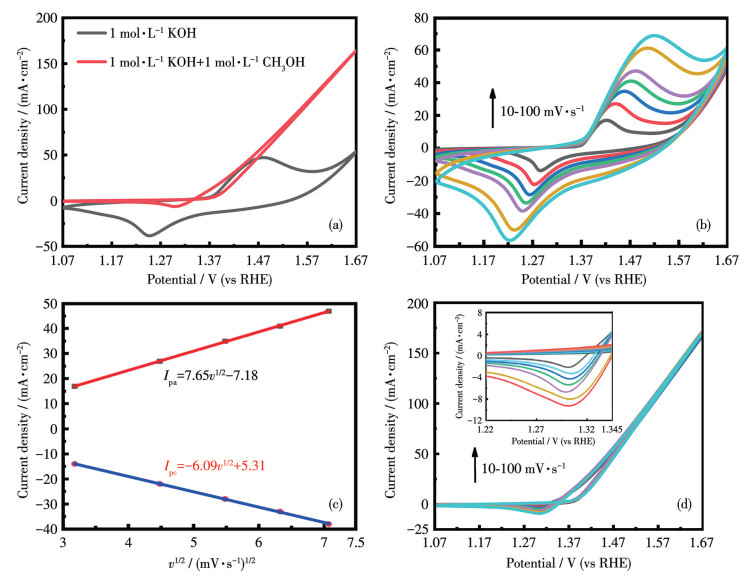
As shown in Fig.4b, with the increase of the scan rate, the anode peak position shifted positively while the cathode peak position shifted negatively. As shown in Fig.4c, the linear relationship between the anode peak current density (Ipa) and the cathode peak current density (Ipc) of electrodes and the square root of the scan rate (v1/2) indicates that the Ni(OH)2⇌NiOOH conversion process is regulated by the diffusion mechanism[37-38]. Significantly, a greater slope of the curve indicated that the material not only had a stronger OH- diffusion flux but also could generate more active substance NiOOH (Fig.4c). The linear slope of Ni-NiO@ CN-500 exceeded those of other samples (Fig.S7), indicating that its Ni site had a more substantial adsorption effect on OH-. As illustrated in Fig.4d, in the mixed solution of 1.0 mol·L-1 KOH+1.0 mol·L-1 CH3OH solution, with the rise of the scan rate, the current density of Ni-NiO@CN-500 did not show significant fluctuations, revealing that a kinetic process dominates the MOR.
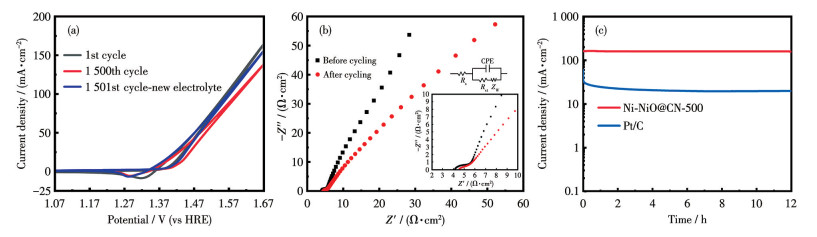
Long-term durability is a key indicator to assess the performance of composites. The durability tests were conducted on Ni-NiO@CN-500 at 1.67 V (vs RHE) in the mixed solution of 1.0 mol·L-1 KOH+1.0 mol·L-1 CH3OH solution. As shown in Fig.5a, after 1 500 CV cycles (50 mV·s-1), the current density decayed by 16%. When the fresh electrolyte was replaced, the current density returned to 94% of the initial one, indicating that the attenuation of the current density was mainly due to the consumption of CH3OH. Meanwhile, the shapes of EIS before and after the CV cycle (Fig.5b) were highly similar, a semi-circle and a straight line correspond to the charge-transfer resistance and the capacitive behavior of the electrodes[39]. The equivalent contact resistance, namely the intercept on the X-axis, increased gradually from 4.0 Ω·cm2 (1st) to 4.5 Ω·cm2 (1 500th), indicating that the change in electrode impedance can be ignored. Furthermore, after the 12 h CA tests (Fig.5c), the current density decreased by only 10.1% (from 169 to 152 mA·cm-2), and the current density on the Pt/C catalyst quickly decreased by 33.1% (from 60 to 20 mA·cm-2). The above results confirm that Ni-NiO@CN-500 has both high activity and good tolerance, and is an excellent MOR catalyst.
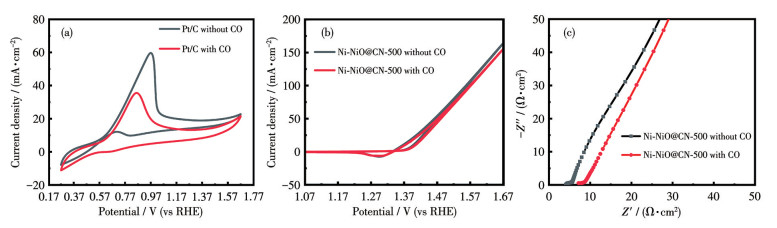
During the MOR process, the generation of CO was inevitable, which can lead to catalytic deactivation by occupying the active sites of the catalyst[40]. As displayed in Fig.6a, at the potential of 0.97 V (vs RHE), the current density of the Pt/C catalyst significantly decayed from 59 mA·cm-2 (without CO) to 35 mA·cm-2 (CO saturated), and the retention rate of the current density was only 59%. In the comparative experiment, the CO tolerance test of Ni-NiO@CN-500 at the potential of 1.67 V (vs RHE) showed that its current density only slightly decreased from 164 mA·cm-2 (in the CO-free system) to 155 mA·cm-2 (in the CO-saturated system) with a retention rate of 94.5% (Fig.6b). Meanwhile, the EIS shapes of Ni-NiO@CN-500 in KOH+CH3OH solution with and without CO were highly consistent (Fig.6c), indicating that its charge transfer resistance was not significantly affected by CO. The above comparative experiments confirm that Ni-NiO@CN-500 has significant anti-CO poisoning performance compared with commercial Pt/C catalysts.
In summary, a composite of Ni-NiO nanoparticles anchored on two-dimensional N-rich CN was successfully constructed in this work. The optimally prepared Ni-NiO@CN-500 demonstrated significantly enhanced MOR catalytic activity, excellent chemical stability, and CO-tolerance. The superb performance of the composite is primarily determined by the fact that the uniformly dispersed Ni-NiO nanoparticles have excellent activity, and the N-rich CN two-dimensional carrier not only promotes electron transfer but also protects the active components from loss. This work provides new methods and ideas for preparing low-cost, high-activity, and anti-CO poisoning MOR electrocatalysts.
LI K, JIN Z, GE J J, LIU C P, XING W. Platinum nanoparticles partially-embedded into carbon sphere surfaces: A low metal-loading anode catalyst with superior performance for direct methanol fuel cells[J]. J. Mater. Chem. A, 2017, 5(37): 19857-19865 doi: 10.1039/C7TA06700C
GAWANDE M B, GOSWAMI A, FELPIN F X, ASEFA T, HUANG X X, SILVA R, ZOU X X, ZBORIL R, VARMA R S. Cu and Cu-based nanoparticles: synthesis and applications in catalysis[J]. Chem. Rev., 2016, 116(6): 3722-3811 doi: 10.1021/acs.chemrev.5b00482
GOSWAMI A, RATHI A K, APARICIO C, TOMANEC O, PETR M, POCKLANOVA R, GAWANDE M B, VARMA R S, ZBORIL R. In situ generation of Pd-Pt core-shell nanoparticles on reduced graphene oxide (Pd@Pt/rGO) using microwaves: Applications in dehalogenation reactions and reduction of olefins[J]. ACS Appl. Mater. Interfaces, 2017, 9(3): 2815-2824 doi: 10.1021/acsami.6b13138
LIN X X, WANG A J, FANG K M, YUAN J H, FENG J J. One-pot seedless aqueous synthesis of reduced graphene oxide (rGO)-supported core-shell Pt@Pd nano-flowers as advanced catalysts for oxygen reduction and hydrogen evolution[J]. ACS Sustain. Chem. Eng., 2017, 5(10): 8675-8683 doi: 10.1021/acssuschemeng.7b01400
WU N, ZHAI M X, CHEN F, ZHANG X, GUO R H, HU T P, MA M M. Nickel nanocrystal/nitrogen-doped carbon composites as efficient and carbon monoxide-resistant electrocatalysts for methanol oxidation reactions[J]. Nanoscale, 2020, 12(42): 21687-21694 doi: 10.1039/D0NR04822D
CHEN F, WU N, ZHAI M X, ZHANG X, GUO R H, HU T P, MA M M. Robust copper nanocrystal/nitrogen-doped carbon monoliths as carbon monoxide-resistant electrodes for methanol oxidation reaction[J]. J. Energy Chem., 2021, 58: 247-255 doi: 10.1016/j.jechem.2020.10.020
YAN L Y, ZHANG H T, LU X Y, LIU L M, ZHANG R H, CHENG Z, FAN S W, ZHOU X W. PtBi nanocatalysts with controlled chain-like structure and composition: Solvothermal synthesis and ethanol oxidation performance[J]. Fuel, 2025, 392: 134918 doi: 10.1016/j.fuel.2025.134918
周新文, 沈晓宇, 付策, 王攀, 严烙意, 程征, 田贵贤, 张荣华. Ir和IrPd催化剂的合成及结构调控对其甲醇氧化性能的影响[J]. 无机化学学报, 2024, 40(2): 412-420ZHOU X W, SHEN X Y, FU C, WANG P, YAN L Y, CHENG Z, TIAN G X, ZHANG R H. Effects of synthesis and structural regulation of Ir and IrPd catalysts on methanol oxidation performance[J]. Chinese J. Inorg. Chem., 2024, 40(2): 412-420
WANG L, ZHOU Q, PU Z H, ZHANG Q, MU X Q, JING H Y, LIU S L, CHEN C Y, MU S C. Surface reconstruction engineering of cobalt phosphides by Ru inducement to form hollow Ru-RuPx-CoxP pre- electrocatalysts with accelerated oxygen evolution reaction[J]. Nano Energy, 2018, 53: 270-276 doi: 10.1016/j.nanoen.2018.08.061
YANG K, XU P P, LIN Z Y, YANG Y, JIANG P, WANG C L, LIU S, GONG S P, HU L, CHEN Q W. Ultrasmall Ru/Cu-doped RuO2 complex embedded in amorphous carbon skeleton as highly active bifunctional electrocatalysts for overall water splitting[J]. Small, 2018, 14(41): 1803009 doi: 10.1002/smll.201803009
CHENG Z, LUO J J, YAN L Y, TIAN G X, ZHANG R H, CHEN L, ZHOU X W. Facile loading of ultrafine Pt nanoparticles on white carbon black for the enhanced methanol oxidation reaction[J]. Ionics, 2024, 30: 1503-1509 doi: 10.1007/s11581-024-05371-1
XIE Y X, LI Z S, LIU Y, YE Y X, ZOU X H, LIN S. Plasmon enhanced bifunctional electro-photo catalytic properties of Pt-Au/graphene composites for methanol oxidation and oxygen reduction reaction[J]. Appl. Surf. Sci., 2020, 508: 145161 doi: 10.1016/j.apsusc.2019.145161
XU J Y, LIU Y F, LI J J, AMORIM I, ZHANG B S, XIONG D H, ZHANG N, THALLURI S M, SOUSA J P. S, LIU L F. Hollow cobalt phosphide octahedral pre-catalysts with exceptionally high intrinsic catalytic activity for electro-oxidation of water and methanol[J]. J. Mater. Chem. A, 2018, 6(42): 20646-20652 doi: 10.1039/C8TA07958G
DU J N, YOU S J, LI X R, TANG B, JIANG B J, YU Y, CAI Z, REN N Q, ZOU J L. In situ crystallization of active NiOOH/CoOOH heterostructures with hydroxide ion adsorption sites on velutipes-like CoSe/NiSe nanorods as catalysts for oxygen evolution and cocatalysts for methanol oxidation[J]. ACS Appl. Mater. Interfaces, 2020, 12(1): 686-697 doi: 10.1021/acsami.9b16626
TONG W, SHAO Q, WANG P T, HUANG X Q. Phase modulating of Cu-Ni Nanowires enables active and stable electrocatalysts for the methanol oxidation reaction[J]. Chem. Eur. J., 2019, 25(29): 7218-7224 doi: 10.1002/chem.201901064
MATIN M A, LEE E, KIM H, YOON W S, KWON Y U. Rational syntheses of core-shell Fe@(PtRu) nanoparticle electrocatalysts for the methanol oxidation reaction with complete suppression of CO-poisoning and highly enhanced activity[J]. J. Mater. Chem. A, 2015, 3(33): 17154-17164 doi: 10.1039/C5TA03809J
YANG W L, YANG X P, JIA J, HOU C M, GAO H T, MAO Y N, WANG C, LIN J H, LUO X L. Oxygen vacancies confined in ultrathin nickel oxide nanosheets for enhanced electrocatalytic methanol oxidation[J]. Appl. Catal. B‒Environ., 2019, 244: 1096-1102 doi: 10.1016/j.apcatb.2018.12.038
DONG B, LI W, HUANG X X, ALI Z, ZHANG T, YANG Z Y, HOU Y L. Fabrication of hierarchical hollow Mn doped Ni(OH)2 nanostructures with enhanced catalytic activity towards electrochemical oxidation of methanol[J]. Nano Energy, 2019, 55: 37-41 doi: 10.1016/j.nanoen.2018.10.050
YE N, JIANG Z, FANG T. Assembling the PdCu/rGO catalysts for methanol oxidation reaction in alkaline media by tuning the electronic structure[J]. Electrochim. Acta, 2020, 352: 136473 doi: 10.1016/j.electacta.2020.136473
CAI X K, LUO Y T, LIU B L, CHENG H M. Preparation of 2D material dispersions and their applications[J]. Chem. Soc. Rev., 2018, 47(16): 6224-6266
CHEN K Y, HUANG X B, WAN C Y, LIU H. Efficient oxygen reduction catalysts formed of cobalt phosphide nanoparticle decorated heteroatom-doped mesoporous carbon nanotubes[J]. Chem. Commun., 2015, 51(37): 7891-7894 doi: 10.1039/C5CC02028J
方惠燕, 赵敬创, 康贤禹, 李艳彩. 镍/生物质衍生氮掺杂多孔碳纳米复合材料的制备及对甲醇氧化反应的电催化[J]. 无机化学学报, 2022, 38(10): 1959-1969FANG H Y, ZHAO J C, KANG X Y, LI Y C. Ni/biomass-derived nitrogen-doped porous carbon nanocomposites: Preparation and electrocatalysis for methanol oxidation reaction[J]. Chinese J. Inorg. Chem., 2022, 38(10): 1959-1969
CAO S W, LOW J X, YU J G, JARONIEC M. Polymeric photocatalysts based on graphitic carbon nitride[J]. Adv. Mater., 2015, 27(13): 2150-2176 doi: 10.1002/adma.201500033
LI X H, ANTONIETTI M. Metal nanoparticles at mesoporous N-doped carbons and carbon nitrides: functional Mott-Schottky heterojunctions for catalysis[J]. Chem. Soc. Rev., 2013, 42(16): 6593-6604 doi: 10.1039/c3cs60067j
WANG X C, BLECHERT S, ANTONIETTI M. Polymeric graphitic carbon nitride for heterogeneous photocatalysis[J]. ACS Catal., 2012, 2(8): 1596-1606 doi: 10.1021/cs300240x
ZHU M S, ZHAI C Y, SUN M J, HU Y F, YAN B, DU Y K. Ultrathin graphitic C3N4 nanosheet as a promising visible-light-activated support for boosting photoelectron catalytic methanol oxidation[J]. Appl. Catal. B‒Environ., 2017, 203: 108-115 doi: 10.1016/j.apcatb.2016.10.012
LI X G, BI W T, ZHANG L, TAO S, CHU W S, ZHANG Q, LUO Y, WU C Z, XIE Y. Single-atom Pt as Co-catalyst for enhanced photocatalytic H2 evolution[J]. Adv. Mater., 2016, 28(12): 2427-2431 doi: 10.1002/adma.201505281
BAI X J, ZONG R L, LI C X, LIU D, LIU Y F, ZHU Y F. Enhancement of visible photocatalytic activity via Ag@C3N4 core-shell plasmonic composite[J]. Appl. Catal. B‒Environ., 2014, 147: 82-91 doi: 10.1016/j.apcatb.2013.08.007
PIETA I S, RATHI A, PIETA P, NOWAKOWSKI R, HOLDYNSKI M, PISAREK M, KAMINSKA A, GAWANDE M B, ZBORIL R. Electrocatalytic methanol oxidation over Cu, Ni and bimetallic Cu-Ni nanoparticles supported on graphitic carbon nitride[J]. Appl. Catal. B‒Environ., 2019, 244: 272-283 doi: 10.1016/j.apcatb.2018.10.072
HONG Y W, YANG J X, CHOI W M, WANG J J, XU J L. B-doped g-C3N4 quantum dots-modified Ni(OH)2 nanoflowers as an efficient and stable electrode for supercapacitors[J]. ACS Appl. Energ. Mater., 2021, 4(2): 1496-1504
RABCHINSKII M K, SHNITOV V V, DIDEIKIN A T, ALEKSENSKII A E, VUL S P, BAIDAKOVA M V, PRONIN I I, KIRILENKO D A, BRUNKOV P N, WEISE J, MOLODTSOV S L. Nanoscale perforation of graphene oxide during photoreduction process in the argon atmosphere[J]. J. Phys. Chem. C, 2016, 120: 28261-28269 doi: 10.1021/acs.jpcc.6b08758
ZHAI Z T, LIU Q, ZHU Y, CAO J N, SHI S J. Synthesis of Ni(OH)2/graphene composite with enhanced electrochemical property by stirring solvothermal method[J]. J. Alloy. Compd., 2019, 775: 1316-1323
LU S, HUMMEL M, GU Z R, WANG Y C, WANG K L, PATHAK R, ZHOU Y, JIA H X, QI X Q, ZHAO X H, XU B B, LIU X T. Highly efficient urea oxidation via nesting nano-nickel oxide in eggshell membrane-derived carbon[J]. ACS Sustain. Chem. Eng., 2021, 9(4): 1703-1713 doi: 10.1021/acssuschemeng.0c07614
ABDULLAH M I, HAMEED A, ZHANG N, ISLAM M H, MA M M, POLLET B G. Ultrasonically surface-activated nickel foam as a highly efficient monolith electrode for the catalytic oxidation of methanol to formate[J]. ACS Appl. Mater. Interfaces, 2021, 13(26): 30603-30613
SHI R, ZHANG Y Y, WANG Z H. Facile synthesis of a ZnCo2O4 electrocatalyst with three-dimensional architecture for methanol oxidation[J]. J. Alloy. Compd., 2019, 810: 151879
QIAN L, LUO S L, WU L S, HU X R, CHEN W, WANG X. In situ growth of metal organic frameworks derived hierarchical hollow porous Co3O4/NiCo2O4 nanocomposites on nickel foam as self- supported flexible electrode for methanol electrocatalytic oxidation[J]. Appl. Surf. Sci., 2020, 503: 144306
DANAEE I, JAFARIAN M, MIRZAPOOR A, GOBAL F, MAHJANI M G. Electrooxidation of methanol on NiMn alloy modified graphite electrode[J]. Electrochim. Acta, 2010, 55(6): 2093-2100
YI Q F, HUANG W, ZHANG J J, LIU X P, LI L. Methanol oxidation on titanium-supported nano-scale Ni flakes[J]. Catal. Commun., 2008, 9(10): 2053-2058
WU N, GUO R H, ZHANG X, GAO N, CHI X Y, CAO D L, HU T P. Nickel/nickel oxide nanocrystal nitrogen-doped carbon composites as efficient electrocatalysts for urea oxidation[J]. J. Alloy. Compd. 2021, 870: 159408
CHEN D J, TONG Y Y J. Irrelevance of carbon monoxide poisoning in the methanol oxidation reaction on a PtRu electrocatalyst[J]. Angew. Chem. ‒Int. Edit., 2015, 54(32): 9394-9398

Figure 1 (a) XRD patterns of NiO@CN-400, Ni-NiO@CN-500, and Ni-NiO@CN-600; (b) Survey, (c) C1s, and (d) Ni2p XPS spectra of Ni-NiO@CN-500

Figure 2 (a, b) SEM images, (c) TEM image, (d) high-resolution TEM image, and (e) SEM-EDS mapping images of Ni-NiO@CN-500

Figure 3 Electrochemical performance: (a) CV curves at 50 mV·s-1 in 1.0 mol·L-1 KOH solution; (b) calculation of the double layer capacitance of different materials; (c) CV curves at 50 mV·s-1 in 1.0 mol·L-1 KOH+1.0 mol·L-1 CH3OH solution; (d) EIS

Figure 4 CV tests of Ni-NiO@CN-500: (a) CV curves at 50 mV·s-1 in different solutions; (b) CV curves at different scanning rates (10, 20, 30, 40, 50, 80, and 100 mV·s-1) in 1.0 mol·L-1 KOH solution; (c) Linear fitting of anodic and cathodic peak current densities to the square roots of the scan rates for Ni-NiO@CN-500; (d) CV curves in 1.0 mol·L-1 KOH+ 1.0 mol·L-1 CH3OH solution at different scanning rates (10, 20, 30, 40, 50, 80, and 100 mV·s-1; inset: the magnified view of a local region)

Figure 5 (a) CV cycling stability tests and (b) EIS (inset: the corresponding enlarged spectra and the fitted circuit diagram) of Ni-NiO@CN-500; (c) CA curves of Ni-NiO@CN-500 at 1.67 V (vs RHE) and Pt/C at 0.97 V (vs RHE) in the mixed solution of 1.0 mol·L-1 KOH and 1.0 mol·L-1 CH3OH solution

 扫一扫看文章


扫一扫关注我们
 下载:
下载:
 下载:
下载:

 下载:
下载: