
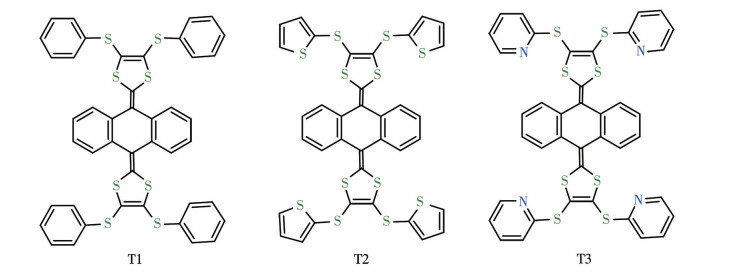
图 1.
化合物T1~T3的结构
Figure 1.
Structures of compounds T1-T3


四硫富瓦烯(TTF)自20世纪70年代首次被报道以来,便由于其独特的电子和结构特性引起科学家的广泛关注[1]。TTF是良好的有机电子给体且具有独特的氧化还原特性,因此TTF及其衍生物被广泛应用于有机半导体、有机导体、有机超导体等领域[2-6]。扩展TTF的π共轭体系是TTF进行化学修饰的重要方向之一,可以增强其给电子能力、提升氧化态稳定性,为进行超分子组装和设计分子器件提供更多可能。
蒽醌扩展式四硫富瓦烯(exTTF)由于扩大了π共轭体系,其氧化还原性能和超分子组装性能均呈现独特的性质[7-11]。对exTTF外围进行修饰会显著影响其电子性质和分子间相互作用,改变exTTF的物理化学性质。在外围位置引入芳基是修饰exTTF的有效方法之一,芳基可以通过π共轭体系调节exTTF的电子性质,并影响分子间相互作用。目前,已报道的芳基化exTTF多是通过C—C键将芳基直接连接到exTTF框架上[12-15]。在这些体系中,芳基的旋转自由度受到空间位阻和共轭体系的限制,影响其结构的变化。芳基通过硫桥与exTTF连接,芳基可以围绕硫桥的2个C—S键旋转。不仅可以调节分子电化学性质,还可以增加分子的内部自由度[16-20]。exTTF分子可以很容易地调整其几何形状以适应客体分子的变化,这为与不同客体的超分子组装创造了有利条件。外围芳基的变化对电荷转移复合物的晶体结构和物理化学性质会产生重要影响。因此,我们选取已报道的硫原子桥联芳基取代exTTF T1~T3(图 1)作为电子给体[21],通过改变exTTF外围芳基取代基,对exTTF的电子态进行调控。本文报道了化合物T1~T3与CuBr2电荷转移复合物的合成、电荷转移和晶体结构,研究外围取代基的变化对客体分子的构型、复合物晶体结构的重要影响。
所用试剂均按标准方法进行处理。CuBr2购自上海新宝化学试剂厂,纯度98%。化合物T1~T3根据本课题组已经报道的方法进行合成[21]。
电化学性质在RST5000电化学工作站上进行测试。溶剂为二氯甲烷,温度控制为20 ℃,待测物浓度为5×10⁻⁴ mol·L-1,并以(TBA)PF6(四丁基六氟磷酸铵)为支持电解质。循环伏安扫描速率设定为0.05 V·s-1,采用铂碳电极为工作电极,Pt电极为辅助电极,饱和甘汞电极为参比电极。UV-Vis吸收光谱在Shimadzu UV-2600紫外可见分光光度计上进行测试。
根据我们已报道的合成方法合成化合物T1~T3,使用前进行重结晶。化合物T1~T3的氧化还原电位如表 1所示[21]。化合物T1为可逆的双电子氧化还原过程,呈现典型的exTTF电化学行为[14, 22-24]。化合物T2则呈现不可逆的双电子氧化还原过程。化合物T3则与T1和T2均不相同,在0.80和0.49 V处各有一个单电子氧化还原峰,说明化合物T3有类似TTF的电化学性质[25]。化合物T1~T3呈现不同的电化学性质与其外围硫原子桥联芳基的变化有密切关系。

 下载:
导出CSV
下载:
导出CSV
| Compound | Eox/V | Ered/V | ΔE/V |
| T1 | 0.59 | 0.46 | 0.13 |
| T2 | 0.63 | 0.37 | 0.26 |
| T3 | 0.57 | 0.25 | 0.32 |
我们采用相似的方法合成化合物T1和T2与CuBr2的电荷转移复合物,以下以化合物T1为例说明。将化合物T1(5 μmol,4.1 mg)溶于4 mL重蒸的四氢呋喃(THF),溶液置于20 mL试管中。将CuBr2(75 μmol,16.8 mg)溶于4 mL重蒸的乙腈(CH3CN)中。然后缓慢加入3 mL重蒸CH3CN于试管中作隔层,缓慢加入CuBr2的CH3CN溶液,封口避光静置。2周后,试管底部有黑色块状晶体生成,过滤,用CH3CN洗涤后干燥,得3.2 mg晶体。以T2制备得到的复合物晶体产量为3.5 mg。
将化合物T3(5 μmol,4.1 mg)溶于4 mL重蒸的二氯甲烷(DCM),溶液置于20 mL试管中。将CuBr2(75 μmol,16.8 mg)溶于4 mL重蒸的CH3CN中。然后缓慢加入3 mL重蒸CH3CN于试管中作隔层,缓慢加入CuBr2的CH3CN溶液,封口避光静置。2周后,试管底部有黑色块状晶体生成,过滤,用乙腈洗涤后干燥,得5.0 mg晶体。
下载:
导出CSV
| Compound | Solution | Complex | Yield/% | Appearance |
| T1 | THF/CH3CN | (T1)[Cu2Br6]·2THF | 41 | Black cuboid |
| T2 | THF/CH3CN | (T2)[Cu2Br6]·2THF | 44 | Black block |
| T3 | DCM/CH3CN | (T3)[Cu2Br6] | 63 | Black block |
选取合适尺寸的单晶样品,采用SuperNova X射线衍射仪(Agilent)进行测试,晶体结构采用直接法由Olex2解析,并通过SHELXL 2018进行校正。非氢原子的坐标及各向异性热参数用全矩阵最小二乘法进行最后修正,氢原子坐标由理论加氢得到。晶体数据列于表 3。
下载:
导出CSV
| Parameter | (T1)[Cu2Br6]·2THF | (T2)[Cu2Br6]·2THF | (T3)[Cu2Br6] |
| Empirical formula | C52H44S8Br6Cu2O2 | C44H36S12Br6Cu2O2 | C40H24S8Br6Cu2N4 |
| Formula weight | 1 563.89 | 1 587.99 | 1 423.65 |
| Temperature/K | 291 | 173 | 173 |
| λ/nm | 0.071 073 | 0.154 184 | 0.154 184 |
| Crystal size/mm | 0.02×0.05×0.1 | 0.05×0.1×0.2 | 0.05×0.1×0.1 |
| Crystal system | Monoclinic | Monoclinic | Triclinic |
| Space group | P21/c | P21/c | P1 |
| a/nm | 0.808 18(5) | 1.657 32(5) | 1.238 25(6) |
| b/nm | 1.673 94(6) | 0.805 41(2) | 1.312 79(7) |
| c/nm | 2.066 70(10) | 2.032 85(5) | 1.644 09(8) |
| α/(°) | 66.557(5) | ||
| β/(°) | 98.911(5) | 101.057(3) | 78.797(4) |
| γ/(°) | 68.412(5) | ||
| V/nm3 | 2.762 2(3) | 2.662 23(13) | 2.276 4(2) |
| Z | 2 | 2 | 2 |
| Dc/(g·cm-3) | 1.880 | 1.981 | 2.077 |
| μ/mm-1 | 5.453 | 10.966 | 11.053 |
| Maximum of 2θ/(°) | 50.052 | 133.146 | 133.17 |
| Reflection, Nres, Npar* | 4 854, 30, 271 | 4 595, 191, 335 | 7 811, 0, 550 |
| GOF | 1.077 | 1.027 | 1.041 |
| R1 [I > 2σ(I)] | 0.073 4 | 0.033 2 | 0.028 9 |
| wR2 (all) | 0.171 6 | 0.092 3 | 0.077 6 |
| *Nres=number of restraints, Npar=number of parameters. | |||
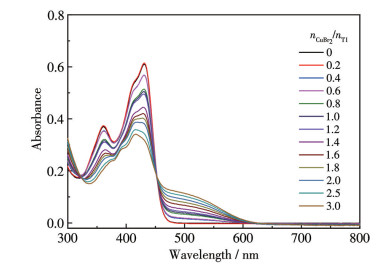
室温条件下,将化合物T1溶于DCM(重蒸)中配制成浓度为20 μmol·L-1的溶液,将CuBr2溶于CH3CN(重蒸)配制为0.5 mmol·L-1的溶液。将CuBr2溶液滴入化合物T1的溶液中,其UV-Vis吸收光谱图变化如图 2所示。随着CuBr2溶液的滴加,T1的430 nm的吸收峰逐渐降低,而450~600 nm处出现了新的吸收峰。说明化合物T1与CuBr2之间发生了电荷转移,化合物T1被氧化。化合物T2和T3与化合物T1的UV-Vis吸收峰变化相似(图S1和S2,Supporting information)所示,说明在溶液中化合物T1~T3均与CuBr2发生了电子转移[21]。但化合物T2的UV-Vis吸收峰在300~430 nm处产生了明显的上移,与T1和T3略有不同,这可能是由于分子间相互作用方式不同引起的。
复合物(T1)[Cu2Br6]·2THF的晶体属单斜晶系P21/c空间群。晶胞中1/2个T12+、1/2个[Cu2Br6]2-和1个THF分子在晶体学上独立。晶胞参数见表 3,晶体结构如图 3所示。由图 3可知,1,3-二硫代环戊烯与中心结构蒽醌单元成近似垂直结构,其二者所在平面的夹角为83.86°。4个苯环分布在1,3-二硫代环戊烯所在平面的两侧,同一端的2个苯环所在平面与中心蒽醌平面的夹角分别为83.56°和65.02°,两苯环所在平面的夹角为32.98°。无机离子[Cu2Br6]2-的构型如图 3所示。2个Cu2+由2个Br—Cu键连接,键长分别为0.243 9和0.245 7 nm,两端Br—Cu键键长均为0.237 5 mm,构成平面状的[Cu2Br6]2-。
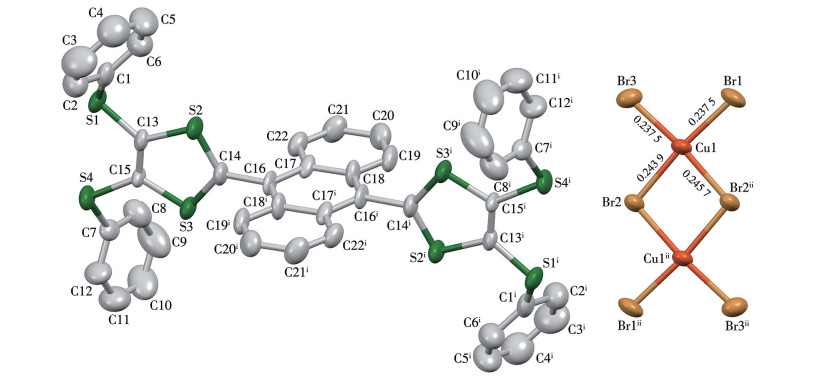
For clarity, the hydrogen atoms are omitted; Symmetry codes: i 1-x, 2-y, -z; ii -x, 1-y, -z
(T1)[Cu2Br6]·2THF分子间相互作用如图 4所示。T12+沿b轴方向通过S…S(0.350 6 nm)相互作用,在b轴方向呈柱状堆积。T12+两端的2个苯环分别通过3个C…H(0.276 2、0.288 3和0.286 9 nm)和2个H…H(0.204 6和0.228 3 nm)与2个THF分子相连,通过1个C…C(0.329 0 nm)、2个C…H(0.283 5和0.250 9 nm)和H…H(0.232 7 nm)与2个THF分子相连。此外,T12+中心蒽醌平面和1,3-二硫代环戊烯分别通过2个C…C(0.338 4和0.324 4 nm)、1个S…C(0.342 7 nm)、4个C…H(0.283 0、0.277 7、0.288 6和0.278 2 nm)和1个S…H(0.299 4 nm)与2个THF分子相连,如图 4a所示,呈三维网格状堆积。[Cu2Br6]2-通过4个Br…C(0.354 3和0.349 5 nm)分别与上下2个T12+相互作用,通过6个Br…H(0.291 4、0.294 3和0.301 5 nm)分别与4个T12+相互作用,如图 4b所示。
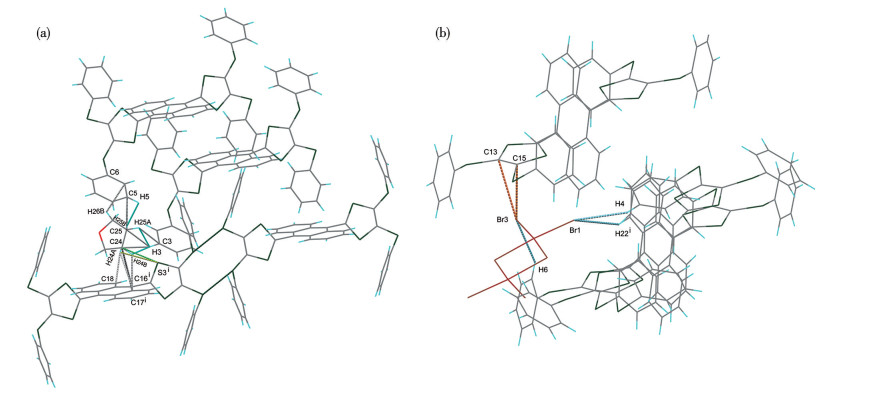
S…S: green dotted line, S…C: light green dotted line, S…H: buff dotted line, C…C: grey dotted line, C…H: light grey dotted line, H…H: blue green dotted line, Br…C: orange dotted line, Br…H: light blue dotted line; Symmetry codes: i 1-x, 2-y, -z; ii -x, 1-y, -z.
复合物(T2)[Cu2Br6]·2THF的晶体属单斜晶系P21/c空间群。晶胞中1/2个T22+、1/2个[Cu2Br6]2-和1个THF分子在晶体学上独立。晶胞参数见表 3,晶体结构如图 5所示。1,3-二硫代环戊烯与中心结构蒽醌单元成近似垂直结构,其二者所在平面的夹角为83.41°。4个噻吩环分布在1,3-二硫代环戊烯所在平面的两侧,同一端的2个苯环所在本面与中心蒽醌平面的夹角分别为71.71°和67.66°,两苯环所在平面的二面角为50.62°。无机离子[Cu2Br6]2-的构型如图 5所示。2个Cu2+由2个Br—Cu键连接,键长分别为0.244 4和0.244 1 nm,两端Br—Cu键键长分别为0.237 6和0.238 6 nm,构成近似平面状的[Cu2Br6]2-。
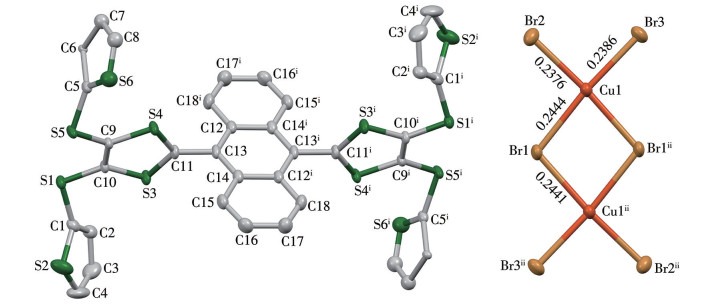
For clarity, the hydrogen atoms are omitted; Symmetry codes: i 1-x, 1-y, 1-z; ii -x, 2-y, 1-z.
(T2)[Cu2Br6]·2THF分子间相互作用如图 6所示。沿a轴方向,T22+通过3个S…S(0.344 6、0.349 1和0.344 6 nm)与相邻的T22+形成相互作用。在c轴方向,T22+与相邻T22+通过噻吩环之间的C…C (0.332 6 nm)和S…H(0.282 8 nm)直接相互作用;此外,还通过四氢呋喃环形成相互作用。一端通过C…H(0.275 1 nm)和H…H(0.230 7 nm),另一端通过C…C(0.332 1 nm)、C…H(0.270 5和0.278 6 nm)、S…H(0.283 6和0.288 2 nm)和S…C(0.325 3 nm)使T22+分子间形成相互作用,呈二维网格状堆积,如图 6a所示。[Cu2Br6]2-通过10个Br…H(0.290 2、0.286 3、0.294 1、0.283 3和0.304 8 nm)、2个Br…S(0.363 6 nm)、2个S…Cu(0.319 6 nm)和4个Br…C(0.345 0和0.347 1 nm)与周围8个T22+相互作用,使(T2)[Cu2Br6]·2THF呈三维网格状堆积,如图 6b所示。
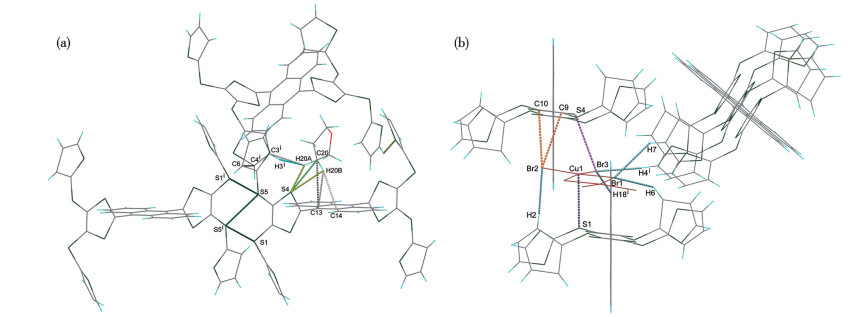
S…S: green dotted line, S…C: light green dotted line, S…H: buff dotted line, C…C: grey dotted line, C…H: light grey dotted line, H…H: blue green dotted line, Br…S: violet dotted line, Br…C: orange dotted line, Br…H: light blue dotted line, S…Cu: purple dotted line; Symmetry codes: i 1-x, 1-y, 1-z; ii -x, 2-y, 1-z.
复合物(T3)[Cu2Br6]的晶体属三斜晶系P1空间群。晶胞中2个1/2个T32+和1个Cu2Br62-在晶体学上独立。晶胞参数见表 3,晶体结构如图 7所示。T32+(A)的2个1,3-二硫代环戊烯在2个平行的平面上,其所在平面与中心结构蒽醌单元所在平面的夹角为82.42°。T32+(A)以蒽醌为中心对称,同一端的2个吡啶环在1,3-二硫代环戊烯平面的两侧,其所在平面与中心蒽醌平面的二面角分别为75.26°和28.42°,两吡啶环所在平面的二面角为48.82°。T32+(B)同一端的2个吡啶环在1,3-二硫代环戊烯平面的两侧,其所在本面与中心蒽醌平面的二面角分别为80.94°和88.65°,两吡啶环所在平面的二面角为34.28°。无机离子[Cu2Br6]2-的构型如图 7所示。2个Cu2+分别由2个Br—Cu键连接,键长分别为0.244 9、0.244 2 nm和0.242 3、0.246 2 nm,两端Br—Cu键键长分别为0.234 4、0.233 8、0.231 1和0.231 1 nm,构成八面体的[Cu2Br6]2-。
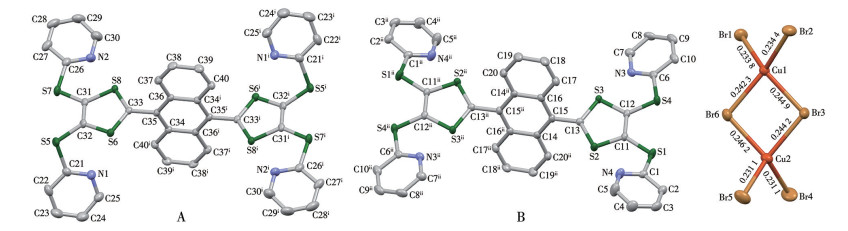
For clarity, the hydrogen atoms are omitted; Symmetry codes: i 1-x, 1-y, 1-z; ii 1-x, -y, 2-z.
(T3)[Cu2Br6]的分子间相互作用如图 8所示。沿b轴方向,T32+(A)分子通过S…C(0.336 8、0.348 8和0.333 2 nm)、S…S(0.359 9 nm)、S…H(0.298 5 nm)、C…C(0.330 6 nm)和C…H(0.284 4 nm)与相邻的2个T32+(B)分子相互作用。沿c轴方向,T32+(A)分子通过2个S…S(0.356 3 nm)与相邻的T32+(A)分子相互作用,形成三维网格状堆积,如图 8a所示。[Cu2Br6]2-通过7个Br…H(0.287 5~0.304 5 nm)、2个Br…C(0.345 1和0.353 1 nm)和2个Br…S(0.342 7和0.353 3 nm)与周围6个T32+形成相互作用,如图 8b所示。
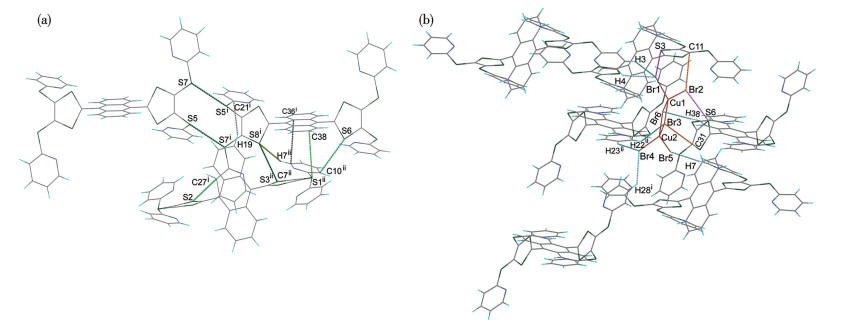
S…S: green dotted line, S…C: light green dotted line, S…H: buff dotted line, C…C: grey dotted line, C…H: light grey dotted line, Br…S: violet dotted line, Br…C: orange dotted line, Br…H: light blue dotted line; Symmetry codes: i 1-x, 1-y, 1-z; ii 1-x, -y, 2-z.
以exTTF衍生物T1~T3作为电子给体,CuBr2作为电子受体,采用扩散的方法合成了3种exTTF衍生物与CuBr2的电荷转移复合物:(T1)[Cu2Br6]·2THF、(T2)[Cu2Br6]·2THF和(T3)[Cu2Br6]。采用单晶X射线衍射仪对其结构进行分析,发现外围芳基的变化对电荷转移复合物的堆积结构会产生重要影响,使(T1)[Cu2Br6]·2THF、(T2)[Cu2Br6]·2THF和(T3)[Cu2Br6]呈现3种不同的堆积结构。在复合物中T12+、T22+和T32+呈现不同的分子构型,外围芳基对[Cu2Br6]2-的分子构型会产生重要影响,说明外围硫原子的存在使得外围芳基具有较好的旋转自由度,可根据客体分子调控自身分子构型。堆积结构和分子间相互作用的变化对复合物的物理化学性能会产生重要影响,后续我们将进一步对其磁学性质和电学性质进行研究。
Supporting information is available at
WUDL F, SMITH G M, HUFNAGEL E J. Bis-1, 3-dithiolium chloride: An unusually stable organic radical cation[J]. J. Chem. Soc. D‒Chem. Commun., 1970, 21: 1453-1454
FRÈRE P, SKABARA P J. Salts of extended tetrathiafulvalene analogues: Relationships between molecular structure, electrochemical properties and solid state organisation[J]. Chem. Soc. Rev., 2005, 34(1): 69-98 doi: 10.1039/B316392J
CANEVET D, SALLÈ M, ZHANG G X, ZHANG D Q, ZHU D B. Tetrathiafulvalene(TTF) derivatives: Key building-blocks for switchable processes[J]. Chem. Commun., 2009, (17): 2245-2269 doi: 10.1039/b818607n
DING H M, LI Y H, HU H, SUN Y M, WANG J G, WANG C X, WANG C, ZHANG G X, WANG B S, XU W, ZHANG D Q. A tetrathiafulvalene-based electroactive covalent organic framework[J]. Chem. ‒Eur. J., 2014, 20(45): 14614-14618 doi: 10.1002/chem.201405330
YIN W Y, WENG Y G, REN Z H, ZHANG Z R, ZHU Q Y, DAI J. Tetrathiafulvalene-based double metal lead iodides: Structures and electrical properties[J]. Dalton Trans., 2021, 50(23): 8120-8126
栗军力, 温一航, 王乐佳, 李星, 肖勋文. 基于2, 6-双(3′-吡啶)-四硫富瓦烯的Zn/Co配位聚合物的光电流响应特性[J]. 无机化学学报, 2022, 38(4): 745-751.LI J L, WEN Y H, WANG L J, LI X, XIAO X W. Photocurrent response properties of 2, 6-bis(3′-pyridyl)-tetrathiafulvalene based Zn/Co coordination polymer[J]. Chinese J. Inorg. Chem., 2022, 38(4): 745-751
COTELLE Y, HARDOUIN-LEROUGE M, LEMASSON E, MORILLE Y, CANEVET D, LEGOUPY S, HUDHOMME P. An original self- assembly using a tetrathiafulvalene-based molecular clip for the recognition of fullerene C60[J]. Chem. Commun., 2020, 56: 3077-3080 doi: 10.1039/C9CC09633G
CALBO J, DE JUAN A, ARAGÓ J, VILLALVA J, MARTÍN N, PÉREZ E M, ORTI E. Understanding the affinity of bis-exTTF macrocyclic receptors towards fullerene recognition[J]. Phys. Chem. Chem. Phys., 2019, 21: 11670-11675 doi: 10.1039/C9CP01735F
PÉREZ E M, SÁNCHEZ L, FERNÁNDEZ G, MARTÍN N. ExTTF as a building block for fullerene receptors. Unexpected solvent‑ dependent positive homotropic cooperativity[J]. J. Am. Chem. Soc., 2006, 128: 7172-7173 doi: 10.1021/ja0621389
CHANG X M, XU Y Z, DELIUS VON M. Recent advances in supramolecular fullerene chemistry[J]. Chem. Soc. Rev., 2024, 53: 47-83
BERA S, DAS S, MELLE-FRANCO M, MATEO-ALONSO A. An organic molecular nanobarrel that hosts and solubilizes C60[J]. Angew. Chem. ‒Int. Edit., 2023, 62(5): e202216540 doi: 10.1002/anie.202216540
HU L, QIN J, ZHU R M, LI Y Z, ZUO J L, YOU X Z. Syntheses, characterization, and properties of functionalized 9, 10-bis(1, 3-dithiol-2-ylidene)-9, 10-dihydroanthracene derivatives and tricarbonylrhenium(Ⅱ) complexes[J]. Eur. J. Inorg. Chem., 2012: 2494-2501
YOSHIMURA A, MISAKI Y. Periphery modification of tetrathiafulvalenes: Recent development and applications[J]. Chem. Rec., 2021, 21: 3520-3531
DEKHTIARENKO M, ALLAIN M, CARRÉ V, AUBRIET F, VOITENKO Z, SALLÉ M, GOEB S. Comparing the self-assembly processes of two redox-active exTTF-based regioisomer ligands[J]. New J. Chem., 2021, 45: 21015-21019 doi: 10.1039/D1NJ04555E
GOEB S, SALLÉ M. Electron-rich coordination receptors based on tetrathiafulvalene derivatives: Controlling the host-guest binding[J]. Accounts Chem. Res., 2021, 54(4): 1043-1055 doi: 10.1021/acs.accounts.0c00828
MA L F, PENG H L, LU X F, LIU L, SHAO X F. Building up 1-D, 2-D, and 3-D polyiodide frameworks by finely tuning the size of aryls on Ar-S-TTF in the charge-transfer(CT) complexes of Ar-S-TTFs and iodine[J]. Chin. J. Chem., 2018, 36(9): 845-850
MA L F, SUN J B, LU X F, ZHANG S X, QI H, LIU L, SHAO Y L, SHAO X F. Copper ion salts of arylthiotetrathiafulvalenes: Synthesis, structure diversity and magnetic properties[J]. Beilstein J. Org. Chem., 2015, 11: 850-859
SUN J B, LU X F, SHAO J F, LI X X, ZHANG S X, WANG B L, ZHAO J L, SHAO Y L, FANG R, WANG Z H, YU W, SHAO X F. Molecular and crystal structure diversity, and physical properties of tetrathiafulvalene derivatives substituted with various aryl groups through sulfur bridges[J]. Chem. ‒Eur. J., 2013, 19: 12517-12525
LU X F, SUN J B, LIU Y, SHAO J F, MA L F, ZHANG S X, ZHAO J L, SHAO Y L, ZHANG H L, WANG Z H, SHAO X F. Decorating tetrathiafulvalene (TTF) with fluorinated phenyls through sulfur bridges: Facile synthesis, properties, and aggregation through fluorine interactions[J]. Chem. ‒Eur. J., 2014, 20: 9650-9656
马龙飞, 祝招辉, 黄小波. 芳基四硫富瓦烯与溴化铜电荷转移复合物的合成及晶体结构[J]. 无机化学学报, 2022, 38(5): 821-828. doi: 10.11862/CJIC.2022.086MA L F, ZHU Z H, HUANG X B. Synthesis and crystal structure of arylthiotetrathiafulvalenes and cupric bromide charge transfer complexes[J]. Chinese J. Inorg. Chem., 2022, 38(5): 821-828 doi: 10.11862/CJIC.2022.086
MA L F, WU WU L X, LU X F. Synthesis, structures, and physical properties of exTTF substituted with aryl groups through sulfur bridges and the electron transfers with C60[J]. Eur. J. Org. Chem., 2025, 28: e202401193
PÉREZ I, LIU S G, MARTÍN N, ECHEGOYEN L. Synthesis and properties of conjugated hybrid tetrathiafulvalene dimers[J]. J. Org. Chem., 2000, 65: 3796-3803
BRUNETTI F G, LOPEZ J L, ATIENZA C, MARTÍN N. π-Extended TTF: A versatile molecule for organic electronics[J]. J. Mater. Chem., 2012, 22: 4188-4205
BRYCE M R, MOORE A J, HASAN M, ASHWELL G J, FRASER A T, CLEGG W, HURSTHOUSE M B, KARAULOV A I. Electrical and magnetic properties and X-ray structure of a highly conductive 4∶1 complex of tetracyanoquinodimethane and a tetrathiafulvalene derivative[J]. Angew. Chem. ‒Int. Edit., 1990, 29: 1450-1452
SUN J B, LU X F, SHAO J F, CUI Z L, SHAO Y, JIANG G Y, YU W, SHAO X F. Straightforward access to aryl-substituted/fused 1, 3-dithiole-2-chalcogenones by Cu-catalyzed C—S coupling between aryl iodides and zinc-thiolate complex (TBA)2[Zn(DMIT)2][J]. RSC Adv., 2013, 3(26): 10193-10196

图 2 CuBr2滴定化合物T1的UV-Vis吸收光谱图
Figure 2 UV-Vis absorption spectra of compound T1 upon titration with CuBr2

图 3 (T1)[Cu2Br6]·2THF中T12+和[Cu2Br6]2-的50%概率水平椭球图
Figure 3 Structure of T12+ and [Cu2Br6]2- in (T1)[Cu2Br6]·2THF with thermal ellipsoids at the 50% probability level
For clarity, the hydrogen atoms are omitted; Symmetry codes: i 1-x, 2-y, -z; ii -x, 1-y, -z

图 4 (T1)[Cu2Br6]·2THF的分子间相互作用: (a) T12+之间的相互作用; (b) [Cu2Br6]2-与T12+的相互作用
Figure 4 Intermolecular interactions of (T1)[Cu2Br6]·2THF: (a) interactions between T12+; (b) interactions between [Cu2Br6]2- and T12+
S…S: green dotted line, S…C: light green dotted line, S…H: buff dotted line, C…C: grey dotted line, C…H: light grey dotted line, H…H: blue green dotted line, Br…C: orange dotted line, Br…H: light blue dotted line; Symmetry codes: i 1-x, 2-y, -z; ii -x, 1-y, -z.

图 5 (T2)[Cu2Br6]·2THF中T22+和[Cu2Br6]2-的50%概率水平椭球图
Figure 5 Structure of T22+ and [Cu2Br6]2- in (T2)[Cu2Br6]·2THF with thermal ellipsoids at the 50% probability level
For clarity, the hydrogen atoms are omitted; Symmetry codes: i 1-x, 1-y, 1-z; ii -x, 2-y, 1-z.

图 6 (T2)[Cu2Br6]·2THF的分子间相互作用: (a) T22+之间的相互作用; (b) [Cu2Br6]2-与T22+的相互作用
Figure 6 Intermolecular interactions of (T2)[Cu2Br6]·2THF: (a) interactions between T22+; (b) interactions between [Cu2Br6]2- and T22+
S…S: green dotted line, S…C: light green dotted line, S…H: buff dotted line, C…C: grey dotted line, C…H: light grey dotted line, H…H: blue green dotted line, Br…S: violet dotted line, Br…C: orange dotted line, Br…H: light blue dotted line, S…Cu: purple dotted line; Symmetry codes: i 1-x, 1-y, 1-z; ii -x, 2-y, 1-z.

图 7 (T3)[Cu2Br6]中T32+和[Cu2Br6]2-的50%概率水平椭球图
Figure 7 Structure of T32+ and [Cu2Br6]2- in (T3)[Cu2Br6] with thermal ellipsoids at the 50% probability level
For clarity, the hydrogen atoms are omitted; Symmetry codes: i 1-x, 1-y, 1-z; ii 1-x, -y, 2-z.

图 8 (T3)[Cu2Br6]的分子间相互作用: (a) T32+之间的相互作用; (b) [Cu2Br6]2-与T32+的相互作用
Figure 8 Intermolecular interactions of (T3)[Cu2Br6]: (a) interactions between T32+; (b) interactions between [Cu2Br6]2- and T32+
S…S: green dotted line, S…C: light green dotted line, S…H: buff dotted line, C…C: grey dotted line, C…H: light grey dotted line, Br…S: violet dotted line, Br…C: orange dotted line, Br…H: light blue dotted line; Symmetry codes: i 1-x, 1-y, 1-z; ii 1-x, -y, 2-z.
表 1 化合物T1~T3的电化学数据
Table 1. Electrochemical properties of compounds T1-T3
| Compound | Eox/V | Ered/V | ΔE/V |
| T1 | 0.59 | 0.46 | 0.13 |
| T2 | 0.63 | 0.37 | 0.26 |
| T3 | 0.57 | 0.25 | 0.32 |
 下载: 导出CSV
表 2 电荷转移复合物的合成条件、组成、产率和形貌
Table 2. Preparation condition, composition, yield, and appearance of the charge-transfer complexes
| Compound | Solution | Complex | Yield/% | Appearance |
| T1 | THF/CH3CN | (T1)[Cu2Br6]·2THF | 41 | Black cuboid |
| T2 | THF/CH3CN | (T2)[Cu2Br6]·2THF | 44 | Black block |
| T3 | DCM/CH3CN | (T3)[Cu2Br6] | 63 | Black block |
下载: 导出CSV
表 3 电荷转移复合物的晶体学数据
Table 3. Crystallographic data for the charge-transfer complexes
| Parameter | (T1)[Cu2Br6]·2THF | (T2)[Cu2Br6]·2THF | (T3)[Cu2Br6] |
| Empirical formula | C52H44S8Br6Cu2O2 | C44H36S12Br6Cu2O2 | C40H24S8Br6Cu2N4 |
| Formula weight | 1 563.89 | 1 587.99 | 1 423.65 |
| Temperature/K | 291 | 173 | 173 |
| λ/nm | 0.071 073 | 0.154 184 | 0.154 184 |
| Crystal size/mm | 0.02×0.05×0.1 | 0.05×0.1×0.2 | 0.05×0.1×0.1 |
| Crystal system | Monoclinic | Monoclinic | Triclinic |
| Space group | P21/c | P21/c | P1 |
| a/nm | 0.808 18(5) | 1.657 32(5) | 1.238 25(6) |
| b/nm | 1.673 94(6) | 0.805 41(2) | 1.312 79(7) |
| c/nm | 2.066 70(10) | 2.032 85(5) | 1.644 09(8) |
| α/(°) | 66.557(5) | ||
| β/(°) | 98.911(5) | 101.057(3) | 78.797(4) |
| γ/(°) | 68.412(5) | ||
| V/nm3 | 2.762 2(3) | 2.662 23(13) | 2.276 4(2) |
| Z | 2 | 2 | 2 |
| Dc/(g·cm-3) | 1.880 | 1.981 | 2.077 |
| μ/mm-1 | 5.453 | 10.966 | 11.053 |
| Maximum of 2θ/(°) | 50.052 | 133.146 | 133.17 |
| Reflection, Nres, Npar* | 4 854, 30, 271 | 4 595, 191, 335 | 7 811, 0, 550 |
| GOF | 1.077 | 1.027 | 1.041 |
| R1 [I > 2σ(I)] | 0.073 4 | 0.033 2 | 0.028 9 |
| wR2 (all) | 0.171 6 | 0.092 3 | 0.077 6 |
| *Nres=number of restraints, Npar=number of parameters. | |||
下载: 导出CSV

 扫一扫看文章


扫一扫关注我们

 下载:
下载: