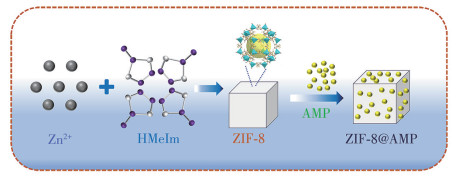
Scheme 1.
Schematic illustration of the preparation of ZIF-8@AMP composites

In situ construction of ammonium phosphomolybdate@ZIF-8 composite for Rb+ and Cs+ adsorption performance
Yang WANG , Lulu ZHANG , Hanjiang HE , Xia ZHANG , Xiaohong SUN , Fan WANG , Shuli WANG


Rubidium (Rb) and cesium (Cs) are rare and valuable alkali metals widely used in high-tech fields such as communications, medicine, aviation, new energy, and advanced materials due to their exceptional chemical reactivity and photoelectric properties[1-3]. In addition to occurring together in minerals, Rb and Cs are also found in liquid resources such as salt lake brine, geothermal water, oil-field water, and seawater[4]. With the continuous depletion of mineral resources, Rb+ and Cs+ in salt lake brine have attracted considerable attention[5-7]. However, the low concentrations of Rb+ and Cs+ and the high concentrations of coexisting ions in salt lake brine make efficient separation and extraction challenging, which has become a critical bottleneck restricting the comprehensive utilization of Rb and Cs from these resources[8-9]. Therefore, developing highly selective adsorbent materials to achieve targeted enrichment of Rb and Cs from salt lake brine is of great significance for ensuring the supply of strategic resources and alleviating resource shortages.
Currently, the primary methods for extracting Rb+ and Cs+ from aqueous solutions include precipitation[10], solvent extraction[11], membrane separation[12], and adsorption[13]. Conventional approaches such as precipitation and solvent extraction require substantial amounts of inorganic and organic reagents, leading to expensive waste treatment and potential environmental pollution. Membrane separation, as an emerging technology, offers good ion selectivity but is limited by factors such as high material costs, limited membrane lifespan, and stringent water quality requirements. Adsorption is regarded as the most suitable and promising method. The core of adsorption technology lies in the development of adsorbent materials[14-17]. For instance, Liu et al.[18] prepared a magnesium ammonium phosphate (MAP) adsorbent for the adsorption of Rb+ and Cs+ from simulated saline solutions. The results indicated that the adsorbent exhibited adsorption capacities of 2.83 mol·g-1 for Rb+ and 4.37 mol·g-1 for Cs+, along with excellent selectivity. Wang and co-workers[19] employed an anti-solvent method to fabricate spherical porous composite tin antimony pyrophosphate (PVC-SSbPP) adsorbent for the effective extraction of Rb+ and Cs+. This granular composite adsorbent demonstrated high adsorption capacities for both Rb+ and Cs+. Even in the presence of competing metal ions such as K+, Na+, Li+, Mg2+, and Ca2+, PVC-SSbPP maintained high adsorption selectivity toward Rb+ and Cs+. Lv and co-workers[20] synthesized a novel potassium magnesium ferrocyanide (KMgFC) adsorbent for the recovery of Rb and Cs from highly saline solutions. The findings revealed that under conditions of pH 8.1, a temperature of 80 ℃, and an equilibrium time of 40 min, the adsorption efficiencies of Rb+ and Cs+ reached 90.7% and 97.9%, respectively.
Ammonium phosphomolybdate (AMP) is a heteropoly acid salt with the chemical formula (NH4)3P Mo12O40·nH2O, which possesses a Keggin-type structure resembling a hollow cage[21]. It consists of 12 [MoO3] octahedral units forming a spherical shell with a PO43- group located at the center. NH4+ ions and water molecules are associated within the crystal and occupy the interstitial spaces between the large spherical [P(Mo12O40)]3- anions, with a cavity size of approximately 0.33 nm[22-24]. The ionic radius of NH4+ in AMP is similar to that of Rb+ and Cs+, contributing to its excellent selectivity for the adsorption of Rb+ and Cs+ from aqueous solutions[25]. However, AMP exists as a fine crystalline powder with small particle size, low mechanical strength, low surface activity, and a tendency to agglomerate, which limits its practical application in adsorption processes[26]. To address these limitations, AMP is often immobilized within a specific framework material to form composite adsorbents with high adsorption capacity. Metal-organic frameworks (MOFs) have emerged as a rapidly developing class of porous materials for adsorption applications. Zeolitic imidazolate frameworks (ZIFs), a subclass of MOFs, are constructed from divalent metal ions (e.g., Co, Zn) and imidazole or its derivatives, forming topological structures analogous to those of zeolites[27]. Among them, ZIF-8, composed of zinc ions and 2-methylimidazole, is one of the most representative ZIF materials. It exhibits advantages such as facile synthesis, high porosity, large specific surface area, and good thermal stability, making it widely applicable in adsorption[28], catalysis[29], sensing[30], and gas storage[31]. Therefore, we propose the incorporation of AMP into ZIF-8 to develop a novel composite adsorbent with high selectivity, large specific surface area, and enhanced adsorption capacity.
Herein, a composite adsorbent ZIF-8@AMP was fabricated by in situ incorporation of functional AMP during the ZIF-8 synthesis via a room-temperature solution-phase method. The microstructure and morphology of the composite were characterized using multiple analytical techniques. The effects of various factors, including pH, temperature, initial mass concentration, contact time, and adsorbent dosage, on the adsorption of Rb+ and Cs+ were systematically investigated. The selectivity, regeneration capability, and reusability of the synthesized material were evaluated to assess its practical applicability. Furthermore, a possible adsorption mechanism was proposed. Experimental results demonstrated that ZIF-8@AMP exhibited promising potential for extracting Rb+ and Cs+ from aqueous resources.
Rubidium chloride (RbCl), cesium chloride (CsCl), and zinc nitrate hexahydrate (Zn(NO3)·6H2O) were purchased from Aladdin Reagent Co., Ltd. (Shanghai, China). Dimethylimidazole (HMeIm) and methanol (CH3OH) were supplied by McLean Co., Ltd. (Shanghai, China). Hydrochloric acid (HCl) and AMP were purchased by Comio Co., Ltd. (Tianjin, China). Detailed information regarding other reagents and instrumental conditions was provided in the Supporting Information.
The ZIF-8 precursor was synthesized with modifications based on previously reported methods[32-33]. Specifically, 1.437 8 g (5.0 mmol) of Zn(NO3)×6H2O was weighed into a beaker, dissolved in 30 mL of deionized water, and ultrasonicated for 5 min to obtain a homogeneous zinc salt solution (marked as A). Meanwhile, 4.105 9 g (50.0 mmol) of 2-methylimidazole was added to 60 mL of ammonia solution and ultrasonicated for 5 min to form a uniform 2-methylimidazole solution (marked as B). Solution A was then slowly poured into solution B under continuous magnetic stirring for 3 h. The resulting mixture was allowed to stand for 24 h. The white product obtained was collected by high-speed centrifugation, washed repeatedly with deionized water and methanol, and finally dried under vacuum at 60 ℃ for 12 h to yield ZIF-8 as a white powder.
ZIF-8@AMP was synthesized with modifications based on previously reported literature[34-35]. Specifically, 1.437 8 g (5.0 mmol) of Zn(NO3)2·6H2O was dissolved in 20 mL of deionized water and ultrasonicated for 5 min to form a homogeneous zinc salt solution (marked as A). Meanwhile, 4.105 9 g (50.0 mmol) of 2-methylimidazole was added to 60 mL of concentrated ammonia solution and ultrasonicated for 5 min to obtain a uniform 2-methylimidazole solution (marked as B). In a separate step, 0.5 g (0.276 2 mmol) of AMP was dispersed in 10 mL of deionized water under ultrasonication for 5 min, yielding a well-dispersed AMP suspension (marked as C). Solution A was then slowly poured into solution B, and the mixture was stirred magnetically for 1 h. Subsequently, suspension C was gradually introduced into the above mixture, followed by continuous stirring for 6 h. The resulting mixture was allowed to stand at room temperature for 24 h, yielding a yellow product. The product was collected by high-speed centrifugation, washed thoroughly with deionized water and methanol, and dried overnight under vacuum at 60 ℃ to obtain ZIF-8@AMP as a yellow solid powder. A schematic illustration of the ZIF-8@AMP synthesis process is shown in Scheme 1.
RbCl and CsCl reagents were first dried in an oven at 110 ℃ until constant weight was achieved. After cooling to room temperature, precise amounts of RbCl (1.414 8 g) and CsCl (1.226 8 g) were weighed and separately dissolved in ultrapure water in 100 mL beakers. The resulting solutions were then separately transferred into a 1 000 mL volumetric flask, diluted to volume with ultrapure water, and mixed thoroughly to obtain two stock solutions with Rb+ and Cs+ mass concentrations of 1 000 mg·L-1, respectively. The prepared solutions were stored at 4 ℃ for further use.
Exactly 50 mL 50 mg·L-1 Rb+ or Cs+ solution was pipetted into a centrifuge tube, followed by the addition of a predetermined amount of adsorbent. The mixture was shaken in a constant-temperature oscillator. After the adsorption equilibrium was reached, the solution was centrifuged, and the supernatant was collected for the determination of Rb+ or Cs+ mass concentrations using inductively coupled plasma mass spectrometry (ICP-MS). The adsorption capacity (qe, mg·g-1) and adsorption efficiency (A, %) were calculated according to Eq.S1 and S2. The effects of various parameters on the adsorption of Rb+ and Cs+ by ZIF-8@AMP were systematically investigated over the following ranges: pH 2-12, adsorbent dosage of 10-80 mg, temperature of 298.15-348.15 K, contact time of 5-90 min, and initial Rb+ or Cs+ mass concentration of 10-500 mg·L-1. Additionally, the influence of coexisting ions (Li+, K+, Na+, Mg2+, and Ca2+) on adsorption performance was evaluated.
Two types of mixed solutions were prepared with molar ratios of coexisting ions to Rb+ or Cs+ ions of 1∶4 and 4∶1. For the 1∶4 molar ratio system, the concentrations of Li+, K+, Na+, Mg2+, and Ca2+ were each set at 0.125 mmol·L-1, while the Rb+ and Cs+ concentration was 0.5 mmol·L-1 respectively. In the 4∶1 system, the concentrations of coexisting ions were each 2.0 mmol·L-1, and the Rb+ and Cs+ concentration remained 0.5 mmol·L-1 respectively. The mixed solutions were prepared accordingly, and 50 mL of each solution was precisely pipetted into a centrifuge tube. A predetermined amount of ZIF-8@AMP adsorbent was added, and the mixture was shaken for 30 min to achieve adsorption equilibrium. The supernatant was then collected for concentration measurement of each ion, and the distribution coefficient (Kd) was calculated according to Eq.S3.
Upon reaching adsorption equilibrium, the ZIF-8@AMP adsorbent was collected by centrifugation and rinsed with deionized water to remove weakly adsorbed Rb+ or Cs+ ions from the surface. The adsorbed ions were then desorbed by treating the material with an NH4NO3 solution under shaking at room temperature. After desorption, the adsorbent was recovered by centrifugation, washed three times with deionized water, and subsequently reused in the next adsorption cycle. The reusability of ZIF-8@AMP was evaluated over five consecutive adsorption-desorption cycles. The desorption efficiency (D, %) was calculated using Eq.S4.
An appropriate amount of Rb+ or Cs+ standard stock solution was accurately pipetted and diluted with ultrapure water to prepare a 50 mg·L-1 Rb+ or Cs+ working standard. Then, 0, 0.05, 0.1, 0.2, 0.5, and 1.0 mL of the Rb+ or Cs+ working standard were separately transferred into six 50 mL volumetric flasks. Each flask was diluted to the mark with ultrapure water and mixed thoroughly to obtain a series of calibration standards with mass concentrations of 0, 0.05, 0.1, 0.2, 0.5, and 1.0 mg·L-1. For analysis, 1 mL of the Rb+ or Cs+ solution collected before and after adsorption/desorption was accurately pipetted into a 100 mL volumetric flask and diluted to volume with ultrapure water. The mass concentrations of Rb+ and Cs+ were determined by ICP-MS using the mass to charge ratios (m/z) of 85Rb and 133Cs. The fitted calibration curves for Rb+ and Cs+ are presented in Fig.S1.
The chemical structures of ZIF-8, AMP, and ZIF-8@AMP were characterized by FTIR. As shown in Fig.1a, all characteristic peaks of ZIF-8 and AMP were present in the spectrum of ZIF-8@AMP. The peaks at 1 581, 1 145, and 420 cm-1 correspond to the stretching vibrations of the C=N bond, the C—N bond in the imidazole ring, and the Zn—N bond in ZIF-8, respectively[32, 36]. In the FTIR spectrum of ZIF-8@AMP, the peaks at 1 064, 961, 866, and 786 cm-1 are attributed to P—O, Mo=O, Mo—Oc—Mo (where Oc represents corner-sharing oxygen), and Mo—Oe—Mo (where Oe represents edge-sharing oxygen) vibrations in the Keggin-type structure of AMP[37-38]. These results provide direct evidence for the successful loading of AMP onto the ZIF-8 framework.
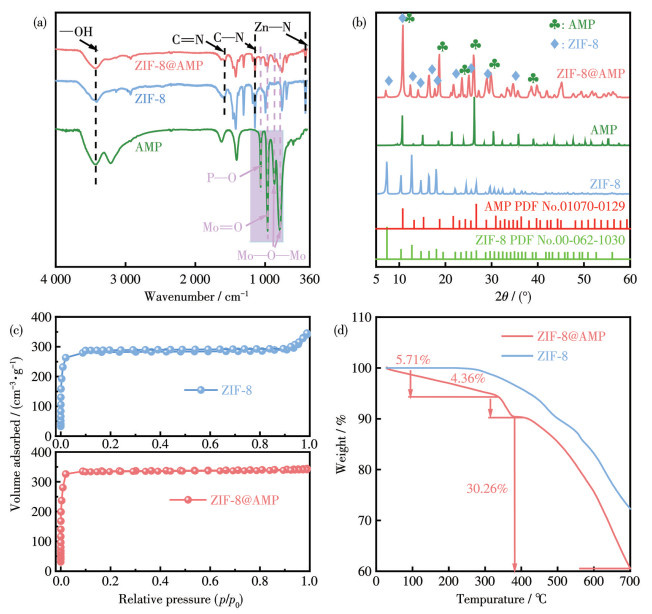
The crystal structures of ZIF-8, AMP, and ZIF-8@AMP were analyzed by X-ray diffraction (XRD). Fig.1b presents the standard reference patterns of ZIF-8 and AMP, along with the experimental XRD patterns of as-synthesized ZIF-8 and ZIF-8@AMP. The main characteristic peaks of the synthesized ZIF-8 were observed at 2θ=7.31°, 10.30°, 12.73°, 14.52°, 16.31°, 18.00°, and 24.56°, corresponding to the (111), (200), (211), (220), (310), (222), and (332) crystal planes[39]. These diffraction peaks match well with the standard ZIF-8 pattern (PDF No.00-062-1030)[32-33, 36], confirming the successful synthesis of ZIF-8. In the XRD pattern of ZIF-8@AMP, diffraction peaks at 10.58°, 15.10°, 21.46°, 26.37°, and 30.55° could be observed, which correspond to the (110), (200), (220), (222), and (400) crystal planes of AMP (PDF No.01070-0129)[33]. This provides further evidence for the successful incorporation of AMP into the ZIF-8 framework.
The specific surface area and pore size distribution of ZIF-8 and ZIF-8@AMP were investigated using N2 adsorption-desorption measurements. As shown in Fig.1c, ZIF-8 exhibited a type Ⅰ isotherm, characterized by a sharp nitrogen uptake at low relative pressure (p/p0 < 0.01) and the absence of a hysteresis loop, indicating a typical microporous structure[40]. The material exhibited an exclusively microporous structure, with pore sizes concentrated in the range of 0.37-2.00 nm. The Brunauer-Emmett-Teller (BET) surface area and pore volume were calculated to be 1 031 m2·g-1 and 0.65 cm3·g-1, respectively. In contrast, ZIF-8@AMP displayed a combined type Ⅰ and type Ⅳ isotherm[36, 41], with a distinct hysteresis loop observed in the desorption branch, suggesting the coexistence of micropores and mesopores. The pore size distribution of ZIF-8@AMP was centered in two regions: 0.5-2.0 nm (micropores) and 2.0-10.0 nm (mesopores). The corresponding BET surface area and pore volume decreased to 848 m2·g-1 and 0.37 cm3·g-1, respectively. The reduction in surface area after AMP loading may be attributed to the partial occupation of ZIF-8 pore channels by AMP particles. Nevertheless, the composite still retained a relatively high surface area and desirable porosity, which are favorable for the adsorption of Rb+ and Cs+.
The thermal stability of ZIF-8 and ZIF-8@AMP was evaluated by TGA under a nitrogen atmosphere. As shown in Fig.1d, ZIF-8 exhibited no significant mass loss below 300 ℃, indicating excellent thermal stability within this range. Above 300 ℃, rapid decomposition of the ZIF-8 carbon skeleton occurred, leading to a sharp decline in mass[32]. In contrast, the thermal degradation of ZIF-8@AMP proceeded in three distinct stages: (1) from room temperature to 300 ℃, a mass loss of 5.71% was observed, attributed mainly to the removal of water molecules trapped in the pores, surface-adsorbed water, and crystal water from AMP; (2) between 300 and 400 ℃, a mass loss of 4.36% occurred, likely resulting from the decomposition of NH4⁺ ions in AMP; (3) above 400 ℃, a sharp mass reduction of 30.26% took place due to the collapse of the ZIF-8 carbon framework together with the decomposition of the Keggin-type structure in AMP[42]. These results demonstrate that ZIF-8@AMP maintains relatively good thermal stability at lower temperatures.
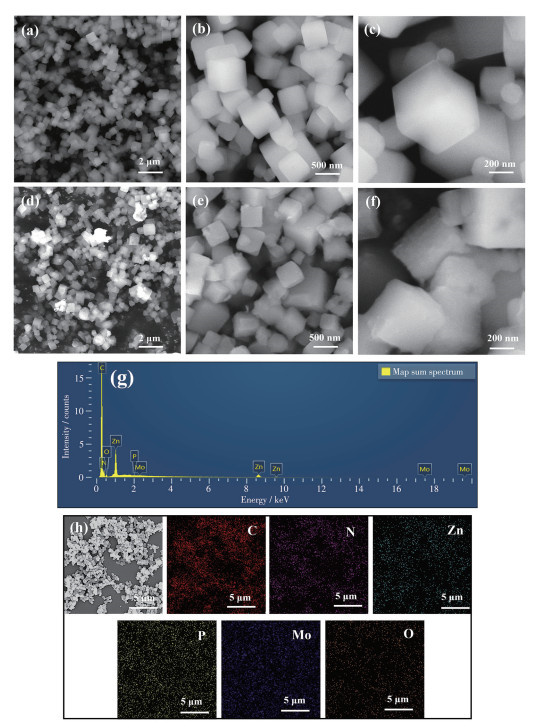
The morphologies of ZIF-8 and ZIF-8@AMP were characterized using scanning electron microscopy (SEM). As clearly shown in Fig.2a-2c, the as- synthesized ZIF-8 particles exhibited a well-defined hexagonal structure with sharp edges and an average particle size of approximately 500 nm. Fig.2d-2f reveal that ZIF-8@AMP retained a regular cubic particle morphology but with a roughened surface, decorated with some larger irregular particles. Certain agglomeration among crystals could also be observed (Fig.2f). These morphological features preliminarily suggest that AMP was successfully loaded onto the surface or into the pore channels of ZIF-8, likely through an adsorption-coating process. Energy-dispersive X-ray spectroscopy (EDS) analysis of ZIF-8@AMP (Fig.2g) confirms the presence of C, O, Zn, N, P, and Mo, with homogeneous distribution of P, Mo, and O. Furthermore, the elemental composition analysis (Fig.2h) indicates the presence of P (mass fraction: 0.23%), Mo (mass fraction: 8.03%), and O (mass fraction: 11.26%), providing clear evidence for the successful formation of the ZIF-8@AMP composite.
The surface chemical bonding and compositional characteristics of ZIF-8@AMP were analyzed by X-ray photoelectron spectroscopy (XPS). As shown in the survey spectrum (Fig.S2a), the surface elemental composition of ZIF-8@AMP before adsorption clearly exhibited C1s and N1s signals at 284.8 and 399.2 eV, respectively, primarily originating from the C—C and C—N bonds as well as pyridinic nitrogen in the imidazole ligand (2-methylimidazole) of ZIF-8. Characteristic Zn2p peaks were also observed, indicating the preservation of the metal-node structure of ZIF-8 in the composite[29-30]. Furthermore, distinct Mo3d and P2p peaks were detected at 229.5 and 133.2 eV, respectively, confirming the successful incorporation of AMP into the ZIF-8 framework[37, 41]. In the high-resolution Mo3d spectrum of ZIF-8@AMP (Fig.S2b), the Mo signal could be deconvoluted into two peaks at 229.5 and 233.0 eV, corresponding to Mo3d5/2 and Mo3d3/2, respectively[43]. The Zn2p spectrum (Fig.S2c) displayed binding energies at 1 021.5 (Zn2p3/2) and 1 044.6 eV (Zn2p1/2), with a spin-energy separation of 23.1 eV, consistent with the Zn—N coordination in ZIF-8. The symmetric peak shape without shoulders suggests a uniform chemical environment for Zn2+, with no significant oxidation or alteration in coordination state. The high-resolution P2p spectrum (Fig.S2d) showed peaks at 133.2 and 134.1 eV, attributed to P=O and P—O bonds, respectively. These binding energies fall within the standard range for phosphate groups (133-134 eV)[37], further verifying the successful loading of AMP onto or within the pores of ZIF-8. Collectively, the XPS survey confirms that ZIF-8@AMP is composed of a Zn2+-imidazole framework (ZIF-8) integrated with AMP, with an elemental composition consistent with the designed structure.
To evaluate the Rb+ and Cs+ adsorption performance of ZIF-8, AMP, and ZIF-8@AMP, experiments were conducted under general adsorption conditions. Specifically, 50 mL 50 mg·L-1 Rb+ or Cs+ solution was mixed with 0.05 g of ZIF-8, AMP, or ZIF-8@AMP adsorbent in centrifuge tubes and oscillated at room temperature for 30 min. The adsorption results are shown in Fig.S3. As observed, the adsorption capacity of ZIF-8 was considerably lower than that of AMP and ZIF-8@AMP. This can be attributed to the lack of specific chemical adsorption sites in ZIF-8, which relies solely on physical adsorption, resulting in limited uptake. In contrast, ZIF-8@AMP exhibited significantly enhanced adsorption performance, with Rb+ and Cs+ adsorption capacities of 38.45 and 39.67 mg·g-1, respectively. This corresponds to an improvement of approximately 350% compared to AMP alone. The superior performance of ZIF-8@AMP is ascribed to a synergistic mechanism: the microporous structure of ZIF-8 (pore size: ca.0.34 nm) provides a highly dispersed platform for AMP, preventing particle agglomeration, while the strongly electronegative phosphate groups (PO43-) in the layered structure of AMP facilitate cation attraction. In addition, NH4+ ions within the AMP crystal structure undergo ion exchange with target Rb+ and Cs+ ions, contributing to high selectivity[44]. Although pure AMP possesses ion-exchange capability, its non-porous structure restricts mass transfer kinetics and active site accessibility. Through structural and functional synergy, ZIF-8@AMP achieved simultaneous enhancement in both adsorption capacity and selectivity. Therefore, ZIF-8@AMP was selected for subsequent adsorption experiments and optimization studies.
The effect of pH on the adsorption of Rb+ and Cs+ by ZIF-8@AMP was evaluated over a pH range of 2-12. In each experiment, 50 mL·L-1 Rb+ or Cs+ solutions was transferred into a centrifuge tube, and the pH was adjusted to 2, 3, 4, 5, 6, 7, 8, 9, 10, 11, or 12 using 0.05 mol·L-1 HCl or NaOH. Then, 0.05 g of adsorbent was added, and the mixture was shaken in a constant-temperature water bath at 298.15 K for 1 h. As shown in Fig.3a, the adsorption capacity of ZIF-8@AMP for Rb+ and Cs+ gradually increased as the pH rose from 2 to 8. This behavior can be attributed to the instability of the ZIF-8 framework under highly acidic conditions, where the Zn—N coordination bonds may break, leading to structural collapse and thus reducing the availability of active sites in AMP[33, 37]. However, when the pH was further increased to 8-10, the adsorption capacity remained relatively high and stable. Beyond pH 10, under strongly alkaline conditions, partial decomposition of AMP occurred[45], resulting in a sharp decline in adsorption performance. Based on these results, pH=8 was selected for all subsequent adsorption experiments.
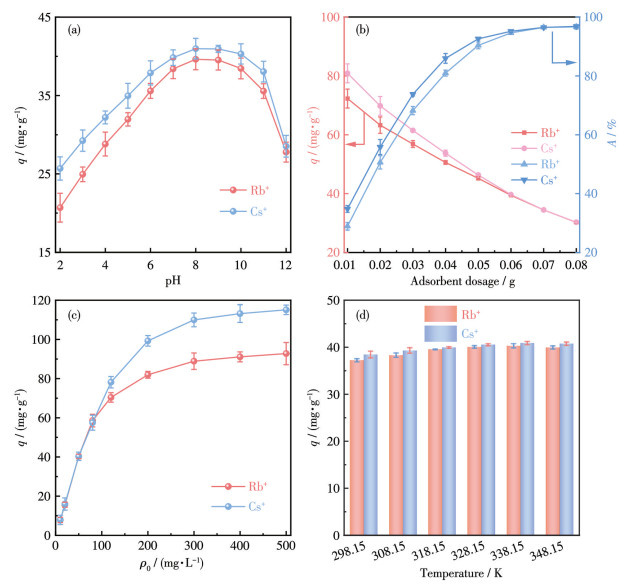
The effect of adsorbent dosage on the adsorption of Rb+ or Cs+ by ZIF-8@AMP was investigated by adding different amounts of adsorbent (0.01, 0.02, 0.03, 0.04, 0.05, 0.06, 0.07, and 0.08 g) into 50 mL of Rb⁺ or Cs⁺ solution (50 mg·L-1, pH=8). The mixtures were shaken at 298.15 K for 1 h in a constant-temperature water bath, after which the supernatant was collected for Rb+ and Cs+ mass concentration measurement. As shown in Fig.3b, the equilibrium adsorption capacity decreased with increasing adsorbent dosage, whereas the adsorption efficiency increased. When the adsorbent amount reached 0.05 g, the adsorption efficiency reached a relatively high value. Further increasing the dosage did not significantly improve the adsorption efficiency, as the residual Rb+ or Cs+ mass concentration in the solution was already very low. The decrease in adsorption capacity with higher adsorbent loadings can be attributed to the insufficient utilization of active sites under fixed initial ion mass concentration and solution volume[13]. Considering both adsorption efficiency and equilibrium adsorption capacity, the optimum adsorbent dosage was determined to be 0.05 g and was adopted in subsequent batch experiments.
The effect of initial mass concentration on the adsorption of Rb+ or Cs+ by ZIF-8@AMP was investigated using 50 mL of solution with mass concentrations ranging from 10 to 500 mg·L-1. The pH was adjusted to 8, and 0.05 g of adsorbent was added. The mixtures were shaken at 298.15 K for 1 h in a constant- temperature water bath, after which the supernatant was analyzed to determine the residual Rb+ or Cs+ mass concentrations. As shown in Fig.3c, the adsorption capacity of ZIF-8@AMP for both Rb+ and Cs+ increased with rising initial mass concentration and reached equilibrium at 300 mg·L-1. The maximum equilibrium adsorption capacities were 92.7 mg·g-1 for Rb+ and 104.5 mg·g-1 for Cs+. This trend can be attributed to the increased number of Rb+ and Cs+ ions per unit volume, which enhances their accessibility to the active sites on ZIF-8@AMP, thereby promoting more efficient adsorption. As the mass concentration continued to increase, the active sites became gradually occupied, leading to adsorption saturation and no further increase in uptake[46]. The results also indicate that ZIF-8@AMP exhibited strong adsorption affinity for Rb+ and Cs+ across both low and high mass concentration ranges.
The influence of temperature on the adsorption of Rb+ and Cs+ by ZIF-8@AMP was evaluated by adding 0.05 g of the adsorbent to 50 mL of Rb+ or Cs+ solution (50 mg·L-1, pH=8) in 100 mL centrifuge tubes. The mixtures were shaken at temperatures of 298.15, 308.15, 318.15, 328.15, 338.15, and 348.15 K for 1 h in a constant-temperature water bath. After adsorption, the supernatant was collected to determine the residual Rb+ or Cs+ mass concentrations. As shown in Fig.3d, the adsorption capacities of Rb+ and Cs+ increased slightly as the temperature rose from 298.15 to 348.15 K. At 298.15 K, the adsorption efficiencies of both Rb+ and Cs+ exceeded 92.57%. Considering both adsorption performance and economic feasibility, 298.15 K was selected as the optimal temperature for subsequent batch experiments.
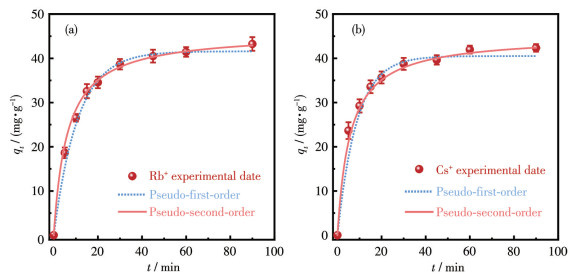
Adsorption kinetics studies provide insights into the adsorption efficiency and underlying reaction mechanisms. Kinetic experiments were conducted using 50 mL of Rb+ or Cs+ solution (initial mass concentration: 50 mg·L-1, pH=8) with 0.05 g of adsorbent at contact times of 5, 10, 15, 20, 30, 45, 60, and 90 min. As shown in Fig.4a and 4b, the adsorption capacities of Rb+ and Cs+ increased rapidly within the first 20 min, which can be attributed to the high initial mass concentration and the resulting strong driving force for overcoming diffusion resistance. Adsorption equilibrium was approached at approximately 30 min, with adsorption efficiencies reaching 93.5% for Rb+ and 95.6% for Cs+. These results demonstrate the fast adsorption kinetics of ZIF-8@AMP toward Rb+ and Cs+, which benefits from the large specific surface area of the composite and the abundant NH4+ sites in its crystalline structure, facilitating efficient ion uptake[37, 44]. Rapid adsorption kinetics are of practical importance for reducing wastewater treatment time and improving process economy. The kinetic data were further analyzed using the pseudo-first-order and the pseudo-second- order models (Eq.S5 and S6) to gain deeper insight into the adsorption process. Nonlinear fitting curves are presented in Fig.4a and 4b, and the corresponding kinetic parameters are summarized in Table S1. The correlation coefficients (R2) for the pseudo-second- order model were 0.987 and 0.971 for Rb+ and Cs+, respectively, significantly higher than those of the pseudo-first-order model (0.918 and 0.902, respectively). These results indicate that the adsorption of Rb+ and Cs+ onto ZIF-8@AMP follows the pseudo-second-order model more closely, suggesting that chemisorption is likely the rate-controlling step. This observation is consistent with previous reports on AMP-based adsorbents[22, 37].
To further investigate the diffusion mechanism and identify the rate-controlling steps in the adsorption process, the experimental data were fitted using the Weber-Morris intraparticle diffusion model[47], as expressed by Eq.S7. The fitted curve of the Weber- Morris model (Fig.S4) showed that the plot of qt versus t0.5 was non-linear and did not pass through the origin, suggesting that film diffusion, intraparticle diffusion, and subsequent ion exchange may occur simultaneously during adsorption. The curve is clearly divided into two linear segments, indicating a two-stage adsorption process. The initial steeper section represents a faster adsorption efficiency, mainly governed by film diffusion[48]. The second, more gradual segment is primarily controlled by intraparticle diffusion and the ion exchange between NH4+ in AMP and Rb+ and Cs+ ions[49].
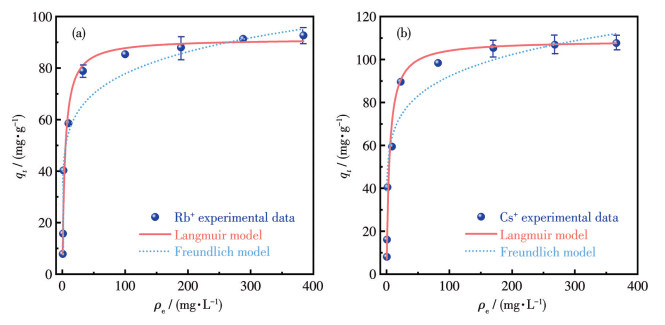
The adsorption isotherm data in this study were analyzed using both the Langmuir and the Freundlich models to investigate the adsorption mechanism, with their non-linear equations given by (Eq.S8 and S9). The fitted curves and corresponding parameters are presented in Fig.5a, 5b, and Table S2. The R2 values of the Langmuir model for Rb+ and Cs+ (0.974 and 0.990, respectively) were higher than those of the Freundlich model (0.861 and 0.907). At 298.15 K, the experimental saturated adsorption capacities for Rb+ and Cs+ (92.7 and 104.5 mg·g-1) agreed well with the values predicted by the Langmuir model (94.8 and 106.3 mg·g-1). The better fit of the Langmuir model suggests that the adsorption of Rb+ and Cs+ onto ZIF-8@AMP can be described as monolayer adsorption with a relatively uniform distribution of adsorption sites[13, 37]. This result indicates that the in-situ grafting process effectively prevented the aggregation of AMP nanoparticles, leading to their homogeneous dispersion on ZIF-8 and thereby increasing the effective surface area for adsorption.
To investigate the effect of temperature on the adsorption performance of ZIF-8@AMP toward Rb+ and Cs+, thermodynamic experiments were conducted at different temperatures, and a series of thermodynamic parameters were calculated based on the corresponding equations. The distribution coefficient Kd (regarded as the thermodynamic equilibrium constant K0) for Cs+/Rb+ at each temperature was first calculated using Eq.S3. According to the van't Hoff equation, ln Kd was then plotted against 1/T, and the data were fitted linearly, as shown in Fig.S5a and S5b. The values of enthalpy change (ΔH) and entropy change (ΔS) were derived from the slope (-ΔH/R) and intercept (ΔS/R) of the linear fit, respectively. Finally, the Gibbs free energy change (ΔG) at different temperatures was calculated using (Eq.S10 and S11)[1]. The positive values of ΔH listed in Table S3 indicate that the adsorption process is endothermic, suggesting that higher temperatures favor the adsorption of Rb+ and Cs+. The negative values of ΔG across all temperatures demonstrate the spontaneous nature of the adsorption process. Furthermore, the positive ΔS values reflect an increase in randomness at the solid-liquid interface during adsorption, which may be attributed to the coexistence of both chemical and physical adsorption mechanisms[5]. These thermodynamic parameters collectively demonstrate that the adsorption of Rb+ and Cs+ onto ZIF-8@AMP is a spontaneous and endothermic process.
Competitive adsorption experiments were conducted for Rb+ and Cs+ in the presence of Li+, Na+, K+, Ca2+, and Mg2+ at two molar ratios (4∶1 and 1∶4) (Table S4), with the results presented in Fig.S6. The Kd of Cs+ and Rb+ were significantly higher than those of the coexisting ions. The superior Kd values for Cs+ and Rb+ can be attributed to the ion-exchange mechanism between NH4+ in AMP and Rb+ and Cs+. The selectivity is governed by the matching of hydrated ionic radii, which follow the order: Rb+ (0.329 nm)=Cs+ (0.329 nm)≈NH4+ (ca. 0.331 nm) < Na+ (0.358 nm) < Li+ (0.382 nm) < Ca2+ (0.412 nm) < Mg2+ (0.428 nm). The thinner hydration shells of Rb+ and Cs+ (0.329 nm) were significantly smaller than those of the coexisting multivalent ions Mg2+ (0.428 nm) and Ca2+ (0.412 nm), and are closer in size to the original NH4+ binding sites (ca. 0.331 nm) compared to the lower charge density ions Na+ (0.358 nm) and Li+ (0.382 nm)[37, 48]. This difference in hydrated radii allows Rb+ and Cs+ to diffuse more readily into the AMP channels, whereas Mg2+, Ca2+, Na+, and Li+ form larger hydrated shells due to strong hydration effects, hindering their access to the confined pore spaces and resulting in reduced exchange capacity[44]. The results demonstrate the high selectivity of ZIF-8@AMP for Rb+ and Cs+ adsorption, indicating its strong potential for extracting these ions from salt lake brine.
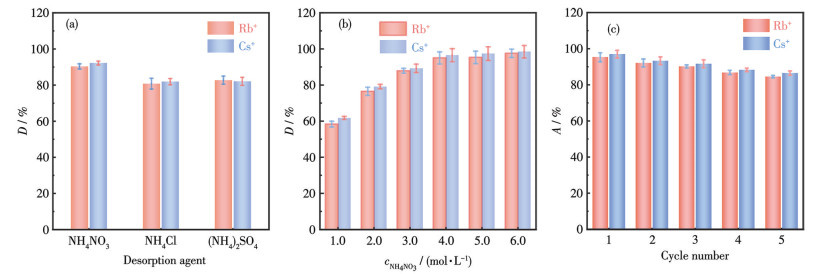
This study evaluated the desorption performance of 4.0 mol·L-1 NH4NO3, NH4Cl, or 2 mol·L-1 (NH4)2SO4 for Rb+ and Cs+ loaded on ZIF-8@AMP. As shown in Fig.6a, NH4NO3 exhibited higher desorption efficiency compared to NH4Cl and (NH4)2SO4. Subsequently, the effect of NH4NO3 concentration in the range of 1.0-6.0 mol·L-1 on Rb+ and Cs+ desorption was investigated. From Fig.6b, it could be observed that the elution efficiency increased with increasing NH4NO3 concentration until reaching a plateau above 4.0 mol·L-1, with maximum desorption efficiencies of 94.51% for Rb+ and 95.81% for Cs+. Therefore, 4.0 mol·L-1 NH4NO3 was selected as the optimal eluent. As illustrated in Fig.6c, after five consecutive adsorption-desorption cycles, ZIF-8@AMP maintained Rb+ and Cs+ adsorption efficiencies of 88.58% and 89.65%, respectively, demonstrating excellent regeneration capability. Moreover, the adsorption capacity of the synthesized adsorbent was compared with other reported materials in Table S5. The results confirm that ZIF-8@AMP exhibits superior adsorption performance over previously reported adsorbents.
To further evaluate the practical application potential of ZIF-8@AMP, adsorption experiments for Rb+ and Cs+ were conducted using a post-lithium-extraction brine sample from the Qarhan Salt Lake in Qinghai Province. Under the conditions of 100 mg adsorbent, 10 mL brine sample, 30 min adsorption time, and pH=8, the results presented in Table S6 show that ZIF-8@AMP exhibited excellent adsorption performance even under strong interference from a high Mg2+ mass concentration of 25 487 mg·L-1. The maximum adsorption efficiencies for Rb+ and Cs+ reached 84.97% and 90.70%, respectively. These results demonstrate the significant potential of ZIF-8@AMP for the selective recovery of Rb+ and Cs+ from authentic salt lake brine.
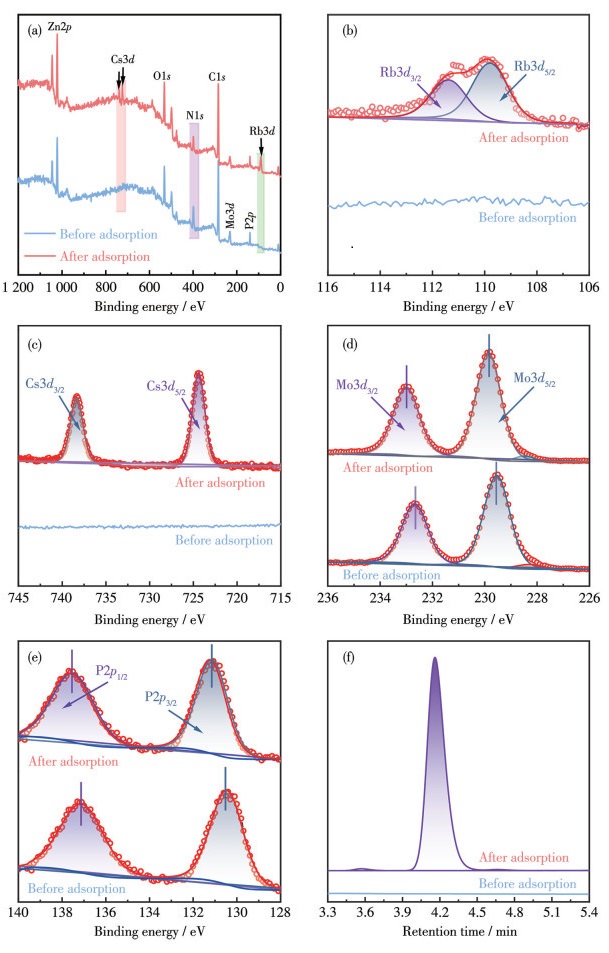
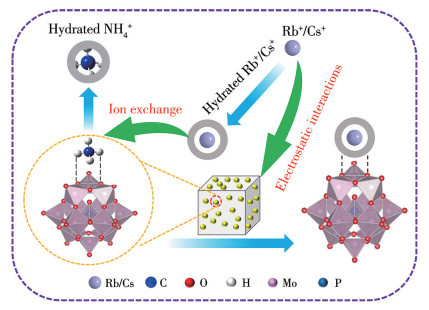
To investigate the possible adsorption mechanism of Rb+ and Cs+ on ZIF-8@AMP, the material was characterized by XPS before and after adsorption. As shown in Fig.7a, the XPS survey spectrum after adsorption exhibited characteristic peaks of Cs3d and Rb3d in addition to the original Zn2p, C1s, N1s, O1s, Mo3d, and P2p signals, confirming the successful adsorption of Rb+ and Cs+ onto ZIF-8@AMP[28]. The high- resolution Rb3d spectrum (Fig.7b) can be deconvoluted into two peaks at 111.5 and 109.9 eV, corresponding to Rb3d3/2 and Rb3d5/2[50]. Similarly, the Cs3d spectrum (Fig.7c) showed two peaks at 738.3 and 724.4 eV, assigned to Cs3d3/2 and Cs3d5/2[5, 51]. No such Rb or Cs signals were observed in the spectra before adsorption. To further verify the interaction between Rb+/Cs+ and the [PMo12O40]3- units, high-resolution Mo3d and P2p spectra were analyzed. As shown in Fig.7d and 7e, the binding energies of Mo3d3/2 and Mo3d5/2 shifted from 232.4 and 229.4 eV before adsorption to 232.9 and 229.9 eV after adsorption, respectively. Similarly, the P2p1/2 and P2p3/2 peaks shifted from 137.1 and 130.3 eV to 137.6 and 130.8 eV. These positive shifts in the binding energies of Mo and P indicate a change in the chemical environment of the Mo—P bonds in ZIF-8@AMP after adsorption, suggesting that NH4+ in AMP may have participated in ion exchange with Rb+ and Cs+ [33, 37]. Comparison of the survey spectra (Fig.7a) also reveals a noticeable decrease in the intensity of the N1s peak after adsorption, supporting the consumption of NH4+ during ion exchange with Rb+ and Cs+. This was further confirmed by ion chromatography, which detected a strong NH4+ signal in the solution after adsorption (Fig.7f). In addition, the spherical anionic [PMo12O40]3- units with Keggin structure in ZIF-8@ AMP impart a negative surface charge, facilitating electrostatic attraction toward positively charged Rb+ and Cs+ ions[44]. Therefore, the adsorption of Rb+ and Cs+ on ZIF-8@AMP is driven by a combination of ion exchange with NH4+ and electrostatic interactions. A schematic illustration of the proposed adsorption mechanism is presented in Fig.8.
(a) Survey; (b) Rb3d; (c) Cs3d; (d) Mo3d; (e) P2p.
In summary, a composite adsorbent, ZIF-8@AMP, was successfully prepared by in situ incorporation of AMP into the zeolitic imidazolate framework-8 (ZIF-8) matrix. The adsorption performance and mechanism of the composite toward Rb+ and Cs+ were systematically investigated. Characterization by SEM, XRD, FTIR, and XPS confirmed the effective formation of the ZIF-8@AMP composite. The material exhibited a BET surface area of 848 m2·g-1 and a bimodal pore structure comprising both micropores and mesopores. ZIF-8@ AMP demonstrated rapid adsorption kinetics, reaching equilibrium within 30 min, with maximum adsorption capacities of 92.7 mg·g-1 for Rb+ and 104.5 mg·g-1 for Cs+. The adsorption process followed the Langmuir isotherm model and the pseudo-second-order kinetic model, indicating monolayer adsorption dominated by chemical interactions. In the presence of coexisting ions, ZIF-8@AMP exhibited excellent selectivity for Rb+ and Cs+. The adsorbent also displayed favorable reusability, maintaining 88.58% and 89.65% of its initial adsorption capacity for Rb+ and Cs+, respectively, after five consecutive adsorption-desorption cycles using NH4NO3 as the eluent. The adsorption mechanism was attributed to electrostatic attraction and ion exchange between NH4+ in AMP and Rb+ and Cs+. This work provides a novel strategy for designing highly efficient adsorbents for the recovery of Rb+ and Cs+ from aqueous solutions.
WANG Y P, ZHANG Q Y, FANG D Z, LI K X, SONG Z M, HAN W J, LI J W, YE X S, LIU H N, ZHANG H F, ZHANG X, WU Z J. Selective adsorption of Rb+ and Cs+ by a superparamagnetic Fe3O4@FeMn-MOF from brine[J]. Desalination, 2025, 600: 118481 doi: 10.1016/j.desal.2024.118481
WANG Y, ZHANG L L, WANG S L, FENG H L, PANG F F, LI H L, LIU B H, ZANG X H, ZHANG S H, WANG Z. Construction of a sulfonic acid functionalized hypercrosslinked polymer for the adsorption of rubidium and cesium[J]. J. Water Process Eng., 2024, 68: 106321 doi: 10.1016/j.jwpe.2024.106321
ZHANG X F, LI C L, LIU P, LUO X G, LI X B, LI W X, LI L M. A sustainable method for cesium and rubidium separation from high- salinity wastewater[J]. J. Environ. Chem. Eng., 2025, 13(5): 118460 doi: 10.1016/j.jece.2025.118460
LE Q T N, CHO K. Caesium adsorption on a zeolitic imidazolate framework (ZIF-8) functionalized by ferrocyanide[J]. J. Colloid Interface Sci., 2021, 581: 741-750 doi: 10.1016/j.jcis.2020.08.017
LI J S, LI T W, MA Y Q, CHEN F K. Distribution and origin of brine-type Li-Rb mineralization in the Qaidam Basin, NW China[J]. Sci. China Earth Sci., 2022, 65(3): 477-489 doi: 10.1007/s11430-021-9855-6
MA C, LI Z, ZHANG Z J, QIN W, JIA J T, HAN G, GUO Y F, PAN T, DENG T L. In-situ polyimidazole-encapsulated Cu-defective PB composite enables green and selective rubidium recovery from salt lake brine[J]. Chem. Eng. J., 2025, 523: 168870 doi: 10.1016/j.cej.2025.168870
ZHANG Z F, ZHAO T Y, HE L H, ZHAO Z W, SUN F L, XU W H, LIU D F. Electrochemical extraction of rubidium from salt lake by using cupric ferrocyanide based on potassium shuttle[J]. Desalination, 2023, 549: 116331 doi: 10.1016/j.desal.2022.116331
CHEN X, WANG Y, LIU B X, GAO L, QIAO L L, XIONG C W, QIAO L J, LI Y Z, ZHANG P, ZHU D R, LIU D H. Ecologically friendly 2D/2D Na+-MXene/LDH for cesium adsorption in salt lakes: A comprehensive study on adsorption performance, mechanisms, and environmental impact[J]. Desalination, 2025, 602: 118632 doi: 10.1016/j.desal.2025.118632
WANG Y P, YE X S, ZHANG Q Y, HAN W J, LIU X, ZHANG H F, LIU H N, WU Z J, SHI G S. Unveiling the adsorption behavior and mass transfer mechanism of Rb+ and Cs+ adsorption on FeMn-MOF[J]. Chem. Eng. J., 2024, 502: 157999 doi: 10.1016/j.cej.2024.157999
XING P, WANG C Y, CHEN Y Q, MA B Z. Rubidium extraction from mineral and brine resources: A review[J]. Hydrometallurgy, 2021, 203: 105644 doi: 10.1016/j.hydromet.2021.105644
LV Y W, LIU Y B, MA B Z, WANG C Y, CHEN Y Q. Preferential extraction of rubidium from high concentration impurity solution by solvent extraction and preparation of high-purity rubidium salts[J]. Desalination, 2023, 545: 116162 doi: 10.1016/j.desal.2022.116162
HUANG Y T, CHEN J J, LIU H N, WANG Y P, LU M, LIU X, YE X S, SHI G S. Crown ether intercalated graphene oxide membranes for highly efficient sieving of cesium with a large water permeability[J]. Sep. Purif. Technol., 2024, 339: 126702 doi: 10.1016/j.seppur.2024.126702
NI J H, SUN B X, LIU P J, JIN G P. Preparation of a core-shell magnetic potassium nickel copper hexacyanoferrate/zeolitic imidazolate framework composite for rubidium adsorption[J]. J. Solid State Chem., 2024, 331: 124554 doi: 10.1016/j.jssc.2024.124554
CHEN S R, XIONG G Y, CUI S L, ZHAO S F, LAI J L, ZHANG X N, ZENG G Y, ZENG Y, SHI H. Selective isolation of rubidium with mesoporous silica loaded with ammonium phosphomolybdate via an in-pore crystallization reaction[J]. Sep. Purif. Technol., 2025, 353: 128364 doi: 10.1016/j.seppur.2024.128364
GAO L, MA G H, ZHENG Y X, TANG Y, XIE G S, YU J W, LIU B X, DUAN J Y. Research trends on separation and extraction of rare alkali metal from salt lake brine: rubidium and cesium[J]. Solvent Extr. Ion Exch., 2020, 38(7): 753-776 doi: 10.1080/07366299.2020.1802820
LI C L, LIU P, ZHANG X F, LUO X G, WEI C, LI X B, DENG Z G, LI M T. Separation of Li, Na, K from salinity wastewater via targeting coordination precipitation with phosphate and chlorine[J]. J. Environ. Chem. Eng., 2025, 13(2): 115510 doi: 10.1016/j.jece.2025.115510
WANG M M, XU J, ZHAO L, LIN C X, GAO J, XIA Y G. Adsorption of rubidium/cesium from aqueous solution using silane-modified prussian blue-based composites[J]. J. Sep. Sci., 2025, 48(5): e70164 doi: 10.1002/jssc.70164
LIU H N, WANG Y P, ZHANG Q Y, HAN W J, ZHANG H F, YE X S. High-efficiency selective adsorption of rubidium and cesium from simulated brine using a magnesium ammonium phosphate adsorbent[J]. Separations, 2024, 11(9): 277-287 doi: 10.3390/separations11090277
WANG G H, ZHANG H B, QIAN W L, TANG A Y, CAO H Z, FENG W Y, ZHENG G Q. Synthesis and assessment of spherogranular composite tin pyrophosphate antimonate adsorbent for selective extraction of rubidium and cesium from salt lakes[J]. Desalination, 2024, 581: 117540 doi: 10.1016/j.desal.2024.117540
LV Y W, MA B Z, LIU Y B, WANG C Y, CHEN Y Q. A novel adsorbent potassium magnesium ferrocyanide for selective separation and extraction of rubidium and cesium from ultra-high salt solutions[J]. J. Water Process Eng., 2023, 55: 104225 doi: 10.1016/j.jwpe.2023.104225
LIU S Y, ZU J H, HAN G, PAN X H, XUE Y, DIAO J J, TANG Q, JIN M J. Ammonium phosphomolybdate-modified UiO-66 as an efficient adsorbent for the selective removal of 137Cs from radioactive wastewater[J]. Sep. Purif. Technol., 2023, 329: 125073
FU C Y, WEI X, LIAN J, CHENG J F, ZHU S, YAN M H. A facile synthesis of polyacrylic acid-ammonium phosphomolybdate microspheres for the highly selective removal of cesium[J]. J. Radioanal. Nucl. Chem., 2024, 333(4): 2207-2220 doi: 10.1007/s10967-024-09416-7
YANG H, MA B Z, SHI S Y, YU J C, LIU Y B, CAO Z H, WANG C Y, CHEN Y Q. Efficient recovery of rubidium from high-salinity brine using dual crosslinked hydrogel beads encapsulating ammonium phosphotungstate[J]. Desalination, 2025, 606: 118794 doi: 10.1016/j.desal.2025.118794
PARK Y J, LEE Y C, SHIN W S, CHOI S J. Removal of cobalt, strontium and cesium from radioactive laundry wastewater by ammonium molybdophosphate-polyacrylonitrile (AMP-PAN)[J]. Chem. Eng. J., 2010, 162(2): 685-695 doi: 10.1016/j.cej.2010.06.026
WANG Y P, LI K X, FANG D Z, YE X S, LIU H N, TAN X L, LI Q, LI J, WU Z J. Ammonium molybdophosphate/metal-organic framework composite as an effective adsorbent for capture of Rb+ and Cs+ from aqueous solution[J]. J. Solid State Chem., 2022, 306: 122767 doi: 10.1016/j.jssc.2021.122767
JIANG C Y, NI J H, JIN G P. Magnetic potassium cobalt hexacyanoferrate nanocomposites for efficient adsorption of rubidium in solution[J]. Sep. Purif. Technol., 2022, 296: 121383 doi: 10.1016/j.seppur.2022.121383
SUN C Y, LIU S X, LIANG D D, SHAO K Z, REN Y H, SU Z M. Highly stable crystalline catalysts based on a microporous metal- organic framework and polyoxometalates[J]. J. Am. Chem. Soc., 2009, 131(5): 1883-1888 doi: 10.1021/ja807357r
ZHAO R C, XIE L H, LIU X M, LIU Z, LI X Y, LI J R. Removal of trace benzene from cyclohexane using a MOF molecular sieve[J]. J. Am. Chem. Soc., 2024, 147(3): 2467-2475
ZHANG S W, OU F X, NING S G, CHENG P. Polyoxometalate-based metal-organic frameworks for heterogeneous catalysis[J]. Inorg. Chem. Front., 2021, 8(7): 1865-1899 doi: 10.1039/D0QI01407A
KHOSRAVI A, HABIBPOUR R, RANJBAR M. Enhanced adsorption and removal of Cd from aqueous solution by amino- functionalized ZIF-8[J]. Sci. Rep., 2024, 14(1): 10736 doi: 10.1038/s41598-024-59982-9
ZENG S, WANG Y H, ZHOU Y M, LI W L, ZHOU W B, ZHOU X, WANG M, ZHAO X Q, REN L. Mixed-linker synthesis of L- histidine@zeolitic imidazole framework-8 on amyloid nanofibrils-modified polyacrylonitrile membrane with high separation and antifouling properties[J]. Sep. Purif. Technol., 2022, 290: 120856 doi: 10.1016/j.seppur.2022.120856
YANG W, KONG Y D, YIN H, CAO M L. Study on the adsorption performance of ZIF-8 on heavy metal ions in water and the recycling of waste ZIF-8 in cement[J]. J. Solid State Chem., 2023, 326: 124217 doi: 10.1016/j.jssc.2023.124217
REN Y, HUANG X Y, WU Y, HU B A, ZHENG X M. Decontamination of washing solution of simulated cesium-contaminated soil by magnetic ammonium phosphomolybdate beads[J]. J. Environ. Chem. Eng., 2024, 12(2): 111968 doi: 10.1016/j.jece.2024.111968
LI H L, ZHANG S H, LIU B H, LI X H, SHANG N Z, ZHAO X X, EGUCHI M, YAMAUCHI Y, XU X T. Nanoarchitectonics of ultrafine molybdenum carbide nanocrystals into three-dimensional nitrogen-doped carbon framework for capacitive deionization[J]. Chem. Sci., 2024, 15(29): 11540-11549 doi: 10.1039/D4SC00971A
AMIN S, ALAVI S A, AGHAYAN H, YOUSEFNIA H. Efficient adsorption of cesium using a novel composite inorganic ion-exchanger based on metal organic framework (Ni[(BDC)(TED)]) modified matal hexacyanoferrate[J]. J. Organomet. Chem., 2022, 961: 122263 doi: 10.1016/j.jorganchem.2022.122263
YU J T, WANG X M, LIU T N, BAI X, HE Z H, HE Y H, TAO J J, WANG Q Q, WU Q H. Synthesis of magnetic hyper-crosslinked polymer from waste-expanded polystyrene as efficient sorbent for removal of Congo red and crystal violet[J]. Sustain. Mater. Technol., 2023, 38: e00760
FU C Y, TAN Z M, CHENG J F, XIE J L, DAI X Z, DU Y Y, ZHU S, WANG S Q, YAN M H. Effective removal of cesium by ammonium molybdophosphate-polyethylene glycol magnetic nanoparticles[J]. J. Environ. Chem. Eng., 2023, 11(5): 110544 doi: 10.1016/j.jece.2023.110544
SINHA A K, SASMAL A K, PAL A, PAL D, PAL T. Ammonium phosphomolybdate[(NH4)3PMo12O40] an inorganic ion exchanger for environmental application for purification of dye contaminant wastewater[J]. J. Photochem. Photobiol. A‒Chem., 2021, 418: 113427 doi: 10.1016/j.jphotochem.2021.113427
LI Y W, WEI L H, OU C J, WU Q, LIAO Z P, ZHA X H. Loofah sponge immobilized ZIF-8 for efficient adsorption removal of U[J]. Inorg. Chem. Commun., 2024, 167: 112838 doi: 10.1016/j.inoche.2024.112838
WANG H Y, HU C, DU Y F, LIU R R, LIU Z, HAN L, ZHOU Y Q. Construction of potassium cobalt iron cyanide double-hollow nanobubble prisms for high selective adsorption of cesium[J]. J. Water Process Eng., 2024, 59: 104944 doi: 10.1016/j.jwpe.2024.104944
QU Y, QIN L, LIU X G, YANG Y Z. Magnetic Fe3O4/ZIF-8 composite as an effective and recyclable adsorbent for phenol adsorption from wastewater[J]. Sep. Purif. Technol., 2022, 294: 121169 doi: 10.1016/j.seppur.2022.121169
BAO A M, ZHENG H, LIU Z Y, HUANG D F, WANG S Y, LI B. Preconcentration and separation of rubidium from salt lake brine by ammonium phosphomolybdate-polyacrylonitrile (AMP-PAN) composite adsorbent[J]. ChemistrySelect, 2017, 2(25): 7741-7750 doi: 10.1002/slct.201700835
LIU Q, GE H J, LIU C, ZHANG N L, GUO Y F, DENG T L. Highly selective and easily regenerated novel porous polyacrylonitrile- ammonium phosphomolybdate beads for cesium removal from geothermal water[J]. J. Water Process Eng., 2023, 51: 103339 doi: 10.1016/j.jwpe.2022.103339
LI J Y, HAN W X, LIU H Y, SU M H, CHEN D Y, SONG G. Simultaneous removal of Cs and U by a novel magnetic AMP@ PDA@Fe3O4 composite[J]. J. Clean Prod., 2023, 409: 137140 doi: 10.1016/j.jclepro.2023.137140
ZHANG N L, CHEN S Q, HU J Y, SHI J, GUO Y F, DENG T L. Robust and recyclable sodium carboxymethyl cellulose-ammonium phosphomolybdate composites for cesium removal from wastewater[J]. RSC Adv., 2020, 10(11): 6139-6145 doi: 10.1039/C9RA09803H
AHMADIJOKANI F, AHMADIPOUYA S, HARIS M H, REZAKAZEMI M, BOKHARI A, MOLAVI H, AHMADIPOUR M, PUNG S Y, KLEMEŠ J J, AMINABHAVI T M, ARJMAND M. Magnetic nitrogen-rich UiO-66 metal-organic framework: An efficient adsorbent for water treatment[J]. ACS Appl. Mater. Interfaces, 2023, 15(25): 30106-30116 doi: 10.1021/acsami.3c02171
LI J C, LIAO L S, JIA Y N, TIAN T, GAO S W, ZHANG C Y, SHEN W, WANG Z. Magnetic Fe3O4/ZIF-8 optimization by box-behnken design and its Cd-adsorption properties and mechanism[J]. Arab. J. Chem., 2022, 15(10): 104119 doi: 10.1016/j.arabjc.2022.104119
YANG X B, WEN Z D, WU Z L, LUO X T. Synthesis of ZnO/ZIF-8 hybrid photocatalysts derived from ZIF-8 with enhanced photocatalytic activity[J]. Inorg. Chem. Front., 2018, 5(3): 687-693 doi: 10.1039/C7QI00752C
NAIDU G, NUR T, LOGANATHAN P, KANDASAMY J, VIGNESWARAN S. Selective sorption of rubidium by potassium cobalt hexacyanoferrate[J]. Sep. Purif. Technol., 2016, 163: 238-246 doi: 10.1016/j.seppur.2016.03.001
XU Z H, RONG M, NI S, MENG Q Y, WU X, LIU H Z, YANG L R. Self-polycondensing hypercross-linked polymers from hydroxybenzyl alcohols for efficient cesium adsorption[J]. ACS Appl. Polym. Mater., 2023, 5(10): 8315-8325 doi: 10.1021/acsapm.3c01468
ZANG Y, YU Y Y, CHEN Y L, FAN M Y, WANG J J, LIU J, XU L, JIA H G, DONG S B. Synthesis of conjugated microporous polymers rich in sulfonic acid groups for the highly efficient adsorption of Cs+[J]. Chem. Eng. J., 2024, 484: 149709 doi: 10.1016/j.cej.2024.149709

Figure 1 (a) FTIR spectra, (b) XRD patterns, (c) N2 adsorption-desorption isotherms, and (d) TGA curves of the prepared samples

Figure 2 (a-c) SEM images of ZIF-8; (d-f) SEM images of ZIF-8@AMP; (g) EDS spectrum and (h) EDS-mappings of ZIF-8@AMP

Figure 3 Effects of (a) pH, (b) dosage of adsorbent, (c) initial mass concentration of Rb+ and Cs+, and (d) temperature on the adsorption of Rb+ and Cs+ at ZIF-8@AMP

Figure 4 Kinetic nonlinear fitting curves for the adsorption of (a) Rb+ and (b) Cs+ by ZIF-8@AMP

Figure 6 (a) Desorption efficiencies of the different eluents for Rb+ and Cs+; (b) Desorption efficiencies of the different concentrations of NH4NO3 for Rb+ and Cs+; (c) Regeneration performance of ZIF-8@AMP

Figure 7 (a-e) XPS spectra of ZIF-8@AMP before and after adsorption; (f) Peak area of NH4+
(a) Survey; (b) Rb3d; (c) Cs3d; (d) Mo3d; (e) P2p.

 扫一扫看文章


扫一扫关注我们
 下载:
下载:

 下载:
下载:


 下载:
下载: