
Table 1.
Crystallographic data of complex 1

A viologen-based zinc framework: Photochromism, photoluminescence, ink-free erasable printing, and multiple optical switching properties
Xiaonan LI , Jingqi ZHANG , Jiaxin LEI , Yuxin JIANG , Xin ZHAO , Tingting GUO , Juanzhi YAN


Coordination polymers, as a class of highly attractive functional materials, have garnered widespread interest over the past few years owing to their versatile structural tunability and multifunctional characteristics. Among various functionalities, photochromic behavior refers to reversible color changes under light irradiation, which has attracted particular attention due to its potential applications in optical storage[1-8], sensors[9-13], and smart materials[14-19]. Meanwhile, photoluminescent properties provide additional functionality, enabling these materials to be used in optoelectronic devices[20-23] and bioimaging[24-26]. The integration of both photochromic and photoluminescent properties into a single coordination polymer offers unique opportunities for advanced technological applications, as the interplay between these two phenomena can lead to novel responsive behaviors.
Viologen-based ligands have been widely explored in the construction of photochromic materials owing to their ability to undergo reversible redox reactions upon light exposure, accompanied by distinct color changes. Moreover, viologen derivatives exhibit diverse coordination modes with metal ions, allowing them to act as versatile structural building blocks for synthesizing functional coordination polymers. As an important category of transition metal ions, zinc ions not only possess diverse coordination geometries and relatively low toxicity but also a specific d10 electronic configuration. This unique electronic structure enables zinc ions to endow the resulting complexes with luminescent properties, making them a preferred choice as central metal ions in such systems. Their use further facilitates the formation of coordination polymers with both structural stability and structural diversity, laying a foundation for integrating multiple functionalities.
Based on the above considerations, a novel coordination polymer [Zn(CV)0.5(BDC)(H2O)]·2H2O has been successfully synthesized via the coordination of the 1, 1′-bis(2-carboxyethyl)-4, 4′-bipyridinium ((H2CV)2+) ligand with zinc ions, along with the incorporation of terephthalic acid (H2BDC). This complex features a 1D chain structure. Notably, complex 1 exhibits photochromic behavior: it undergoes a distinct color change from colorless to blue upon light irradiation, and the blue-colored sample can gradually revert to its original color when placed in air, demonstrating excellent reversibility. This reversible photochromic property endows 1 with great potential in ink-free printing. In addition, complex 1 also shows photoluminescent behavior, emitting blue light in the dark. Interestingly, this photoluminescent property is inversely correlated with the photochromic phenomenon (luminescence intensity decrease when photochromism occurs). The coexistence of these two distinct optical properties in 1 endows the complex with photo-controllable switching performance. This dual characteristic holds significant value, as unraveling the fundamental mechanisms behind these properties and investigating their synergistic interactions may pave the way for the creation of more sophisticated and versatile materials.
The materials and physical measurements can be found in the Supporting information.
ZnBr2 (22.5 mg, 0.1 mmol), (H2CV)Cl2 (30 mg, 0.1 mmol), and H2BDC (16.6 mg, 0.1 mmol) were dissolved in a mixed solvent consisting of EtOH (2 mL), DMF (2 mL), and H2O (2 mL), followed by stirring at room temperature for 10 min. The resulting mixture was then transferred into a 25 mL Teflon-lined autoclave. The autoclave was placed in an oven, where the temperature was programmed to rise to 70 ℃ over 12 h, and the reaction was maintained at this temperature for 72 h. Then, the products were cooled to room temperature, and filtration yielded colorless and transparent crystals. The yield was 34% (based on ligand (H2CV)Cl2). Elemental analysis Calcd. for C16H18NO9Zn(%): C, 44.27; H, 4.15; N, 3.23. Found(%): C, 44.31; H, 4.18; N, 3.25.
Single crystals of complex 1 were grown via solvothermal synthesis of a reaction in a mixed solution of EtOH (2 mL), DMF (2 mL), and H2O (2 mL) at 70 ℃. A suitable crystal with dimensions of 0.6 mm×0.4 mm×0.3 mm was selected and mounted on a Bruker SMART APEX Ⅱ CCD diffractometer. X-ray diffraction data were collected using graphite-monochromated Mo Kα radiation (λ=0.071 073 nm) at 297.16 K. The crystal structure was solved and refined by full-matrix least-squares techniques on F 2 using Olex2. Absorption corrections were performed via the multi-scan method.
The crystallographic data of 1 are summarized in Table 1, and the selected bond lengths, bond angles, and hydrogen bonds are tabulated in Table S1-S3.
 下载:
导出CSV
下载:
导出CSV
| Parameter | 1 |
| Empirical formula | C16H18NO9Zn |
| Formula weight | 433.68 |
| Crystal system | Monoclinic |
| Space group | P21/n |
| a / nm | 1.029 16(14) |
| b / nm | 1.630 0(3) |
| c / nm | 1.041 04(18) |
| β / (°) | 97.407(5) |
| V / nm3 | 1.731 8(5) |
| Z | 4 |
| F(000) | 892.0 |
| GOF (F 2) | 1.031 |
| Final R indexes* [I≥2σ(I)] | R1=0.040 6, wR2=0.077 4 |
| Final R indexes (all data) | R1=0.068 4, wR2=0.088 5 |
| *R1=∑||Fo|-|Fc||/∑|Fo|, wR2={∑w[(Fo)2-(Fc)2]2/∑w[(Fo)2]2}1/2. | |
Through single-crystal X-ray diffraction analysis, it was found that complex 1 crystallizes in the monoclinic system and belongs to the space group P21/n. The asymmetric unit of 1 is composed of one Zn2+ ion, half of one CV ligand, one BDC2- ligand, one coordinated water molecule, and two free water molecules. As illustrated in Fig.1a, each Zn2+ ion is four-coordinated, bonding with two oxygen atoms from two BDC2- ligands, one oxygen atom from a CV ligand, and one oxygen atom from a coordinated water molecule, thus adopting a distorted tetrahedral geometry. The Zn2+ ions, CV ligands, and BDC2- ligands are interconnected to form a 1D chain structure (Fig.1b). The Zn—O bond lengths range from 0.191 6 to 0.201 5 nm. The shortest hydrogen bond, O2—H2B…O4 (H2B…O4 0.184 nm), is a strong O—H…O interaction and contributes significantly to the structural stability of the coordination polymer framework. Thermogravimetric analysis (TGA) of 1 showed a stable plateau from 30 to 105 ℃, indicating that 1 exhibits good thermal stability within this temperature range. The TGA also revealed a weight loss of 13% from 105 to 196 ℃, which corresponds to the removal of two free water molecules and one coordinated water molecule (Calcd. 12.46%). Above 196 ℃, 1 underwent a significant weight loss, suggesting that the framework of 1 began to collapse (Fig.S1).
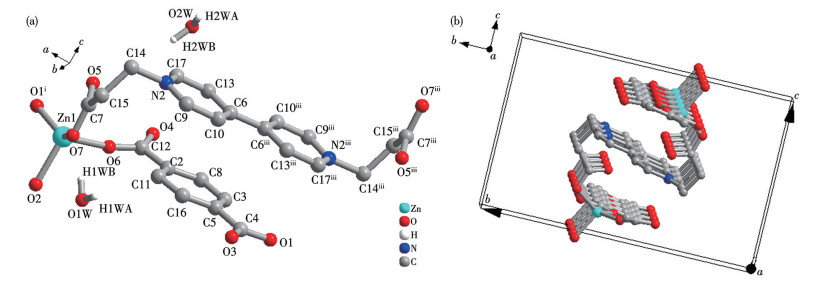
Symmetric codes: ⅰ 1+x, y, z; ⅱ-1+x, y, z; ⅲ 1-x, 1-y, 1-z.
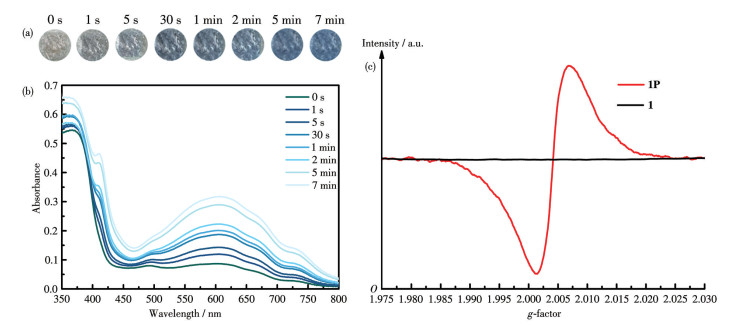
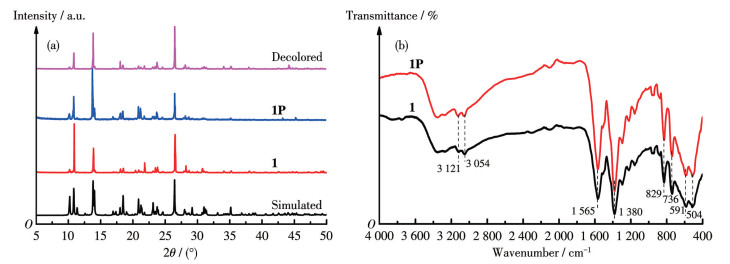
Complex 1 changed color from colorless to blue upon irradiation with sunlight or a 300 W xenon lamp. Notably, a visible color change could be observed as early as 1 s after irradiation, and the color gradually deepens with increasing irradiation time (Fig.2a). The blue sample after irradiation was designated as 1P. When 1P was stored in the dark, it would gradually revert to its original color. To investigate the photochromic mechanism of 1, solid-state UV-Vis diffuse reflectance spectroscopy was performed. As shown in Fig.2b, before light irradiation, 1 showed no obvious absorption peaks. In contrast, 1P exhibited two strong absorption peaks at 410 and 606 nm in the solid diffuse reflectance absorption spectrum, and the intensity of these absorption peaks increased with prolonged irradiation time. These peaks were similar to the absorption peaks of viologen-based complexes reported previously[27-33], indicating that they originate from the formation of viologen radicals. To confirm the generation of viologen radicals during the photochromic process, electron paramagnetic resonance (EPR) spectroscopy was conducted on samples of 1 before and after irradiation. As depicted in Fig.2c, no signal peak was observed for 1 before irradiation, while a strong signal peak appeared at g=2.035 1 after irradiation. This result demonstrates that the photochromic property of 1 stems from the generation of viologen radicals[34-41]. Powder X-ray diffraction (PXRD) and IR analyses revealed that the framework of 1 remains unchanged before and after irradiation (Fig.3), indicating that no photoisomerization or photodecomposition occurs during the coloring and fading processes of 1[42].
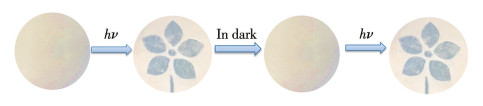
Given that complex 1 exhibits excellent photochromic properties, it can serve as a medium for ink-free erasable printing. A certain amount of ground sample of 1 was dispersed in a specific volume of ethanol, and the mixture was ultrasonicated for 30 min. The suspension was dropped onto filter paper. The paper was stored in the dark to dry, and this operation was repeated five times. Subsequently, by placing a template with patterns on the printed paper, the photo-printed content could be obtained after irradiation. As shown in Fig.4, after irradiating the printed paper containing 1 for 30 s and removing the template, a blue flower pattern appeared on the white paper, which showed a distinct color contrast with the white background, facilitating the visual reading of relevant content. The printed content could be erased after approximately 7 d, and upon re-irradiation, the blue pattern reappeared, demonstrating the reusability of the composite paper.
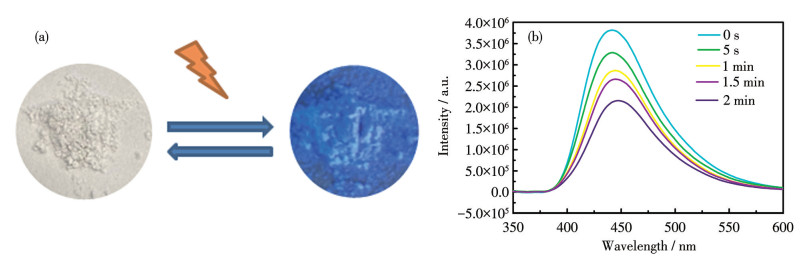
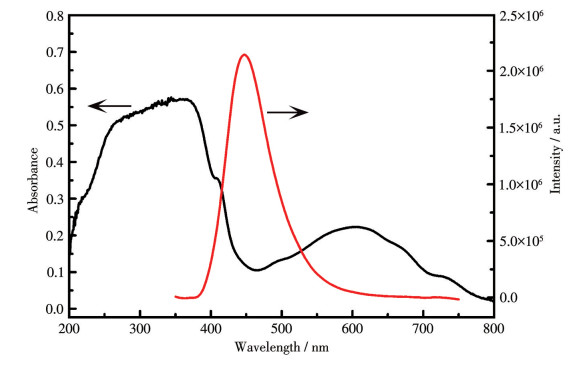
When complex 1 is irradiated with a xenon lamp in the dark, it emits blue luminescence (Fig.5a). Therefore, the luminescent properties of 1 were investigated. When 320 nm was used as the excitation wavelength, 1 exhibited a characteristic emission peak at 441 nm, and its fluorescence emission intensity gradually decreased with increasing irradiation time (Fig.5b). This is exactly opposite to the photochromic behavior of complex 1, suggesting that there may be an energy competition relationship between the photochromic behavior and photo-controlled fluorescence behavior of 1. As depicted in Fig.6, the fluorescence emission spectrum of pristine complex 1 showed significant overlap with the solid-state UV-Vis diffuse reflectance absorption spectrum of photoirradiated 1P, which further indicates that the light-controlled fluorescence property of 1 is caused by intramolecular energy transfer.
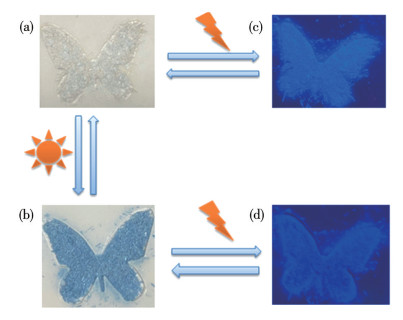
As shown in Fig.7a and 7b, the initially colorless crystals of complex 1 underwent a distinct color transition to blue upon exposure to light irradiation. When 1 was subjected to ultraviolet light in a dark environment, it exhibited prominent blue luminescence (Fig.7c). In contrast, the luminescent brightness of sample 1P became relatively weaker when illuminated under the same dark conditions (Fig.7d). These phenomena clearly demonstrate that there exists a competitive interplay between the photochromic behavior and light-modulated fluorescence properties of this complex. Furthermore, such dual-responsive characteristics further confirm that the complex possesses photo-switchable functionality. Notably, complex 1 exhibits versatile switching capabilities, encompassing multiple responsive behaviors. It can undergo reversible transitions in both color and luminescence upon specific light stimuli, thus functioning as a multi-channel optical switch.
In conclusion, a viologen-based zinc coordination polymer has been successfully synthesized, which features a 1D chain structure. Notably, this complex exhibits multiple distinctive functionalities, including photochromism, ink-free printing capability, photo-induced fluorescence, and multiple photo-switching performances. The synergistic integration of these integrated optoelectronic properties endows complex 1 with considerable potential as a promising candidate for advanced applications in optoelectronic devices, smart printing materials, and other related fields.
HU J S, DUAN B, YAO J C, LUO T, WU Y X, WANG F Y, LIU T, DING C C, FAN Q C, FU H. Multimodal anti-counterfeiting and optical storage application based on luminescence reversible modification and color change of photochromic phosphor[J]. Appl. Mater. Today, 2024, 40: 102392 doi: 10.1016/j.apmt.2024.102392
MA R B, GONG X Y, DENG C Y, HUANG W C. Bismuth-activated luminescence reversible modification of photochromic[J]. J. Alloy. Compd., 2025, 1022: 179812 doi: 10.1016/j.jallcom.2025.179812
ZI Y Z, HUANG A J, ZHAO H P, BAI X, XU Z, ULLAH A, LIU Y, CUN Y K, SONG Z G, QIU J B, TATIANA C, SHEN Y, YANG Z W. Efficient reversible upconversion luminescence modulation based on photochromism of lanthanides-doped BaMgSiO4 glass ceramics toward optical storage application[J]. Laser Photonics Rev., 2024, 18(12): 2400882 doi: 10.1002/lpor.202400882
ZHAO H P, LIAO J Y, FU S S, ZI Y Z, BAI X, CI Y, ZHANG Y T, CAI X H, LI Y W, CUN Y K, HUANG A J, LIU Y, QIU J B, SONG Z G, LI G G, ZHOU J, YANG Z W. Direct 3D lithography of reversible photochromic patterns with tunable luminescence in amorphous transparent media[J]. ACS Energy Lett., 2025, 10(3): 1235-1244 doi: 10.1021/acsenergylett.5c00024
ZHAO H P, CUN Y K, BAI X, XIAO D W, QIU J B, SONG Z G, LIAO J Y, YANG Z W. Entirely reversible photochromic glass with high coloration and luminescence contrast for 3D optical storage[J]. ACS Energy Lett., 2022, 7(6): 2060-2069 doi: 10.1021/acsenergylett.2c00574
BAO Y, GAO L, HAN P, LIU F, ZHOU J B, ZHANG W B. Multi-color photochromic waterborne polyurethane with high color fastness from hydroxyl-functionalized trichromatic spiropyrans[J]. Dyes Pigment., 2025, 235: 112577 doi: 10.1016/j.dyepig.2024.112577
DOU X Y, LI X, ZHANG Z H, JIANG X X, MIAO J Y, QI X P, FU S C, ZHANG X T. High-efficient photochromic P123/WOx films via semi-annealing for enhanced optical data storage[J]. J. Appl. Polym. Sci., 2025, 142(15): e56727 doi: 10.1002/app.56727
ZHU X D, HUANG A J, ZHAO H P, LIU Y, CUN Y K, SONG Z G, QIU J B, TATIANA C, LIAO J Y, YANG Z W. Defects-induced photochromism and luminescent modulation based on lanthanides-doped cadmium glass toward optical storage applications[J]. Laser Photon. Rev., 2024, 18(6): 2301326 doi: 10.1002/lpor.202301326
ZHANG J F, CHEN L, CHEN Q, YUE Y L, CHEN Q H, YIN D J, ZHANG C. An efficient dual-response luminescent metal-organic framework sensor constructed by new photochromic ligand[J]. Dyes Pigment., 2023, 220: 111751 doi: 10.1016/j.dyepig.2023.111751
LIANG J D, LI B T, GAI X D, LI N, WANG J, ZHANG Y C, ZHOU Q, SUN YC. Photochromic/electrochromic strain sensor with a fast and reversible light-printing ability[J]. J. Mater. Chem. C, 2023, 11(10): 3634-3643 doi: 10.1039/D2TC05417E
HASSAN F, TANG Y Q, BISOYI H K, LI Q. Photochromic carbon nanomaterials: An emerging class of light-driven hybrid functional materials[J]. Adv. Mater., 2024, 36(32): 2401912 doi: 10.1002/adma.202401912
ZHENG J C, HE H, CHEN J, SUN R F, ZHANG W W, HUANG Y, SHAO J W, CHI Y W. Visualized fluorescence sensor for dichloromethane based on photochromic perovskite nanocrystals[J]. ACS Appl. Nano Mater., 2024, 7(18): 21463-21470 doi: 10.1021/acsanm.4c03205
WANG W, CHENG Y, XIE X J. Design and applications of photochromic compounds for quantitative chemical analysis and sensing[J]. Chem. Commun., 2025, 61(46): 8327-8338 doi: 10.1039/D5CC01830G
BUKREEVA T, BARACHEVSKY V, VENIDIKTOVA O, KRIKUNOVA P, PALLAEVA T. Recent development of photochromic polymer capsules for smart materials[J]. Mater. Today Commun., 2024, 38: 107769 doi: 10.1016/j.mtcomm.2023.107769
LI Q F, ZHANG L L, SHEN M D, WANG J T, JIN L, WANG Z L. Photochromic diarylethene induced fluorescence switching materials constructed by non-covalent interactions[J]. J. Mater. Chem. C, 2023, 11(38): 12828-12847 doi: 10.1039/D3TC02310A
KOZLENKO A S, OZHOGIN I V, PUGACHEV A D, LUKYANOV A M B, EL-SEWIFY I M, LUKYANOV B S. A modern look at spiropyrans: From single molecules to smart materials[J]. Top. Curr. Chem., 2023, 381: 8
LIU C, CHEN X Y, CAO X J, ZHANG W M, CAO L H. Dual free radical synergism for enhancing proton conductivity in photochromism iHOFs[J]. Precis. Chem., 2025, 3(4): 221-230 doi: 10.1021/prechem.4c00102
ZHOU F, ZHANG Y L, ZONG H, ZHOU G. Photochromic and thermochromic inks based on supramolecular complexes of viologens and cyclodextrin for printable anticounterfeiting applications[J]. Chem. Eng. J., 2025, 507: 160650 doi: 10.1016/j.cej.2025.160650
ZHUANG Y L, ZHANG Q D, LIN X Q. The influence of halogen anions on the color/fluorescence dual-switching behaviors of 1, 10-phenanthroline-based viologen derivatives[J]. ChemNanoMat, 2024, 10(12): e202400418 doi: 10.1002/cnma.202400418
LUO C Y, LUO X, LIU D Y, MA G M, ZHANG L F, FU J L, LI Y, GUO F W, ZHANG M T, LONG Y. Self-healing, photoluminescent elastomers for 3D printing fabrication of flexible sensors[J]. Chem. Eng. J., 2024, 501: 157761 doi: 10.1016/j.cej.2024.157761
GAN Z Y, LAI J B, LAI L X, XIE S Y, ZHANG Q Y. Multi-helical architectures and heteroatom doping: Design strategies for enhancing photophysical performance in helicene-based materials[J]. Adv. Opt. Mater., 2025, 13(24): e00976 doi: 10.1002/adom.202500976
QING W Y, SI Y L, CAI M F, ZHOU L K, WU L J, HOU Z W, LIU D, TIAN X L, LIU W Y, LIN L H, ZHANG H. Photosensitizer-assisted direct 2D patterning and 3D printing of colloidal quantum dots[J]. Nano Res., 2024, 17: 10460-10466 doi: 10.1007/s12274-024-6947-0
ZHANG Q R, WANG Y H, ZHANG H B, LEI J C. High-stability flexible patterned perovskite optoelectronic structures fabricated by a laser pyrolysis assisted process[J]. Adv. Mater. Technol., 2023, 8(19): 2300741 doi: 10.1002/admt.202300741
SHEN S, XIE Q S, SAHOO S R, JIN J, BARYSHNIKOV G V, SUN H, WU H W, ÅGREN H, LIU Q S, ZHU L L. Edible long-afterglow photoluminescent materials for bioimaging[J]. Adv. Mater., 2024, 36(30): 2404888 doi: 10.1002/adma.202404888
GONG L S, CHEN L X, LIN Q J, WANG L H, ZHANG Z J, YE Y X, CHEN B L. Nanoscale metal-organic frameworks as a photoluminescent platform for bioimaging and biosensing applications[J]. Small, 2024, 20(45): 2402641
SUN J Q, CHENG W Y, LIU X, XIANG H X, RUAN C H, CHEN F Z, YAO C H. Gold clusters: A promising NIR-Ⅱ probe for bioimaging and biosensing[J]. Coord. Chem. Rev., 2025, 533: 216544 doi: 10.1016/j.ccr.2025.216544
HAN H B, LI L, LIU J J. Structure and photochromic properties of two metal-viologen complexes derived from 1-amyl-4, 4′-bipyridinium ligand[J]. J. Mol. Struct., 2025, 1334: 141933 doi: 10.1016/j.molstruc.2025.141933
LI X N, HAN H, GUO T T, WU L Z, CAO X Y, HAO J R, ZHANG X L, YAN J Z. Two multifunctional Eu-MOFs with dual photochromic and luminous centers for multiple optical switches and anti-counterfeiting properties[J]. Dyes Pigment., 2024, 230: 112358 doi: 10.1016/j.dyepig.2024.112358
SHI Y S, XIAO T, YANG D D, ZHENG X J. Incorporation of a one-dimensional electron-rich chain in viologen-based coordination polymers for super photochromic properties and improved optical applications in polyvinyl alcohol film[J]. Inorg. Chem. Front., 2024, 11: 3200-3210 doi: 10.1039/D4QI00200H
LIU J J, WANG Z J, XIA S B, LIU J M, SHEN X. Photochromic and photocontrolled luminescence properties of two metal-organic frameworks constructed from a naphthalene diimide derivative[J]. Dyes Pigment., 2020, 172: 107856
ZHANG T, YANG J N, FANG N N, ZHANG Q, LI Z H. A one-dimensional viologen-based coordination polymer derived from viologen-carboxylate and sulfate ligands: Crystal structure, photochromism and inkless printing[J]. J. Mol. Struct., 2025, 1329: 141431
LI S L, XU H M, ZHANG Y, YANG W, QI Z K, ZHANG J, ZHANG X M. A photochromic zinc viologen framework with a high-contrast nonlinear optical switchable behavior[J]. Cryst. Growth Des., 2021, 21(10): 5752-5759
LIU J J, SUN Z L, LIU J, XIA S B. A series of multi-responsive viologen-based alkaline-earth metal coordination complexes: Thermochromism, photochromism, and vapochromism[J]. J. Mol. Struct., 2021, 1238: 130444
ROM T, POOJITA, PAUL A K. Bifunctional role of methyl viologen in UV and X-ray sensitive switchable organophosphonate single crystal[J]. Inorg. Chem., 2024, 63(1): 61-66
GAO B H, SUN Y P, LI G, ZHANG C C, LIU X L, ZHOU Y T, WANG X Y. Photochromic and photo-regulated fluorescent coordination polymers derived from thiazolothiazole extended viologen in solid state and polymer film[J]. Dyes Pigment., 2025, 232: 112490
GUO Z Y, SU Y Z, ZONG H, ZHOU F, WANG M, ZHOU G. A universal strategy for reversible photochromism of viologen derivatives in solutions[J]. Adv. Opt. Mater., 2024, 12(35): 2401791
LI X Y, HUANG C, XUE R, TONG J P, CHENG Y H, AN B L, XU J Q, BAI Y L. A viologen derivative transition from photosilence to sensitive photochromism through ion exchange[J]. Cryst. Growth Des., 2024, 24(7): 3077-3084
WAN F, QIU L X, ZHOU L L, SUN Y Q, YOU Y. A fluorescent, photochromic and thermochromic trifunctional material based on a layered metal-viologen complex[J]. Dalton Trans., 2015, 44(42): 18320-18323
LIU J J, LU Y W, LI J, LU W B. UV and X-ray dual photochromic properties of three CPs based on a new viologen ligand[J]. Dyes Pigment., 2020, 177: 108276
刘进剑, 刘娜, 陆艺炜. 基于羧苄基紫精配体构筑的三种多重响应配合物[J]. 无机化学学报, 2022, 38(9): 1825-1833 doi: 10.11862/CJIC.2022.184LIU J J, LIU N, LU Y W. Three multiple-responsive complexes based on a carboxybenzyl viologen ligand[J]. Chinese J. Inorg. Chem., 2022, 38(9): 1825-1833 doi: 10.11862/CJIC.2022.184
刘慧荣, 徐昊, 朱敦如, 张俊勇, 宫春华, 谢景力. 两个紫精-多酸杂化材料的合成、结构及其光致变色和光催化性质[J]. 无机化学学报, 2024, 40(7): 1368-1376 doi: 10.11862/CJIC.20240066LIU H R, XU H, ZHU D R, ZHANG J Y, GONG C H, XIE J L. Syntheses, structures, photochromic and photocatalytic properties of two viologen-polyoxometalate hybrid materials[J]. Chinese J. Inorg. Chem., 2024, 40(7): 1368-1376 doi: 10.11862/CJIC.20240066
LI S L, SHEN Y, YANG W, WANG Y J, QI Z K, ZHANG J, ZHANG X M. A photo-responsive charge-assisted hydrogen-bonded organic network with ultra-stable viologen radicals[J]. Chin. J. Chem., 2022, 40(3): 351-356

Figure 1 (a) Coordination environment of complex 1; (b) 1D chain structure of 1 along the a-axis
Symmetric codes: ⅰ 1+x, y, z; ⅱ-1+x, y, z; ⅲ 1-x, 1-y, 1-z.

Figure 2 (a) Color of complex 1 as a function of different light irradiation durations; (b) Solid UV-Vis diffuse reflectance spectra of 1 with irradiation time variations; (c) EPR spectrum of 1 before and after light irradiation

Figure 3 (a) Simulated and experimental PXRD patterns of complex 1 in the photochromic processes; (b) IR spectra of 1 in the photochromic process

Figure 5 (a) Luminescent image of complex 1; (b) Fluorescence spectra of 1 in a prolonged irradiation duration

Figure 6 Spectra overlap between the absorption spectrum of 1P and fluorescence emission of complex 1
Table 1. Crystallographic data of complex 1
| Parameter | 1 |
| Empirical formula | C16H18NO9Zn |
| Formula weight | 433.68 |
| Crystal system | Monoclinic |
| Space group | P21/n |
| a / nm | 1.029 16(14) |
| b / nm | 1.630 0(3) |
| c / nm | 1.041 04(18) |
| β / (°) | 97.407(5) |
| V / nm3 | 1.731 8(5) |
| Z | 4 |
| F(000) | 892.0 |
| GOF (F 2) | 1.031 |
| Final R indexes* [I≥2σ(I)] | R1=0.040 6, wR2=0.077 4 |
| Final R indexes (all data) | R1=0.068 4, wR2=0.088 5 |
| *R1=∑||Fo|-|Fc||/∑|Fo|, wR2={∑w[(Fo)2-(Fc)2]2/∑w[(Fo)2]2}1/2. | |
 下载: 导出CSV

 扫一扫看文章


扫一扫关注我们


 下载:
下载: