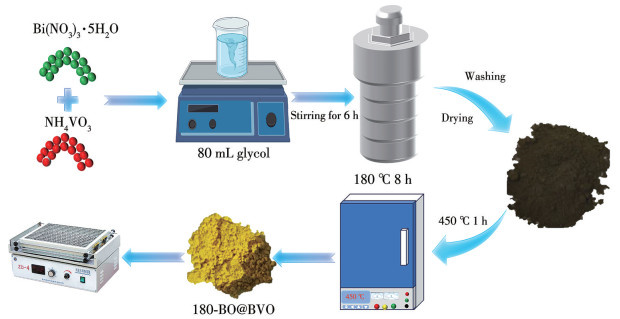
Scheme 1.
Schematic diagram of the synthesis of 180-BO@BVO

In-situ synthesis of Bi2O3@BiVO4 composite via solvothermal method and its adsorption performance for rhodamine B in water
Xian XIA , Qin SHI , Wanyi SU , Qingjun XUE , Honghui PAN , Xixiang LIU , Chuanqi ZHAO


The accelerated process of industrialization has resulted in increasingly severe pollution from organic dye wastewater. Rhodamine B (RhB), a representative cationic azo dye, poses a significant threat to both the ecosystem and human health due to its high color intensity, potent biotoxicity, and resistance to photodegradation[1-2]. In recent years, research on dye adsorption has garnered widespread attention, with a focus on developing efficient and environmentally friendly adsorbent materials. For instance, natural polymer materials (such as chitosan[3]) and synthetic materials [such as metal-organic frameworks (MOFs)[4]] have shown significant effects in dye adsorption. Usman et al.[5] successfully synthesized a novel adsorbent, NTA-β-CD-CS, by integrating the encapsulation ability of β-CD with the functional group adsorption capacity of chitosan. This resulted in efficient simultaneous removal of heavy metals and organic dyes, good reusability, and provided a feasible solution for complex industrial wastewater treatment. Vargas et al.[6] used activated carbon prepared from flame tree pods to study its adsorption behavior towards three food dyes (acid yellow 6, acid yellow 23, and acid red 18), and detailed the adsorption performance through various isothermal and kinetic models. Yang et al.[7] fabricated a composite by in-situ growth of Zr-based MOFs onto modified cellulose sponges. The resulting composite demonstrated excellent performance in removing organic dyes from complex wastewater. Moreover, many studies have explored the kinetics and thermodynamics of the dye adsorption process[8].
It is worth noting that bismuth vanadate (BiVO4), as a photocatalytic material, is widely used for dye degradation due to its excellent photocatalytic performance. Under visible light irradiation, it can excite electrons, generating highly oxidative free radicals that effectively degrade organic dyes in water[9]. For instance, Rajkumar et al.[10] hydrothermally synthesized BiVO4-MoS2 nanocomposites for RhB dye degradation and achieved 96.5% RhB degradation under sunlight in 45 min. Narzary et al.[11] developed an oxygen vacancy mediated Zn3V2O8/BiVO4 heterojunction at a 2∶1 molar ratio using the hydrothermal method and achieved 83.7% and 95.03% degradation of Congo red (CR) dye within 120 min under visible light and direct sunlight. Although these studies have demonstrated significant advancements in photocatalytic degradation, the adsorption behavior of BiVO4, as a prerequisite and important step for photocatalytic reactions, has not been sufficiently studied, so its comprehensive application in dye wastewater treatment remains to be further explored.
It is found that oxygen vacancies are crucial for the adsorption behavior of pollutants on the surface of BiVO4. Ma et al.[12] revealed that the creation of surface oxygen vacancies greatly shifted the d-band center of BiVO4 and increased the adsorption energy of methylene blue (MB) on the BiVO4 (010) surface. This phenomenon indicates that the surface oxygen-deficient BiVO4 is more favorable for the adsorption of dye molecules. The dye adsorption performance of BiVO4 can be enhanced by regulating the concentration of oxygen vacancies. In terms of improving adsorption efficiency and multifunctionality, the composite of BiVO4 with other materials (such as MOFs, graphene, tungsten oxide) has shown significant potential[13-14]. Current research has made important progress by using a heterogeneous structure strategy to composite BiVO4 with Bi2O3. Jiang et al.[15] synthesized BiVO4/Bi2O3 composites using a homogeneous precipitation method and systematically studied the role of surface dispersants in regulating the morphology of BiVO4 and its visible-light photocatalytic performance, confirming its high-efficiency degradation of RhB under visible light. Lopes et al.[16] proposed a new strategy based on solubility differences, where BiVO4 nanoparticles were grown on the surface of Bi2O3 to construct a heterogeneous structure, and systematically explored the significant improvement of this structure on visible-light photocatalytic performance. Obviously, existing research mainly focuses on optimizing the photocatalytic degradation performance of Bi2O3/BiVO4 composites by regulating composite ratios and preparation processes. However, the adsorption behavior of Bi2O3/BiVO4 has not attracted the attention of researchers. To expand the photocatalytic performance of Bi2O3/BiVO4 in removing environmental pollutants, it is imperative to develop efficient ways to engineer its adsorption performance and understand the underlying mechanism.
We employed a solvothermal method to synthesize Bi2O3@BiVO4 composites with abundant surface oxygen vacancies by regulating the reaction temperature. The in situ growth of Bi2O3 induced the formation of oxygen vacancies in BiVO4, significantly enhancing the adsorption performance for RhB. The mechanism of the enhancement is the specific interaction between RhB molecules and the surface oxygen vacancies of the material, along with electrostatic interactions at the interface. Further studies indicated that parameters such as solution pH, pollutant mass concentration, and temperature have a significant impact on the adsorption process, with the pseudo-second-order kinetic model effectively describing the adsorption behavior. This study not only provides new insights for optimizing the design of traditional photocatalysts but also offers valuable new materials for the removal of cationic dyes.
Ethylene glycol was purchased from Aladdin Bio-Chem Technology Co., Ltd. Bismuth nitrate pentahydrate (Bi(NO3)3·5H2O) was purchased from Xilong Scientific Co., Ltd. RhB, MB, crystal violet (CV), CR, methyl orange (MO), titanium dioxide (TiO2), tungsten trioxide (WO3), and ammonium metavanadate (NH4VO3) were all purchased from Shanghai Macklin Biochemical Technology Co., Ltd. All chemicals used in the experiments are of analytical grade.
Bi2O3@BiVO4 composites were synthesized using a solvothermal method. As shown in Scheme 1, 8 mmol of Bi(NO3)3·5H2O and 8 mmol of NH4VO3 were dissolved in ethylene glycol and stirred continuously until fully dissolved, yielding a yellow precursor solution. Then, 60 mL of the precursor solution was transferred to a Teflon-lined high-pressure reactor and reacted for 8 h at 120, 150, 180, and 220 ℃, respectively. After the obtained product was centrifuged, the precipitate was washed three times with anhydrous ethanol and ultrapure water, respectively. The washed product was then dried at 60 ℃ to obtain the precursor powder. This powder was heated to 450 ℃ at a heating rate of 5 ℃·min-1, held for 1 h, and then cooled to room temperature, yielding composites synthesized at different reaction temperatures. The resulting samples were labeled as 120-BO@BVO, 150-BO@BVO, 180-BO@ BVO, and 220-BO@BVO.
The crystallographic structure of the samples was characterized using an X-ray diffractometer (XRD, Rigaku SmartLab SE) with the following experimental conditions: Cu Kα radiation λ=0.154 06 nm at an operating voltage of 40 kV and a current of 40 mA, with a 2θ scanning range of 5°-90° and a scanning rate of 2 (°)·min-1. The chemical state and valence state of the surface elements were analyzed using X-ray photoelectron spectroscopy (XPS, Thermo Scientific K-Alpha), with a monochromatic Al Kα radiation source (hν= 1 486.6 eV). The binding energy was calibrated using the carbon C1s peak (284.8 eV) as a reference. The morphology of the materials was observed using a scanning electron microscope (SEM, TESCAN MIRA LMS) and a transmission electron microscope (TEM, JEOL JEM-F200, acceleration voltage 200 kV). Molecular functional group information was collected using a Fourier-transform infrared spectrometer (FTIR, Thermo Scientific Nicolet iN10) with a spectral resolution of 4 cm-1 and a scan range of 400-4 000 cm-1. The specific surface area and pore structure parameters were measured using a fully automatic surface area and porosity analyzer (Brunauer-Emmett-Teller, BET, Micromeritics ASAP 2460). The surface potential (ζ potential) was determined using a laser particle size-ζ potential system (Malvern Zetasizer Pro). Electron paramagnetic resonance (EPR) spectroscopy (Bruker EMXplus-6/1) was employed to detect and analyze the oxygen vacancies in the samples.
The adsorption experiment procedure was as follows: 100 mg of Bi2O3@BiVO4 adsorbent was dispersed into 100 mL of RhB solution (10 mg·L-1) in a conical flask, and dark adsorption was conducted in a constant-temperature shaker at 25, 30, 35, 40, and 45 ℃. Solution samples were collected at 5, 10, 15, 20, 25, 30, 60, 90, and 120 min for subsequent analysis. After rapid solid-liquid phase separation was performed using a 0.45 μm microporous filter membrane, the residual RhB mass concentration was quantitatively analyzed using an ultraviolet-visible spectroscopy spectrophotometer (UV-Vis, Shimadzu UV-3600 Plus, λ=554 nm). In the adsorption cycle experiment, the used 180-BO@BVO powder samples were collected and subjected to ultrasonic treatment for 30 min in ethanol solution. After thorough washing and drying in a 70 ℃ oven for 10 h, the samples were reused in subsequent adsorption cycles to evaluate their recyclability[17]. The dye adsorption amount and dye removal rate (R, %) were calculated using formulas 1-3[18-19].
|
|
(1) |
|
|
(2) |
|
|
(3) |
where qt and ρt represent the adsorption capacity (mg·g-1) and RhB mass concentration (mg·L-1) at time t, respectively; ρ0 is the initial mass concentration of the RhB solution (mg·L-1); qe and ρe are the equilibrium adsorption capacity (mg·g-1) of the dye and the equilibrium mass concentration of the RhB solution (mg·L-1), respectively; m (mg) and V (mL) are the mass of the adsorbent and the volume of the RhB solution, respectively.
The adsorption kinetics of RhB onto the Bi2O3@ BiVO4 composite were analyzed using the pseudo-first-order (PFO) kinetic model (Eq.4), and the pseudo-second-order (PSO) kinetic model (Eq.5). The Weber-Morris intraparticle diffusion (IPD) model (Eq.6) was applied to elucidate the mass transfer mechanism of RhB in the Bi2O3@BiVO4 composite[20-21].
|
|
(4) |
|
|
(5) |
|
|
(6) |
where k1 (min-1) and k2 (g·mg-1·min-1) are the rate constants; kdi (mg·g-1·min-1/2) and C (mg·g-1) are the IPD constant and the intercept at different stages, respectively.
The adsorption equilibrium isotherms and their fitting parameters were used to elucidate the adsorption mechanism. The adsorption equilibrium data were fitted using the Langmuir isotherm model (Eq.7) and the Freundlich isotherm model (Eq.8)[22].
|
|
(7) |
|
|
(8) |
where qm (mg·g-1) is the maximum adsorption capacity of the adsorbent; KL (L·mg-1) is the Langmuir constant; KF (
The effect of temperature on the adsorption of RhB by Bi2O3@BiVO4 was explored by studying the standard free energy (ΔG⊖) (Eq.9), standard enthalpy (ΔH⊖), and standard entropy (ΔS⊖) (Eq.10 and 11). The thermodynamic parameters of adsorption were calculated using the following formulas 9-12[23-24].
|
|
(9) |
|
|
(10) |
|
|
(11) |
|
|
(12) |
where T is the absolute temperature, R is the gas constant (8.314 J·K-1·mol-1), M (g·mol-1) is the molar mass of RhB, Ka is the dimensionless adsorption equilibrium constant converted from KL (Eq.12), and KL can be calculated using Eq.7.
In this study, a temperature gradient control strategy of the solvothermal process was employed to successfully construct Bi2O3@BiVO4 composites with a high concentration of oxygen vacancies. SEM analysis revealed the temperature-dependent morphological evolution pattern: in the low-temperature of 120 and 150 ℃, the material formed a nanoparticle assembly with a multi-level pore structure, showing good geometric continuity (Fig.1a, 1b)[25]; when the temperature rose to 180 ℃, the high surface energy drove small particles to migrate and fuse, evolving into a spherical structure with closely packed submicron cubes (Fig.1c)[26-27]. Further increasing the temperature to 220 ℃, the Ostwald ripening effect dominated crystal boundary relaxation (Fig.1d)[28]. These observations indicate that the solvothermal temperature has a significant impact on the morphology of Bi2O3@BiVO4. Fig.1e shows the XRD patterns of Bi2O3@BiVO4 composites prepared at different solvothermal temperatures. The 120-BO@BVO sample exhibited characteristic diffraction peaks of the monoclinic scheelite BiVO4 structure, with main peaks at 18.8° (011), 28.9° (121), and 30.5° (040) crystal planes (PDF No.14-0688)[29]. As the solvothermal temperature increased, the XRD of 150-BO@BVO detected the characteristic peak of α-Bi2O3 (012) at 28.0°. When the temperature further rose to 180 and 220 ℃, the characteristic diffraction peaks of α-Bi2O3 were clearly observed at 26.9° (111) and 28.0° (012) crystal planes (PDF No.41-1449)[30]. These results indicate that by regulating the solvothermal temperature, the Bi2O3@ BiVO4 composite can be controllably synthesized.
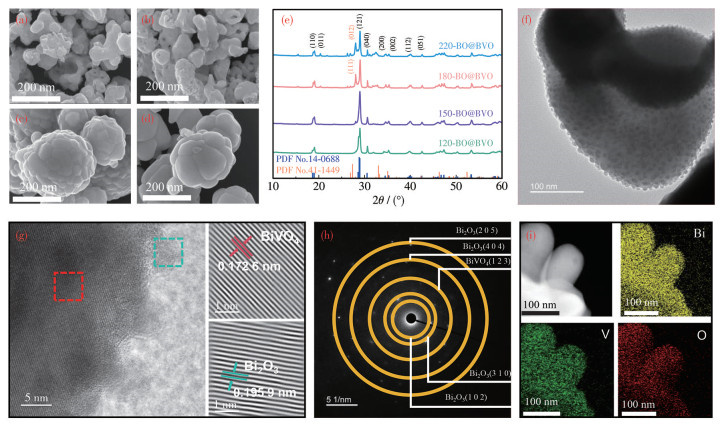
Fig. 1f shows that 180-BO@BVO were composed of a large number of nanoparticle assemblies. The size distribution analysis of the TEM image (Fig.S1, Supporting information) indicates that the average nanoparticle size was 7 nm. The high-resolution TEM (HRTEM) image of 180-BO@BVO (Fig. 1g) reveals multi-directional lattice fringes, with an inner 0.172 6 nm interplanar spacing corresponding to the (222) crystal plane of the monoclinic BiVO4 phase, and an outer 0.195 9 nm spacing attributed to the (041) crystal plane of α-Bi2O3[31-32]. The selected area electron diffraction (SAED) pattern of 180-BO@BVO (Fig. 1h) showed a typical polycrystalline diffraction pattern, with discrete diffraction spots arranged in concentric rings. The calibration confirmed that the significant diffraction spots originate from the (123) crystal plane of BiVO4 (PDF No.14-0688) and the (310), (102), (404), and (205) crystal planes of α-Bi2O3 (PDF No.41-1499), further confirming the coexistence of BiVO4 and Bi2O3. The energy dispersive X-ray spectroscopy (EDS) elemental mapping results in Fig. 1i showed that the distributions of Bi, O, and V elements were highly uniform, with no segregation phenomenon[33]. It is inferred that the synthesis process of the Bi2O3@BiVO4 composite primarily involves: under solvothermal conditions, Bi3+ in the solution reacted with vanadate ions (VO3-) to form BiVO4 (Eq.13)[34]. At the same time, ethylene glycol was oxidized during the reaction to generate oxalate ions (C2O42-), which subsequently combined with Bi3+ and OH- in the solution to form a Bi(OH)C2O4 intermediate through co-precipitation (Eq.14). Bi(OH)C2O4 then underwent thermal decomposition to convert into Bi2O3 (Eq.15)[35]. Through this series of continuous reactions, the Bi2O3@BiVO4 composite was successfully synthesized.
|
|
(13) |
|
|
(14) |
|
|
(15) |
Fig.S2a shows the XPS survey spectra, confirming that all samples exhibited characteristic peaks of Bi, V, O, and C on their surfaces, indicating that the main elements are Bi, V, and O. Additionally, the C1s peak shows no shift (Fig.S2b), ruling out instrument error. Notably, as the solvothermal temperature increased, the Bi4f and V2p spectral characteristic peaks shifted towards higher binding energies, which is attributed to the formation of Bi2O3@BiVO4 composites. At the interface between Bi2O3 and BiVO4, electrons transfer from BiVO4 to Bi2O3, leading to a decrease in the electronic density of Bi/V atoms in the BiVO4 lattice, causing the binding energy to shift towards higher energy[36]. The Bi4f spectra (Fig.2a) exhibited a double peak at 158.97 eV (Bi4f7/2) and 164.27 eV (Bi4f5/2) with a ΔE (binding energy splitting) of 5.3 eV, indicating that all samples have Bi in the Bi3+ oxidation state[37]. The main peak of the V2p spectra (Fig.2b) appeared at 516.5 eV (V2p3/2) and 523.8 eV (V2p1/2), which is attributed to V5+[38]. It was observed that for 150-BO@BVO, 180-BO@BVO, and 220-BO@BVO, a weak peak appeared at 515.2 eV in the V2p spectrum, indicating that increasing the temperature can induce the formation of V4+ species. This phenomenon is closely related to the charge compensation mechanism induced by oxygen vacancies[39].
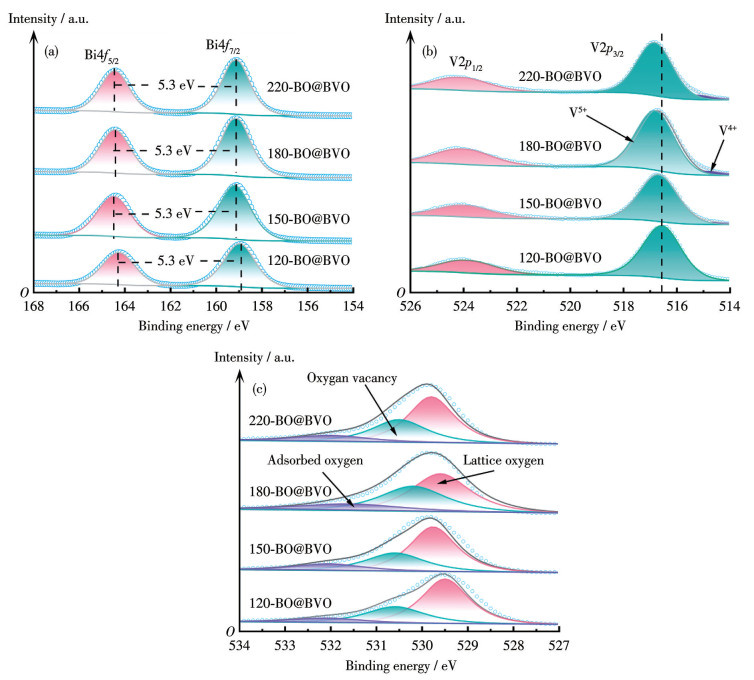
Fig.2c shows the O1s spectra of all the samples. Through peak fitting, it can be observed that the O1s characteristic peak could be divided into three components: the main peak at 529.6 eV corresponds to lattice oxygen, the sub-peak at 530.6 eV corresponds to surface oxygen vacancies[40], and the characteristic peak at 532.1 eV is attributed to surface chemisorbed oxygen[41-42]. Notably, the oxygen vacancy characteristic peak and the presence of V4+ confirm the existence of oxygen vacancy structures in the material system. Comparing the peak area ratio of the oxygen vacancy characteristic peaks for different samples, the trend of oxygen vacancy content was found to be 180-BO@ BVO (12.9%)>220-BO@BVO (12.1%)>150-BO@BVO (10.4%)>120-BO@BVO (9.8%). It can be seen that a temperature of 180 ℃ induces the highest concentration of oxygen defects. These findings suggest that oxygen vacancies are formed via the reduction of V5+ to V4+ during the hydrothermal process. The reducing agent C2O42-, which formed ethylene glycol, also facilitated the reduction of V5+ to V4+. This redox reaction is thermodynamically favorable under hydrothermal conditions, promoting the simultaneous generation of oxygen vacancies.
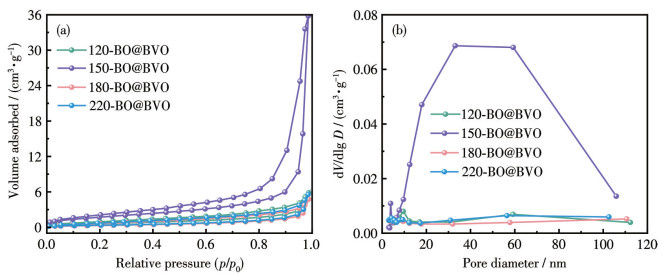
Fig.3 shows the N2 adsorption-desorption isotherms and pore size distributions of Bi2O3@BiVO4. The Bi2O3@BiVO4 samples follow type Ⅳ isotherms with H3-type hysteresis loops, indicating the presence of mesoporous structures[43-44]. Pore size distribution analysis (Fig.3b) showed that the pore sizes of all samples were concentrated below 10 nm, in line with the classification standard for mesoporous materials (2-50 nm). The mesoporous structure mainly results from the gaps formed by the stacking of nanoparticles during the crystallization process[45]. The pore volume, specific surface area (SBET), and average pore size of each sample are shown in Table 1. The specific surface areas of 120-BO@BVO, 150-BO@BVO, 180-BO@BVO, and 220-BO@BVO were 2, 7, 1, and 1 m2·g-1, respectively. The specific surface area of 150-BO@BVO was significantly higher than that of the other samples. At low temperatures (120 ℃), the precursor crystallization driving force was insufficient, leading to particle agglomeration or a more compact structure, resulting in a small specific surface area. When the temperature was increased to 150 ℃, the solvation ability of ethylene glycol and the reaction activity were moderate, which also inhibited excessive particle growth, forming a loose and porous structure that increased the specific surface area. However, at higher temperatures (180 and 220 ℃), rapid grain growth, increased agglomeration, or collapse of the pore structure occurred, leading to an increase in material densification and a decrease in the specific surface area[46].

 下载:
导出CSV
下载:
导出CSV
| Sample | SBET / (m2·g-1) | Pore volume / (cm3·g-1) | Average pore size / nm |
| 120-BO@BVO | 2 | 0.009 04 | 15.52 |
| 150-BO@BVO | 7 | 0.055 36 | 33.21 |
| 180-BO@BVO | 1 | 0.007 32 | 24.14 |
| 220-BO@BVO | 1 | 0.008 61 | 24.85 |
The adsorption performance of Bi2O3@BiVO4 prepared at different solvothermal temperatures for RhB was studied. As shown in Fig.4a, 120-BO@BVO exhibited a low removal efficiency of only 18.2%, demonstrating weak adsorption ability. When the solvothermal temperature was increased to 150 ℃, the adsorption performance significantly improved, and the removal efficiency reached 65.4%. Notably, 180-BO@BVO demonstrated the best adsorption performance, with a removal efficiency of 83.0%, which was higher than that of 220-BO@BVO (69.3%). Therefore, 180-BO@BVO was selected as the optimal adsorbent for subsequent adsorption experiments. Note that, although 150-BO@ BVO had the largest specific surface area (Table 1), its adsorption effect on RhB was inferior to that of 180-BO@BVO, suggesting that the increase in specific surface area is not the dominant factor for the enhanced adsorption performance of 180-BO@BVO. Based on the XPS analysis results in Fig.2, it can be speculated that the enhanced adsorption performance of 180-BO@BVO is due to the increased surface oxygen vacancies, which strengthen its chemical adsorption of RhB[47]. Furthermore, as shown in Fig.4b, several common photocatalytic materials were compared with 180-BO@ BVO for RhB adsorption. The results indicate that the adsorption capacity of 180-BO@BVO for RhB was more than four times higher than that of BiVO4, TiO2, and WO3. These demonstrate that constructing the Bi2O3@BiVO4 heterostructure significantly enhances the adsorption performance. To further investigate the broad-spectrum adsorption performance of 180-BO@ BVO, four types of representative pollutants were selected for the same adsorption experiments, including diclofenac (DCF), tetracycline hydrochloride (TC), ammonia nitrogen (NH3-N), and norfloxacin (NOR). As shown in Fig.S3, the adsorption performance of 180-BO@BVO for the four types of pollutants varied significantly. It exhibited good adsorption performance for NH3-N and DCF, with removal efficiencies of 65.3% and 60.0%, respectively. However, the adsorption removal efficiencies for TC and NOR were relatively poor, at only 41.2% and 15.3%, respectively. Clearly, 180-BO@BVO is more suitable for removing positively charged or small neutral molecules, while its adsorption performance for large, negatively charged antibiotics is poor, which can be attributed to its lower specific surface area.
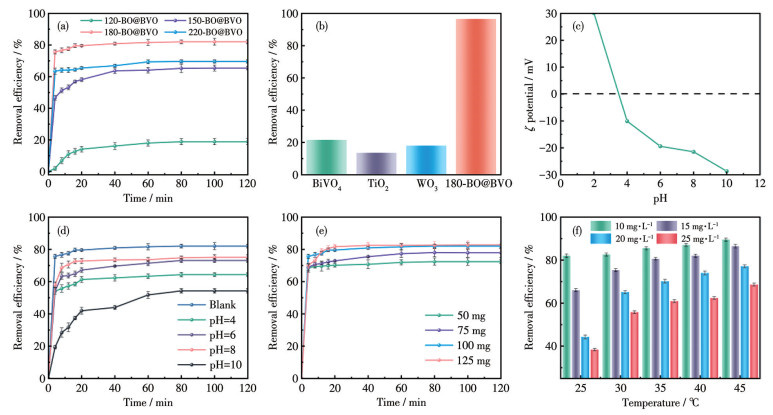
a-d: 100 mg of adsorbent was added to 100 mL of dye solution with an initial concentration of 10 mg·L-1, and the adsorption was conducted at room temperature (25 ℃) for 120 min; e, f: the other experimental conditions were identical to those in a-c, except for changing the adsorbent dosage or initial RhB mass concentration.
The point of zero charge (pHpzc) of an adsorbent is a key parameter for analyzing the charge behavior of the solid-liquid interface, which directly affects the environmental response characteristics of the adsorption process. The pHpzc value of 180-BO@BVO was measured to be 3.5 (Fig.4c). When the solution pH was below 3.5, the surface of 180-BO@BVO carried a positive charge. Conversely, at pH values above 3.5, it carried a negative charge. Utilizing this charge characteristic, this study investigated the effect of pH on the adsorption of RhB (Fig.4d). The experimental results showed that under conditions where pH≥4, the surface of 180-BO@BVO consistently carried a negative charge, allowing efficient adsorption of the cationic RhB dye through electrostatic attraction. The removal efficiency could reach 82.0% when the pH was unadjusted (initial pH=6.83)[48]. Notably, when the solution pH was further increased (pH=8 and 10), the RhB molecules underwent protonation equilibrium shift, forming zwitterionic states, which led to molecular aggregation and ultimately resulted in a decrease in adsorption performance[49]. To further verify the electrostatic adsorption mechanism of 180-BO@BVO for dyes, adsorption experiments were conducted with various ionic dyes, including cationic dyes such as MB and CV, as well as anionic dyes like MO and CR. The results are shown in Fig.S4. It can be seen that the adsorption removal efficiencies of MB and CV by 180-BO@BVO were 69.2% and 92.2%, respectively, which were higher than those of MO and CR (12.1% and 10.3%). This difference indicated that 180-BO@BVO exhibited stronger selective adsorption for cationic dyes. Its negatively charged surface can significantly promote the adsorption process by forming electrostatic interactions with cationic dyes, which serve as a key driving force for adsorption.
To investigate the effect of the 180-BO@BVO dosage on RhB adsorption performance, the removal efficiency was examined under various dosages ranging from 50 to 125 mg (Fig.4e). The results showed that at a dosage of 50 mg, the RhB removal efficiency after 120 min was 72.3%, and the adsorption process reached equilibrium after 60 min. When the dosage was increased to 75 mg, the removal efficiency increased to 77.8%. Further increasing the dosage to 100 mg significantly improved the removal efficiency to 83.0%, indicating that the dosage range of 50-100 mg has a significant effect on adsorption efficiency. Within this range, increasing the dosage helps to improve the adsorption efficiency. Moreover, for the 100 mg dosage group, a rapid adsorption kinetic characteristic was observed between 0-40 min, which can be attributed to the ample active sites provided by the higher dosage, facilitating the efficient adsorption of RhB molecules[50-51]. It is worth noting that further increasing the dosage to 125 mg did not significantly improve the removal efficiency, possibly due to the poor dispersion of 180-BO@BVO in the solution at higher dosages, leading to particle agglomeration and reducing the exposure of effective active sites.
Fig. 4f investigates the effect of solution temperature (25-45 ℃) and initial RhB mass concentration (10-25 mg·L-1) on the adsorption performance of 180-BO@BVO. At the same initial RhB mass concentration, as the temperature increased from 25 to 45 ℃, the RhB removal efficiency increased from 82.0% to 89.5%. This indicates that increasing the temperature has a significant impact on the adsorption performance of 180-BO@BVO. According to thermodynamic calculations discussed in the later section, it can be that ΔH⊖>0, suggesting that this adsorption process is endothermic, and the adsorption efficiency of the endothermic reaction increases with temperature[52]. In the initial RhB mass concentration gradient experiment (Fig. 4f), when at the same temperature, as the initial RhB mass concentration increased, the removal efficiency gradually decreased. However, when the initial RhB mass concentrations were 10, 15, 20, and 25 mg·L-1 at 25 ℃, the equilibrium adsorption capacities of 180-BO@BVO were 7.2, 7.4, 7.8, and 8.0 mg·g-1, respectively. The equilibrium adsorption capacity slightly increased with the initial mass concentration. Clearly, as the RhB mass concentration increases, the driving force increases, causing more RhB molecules to transfer from the liquid phase to the adsorbent surface and occupy remaining adsorption sites, thereby increasing the equilibrium adsorption capacity. The decrease in removal efficiency is primarily due to the insufficient adsorption sites on 180-BO@BVO to adsorb a large number of RhB molecules. Even when the adsorbent becomes saturated, many RhB molecules remain in the solution, leading to a reduction in the removal efficiency[53].
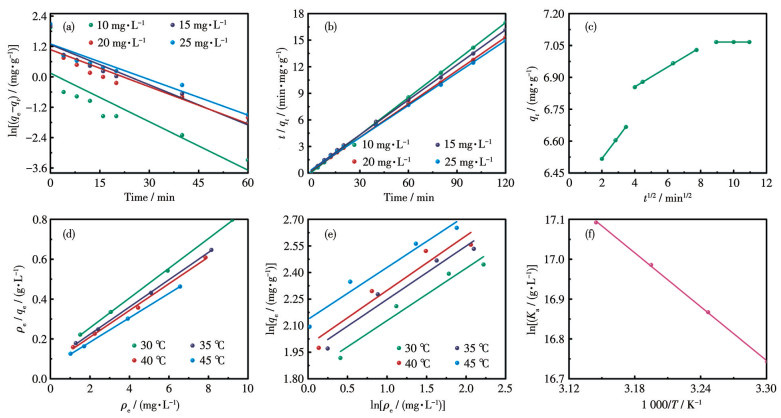
The control mechanism of RhB adsorption by 180-BO@BVO was revealed through kinetic modeling. Based on the adsorption data from Fig.4e, PFO, PSO, and IPD models were established to analyze the interfacial process (Fig.5a, 5b), with the relevant fitting parameters shown in Table 2. Among them, the PSO model exhibited the best fitting quality (R2=0.999 9), and the theoretical adsorption capacity (qe, cal=7.095 7 mg·g-1) showed a relative deviation of only 0.8% from the experimental equilibrium adsorption capacity (qe, exp=7.066 2 mg·g-1), indicating that chemical adsorption dominates the process[54]. The IPD model, based on the Weber-Morris theory, decoupled the multiscale mass transfer process (Fig.5c). The entire adsorption process could be divided into three stages: in the initial stage, RhB molecules rapidly diffuse from the bulk solution to the liquid film layer on the surface of the adsorbent, with a rate constant of kd1=0.10, exhibiting efficient membrane diffusion characteristics; in the intermediate stage, the diffusion process shifts to the slow migration of RhB molecules within the adsorbent particles, with the rate constant decreasing to kd2=0.04, where the diffusion resistance significantly increases, becoming the limiting factor of the entire adsorption rate; in the final stage, the system reaches dynamic adsorption equilibrium, with a rate constant kd3=0, and RhB molecules have largely occupied the active sites on the 180-BO@BVO adsorbent, leading to equilibrium between adsorption and desorption[55]. It is worth noting that the fitting curve did not pass through the origin, which indicates that, in addition to IPD, interfacial chemical reactions, surface adsorption, and other mechanisms also influence the adsorption process, suggesting that RhB adsorption in this system is typically regulated by multiple factors working synergistically[56].
 下载:
导出CSV
下载:
导出CSV
| Dosage / (mg·L-1) |
PFO | PSO | ||||||
| qe, exp / (mg·g-1) | qe, cal / (mg·g-1) | k1 / min-1 | R2 | qe, cal / (mg·g-1) | k2 / (g·mg-1·min-1) | R2 | ||
| 10 | 7.066 2 | 1.156 6 | 0.063 9 | 0.672 2 | 7.095 7 | 0.279 3 | 0.999 5 | |
| 15 | 7.415 7 | 3.580 9 | 0.053 0 | 0.899 6 | 7.586 7 | 0.048 9 | 0.999 2 | |
| 20 | 7.702 9 | 2.932 4 | 0.048 8 | 0.802 3 | 7.951 7 | 0.063 6 | 0.999 5 | |
| 25 | 8.027 5 | 3.668 0 | 0.046 8 | 0.852 5 | 8.209 5 | 0.042 9 | 0.998 8 | |
RhB adsorption experiments were conducted on 180-BO@BVO at different temperatures, and the results were fitted using the Langmuir and Freundlich adsorption isotherm models (Fig.5d, 5e), with the relevant parameters listed in Table 3. It could be seen that the Langmuir model showed a higher linear correlation, significantly outperforming the Freundlich model. This characteristic indicates that the adsorption of RhB on the surface of 180-BO@BVO follows a monolayer adsorption mechanism, where the adsorption sites are uniformly distributed on the material surface, and there are no lateral interactions between molecules[57]. Furthermore, the calculated maximum adsorption capacity (qm) was in good agreement with the experimental data (qe) (Table S1). For the thermodynamic properties of RhB adsorption on 180-BO@BVO, the key thermodynamic parameters of the adsorption process were determined through the derivation of Eq.9, 10, and 11, providing a quantitative basis for revealing the adsorption mechanism. As shown in Fig.5f, the linear fit between ln Ka and 1 000/T was obtained. Based on the slope and intercept of the fitted line, the values of ΔH⊖, ΔS⊖, and ΔG⊖ were calculated, and the results are shown in Table 4. Among them, the ΔG⊖ values were negative, and their absolute values increased with temperature, indicating that the adsorption of RhB on 180-BO@BVO is a spontaneous and thermodynamically favorable process[58], further confirming that the adsorption reaction of RhB on 180-BO@BVO is an endothermic reaction, which was consistent with the experimental results.
下载:
导出CSV
| T / ℃ | Langmuir model | Freundlich model | |||||
| qm / (mg·g-1) | KL / (L·mg-1) | R2 | KF / |
1/n | R2 | ||
| 30 | 13.388 7 | 0.702 6 | 0.999 4 | 6.252 4 | 0.295 6 | 0.942 2 | |
| 35 | 14.596 4 | 0.795 6 | 0.999 4 | 7.004 4 | 0.301 3 | 0.923 5 | |
| 40 | 14.916 5 | 0.895 8 | 0.995 4 | 7.315 1 | 0.308 9 | 0.887 1 | |
| 45 | 16.345 2 | 0.996 6 | 0.999 6 | 8.462 0 | 0.293 0 | 0.941 0 | |
下载:
导出CSV
| T / ℃ | ΔG⊖ / (kJ·mol-1) | ΔH⊖ / (kJ·mol-1) | ΔS⊖ / (kJ·mol-1·K-1) |
| 30 | -42.18 | 18.71 | 0.20 |
| 35 | -43.19 | ||
| 40 | -44.20 | ||
| 45 | -45.18 |
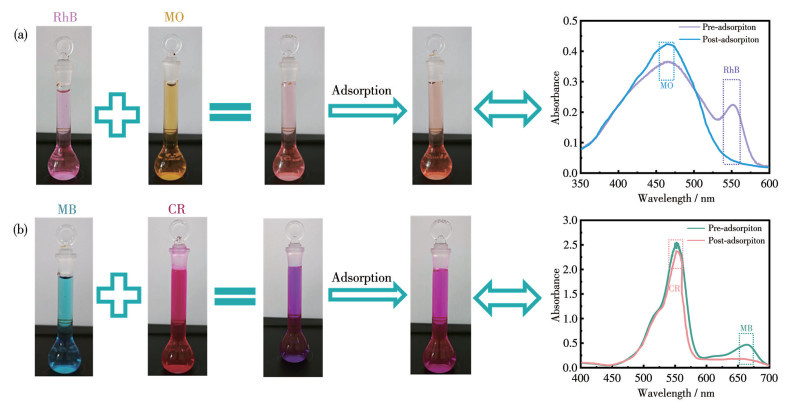
To further confirm the selective adsorption of cationic dyes by 180-BO@BVO, adsorption experiments were conducted on a mixed solution of cationic and anionic dyes. The dye combinations of RhB+MO and MB+CR were selected for the selective adsorption experiments. A 100 mL mixed solution was prepared by mixing the cationic dye (RhB, 10 mg·L-1) and anionic dye (MO, 10 mg·L-1) at a volume ratio of 1∶1, then treated with 100 mg of 180-BO@BVO for 120 min. The UV-Vis spectra of the resulting solutions were recorded and are presented in Fig.6a and 6b. As shown in Fig.6a, the RhB+MO mixed solution appeared orange-red (with RhB being purplish-red and MO being orange). After adsorption by 180-BO@BVO, the solution turned orange. This phenomenon indicates that RhB was almost completely adsorbed by the adsorbent, with only MO remaining in the solution. The UV-Vis spectra also confirmed this. After adsorption, the absorption peak at 554 nm corresponding to RhB disappeared, while the absorption peak at 464 nm attributed to MO remained unchanged (Fig.6a). To further verify this, the same treatment was applied to other mixed systems containing one cationic dye and one anionic dye, and similar results were observed. For instance, the MB+CR mixed solution changed from purple to deep red after adsorption (Fig.6b), and its UV-Vis spectral results were consistent with the color change: the characteristic absorption peak for MB at 668 nm disappeared, while the characteristic absorption peak for CR at 490 nm remained unchanged. The above results show that 180-BO@BVO has excellent selective adsorption performance for cationic dyes.
As shown in Fig.7a, after five cycles, the RhB removal efficiency by 180-BO@BVO remained above 80%, indicating good stability and repeatability. The XPS spectra of 180-BO@BVO before and after adsorption in Fig.S5 revealed that the valence states of Bi, V, and O did not undergo significant shifts or changes. This strongly indicates that 180-BO@BVO maintains excellent chemical stability during the adsorption process. Fig.7b shows the FTIR spectra of 180-BO@BVO before and after RhB adsorption. The peak at 3 437 cm-1 corresponds to the assigned to OH- stretching vibrations of the hydroxyl groups, signifying O—H stretching modes of surface adsorbed water molecules or hydroxyl groups, and indicates the presence of adsorbed water molecules on the 180-BO@BVO[59]. After adsorption, the O—H peak became significantly weaker, suggesting that the surface O—H groups of 180-BO@BVO were reduced by the adsorbed RhB during the process[60]. These results suggest that RhB regulates the surface chemical environment of oxygen vacancies of 180-BO@BVO through competitive adsorption and coordination interactions. To further verify the existence of oxygen vacancies in 180-BO@ BVO, EPR spectroscopy was employed to detect unpaired electrons associated with oxygen vacancies. As shown in Fig.7c, a distinct oxygen vacancy signal appears at g=2.003 for 180-BO@BVO[61]. Together with the data in Fig.2, the presence of oxygen vacancies in 180-BO@BVO was confirmed.
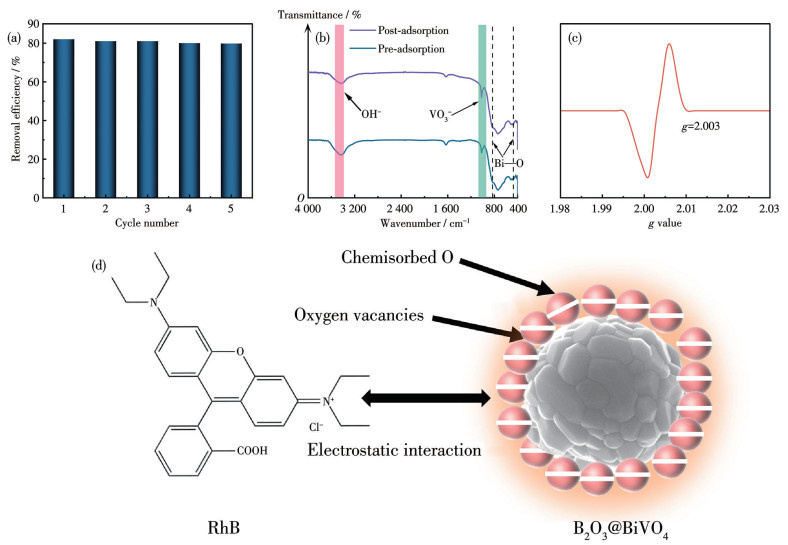
In summary, the adsorption mechanism of 180-BO@BVO is derived as shown in Fig.7d. Firstly, during the solvothermal process, Bi2O3 was in situ grown on the surface of BiVO4, and a large number of oxygen vacancies were formed at the interface due to the reduction of V5+ to V4+[62]. The oxygen vacancies on the 180-BO@BVO surface play a key role in the adsorption of RhB molecules. These vacancies can adsorb adventitious oxygen species (including both free and combined oxygen) at the vacancy sites. Due to the strong electronegativity of the adsorbed oxygen species, they tend to attract electrons, thereby acquiring a negative charge (Fig.4c)[12]. As a result, under neutral conditions, the cationic dye RhB molecules were readily adsorbed onto the 180-BO@BVO surface via electrostatic attraction. This leads to a weakening of the OH- peak in the FTIR spectra, indicating that the —OH groups are competitively adsorbed by RhB molecules. The reduction in the hydroxyl signal further confirms that cationic dye molecules preferentially occupy the negatively charged sites around oxygen vacancies, competing with the —OH groups for adsorption.
Bi2O3@BiVO4 composites with abundant oxygen vacancies were successfully prepared via a solvothermal method, and their adsorption performance and mechanism for RhB were investigated. The results show that the 180-BO@BVO composite prepared at 180 ℃ exhibited the best adsorption performance for RhB, with a removal efficiency of up to 83.0%. 180-BO@BVO achieved efficient adsorption of RhB through electrostatic interactions with the oxygen vacancies on the material surface. The adsorption process follows the Langmuir isotherm model and the PSO kinetic model, confirming that the adsorption is primarily characterized by monolayer coverage and follows a chemical adsorption mechanism. Thermodynamic analysis shows that the ΔG⊖ of the adsorption process was negative, indicating that the adsorption is thermodynamically spontaneous. After five cycles of adsorption, the RhB removal efficiency of 180-BO@BVO remained above 80%, demonstrating excellent recyclability. In summary, the Bi2O3@BiVO4 composite prepared in this study exhibits efficient and specific adsorption performance for cationic dyes, highlighting its significant practical application potential for selectively removing cationic dyes from polluted water on an industrial scale.
Supporting information is available at
PENG X, XIE S, XIONG S J, LI R, WANG P, ZHANG X M, LIU Z T, HU L S, GAO B, KELLY P, CHU P K. Ultralow-voltage hydrogen production and simultaneous rhodamine B beneficiation in neutral wastewater[J]. J. Energy Chem., 2023, 81: 574-582 doi: 10.1016/j.jechem.2023.03.022
XU T, FU L Y, LU H Y, ZHANG M Y, WANG W L, HU B N, ZHOU Y H, YU G. Electrochemical oxidation degradation of rhodamine B dye on boron-doped diamond electrode: Input mode of power attenuation[J]. J. Clean. Prod., 2023, 401: 136794 doi: 10.1016/j.jclepro.2023.136794
SU X, WANG X M, GE Z Y, BAO Z R, LIN L, CHEN Y X, DAI W N, SUN Y Y, YUAN H C, YANG W, MENG J, WANG H L, PILLAI S C. KOH-activated biochar and chitosan composites for efficient adsorption of industrial dye pollutants[J]. Chem. Eng. J., 2024, 486: 150387 doi: 10.1016/j.cej.2024.150387
PAN Y D, SANATI S, ABAZARI R Z, JANKOWSKA A, GOSCIANSKA J, SRIVASTAVA V, LASSI U, GAO J K. Vanadium- and manganese-based metal-organic frameworks for potential environmental and catalysis applications[J]. Coord. Chem. Rev., 2025, 522: 216231 doi: 10.1016/j.ccr.2024.216231
USMAN M, AHMED A, YU B, WANG S, SHEN Y Q, CONG H L. Simultaneous adsorption of heavy metals and organic dyes by β-Cyclodextrin-Chitosan based cross-linked adsorbent[J]. Carbohydr. Polym., 2021, 255: 117486 doi: 10.1016/j.carbpol.2020.117486
VARGAS A M M, CAZETTA A L, MARTINS A C, MORAES J C G, GARCIA E E, GAUZE G F, COSTA W F, ALMEIDA V C. Kinetic and equilibrium studies: Adsorption of food dyes acid yellow 6, acid yellow 23, and acid red 18 on activated carbon from flamboyant pods[J]. Chem. Eng. J., 2012, 181/182: 243-250 doi: 10.1016/j.cej.2011.11.073
YANG Y X, GUO Y F, QIU Z, GONG W H, WANG Y G, XIE Y J, XIAO Z F. In situ growth of Zr-based metal-organic frameworks on cellulose sponges for Hg2+ and methylene blue removal[J]. Carbohydr. Polym., 2024, 328: 121750 doi: 10.1016/j.carbpol.2023.121750
HUSSAIN Z, CHANG N, SUN J Q, XIANG S M, AYAZ T, ZHANG H, WANG H T. Modification of coal fly ash and its use as low-cost adsorbent for the removal of directive, acid and reactive dyes[J]. J. Hazard. Mater., 2022, 422: 126778 doi: 10.1016/j.jhazmat.2021.126778
CHENG Y, YU T, LEI X F, WANG B, MU W N, LIU X W, GUO R. Regulation of oxygen vacancy by in-situ piezoelectric synthesized BiVO4 to induce spin polarization for boosting the piezo-photocatalytic activity[J]. Chem. Eng. J., 2025, 504: 158900 doi: 10.1016/j.cej.2024.158900
RAJKUMAR S, NAGARAJAN K, PERUMALSAMY S V, CHIDAMBARAM S G T, KULANDAIVEL J. Synergistic effects of BiVO4-MoS2 nanocomposites in photocatalytic dye degradation and nonlinear optical properties[J]. Mater. Sci. Eng. B, 2026, 324: 118993 doi: 10.1016/j.mseb.2025.118993
NARZARY M, WARY R R, BRAHMA B B, KALITA P, BARUAH M B. Oxygen vacancy mediated Zn3V2O8/BiVO4 type-Ⅰ heterojunction: An efficient photocatalyst for the degradation of organic dye[J]. Colloids Surf. Physicochem. Eng. Asp., 2025, 719: 137057 doi: 10.1016/j.colsurfa.2025.137057
MA Q F, MA J Y, LU Z S, YAO K H, YI Z, WU X W, CHEN X J, YANG H. Experimental and theoretical elucidation of adsorption performance and mechanism of surface-engineered BiVO4 hollow cuboids for removing MB and other pollutants[J]. J. Mol. Liq., 2023, 373: 121234 doi: 10.1016/j.molliq.2023.121234
WANG S P, WAN K, FENG J Y, YANG Y L, WANG S C. BiVO4 photoanodes with enhanced photoelectrochemical performance: Preparation, modification and emerging applications[J]. J. Mater. Sci. Technol., 2025, 217: 182-220 doi: 10.1016/j.jmst.2024.08.014
CAO Y, TIAN Y H, HE B, QIAO Z Y, LI L Y, ZHU Y H, YANG Y K, LIU X Q. Modulating hole extraction and water oxidation kinetics in CoPi/Au/BiVO4 photoanode via strong metal-support interactions[J]. J. Energy Chem., 2025, 109: 315-324 doi: 10.1016/j.jechem.2025.05.048
JIANG H Y, DAI H X, MENG X, JI K M, ZHANG L, DENG J G. Porous olive-like BiVO4: Alcoho-hydrothermal preparation and excellent visible-light-driven photocatalytic performance for the degradation of phenol[J]. Appl. Catal. B‒Environ., 2011, 105(3/4): 326-334
LOPES O F, CARVALHO K T G, AVANSI W, RIBEIRO C. Growth of BiVO4 nanoparticles on a Bi2O3 surface: Effect of heterojunction formation on visible irradiation-driven catalytic performance[J]. J. Phys. Chem. C, 2017, 121(25): 13747-13756 doi: 10.1021/acs.jpcc.7b03340
JING S Y, CHENG Q H, LIANG H G, CHENG R L, BROUZGOU A, TSIAKARAS P. Persulfate activation over B, N co-doped carbon nanotubes encapsulated with Fe3C (Fe3C@BN-CNT-x) studied for degradation of rhodamine B[J]. Carbon, 2025, 243: 120447 doi: 10.1016/j.carbon.2025.120447
LI D, SUN L W, YANG L, LIU J, SHI L J, ZHUO L, YE T T, WANG S J. Adsorption behavior and mechanism of modified Pinus massoniana pollen microcarriers for extremely efficient and rapid adsorption of cationic methylene blue dye[J]. J. Hazard. Mater., 2024, 465: 133308 doi: 10.1016/j.jhazmat.2023.133308
DIAO Z Q, ZHANG L, LI Q, GAO X Y, GAO X, SELIEM M K, DHAOUDI F, SELLAOUI L, DENG S G, BONILLA-PETRICIOLET A, BADAWI M, LI Z C. Adsorption of food dyes from aqueous solution on a sweet potato residue-derived carbonaceous adsorbent: Analytical interpretation of adsorption mechanisms via adsorbent characterization and statistical physics modeling[J]. Chem. Eng. J., 2024, 482: 148982 doi: 10.1016/j.cej.2024.148982
PHU N A M M, WI E, JEONG G, KIM H, SINGHA N R, CHANG M. Highly efficient dye adsorption by hierarchical porous SA/PVA/ZIF-8 composite microgels prepared via microfluidics[J]. Carbohydr. Polym., 2025, 350: 123016 doi: 10.1016/j.carbpol.2024.123016
CHENG Y Z, LI A W, SHI W, ZHAO L S. Magnetic chitosan-functionalized waste carton biochar composites for efficient adsorption of anionic and cationic dyes[J]. Chem. Eng. J., 2024, 481: 148535 doi: 10.1016/j.cej.2024.148535
LI R, TANG X H, WU J L, ZHANG K, ZHANG Q N, WANG J Q, ZHENG J Y, ZHENG S R, FAN J, ZHANG W G, LI X L, CAI S L. A sulfonate-functionalized covalent organic framework for record-high adsorption and effective separation of organic dyes[J]. Chem. Eng. J., 2023, 464: 142706 doi: 10.1016/j.cej.2023.142706
WANG S M, LIU M, GE W X, JIN C, BI W T. Sustainable and efficient extraction of lignin from wood meal using a deep eutectic system and adsorption of neutral red dye with the extraction residue[J]. J. Clean. Prod., 2023, 430: 139687 doi: 10.1016/j.jclepro.2023.139687
TRAN H N, YOU S J, HOSSEINI-BANDEGHARAEI A, CHAO H P. Mistakes and inconsistencies regarding adsorption of contaminants from aqueous solutions: A critical review[J]. Water Res., 2017, 120: 88-116 doi: 10.1016/j.watres.2017.04.014
WEI P C, WEN Y, LIN K F, LI X. 2D/3D WO3/BiVO4 heterostructures for efficient photoelectrocatalytic water splitting[J]. Int. J. Hydrog. Energy, 2021, 46(54): 27506-27515 doi: 10.1016/j.ijhydene.2021.06.007
LIU S Q, TANG H L, ZHOU H, DAI G P, WANG W Q. Photocatalytic perfermance of sandwich-like BiVO4 sheets by microwave assisted synthesis[J]. Appl. Surf. Sci., 2017, 391: 542-547 doi: 10.1016/j.apsusc.2016.06.184
LU J Q, HUANG Z F, LIU Y, ZHANG C, HOU H L, HUANG A J, CHEN F. Thermodynamic ripening induced multi-modal precipitation strengthened NiTi shape memory alloys by directed energy deposition[J]. Addit. Manuf., 2024, 92: 104374
KHARATYAN T, GOPIREDDY S R, OGAWA T, KODAMA T, NISHIMOTO N, OSADA S Y K, SCHERLIESS R, URBANETZ N A. Quantitative analysis of glassy state relaxation and ostwald ripening during annealing using freeze-drying microscopy[J]. Pharmaceutics, 2022, 14(6): 1176 doi: 10.3390/pharmaceutics14061176
CHEN S, HUANG D L, DU L, LEI L, CHEN Y S, WANG G F, WANG Z W, ZHOU W, TAO J X, LI R J, ZHOU C Y. Peroxymonosulfate activation by surface-modified bismuth vanadate for ciprofloxacin abatement under visible light: Insights into the generation of singlet oxygen[J]. Chem. Eng. J., 2022, 444: 136373 doi: 10.1016/j.cej.2022.136373
PALANIMUTHU N, SUBRAMANIAM M R, AUSTERIA P M, SHARMA P K, RAMALINGAM V, PERAMAIAH K, RAMAKRISHNAN S, GU G H, YU E H, YOO D J. Surface area-enhanced cerium and sulfur-modified hierarchical bismuth oxide nanosheets for electrochemical carbon dioxide reduction to formate[J]. Small, 2024: 2400913
HUANG L, HOU D F, GAN S L, QIAO X, LI D. Multifunctional mulberry-like BiVO4-Bi2O3 p-n heterostructures with enhanced both photocatalytic reduction and oxidation activities[J]. ChemCatChem, 2021, 13(14): 3357-3367 doi: 10.1002/cctc.202100422
CORRADINI P G, BRITO J F D, BLASKIEVICZ S F, SALVATI B S, MENEZES B C E S, ZANONI M V B, MASCARO L H. Contribution of CuO on lamellar BiVO4/Bi2O3-based semiconductor for photoconversion of CO2[J]. J. Photochem. Photobiol. Chem., 2023, 444: 114901 doi: 10.1016/j.jphotochem.2023.114901
WANG X Y, YOU J H, XUE Y J, REN J L, ZHANG K D, FU B, XUE Q Z, TIAN J, ZHANG H Z. Structural regulation of three-dimensional bismuth vanadate nanochannels for excellent visible light photocatalytic nitrogen fixation[J]. Appl. Catal. B‒Environ. Energy, 2025, 363: 124817 doi: 10.1016/j.apcatb.2024.124817
PATIL S S, LEE J, KIM T, NAGAPPAGARI L R, LEE K. Controlled synthesis and structural modulation to boost intrinsic photocatalytic activity of BiVO4[J]. CrystEngComm, 2022, 24(14): 2686-2696 doi: 10.1039/D1CE01700D
MAO M M, CHEN F, ZHENG C C, NING J Q, ZHONG Y J, HU Y. Facile synthesis of porous Bi2O3-BiVO4 p-n heterojunction composite microrods with highly efficient photocatalytic degradation of phenol[J]. J. Alloys Compd., 2016, 688: 1080-1087 doi: 10.1016/j.jallcom.2016.07.128
PAN M F, GAO R, LIANG S Q, HU X C, XIE M J, CHEN W J, WANG S. Oxygen vacancies-rich bimetallic Zr/Co-UiO-66 materials for bifunctional adsorption-photodegradation of tetracycline antibiotics in water[J]. Chem. Eng. J., 2025, 517: 164397 doi: 10.1016/j.cej.2025.164397
SU W Y, LU Z Z, SHI Q, CHENG C X, LIU C X, LU C Y, XIE H X, LU B, HUANG K S, XU M, XU C Y, PAN H H, ZHAO C Q. Surface states of Mo-doped BiVO4 nanoparticle-based photoanodes for photoelectrochemical degradation of chloramphenicol[J]. ACS Appl. Nano Mater., 2024, 7(12): 14232-14241 doi: 10.1021/acsanm.4c01743
LI L Y, YANG D, ZENG J, FANG D, YI J H, HE Z L. Plasmonic Ag/Bi/BiVO4 Schottky heterojunction on flexible PDA-cotton fabric for synergistically enhanced photocatalytic oxygen evolution and recyclability[J]. Appl. Surf. Sci., 2025, 703: 163386 doi: 10.1016/j.apsusc.2025.163386
AL ABASS N, QAHTAN T F, ALHARTHI A I, ALOTAIBI M A, ALANSI A M, BUBSHAIT A, SALEH T A. Scalable ambient conditions-based fabrication of flower-like bismuth vanadate (BiVO4) film incorporating defects aimed at visible-light-induced water-splitting application[J]. Int. J. Hydrog. Energy, 2023, 48(90): 35026-35037 doi: 10.1016/j.ijhydene.2023.05.200
ZHANG Y Q, HAN W J, DING L L, FANG F, XIE Z Z, LIU X L, CHANG K. Insight into the regulation between crystallinity and oxygen vacancies of BiVO4 affecting the photocatalytic oxygen evolution activity[J]. Catal. Sci. Technol., 2022, 12(12): 4040-4049 doi: 10.1039/D2CY00574C
WU X R, HU Y W, NIU C, ZHANG X, LI L S. Engineering Z-scheme heterojunction via CuFe2O4-activated decahedral BiVO4 for tuned radical generation pathways in peroxymonosulfate activation for norfloxacin degradation[J]. J. Colloid Interface Sci., 2025, 693: 137651 doi: 10.1016/j.jcis.2025.137651
PÉREZ-MOLINA Á, PASTRANA-MARTÍNEZ L M, GALATA E, THEODORAKOPOULOS G V, ROMANOS G E, MALDONADO-HÓDAR F J, MORALES-TORRES S. Synthesis and immobilization of BiVO4/graphene oxide composites on 3D/2D-structured supports for the solar-LED photocatalytic oxidation of cytostatic drugs in polluted water[J]. J. Environ. Chem. Eng., 2025, 13(4): 117148 doi: 10.1016/j.jece.2025.117148
VARMAZIAR M, AMOOEY A A, GHASEMI S. BiVO4/sulfur-doped g-C3N4 nanocomposite as photocatalyst for degradation of ciprofloxacin under visible light irradiation[J]. Diam. Relat. Mater., 2024, 149: 111539 doi: 10.1016/j.diamond.2024.111539
GUO W W, SHUAI Y T, XU M M, WU S W, PENG R, WANG X M. Facile synthesis of flower-shaped BiVO4 microspheres for acetone sensor[J]. Mater. Lett., 2022, 324: 132722 doi: 10.1016/j.matlet.2022.132722
WANG L Z, LIU J L, WANG J J, HUANG J H. Bifunctional thiophene-based covalent organic frameworks for Hg2+ removal and I2 vapor adsorption[J]. Chem. Eng. J., 2023, 473: 145405 doi: 10.1016/j.cej.2023.145405
ZHAO M, CUI W Z, LIU Z C, CHEN H. Effect of Bi2O3 on the ZnVMnCoTiO based varistor ceramic sintered at 800 ℃[J]. J. Mater. Sci. Mater. Electron., 2021, 32(14): 19724-19732 doi: 10.1007/s10854-021-06496-z
FANG Y R, LI H J, ZHANG Q, WANG C Y, XU J, SHEN H, YANG J, PAN C Q, ZHU Y H, LUO Z, GUO Y B. Oxygen vacancy-governed opposite catalytic performance for C3H6 and C3H8 combustion: The effect of the Pt electronic structure and chemisorbed oxygen species[J]. Env. Sci Technol., 2022, 56(5): 3245-3257 doi: 10.1021/acs.est.1c07573
ANJUM H, JOHARI K, APPUSAMY A, GNANASUNDARAM N, THANABALAN M. Surface modification and characterization of carbonaceous adsorbents for the efficient removal of oil pollutants[J]. J. Hazard. Mater., 2019, 379: 120673 doi: 10.1016/j.jhazmat.2019.05.066
ZHANG Y N, HAN H J, WANG X H, ZHANG M, CHEN Y G, ZHAI C X, SONG H, DENG J T, SUN J, ZHANG C L. Utilization of NaP zeolite synthesized with different silicon species and NaAlO2 from coal fly ash for the adsorption of rhodamine B[J]. J. Hazard. Mater., 2021, 415: 125627 doi: 10.1016/j.jhazmat.2021.125627
CHEN Z H, HUANG X Q, ZUO Y J, WANG H B, CHEN W M, KONG L C, LIN X Y. High-entropy perovskite embedded in carbon-based catalyst toward peroxymonosulfate activation to degrade rhodamine B: Performance and mechanism insights[J]. Water Res., 2025, 282: 123919 doi: 10.1016/j.watres.2025.123919
VASCONCELOS K C, ALENCAR S G, FERRO A B, OLIVEIRA L F A M, FONSECA E J S, BERNARDO V B, ZANTA C L P S, DUARTE J L S, OLIVEIRA L M T M. Novel kapok pods (Ceiba pentandra (l.) Gaerth) adsorbent and its reusability by transformation on hydrochar with an outstanding adsorptive capacity for rhodamine B removal[J]. Sep. Purif. Technol., 2023, 326: 124787 doi: 10.1016/j.seppur.2023.124787
LU Z Y, TIAN W J, CHU M L, ZHANG S R, ZHAO J, LIU B K, HUO B J, CHEN Z, ZHANG R J. A novel and thorough research into desorption behavior of PAHs from sediments to seawater: Aging process, thermodynamics, kinetics, influencing factors[J]. Chem. Eng. J., 2024, 480: 148322 doi: 10.1016/j.cej.2023.148322
WU L, QI S, ZHANG T W, JIN Y C, XIAO H N. One-step carbonization/activation synthesis of chitosan-based porous sheet-like carbon and studies of adsorptive removal for rhodamine B[J]. Carbohydr. Polym., 2024, 330: 121832 doi: 10.1016/j.carbpol.2024.121832
ZHANG C F, WANG Y, ZHAO Y Q, ZHANG G J. Ultrahigh-capacity adsorption of rhodamine B by N, S co-doped carbon nanotube composites derived from coal[J]. Sep. Purif. Technol., 2025, 376: 134045 doi: 10.1016/j.seppur.2025.134045
OFOMAJA A E. Intraparticle diffusion process for lead(Ⅱ) biosorption onto mansonia wood sawdust[J]. Bioresour. Technol., 2010, 101(15): 5868-5876 doi: 10.1016/j.biortech.2010.03.033
GUO L H, HUO Q M, FENG S Y, WANG D X, LIU H Z. Porous organic polymers incorporating BODIPY moieties for efficient removal of organic dyes from aqueous solutions[J]. Polym. Chem., 2024, 15(12): 1194-1203 doi: 10.1039/D3PY01053H
JIANG S S, XU L, LYU Y, ZHANG J, WU F, ZHANG X, XIONG W, HE B, YI H. Adsorption mechanism of rhodamine wastewater in the MOFs materials: Effect of metal center and organic ligand[J]. Sep. Purif. Technol., 2025, 363: 132056 doi: 10.1016/j.seppur.2025.132056
BOUZIDI M, DHAOUADI F, ALKATHIRI T, BONILLA-PETRICIOLET A, ALWADAI N, SAIDANI T, LAMINE A B. Adsorption properties of a magnetic nanoparticle composite for the removal of alizarin red and Congo red from aqueous solutions: Mechanistic and thermodynamic analyses based on statistical physics theory[J]. J. Clean. Prod., 2025, 520: 146084 doi: 10.1016/j.jclepro.2025.146084
TEKIN A, AYDIN R, AKIN Ü, KAHVECI O, AKKAYA A, KARA H, ŞAHIN B. Nanoscale engineering of Sr-doped ZnO nanorods/CuO nanocomposites for the photocatalytic treatment of methylene blue pollutant[J]. Mater. Chem. Phys., 2025, 343: 131009 doi: 10.1016/j.matchemphys.2025.131009
FENG J Y, MA L X, WANG C, MA Y X, SUN X, JIA L J, NING P, ZHANG R G, WANG F, LI K. Catalytic decomposition mechanism of PH3 on 3DCuO/C and high value utilization of deactivated catalysts[J]. Small, 2023, 19(28): 2301169 doi: 10.1002/smll.202301169
YE S J, XU Y B, HUANG L, LAI W K, DENG L H, LIN Z T, PENG H S, ZHOU X, XIE G Y. MWCNT/BiVO4 photocatalyst for inactivation performance and mechanism of Shigella flexneri HL, antibiotic-resistant pathogen[J]. Chem. Eng. J., 2021, 424: 130415 doi: 10.1016/j.cej.2021.130415
GUPTA R S, PANDEY S, GHOSH A, SAHOO S K, RAHAMAN A, GOUTAM U K, PANDEY S, SINGH V R. The effects of substrates on the structural, morphological, magnetic and electronic properties of V2O5 thin films[J]. J. Sol-Gel Sci. Technol., 2025, 113(3): 837-84 doi: 10.1007/s10971-025-06666-z

Figure 1 SEM images of (a) 120-BO@BVO, (b) 150-BO@BVO, (c) 180-BO@BVO, and (d) 220-BO@BVO; (e) XRD patterns of different Bi2O3@BiVO4 samples; (f) TEM image, (g) HRTEM images, (h) SAED pattern, and (i) elemental mapping images of 180-BO@BVO

Figure 2 (a) Bi4f, (b) V2p, and (c) O1s high-resolution XPS spectra of different Bi2O3@BiVO4 samples

Figure 3 (a) N2 adsorption-desorption isotherms and (b) the corresponding pore size distribution curves of different Bi2O3@BiVO4 samples

Figure 4 (a) Removal efficiency of RhB on different Bi2O3@BiVO4 samples; (b) Removal efficiency of RhB on different adsorbents; (c) ζ potential-pH curves of 180-BO@BVO; Effect of (d) pH, (e) dosage, (f) initial mass concentration of RhB, and temperature on RhB removal efficiency of 180-BO@BVO
a-d: 100 mg of adsorbent was added to 100 mL of dye solution with an initial concentration of 10 mg·L-1, and the adsorption was conducted at room temperature (25 ℃) for 120 min; e, f: the other experimental conditions were identical to those in a-c, except for changing the adsorbent dosage or initial RhB mass concentration.

Figure 5 Fitting curves of (a) PFO, (b) PSO, (c) IPD model, (d) Langmuir isotherm model, (e) Freundlich isotherm model, and (f) thermodynamic analysis via van′t Hoff plot for the adsorption of RhB on 180-BO@BVO

Figure 6 Photos and UV-Vis absorption spectra of (a) RhB+MO and (b) MB+CR binary dye mixtures before and after the adsorption treatment with 180-BO@BVO

Figure 7 (a) Cyclic adsorption performance, (b) FTIR spectra before and after RhB adsorption, (c) EPR spectrum, and (d) proposed adsorption mechanism of 180-BO@BVO
Table 1. Textural parameters of different Bi2O3@BiVO4 samples determined by N2 adsorption-desorption measurements
| Sample | SBET / (m2·g-1) | Pore volume / (cm3·g-1) | Average pore size / nm |
| 120-BO@BVO | 2 | 0.009 04 | 15.52 |
| 150-BO@BVO | 7 | 0.055 36 | 33.21 |
| 180-BO@BVO | 1 | 0.007 32 | 24.14 |
| 220-BO@BVO | 1 | 0.008 61 | 24.85 |
 下载: 导出CSV
Table 2. Parameters of linear kinetic models for the removal of RhB on 180-BO@BVO
| Dosage / (mg·L-1) |
PFO | PSO | ||||||
| qe, exp / (mg·g-1) | qe, cal / (mg·g-1) | k1 / min-1 | R2 | qe, cal / (mg·g-1) | k2 / (g·mg-1·min-1) | R2 | ||
| 10 | 7.066 2 | 1.156 6 | 0.063 9 | 0.672 2 | 7.095 7 | 0.279 3 | 0.999 5 | |
| 15 | 7.415 7 | 3.580 9 | 0.053 0 | 0.899 6 | 7.586 7 | 0.048 9 | 0.999 2 | |
| 20 | 7.702 9 | 2.932 4 | 0.048 8 | 0.802 3 | 7.951 7 | 0.063 6 | 0.999 5 | |
| 25 | 8.027 5 | 3.668 0 | 0.046 8 | 0.852 5 | 8.209 5 | 0.042 9 | 0.998 8 | |
下载: 导出CSV
Table 3. Parameters of linear kinetic models for the removal of RhB on 180-BO@BVO
| T / ℃ | Langmuir model | Freundlich model | |||||
| qm / (mg·g-1) | KL / (L·mg-1) | R2 | KF / |
1/n | R2 | ||
| 30 | 13.388 7 | 0.702 6 | 0.999 4 | 6.252 4 | 0.295 6 | 0.942 2 | |
| 35 | 14.596 4 | 0.795 6 | 0.999 4 | 7.004 4 | 0.301 3 | 0.923 5 | |
| 40 | 14.916 5 | 0.895 8 | 0.995 4 | 7.315 1 | 0.308 9 | 0.887 1 | |
| 45 | 16.345 2 | 0.996 6 | 0.999 6 | 8.462 0 | 0.293 0 | 0.941 0 | |
下载: 导出CSV
Table 4. Adsorption thermodynamic parameters of 180‑BO@BVO towards RhB
| T / ℃ | ΔG⊖ / (kJ·mol-1) | ΔH⊖ / (kJ·mol-1) | ΔS⊖ / (kJ·mol-1·K-1) |
| 30 | -42.18 | 18.71 | 0.20 |
| 35 | -43.19 | ||
| 40 | -44.20 | ||
| 45 | -45.18 |
下载: 导出CSV

 扫一扫看文章


扫一扫关注我们

 下载:
下载: