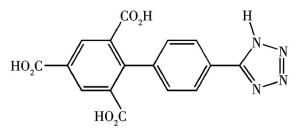
Figure 1.
Structure of ligand H4bta

Highly sensitive and multi-response Zn-MOF fluorescence sensor: Design, synthesis, and detection of 4-nitrophenol, Cu2+, and pyrimethanil
Fan LIU , Xiaoli CHEN , Jing REN , Yantao LEI , Huali CUI , Hua YANG , Jijiang WANG


Along with the rapid development of society, many environmental hazards have emerged alongside the convenience. Excessive emissions of pollutants, such as nitroaromatic hydrocarbons, antibiotics, and heavy metal ions, into the environment not only threaten ecological balance but also pose serious hazards to aquatic organisms and human health[1-3]. Under this background, the development of rapid, sensitive, and selective pollutant detection technologies becomes particularly important[4-6]. Traditional detection methods, such as gas chromatography-mass spectrometry (GC-MS) and high-performance liquid chromatography (HPLC), are highly sensitive, but they have disadvantages such as complex instruments, cumbersome sample pretreatment, and high costs, making it difficult to achieve on-site real-time monitoring[7]. In recent years, metal-organic framework (MOF) materials have shown broad application prospects in environmental monitoring, energy storage, medicine, and catalysis due to their controllable pore structure, abundant active sites, and excellent chemical tunability[8-9].
Nitro explosives, due to their high energy density and stability, are widely used in military, industrial, and civilian fields. However, the leakage and residue problems during their production, use, and illegal disposal have led to severe pollution of soil, water bodies, and the atmosphere[10-11]. Among them, 4-nitrophenol (4-NP) is particularly toxic. This substance can be absorbed through skin contact, causing symptoms such as dermatitis, redness, and burning pain. Even low-dose exposure may lead to liver cell necrosis, renal tubular degeneration, and significant elevation of serum transaminase levels. Given its strong carcinogenicity, the International Agency for Research on Cancer (IARC) has classified it as a 2B class carcinogen[12-14]. Therefore, developing a highly sensitive and selective detection method for 4-Nitrophenol has significant practical significance.
Copper ions are an important trace element in the body of living organisms, playing a significant role in key physiological processes such as energy metabolism, antioxidant defense, and neural signal transmission[15]. However, industrial wastewater discharge, mining activities, and agricultural pollution have led to excessive concentrations of Cu2+ ions in the environment[16]. Excessive Cu2+ has strong oxidizing properties and can cause metabolic disorders, neurotoxicity, and severe liver and kidney damage through bioaccumulation[17], thus being classified by the World Health Organization (WHO) as one of the heavy metals that require focused monitoring. For the detection of Cu2+, the existing research is relatively limited, and the detection sensitivity needs to be improved. For instance, Zhang et al. used the solvothermal method and 2-fluoro-benzoic acid as the core cluster directing agent to synthesize the MOF [Tb4(TATB)2] (H3TATB=4, 4′, 4″-(1, 3, 5-triazine-2, 4, 6-triyl)trisphenylmethanoic acid), and the detection limit of this material for Cu2+ in aqueous solution was 2.92 μmol·L-1 [18]; Huang et al. synthesized the coordination polymer [Zn3(3-BABA)2(bpa)2(H2O)2]n, and the detection limit of Cu2+ for this material was 0.363 μmol·L-1 [19]. These results indicate that there is still potential for developing Cu2+ sensing methods with lower detection limits.
Furthermore, pyrimethanil (Pth), a commonly used fungicide, also poses significant environmental and health risks that cannot be ignored. The traditional methods currently used to determine pyrimethanil (such as chromatography techniques) often have drawbacks such as complex operation, reliance on large instruments, long detection cycles, or high costs, making them unable to meet the requirements for rapid and efficient on-site testing[20-22].
In response to the aforementioned challenges, we designed and synthesized a novel Zn-MOF based on H4bta (Fig.1) and 2, 2′-bipyridine (bpy) ligands: {[Zn2(bta)(bpy)2(H2O)]·1.5H2O}n. Fluorescence sensing experiments demonstrated that this Zn-MOF can serve as an efficient multifunctional fluorescence probe for detecting 4-NP, Cu2+, and Pth in aqueous solutions, with detection limits as low as 0.270, 0.091 8, and 0.738 μmol·L-1, respectively. Additionally, we further explored the fluorescence detection mechanism.
The chemicals, instrumentation utilized, and the crystal data are documented in the Supporting information.
A mixture containing H4bta (0.05 mmol, 0.008 9 g), Zn(CH3COO)2·2H2O (0.05 mmol, 0.011 0 g), and bpy (0.05 mmol, 0.007 8 g) was combined with 5 mL of H2O, subjected to sonication for 15 min, followed by the addition of 5 mmol·L-1 NaOH solution to adjust the pH to 7. Subsequently, it was enclosed in a 10 mL glass container, subjected to an oven reaction at 95 ℃ for 4 d, cooled to ambient temperature, and cleansed with H2O. Generating colorless bulk crystals led to a yield of 65%, as measured by Zn. (838.37). Elemental analysis Calcd. For C36H27Zn2N8O8.5(%): C 51.53, N 13.36, H 3.22; Found(%): C 51.22, N 13.84, H 3.93. Peaks in infrared spectrum (KBr, cm-1): 3 373 (s), 3 077 (s), 1 619 (s), 1 353 (m), 1 249 (w), 1 153 (w), 928 (w), 825 (m), 771 (m), 714 (m), 612 (w).
We introduced 30 mg of Zn-MOF into 100 mL of distilled water (cMOF=3.6×10⁻⁴ mol·L-1), then exposed it to ultrasonic waves for 3 h and aged it for 3 d, which led to the formation of a stable suspension, followed by a fluorescence examination. 10 variety of nitro explosives (15 μL, 0.15 mmol·L-1), including p-nitrophenylhydrazine (4-NPH), p-nitrobenzoic acid (PNBA), 2, 4- dinitrophenyl-hydrazine (DNP), 4-nitrophenol (4-NP), nitrobenzene (NB), o-nitroaniline (O-NT), 2, 4, 6-trinitro-phenol (TNP), o-nitrophenol (2-NP), m-nitroaniline (3-NT), 2, 4, 6-trinitrophenylhydrazine (TRI), were chosen for Zn-MOF solution (1 mL) to evaluate Zn-MOF′s fluorescence detection capability. The volume ratio of Zn-MOF solution to Nitro explosive solution was 200∶3. The fluorescence sensing ability of Zn-MOF for metal cations and pesticides was explored similarly. The concentration of nitro explosive standard stock solution and pesticide standard stock solution was 1 mmol·L-1, and the concentration of metal ion standard stock solution was 5 mmol·L-1.
Zn-MOF belongs to the monoclinic crystal system, space group P1. Each asymmetric unit contains two independently crystalline zinc ions, a bta4- ion, two bpy ligands, one coordinated and 1.5 lattice water molecules (Fig.2a). Zn1 is coordinated to four nitrogen atoms (N1, N2, N6A, and N7B) and one oxygen atom (O2), where N1 and N2 atoms come from a bpy ligand [Zn1—N1 0.212 46(19) nm, Zn1—N2 0.212 46(19) nm], N6A and N7B come from the thiazole group of a bta4- ion [Zn1—N7B 0.213 97(17) nm, Zn1—N6A 0.203 16(17) nm], and O2 atom comes from the carboxylic group of a bta4- ion [Zn1—O2 0.197 32(14) nm]. The Zn1 center has a five-coordinated, slightly distorted triangular bipyramid structure. Comparable to the Zn1 ion, the Zn2 ion is five-coordinated and exhibits a somewhat altered triangular bipyramid formation. However, Zn2 is coordinated to two carboxyl oxygen atoms of bta4- ions [Zn2—O3 0.199 18(18) nm, Zn2—O6B 0.201 1(3) nm], one oxygen atom in H2O [Zn2—O7 0.213 90(19) nm], and two N atoms in a bpy [Zn2—N3 0.216 0(2) nm, Zn2—N4 0.211 83(19) nm] (Fig.2b). Through the connection of Zn2+ ions via bta4- ions, a 1D double-layer chain structure is formed (Fig.2c). Neighboring dual-layer networks additionally create a 2D supramolecular structure via hydrogen bonding [O7…O5 0.289 2(4) nm] (Fig.2d).
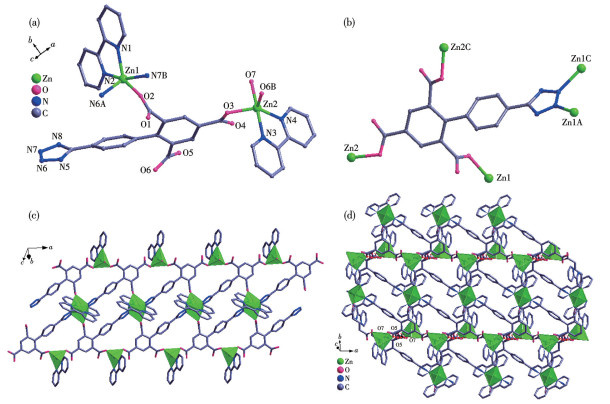
Symmetry codes: A: 1-x, 2-y, 2-z; B: 1+x, y, z; C: -1+x, y, z.
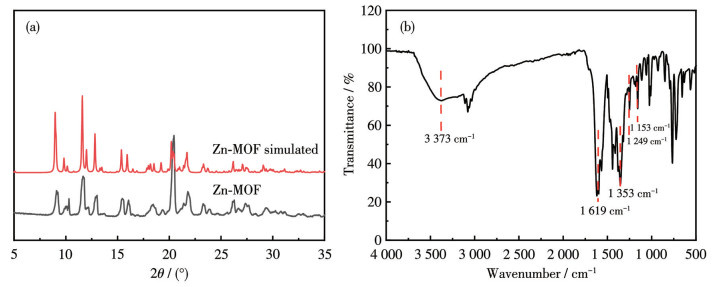
Powder X-ray diffraction (PXRD) experiments were utilized to assess the purity of Zn-MOF. Findings indicated a strong correlation between the X-ray diffraction peaks of the Zn-MOF powder and the simulated peaks of the single crystal data, verifying the Zn-MOF phase′s high purity(Fig.3a).
To assess the thermal stability of Zn-MOF, thermogravimetric analysis (TGA) was performed at a heating rate of 20 ℃·min-1 in an N2 atmosphere. As shown in Fig.S1, Zn-MOF first lost its coordinated and lattice water molecules below 135 ℃; the weight loss found of 5.2% was consistent with that calculated (5.36%). The weight decreased further in a range of 435-795 ℃, with a loss rate of 77.6% (Calcd. 78.2%), indicating decomposition of the H4bta and bpy ligands. The remaining (18.60%) is ZnO (Calcd. 19.3%).
Analysis of Zn-MOF′s infrared absorption spectrum reveals that the absorption peaks between 3 373 cm-1 are due to the stretching vibrations of O—H and N—H in the bta4- ligand; the 1 619 cm-1 peaks result from the carboxyl groups′ asymmetric stretching vibrations, while the 1 353 cm-1 peaks are linked to symmetric vibrations; and the 1 249 and 1 153 cm-1 peaks are due to the stretching vibrations of C—C and C—N (Fig.3b).
The luminescence properties of Zn-MOF and H4bta ligand at room temperature were studied (Fig.S2). When the excitation wavelength was 356 nm, the H4bta ligand had a maximum emission peak at 423 nm. When the excitation wavelength was 386 nm, Zn-MOF had a maximum peak at 454 nm. Compared to the unbound H4bta ligand, Zn-MOF exhibited a red shift of around 21 nm, suggesting a potential link to the ligand-metal charge transfer (LMCT)[23].
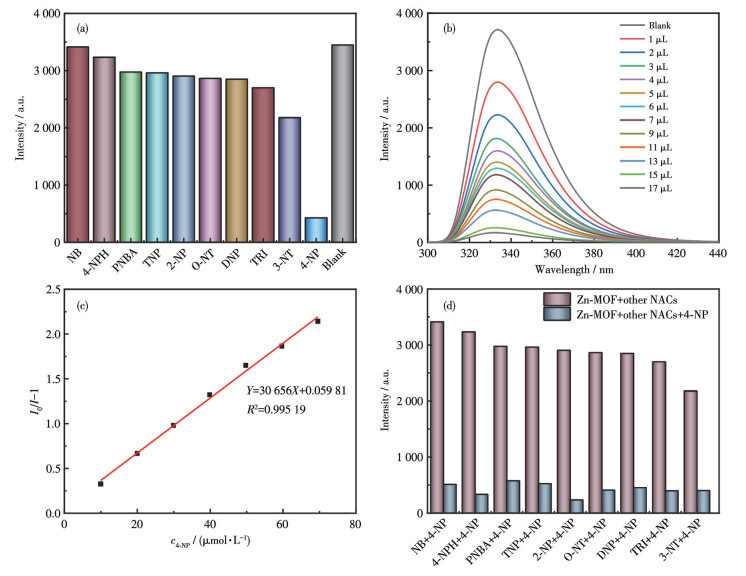
Fig.4a shows the diverse fluorescence intensity of Zn-MOF in different nitro explosives. With an increase in 4-NP concentration, fluorescence intensity diminished. The fluorescence nearly vanished at a concentration of 1.67×10⁻⁴ mol·L-1 (Fig.4b). At lower concentrations, the concentration of 4-NP exhibited a strong linear correlation with the fluorescence intensity. The relationship between 4-NP concentration and luminescence intensity was further investigated using I0/I=1+ Ksvc4-NP, where I0 and I are the luminescence intensity of Zn-MOF in the absence and presence of 4-NP, respectively, Ksv is the quenching constant, and c4-NP is the 4-NP concentration. The data showed good linearity in a concentration range of 10-69.5 μmol·L-1: Ksv=3.07×10⁴ L·mol-1, R2=0.995 19 (Fig.4c). The threshold for detection stood at 0.270 μmol·L-1 (LOD=3σ/k, LOD: limit of detection, σ: standard deviation, k: slope). Furthermore, studies were conducted on the anti-interference effects of other nitro explosives on 4-NP. Research indicates that Zn-MOF maintained its ability to suppress fluorescence of 4-NP in water, even when exposed to the same amount of other nitro explosives, confirming its selectivity aligns with experimental expectations (Fig.4d). Ultimately, research was conducted on the stability and retrievability of Zn-MOF in aquatic environments. Following the introduction of 4-NP, the brightness level of Zn-MOF altered right away and stayed stable over an extended period (Fig.S3a). The retrieval of Zn-MOF is possible through processes of centrifugation and drying. The crystals obtained through this method could be recycled a minimum of four times to regain their initial brightness (Fig.S3b). Consequently, Zn-MOF serves not just as a detection substance for 4-NP in water-based solutions, but also boasts notable stability and the ability to recover.
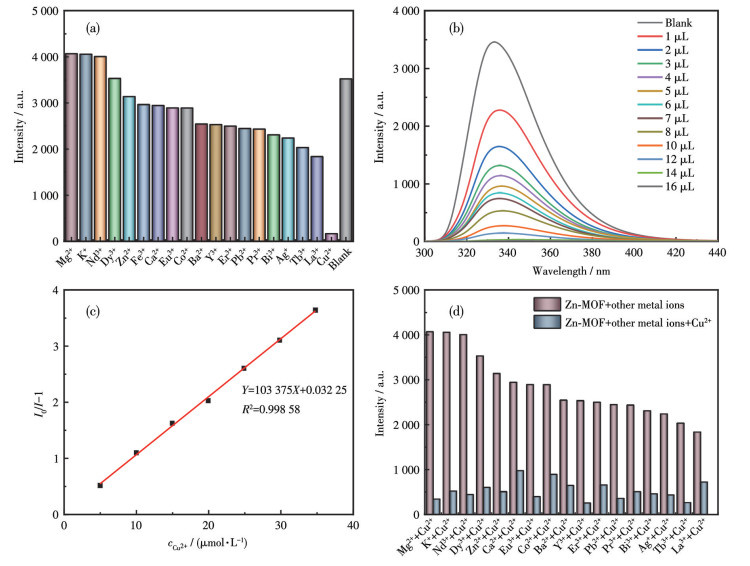
Cations were detected in the same way as nitro explosives. Nineteen different metal cations (Er3+, Co2+, Dy3+, Y3+, Ca2+, Tb3+, Pb2+, Ba2+, Fe3+, La3+, K+, Bi2+, Pr3+, Ag+, Nd3+, Eu3+, Mg2+, Zn2+, Cu2+) were selected as the research objects. With the addition of Cu2+, the fluorescence intensity of Zn-MOF was significantly reduced, showing an obvious quenching effect (Fig.5a). Subsequently, the copper ion sensing properties of Zn-MOF were further studied by the concentration titration method. The fluorescence intensity of Zn-MOF decreased gradually with increasing Cu2+ concentration (Fig.5b). In the low concentration range of 5.0-35 μmol·L-1, the Ksv was 1.03×10⁵ L·mol-1, and R2 was 0.998 58 (Fig.5c). Utilizing the LOD=3σ/k equation, it was determined that Zn-MOF could detect Cu2+ at a concentration of 0.091 8 μmol·L-1, signifying its effective fluorescence detection capabilities for Cu2+. The selective binding of Zn-MOF to Cu2+ in the presence of various metal cations was investigated using anti- interference experiments. In the absence of Cu2+, introducing additional anti-interference solutions resulted in minimal alteration of fluorescence intensity, whereas the presence of Cu2+ led to a significant drop in fluorescence intensity (Fig.5d), indicating that it can be used for the detection of Cu2+ in complex systems. The study focused on the effectiveness of this anti-interference feature in offering both feasibility and ease in water. Finally, the stability and recoverability of Zn-MOF in water were studied. Upon addition of Cu2+, the luminescence intensity of Zn-MOF changed immediately, not only after 20 s, but also over a longer period of time (Fig.S4a). Zn-MOFs can be reused at least four times; after centrifugation and drying, the recovered crystals regained their original luminescence intensity (Fig.S4b). Particularly, the outstanding detection performance of Zn-MOF for 4-NP and Cu2+ surpassed most similar materials (Table S3).
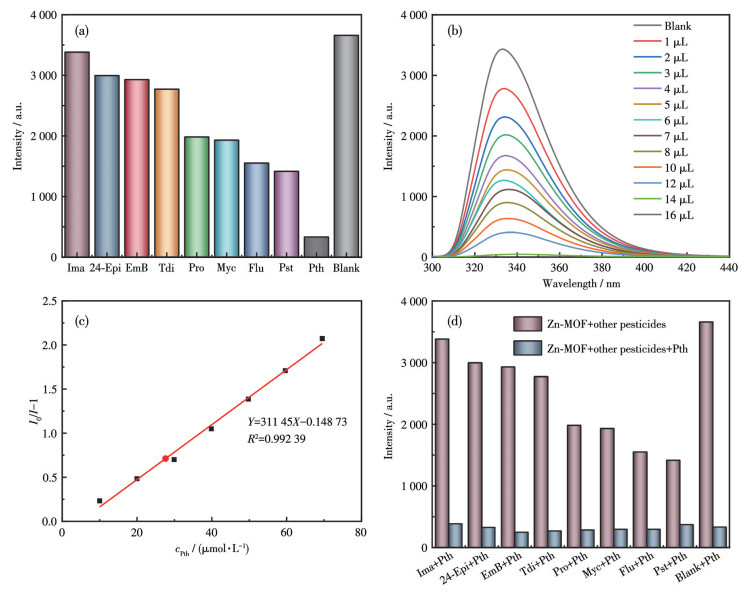
A total of nine pesticides [imazalil (Ima), 24- epibrassinolide (24-Epi), emamectin benzoate (EmB), toluene diisocyanate (Tdi), prochloraz (Pro), zhong- shengmycin (Myc), fluazinam (Flu), pyraclostrobin (Pst), pyrimethanil (Pth)] were chosen and identified using fluorescence at a 1 mmol·L-1 concentration. The addition of identical quantities of other pesticides did not significantly alter the fluorescence intensity. Fluorescence intensity decreased significantly after Pth was added, indicating that Pth had an obvious quenching effect on Zn-MOF (Fig.6a). The concentration titration experiment (Fig.6b) was employed to investigate how Pth inhibits the fluorescence of Zn-MOF. Findings indicate that Zn-MOF exhibited a fluorescence quenching efficiency of 98.6%. Upon the addition of Pth solution, a linear correlation emerged between 10 and 70 μmol·L-1 (Fig.6c). As per the 3σ/k formula, the detection threshold stood at 0.738 μmol·L-1. Experiments against interference revealed that the fluorescence intensity of Zn-MOF significantly diminished even when Pth was introduced alongside other pesticides, indicating its effective anti-interference properties (Fig.6d). Research was conducted on the stability and reactivity of Zn-MOF in aqueous environments. Following the introduction of Pth, there was an immediate shift in the luminescence intensity of Zn-MOF, which stayed stable for an extended period, not just after 20 s (Fig.S5a). The retrieval of Zn-MOF was possible through processes of centrifugation and drying. The retrieved crystals were capable of being recycled a minimum of four times to restore their initial luminescent strength (Fig.S5b).
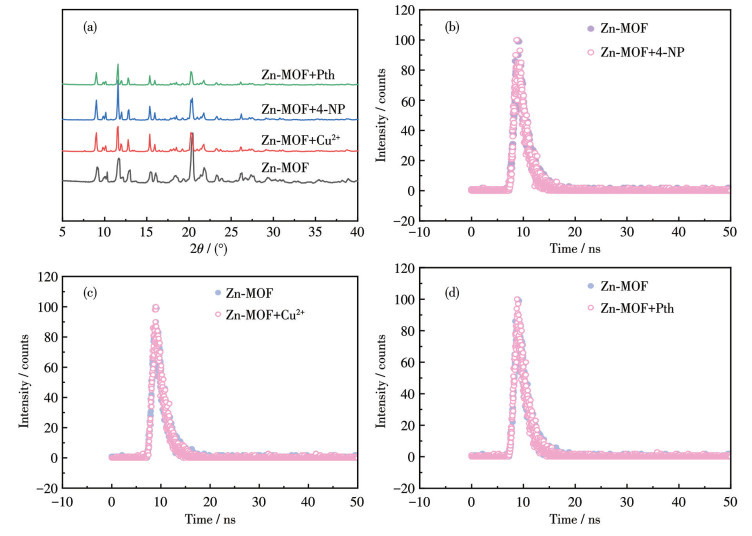
For the purpose of investigating how Zn-MOF exerts its quenching effect on 4-NP, Cu2+, and Pth, corresponding experimental procedures and theoretical calculations were performed. PXRD analysis results demonstrated that the structural framework of Zn-MOF remained unimpaired, maintaining its original integrity despite being subjected to treatment with 4-NP, Cu2+, and Pth-containing solutions (Fig.7a). Therefore, luminescence quenching cannot be attributed to structural collapse. From the formula for average lifetime: τavg=(A1τ12+A2τ22)/(A1τ1+A2τ2)[24-25], the luminescence lifetimes before and after analyte addition were 1.73 and 1.69 ns for 4-NP (Fig.7b), respectively, 1.73 and 1.66 ns for Cu2+ (Fig.7c), and 1.73 and 1.72 ns for Pth (Fig.7d), which is sufficient to indicate that 4-NP, Cu2+, and Pth are statically quenched[26].
For identifying the quenching mechanism as Förster resonance energy transfer (FRET) or inner filter effect (IFE), the UV-Vis absorption spectrum of the acceptor (analyte) was contrasted with the emission and excitation spectra of the donor (luminophore) to examine if effective overlap exists between them. The UV-Vis absorption peaks of 4-NP and Pth (Fig.S6a-S6c) showed significant spectral overlap with the excitation peaks of Zn-MOF; in contrast, the corresponding peaks of other substances were spaced farther apart. This indicates that 4-NP and Pth can partially absorb the excitation light. Therefore, the fluorescence quenching of 4-NP and Pth is mainly due to the energy competition between Zn-MOF and 4-NP, Pth[27-28]. The UV-Vis absorption spectrum of the Cu2+ (Fig.S6b) showed almost no overlap with the excitation spectrum of Zn-MOF, thus ruling out the possibility that there is competitive absorption between copper ions and Zn-MOF.
To further elucidate the possible weak interactions existing between Zn-MOF and 4-NP, Cu2+, and Pth, X-ray photoelectron spectroscopy (XPS) was utilized. For this purpose, single-phase Zn-MOF was immersed in 4-NP, Cu2+, and Pth solutions for 3 d, following which its XPS spectra were measured. The O1s binding energy of Zn-MOF was 531.10 eV. The results of binding energy analysis indicated that for 4-NP (Fig.8a), Cu2+ (Fig.8b), and Pth (Fig.8c), their respective binding energies were 531.26, 531.02, and 531.13 eV, which indicate that the interactions between Zn-MOF and 4-NP, Cu2+, and Pth result in the alteration of electron cloud density during the ligand contact process, leading to fluorescence quenching. The interaction forces between 4-NP and Pth are mainly hydrogen bond interactions. While the fluorescence quenching interaction between Zn-MOF and Cu2+ is mainly the result of their chemical reaction[29].
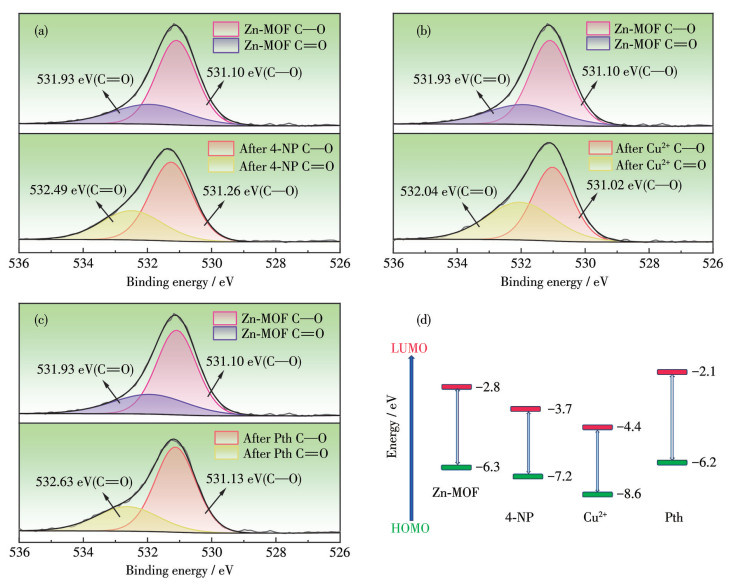
The orbital energies of Zn-MOF, 4-NP, Cu2+, and Pth have been determined by density functional theory (DFT) calculations at the B3LYP/6-31+G(d) level. As shown in Fig.8d, the LUMO level of Zn-MOF is -2.8 eV, while the LUMO levels of 4-NP, Cu2+, and Pth are -3.7, -4.4, and -2.1 eV, respectively. The LUMO levels of 4-NP and Cu2+ are lower than those of Zn-MOF, while the LUMO level of Pth is slightly higher than that of Zn-MOF. This analysis shows that electrons move from the LUMOs of Zn-MOF to the LUMOs of the analytes 4-NP and Cu2+ during excitation, resulting in fluorescence quenching. However, the fluorescence lifetimes of Zn-MOF+4-NP and Zn-MOF+Cu2+ had little change compared with Zn-MOF, thus suggesting that the fluorescence quenching of 4-NP and copper ions may be caused by the internal photophysical emission mechanism[29-31].
The experimental data indicated that for Cu2+, the recovery percentage was between 98% and 100% when tested at various concentrations. The relative standard deviation (RSD) value was 0.58%-1.52% (Table 1), indicating that Zn-MOF has certain reliability and practicability in detecting Cu2+ in actual water samples.

 下载:
导出CSV
下载:
导出CSV
| RSD / % | Recovery / % | ||
| Spiked | Detected | ||
| 0 | — | ||
| 1 | 0.98 | 1.41 | 98 |
| 2 | 1.96 | 0.58 | 98 |
| 3 | 3.97 | 1.52 | 100 |
In conclusion, a 2D Zn-MOF was designed and synthesized under hydrothermal conditions using H4bta and bpy as the ligands. The Zn-MOF enables high- efficiency and high-sensitivity detection of diverse water pollutants. More importantly, its successful application in real environmental water samples (Yanhe River) strongly demonstrates its excellent anti-interference ability and practical potential, marking an outstanding achievement in moving from fundamental research to practical application. In the future, we can further explore the microscopic mechanism of its fluorescence sensing and systematically evaluate the selectivity and long-term stability of the material in complex water bodies. Based on this, we will promote the development of the material towards portable detection devices.
AERTS R, JOLY L, SZTERNFELD P, TSILIKAS K, CREMER K D, CASTELAIN P, AERTS J M, ORSHOVEN J V, SOMERS B, HENDRICKX M, ANDJELKOVIC M, NIEUWENHUYSE A V. Silicone wristband and passive samplers yield highly individualized pesticide residue exposure profiles[J]. Environ. Sci. Technol., 2018, 52: 298-307 doi: 10.1021/acs.est.7b05039
MA Y L, YANG L P, BAI X L, WANG K M. Sensitive detection of organophosphorus pesticides in agricultural food products by a highly luminescent coordination polymer[J]. Spectroc. Acta Pt. A‒Molec. Biomolec. Spectr., 2025, 341: 126471 doi: 10.1016/j.saa.2025.126471
LI C P, LONG W W, LEI Z, GUO L, XIE M J, LV J, ZHU X D. Anionic metal-organic framework as a unique turn-on fluorescent chemical sensor for ultra-sensitive detection of antibiotics[J]. Chem. Commun., 2020, 56: 12403-12406 doi: 10.1039/D0CC05175F
CHEN W T, LI L Y, LI X X, LIN L D, WANG G Q, ZHANG Z, LI L Y, YU Y. Layered rare earth-organic framework as highly efficient luminescent matrix: The crystal structure, optical spectroscopy, electronic transition, and luminescent sensing properties[J]. Cryst. Growth Des., 2019, 19(8): 4754-4764 doi: 10.1021/acs.cgd.9b00635
ZHAO F H, WU X H, LI S Q, LI Z L, HE Y C. Fluorescence sensors for folic acid detection based on two Cd(Ⅱ) CPs of 1, 5-naphthalenedisulfonate with bis(benzimidazole) and bis(2-methyl-imidazole) ligands[J]. J. Mol. Struct., 2025, 1348: 143495
LIU Q Q, YUE K F, WENG X J, WANG Y. Luminescence sensing and supercapacitor performances of a new (3, 3)-connected Cd-MOF[J]. CrystEngComm, 2019, 21(41): 6186-6195 doi: 10.1039/C9CE01087D
FUJIWARA T, HATTORI A, ITO T, FUNATSU T, TSUNODA M. Analysis of intracellular α-keto acids by HPLC with fluorescence detection[J]. Anal. Methods, 2020, 12: 2555-2559 doi: 10.1039/D0AY00556H
CHAI H, ZHANG G, JIAO C, REN Y, GAO L. A multifunctional Tb-MOF detector for H2O2, Fe3+, Cr2O72-, and TPA explosive featuring coexistence of binuclear and tetranuclear clusters[J]. ACS Omega, 2020, 5(51): 33039-33046 doi: 10.1021/acsomega.0c04526
CHI Z M, CHU S Q, WANG B Q, ZHANG Z, LIU G C, WANG X L. Advances in metal complex-based colorimetric sensors [J]. Talanta, 2025, 297: 128591
KEERTHANA P, CHERIAN A R, SIRIMAHACHAI U, THADATHIL D A, VARGHESE A, HEGDE G. Detection of picric acid in industrial effluents using multifunctional green fluorescent B/N-carbon quantum dots[J]. J. Environ. Chem. Eng., 2022, 10: 107209 doi: 10.1016/j.jece.2022.107209
NIPPER M, CARR R S, BIEDENBACH J M, HOOTEN R L, MILLER K. Fate and effects of picric acid and 2, 6-DNT in marine environments: Toxicity of degradation products[J]. Mar. Pollut. Bull., 2005, 50: 1205-1217 doi: 10.1016/j.marpolbul.2005.04.019
CHEN J Q, ZHENG Q Q, XIAO S J, ZHANG L, LIANG R P, OUYANG G F, QIU J D. Construction of two-dimensional fluorescent covalent organic framework nanosheets for the detection and removal of nitrophenols[J]. Anal. Chem., 2022, 94(5): 2517-2526 doi: 10.1021/acs.analchem.1c04406
SHI X, QUAN S, YANG L, SHI G, SHI F. Facile synthesis of magnetic Co3O4/BFO nanocomposite for effective reduction of nitrophenol isomers[J]. Chemosphere, 2019, 219: 914-922 doi: 10.1016/j.chemosphere.2018.12.045
WANG Y, WU X K, DU C P, PEI K L, WU D, LAI J P, QI W J. A fast and highly efficient strategy for discrimination and detection of three nitrophenol isomers[J]. Sens. Actuator B‒Chem., 2023, 383: 133572 doi: 10.1016/j.snb.2023.133572
ZHANG M, ZHANG J H, CHE X, JIANG J J, TU Q, WANG J Y. Biomimetic mineralization-based in situ growth of AuNCs@ZIF-8 on paper fibers for visual detection of copper ions[J]. Talanta, 2024, 268: 125364 doi: 10.1016/j.talanta.2023.125364
PARK S, BONG S Y, SHARMA S, SINGH N, PARK Y I, PARK J, JANG D O. Simple turn-on fluorescent chemosensor for ultrafast and highly selective trace-level detection of Cu2+ ions in aqueous solutions[J]. Spectroc. Acta Pt. A‒Molec. Biomolec. Spectr., 2023, 305: 123555
ZHANG Y B, MIU J, WANG B L, RONG X Q, LIU J, TANG C, WANG C, GAO W X, GUI Y R, WANG H P, FANG M X, SHANG J T. A novel near-infrared fluorescent probe based on the dicyanoisophorone for the selective detection of Cu2+ in real water samples[J]. J. Mol. Struct., 2023, 1286: 135632
ZHANG X F, FENG L H, MA S Y, XIA T F, JIAO F F, KONG Z, DUAN X. A microporous Tb-based MOF for multifunctional detection of the α-CHC, Cu2+ and Fe3+[J]. J. Solid State Chem., 2022, 312: 123232 doi: 10.1016/j.jssc.2022.123232
HUANG G M, LI S, MA M X, LI S M, LI W Q, NI Q L, GUI L C, WANG X J. Construction of ZnⅡ/CdⅡ-based MOFs containing a tripodal aromatic carboxylate ligand with unequal arms and their fluorescent detection for Cu2+ and Fe3+ cations[J]. CrystEngComm, 2023, 8: 1-7
ESKANDARI H, AMIRZEHNI M, HASSANZADEH J, VAHID B. Mesoporous MIP-capped luminescent MOF as specific and sensitive analytical probe: Application for chlorpyrifos[J]. Microchim. Acta, 2020, 187(12): 673-683 doi: 10.1007/s00604-020-04654-4
ZHAO Y, XU X, QIU L, KANG X, WEN L, ZHANG B. Metal-organic frameworks constructed from a new thiophene-functionalized dicarboxylate: Luminescence sensing and pesticide removal[J]. ACS Appl. Mater. Interfaces, 2017, 9(17): 15164-15175 doi: 10.1021/acsami.6b11797
SUN A, YANG Y, LIU Y, DING L, DUAN P, YANG W, PAN Q. A zinc coordination polymer sensor for selective and sensitive detection of doxycycline based on fluorescence enhancement[J]. Cryst. Growth Des., 2021, 21(9): 4971-4978 doi: 10.1021/acs.cgd.1c00406
VALEUR B. Molecular fluorescence: Principles and applications[M]. Weinheim: Wiley-VCH, 2002.
FU Y P, YANG H, LIU H L, LI Y H, CHEN X L, CUI H L, WANG J J. Synthesis, structure, fluorescence and photocatalytic properties of two complexes based on a dimethylimidazole biphenyl/isophthalic acid ligand[J]. J. Mol. Struct., 2024, 1305: 137741
BEHERA P, RAY A, TRIPATHY S P, SUBUDHI S, ACHARYA L, PARIDA K. NixPy cocatalyst-loaded MOF-derived C/N-ZnO@B-doped g-C3N4-based Z-scheme nanohybrid: A combinatorically enhanced ternary photocatalyst towards hydrogen peroxide and hydrogen production [J]. ACS Appl. Eng. Mater., 2023, 1: 2876-2891 doi: 10.1021/acsaenm.3c00403
SUBUDHI S, TRIPATHY S P, PARIDA K. Metal oxide integrated metal organic frameworks (MO@MOF): Rational design, fabrication strategy, characterization and emerging photocatalytic applications[J]. Inorg. Chem. Front., 2021, 8: 1619-1636 doi: 10.1039/D0QI01117G
ZHANG Q S, JIANG X, KIRILLOW A M, ZHANG Y W, HU M Y, LIU W, YANG L Z, FANG R, LIU W S. Covalent construction of sustainable hybrid UiO-66-NH2@Tb-CP material for selective removal of dyes and detection of metal ions[J]. ACS Sustain. Chem. Eng., 2019, 7: 3203-3212 doi: 10.1021/acssuschemeng.8b05146
RACHURI Y, PARMAR B, SURESH E. Three-dimensional Co(Ⅱ)/ Cd(Ⅱ) MOFs: Luminescent Cd-MOF for detection and adsorption of TNP in aqueous phase[J]. Cryst. Growth Des., 2018, 18: 3062-3072 doi: 10.1021/acs.cgd.8b00204
ZHAO Y F, ZENG H, ZHU X W, LU W G, LI D. Metal-organic frameworks as photoluminescent biosensing platforms: Mechanisms and applications[J]. Chem. Soc. Rev., 2021, 50: 4484-4513 doi: 10.1039/D0CS00955E
BAIRY G, DEY A, DUTTA B, RAY P P, SINHA C. 2D Cd(Ⅱ)-MOF of pyridyl-imidazoquinazoline: Structure, luminescence, and selective detection of TNP and fabrication of semiconducting devices[J]. Cryst. Growth Des., 2022, 22: 3138-3147 doi: 10.1021/acs.cgd.2c00017
LIU W, CUI H L, ZHOU J, SU Z T, ZHANG Y Z, CHEN X L, YUE E L. Synthesis of a Cd-MOF fluorescence sensor and its detection of Fe3+, fluazinam, TNP, and sulfasalazine enteric-coated tablets in aqueous solution[J]. ACS Omega, 2023, 8: 24635-24643 doi: 10.1021/acsomega.3c03073

Figure 2 (a) Coordination environment of Zn(Ⅱ) in MOF; (b) Coordination modes of bta4- ion; (c) View of 1D double-layer chain; (d) View of 2D supramolecular network
Symmetry codes: A: 1-x, 2-y, 2-z; B: 1+x, y, z; C: -1+x, y, z.

Figure 4 (a) Fluorescence intensities of Zn-MOF in various nitro explosives; (b) Changes in the fluorescence emission spectra of Zn-MOF upon the gradual addition of 1 mmol·L-1 4-NP solution; (c) Linear relationship of fluorescence intensity of Zn-MOF with 4-NP concentration; (d) Anti-interference of 4-NP detection by Zn-MOF after adding different nitro explosives

Figure 5 (a) Fluorescence intensities of Zn-MOF in different metal cation solutions; (b) Changes in the fluorescence emission spectra of Zn-MOF upon the gradual addition of 5 mmol·L-1 Cu2+ solution; (c) Stern-Volmer plot for Zn-MOF sensing Cu2+; (d) Anti-interference of Zn-MOF sensing Cu2+ after adding different cations

Figure 6 (a) Fluorescence intensity of Zn-MOF in different pesticide solutions; (b) Changes in the fluorescence emission spectra of Zn-MOF upon the gradual addition of 1 mmol·L-1 Pth solution; (c) Correlation between low Pth concentrations and the fluorescence intensities of Zn-MOF; (d) Impact of diverse pesticide solutions on the detection of Pth using Zn-MOF

Figure 7 (a) PXRD patterns acquired from the Zn-MOF samples that were immersed in Pth, 4-NP, and Cu2+ systems for 3 h, respectively; (b) Fluorescence lifetimes of Zn-MOF before and after the addition of 4-NP; (c) Fluorescence lifetimes of Zn-MOF before and after the addition of Cu2+; (d) Fluorescence lifetimes of Zn-MOF before and after the addition of Pth

Figure 8 XPS O1s binding energy changes of Zn-MOF before and after the addition of the analyte: (a) 4-NP, (b) Cu2+, and (c) Pth; (d) Schematic energy diagrams of the HOMOs and LUMOs of Zn-MOF, 4-NP, Cu2+, and Pth
Table 1. Recovery test results of Cu2+ spiked in river water samples
| RSD / % | Recovery / % | ||
| Spiked | Detected | ||
| 0 | — | ||
| 1 | 0.98 | 1.41 | 98 |
| 2 | 1.96 | 0.58 | 98 |
| 3 | 3.97 | 1.52 | 100 |
 下载: 导出CSV

 扫一扫看文章


扫一扫关注我们


 下载:
下载: