Received Date:
02 June 2025 Revised Date:
15 September 2025 Available Online:
10 December 2025
Abstract:
The residues of Al3+, Ga3+, and In3+ in the environment pose an increasingly serious threat to human health and ecosystems. However, their specific and rapid detection remains challenging. In this study, we present a water-stable cadmium metal-organic framework (Cd-MOF) based luminescence probe, which can detect Al3+, Ga3+, and In3+ ions in aqueous solutions via a luminescence "turn-on" mode. The corresponding detection limits for the Al3+, Ga3+, and In3+ ions were 2.31, 3.06, and 2.78 μmol·L-1, respectively. This probe operated effectively within a pH range of 3-10 in an all-aqueous environment. Investigations into the detection mechanism revealed that this "turn-on" recognition is attributed to the formation of new structures upon ion interaction.
Aluminum and its main group congeners gallium and indium have found widespread applications in modern industries. However, the extensive utilization of these elements has led to their progressive environmental accumulation and bioenrichment, posing potential risks to human health through long-term exposure. Compelling evidence indicates that excessive intake of Al3+ or prolonged contact with Ga3+/In3+ may induce detrimental effects on multiple physiological systems, including the central nervous system, digestive tract, and immune function. These findings underscore the critical need for developing convenient detection strategies that target these metal ions[1]. Although conventional analytical techniques, such as inductively coupled plasma (ICP) spectroscopy and atomic absorption spectrometry, offer reliable quantification, their practical implementation is often hindered by complex instrumentation and time-consuming procedures. In contrast, luminescent detection methods have emerged as promising alternatives due to their rapid response, simplified sample pretreatment, and superior sensitivity[2].
Metal-organic frameworks (MOFs), a class of crystalline materials constructed from metal nodes and organic linkers, have recently garnered considerable interest as versatile luminescent probes[3-4]. Their unique advantages, including tunable energy levels, structural modularity, and analyte pre-concentration capabilities, enable tailored design for specific sensing applications[4-5]. Despite numerous reports on MOF-based sensors for diverse analytes[5-6], a significant limitation persists: many MOF probes exhibit poor aqueous stability, severely restricting their utility in environmental water monitoring[7]. In addition, this type of probe is currently also used for the detection of Al3+, Ga3+, and In3+, but basically one probe can only detect one or two of these metal ions[8-9]. The detection of these three metal ions using the same MOF probe can greatly save the preparation cost of the probe. However, there are very few related reports, and they all need to work in an organic solvent-containing system[10-11]. These challenges highlight the urgent demand for developing water-stable MOF probes with broad-spectrum detection capability for Al3+, Ga3+, and In3+ ions.
To address these limitations, we present a Cd-MOF probe, [Cd(L)(H2O)3]·H2O (1, H2L=5-[(naphthalen-1‐methylene)‐amino]‐isophthalic acid), engineered with excellent aqueous stability and selective responsiveness toward Al3+, Ga3+, and In3+ ions. Compound 1 demonstrated remarkable luminescent "turn-on" behavior upon exposure to these trivalent cations, achieving detection limits of 2.31 μmol·L-1 (Al3+), 3.06 μmol·L-1 (Ga3+), and 2.78 μmol·L-1 (In3+), respectively. Mechanistic investigations revealed that the enhanced emission originates from structural transformation triggered by metal coordination.
1.
Experimental
1.1
Materials and methods
All chemicals used in this study were commercially available reagents of analytical grade and were utilized as received. Luminescence spectra were obtained using a Hitachi F-7000 FL spectrophotometer. Powder X-ray diffraction (PXRD) patterns were collected on a D/MAX-2400 X-ray diffractometer employing Cu Kα radiation (λ=0.154 060 nm) at a scan rate of 10 (°)·min-1 (voltage: 40 kV, current: 25 mA, scan range: 5°-50°). Infrared spectra were recorded in a range of 650-4 000 cm-1 using a Nicolet-iS50 spectrometer via the KBr pellet pressing method. The synthesis of compound 1 was carried out according to the established literature method[12].
1.2
Luminescence detection of metal ions in aqueous solution
Each luminescence detection experiment was repeated at least three times to ensure the reliability and accuracy of the experimental data. Each time, 1.0 mg finely-ground powders of compound 1 were dispersed in 2 mL deionized water, ultrasonicated for 15 min to form a stable emulsion for the luminescent studies. Then 0.1 mol·L-1 aqueous solutions of M3+ (M=Al, Ga, and In) were prepared for the detection experiments. After adding the aqueous solution of metal ions to the obtained suspension to a specific concentration, luminescence detection was carried out.
2.
Results and discussion
2.1
Synthesis and characterization of compound 1
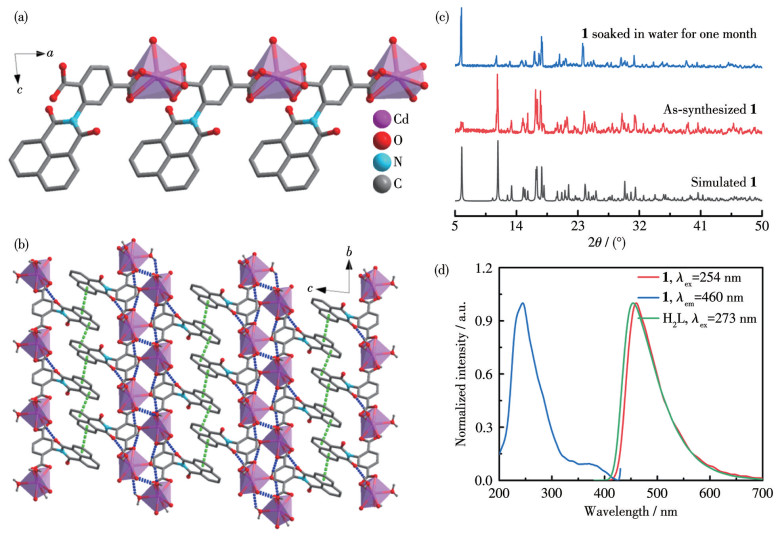
Compound 1 was synthesized following a reported method[10]. As illustrated in Fig. 1a, the compound adopts a 1D chain structure. Adjacent chains assemble into a 3D supramolecular structure via π‐π stacking and hydrogen‐bonding interactions (Fig. 1b). The phase purity of the synthesized sample was confirmed by PXRD. Fig. 1c demonstrates that the experimental PXRD pattern closely matched the simulated pattern derived from single-crystal data[12], confirming the successful synthesis and high purity of 1.
Figure 1
Figure 1.
Structure and characterization of compound 1: (a) 1D chain structure along the a-axis; (b) packing of the chains viewed along the a-axis (π-π stacking and hydrogen-bonding interactions are presented as green and blue dotted lines, respectively); (c) experimental and simulated PXRD patterns; (d) normalized solid-state excitation and emission spectra
The photoluminescent properties of compound 1 and its ligand (H2L) were investigated. Upon excitation at 273 nm, the free ligand exhibited an emission peak at 454 nm. In contrast, 1 displayed a redshifted emission peak at 460 nm (Fig. 1d), which is redshifted by 6 nm compared with that of the ligand and can be classified as a ligand-related emission. Notably, the aqueous suspension of 1 showed a slightly blueshifted emission at 450 nm.
The stability of compound 1 in water was evaluated. After being immersed in water for one month, the PXRD pattern of the resulting sample was basically the same as that before immersion, indicating that long-term water immersion did not cause structural transformation or collapse. The luminescence spectrum of the suspension of 1 after one month of storage was basically the same as that before storage. These results indicate that 1 has good structural and luminescent stability in water and may be a promising candidate for luminescence-based sensing in aqueous systems.
2.2
Detection of Al3+, Ga3+, and In3+ ions
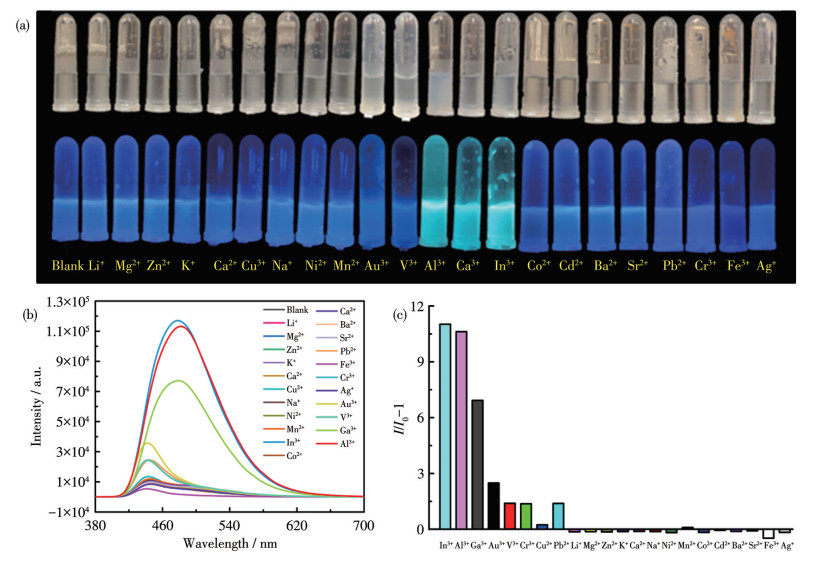
The potential of compound 1 as a luminescent probe for metal ion detection was explored. Water suspensions of 1 were treated with nitrate salts of 21 metal ions [M(NO3)x] (Mx+=Na+, K+, Li+, Ag+, Ca2+, Mg2+, Sr2+, Cd2+, Ba2+, Cu2+, Co2+, Zn2+, Ni2+, Mn2+, Pb2+, Fe3+, Al3+, Ga3+, In3+, V3+, Cr3+), and AuCl3. Then the color changes before and after adding metal ions under the irradiation of sunlight and a 254 nm ultraviolet lamp were observed. The results showed that there was no observable color change in the suspensions upon adding metal ions when irradiated with sunlight. However, under the irradiation of a 254 nm ultraviolet lamp, distinct differences in emission were evident among the suspensions.
With the exception of the Fe3+ ion, the addition of all other trivalent metal ions (Al3+, Ga3+, In3+, V3+, Cr3+, and Au3+) and Pb2+, Cu2+ could lead to varying degrees of enhancement in the luminescence of the suspensions of compound 1. Notably, following the addition of Al3+, Ga3+, and In3+ ions, the suspensions exhibited not only a significant increase in luminescence intensity but also an apparent color change‒transitioning rapidly from blue to blue-green‒which distinctly sets them apart from other tested suspensions.
The luminescence spectra of the suspensions of compound 1 after the addition of different metal ions were further analyzed (Fig. 2b). Upon introducing Al3+, Ga3+, and In3+ ions, a significant enhancement in luminescence was observed, with increases to 11.6, 8.0, and 12.0 times that of the initial state, respectively. Additionally, all these enhancements were accompanied by a redshift of approximately 35 nm, which aligned with the changes in luminescence color noted visually. In contrast, when Au3+, V3+, Cr3+, Cu2+, and Pb2+ ions interacted with compound 1, the corresponding luminescence enhancement factors for the suspension were only 3.5, 2.4, 2.4, 1.2, and 2.4 times that of the initial state, respectively; notably, no shift in emission peak occurred under these conditions. The remaining metal ions did not induce any significant changes in the luminescent properties of suspensions of 1. These findings suggest that compound 1 serves as an effective luminescent probe capable of selectively detecting Al3+, Ga3+, and In3+ ions through both increased luminescent intensity and observable shifts in color.
Figure 2
Figure 2.
Luminescence responses of water suspensions of compound 1 to different metal ions: (a) photographs under sunlight (upper) and 254 nm UV light (lower); (b) corresponding emission spectra; (c) corresponding changes in luminescence intensity (I0 and I are the luminescence intensities of the suspensions before and after adding different metal ions, respectively.)
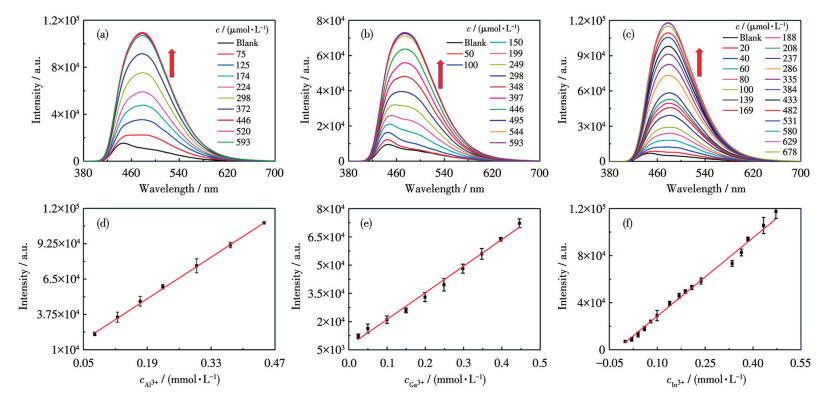
To thoroughly investigate the detection performance of this probe for Al3+, Ga3+, and In3+ ions, luminescence titration experiments were conducted. As illustrated in Fig. 3, varying amounts of aqueous solutions containing Al3+, Ga3+, and In3+ ions were added to the suspensions of compound 1, respectively. Subsequently, the emission spectra of these systems were analyzed. With an increase in the concentration of metal ions, the intensity of the emission peak at 447 nm gradually increased while exhibiting a redshift in peak position. The luminescence intensity demonstrated a linear relationship with concentrations of Al3+ (0-0.45 mmol·L-1), Ga3+ (0-0.44 mmol·L-1), and In3+ (0-0.46 mmol·L-1), respectively. The linear equations derived from fitting are presented as Eq.1, 2, and 3, where I1, I2, and I3 correspond to the luminescence intensities after interaction with Al3+, Ga3+, and In3+ ions:
Figure 3.
Emission spectra of the suspensions of compound 1 after the addition of different amounts of Al3+ (a), Ga3+ (b), and In3+ (c) ions; Corresponding linear relationships between luminescence intensity and the concentration of Al3+ (d), Ga3+ (e), and In3+ (f) ions
The corresponding correlation coefficients (R2) were found to be 0.997, 0.992, and 0.992.
Based on the signal-noise ratio of being 3σ/k (σ represents the relative standard deviation of emission intensity of blank samples across ten tests; k is the slope), the detection limits of compound 1 to Al3+, Ga3+, and In3+ ions were calculated to be 2.31, 3.06, and 2.78 μmol·L-1, respectively. Notably, the detection limit of Al3+ was lower than the maximum allowable concentration of Al3+ in drinking water (7.41 μmol·L-1) as stipulated by the World Health Organization (WHO). All three detection limits are remarkably low and comparable to those reported for other probes targeting these three metal ions[8-11], indicating that 1 serves as an excellent probe for their efficient detection.
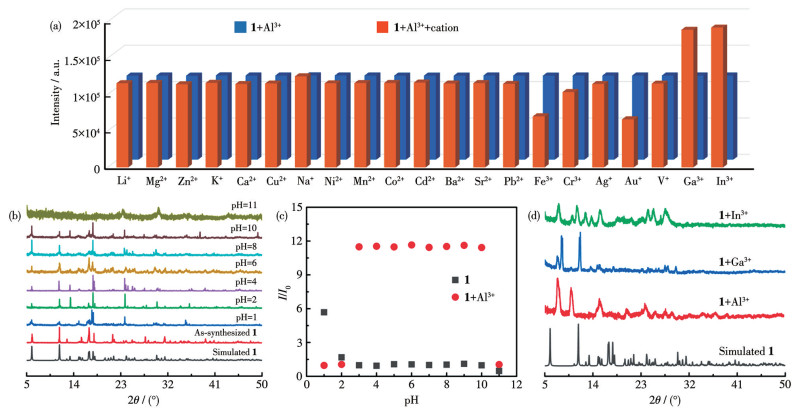
In the actual detection process, interference problems from other metal ions often occur. Therefore, an anti-interference study was carried out. In the experiments, both the measured ion concentration and the interfering ion concentration were 0.5 mmol·L-1. Fig. 4a shows the interference of other metal ions on the luminescence of the "1+Al3+" system. When Al3+, Ga3+, and/or In3+ ions coexist in the system simultaneously, strong interference will occur, resulting in enhanced luminescence. Unfortunately, there is no linear relationship between the luminescence intensity and the total concentration at this time, indicating that this probe cannot be used for the detection of the total concentration of the mixed system of the three metal ions. In addition, the presence of Fe3+ and Au3+ ions could cause a certain degree of quenching of the luminescence in the detection system, which may be caused by the paramagnetic characteristics of the ions. For the "1+Ga3+" and "1+In3+" systems, Fe3+, as well as Cr3+ and Au3+, would respectively cause a certain degree of quenching of their luminescence. Overall, the vast majority of metal ions do not interfere with the detection.
Figure 4
Figure 4.
Evaluation of the detection performance of compound 1: (a) interference of other metal cations on the detection of Al3+ by 1; (b) PXRD patterns of the samples of 1 after being immersed in solutions of different pH values for one day; (c) luminescence intensity variations of 1 and "1+Al3+" suspensions under different pH conditions; (d) PXRD patterns of the solid samples obtained after adding Al3+, Ga3+ and In3+ ions to the suspensions of 1 respectively
The emission spectra that changed over time after adding 0.5 mmol·L-1 of Al3+, Ga3+, and In3+ ions, respectively, to the suspension of compound 1 were measured. The results showed that after the addition of Al3+, the luminescence intensity of the suspension increased rapidly and reached equilibrium within 120 s. After adding Ga3+ or In3+, the response time was even shorter, and the luminescence intensity reached equilibrium within 25 s. In the subsequent half an hour, the luminescence basically remained unchanged. The above results indicate that compound 1 has the advantage of rapid response as a probe for Al3+, Ga3+, and In3+ ions.
The luminescence stability of the probe under different pH environments was studied. Firstly, the PXRD patterns of the samples after being soaked for one day under different pH conditions (pH=1-11) were tested (Fig. 4b). The results show that the structure was stable under the condition of pH 1-10. However, when pH=11, the structure collapsed and transformed into an amorphous phase. Further research found that the luminescence of the suspension in the pH range of 3-10 was not affected by pH (Fig. 4c), and the detection of Al3+, Ga3+, and In3+ ions by compound 1 in this pH range was not interfered with by pH. These results indicate that 1 has a good pH working window.
2.3
Sensing mechanism
The investigation into the widespread detection capability of compound 1 for three metal ions within the same group has been conducted. Initially, we examined the influence of absorbance caused enhancement (ACE) on detection efficacy[10]. The UV-Vis absorption spectra of the suspensions of 1 were measured before and after the addition of 0.5 mmol·L-1 Al3+, Ga3+, and In3+, respectively. The results indicated that there was no significant difference in absorbance between the suspensions prior to and following the introduction of these metal ions. This suggests that the luminescence enhancement observed in 1 during detection is not attributable to changes in absorbance; thus, its interaction with these metal ions does not involve an ACE mechanism.
To further ascertain whether any structural alterations occurred in compound 1 before and after detection, Al3+, Ga3+, and In3+ were added separately to suspensions of 1. The resulting solid samples were then collected for PXRD analysis. As illustrated in Fig. 4d, the PXRD patterns obtained from these samples exhibited significant differences compared to that of 1 itself, indicating that a structural transformation induced by metal ion interaction may have transpired upon contact with these ions‒ultimately leading to enhanced luminescence from the probe. Notably, distinct PXRD patterns were observed for "1+Al3+", "1+Ga3+", and "1+In3+" samples; this variability may explain why this probe cannot be employed for detecting total concentrations of all three ions simultaneously. Our previous research has established that generating products with identical structures is a prerequisite condition for MOF-based probes when detecting total analyte content through structural transformation mechanisms[13]. Regrettably, despite numerous attempts, we have yet to determine the specific structure of the probe post‐ detection.
Control experiments were conducted by introducing metal ions into a ligand solution that had been neutralized with sodium hydroxide (with a molar ratio of NaOH to H2L of 2.1∶1), followed by the assessment of the emission spectra of the resulting mixtures. The results indicated that as the concentrations of Al3+, Ga3+, and In3+ ions increased, there was a gradual enhancement in the luminescence intensity of the solutions. This finding substantiates the validity of our inference.
To date, several MOF-based probes for detecting Al3+, Ga3+, and In3+ ions have been reported[8-11]. However, most existing probes are limited to detecting only one or two of these metal ions. Notably, only two instances have demonstrated the capability to detect all three metal ions simultaneously[10-11]. In comparison with these two probes, the probe presented in this study exhibits several distinctive features: (1) the detection occurs within an all-aqueous system with a relatively broad working pH range; (2) it demonstrates excellent detection specificity for only three ions (Al3+, Ga3+, and In3+ ions), and other ions, particularly trivalent metal ions, do not exhibit significant interference; (3) the probe displays a "turn on" luminescence response upon interaction with these metal ions, accompanied by a color change from blue to blue-green‒facilitating easy observation without specialized equipment; (4) its detection limit is comparable to those reported for other probes[8-11,14]. Collectively, these characteristics suggest that this probe possesses notable advantages in detecting Al3+, Ga3+, and In3+ ions.
3.
Conclusions
In summary, we have successfully developed a "turn on" Cd-based MOF luminescent probe capable of specifically detecting Al3+, Ga3+, and In3+ among 22 metal ions in an all-aqueous medium; its respective detection limits were 2.31 μmol·L-1 for Al3+, 3.06 μmol·L-1 for Ga3+, and 2.78 μmol·L-1 for In3+. Furthermore, both its structure and luminescent properties demonstrate exceptional stability against water as well as acid/alkali conditions. During detection processes, the luminescence color transitions from blue to blue-green, further enhancing visibility through naked-eye observation. The recognition mechanism is the structural transformation induced by the three metal ions, resulting in an enhanced luminescence of the probe.
Acknowledgements:
This research is supported by the National Natural Science Foundation of China (Grant No.21871038).
[1]
JANG H J, KANG J H, YUN D, KIM C. A multifunctional selective "turn-on" fluorescent chemosensor for detection of group Ⅲ A ions Al3+, Ga3+ and In3+[J]. Photochem. Photobiol. Sci., 2018, 17(9): 1247-1125 doi: 10.1039/c8pp00171e
[2]
LI R F, CHEN X Y, ZHANG H, WANG Y R, LV Y, JIANG H P, GUO B W, FENG X. Co-based metal-organic framework nanosheets for robust hydrogen evolution in alkaline media[J]. Inorg. Chem., 2024, 63(4): 2282-2288 doi: 10.1021/acs.inorgchem.3c04291
[3]
WANG H Y, MIAO L, ZHANG B L, SUN Y J, CHEN J, LIU S Q, ZHANG W Q, WANG T, ZHANG J J. Coordinated solvent molecules enable the excellent capabilities of two Zn2+-based complexes in detecting L-arginine via long-lived luminescence recovery[J]. Adv. Funct. Mater., 2024, 34(40): 2403734 doi: 10.1002/adfm.202403734
[4]
YUAN J Y, DONG J, LEI S B, HU W P. Long afterglow MOFs: A frontier study on synthesis and applications[J]. Mater. Chem. Front., 2021, 5(18): 6824-6849 doi: 10.1039/D1QM00689D
[5]
ZHANG W Q, ZHANG B L, WANG T, CHEN J, LI ZY, WANG R H, LIU S Q, ZHANG J J. Two new Cd-based metal-organic frameworks for afterglow detection of Fe3+ and NH3[J]. J. Mater. Chem. A, 2024, 12(13): 7732-7741 doi: 10.1039/D4TA00356J
[6]
ASSEN A H, YASSINE O, SHEKHAH O, EDDAOUDI M, SALAMA K N. MOFs for the sensitive detection of ammonia: Deployment of fcu MOF thin films as effective chemical capacitive sensors[J]. ACS Sens., 2017, 2(9): 1294-1301 doi: 10.1021/acssensors.7b00304
[7]
王婷, 张佩佩, 刘淑芹, 王瑞红, 张建军. 一例Bi-CP基固态薄膜传感器的制备及其对生物胺蒸气的发光传感[J]. 无机化学学报, 2024, 40(8): 1615-1621WANG T, ZHANG P P, LIU S Q, WANG R H, ZHANG J J. A Bi‐CP‐based solid‐state thin‐film sensor: Preparation and luminescence sensing for bioamine vapors[J]. Chinese J. Inorg. Chem., 2024, 40(8): 1615-1621
[8]
DING Y, HU Y Y, ZHAO Y Y, LI Y R, HUANG Z T, CHAKIR S, XU Y F, SUN D S, LIU S Q, WANG H T, WANG X B. Plasma tailoring of NH2-MIL-53 with enhanced fluorescence emission for simultaneous detection of multiple heavy metals in water[J]. ACS Appl. Mater. Interfaces, 2024, 16(45): 62497-62508 doi: 10.1021/acsami.4c09330
[9]
LI J, ZHU Y L, XU H, ZHENG T F, LIU S J, WU Y Q, CHEN J L, CHEN Y Q, WEN H R. A benzothiadiazole-based Eu3+ metal-organic framework as the turn-on luminescent sensor toward Al3+ and Ga3+ with potential bioimaging application[J]. Inorg. Chem., 2022, 61(8): 3607-3615 doi: 10.1021/acs.inorgchem.1c03661
[10]
WANG M, GUO L, CAO D P. Metal-organic framework as luminescence turn-on sensor for selective detection of metal ions: Absorbance caused enhancement mechanism[J]. Sens. Actuator B‒Chem., 2018, 256: 839-845 doi: 10.1016/j.snb.2017.10.016
[11]
HAN Y X, WU X B, MA J C, WANG G. A post-modified metal- organic framework ZIF-90-AN as "turn-on" fluorescence probe for the highly selective and ultra-sensitive quantitative detection of common trivalent metal cations[J]. Mater. Today Chem., 2024, 36: 101984 doi: 10.1016/j.mtchem.2024.101984
[12]
HUANG J X, ZHAO H, ZHANG J J, ZHANG B L, NI J, SONG B, LI Y Q, LIU S Q, DUAN C Y. Diemissive dye@CP composites with full-spectrum tunable mechanoluminescence[J]. J. Mater. Chem. C, 2021, 9(42): 15165-15174 doi: 10.1039/D1TC02841C
[13]
ZHANG P P, ZHANG B L, SHI W J, CHEN J, SONG W T, ZHANG J J, LIU S Q, NI J. MOF-based probes for total content detection of Ca2+/Sr2+‒Regulating detection performance indicators of probes via "paramagnetic/diamagnetic heterometallic probes" strategy[J]. Sens. Actuator B‒Chem., 2024, 413: 135888 doi: 10.1016/j.snb.2024.135888
[14]
陈曦, 李思媛, 王元, 吴伟娜, 陈忠. 一种席夫碱Al3+荧光探针的制备及细胞成像应用[J]. 无机化学学报, 2022, 38(10): 1993-1998CHEN X, LI S Y, WANG Y, WU W N, CHEN Z. A Schiff base fluorescent probe for Al3+: Synthesis and application in living cells imaging[J]. Chinese J. Inorg. Chem., 2022, 38(10): 1993-1998
Figure 1
Structure and characterization of compound 1: (a) 1D chain structure along the a-axis; (b) packing of the chains viewed along the a-axis (π-π stacking and hydrogen-bonding interactions are presented as green and blue dotted lines, respectively); (c) experimental and simulated PXRD patterns; (d) normalized solid-state excitation and emission spectra
Figure 2
Luminescence responses of water suspensions of compound 1 to different metal ions: (a) photographs under sunlight (upper) and 254 nm UV light (lower); (b) corresponding emission spectra; (c) corresponding changes in luminescence intensity (I0 and I are the luminescence intensities of the suspensions before and after adding different metal ions, respectively.)
Figure 3
Emission spectra of the suspensions of compound 1 after the addition of different amounts of Al3+ (a), Ga3+ (b), and In3+ (c) ions; Corresponding linear relationships between luminescence intensity and the concentration of Al3+ (d), Ga3+ (e), and In3+ (f) ions
Figure 4
Evaluation of the detection performance of compound 1: (a) interference of other metal cations on the detection of Al3+ by 1; (b) PXRD patterns of the samples of 1 after being immersed in solutions of different pH values for one day; (c) luminescence intensity variations of 1 and "1+Al3+" suspensions under different pH conditions; (d) PXRD patterns of the solid samples obtained after adding Al3+, Ga3+ and In3+ ions to the suspensions of 1 respectively


 下载:
下载:

 下载:
下载:


 下载:
下载:

