
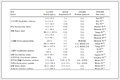
表 1
Crystallographic data and refinement parameters for complexes 1 and 3


The chemistry of organotin carboxylates continues to be an active research area in recent years because of their versatile structures[1] as well as significant biological activities[2], especially anticancer activity[3-4]. Recently, the synthesis of organotin carboxylates of multifunctional carboxylic acids with additional O, S or N donor groups is drawing more and more attention due to the functionalized carboxylic acids showing variable coordination modes as well as notable bioactivities[5-10]. Among these functionalized carboxylic acids, pyrazolyl carboxylic acids have attracted a special interest owing to the important biological activity of pyrazole derivatives[11] as well as the good coordinating ability of pyrazole[12]. Many organotin carboxylates derived from pyrazolyl carboxylic acids have been synthesized and characterized, which demonstrated fascinating structural features and excellent biological activities[13-21], such as antitumor[21] and antifungal activities[14]. Polycarboxylic acids have been extensively used as multifunctional ligands in designing novel and fascinating supramolecular structures with special properties[22]. Many organotin polycarboxylates based on di-, tri-and tetracarboxylic acids have been reported in the literatures[23-28], which display interesting supramolecular architectures. It is known that the structures and biochemical behaviors of organotin carboxylates significantly depend on the type of the substituents attached to the tin atom and also on the kind of carboxylate ligands[3-4]. As an extension of our investigations on biologically active organotin derivatives[10], we herein report the synthesis, structure and antitumor activity in vitro of organotin 1, 1'-methylenebis(1H-pyrazole-4-carboxylates).
IR spectra were obtained from a Tensor 27 spectrometer as KBr discs. NMR spectra were obtained with a Bruker 400 spectrometer, and the chemical shifts were reported with respect to reference standards (internal SiMe4 for 1H and 13C NMR spectra, external SnMe4 for 119Sn NMR). Elemental analyses were carried out on an Elementar Vario EL analyzer. HR mass spectra were carried out on a Varian QFT-ESI spectrometer. Melting points were measured with an X-4 digital micro melting-point apparatus and were uncorrected. Ethyl 1H-pyrazole-4-carboxylate and organotin reagents are commercially available and used as received without further purification.
Powdery potassium hydroxide (85%, 3.29 g, 50 mmol) was added to the solution of ethyl 1H-pyrazole-4-carboxylate (7 g, 50 mmol) in CH3CN (100 mL). The reaction mixture was stirred and heated to reflux, then the solution of CH2Br2 (4.35 g, 25 mmol) in CH3CN (20 mL) was added dropwise. After the completion of addition, the reaction mixture was continuously stirred and refluxed for 6 h. The solvent was removed in vacuo to give a white solid, which was dissolved in the mixed solvent of CH2Cl2 (50 mL) and H2O (50 mL). The organic phase was separated, washed with H2O (2×30 mL) and dried over Na2SO4. Removing the solvent, the residual was recrystallized from hexane to afford white crystals of diethyl 1, 1'-methylenebis(1H-pyrazole-4-carboxylate). Yield:68% (5 g).
Diethyl 1, 1'-methylenebis(1H-pyrazole-4-carboxy-late) (2.34 g, 8 mmol) was added to the solution of NaOH (3.20 g, 80 mmol) in H2O (100 mL). The reaction mixture was stirred and heated at reflux for 4 h. After cooling to room temperature, the pH value was adjusted to 5 by dilute hydrochloric acid (3 mol·L-1) to give white solids, which were filtered off, washed with H2O and dried in air to afford 1, 1'-methylenebis(1H-pyrazole-4-carboxylic acid) (L). Yield:90% (1.69 g). 1H NMR (DMSO-d6):δ 6.52 (s, 2H), 7.88 (s, 2H), 8.57 (s, 2H), 12.58 (s, 2H). 13C NMR (DMSO-d6):δ 65.0, 116.4, 135.1, 142.2, 163.9. IR (cm-1):ν(OH) 3 110~ 2 574 (br), ν(C=O) 1 697. HRMS (ESI, m/z):235.047 0 (Calcd. for C9H7N4O4:235.047 3, [M-H]-).
Compound L (0.12 g, 0.5 mmol) and Ph3SnOH (0.37 g, 1 mmol) were added to anhydrous benzene (30 mL), and the reaction mixture was stirred and heated at reflux for 6 h. Removing the solvent in vacuo, the residual was recrystallized from benzene/hexane to give colorless crystals of 1, which was dried in vacuo before the characterization work. Yield:82% (0.38 g), m.p. 89~91℃. 1H NMR (CDCl3):δ 6.22 (s, 2H), 7.42~7.47 (m, 18H), 7.73~7.76 (m, 12H), 7.95 (s, 2H), 8.15 (s, 2H). 13C NMR (CDCl3):δ 65.7, 117.0, 129.0 (3J(13C-119/117Sn)=63.7 Hz), 130.2, 133.9, 136.9 (2J(13C-119/117Sn)=48.2 Hz), 138.1, 143.3, 168.3. 119Sn NMR (CDCl3):δ -106.3. IR (cm-1):νas(COO) 1 634, νs(COO) 1 378. Anal. Calcd. for C45H36N4O4Sn2(%):C 57.85, H 3.88, N 6.00; Found(%):C 57.43, H 4.25, N 6.34.
This complex was obtained similarly using tricyclohexyltin hydroxide instead of Ph3SnOH as described above for 1. Yield:93%, m.p. 164~166℃. 1H NMR (CDCl3):δ 1.32~1.41 (m, 18H), 1.68~1.75 (m, 30H), 1.90~2.02 (m, 18H), 6.27 (s, 2H), 7.95 (s, 2H), 8.10 (s, 2H). 13C NMR (CDCl3):δ 26.9, 28.9 (3J(13C-119/117Sn)=64.3 Hz), 31.1 (2J(13C-119/117Sn)=13.9 Hz), 33.9 (1J(13C-119/117Sn)=337.5, 323.4 Hz), 65.6, 118.6, 133.2, 143.0, 167.0. 119Sn NMR (CDCl3):δ 19.2. IR (cm-1): νas(COO) 1 644, νs(COO) 1 372. Anal. Calcd. for C45H72N4O4Sn2(%):C 55.69, H 7.48, N 5.77; Found(%):C 55.46, H 7.64, N 5.88.
This complex was obtained similarly using (Et3Sn)2O instead of Ph3SnOH as described above for 1, but in a 1:1 molar ratio. Yield:90%, m.p. 93~95℃. 1H NMR (CDCl3):δ 1.20~1.42 (m, 30H), 6.27 (s, 2H), 7.93 (s, 2H), 8.10 (s, 2H). 13C NMR (CDCl3):δ 8.0 (1J(13C-119/117Sn)=365.8, 349.9 Hz), 9.9 (2J(13C-119/117Sn)=25.1 Hz), 65.7, 118.3, 133.3, 143.9, 167.5. 119Sn NMR (CDCl3):δ 114.0. IR (cm-1):νas(COO) 1 595, νs(COO) 1 375. Anal. Calcd. for C21H36N4O4Sn2(%):C 39.05, H 5.62, N 8.67; Found(%):C 39.31, H 5.36, N 8.46.
This complex was obtained similarly using (n-Bu3Sn)2O instead of Ph3SnOH as described above for 1, but in a 1:1 molar ratio. Hexane was used as the solvent in recrystallization. Yield:79%, m.p. 73~75℃. 1H NMR (CDCl3):δ 0.91 (t, J=7.3 Hz, 18H), 1.28~1.39 (m, 24H), 1.59~1.67 (m, 12H), 6.25 (s, 2H), 7.90 (s, 2H), 8.06 (s, 2H). 13C NMR (CDCl3):δ 13.6, 16.5 (1J(13C-119/117Sn)=352.7, 341.6 Hz), 27.0 (3J(13C-119/117Sn)=64.5 Hz), 27.8 (2J(13C-119/117Sn)=20.5 Hz), 65.6, 118.5, 133.2, 142.9, 167.3. 119Sn NMR (CDCl3):δ 115.4. IR (cm-1):νas(COO) 1 593, νs(COO) 1 375. Anal. Calcd. for C33H60N4O4Sn2(%):C 48.68, H 7.43, N 6.88; Found(%):C 48.45, H 7.33, N 7.04.
Crystals of 1 and 3 suitable for X-ray analysis were obtained by slowly cooling their hot benzene/hexane solutions. All intensity data were collected with a SuperNova diffractometer using Mo Kα radiation (λ=0.071 073 nm). The structures were solved by direct methods and difference Fourier map using SHELXS of the SHELXTL package and refined with SHELXL[29] by full-matrix least-squares on F2. The SQUEEZE of the PLATON software[30] was used in the refinement of the structures of 1 and 3. The highly disordered solvents (ca. 1.375 hexane molecules for 1 and 3 according to the number of removed electrons, respectively) in the voids were removed by the SQUEEZE process. All non-hydrogen atoms were refined with anisotropic displacement parameters. Hydrogen atoms were added geometrically and refined with riding model position parameters. A summary of the fundamental crystal data for these two complexes is listed in Table 1.
 下载:
导出CSV
下载:
导出CSV
| Complex | 1·1.375C6H14 | 3·1.375C6H14 |
| Formula | C53.25H55.25N4O4Sn2 | C29.25H55.25N4O4Sn2 |
| Formula weight | 1 052.64 | 764.40 |
| Crystal size/mm | 0.50×0.10×0.05 | 0.80×0.20×0.20 |
| Crystal system | Monoclinic | Monoclinic |
| Space group | P21/c | P21/c |
| a/nm | 0.917 48(2) | 1.007 88(5) |
| b/nm | 1.847 59(4) | 2.187 8(2) |
| c/nm | 2.888 60(6) | 1.467 30(9) |
| β/(°) | 92.089(2) | 93.472(5) |
| T/K | 120.0(1) | 150.0(1) |
| V/nm3 | 4.893 3(2) | 3.229 5(4) |
| Z | 4 | 4 |
| Dc/(g·cm-3) | 1.429 | 1.572 |
| θ range/(°) | 3.030~25.010 | 2.933~25.009 |
| F(000) | 2 139 | 1 563 |
| μ/mm-1 | 1.069 | 1.585 |
| Measured reflection | 18 642 | 12 419 |
| Unique reflection (Rint) | 8 598 (0.031 3) | 5 681 (0.062 1) |
| Observed reflection with[I ≥ 2σ(I)] | 7 272 | 3 992 |
| Parameter | 496 | 286 |
| GOF | 1.047 | 1.137 |
| Residual R1, wR2 | 0.034 8, 0.075 4 | 0.088 0, 0.234 7 |
CCDC:1949278, 1; 1949279, 3.
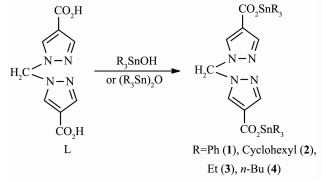
1, 1'-Methylenebis(1H-pyrazole-4-carboxylic acid) (L) was synthesized in the hydrolysis of its ethyl ester, which was obtained via the coupling reaction of ethyl 1H-pyrazole-4-carboxylate with CH2Br2 under basic condition. Reaction of L with organotin oxide or organotin hydroxide gave organotin 1, 1'-methylenebis(1H-pyrazole-4-carboxylates) (1~4) in good yields (Scheme 1). These complexes showed good soluble in chlorinated solvents. Complexes 1~4 have been chara-cterized by IR and NMR (1H, 13C and 119Sn) spectra as well as elemental analyses. It should be pointed out that the vacuum-dried samples for above-mentioned characterization do not contain any solvent, though the single crystal samples contain partially crystallized solvents.
In the IR spectra, the strong and broad band in L ascribed to the carboxyl group disappeared in compl-exes 1~4. Moreover, the carbonyl stretching frequencies in complexes 1~4 were significantly lower than that in L. These infrared absorption characteristics indicate the formation of the Sn-O bonds[31]. In addition, the asymmetric stretching vibrations of the carboxylate group in 1 (1 634 cm-1) and 2 (1 644 cm-1) were significantly higher than those in 3 (1 595 cm-1) and 4 (1 593 cm-1), revealing that the carboxylate groups in these complexes possibly show different coordination modes[31-32]. The larger values of Δν(νas(COO)-νs(COO)) for 1 (256 cm-1) and 2 (272 cm-1) compared with those of 3 (220 cm-1) and 4 (218 cm-1) imply the monodentate manner of the carboxylate group to the tin atom in 1 and 2 as well as the corresponding bidentate manner in 3 and 4[31-32]. The 1H NMR spectra of 1~4 exhibited the expected integral values and chemical shifts. The 13C NMR spectra of 2~4 clearly showed the 1J(13C-119/117Sn) coupling constant, which is consistent with the characteristic of 4-coordinated trialkyltin compounds (325~390 Hz)[33]. The 119Sn NMR chemical shifts of 1~4 are also compared with those values reported in the corresponding 4-coordinated triphenyltin, tricyclohexy-ltin, triethyltin and tri(n-butyl)tin carboxylates[1].
The molecular structures of 1 and 3 have been confirmed by X-ray crystallography, and presented in Fig. 1 and 2, respectively. The selected bond distances and angles are listed in Table 2. Fig. 1 shows that the carboxylate group exhibits a monodentate coordination mode in 1 as above-mentioned by its IR spectrum, leading to each tin atom with a four-coordinated distorted tetrahedron geometry. The pyrazolyl nitrogen atoms do not coordinate to the tin atoms, possibly owing to the carboxylate groups on the pyrazolyl rings decreasing the donating ability of the pyrazolyl nitrogen atoms[13]. The non-bond Sn…O distances (Sn1…O2 0.267 4(2) and Sn2…O4 0.284 1(2) nm) are considerably shorter than the sum of the van der Waals radii for the Sn and O atoms of 0.357 nm[34], suggesting relatively strong non-bonded Sn…O interac-tions in 1. As shown in Fig. 2, the coordination mode of the carboxylate groups in 3 is significantly different from that in 1. The carboxylate groups act as a bridging bidentate ligand in 3, consistent with its IR spectrum. This complex forms a 2D-coordination polymer with 32-membered macrocyclic units through the carboxylate oxygen atoms (Fig. 3). Each tin atom adopts a five-coordinated distorted trigonal bipyramidal geometry with the electronegative oxygen atoms at the apical positions. The covalent Sn-O bond distances in bridging bidentate carboxylate groups, such as Sn2-O2 (0.216 2(9) nm), are shorter than the covalent-coordinated Sn-O bond distances, such as Sn1-O1 (0.245 0(8) nm). However, all these Sn-O bond distances fall in the typical range for triorganotin carboxylates[1]. It is worthy of note that the polymeric structure of complex 3 in solid would break down in solution owing to the intermolecular weak Sn…O interactions, as indicated by its 13C and 119Sn NMR spectra.
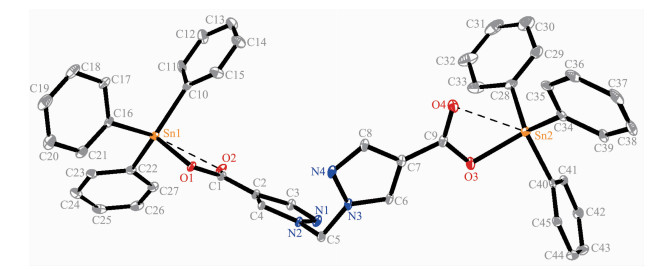
H atoms are omitted for clarity
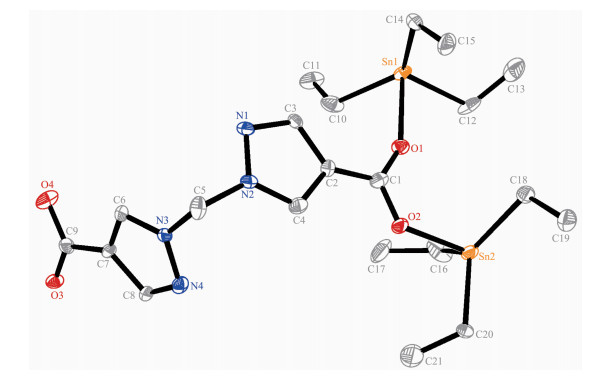
H atoms are omitted for clarity
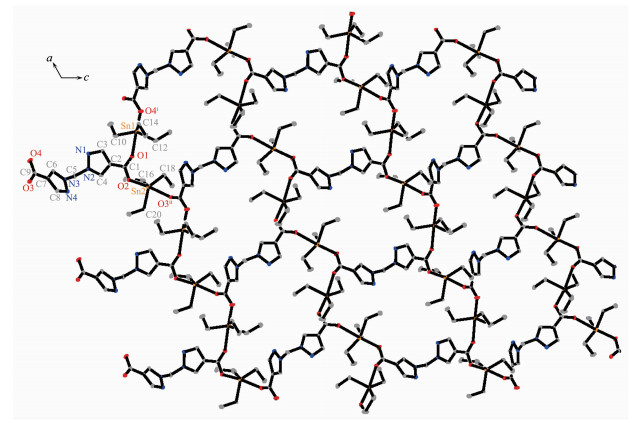
H atoms are omitted for clarity; Symmetry codes: i 1-x, 0.5+y, 1.5-z; ii-x, 0.5+y, 1.5-z
下载:
导出CSV
| 1 | |||||
| Sn1-O1 | 0.207 6(2) | Sn1…O2 | 0.267 4(2) | Sn2-O3 | 0.205 2(2) |
| Sn2…O4 | 0.284 1(2) | C1-O1 | 0.131 3(4) | C1-O2 | 0.122 8(4) |
| C9-O3 | 0.131 9(4) | C9-O4 | 0.122 2(4) | C5-N2 | 0.143 8(4) |
| C16-Sn1-O1 | 95.7(1) | C34-Sn2-O3 | 113.9(1) | C28-Sn2-C40 | 113.0(1) |
| O1-C1-O2 | 121.4(3) | O3-C9-O4 | 121.5(3) | N2-C5-N3 | 111.8(3) |
| 3 | |||||
| Sn1-O1 | 0.245 0(8) | Sn1-O4i | 0.215 5(8) | Sn2-O2 | 0.216 2(9) |
| Sn2-O3ii | 0.250 9(8) | C1-O1 | 0.125 8(17) | C1-O2 | 0.127 4(14) |
| C9-O3 | 0.122 8(15) | C9-O4 | 0.128 8(14) | C5-N2 | 0.148 0(17) |
| O1-Sn1-O4i | 173.2(3) | C10-Sn1-C12 | 118.9(7) | O1-C1-O2 | 121.7(13) |
| O2-Sn2-O3ii | 172.1(3) | C18-Sn2-C20 | 117.5(5) | O3-C9-O4 | 123.9(11) |
| Sn1-O1-C1 | 154.9(8) | Sn2-O2-C1 | 123.4(9) | N2-C5-N3 | 109.5(9) |
| Symmetry codes: i 1-x, 0.5+y, 1.5-z; ii -x, 0.5+y, 1.5-z. | |||||
The cytotoxic activity of dried complexes 1~4 and the free acid (L) for MCF-7 and A549 cells in vitro was assayed by the MTT method[35], and the data of IC50 are summarized in Table 3. From these results, it is observed that the free acid has scarcely any activity against MCF-7 and A549 cells, but all complexes display higher activity to these two cells than cisplatin, especially complex 1, which is a promising candidate against these two cells.
下载:
导出CSV
| Compound | MCF-7 | A549 |
| 1 | 0.050 | 0.082 |
| 2 | 1.05 | 1.20 |
| 3 | 1.09 | 0.57 |
| 4 | 1.03 | 0.61 |
| L | >100 | >100 |
| Cisplatin | 5.4 | 5 |
In conclusion, four triorganotin 1, 1'-methylenebis(1H-pyrazole-4-carboxylates) have been synthesized and characterized. The crystal structural analyses of two of them reveal that the carboxylate groups show considerably different coordination modes in these complexes. The carboxylate group acts as a mono-dentate ligand in the triphenyltin complex, while a bridging bidentate coordinate mode is observed in the triethyltin complex. Moreover, the triphenyltin complex only shows a dinuclear structure, while the triethyltin complex forms a 2D supramolecular archite-cture with 32-membered macrocyclic units. All comp-lexes, especially the triphenyltin complex, display good cytotoxicities for MCF-7 and A549 cells in vitro.
Chandrasekhar V, Nagendran S, Baskar V. Coord. Chem. Rev., 2002, 235:1-52 doi: 10.1016/S0010-8545(02)00178-9
Hadjikakou S K, Hadjiliadis N. Coord. Chem. Rev., 2009, 253:235-249 doi: 10.1016/j.ccr.2007.12.026
Banti C N, Hadjikakou S K, Sismanoglu T, et al. J. Inorg. Biochem., 2019, 194:114-152 doi: 10.1016/j.jinorgbio.2019.02.003
Amir M K, Khan S, Rehman Z, et al. Inorg. Chim. Acta, 2014, 423:14-25 doi: 10.1016/j.ica.2014.07.053
Shakir M, Sharma P K, Hanif S, et al. J. Coord. Chem., 2017, 70:2625-2643 doi: 10.1080/00958972.2017.1363889
张复兴, 何唐锋, 姚淑芬, 等.无机化学学报, 2019, 35:598-604 doi: 10.11862/CJIC.2019.083ZHANG Fu-Xing, HE Tang-Feng, YAO Shu-Fen, et al. Chinese J. Inorg. Chem., 2019, 35:598-604 doi: 10.11862/CJIC.2019.083
罗波, 余浩田, 刘梦琴, 等.无机化学学报, 2019, 35:1212-1220 doi: 10.11862/CJIC.2019.151LUO Bo, YU Hao-Tian, LIU Meng-Qin, et al. Chinese J. Inorg. Chem., 2019, 35:1212-1220 doi: 10.11862/CJIC.2019.151
Ma C, Wang Q, Zhang R. Inorg. Chem., 2008, 47:7060-7061 doi: 10.1021/ic800903s
Hussain S, Ali S, Shahzadi S, et al. Polyhedron, 2016, 117:64-72 doi: 10.1016/j.poly.2016.05.045
谢运甫, 于洋, 唐良富.无机化学学报, 2018, 34:2291-2297 doi: 10.11862/CJIC.2018.273XIE Yun-Fu, YU Yang, TANG Liang-Fu. Chinese J. Inorg. Chem., 2018, 34:2291-2297 doi: 10.11862/CJIC.2018.273
Ansari A, Ali A, Asif M, et al. New J. Chem., 2017, 41:16-41 doi: 10.1039/C6NJ03181A
Pettinari C, Tbcaru A, Galli S. Coord. Chem. Rev., 2016, 307:1-31 doi: 10.1016/j.ccr.2015.08.005
Li F L, Chen Q, Song H B, et al. Polyhedron, 2014, 83:102-107 doi: 10.1016/j.poly.2014.04.058
王志宏, 王贺, 郭彦召, 等.无机化学学报, 2012, 28:1926-1934 http://www.wjhxxb.cn/wjhxxbcn/ch/reader/view_abstract.aspx?flag=1&file_no=20120922&journal_id=wjhxxbcnWANG Zhi-Hong, WANG He, GUO Yan-Zhao, et al. Chinese J. Inorg. Chem., 2012, 28:1926-1934 http://www.wjhxxb.cn/wjhxxbcn/ch/reader/view_abstract.aspx?flag=1&file_no=20120922&journal_id=wjhxxbcn
Geng W Q, Zhou H P, Cheng L H, et al. Polyhedron, 2012, 31:738-747 doi: 10.1016/j.poly.2011.10.032
Chandrasekhar V, Thirumoorthi R, Metre R K, et al. J. Organomet. Chem., 2011, 696:600-606 doi: 10.1016/j.jorganchem.2010.09.032
Chandrasekhar V, Thirumoorthi R. Organometallics, 2009, 28:2096-2106 doi: 10.1021/om8011739
Chandrasekhar V, Thirumoorthi R, Azhakar R. Organo-metallics, 2007, 26:26-29 doi: 10.1021/om061010x
Chandrasekhar V, Thilagar P, Sasikumar P. J. Organomet. Chem., 2006, 691:1681-1692 doi: 10.1016/j.jorganchem.2005.11.030
Pellei M, Santini C, Lobbia G G, et al. Appl. Organometal. Chem., 2005, 19:583-589 doi: 10.1002/aoc.865
Wen Z K, Song H B, Du M, et al. Appl. Organometal. Chem., 2005, 19:1055-1059 doi: 10.1002/aoc.960
Gu J, Wen M, Liang X, et al. Crystals, 2018, 8:83 doi: 10.3390/cryst8020083
Rojas-León I, Alnasr H, Jurkschat K, et al. Organometallics, 2019, 38:2443-2460 doi: 10.1021/acs.organomet.9b00132
Yan F F, Zhu Q, Li Q L, et al. J. Organomet. Chem., 2019, 880:156-162 doi: 10.1016/j.jorganchem.2018.11.003
Xiao X, Sui C, Han L, et al. Heteroatom Chem., 2017, 28:e21356 doi: 10.1002/hc.21356
Roy M, Devi S S, Roy S, et al. Inorg. Chim. Acta, 2015, 426:89-98 doi: 10.1016/j.ica.2014.11.030
Pruchnik H, Pruchnik F P. J. Organomet. Chem., 2013, 729:60-67 doi: 10.1016/j.jorganchem.2013.01.015
García-Zarracino R, Höpfl H. J. Am. Chem. Soc., 2005, 127:3120-3130 doi: 10.1021/ja0437095
Sheldrick G M. Acta Crystallogr. Sect. C, 2015, C71:3-8 doi: 10.1107/S2053273314026370
Spek A L. J. Appl. Crystallogr., 2003, 36:7-13 doi: 10.1107/S0021889802022112
Baul T S B, Dhar S, Pyke S M, et al. J. Organomet. Chem., 2001, 633:7-17 doi: 10.1016/S0022-328X(01)01024-5
Szorcsik A, Nagy L, Sletten J, et al. J. Organomet. Chem., 2004, 689:1145-1154 doi: 10.1016/j.jorganchem.2003.11.040
Xie Y F, Yu Y, Fan Z J, et al. Appl. Organometal. Chem., 2010, 24:1-7
Nádvorník M, Holeek J, Handí K, et al. J. Organomet. Chem., 1984, 275:43-51 doi: 10.1016/0022-328X(84)80576-8
Li F L, Song H B, Dai B, et al. Appl. Organometal. Chem., 2010, 24:669-674 doi: 10.1002/aoc.1664

图 1 Molecular structure of 1 with 30% probability displacement ellipsoids
H atoms are omitted for clarity

图 2 Asymmetrical structural unit of 3 with 30% probability displacement ellipsoids
H atoms are omitted for clarity

图 3 Two dimensional supramolecular structure of 3
H atoms are omitted for clarity; Symmetry codes: i 1-x, 0.5+y, 1.5-z; ii-x, 0.5+y, 1.5-z
表 1 Crystallographic data and refinement parameters for complexes 1 and 3
| Complex | 1·1.375C6H14 | 3·1.375C6H14 |
| Formula | C53.25H55.25N4O4Sn2 | C29.25H55.25N4O4Sn2 |
| Formula weight | 1 052.64 | 764.40 |
| Crystal size/mm | 0.50×0.10×0.05 | 0.80×0.20×0.20 |
| Crystal system | Monoclinic | Monoclinic |
| Space group | P21/c | P21/c |
| a/nm | 0.917 48(2) | 1.007 88(5) |
| b/nm | 1.847 59(4) | 2.187 8(2) |
| c/nm | 2.888 60(6) | 1.467 30(9) |
| β/(°) | 92.089(2) | 93.472(5) |
| T/K | 120.0(1) | 150.0(1) |
| V/nm3 | 4.893 3(2) | 3.229 5(4) |
| Z | 4 | 4 |
| Dc/(g·cm-3) | 1.429 | 1.572 |
| θ range/(°) | 3.030~25.010 | 2.933~25.009 |
| F(000) | 2 139 | 1 563 |
| μ/mm-1 | 1.069 | 1.585 |
| Measured reflection | 18 642 | 12 419 |
| Unique reflection (Rint) | 8 598 (0.031 3) | 5 681 (0.062 1) |
| Observed reflection with[I ≥ 2σ(I)] | 7 272 | 3 992 |
| Parameter | 496 | 286 |
| GOF | 1.047 | 1.137 |
| Residual R1, wR2 | 0.034 8, 0.075 4 | 0.088 0, 0.234 7 |
 下载: 导出CSV
表 2 Selected bond distances (nm) and angles (°) for complexes 1 and 3
| 1 | |||||
| Sn1-O1 | 0.207 6(2) | Sn1…O2 | 0.267 4(2) | Sn2-O3 | 0.205 2(2) |
| Sn2…O4 | 0.284 1(2) | C1-O1 | 0.131 3(4) | C1-O2 | 0.122 8(4) |
| C9-O3 | 0.131 9(4) | C9-O4 | 0.122 2(4) | C5-N2 | 0.143 8(4) |
| C16-Sn1-O1 | 95.7(1) | C34-Sn2-O3 | 113.9(1) | C28-Sn2-C40 | 113.0(1) |
| O1-C1-O2 | 121.4(3) | O3-C9-O4 | 121.5(3) | N2-C5-N3 | 111.8(3) |
| 3 | |||||
| Sn1-O1 | 0.245 0(8) | Sn1-O4i | 0.215 5(8) | Sn2-O2 | 0.216 2(9) |
| Sn2-O3ii | 0.250 9(8) | C1-O1 | 0.125 8(17) | C1-O2 | 0.127 4(14) |
| C9-O3 | 0.122 8(15) | C9-O4 | 0.128 8(14) | C5-N2 | 0.148 0(17) |
| O1-Sn1-O4i | 173.2(3) | C10-Sn1-C12 | 118.9(7) | O1-C1-O2 | 121.7(13) |
| O2-Sn2-O3ii | 172.1(3) | C18-Sn2-C20 | 117.5(5) | O3-C9-O4 | 123.9(11) |
| Sn1-O1-C1 | 154.9(8) | Sn2-O2-C1 | 123.4(9) | N2-C5-N3 | 109.5(9) |
| Symmetry codes: i 1-x, 0.5+y, 1.5-z; ii -x, 0.5+y, 1.5-z. | |||||
下载: 导出CSV
表 3
IC50 values of complexes 1~4 for MCF-7 and A549 cells
| Compound | MCF-7 | A549 |
| 1 | 0.050 | 0.082 |
| 2 | 1.05 | 1.20 |
| 3 | 1.09 | 0.57 |
| 4 | 1.03 | 0.61 |
| L | >100 | >100 |
| Cisplatin | 5.4 | 5 |
下载: 导出CSV

 扫一扫看文章


扫一扫关注我们

 下载:
下载: