
表 1
Crystallographic data of 1 and 2
Table 1.
Crystallographic data of 1 and 2

Two Mono- and Binuclear Zn(Ⅱ) Coordination Complexes Containing 4-Pyridyl-NH-1, 2, 3-triazole Ligand: Syntheses, Structures and Photoluminescence Properties
Xue LEI , Yun-Zhou CHEN , Yuan-Xiang LI , Li-Hui JIA , Yun-Feng CHEN


Coordination polymers (CPs), known as a type of organic-inorganic hybrid materials, are very promising for developing multifunctional luminescent materials[1-3]. Both the inorganic and the organic moieties can provide the platforms to generate luminescence, while metal-ligand charge transfer also contributed to luminescence[4]. The size and nature of metal ions, the orientation and arrangement of ligands, even the supramolecular interactions can affect the fluorescent properties of CPs[5-8]. Therefore, controlling these interactions by exploring various metals and organic ligands is crucial for tuning the luminescence properties for a particular application.
In the recent years, a great deal of attention has been devoted to the synthesis of N-heterocyclic-based coordination polymers due to their surprising structural variability[9-12]. With the development of the Cu(Ⅰ) catalyzed azide-alkyne cycloaddition (CuAAC) reaction[13-14], 1, 2, 3-triazole which could exhibit abundant coordination modes has been appreciated as a metal coordination ligand[15-19]. Since the extended π-systems of small florescence molecules facilitate the ligand-centered π→π* transition[20-23], we have intended to add aromatic groups to 1, 2, 3-triazole and incorporate this moiety into coordination polymers. Based on our previous work about the syntheses of 1, 2, 3-triazoles and related complexes[24-28], we chose the small molecular 4-pyridyl-NH-1, 2, 3-triazole as the ligand. On the other hand, zinc complexes have received much attention because they not only exhibit interesting structures but also show better luminescent properties[29-32]. Herein, we report the syntheses, structures, and luminescent properties of two coordination complexes [Zn2(L)2Cl4] (1) and [Zn(L)2Cl2]·2H2O (2).
All reagents were purchased and used without further purification. Thermogravimetric analysis (TGA) was performed on a NETZSCH TG 209 F3 thermogravimetric analyzer in flowing N2 (20 mL ·min-1) with a heating rate of 10 ℃·min-1. The FT-IR spectra were recorded from KBr pellets in the range of 4000~450 cm-1 on an Agilent FT-IR spectrometer. The luminescence spectra for powdered samples and aqueous samples were recorded on Perkin Elmer Florescence Spectrometer LS S5 with a xenon arc lamp as the light source with the pass width of emission and excitation spectra of 15 and 2.5 nm. The UV-Vis spectra for samples (0.1 mmol·L-1 in methanol) were recorded on Perkin Elmer UV WinLab 6.0.4.0738/Lambda35 1.27. Elemental analysis of carbon, nitrogen, hydrogen was performed using an Elementar Vario MICRO CUBE (Germany) analyzer. PXRD data for complexes 1 and 2 were collected in the range of 5°~50° for 2θ on crystalline samples using a XPERT-PRO diffractometer with Cu Kα radiation (λ=0.154 18 nm, 40 kV, 40 mA) in flat-plate geometry at room temperature. The experimental powder X-ray diffraction pattern was compared to the calculated one from the single-crystal structure to identify the phase of the sample (Fig.S6~S7).
A mixture of ZnCl2·2H2O (0.15 mmol), L (0.15 mmol) and acetonitrile (5 mL) was placed in a 20 mL glass bottle. The mixture was sealed and heated at 80 ℃ for 48 hours and cooled to room temperature naturally. Grey block crystals of 1 was obtained by filtration. IR (KBr, cm-1): 3 112 (s), 2 963(m), 1 609(m), 1 139(m), 711(w). Elemental analysis Calcd. for C14H12Cl4N8Zn2(%): C 29.77, H 2.14, N 19.84; Found(%): C 29.61, H 2.04, N 19.65. To a solution of 25.8 mg ZnCl2·2H2O (0.15 mmol) in 1 mL distilled water was added 22.1 mg L (0.15 mmol) in 4 mL acetonitrile. The mixture was left to evaporate in air until colorless block crystals of 2 were obtained after 3 days. IR (KBr, cm-1): 3 342(s), 3 042(m), 2 732(m), 2 362(m), 1 615(m), 1 445(m), 1 337(w), 1 243(m), 787(s), 714(w) cm-1. Elemental analysis Calcd. for C14H16O2Cl2N8Zn(%): C 36.19, H 3.47, N 24.12; Found(%): C 36.02, H 3.22, N 24.00.
Single crystals of complexes 1 and 2 suitable for single-crystal X-ray diffraction were grown up from acetonitrile solution under hydrothermal reaction and slow evaporation at room temperature. The crystallographic data for the single crystals of 1 and 2 were collected on a CrysAlis PRO 1.171.39.7a (Rigaku OD, 2015) employing graphite-monochromated Mo Kα radiation (λ=0.071 073 nm). Empirical absorption correction using spherical harmonics, implemented in SCALE3 ABSPACK scaling algorithm. All structures were solved by direct methods using the Olex2 program with the SHELXTL package and refined with SHELXL[33-34]. Hydrogen atoms were added geometrically and refined with riding model position parameters and fixed isotropic thermal parameters. Crystallographic data for 1 and 2 are listed in Table 1, selected bond lengths and angles, and hydrogen bond lengths and angles are listed in Table S1 and S2.
 下载:
导出CSV
下载:
导出CSV
| Complex | 1 | 2 |
| Empirical formula | C14H12Cl4N8Zn2 | C14H16O2Cl2N8Zn |
| Formula weight | 564.86 | 464.62 |
| Crystal system | Triclinic | Monoclinic |
| Space group | P1 | P21/n |
| a/nm | 0.750 9(1) | 0.804 5(1) |
| b/nm | 0.809 3(1) | 0.770 3(1) |
| c/nm | 0.886 9(1) | 1.517 6(2) |
| α/(°) | 88.708(9) | 94.614(8) |
| β/(°) | 73.294(9) | |
| γ/(°) | 71.798(11) | |
| V/nm3 | 0.489 0(1) | 0.937 4(2) |
| Z | 1 | 2 |
| Dc/(g·cm-3) | 1.918 | 1.646 |
| μ/mm-1 | 3.018 | 1.623 |
| Crystal size/mm | 0.2×0.1×0.1 | 0.3×0.3×0.1 |
| θ range/(°) | 2.7~26.0 | 2.7~25.0 |
| Reflection collected | 2 786 | 8 826 |
| Independent reflection | 1 919 | 1 648 |
| Observed reflection [I > 2σ(I)] | 1 469 | 1 360 |
| Rint | 0.054 4 | 0.038 7 |
| GOF on F2 | 1.083 | 1.116 |
| R1, wR2[I≥2σ(I)] | 0.046 2, 0.119 4 | 0.028 9, 0.069 2 |
| R1, wR2 (all data) | 0.054 7, 0.131 4 | 0.039 7, 0.073 8 |
| Largest diff. peak and hole/(e·nm-3) | 867 and -1 088 | 528 and -281 |
CCDC: 1554502, 1; 1554503, 2.
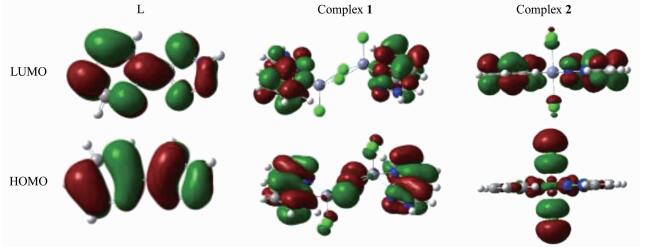
The initial structures of complex 1 and complex 2 were obtained from the single-crystal data and the initial structure of free ligand L was obtained from that of complex 2 by deleting other atoms. The geometry optimization were performed at B3LYP/6-31G(d, p)[35-37] theory level in methanol solvent with PCM model by using Gaussian 16 software[38]. At the optimized structures, harmonic vibrational frequencies (all real) were calculated to confirm that all optimized structures correspond to energy minima. Molecular orbitals cube files were generated and visualized with GaussView 6.0.16.
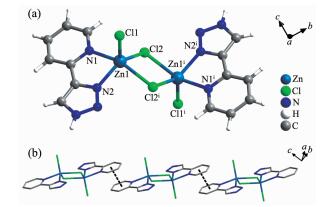
X-ray structural analyses reveal that the 1 and 2 crystallize in different space groups, P1 and P21/n, respectively. In the structure of 1, Zn2+ exhibits five coordination (the degree of trigonality, τ=0.43)[39] with one terminal Cl, two μ2-Cl and two N atoms from a chelating L (Fig. 1a). There are three kinds of H-bonds within the molecular units. One is the strong intermolecular H-bond, N4-H4…Cl1 (H4…Cl1 0.229 1(55) nm, N4-H4…Cl1 162.55(558)°), connecting the neighbor units to form dimer in ac plane. The second H-bond originates from C2-H2…Cl2, with dC2-H2=0.278 2(60) nm and ∠C2-H2…Cl2=169.00(572)°. The third is an intramolecular H-bonds, C7-H7… Cl1 (H7…Cl1 0.273 5(48) nm, C7-H7…Cl1 160.98(370)°) (Fig.S1). Besides the H-bonds, there is one offset π-π stacking interaction between two pyridine (C5N) rings with a centroid-to-centroid distance of 0.362 0(1) nm and an interplane separation of 0.333 4(1) nm (Fig. 1b). These intermolecular interactions are important for the crystallization of 1. The Zn1…Zn1i distance is 0.357 2(1) nm and the Zn1-Cl2-Zn1i angle is 93.880(39)°[40-41].
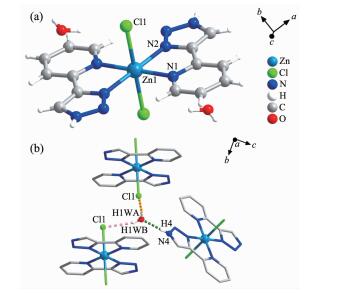
In the structure of 2, Zn2+ exhibits six coordinated with two terminal Cl, four N atoms from chelating L(Fig. 2a). Four intermolecular H-bonds were found. The first is C4-H4…Cl1, with dH4… Cl1=0.281 6(33) nm and ∠C4-H4…Cl1=159.07(260)°. As a result, the adjacent mono-zinc(Ⅱ) blocks are assembled into H-bonded one dimensional chains along a direction with the shortest intrachain separation of 0.804 5(1) nm (Fig.S2a). As for the bc plane, three kinds of intermolecular H-bonds connect the chains. Each H2O acts as a double H-bond donor leading to intermolecular O1W-H1WA…Cl1 (H…Cl 0.232 2(39) nm, O-H…Cl 170.33(363)°) and O1W-H1WB…Cl1 (H…Cl 0.254 0(32) nm, O-H…Cl 164.82(33)°). Moreover, the water molecular serve as an H-bond acceptor, which generate strong hydrogen bonding N4-H4A…O1W, with dH4A…O1W=0.189 7(31) nm and ∠N4-H4A…O1W=174.90(311)°(Fig. 2b). The intramolecular H-bond is C1-H1…N3 (dH1…N3=0.263 7(24) nm, ∠C1-H1…N3=149.28 (195)°) (Fig.S2b).
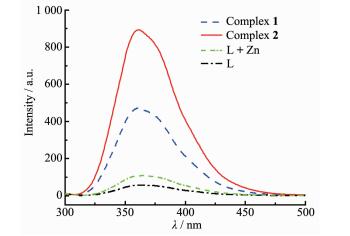
The phase purities of 1 and 2 have been confirmed by PXRD (Fig.S6 and S7). Firstly, the photoluminescence spectra of the free ligand L and the two Zn(Ⅱ) coordination complexes were measured in methanol (10 μmol·L-1, λex=301 nm). The free ligand L and the corresponding Zn coordination complexes exhibit similar emission spectra centered at λem=361 nm (Fig. 3). Compared with free L and Zn2+ ion, the enhancement of fluorescence intensity came up in the complexes 1 and 2, and the mononuclear 2 is stronger than the dimer 1. It is probably due to the coordination of L to the Zn(Ⅱ) center, increasing the conformational rigidity of the ligand, thereby reducing the nonradiative decay of the intraligand (π-π*) excited state[42].
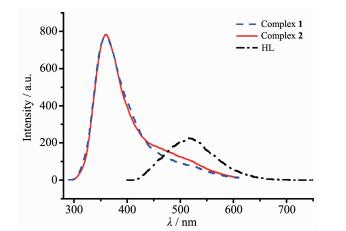
Further, the solid-state photoluminescent properties of Zn(Ⅱ) coordination complexes 1 and 2 have been investigated together with free ligand L at room temperature (Fig. 4). Ligand L displays strong green photoluminescence with a maximum emission peak at 517 nm upon excitation at 260 nm, which could probably be attributed to the π*-π and π*-n transitions[43-45]. For the complexes 1 and 2, excitation of the microcrystalline samples leads to the generation of strong blue fluorescent emissions with the same maximal peak occurring at 358 nm (λex=260 nm). Obviously, this characteristic emission can probably be attributed to the intraligand charge transitions. As for the correlation of structure and fluorescent properties, the π-π packing in the L ligand and its coordination complexes have influence on the fluorescent properties[46]. From the photoluminescence spectra of the free ligand L (Fig.S8), the big change was observed in the methanol solution and solid state at room temperature, which is due to the enhancement of π-π packing in ligand under the condition of solid state. The observed blue-shift of the emission bands between the L ligand and the corresponding complexes 1~2 might tentatively originate from the weakened structure packing of ligand L because of the coordination with the metal ions.
It can be concluded reasonably that the HOMO of ligand is π bonding orbital, and the HOMO of complex 2 is mainly based on coordinated chloride ions, while the HOMO of complex 1 is based on both coordinated chloride ions and the π-bonding orbitals of ligand. In contrast, the LUMOs of ligand and complexes 1 and 2 are mainly contributed by the π-antibonding orbits of ligand (Fig. 5). As a consequence, the UV-Vis and luminescence spectra of complex 1 and 2 should be mainly assigned to charge transfer between chloride ions and ligand in nature[47].
In summary, two new pyridyl triazole complexes of Zn(Ⅱ) were synthesized and their photophysical properties were explored. Structurally, the free ligand L coordinated with Zn(Ⅱ) in different ways, resulting in the mono- and di-nuclear Zn2+ complexes. With Cl- occupying the axial positions, the complexes exhibit weaker π-π stacking compared with small-molecular ligand, which led to blue shift of the ligand in solid state.
Acknowledgements: The authors are grateful to Prof. ZHANG Yue-Xing and Prof. LIU Jun-Liang on density functional theory calculations.
Supporting information is available at http://www.wjhxxb.cn
Suh M P, Cheon Y E, Lee E Y. Chem. Rev., 2008, 252:1007-1026 http://www.sciencedirect.com/science/article/pii/S0010854508000234
Maspoch D, Ruiz-Molina D, Veciana J. Chem. Soc. Rev., 2007, 36:770-818 doi: 10.1039/b501600m
Rocha J, Carlos L D, Paz F A A, et al. Chem. Soc. Rev., 2011, 40:926-940 doi: 10.1039/C0CS00130A
Cui Y J, Yue Y F, Qian G D, et al. Chem. Rev., 2012, 112: 1126-1162 doi: 10.1021/cr200101d
Xiang J, Li Z G, Zou H. Cryst. Res. Technol., 2013, 48:87-93 doi: 10.1002/crat.201200500
Yu F, Chu W K, Shen C, et al. Eur. J. Inorg. Chem., 2016, 24:3892-3899 doi: 10.1002/ejic.201600438/full
徐海兵, 陈忠宁.无机化学学报, 2011, 10:1887-1903 http://www.wjhxxb.cn/wjhxxbcn/ch/reader/view_abstract.aspx?flag=1&file_no=20111001&journal_id=wjhxxbcnXU Hai-Bing, CHEN Zhong-Ning. Chinese J. Inorg. Chem., 2011, 10:1887-1903 http://www.wjhxxb.cn/wjhxxbcn/ch/reader/view_abstract.aspx?flag=1&file_no=20111001&journal_id=wjhxxbcn
Huang Y Q, Wan Y, Chen H Y, et al. New J. Chem., 2016, 40:7587-7595 doi: 10.1039/C6NJ01231K
Aromi G, Barrios L A, Roubeau O, et al. Coord. Chem. Rev., 2011, 255:248-546 https://www.sciencedirect.com/science/article/pii/S0010854510002286
闫娟枝, 卢丽萍.无机化学学报, 2017, 33:1697-1704 doi: 10.11862/CJIC.2017.165YAN Juan-Zhi, LU Li-Ping. Chinese J. Inorg. Chem., 2017, 33:1697-1704 doi: 10.11862/CJIC.2017.165
肖伯安, 陈水生.无机化学学报, 2017, 33:347-353 doi: 10.11862/CJIC.2017.014XIAO Bo-An, CHEN Shui-Sheng. Chinese J. Inorg. Chem., 2017, 33:347-353 doi: 10.11862/CJIC.2017.014
Huang Y Q, Cheng H D, Chen H Y, et al. CrystEngComm, 2015, 17:5690-5701 doi: 10.1039/C5CE00677E
Rostovtsev V V, Green L G, Fokin V V, et al. Angew. Chem., Int. Ed., 2002, 41:2596-2599 doi: 10.1002/(ISSN)1521-3773
Torne C W, Christensen C, Meldal M. J. Org. Chem., 2002, 67:3057-3064 doi: 10.1021/jo011148j
Obata M, Kitamura A, Mori A, et al. Dalton Trans., 2008, 25:3292-3300 http://europepmc.org/abstract/MED/18560661
Uppal B S, Booth R K, Ali N, et al. Dalton Trans., 2011, 40: 7610-7616 doi: 10.1039/c1dt10634a
Connell T U, White J M, Smith T A, et al. Inorg. Chem., 2016, 55:2776-2790 doi: 10.1021/acs.inorgchem.5b02607
Bai S, Jiang L, Zuo J L, et al. Aust. J. Chem., 2013, 66:1029-1033 doi: 10.1071/CH13224
Zou J Y, Gao H L, Shi W, et al. CrystEngComm, 2013, 15: 2682-2687 doi: 10.1039/c3ce26854c
Xiang J, Lo L T, Leung C, et al. Organometallics, 2012, 31: 7101-7108 doi: 10.1021/om300621x
Ballardini R, Varani G, Indelli M T, et al. Inorg. Chem., 1986, 34:3858-3865 doi: 10.1002/chin.198709041/full
Donges D, Nagle J K, Yersin H. Inorg. Chem., 1997, 36: 3040-3048 doi: 10.1021/ic9609463
Outlaw V K, Zhou J, Bragg A, et al. RSC Adv., 2016, 6:61249-61253 doi: 10.1039/C6RA10605F
Deng X C, Lei X, Nie G, et al. J. Org. Chem., 2017, 82:6163-6171 doi: 10.1021/acs.joc.7b00752
Chen Y F, Nie G, Zhang Q, et al. Org. Lett., 2015, 17:1118-1121 doi: 10.1021/ol503687w
Hu Q Q, Liu Y, Deng X C, et al. Adv. Synth. Catal., 2016, 358:1689-1693 doi: 10.1002/adsc.v358.10
Ma C L, Wu J, Chen Y F. Russ. J. Coord. Chem., 2015, 41: 447-450 doi: 10.1134/S1070328415070064
Chen Y F, Wu J, Ma S, et al. J. Mol. Struct., 2015, 1089:1-8 doi: 10.1016/j.molstruc.2015.02.028
Yuan G, Shao K Z, Du D Y, et al. Solid State Sci., 2011, 13: 1083-1091 doi: 10.1016/j.solidstatesciences.2011.01.014
Du J Y. Transition Met. Chem., 2004, 29:699-702 doi: 10.1007/s11243-003-5593-8
Qin J S, Du D Y, Li M, et al. J. Am. Chem. Soc., 2016, 138: 5299-5307 doi: 10.1021/jacs.6b01093
Zeng M H, Yin Z, Liu Z H, et al. Angew. Chem. Int. Ed., 2016, 55:11407-11411 doi: 10.1002/anie.201604813
Dolomanov O V, Bourhis L J, Gildea R J, et al. J. Appl. Cryst., 2009, 42:339-341 doi: 10.1107/S0021889808042726
Sheldrick G M. Acta Crystallogr., Sect. A: Found. Crystallogr., 2008, A64:112-122 https://www.scienceopen.com/document?vid=9001a01f-495e-41c1-a9ff-560bde2378a2
Fernandez-Hernandez J M, Yang C H, Beltran J I, et al. J. Am. Chem. Soc., 2011, 133:10543-10558 doi: 10.1021/ja201691b
Zhong A, Zhang Y X, Bian Y Z. J. Mol. Graphics Modell., 2010, 29:470-480 doi: 10.1016/j.jmgm.2010.09.003
Zhang Y X, Cai X, Yao P, et al. Chem. Eur. J., 2007, 13: 9503-9514 doi: 10.1002/(ISSN)1521-3765
Frisch M J, Trucks G W, Schlegel H B, et al. Gaussian 16 Software, Gaussian Inc., Wallingford CT, 2016.
Addison A W, Rao T N, Reedijk J, et al. J. Chem. Soc. Dalton Trans., 1984:1349-1356
Janiak C. J. Chem. Soc. Dalton Trans., 2000:3885-3896
Jeffrey G A. Crystallogr. Rev., 2003, 9:135-176 doi: 10.1080/08893110310001621754
Li Y W, Ma H, Chen Y Q, et al. Growth Des., 2012, 12:189-196 doi: 10.1021/cg200926z
Xu C Y, Guo Q Q, Wang X J, et al. Cryst. Growth Des., 2011, 11:1869-1879 doi: 10.1021/cg200052t
Hua J A, Zhao Y, Liu Q, et al. CrystEngComm, 2014, 16: 7536-7546 doi: 10.1039/C4CE00835A
Meng F D, Zhang M D, Shen K, et al. Dalton. Trans., 2015, 44:1412-1419 doi: 10.1039/C4DT02811B
Zhu X F, Yang Y, Jiang N, et al. Z. Anorg. Allg. Chem., 2015, 641:699-703 doi: 10.1002/zaac.201400459
Scaltrito D V, Thompson D W, O'Callaghan J A, et al. Coord. Chem. Rev., 2000, 208:243-266 doi: 10.1016/S0010-8545(00)00309-X

Figure 1 Structure of 1: (a) Coordination environment of Zn(Ⅱ); (b) π-π interactions
Dotted line represents the interaction between two pyridine rings; Symmetry codes: i -x+1, -y, -z+1

Figure 2 Structure of 2: (a) Coordination environment of Zn(Ⅱ); (b) Various hydrogen bonds generated by H2O

Figure 3 Emission spectra of the complexes and the ligand recorded at room temperature in methanol
λex=301 nm, c=10 μmol·L-1
Table 1. Crystallographic data of 1 and 2
| Complex | 1 | 2 |
| Empirical formula | C14H12Cl4N8Zn2 | C14H16O2Cl2N8Zn |
| Formula weight | 564.86 | 464.62 |
| Crystal system | Triclinic | Monoclinic |
| Space group | P1 | P21/n |
| a/nm | 0.750 9(1) | 0.804 5(1) |
| b/nm | 0.809 3(1) | 0.770 3(1) |
| c/nm | 0.886 9(1) | 1.517 6(2) |
| α/(°) | 88.708(9) | 94.614(8) |
| β/(°) | 73.294(9) | |
| γ/(°) | 71.798(11) | |
| V/nm3 | 0.489 0(1) | 0.937 4(2) |
| Z | 1 | 2 |
| Dc/(g·cm-3) | 1.918 | 1.646 |
| μ/mm-1 | 3.018 | 1.623 |
| Crystal size/mm | 0.2×0.1×0.1 | 0.3×0.3×0.1 |
| θ range/(°) | 2.7~26.0 | 2.7~25.0 |
| Reflection collected | 2 786 | 8 826 |
| Independent reflection | 1 919 | 1 648 |
| Observed reflection [I > 2σ(I)] | 1 469 | 1 360 |
| Rint | 0.054 4 | 0.038 7 |
| GOF on F2 | 1.083 | 1.116 |
| R1, wR2[I≥2σ(I)] | 0.046 2, 0.119 4 | 0.028 9, 0.069 2 |
| R1, wR2 (all data) | 0.054 7, 0.131 4 | 0.039 7, 0.073 8 |
| Largest diff. peak and hole/(e·nm-3) | 867 and -1 088 | 528 and -281 |
 下载: 导出CSV

 扫一扫看文章


扫一扫关注我们


 下载:
下载: