
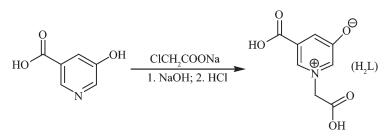
图 Scheme 1
Synthesis and structure of the H2L
Figure Scheme 1.
Synthesis and structure of the H2L


The rational design and assembly of metal-organic coordination polymers (CPs) have made rapid progress due to their aesthetic architectures, topologies and fascinating potential applications, such as luminescence, magnetism, gas storage/separation, catalysis and drug delivery[1-12]. Over the past decade, much effort has been invested in the purposeful design and controllable synthesis of these functional CPs[13]. However, it is still a great challenge to construct target CPs with desired structures and functional properties because many factors, such as metal ion, organic ligand, reagent ratio, solvent, pH value, temperature, and so on, affect the final results[14-16]. Among these strategies for constructing metal-organic coordination polymers, the self-assembly of N-heterocyclic neutral ligands with metal ions under hydro(solvo)thermal conditions has become one of the most effective approaches[17-19].
Moreover, Pb(Ⅱ), a heavy toxic metal, is commonly found in critical life cycles due to its widespread use in numerous industrial applications[20-21]. A good knowledge of the Pb(Ⅱ) coordination properties, including aspects such as the lone pair of electrons, coordination number, and coordination geometry, is crucial for the understanding of the toxicological properties of Pb(Ⅱ). In contrast to transition metals, the main group Pb(Ⅱ) possess unique coordination preferences and electronic properties observed rarely in the rest of the periodic table, presenting unique opportunities for the preparation of novel structures with new and interesting characteristics[22].
We have engaged in the research of CPs with a flexible asymmetric ligand, N-acetic-5-oxygen-nicotinic acid (H2L)[23-24] (Scheme 1). Here we report one-pot synthesis of two new coordination polymers, [Pb4(μ3-O)2L2]n (1) and [Pb3(μ4-O)2L]n (2) from Pb(NO3)2 and H2L (Scheme 2). Because the isolated yield of 1 is too small, thermogravimetry and fluorescence of only 2 were determined.

The ligand H2L was prepared according to the literature method[24]. All other reagents were purchased from Jinan Camolai Trading Company and used without further purification. The elemental analyses of C, H and N were performed on a Perkin-Elmer 2400 Ⅱ elemental analyzer. IR spectrum was measured from KBr pellets in the range of 4 000~400 cm-1 on a Nicolet 5DX FT-IR spectrometer. TG measurements were performed under a flow of nitrogen gas (100 cm3·min-1) from room temperature to 900 ℃ at a heating rate of 10 ℃·min-1 by using a Perkin Elmer TGA-7 thermogravimetric analyzer. The fluorescence spectra were performed on a HITACHIF-2500 fluorescence spectrometer in solid state at room temperature.
A mixture of Pb(NO3)2 (0.40 mmol, 0.133 g), H2L (0.10 mmol, 0.021 g), NaOH (0.60 mmol, 0.024 g), DMF (0.5 mL) in H2O (15 mL) and EtOH (2 mL) was sealed in a 25 mL Teflon-lined stainless steel container, which was heated at 120 ℃ for 72 h and then cooled down to room temperature at a rate of 1.8 ℃·h-1. The pale yellow block-shaped crystals of 1 and the colorless block-shaped crystals of 2 were collected and washed with distilled water and dried in air. The yield of 1 is about 2.0% (based on H2L). Anal. Calcd. for C16H10Pb4N2O12(%): C, 15.36; H, 0.81; N, 2.24. Found(%): C, 15.25; H, 0.77; N, 2.21. IR (KBr, cm-1): 3 532, 3 044, 1 675, 1 577, 1 315, 984, 779, 624. And the yield of 2 is about 67.9% (based on H2L). Anal. Calcd. for C8H5Pb3NO7(%): C, 11.32; H, 0.60; N, 1.65. Found (%): C, 11.30; H, 0.58; N, 1.67. IR (KBr, cm-1): 3 483, 3 052, 1 683, 1 579, 1 308, 984, 750, 617.
Data collection of polymers 1 and 2 were determined on a Bruker SMART APEX Ⅱ diffractometer equipped with a graphite-monochromatized Mo Kα radiation (λ=0.071 073 nm) at 296(2) K. Data intensity was corrected by Lorentz-polarization factors and empirical absorption. The structure was solved by the direct methods and expanded with the difference Fourier techniques. The anisotropic displacement parameters were applied to all non-hydrogen atoms in full-matrix least-squares refinements based on F2. The hydrogen atoms were assigned with isotropic displacement factors and included in the final refinement cycles using geometrical restrains. All calculations were performed with SHELXS-97 and SHELXTL-97 program packages[25]. Single crystal X-ray diffraction analysis reveals that 2 crystallizes in an orthorhombic chiral space group P212121, Flack parameter is 0.48(9) and its absolute structure is not decided. The detailed crystallographic data and structure refinement parameters are summarized in Table 1. Selected bond lengths and angles are given in Table 2.
 下载:
导出CSV
下载:
导出CSV
| Coordination polymer | 1 | 2 |
| Empirical formula | C16H10Pb4N2O12 | C8H5Pb3NO7 |
| Formula weight | 1 251.02 | 848.7 |
| Crystal system | Monoclinic | Orthorhombic |
| Space group | C2/c | P212121 |
| a/nm | 1.442 95(6) | 0.579 73(17) |
| b/nm | 1.648 18(6) | 1.095 1(3) |
| c/nm | 1.941 85(8) | 2.063 2(6) |
| β/(°) | 99.992(3) | |
| V/nm3 | 4.548 1(3) | 1.309 8(7) |
| Z | 8 | 4 |
| Dc/(g·cm-3) | 3.654 | 4.304 |
| μ/mm-1 | 29.589 | 38.493 |
| F(000) | 4 352 | 1 448 |
| Flack parameter | 0.48(9) | |
| θ range/(°) | 1.89~27.73 | 3.5~27.61 |
| Reflection collected | 81 178 | 13 541 |
| Unique reflection (Rint) | 5 324 (0.086 2) | 1 780 (0.106 2) |
| Data with I > 2σ(I) | 4 698 | 1 506 |
| Parameter refined | 307 | 88 |
| goodness-of-fit (on F2) | 1.055 | 1.054 |
| R, wR [I > 2σ(I)] | 0.038 2, 0.096 6 | 0.056 6, 0.142 0 |
| R, wR (all data) | 0.046 4, 0.100 8 | 0.069 3, 0.148 9 |
| (△ρ)max, (△ρ)min/(e·nm-3) | 5 924, -2 218 | 5 813, -4 748 |
下载:
导出CSV
| 1 | |||||
| Pb1-O11 | 0.224 0(7) | Pb1-O11#1 | 0.233 1(7) | Pb1 -O8 | 0.237 6(8) |
| Pb2-O2 | 0.261 2(8) | Pb2-O11 | 0.230 3(7) | Pb2-O12 | 0.232 9(7) |
| Pb2-O3#2 | 0.250 8(8) | Pb3-O12#3 | 0.230 8(7) | Pb3-O3#2 | 0.244 7(8) |
| Pb3-O12 | 0.234 7(7) | Pb3-O5#4 | 0.274 1(9) | Pb4-O6#6 | 0.271 2(9) |
| Pb4-O12 | 0.222 6(7) | Pb4-O11 | 0.233 3(7) | Pb4-O7#6 | 0.261 6(8) |
| Pb4-O9#5 | 0.261 6(9) | ||||
| O11-Pb1-O11#1 | 75.1(3) | O11-Pb1-O8 | 85.7(3) | O11#1-Pb1-O8 | 78.4(3) |
| O11-Pb2-O3#2 | 99.1(3) | O11-Pb2-O12 | 73.5(3) | O11-Pb2-O2 | 99.2(3) |
| O12-Pb2-O3#2 | 71.7(3) | O3#2-Pb2-O2 | 140.4(3) | O12-Pb2-O2 | 80.4(3) |
| O12#3-Pb3-O12 | 73.0(3) | O12#3-Pb3-O3#2 | 106.7(3) | O12-Pb3-O3#2 | 72:5(3) |
| O12#3-Pb3-O5#4 | 82.0(3) | O12#3-Pb3-O5#4 | 77:5(3) | O3#2-Pb3-O5#6 | 144.3(3) |
| O12-Pb4-O11 | 74.9(3) | O12-Pb4-O9#5 | 81.8(3) | O11-Pb4-O9#5 | 75:0(3) |
| O12-Pb4-O7#6 | 99.1(3) | O11-Pb4-O7#6 | 77.5(2) | O9#5-Pb4-O7#6 | 151.2(3) |
| O12-Pb4-O6#6 | 77.9(3) | O11-Pb4-O6#6 | 113.8(3) | ||
| 2 | |||||
| Pb1-O8#1 | 0.219(2) | Pb1-O7 | 0:220(2) | Pb1-O6 | 0.258(18) |
| Pb2-O7#1 | 0.240(2) | Pb2-O7 | 0:234(2) | Pb2-O8 | 0:242(2) |
| Pb2-O8#1 | 0.240(2) | Pb3-O8 | 0.221(2) | Pb3-O7#1 | 0.230(2) |
| Pb3-O1#2 | 0.241(2) | Pb3-O3#3 | 0.266(19) | ||
| O8#1-Pb1-O7 | 81.5(7) | O8#1-Pb1-O6 | 76:6(7) | O7-Pb1-O6 | 78.5(7) |
| O7-Pb2-O7#1 | 115.5(4) | O7-Pb2-O8#1 | 74.1(6) | O7#1-Pb2-O8#1 | 72:4(7) |
| O7-Pb2-O8 | 73.2(7) | O7#1-Pb2-O8 | 75.1(6) | O8#1-Pb2-O8 | 116.6(4) |
| O8-Pb3-O7#1 | 81.2(6) | O8-Pb3-O1#2 | 88:2(8) | O7#1-Pb3-O1#2 | 78.1(7) |
| O8-Pb3-O3#3 | 76.1(7) | O7#1-Pb3-O3#3 | 152.0(7) | O1#2-Pb3-O3#3 | 84:9(7) |
| Symmetry codes: #1: -x, -y+1, -z; #2: x, -y+1, z-1/2; #3: -x+1/2, -y+1/2, -z; #4: x-1/2, -y+1/2, z-1/2; #5: -x-1/2, -y+1/2, -z; #6: -x, y, -z+1/2; #7: x, -y+1, z+1/2; #8: x+1/2, -y+1/2, z+1/2 for 1; #1: x-1/2, -y+1/2, -z+1; #2: x, y+1, z; #3: -x+1, y+1/2, -z+1/2; #4: x, y-1, z; #5: -x+1, y-1/2, -z+1/2; #6: x+1/2, -y+1/2, -z+1 for 2. | |||||
CCDC: 1432217, 1; 1432218, 2.
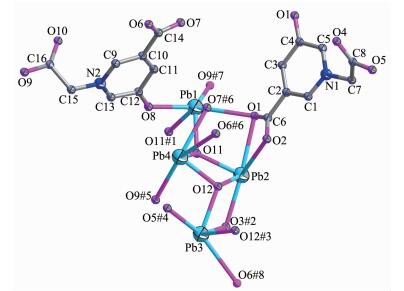
Single crystal X-ray diffraction analysis reveals that 1 crystallizes in the monoclinic space group C2/c. The asymmetric unit contains four Pb(Ⅱ) cations, two L2- ligands and two μ3-O2- anions. As shown in Fig. 1, the four Pb(Ⅱ) ions are bridged by two μ3-O2-(O11, O12) anions from the inner of the Pb4 distorted tetrahedron core, simultaneously, the four Pb(Ⅱ) ions inhabit the four apexes of the presumed tetrahedron and the four Pb(Ⅱ) ions are all five-coordinated by five oxygen atoms. Pb1 is coordinated by two μ3-O2- anion, one oxygen atom from -CH2-COOH group, one carboxylate oxygen atom and one phenol oxygen atom. Pb2 is coordinated by two μ3-O2- anions, two carboxylate oxygen atoms and one phenol oxygen atom. Pb3 is coordinated by two μ3-O2- anions, one oxygen atom from -CH2-COOH group, one carboxylate oxygen atom and one phenol oxygen atom. Pb4 is coordinated by two μ3-O2- anions, two carboxylate oxygen atoms and one oxygen atom from -CH2-COOH group. The Pb-O bond lengths are in the range of 0.222 6(7)~0.285 8(11) nm, which are comparable to those reported for other Pb(Ⅱ) complexes[26].
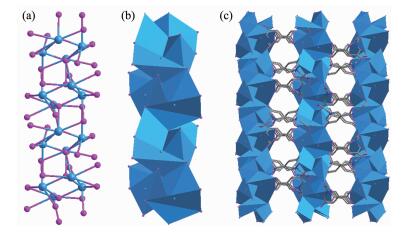
[Pb4(μ3-O)2] motif and its crystallographically equivalent ones form a [Pb4(μ3-O)2]n rigid inorganic chain (Fig. 2a), referred to as secondary building units (SBUs)[27]. The SBUs can be considered as the "joints" and the organic links as the "struts", and 1 displays a 3D network constructed from discrete inorganic chains and organic links (Fig. 2b, 2c).
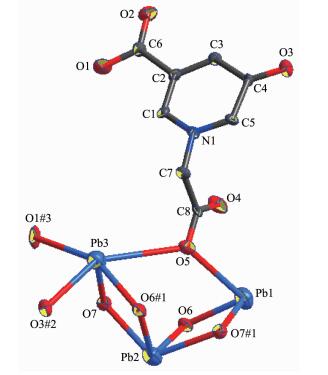
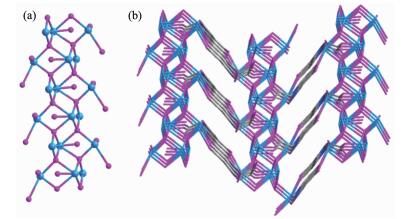
Single crystal X-ray diffraction analysis reveals that there are three unique Pb(Ⅱ) cations, one L2- ligand and two μ4-O2- anions in asymmetric unit of 2. As shown in Fig. 3, the three Pb(Ⅱ) ions are bridged by four μ4-O2- anions. Pb1 is three-coordinated and has a slightly triangular pyramid coordination environment. Pb2 is four-coordinated with four μ4-O2- anions and has a slightly distorted pyramid environment. Pb3 ion is four-coordinated and has a distorted pyramid coordination environment. The Pb-O distances range from 0.220(2) to 0.268 3(19) nm, which are in agreement with those reported Pb(Ⅱ) complexes[26]. [Pb3(μ4-O)2] motif and its crystallographically equivalent ones form a [Pb3(μ4-O)2]n inorganic chain (Fig. 4a). 2 displays a 3D network constructed from inorganic chains and organic links (Fig. 4b).
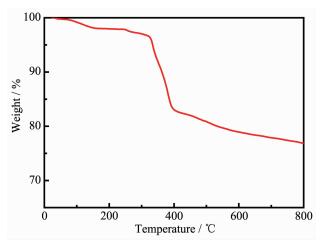
As shown in Fig. 5, the TG curve of 2 indicates that the first weight loss of 3.54% from 84 to 325 ℃ corresponds to the removal of two crystalline μ4-O ions (Calcd. 3.78%). The decomposition of the residue occurs in the range of 325~415 ℃, it may be caused by the complete decomposition of L2- ligands. The remaining weight of 78.89% should be the final product PbO (Calcd. 78.25%).
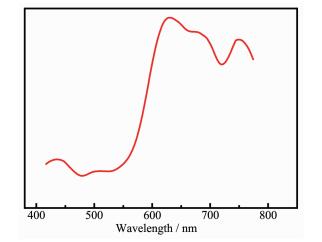
The solid fluorescence spectra of 2 at room temperature are shown in Fig. 6. According to the literature[25], the free H2L displays one strong peak at maxima 564 nm under excitation at 366 nm. Polymer 2 shows a fluorescence emission band locating at around 645 nm upon excitation at 397 nm, which could be assigned to ligand-to-metal-charge-transfer (LMCT) process[28-30].
Silva P, Vilela S M F, Tome J P C, et al. Chem. Soc. Rev., 2015, 44:6774-6803 doi: 10.1039/C5CS00307E
Niu L Y, Chen Y Z, Zheng H R, et al. Chem. Soc. Rev., 2015, 44:6143-6160 doi: 10.1039/C5CS00152H
Cui Y J, Zhu F L, Chen B L, et al. Chem. Commun., 2015, 51:7420-7431 doi: 10.1039/C5CC00718F
Cao K L, Xia Y, Wang G X, et al. Inorg. Chem. Commun., 2015, 53:42-45 doi: 10.1016/j.inoche.2015.01.021
Xia Y, Cao K L, Han M M, et al. Inorg. Chem. Commun., 2015, 56:76-78 doi: 10.1016/j.inoche.2015.03.049
Zhang L, Liu L, Huang C, et al. Cryst. Growth Des., 2015, 15:3426-3434 doi: 10.1021/acs.cgd.5b00504
Wu N, Melan C F C, Stevenson K A, et al. Dalton Trans., 2015, 44:14991-15005 doi: 10.1039/C5DT00233H
Jiang J C, Yaghi O M. Chem. Rev., 2015, 115:6966-6997 doi: 10.1021/acs.chemrev.5b00221
He Y B, Li B, O'Keeffe M, et al. Chem. Soc. Rev., 2014, 43: 5618-5656 doi: 10.1039/C4CS00041B
He H M, Song Y, Sun F X, et al. Cryst. Growth Des., 2015, 15:2033-2038 doi: 10.1021/acs.cgd.5b00229
Li S Z, Huo F W. Nanoscale, 2015, 7:7482-7501 doi: 10.1039/C5NR00518C
Sun L B, Liu X Q, Zhou H C. Chem. Soc. Rev., 2015, 44: 5092-5147 doi: 10.1039/C5CS00090D
Zhang J P, Zhang Y B, Lin J B, et al. Chem. Rev., 2012, 112:1001-1033 doi: 10.1021/cr200139g
Wang R Y, Song D T, Wang S N. Chem. Commun., 2002: 368-369 http://pubs.rsc.org/en/content/articlelanding/2002/cc/b105969f#!divAbstract
Ma T, Li M X, Wang Z X, et al. Cryst. Growth Des., 2014, 14:4155-4165 doi: 10.1021/cg500751e
Gai Y L, Jiang F L, Chen L, et al. Dalton Trans., 2013, 42: 9954-9965 doi: 10.1039/c3dt50532d
刘光祥.无机化学学报, 2013, 29(9):1914-1920 http://www.wjhxxb.cn/wjhxxbcn/ch/reader/view_abstract.aspx?flag=1&file_no=20130923&journal_id=wjhxxbcnLIU Guang-Xiang. Chinese J. Inorg. Chem., 2013, 29(9):1914-1920 http://www.wjhxxb.cn/wjhxxbcn/ch/reader/view_abstract.aspx?flag=1&file_no=20130923&journal_id=wjhxxbcn
刘振香, 陈鋆, 罗小会, 等.无机化学学报, 2015, 31(12):2291-2297 http://www.wjhxxb.cn/wjhxxbcn/ch/reader/view_abstract.aspx?flag=1&file_no=20151203&journal_id=wjhxxbcnLIU Zhen-Xiang, CHEN Yun, LUO Xiao-Hui, et al. Chinese J. Inorg. Chem., 2015, 31(12):2291-2297 http://www.wjhxxb.cn/wjhxxbcn/ch/reader/view_abstract.aspx?flag=1&file_no=20151203&journal_id=wjhxxbcn
刘娥, 张强, 董丽芳, 等.化学通报, 2016, 79:839-843 doi: 10.3969/j.issn.1007-2802.2016.05.004LIU E, ZHANG Qiang, DONG Li-Fang, et al. Chemistry, 2016, 79:839-843 doi: 10.3969/j.issn.1007-2802.2016.05.004
Chen S C, Zhang Z H, Zhou Y S, et al. Cryst. Growth Des., 2011, 11:4190-4197 doi: 10.1021/cg200785g
Fan S R, Zhu L G. Inorg. Chem., 2007, 46:6785-6793 doi: 10.1021/ic700611e
Zhao Y H, Xu H B, Fu Y M, et al. Cryst. Growth Des., 2008, 10:3566-3576 doi: 10.1021/cg701224h
Zhan C H, Jiang M X, Feng Y L, et al. CrystEngComm, 2010, 12:420-424 doi: 10.1039/B909889E
Jiang M X, Zhan C H, Feng Y L, et al. Cryst. Growth Des., 2010, 10:92-98 doi: 10.1021/cg900416v
Sheldrick G M. SHELXS-97, Program for Crystal Structure Refinement, and SHELXL-97, Program for Crystal Structure Solution, Göttingen University, Germany, 1997.
Gabriel C, Karakosta P, Vangelis A A, et al. Cryst. Growth Des., 2015, 15:1666-1682 doi: 10.1021/cg501628d
Rosi N L, Kim J, Eddaoudi M, et al. J. Am. Chem. Soc., 2005, 127:1504-1518 doi: 10.1021/ja045123o
Qin Y Y, Zhang J, Li Z J, et al. Chem. Commun., 2008:2532-2534 http://pubs.rsc.org/en/content/articlelanding/2008/cc/b800017d#!divAbstract
Chen L, Xu G J, Shao K Z, et al. CrystEngComm, 2010, 12: 2157-2165 doi: 10.1039/b918647f
Dai J C, Wu X T, Fu Z Y, et al. Inorg. Chem., 2002, 41: 1391-1396 doi: 10.1021/ic010794y

Figure 1 View of the coordination environment of the center Pb(Ⅱ) ions in 1
H atoms and lattice water molecules are omitted for clarity; Thermal ellipsoids are shown at the 30% probability level; Symmetry codes: #1:-x, -y+1, -z; #2: x, -y+1, z-1/2; #3: -x+1/2, -y+1/2, -z; #4: x-1/2, -y+1/2, z-1/2; #5: -x-1/2, -y+1/2, -z; #6: -x, y, -z+1/2; #7: x+1/2, y+1/2, z; #8: x+1/2, -y+1/2, z-1/2

Figure 2 (a) Ball-and-stick representation of inorganic SBU; (b) SBU with Pb(Ⅱ) shown as polyhedron; (c) 3D framework with inorganic SBUs linked together via L2-

Figure 3 View of the coordination environment of the center Pb(Ⅱ) ions in 2
H atoms and lattice water molecules are omitted for clarity; Thermal ellipsoids are shown at the 30% probability level; Symmetry codes: #1: x+1/2, -y+3/2, -z+1; #2: x, y+1, z; #3:-x, y+1/2, -z+1/2

Figure 4 (a) Ball-and-stick representation of inorganic SBU; (b) 3D framework with inorganic SBUs linked together via L2-
Table 1. Crystal data and structure refinements for 1 and 2
| Coordination polymer | 1 | 2 |
| Empirical formula | C16H10Pb4N2O12 | C8H5Pb3NO7 |
| Formula weight | 1 251.02 | 848.7 |
| Crystal system | Monoclinic | Orthorhombic |
| Space group | C2/c | P212121 |
| a/nm | 1.442 95(6) | 0.579 73(17) |
| b/nm | 1.648 18(6) | 1.095 1(3) |
| c/nm | 1.941 85(8) | 2.063 2(6) |
| β/(°) | 99.992(3) | |
| V/nm3 | 4.548 1(3) | 1.309 8(7) |
| Z | 8 | 4 |
| Dc/(g·cm-3) | 3.654 | 4.304 |
| μ/mm-1 | 29.589 | 38.493 |
| F(000) | 4 352 | 1 448 |
| Flack parameter | 0.48(9) | |
| θ range/(°) | 1.89~27.73 | 3.5~27.61 |
| Reflection collected | 81 178 | 13 541 |
| Unique reflection (Rint) | 5 324 (0.086 2) | 1 780 (0.106 2) |
| Data with I > 2σ(I) | 4 698 | 1 506 |
| Parameter refined | 307 | 88 |
| goodness-of-fit (on F2) | 1.055 | 1.054 |
| R, wR [I > 2σ(I)] | 0.038 2, 0.096 6 | 0.056 6, 0.142 0 |
| R, wR (all data) | 0.046 4, 0.100 8 | 0.069 3, 0.148 9 |
| (△ρ)max, (△ρ)min/(e·nm-3) | 5 924, -2 218 | 5 813, -4 748 |
 下载: 导出CSV
Table 2. Selected bond lengths (nm) and angles (°) for 1 and 2
| 1 | |||||
| Pb1-O11 | 0.224 0(7) | Pb1-O11#1 | 0.233 1(7) | Pb1 -O8 | 0.237 6(8) |
| Pb2-O2 | 0.261 2(8) | Pb2-O11 | 0.230 3(7) | Pb2-O12 | 0.232 9(7) |
| Pb2-O3#2 | 0.250 8(8) | Pb3-O12#3 | 0.230 8(7) | Pb3-O3#2 | 0.244 7(8) |
| Pb3-O12 | 0.234 7(7) | Pb3-O5#4 | 0.274 1(9) | Pb4-O6#6 | 0.271 2(9) |
| Pb4-O12 | 0.222 6(7) | Pb4-O11 | 0.233 3(7) | Pb4-O7#6 | 0.261 6(8) |
| Pb4-O9#5 | 0.261 6(9) | ||||
| O11-Pb1-O11#1 | 75.1(3) | O11-Pb1-O8 | 85.7(3) | O11#1-Pb1-O8 | 78.4(3) |
| O11-Pb2-O3#2 | 99.1(3) | O11-Pb2-O12 | 73.5(3) | O11-Pb2-O2 | 99.2(3) |
| O12-Pb2-O3#2 | 71.7(3) | O3#2-Pb2-O2 | 140.4(3) | O12-Pb2-O2 | 80.4(3) |
| O12#3-Pb3-O12 | 73.0(3) | O12#3-Pb3-O3#2 | 106.7(3) | O12-Pb3-O3#2 | 72:5(3) |
| O12#3-Pb3-O5#4 | 82.0(3) | O12#3-Pb3-O5#4 | 77:5(3) | O3#2-Pb3-O5#6 | 144.3(3) |
| O12-Pb4-O11 | 74.9(3) | O12-Pb4-O9#5 | 81.8(3) | O11-Pb4-O9#5 | 75:0(3) |
| O12-Pb4-O7#6 | 99.1(3) | O11-Pb4-O7#6 | 77.5(2) | O9#5-Pb4-O7#6 | 151.2(3) |
| O12-Pb4-O6#6 | 77.9(3) | O11-Pb4-O6#6 | 113.8(3) | ||
| 2 | |||||
| Pb1-O8#1 | 0.219(2) | Pb1-O7 | 0:220(2) | Pb1-O6 | 0.258(18) |
| Pb2-O7#1 | 0.240(2) | Pb2-O7 | 0:234(2) | Pb2-O8 | 0:242(2) |
| Pb2-O8#1 | 0.240(2) | Pb3-O8 | 0.221(2) | Pb3-O7#1 | 0.230(2) |
| Pb3-O1#2 | 0.241(2) | Pb3-O3#3 | 0.266(19) | ||
| O8#1-Pb1-O7 | 81.5(7) | O8#1-Pb1-O6 | 76:6(7) | O7-Pb1-O6 | 78.5(7) |
| O7-Pb2-O7#1 | 115.5(4) | O7-Pb2-O8#1 | 74.1(6) | O7#1-Pb2-O8#1 | 72:4(7) |
| O7-Pb2-O8 | 73.2(7) | O7#1-Pb2-O8 | 75.1(6) | O8#1-Pb2-O8 | 116.6(4) |
| O8-Pb3-O7#1 | 81.2(6) | O8-Pb3-O1#2 | 88:2(8) | O7#1-Pb3-O1#2 | 78.1(7) |
| O8-Pb3-O3#3 | 76.1(7) | O7#1-Pb3-O3#3 | 152.0(7) | O1#2-Pb3-O3#3 | 84:9(7) |
| Symmetry codes: #1: -x, -y+1, -z; #2: x, -y+1, z-1/2; #3: -x+1/2, -y+1/2, -z; #4: x-1/2, -y+1/2, z-1/2; #5: -x-1/2, -y+1/2, -z; #6: -x, y, -z+1/2; #7: x, -y+1, z+1/2; #8: x+1/2, -y+1/2, z+1/2 for 1; #1: x-1/2, -y+1/2, -z+1; #2: x, y+1, z; #3: -x+1, y+1/2, -z+1/2; #4: x, y-1, z; #5: -x+1, y-1/2, -z+1/2; #6: x+1/2, -y+1/2, -z+1 for 2. | |||||
下载: 导出CSV

 扫一扫看文章


扫一扫关注我们


 下载:
下载: