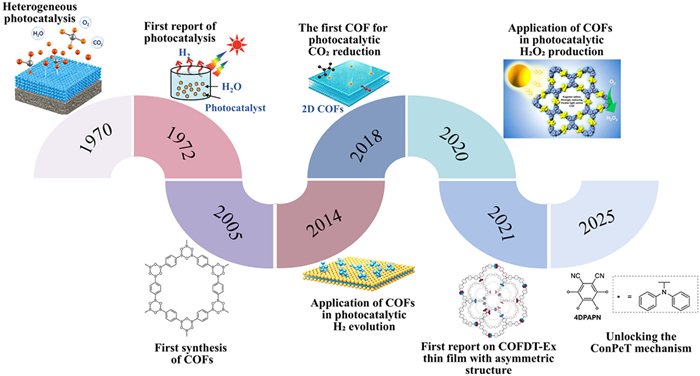
Figure 1.
Technology evolution from basic photocatalysis to COFs asymmetric structure innovation.

Research progress on the regulation of asymmetric defect electronic structure of COFs to enhance solar energy conversion
Luyuan Zhang , Xibao Li , Dian Bao , Yu Xie , Yingtang Zhou , Yidan Luo , Bin Liu


Photocatalysis is a key technology path to realize the conversion of solar energy to chemical energy. However, the energy transfer efficiency and photon utilization rate of the existing asymmetric photocatalytic system are still far from the theoretical limit, which seriously restricts the efficient conversion and storage of solar energy [1]. At present, the continuous consumption of global fossil energy has spawned a severe energy and environmental crisis, and the development of renewable energy has become the focus of development. Solar energy has the advantages of clean, renewable and abundant reserves. It is of great significance to alleviate energy pressure and improve the ecological environment to realize its efficient utilization [2,3]. As a key technical path for solar energy conversion, the field of photocatalysis has undergone an evolution from basic theory to application innovation, As shown in Fig. 1, heterogeneous photocatalysis research began to be proposed and explored by researchers around 1970. In 1972, Japanese scientist Fujishima found the phenomenon of titanium dioxide photolysis of water [4], officially opening a new era of semiconductor photocatalysis research. With the development of material science, photocatalytic systems continue to break through the traditional boundary-covalent organic framework (COF) materials because of their designability into the research field of vision. In 2005, the Omar Yaghi research group at the University of California, Berkeley, first reported COFs in 'science', that is, its asymmetric defect characteristics, which opened up a new dimension for the regulation of photocatalytic performance [5]. Since then, the application of COFs in the field of photocatalysis has been rapidly deepened. In 2014, Stegbauer et al. first developed COF materials based on hydrazone bonds and successfully applied them to photocatalytic hydrogen production [6]. After that, Yang et al. further expanded its application boundary, and designed two-dimensional COFs to achieve visible-light-driven CO2 reduction [7]; in 2020, Krishnaraj et al. made a key breakthrough and developed strong reducing COFs based on the structure of diarylamine benzene, which realized the generation of H2O2 driven by visible light under metal-free conditions [8]. In the face of challenges, technological innovation continues to advance. In the past two years, COFDT-Ex asymmetric structure films with hydrophilic gradient and pore size gradient have been successfully developed, and the photocatalytic performance has been optimized [9]. By 2025, the revelation of the ConPeT mechanism has further analyzed the photocatalytic process of COFs from the atomic scale, providing a theoretical breakthrough for the rational design of high-performance materials [10].
Photocatalytic modification strategies for COFs can be classified into four categories: Traditional defect engineering, skeleton functionalization, topological regulation, and asymmetric structure construction. The former three approaches operate at the macroscopic level by introducing random disorder, appending functional groups, or modulating topological frameworks. In contrast, asymmetric defects are microscopic symmetry-breaking units, including vacancies, bonding imbalances, and lattice distortions, that differ fundamentally in both scale and electronic mechanism. Accordingly, this review strictly includes only original studies that employ asymmetric defects to engineer the electronic structure of COFs with quantitative validation of photocatalytic performance, while excluding reports limited to macroscopic asymmetry or lacking defect quantification. This enables a focused understanding of how asymmetric defects influence carrier separation, clarifies the boundaries among modification strategies, and provides a clear overview of the current research landscape.
In recent years, asymmetric defect photocatalysis has become the frontier direction to improve solar energy conversion efficiency. By introducing asymmetric defects such as vacancies [11], doping [12], and lattice distortion [13], the electronic structure and surface properties of the photocatalyst can be accurately regulated, and the separation efficiency and reaction kinetics of photogenerated carriers can be significantly improved. However, this field faces three core challenges: Difficulty in precise defect control, insufficient defect stability, and lagging in-situ quantitative characterization.
Taking COFs catalyst as an example, its defect concentration window is extremely narrow [14], spatial distribution control is difficult [15], site stability is poor [16,17], and the characterization mechanism is missing [18]. High charge recombination rate [19], high synthesis cost and large-scale production obstacles [20,21] restrict the practical application process.
Although there are still many intractable bottlenecks in the strategy of regulating the photocatalytic performance of COFs through conventional intrinsic defect engineering, the proposal of asymmetric defects offers a new approach to addressing these limitations. Asymmetric defects are defined as micro-distortion units within the intrinsically highly symmetric crystal lattice of COFs, where irreversible local symmetry breaking occurs due to atomic loss, bonding imbalance, local lattice distortion, unequal substitution of heterogeneous atoms, and charge mismatch at two-phase interfaces. According to its structural characteristics and formation mechanism, asymmetric defects can be divided into three types: Vacancy type, distortion type and doping type. Unlike symmetric defects that only break periodicity, or conventional defects that only lead to disordered performance degradation, asymmetric defects achieve dual symmetry breaking. This property enables the formation of directional field gradients, allowing precise control over carrier dynamics, polarization, and stress, thereby transforming inherent lattice imperfections into effective anisotropic functional platforms.
COFs are two-dimensional or three-dimensional crystalline porous materials formed by ordered polymerization of organic monomers. Conventional polymerization is easy to lead to disordered structure due to irreversible reaction, and the synthesis of crystalline ordered COFs needs to rely on reversible covalent bonds (such as imine bonds and borate ester bonds). The reaction has dynamic error correction ability by heating and other conditions, and the dynamic reversible bonds are used to assemble molecules to construct units to form an ordered crystal framework, which promotes the transformation of molecules from disordered kinetic products to ordered thermodynamic products. The periodic lattice connected by covalent bonds can realize the regulation of electronic structure from molecular to macroscopic scale, and has significant advantages in light absorption, carrier migration and surface active site optimization. These materials have ultra-lightweight, high specific surface area characteristics [22], and the pore structure and overall framework can be adjusted on demand [23]. Their ordered porosity shows significant application potential in the fields of catalysis, adsorption and separation, photoelectric conversion, sensing, energy storage and environmental remediation [24-29].
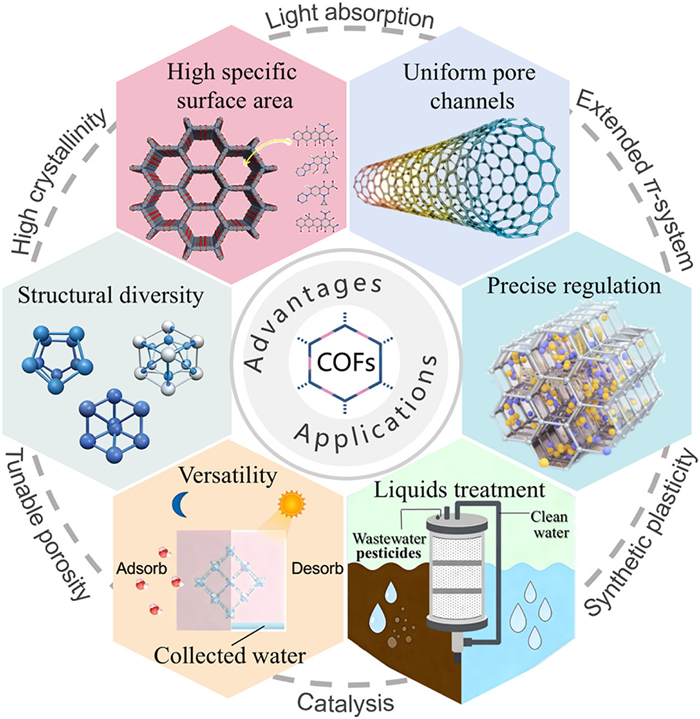
The light absorption range of traditional semiconductors is narrow. Although some semiconductors have visible light absorption, the structure is relatively single and the control methods are relatively limited. It is difficult to achieve continuous and accurate control of their optical properties and electronic structures. The application conversion efficiency of traditional semiconductor photocatalysts is generally less than 10%. As shown in Fig. 2, compared with traditional inorganic photocatalytic materials, COFs as heterogeneous photocatalysts have unique advantages: (1) The molecular controllable structure based on the organic building unit can accurately adjust the catalytic function and energy level [30,31]; (2) Uniform pore structure promotes substrate mass transfer and forms a limited catalytic environment [32]; (3) Simple post-synthetic functionalization can enhance catalytic activity or give versatility [33]; (4) The structure is diverse and adjustable. The π-conjugated network is constructed by monomer selection, and the energy band is accurately controlled to achieve wide spectral absorption; (5) COFs usually exhibit excellent porosity and large specific surface area. The Brunauer-Emmett-Teller (BET) specific surface area of 3D-TFB-COF-Et can reach 4502 m2/g [34]; (6) The clear crystal structure is conducive to mechanism research, and molecular design and modification can expand the application [35].
The core challenge of photocatalysis is to achieve efficient charge separation and directional migration, and asymmetric defects play a key role in this process. Asymmetric defects can break the symmetry of the electronic structure of the material, trigger energy level reconstruction, and form a stepped band arrangement between the electron-donating unit and the electron-withdrawing unit. The inhomogeneity of the local electronic environment caused by defects will distort the energy band structure, form local energy levels and change the electron transport path, and then generate a built-in electric field from the donor to the acceptor due to the asymmetric charge distribution. The built-in electric field acts as an 'electron pump', providing a driving force for charge separation, guiding the directional migration of photogenerated electrons, and significantly inhibiting carrier recombination. The synergistic effect of energy level reconstruction and built-in electric field realizes the precise regulation of electronic states, which provides an important guarantee for the efficient separation and utilization of photogenerated charges.
The photocatalytic activity of defective photocatalysts is jointly determined by defect energy level, concentration, spatial distribution, local electronic structure, and adsorption behavior. Shallow-level defects promote charge separation, while deep-level ones trap carriers and exacerbate recombination. Low defect concentrations are functional, but excessive loading turns isolated defects into recombination channels. Bulk-distributed defects enhance recombination, whereas surface-segregated ones benefit separation. Moderate lattice distortion aids transport, while excessive distortion impedes it.
The core criterion for determining defect functionality lies in the coupling efficiency between defect engineering and reactant adsorption and activation. Specifically, defects that simultaneously enable charge capture and reactant activation can compensate for carrier recombination losses and boost photocatalytic activity. In contrast, defective sites lacking such dual functions will offset the advantages of enhanced charge separation. Accordingly, defects featuring shallow energy levels, low concentration, interfacial segregation, and moderate reactant adsorption are conducive to photocatalysis, whereas deep-level, high-concentration, bulk-dispersed defects with inappropriate adsorption behavior generally serve as detrimental recombination centers. Notably, these two functional states of defects can undergo dynamic interconversion under external field regulation, necessitating accurate identification and systematic verification via advanced characterization techniques and theoretical calculations.
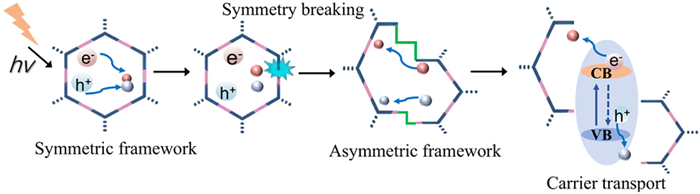
The efficient separation and directional migration of photogenerated carriers are the core of photocatalytic efficiency improvement, and charge enrichment and interface synergy provide a key guarantee for this process. As shown in Fig. 3, under the excitation of light, the electrons in the valence band (VB) of the material transition to the conduction band (CB) to produce photogenerated electrons (e-) and holes (h+), but the carriers in the intrinsic structure are easy to recombine quickly, resulting in a limited number of carriers effectively participating in the reaction. By introducing asymmetric defects (structural distortion and site deletion shown in the green area of the graph), precise electron traps can be constructed inside the material to realize the directional capture and enrichment of photogenerated electrons, fundamentally inhibit the bulk recombination of carriers, and transform dispersed active sites into highly active reaction centers, greatly improving the reduction rate of reactants. When the asymmetric defect strategy is applied to the heterojunction system, the defect-modified heterojunction interface further exerts a synergistic effect: On the one hand, the built-in electric field and energy level matching at the interface can drive the directional migration of carriers and accelerate the separation of electron-hole pairs; on the other hand, the high concentration of electrons enriched at the defect sites can optimize the surface electron cloud distribution and intermediate adsorption strength, reduce the reaction energy barrier and improve the selectivity. In essence, this process realizes the efficient management of the whole chain of photogenerated carriers from excitation, separation, migration to enrichment and utilization through the integrated collaborative optimization of the electronic structure and interface characteristics of the material, and converts more light energy into chemical energy, which fundamentally improves the overall efficiency and practicability of the photocatalytic system.
When the electron is transferred from the donor (D) to the acceptor (A), this type of reaction is defined as an electron transfer (ET) reaction. The classical Marcus theory [36] is often used to explain the electron transfer reaction. Electron transfer can occur either between ground state molecules or from thermally excited states or photoexcited states. When the electron transfer occurs after the photoexcitation of the donor or acceptor, the process is called photoinduced electron transfer (PET). Since the molecular light excitation will lead to an increase in its energy state, the driving force of electron transfer in the excited state is enhanced. The electron transfer from the photoexcited donor (D*) to the acceptor is usually expressed as
|
|
The donor excited by light can form three states: Ground state (D-A), initial excited state (
|
|
The analysis of the equation reveals that the relationship between the reaction driving force and the rate is divided into three characteristic intervals: In the 'normal zone', the rate increases with the increase of the driving force; into the 'no activation zone', the rate reaches the maximum; when the driving force further increases to the 'abnormal zone', the rate decreases abnormally with the increase of the driving force. This three-region model reveals that the driving force in the electron transfer process is not as large as possible, which provides an important theoretical basis for the optimization of charge separation efficiency in photocatalytic system [37]. The continuous photoinduced electron transfer (ConPET) mechanism realizes energy superposition by step-by-step two-photon excitation, which can continuously transfer electrons, complete efficient reduction under mild conditions, and avoid the instability of high-energy intermediates. At present, many research teams have studied the reaction mechanism of photosensitizer 4DPAPN (PC) and made new progress. The reaction mechanism of PC*•− is controversial: The Italian team believed that PC*•− reacts with acetonitrile to form a solvated electron-dominated reaction [10]. However, the team of Nankai University confirmed through rigorous experiments that the solvated electron path thermodynamics is not feasible, and the results may be due to system defects or impurity interference, and cannot rule out the proton-coupled electron transfer (PCET) process secondary to ConPET, and then proposed a new mechanism including proton reduction and hydrogen atom transfer (HAT) [38]. This controversy highlights the complexity of photocatalytic reduction mechanism research.
The asymmetric distribution of the electron cloud caused by the defect structure forms a stronger built-in electric field inside the COF, which directly induces band bending and distortion, and produces local energy levels that can act as intermediate states for electron capture or transfer [39]. Within the framework of Marcus theory, asymmetric defects significantly accelerate electron transfer by reducing the internal reorganization energy (λ) and increasing the effective driving force (-ΔG). Two charge separation states (CSS-1 and CSS-2) generated by sequential electron transfer were directly observed via femtosecond transient absorption spectroscopy of benzothiadiazole (BTD)-COF with asymmetric ternary units. The lifetimes of CSS-1 and CSS-2 are significantly longer than those of symmetric control samples, which confirms that asymmetric defects can stabilize charge separation states and inhibit charge recombination [40]. However, when single photoexcitation or one-step electron transfer is not sufficient to overcome the high activation energy barrier of subsequent catalytic steps, the ConPET mechanism demonstrates its unique value. In this mechanism, a catalyst (such as perylene diimide PDI) is first reduced to a stable radical anion, which then absorbs a second photon to transition to a more reductive excited state. This process achieves energy accumulation and enables high-difficulty reduction reactions [41].
The local energy level in the asymmetric defect COF can act as a stable PDI intermediate to promote efficient ConPET processes. Similarly, anthraquinone-based COF (DAAQ-TFP) forms a supramolecular charge transfer system via host-guest assembly. Femtosecond transient absorption spectroscopy and electron paramagnetic resonance measurements confirm that photoinduced charge transfer completes within 110 fs, and the charge separation quantum yield at room temperature reaches 13%. This work demonstrates that the π-π stacking network of two-dimensional COF can construct charge transport pathways and stabilize the redox state of active species. This mechanism is essentially interconnected with the stabilization of intermediates by the local energy levels of defective COF: Both indicate that ordered charge transport pathways are the core of efficient carrier separation [42]. Marcus theory is suitable for describing the initial single-step electron transfer of photogenerated charges in COF, but it struggles to explain multi-photon and multi-step processes. While the ConPET mechanism accounts for stepwise electron transfer, it is constrained by the stability of intermediates and secondary light-harvesting efficiency. These two frameworks achieve synergistic effects in asymmetrically defective COF: In desymmetric NiSN3Por-PDAN-COF, thiophene, pyrrole, and metal sites act as electron channels, proton hopping sites, and CO2 binding sites, respectively. Local energy levels and band bending regulate the flow of electrons, protons, and holes, enabling spatial coordination of initial charge separation and subsequent multi-electron transfer, and achieving a CO yield approximately 65 times that of the symmetric structure [43]. Therefore, asymmetric defects not only improve intrinsic charge transfer efficiency by regulating the driving force and recombination energy in Marcus theory, but also create conditions for stabilizing intermediates and enabling stepwise transfer for multi-step mechanisms such as ConPET.
Based on the intrinsic origin of asymmetric defects in COF skeletons, all construction strategies are reclassified into three categories: (1) In-situ defect generation during monomer assembly, which produces linkage defects, vacant sites and steric-induced lattice distortion at the molecular polymerization stage; (2) post-skeleton reconstruction to introduce local asymmetry, including post-synthetic functionalization, topological rearrangement and template-induced asymmetric interfaces; (3) multicomponent one-pot polymerization to construct multi-site asymmetric frameworks. The following sections systematically summarize each category, organized by defect formation mode, for solar photocatalysis applications.
Linkage modification generates asymmetric linkage defects via covalent bond regulation. This method is an effective means of regulating the skeleton of COFs. It introduces functional groups with specific electronic or spatial effects by precise chemical regulation of covalent bonds or side groups in COFs. In recent years, Li et al. [44] systematically investigated polyimide (PI) linkers for COF construction, highlighting that PI linkers integrate donor amine and acceptor anhydride moieties to impart reversible electron transfer capability to the COF framework. This work establishes a clear design strategy for precisely tuning the band structure and electronic behavior of COFs via chemical modification of linkers, which lays a foundational connection chemistry framework for optimizing the exciton dissociation and charge separation efficiency of COFs through the construction of asymmetric defect structures, ultimately improving their solar energy conversion performance. Although the synthesis of imino COFs (Im-COFs) is relatively easy and the structure is stable, the acid and alkali resistance of the imine bond is poor [45], and there are problems such as rapid recombination of photogenerated carriers and low solar-to-hydrogen (STH) conversion efficiency [46].
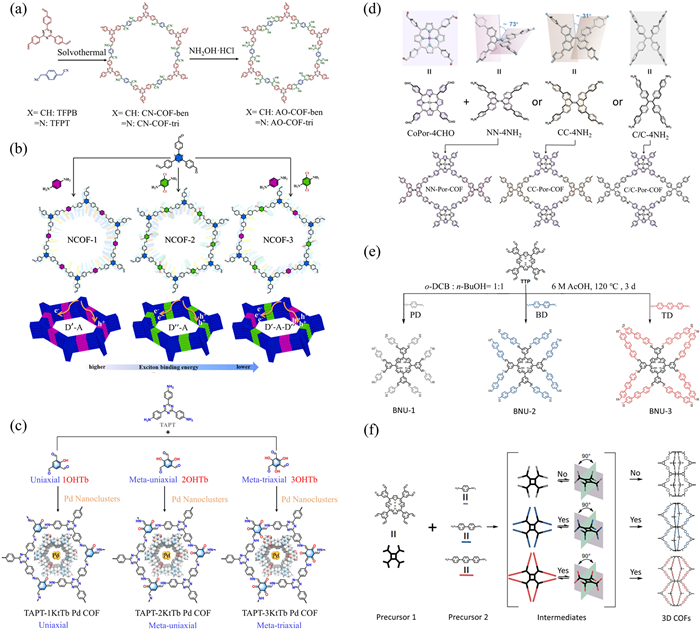
In order to improve the performance of Im-COFs, the conversion of imine to amide bond can be achieved by oxidizing the imine bond [47,48]. Although this conversion can regulate the electronic structure, the intramolecular hydrogen bond formed by the amide group will limit the slip between the layers, resulting in an increase in the π-stacking distance and a decrease in the electronic coupling. Ammoximation functionalization is another effective method. It forms asymmetric defects by constructing a hydrogen bond network and introducing functional groups, changes the electron cloud distribution of COFs, breaks the symmetry of the electronic structure, adjusts the energy band structure, and optimizes the generation, separation and transmission paths of photogenerated carriers. This method can greatly increase the formation rate of H2O2 to 6024 µmol h−1g−1, which is 4.1 times that of traditional cyano COFs [49]. Chen et al. [50] used the amidoxime-functionalized COFs to convert the cyano group into an amidoxime group through a post-modification strategy, giving COF a strong hydrogen bond force. AO-COF-tri was synthesized by a two-step method: First, cyano-COF (CN-COF-tri) was synthesized by solvothermal method, and then the cyano group was converted into aminooxime group by hydroxylamine treatment, as shown in Fig. 4a. This post-modification strategy does not require complex monomer design, and can flexibly introduce polar groups to break the electronic symmetry, while maintaining the regularity of the framework and improving the photocatalytic performance.
Low-symmetry monomer assembly introduces vacancy and pore asymmetric defects. The symmetry breaking of the monomer can break the singleness of the traditional COF topology and achieve precise control of performance. This strategy destroys the regular network of high-symmetry monomers at the molecular level, mainly through two ways: Using low-symmetry rigid monomers, or using monomers with different functional groups and spatial configurations to induce directional rearrangement to obtain a functionally optimized topology. Symmetry breaking can generate defects such as pores, grain boundaries, dislocations, and vacancies in multiple dimensions [51].
Shi et al. [52] used the symmetry breaking strategy to condense D2h with low-symmetric C2v monomers, and further broke the symmetry by using the steric hindrance of phenolic hydroxyl groups to achieve 1D/2D controllable switching of imine COFs, and the photocatalytic H2O2 production rate was increased by about 2.4 times. He et al. [53] constructed three asymmetric imine COFs with polyaldehyde central molecules and different amino monomers through the 'block asymmetry relationship', and established the relationship between chlorine-substituted blocks and structure-performance for the first time, providing a new method for the study of the structure-activity relationship of COFs. Furthermore, the arrangement and stacking of COF molecules can also be effectively regulated by the monomer asymmetric breaking strategy (Fig. 4b). At the same time, researchers have constructed β-ketoamine COFs with different symmetries by regulating the number of axial hydroxyl groups of COF monomers, and introduced asymmetric defects to optimize the electronic structure and carrier separation (Fig. 4c) [54], to achieve efficient photocatalytic production of H2O2 in seawater system. The advantages of monomer symmetry breaking strategy in the field of catalysis also contribute to the improvement of hydrogen peroxide yield. Through the asymmetric reduction of carbonyl functional groups to form anionic radical intermediates, the enhancement of oxygen adsorption and the reduction of O2 reduction reaction energy barrier are realized, which also significantly improves the efficiency of photocatalytic synthesis of H2O2 [55]. This process essentially breaks the symmetry of the monomer structure, introduces active sites with specific functions, and then optimizes the catalytic reaction path, providing a new direction for the development of efficient photocatalytic materials.
Steric hindrance triggers local asymmetric defects of the lattice distortion type. In the synthesis of COFs, the introduction of asymmetric structure or steric hindrance can regulate the topological structure and photophysical properties. Large-size or irregular configuration monomers will produce spatial steric hindrance, destroy the high symmetrical arrangement of the frame, distort the structure and form asymmetric defects, thereby improving the photocatalytic performance. As shown in Fig. 4d, the introduction of a large sterically hindered carbazole asymmetric connector in NN-Por-COF distorted the porphyrin layer to form a wave structure with an interlayer angle of 17.3, which greatly shortened the carrier migration distance to 2.3 nm and significantly reduces the recombination probability [56]. The construction of D-A structure of COFs can introduce asymmetry and defects at the molecular level, break molecular symmetry and increase active sites. Liu et al. [57] prepared methyl-modified MDB-COF, introduced sterically hindered asymmetric defects by means of methyl site regulation, effectively enhanced the built-in electric field, accelerated carrier separation, and greatly improved the photocatalytic H2O2 production performance of the material in real seawater, confirming that this defect engineering strategy can significantly optimize the photocatalytic H2O2 production effect. The twisted strategy induced by steric hindrance is not only suitable for the structural regulation of two-dimensional COFs, but also shows unique value in the directional construction of three-dimensional COFs. By adjusting the steric hindrance of the polymerization intermediate, the research group of Lanqun Mao used the rotatable eight-node porphyrin as the precursor, with different lengths of linear connectors, and used the gradually increasing steric hindrance to drive the formation of a rigid three-dimensional conformation. The intermediate was transformed into an 'adaptive active precursor', and the highly crystalline three-dimensional COFs such as BNU-1, BNU-2, and BNU-3 were controllablely constructed to realize the precise construction of two-dimensional units to three-dimensional frameworks [58], as shown in Figs. 4e and f. The molecular design strategies such as steric hindrance distortion, D-A molecular design, three-dimensional framework directional construction and energy band engineering effectively solve the core problems of exciton dissociation, slow charge transport and insufficient active sites in COF photocatalysis, which provide a systematic design idea for efficient and stable COF photocatalysts.
Post-modification reconstructs the asymmetric surface charge distribution. The traditional highly symmetrical COF has a regular structure, but the molecules are closely arranged, which hinders charge separation and transmission and insufficient exposure of active sites. It is difficult to introduce multifunctional groups, which limits the photocatalytic application. The post-synthetic modification (PSM) strategy breaks through these limitations, such as introducing cationic sites through PSM, introducing chiral substituents to accurately anchor functional groups and maintain skeleton structure, providing a new path for COF functionalization. To improve the photocatalytic solar energy conversion efficiency of COFs, research focus in recent years has shifted from merely exploiting simple adsorption properties to the precise regulation of COF electronic structure. Gu et al. successfully tuned the exciton binding energy by introducing chalcogen atoms (S, Se) into the COF skeleton, reducing the binding energy from the typical value of over 100 meV to 39.5 meV [59]. This change significantly promoted the dissociation of photogenerated excitons into free charge carriers and boosted solar photocatalytic activity. Beyond electronic structure regulation via atomic doping, precise chemical post-modification of the COF skeleton is also an important functionalization strategy. This approach can introduce new active sites or tune the physicochemical properties of COFs, while retaining their original crystalline structure. As shown in Fig. 5a, Zhao Meiting's team achieved the construction of skeleton asymmetry through multi-step single-crystal transformation [60], in which formamide groups induced steric distortion and established local asymmetric electronic environments within COF lattices.
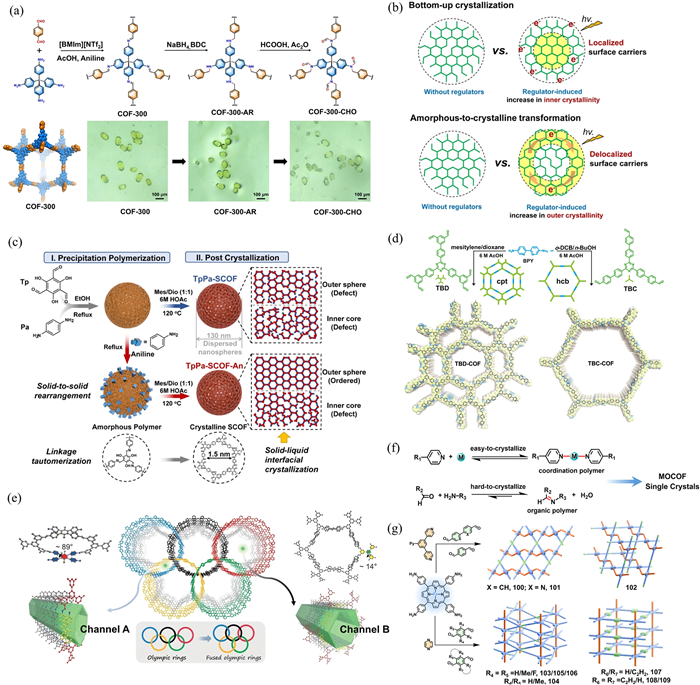
Guo Jia's team from Fudan University proposed a regional crystallization strategy, which modified amorphous pre-polymer microspheres with monofunctional aniline to effectively improve the surface order of COF during the transition from amorphous to crystallization. Fig. 5b showed that under the two crystallization modes, the modifier can not only improve the internal crystallinity of COF, but also improve the surface order and promote the carrier delocalization in the amorphous crystallization transformation. As shown in Fig. 5c, amorphous microspheres were prepared by precipitation polymerization, and then TpPa-type COF was prepared by solid-state rearrangement crystallization. Its photocatalytic hydrogen production performance was excellent, and the performance of core-shell SiO2@COF was further improved. Highly ordered surfaces can construct a built-in electric field, promote electron enrichment and reduce interface electron transfer energy barriers, providing new ideas for organic photocatalytic design [61].
Non-centrosymmetric topology constructs asymmetric global frameworks. In view of the difficulty in controlling the distribution of post-synthetic modification sites and the lack of easily damaged structures, topological regulation strategies have emerged. A non-centrosymmetric topological network is constructed by directional assembly of different symmetric monomers, with built-in electric field and charge transfer channels to achieve efficient spatial separation of carriers, which has become a key path to improve the performance of photocatalytic hydrogen peroxide production. As shown in Fig. 5d, for the first time, a pair of 2D COFs with similar chemical composition but different topological structures were synthesized by accurately adjusting the monomer connection sites. It was found that TBD-COF with cpt topology had significantly better H2O2 light yield than TBC-COF with hcb topology under the condition of no sacrificial agent, and its advantage was due to the optimal regulation of multiple reaction paths by cpt structure [62]. Furthermore, the team of South China Normal University broke through the traditional topological type [63] and constructed 3D COFs with rare zyg topology for the first time by using unequal hexagons and square monomers. Its unique 'fusion Olympic ring' structure induced the formation of a stable free ground state, which increased the photocatalytic activity of PTZ-based COF by 400%, as shown in Fig. 5e. On this basis, the researchers used 8-connected aluminum-oxygen clusters as nodes and linear dialdehyde as bridging units to achieve [8 + 2] three-dimensional assembly through one-step solvothermal Schiff base condensation, and successfully prepared metal cluster-based COFs with a connectivity of up to 10 [64]. These studies together show that from two-dimensional topology optimization to three-dimensional complex grid construction, and then to highly connected metal cluster integration, topology engineering is continuously promoting the boundary of COF photocatalytic performance through multi-dimensional structure innovation.
Template confinement induces interface charge asymmetry. Topology control can accurately control the geometric symmetry of COF, and the new strategy of template induction further breaks through the limitation of chiral microenvironment construction. Relying on the host-guest interaction between the chiral template and the precursor to achieve chiral transfer, the chiral pores and active sites are printed by the template space configuration, and the chiral catalytic environment is accurately constructed in the achiral skeleton. Liu et al. [65] first proposed an organic-inorganic hybrid PN heterojunction film, using monolayer MoS2 as a template to guide the directional self-assembly of high and low symmetric monomers to construct a regular square lattice-type c (sql-c) topological COF film. The photocatalytic H2O2 production rate was 2.5–4 times higher than that of traditional catalysts. Furthermore, the research team has developed a metal ion-organic ligand-coordinated MOF-COF (MOCOF) templating strategy, which precisely regulated the lattice orientation of COF through the coordination of metal ions and organic ligands, and realized the controllable synthesis of single crystal COF for the first time [66]. As shown in Figs. 5f and g, a large-sized (50–500 µm) single-crystal COF was successfully synthesized by in-situ Schiff-base condensation of organic amines and aldehyde monomers in the lattice channels of easily crystallized coordination polymer (MOCOF) single crystal as a template, followed by removal of metal nodes. The coordination template-induced single crystal COF construction strategy was realized.
Multi-component monomers enable multi-site asymmetric substitution defects. Multicomponent reaction (MCR) involves three or more components, which has the advantages of high atom economy, environmental friendliness and simple reaction process. Compared with the two-component method, it is more conducive to the construction of structurally diverse COFs. The Arne Thomas team prepared a new type of MCR-COFs by a multi-component one-pot method. DMCR-COFs exhibited high crystallinity and abundant active sites for visible-light-driven H2O2 production with favorable cycling stability. DMCR-COFs were used for photocatalytic production of H2O2, among which DMCR-1NH had the highest performance, up to 2588 µmol g−1 h−1, and had good cycle stability [67]. Based on this strategy, Chen et al. [68] used the end-capped fluorination strategy to post-modify vinylidene COFs, effectively introducing electron-withdrawing domains and O2 adsorption sites. The H2O2 yield of Post-v-COF-F2 under visible light was increased by 1.75 times. It is worth noting that the degree of fluorination has a volcano-shaped relationship with the catalytic activity-moderate fluorination is optimal, while excessive fluorination inhibits performance. In addition to improving the photocatalytic performance, regulating the regular pores and stable framework constructed by the crystallinity of COFs can effectively optimize the mass transfer efficiency. Introducing asymmetric defects into the COF skeleton to regulate the local electronic structure has been proven to effectively promote charge separation and optimize the energy barrier of active sites. This is regarded as a key strategy for improving the efficiency of solar-chemical energy conversion. However, the defect-induced electron transfer pathway, along with its quantitative contribution to the photocatalytic mechanism, remains elusive, substantially impeding the rational design of high-performance catalysts. In the future, combining theoretical calculations with advanced characterization techniques will enable in-depth revelation of the structure-activity relationship of asymmetric defects. This work will further promote the development of COF photocatalysts toward intelligence and large-scale application, and facilitate the practical application of solar fuel production and pollutant degradation [69]. The comparison of the performance and structural characteristics of the photocatalysts based on COFs prepared by different construction strategies in photocatalysis is summarized in Table S1 (Supporting information).
In order to verify the successful construction of asymmetric defects and analyze its influence on the crystal structure, firstly, the defective DAAQ-based COFs and AD-based COFs were characterized by powder X-ray diffraction (PXRD), nitrogen adsorption-desorption and pore size distribution, as shown in Fig. 6a. The results showed that the crystallinity and pore structure parameters of the defective material have decreased, which proved that the defect has been successfully introduced [70]. However, this characterization method has inherent limitations. PXRD and nitrogen adsorption can only reflect the overall changes in the material's crystal order, pore volume, and pore size, and can only confirm that the lattice order has been destroyed. They cannot independently distinguish the specific type, spatial distribution, and atomic-scale configuration of defects, and it is difficult to determine whether the observed structural disorder is dominated by asymmetric defects. Further combined with low-dose aberration-corrected high-resolution transmission electron microscopy (HR-TEM) and Fourier filtering analysis, the intrinsic structure dominated by channel defects was observed in the powder COF for the first time, which was confirmed by in-situ PXRD [71]. HR-TEM enables direct visual observation of the micromorphology, geometric configuration, and spatial distribution of defects, which compensates for the limitation of PXRD that can only provide average crystal structure information. However, HR-TEM cannot simultaneously obtain information on chemical bonding and electronic states corresponding to defect sites. In terms of mechanism analysis, in-situ diffuse reflectance infrared Fourier transform spectroscopy (DRIFTS) can capture the changes of key reaction intermediates such as *OOH in real time, providing direct evidence for the evolution of chemical bonds in the process of CO2 reduction. In Figs. 6b and c, Zhang et al. [72] explored the active sites of Cu-Bpy-COF by in-situ DRIFTS. The corresponding changes of characteristic peaks after CO adsorption confirmed that Cu was the active site of CO formation. Site optimization can improve photocatalytic performance. However, pure infrared spectroscopy can only reflect changes in the vibration signals of functional groups and adsorption intermediates. It is difficult to quantitatively distinguish common coordination sites from asymmetric defect active sites, and it is impossible to establish a direct correspondence between the defect structure and catalytic activity by this method alone. Figs. 6d and e showed the exciton characteristics of two types of COFs studied by Liu et al. [73] using temperature-dependent photoluminescence (TDPL). Through the Knoevenagel condensation reaction, the vinylene-linked donor-acceptor Btt-Bdd was synthesized and exhibited a significantly lowered exciton binding energy (Eb) of 39.2 meV, much lower than that of the control sample Btt-Btd (90.9 meV). It was confirmed that the synergistic effect of vinylidene linkage and D-A structure can significantly reduce the exciton binding energy and promote the effective dissociation and charge separation of photogenerated excitons. However, TDPL can only characterize the overall properties of carrier recombination dynamics, and cannot locate microscopic asymmetric defect sites. Furthermore, it is difficult to distinguish the respective contributions of bulk disorder and surface asymmetric defects to charge recombination, and to independently clarify the microscopic origin of non-radiative recombination.
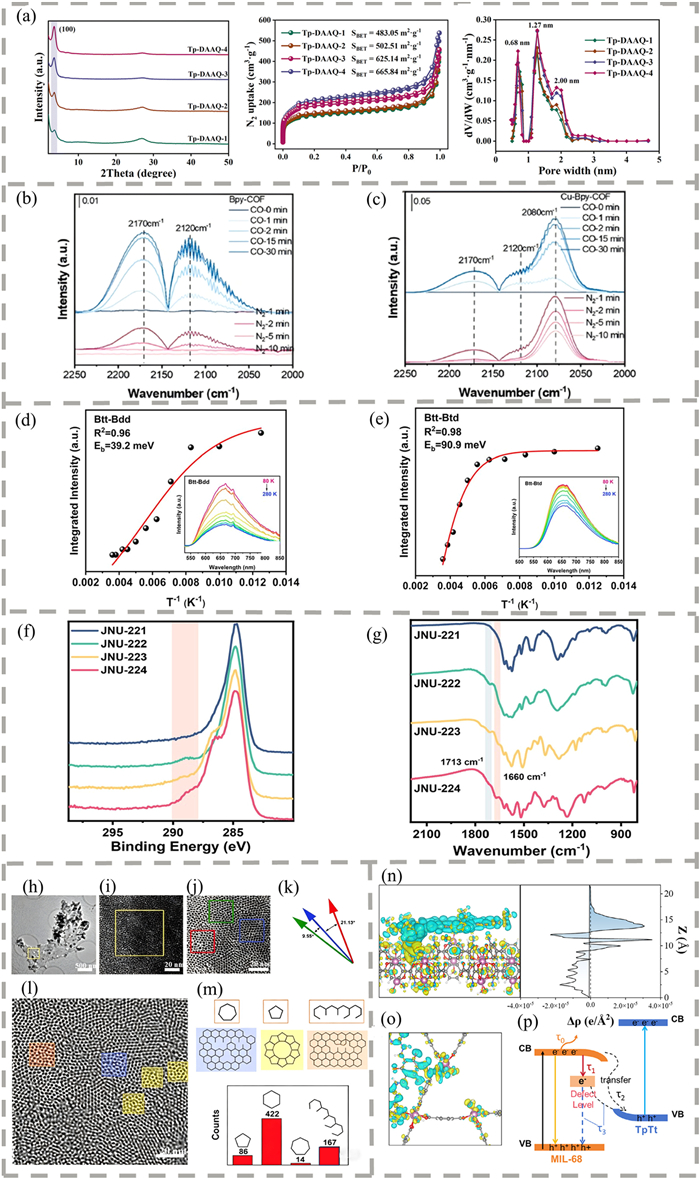
Aiming at the type and distribution of asymmetric defects, multi-means joint characterization is used. As shown in Figs. 6f and g, combined with X-ray photoelectron spectroscopy (XPS), it can be seen that the characteristic peak at 398.2 eV in the N 1s spectrum of JNU-224 belonged to the nitrogen in C=N, and the characteristic peak at 288.6 eV in the C 1s high-resolution spectrum belonged to the carboxyl carbon. At the same time, the stretching vibration peaks of C=O and C=N appeared at about 1720 cm−1 and 1660 cm−1 in the Fourier transform infrared spectrometer (FTIR) spectrum, which confirmed the successful introduction of carboxyl functional groups and quinoline structures in the process of stepwise surface engineering. The intensity of these structural characteristic peaks gradually increased, indicating the gradual increase of functional group density [74]. XPS and FTIR can effectively capture changes in elemental valence states, as well as the type and concentration of surface functional groups induced by defects, and provide evidence for the chemical existence forms of asymmetric defects. However, both techniques belong to macroscopically averaged characterization methods and lack spatial resolution. It is impossible to confirm that the detected distorted functional group sites are the core active centers of catalytic reactions using only these two spectroscopic techniques.
HR-TEM observation further revealed that there were pentagons, polygons and a large number of channel defects in TPB-DMTP-COF nanosheets, and the proportion of channel defects was as high as 62.5% [71], as shown in Figs. 6h–m. Femtosecond transient absorption (fs-TA), based on the ultrafast pump-probe principle, is an important means to analyze the dynamics of photogenerated carrier transfer and exciton relaxation. It can accurately capture the complete kinetic signals of defect-mediated charge separation, transfer, and relaxation processes. However, this technique only reflects the evolution patterns of carriers and cannot independently prove that asymmetric defects directly regulate substrate activation and reaction pathways. Upon confirming the successful introduction of chemical defects such as oxygen vacancies, electron density fistribution (EDD) enables quantitative FTIR spectral comparison. Specifically, EDD modulates bond polarizability and thereby dipole moment changes, which fundamentally determine the peak position and absorption intensity of FTIR signals, rendering EDD the essential electronic determinant of FTIR spectral responses. The analysis of Figs. 6n–p indicated that MOF/COF heterojunctions with higher EDD values (such as MIL@COF) exhibit longer carrier lifetime and better charge separation efficiency. Therefore, FTIR provides chemical evidence for the existence of defects, while EDD quantifies the defect concentration through kinetic data and is directly related to the enhancement mechanism of 'dual-channel charge transport' [75].
In the study of Wang et al. [76], time-resolved fluorescence test can confirm that TAPT-COF-7 has excellent carrier lifetime and can effectively inhibit carrier recombination. At the same time, electrochemical impedance spectroscopy (EIS) test can show that its charge transfer resistance is small and charge transfer efficiency is high. The synergistic effect of the two greatly improves the charge separation effect and makes it have excellent photocatalytic performance. EIS can quantitatively characterize the interfacial charge transfer resistance and reflect how defects regulate conductivity, but it still cannot distinguish the respective contributions of asymmetric defects and ordinary lattice disorder to interfacial impedance. Overall, all types of characterization techniques have functional limitations: PXRD and nitrogen adsorption can only reflect the crystallographic order and the attenuation of the pore structure, but cannot determine the configuration of defect atoms; XPS and FTIR can only prove the distortion of the chemical structure, and it is difficult to anchor the active sites of actual defects. TRPL and fs-TA can analyze carrier dynamics, but cannot independently establish a direct correlation between asymmetric defects and catalytic reaction pathways. HR-TEM can visually observe defect morphology, but lacks synchronous information on electronic states and catalytic activity. However, TDPL has the defects of being unable to locate microscopic active sites and distinguish bulk/surface recombination in photocatalytic research, and it is also difficult to clarify the specific mechanism of non-radiative recombination. Different techniques for identifying defects in COFs are summarized in Table S2 (Supporting information).
Electronic structure regulation can efficiently capture light energy, inhibit recombination and promote directional migration by optimizing energy band structure and carrier separation path, which is the key to achieve stable conversion of light energy. According to the classical theory, the total photocatalytic efficiency is determined by the product of three parts: Light absorption, charge separation and transfer, and surface reaction. Among them, charge separation and transfer are the core bottlenecks before and after the connection [77,78]. In response to this bottleneck, molecular-level electronic structure regulation strategies have shown significant potential. In recent years, Fan et al. [79] constructed a two-dimensional nanosheet hybrid system by supramolecular self-assembly, and effectively inhibited charge recombination by stepwise electron transfer mechanism. Starting from the molecular cocrystal engineering, Xu et al. [80] achieved efficient photothermal conversion in the near-infrared region by balancing the degree of charge transfer and molecular stacking mode. A variety of studies have shown that optimizing the electronic structure to regulate exciton behavior and charge transfer kinetics is the core path to break through the bottleneck of light energy conversion efficiency. For COF materials, although the change of bonding mode provides a new way to improve the performance of photooxidation reduction, there is still a time gap of six orders of magnitude between the photogenerated charges from femtosecond excitation to millisecond surface reaction, and the recombination loss of bulk phase and interface is serious in each stage. Therefore, the development of electronic structure design strategies such as step-by-step electron transfer and accurate balance of charge transfer/stacking relationship is the fundamental direction to promote the rational construction of efficient light energy conversion materials.
Defect sites are often thermodynamically metastable due to their high reactivity. Under the synergistic effect of continuous illumination, water molecule attack and high-energy reactive oxygen species, structural relaxation, bond reconstruction or irreversible oxidation are prone to occur, resulting in defect "deactivation" and even skeleton collapse. Taking imine-bonded COFs as an example, the core mechanism of deactivation is that electrophilic attack by photogenerated holes or •OH radicals on C=N bonds triggers hydrolysis, and the accumulation of carriers at defects further aggravates local distortion and skeleton disorder. Strong adsorption of reaction intermediates or by-products may also cover active sites and cause loss of catalytic function.
Zhou et al. quantitatively studied this deactivation process via femtosecond transient absorption spectroscopy [81], and revealed the pH-dependent deactivation boundary of protonated imine COFs in aqueous photocatalytic H2O2 synthesis: The material exhibits excellent stability under weak acidic conditions (pH ≥ 3), while protonation of imine nitrogen under strong acidic conditions (pH < 3) significantly accelerates the irreversible hydrolysis process. This study clearly defined the pH threshold for the stable operation of imine-bonded COFs. Based on in-depth understanding of the deactivation mechanism, researchers have developed a variety of strategies to improve material stability. In terms of chemical reinforcement via bond locking, Wu et al. verified through first-principles calculations that cyclization locking of the imine bond in triazine-imine-triazine COFs (introducing NH, O, S, and Se to form a five-membered ring) can reduce proton adsorption affinity by approximately 0.6 eV, and transfer active sites from easily hydrolyzed imine nitrogen to the more stable triazine unit [82]. After cyclization, hydrolysis resistance is significantly enhanced, and the solar-to-hydrogen energy conversion efficiency remains 2.4%.
COFs show great potential in photocatalytic overall water splitting for hydrogen production. However, the high electron density distribution of aromatic carbon in COFs leads to the release of inert oxygen, which significantly hinders the overall water splitting activity of photocatalysis. The team of Professor Li Xuanhua from Northwestern Polytechnical University synthesized PY-COF containing phosphonate phyllohedral structures after three steps. Photocatalytic hydrogen production was 24.7 µmol/h, oxygen production was 12.0 µmol/h (62 times higher than the original COFs), and the apparent quantum efficiency at 500 nm was 16.5%. Density functional theory (DFT) showed that the exciton binding energy was reduced to 0.22 eV, and the oxygen evolution reaction energy barrier was only 0.15 eV. It can produce hydrogen more than 300 mmol/d in a 4 m2 outdoor device, which had practical application potential [83].
By analyzing the spatial distribution of HOMO-LUMO via DFT calculations, it can be confirmed that the asymmetric electron cloud distribution induced by the phosphonate group promotes charge separation. Meanwhile, by calculating the free energy change of each elementary step of the oxygen evolution reaction (OER), it is identified that *OOH formation is the rate-determining step, and its low energy barrier of 0.15 eV is attributed to the optimized adsorption configuration of the phosphonate layer on the reaction intermediate. This finding provides direct thermodynamic evidence for the enhanced macroscopic oxygen production activity.
The development of photocatalysts that can efficiently activate molecular oxygen to generate 1O2 is a key issue in environmental catalysis. In recent years, Huang et al. successfully constructed a twisted skeleton by precisely tailoring the electronic structure of COF through a topological control strategy, which significantly optimized the energy level arrangement and overlap efficiency of molecular orbitals [84]. Benefiting from this electronic structure regulation, the catalyst can efficiently generate 1O2 and use it for H2O2 synthesis without sacrificial agent under room temperature illumination, which not only has a record yield, but also has a solar energy conversion efficiency of 1.25%. The 'triplet exciton pathway' revealed in this work provides a new idea for breaking through the energy barrier limitation of traditional photocatalytic reactions and designing organic photocatalysts from the perspective of electronic structure. In the field of photocatalysis, through defect engineering (such as asymmetric coordination defects in COFs) or single atom doping to reconstruct the electronic structure, a built-in electric field can be constructed to promote the directional separation of photogenerated carriers (recombination rate < 20%) and reduce the formation energy barriers of intermediates such as *COOH and *H [85].
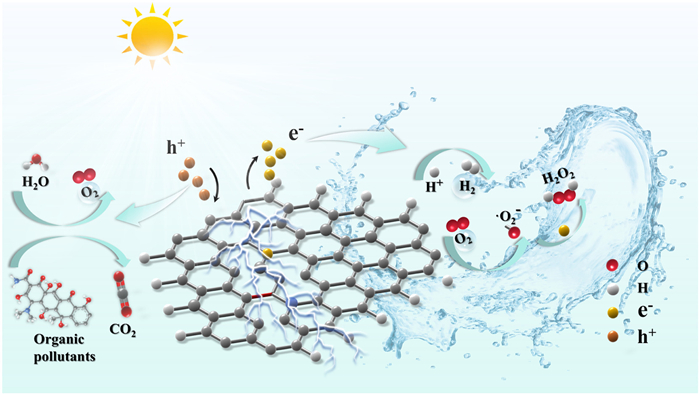
High-efficiency solar energy conversion technology under the dual-carbon background has attracted much attention, and its core lies in the precise regulation of the electronic structure of photocatalytic materials. As shown in Fig. 7, asymmetric defects constructed on COFs act as key active sites, inducing the built-in electric field to drive the efficient separation and directional migration of photogenerated electrons (e-) and holes (h+). This effectively suppresses charge recombination, enabling electrons to participate in the reduction reaction to produce H2, while holes drive the oxidation of H2O to generate O2. Therefore, the controllable construction of asymmetric defects has become a key bottleneck for unlocking high-performance solar-to-chemical energy conversion. At present, there are two major problems: First, the asymmetric defects are randomly distributed, and the existing synthesis methods are difficult to accurately control the type, quantity and spatial distribution of defects, and it is difficult to form a uniform carrier transport channel [86]; Second, it is difficult to introduce asymmetric defects at a fixed point without destroying the overall crystalline structure of COFs [87]. In the future, it is necessary to overcome the low-cost and large-scale preparation technology of COFs. At the same time, the defective COF is coupled with photovoltaic reactor to build a practical photocatalytic system, and its efficiency, stability and economic feasibility under actual working conditions are verified through pilot tests.
Luyuan Zhang: Writing – original draft, Data curation. Xibao Li: Writing – review & editing, Project administration. Dian Bao: Investigation. Yu Xie: Formal analysis. Yingtang Zhou: Software. Yidan Luo: Validation. Bin Liu: Supervision.
The authors declare that they have no known competing financial interests or personal relationships that could have appeared to influence the work reported in this paper.
The authors gratefully acknowledge the financial support provided by National Natural Science Foundation of China (Nos. 22262024 and 22662025), Jiangxi Province Academic and Technical Leader of Major Disciplines (No. 20232BCJ22008), Key Project of Natural Science Foundation of Jiangxi Province (No. 20232ACB204007).
Supplementary material associated with this article can be found, in the online version, at doi:
Y.B. Wang, Y.A. Xu, C. Li, et al., Science 392 (2026) 850–857. doi: 10.1126/science.aeb8506
E.T. Cui, Y.L. Lu, Z.X. Li, et al., Chin. Chem. Lett. 36 (2025) 110288. doi: 10.1016/j.cclet.2024.110288
T.T. Yu, B. Yang, R. Zhang, et al., J. Mater. Sci. Technol. 188 (2024) 11–26. doi: 10.1016/j.jmst.2023.12.004
A. Fujishima, K. Honda, Nature 238 (1972) 37–38. doi: 10.1038/238037a0
A.P. Côté, A.I. Benin, N.W. Ockwig, et al., Science 310 (2005) 1166–1170. doi: 10.1126/science.1120411
L. Stegbauer, K. Schwinghammer, B.V. Lotsch, Chem. Sci. 5 (2014) 2789–2793. doi: 10.1039/C4SC00016A
S.Z. Yang, W.H. Hu, X. Zhang, et al., J. Am. Chem. Soc. 140 (2018) 14614–14618. doi: 10.1021/jacs.8b09705
C. Krishnaraj, H.S. Jena, L. Bourda, et al., J. Am. Chem. Soc. 142 (2020) 20107–20116. doi: 10.1021/jacs.0c09684
S. Zhao, C.H. Jiang, J.C. Fan, et al., Nat. Mater. 20 (2021) 1551–1558. doi: 10.1038/s41563-021-01052-w
M. Villa, A. Fermi, F. Calogero, et al., Angew. Chem. Int. Ed. 64 (2025) e202420009. doi: 10.1002/anie.202420009
W.M. Ding, S.B. Yuan, Y. Yang, et al., J. Mater. Chem. A 11 (2023) 23653–23682. doi: 10.1039/D3TA04947G
S.Q. Zhang, X.S. Yi, G.H. Hu, et al., Coord. Chem. Rev. 478 (2023) 214970. doi: 10.1016/j.ccr.2022.214970
S. Siddique, G. Abbas, M.M. Yaqoob, et al., Adv. Sci. 12 (2025) 2411594. doi: 10.1002/advs.202411594
Y.L. Yang, N. Luo, S.Y. Lin, et al., ACS Catal. 12 (2022) 10718–10726. doi: 10.1021/acscatal.2c02908
X.K. Yu, S.H. Guo, Y.L. Zhu, et al., ACS Nano 19 (2025) 29141–29148. doi: 10.1021/acsnano.5c02505
C.B. Wu, F.H. Chu, Y.C. Hao, et al., Chin. J. Catal. 74 (2025) 329–340. doi: 10.1016/S1872-2067(25)64740-1
J.R. Wang, K.P. Song, T.X. Luan, et al., Nat. Commun. 15 (2024) 1267. doi: 10.1038/s41467-024-45457-y
S. Daliran, M. Blanco, A. Dhakshinamoorthy, et al., Adv. Funct. Mater. 34 (2024) 2312912. doi: 10.1002/adfm.202312912
Y.Y. Zhao, Y. Han, Y.J. Yu, Chem. Eng. J. 497 (2024) 154997. doi: 10.1016/j.cej.2024.154997
L.W. Yuan, Y.Y. Peng, Z.J. Guan, et al., Acta Phys. Chim. Sin. 41 (2025) 100086. doi: 10.1016/j.actphy.2025.100086
J.H. Li, Z.X. Li, Q.H. Sun, et al., Adv. Energy Mater. 14 (2024) 2402441. doi: 10.1002/aenm.202402441
C. Liu, T. Gao, G. Wang, et al., Chem. Res. Chin. Univ. 41 (2025) 726. doi: 10.1007/s40242-025-5033-9
H.J. Dong, C.H. Qu, C.M. Li, et al., Chin. J. Catal. 70 (2025) 142–206. doi: 10.1016/S1872-2067(24)60184-1
X.B. Li, Y.Y. Wan, F. Deng, et al., Chin. Chem. Lett. 36 (2025) 111418. doi: 10.1016/j.cclet.2025.111418
C.X. Chen, H.F. Shi, X.Y. Cai, et al., Acta Phys. Chim. Sin. 41 (2025) 100155. doi: 10.1016/j.actphy.2025.100155
Y.Q. Shi, J.L. Yang, F. Gao, et al., ACS Nano 17 (2023) 1879–1905. doi: 10.1021/acsnano.2c11346
X.W. Zhao, Y. Cao, M.J. Lei, et al., Acta Phys. Chim. Sin. 41 (2025) 100152. doi: 10.1016/j.actphy.2025.100152
Y.J. Wang, H.R. Wang, Y.N. Liu, et al., Chin. Chem. Lett. 36 (2025) 110189. doi: 10.1016/j.cclet.2024.110189
Y.R. Sun, C.Q. Liu, S.Q. Ji, et al., Compos. Funct. Mater. 1 (2025) 20250202. doi: 10.63823/20250202
J.M. Cai, Y.M. Zhu, D.S. Liu, et al., ACS Catal. 5 (2015) 1708–1716. doi: 10.1021/acscatal.5b00055
W. Li, J.J. Li, Z.F. Liu, et al., Rare Met. 43 (2024) 533–542. doi: 10.1007/s12598-023-02419-5
Y.H. Shao, R.C. Shen, S. Wang, et al., Acta Phys. Chim. Sin. 41 (2025) 100176. doi: 10.1016/j.actphy.2025.100176
L. Qiang, H. Bai, X.Y. Li, et al., Macromol. Rapid Commun. 45 (2024) 2300506. doi: 10.1002/marc.202300506
Y. Yin, Y. Zhang, X. Zhou, et al., Science 386 (2024) 693–696. doi: 10.1126/science.adr0936
L.L. Wang, W.D. Zhang, T. Li, et al., Chem. Commun. 57 (2021) 13162–13165. doi: 10.1039/D1CC04369B
R.A. Marcus, Angew. Chem. Int. Ed. 32 (1993) 1111–1121. doi: 10.1002/anie.199311113
P.F. Barbara, T.J. Meyer, M.A. Ratner, J. Phys. Chem. 100 (1996) 13148–13168. doi: 10.1021/jp9605663
Y. Zhang, Z.B. Guo, R.H. Qiu, et al., Angew. Chem. Int. Ed. 64 (2025) e202514007. doi: 10.1002/anie.202514007
C.X. You, Y. Zhou, M.T. Yang, et al., J. Environ. Chem. Eng. 14 (2026) 122074. doi: 10.1016/j.jece.2026.122074
H.J. Pan, Q. Niu, M.F. Yu, et al., ACS Energy Lett. 10 (2025) 4580–4588. doi: 10.1021/acsenergylett.5c02419
Y. Zhang, Z.Q. Xie, Y.G. Ma, CCS Chem. 7 (2025) 10–21. doi: 10.31635/ccschem.024.202303827
A. Jha, K.R. Mote, S. Chandra, et al., J. Phys. Chem. C 125 (2021) 10891–10900. doi: 10.1021/acs.jpcc.1c02497
Y. Wang, Y.H. Zhong, Y.D. Wang, et al., CCS Chem. 7 (2025) 2659–2671. doi: 10.31635/ccschem.024.202404867
Q. Li, M.Q. Liang, H.F. Zhuang, et al., Chin. Chem. Lett. 37 (2026) 111593. doi: 10.1016/j.cclet.2025.111593
Y.L. Li, X.L. Jin, Y.T. Ma, et al., Rare Met. 43 (2024) 758–769. doi: 10.1007/s12598-023-02476-w
Y.H. Hou, P. Zhou, F.Y. Liu, et al., Nat. Commun. 15 (2024) 7350. doi: 10.1038/s41467-024-51878-6
L.Q. Song, Z.H. Lin, Z.H. Zhang, et al., J. Catal. 447 (2025) 116118. doi: 10.1016/j.jcat.2025.116118
C.S. Du, T.T. Jia, W.J. Na, et al., J. Mater. Chem. A 13 (2025) 5954–5960. doi: 10.1039/D4TA08616C
Z.W. Yu, F.T. Yu, M. Xu, et al., Adv. Sci. 12 (2025) 2415194. doi: 10.1002/advs.202415194
H. Chen, W.L. Liu, L. Cheng, et al., Chem. Eng. J. 429 (2022) 132162. doi: 10.1016/j.cej.2021.132162
W.W. Li, J.L. Shi, K.H.L. Zhang, et al., Mater. Horiz. 7 (2020) 2832–2859. doi: 10.1039/D0MH00899K
P.Z. Shi, K. Wang, Z. Chen, et al., CCS Chem. 6 (2024) 941–952. doi: 10.31635/ccschem.023.202303367
Y.X. He, X.J. Chen, R. Zhang, et al., J. Hazard. Mater. 492 (2025) 138055. doi: 10.1016/j.jhazmat.2025.138055
J.Y. Chen, J. Zhou, N. Li, et al., Chem. Sci. 17 (2026) 8126–8135. doi: 10.1039/D5SC09083K
W.W. Chi, Y.M. Dong, B. Liu, et al., Nat. Commun. 15 (2024) 5316. doi: 10.1038/s41467-024-49663-6
X.L. Ma, J.Y. Hu, S.Z. Li, et al., Sci. Bull. 70 (2025) 2277–2284. doi: 10.1016/j.scib.2025.04.002
L.Y. Liu, X.J. Xie, Y. Li, et al., Appl. Catal. B: Environ. Energy 381 (2026) 125821. doi: 10.1016/j.apcatb.2025.125821
J.W. Lai, S.K. Liu, W.J. Ma, et al., Nat. Commun. 16 (2025) 6071. doi: 10.1038/s41467-025-61373-1
Z.J. Gu, Z. Shan, Y.L. Wang, et al., Chin. Chem. Lett. 35 (2024) 108356. doi: 10.1016/j.cclet.2023.108356
Y.K. Li, Y. Wan, X.Y. Deng, et al., J. Am. Chem. Soc. 147 (2025) 29526–29533. doi: 10.1021/jacs.5c10341
Z. Lin, X.K. Yu, Z.J. Zhao, et al., Nat. Commun. 16 (2025) 1940. doi: 10.1038/s41467-025-57166-1
J.Y. Yue, J.X. Luo, Z.X. Pan, et al., Angew. Chem. Int. Ed. 63 (2024) e202405763. doi: 10.1002/anie.202405763
T.T. Ma, G.Z. Huang, X.H. Wang, et al., Natl. Sci. Rev. 11 (2024) nwae177. doi: 10.1093/nsr/nwae177
M. Zhang, P. Huang, R.H. Li, et al., Angew. Chem. Int. Ed. 64 (2025) e202507624. doi: 10.1002/anie.202507624
M.H. Liu, Y.C. Xu, Y.X. Liu, et al., Angew. Chem. Int. Ed. 64 (2025) e202505491. doi: 10.1002/anie.202505491
W.Q. Zhang, Y.T. Zhang, W.L. Ma, et al., Chem 11 (2025) 102398. doi: 10.1016/j.chempr.2024.102398
P. Das, G. Chakraborty, J. Roeser, et al., J. Am. Chem. Soc. 145 (2023) 2975–2984. doi: 10.1021/jacs.2c11454
A.Q. Chen, Y. Jian, Q.J. Xie, et al., Chem. Commun. 61 (2025) 7101–7104. doi: 10.1039/D5CC01033K
Y.X. Wu, J. Phys. : Conf. Ser. 3112 (2025) 012010. doi: 10.1088/1742-6596/3112/1/012010
D.C. Mei, B. Yan, J. Mater. Chem. A 13 (2025) 14928–14939. doi: 10.1039/D5TA01632K
J. Li, Y.K. Liu, X.Z. Tian, et al., J. Am. Chem. Soc. 147 (2025) 26955–26968. doi: 10.1021/jacs.5c09081
Y.Z. Zhang, L.L. Cao, G.Y. Bai, et al., Small 19 (2023) 2300035. doi: 10.1002/smll.202300035
W.H. Liu, Y.J. Li, F. Duan, et al., J. Mater. Chem. A 13 (2025) 786–794. doi: 10.1039/D4TA06162D
K. Wu, Q.H. Wang, H.B. Wang, et al., Sci. China Chem. 68 (2025) 5971–5977. doi: 10.1007/s11426-025-2744-0
Y.Q. Zhong, X.P. Wang, W.Q. Shi, et al., Adv. Sci. 13 (2026) e20433. doi: 10.1002/advs.202520433
J.X. Wang, X.X. Tian, L. Yu, et al., J. Mater. Chem. A 9 (2021) 25474–25479. doi: 10.1039/D1TA07634E
X.Y. Li, Y.Q. Zhao, Y.P. Liu, et al., J. Liaocheng Univ. Nat. Sci. Ed. 38 (2025) 370–382.
L.Q. Cheng, X. Wang, Y.S. Zhang, et al., EcoEnergy 4 (2026) e70056. doi: 10.1002/ece2.70056
Y. Fan, J. Tan, C.J. Zou, et al., Chin. Chem. Lett. 36 (2025) 110101. doi: 10.1016/j.cclet.2024.110101
J.Q. Xu, W.B. Chen, S.K. Li, et al., Chin. Chem. Lett. 35 (2024) 109808. doi: 10.1016/j.cclet.2024.109808
X. Zhou, Y.T. Huo, S.Y. Yang, et al., Acta Phys. Chim. Sin. 41 (2025) 100160. doi: 10.1016/j.actphy.2025.100160
Y.T. Wu, H.F. Lv, X.J. Wu, et al., J. Phys. Chem. Lett. 17 (2026) 5337–5345. doi: 10.1021/acs.jpclett.6c00778
S.M. Mao, Y.Z. Zhang, Y.J. Wang, et al., Adv. Mater. 37 (2025) 2507668. doi: 10.1002/adma.202507668
C. Huang, Y.Z. Zhang, R.C. Shen, et al., Adv. Mater. 38 (2026) e11092. doi: 10.1002/adma.202511092
L.M. Zhao, K.Q. Xu, C.B. Bie, et al., Acta Phys. Chim. Sin. 42 (2026) 100216. doi: 10.1016/j.actphy.2025.100216
C. Liu, T.Y. Gao, G.H. Wang, et al., Chem. Res. Chin. Univ. 41 (2025) 726–733. doi: 10.1007/s40242-025-5033-9
J.L. Wang, K.N. Zhang, T.T.T. Nga, et al., Chin. J. Catal. 64 (2024) 54–65. doi: 10.1016/S1872-2067(24)60103-8

Figure 1 Technology evolution from basic photocatalysis to COFs asymmetric structure innovation.

Figure 3 Schematic diagram of energy level reconstruction based on asymmetric defects in COF substrates and the mechanism of interface-assisted photocatalytic charge separation.

Figure 4 (a) Synthesis routes and structure diagrams of AO-COF-ben and AO-COF-tri. Reproduced with permission [50]. Copyright 2022, Elsevier. (b) The synthetic process and chemical structure of NCOF-1, NCOF-2 and NCOF-3, respectively. Reproduced with permission [53]. Copyright 2025, Elsevier. (c) Schematic diagram of the synthetic route and chemical structures of TAPT-1KtTb Pd COF, TAPT-2KtTb Pd COF, and TAPT-3KtTb Pd COF. Reproduced with permission [54]. Copyright 2025, Royal Society of Chemistry. (d) Synthesis of X-Por-COF (X = NN, CC or C/C). Reproduced with permission [56]. Copyright 2025, Elsevier. (e) Schematic diagram of the synthesis of three-dimensional covalent organic frameworks (3D COFs). (f) Schematic diagram of the mechanism of the formation of three-dimensional COFs induced by the steric hindrance effect of intermediates. Reproduced with permission [58]. Copyright 2025, Springer Nature.

Figure 5 (a) Single-crystal-to-single-crystal transformation strategy for the synthesis of formamide-based COFs. Reproduced with permission [60]. Copyright 2025, American Chemical Society. (b) Influence of growth pathways on COF domain crystallization. (c) Synthesis of TpPa SCOF and TpPa SCOF-1An via the amorphous-to-crystalline transformation pathway, respectively. Reproduced with permission [61]. Copyright 2025, Springer Nature. (d) Design strategy and synthetic route schematic diagram of TBD-COF and TBC-COF. Reproduced with permission [62]. Copyright 2024, Wiley-VCH. (e) M-COF as an example of the zyg-type COFs fused with the Olympic ring skeletons and two distinct pore channels. Reproduced with permission [63]. Copyright 2024, Oxford University Press. (f) Construction of MOCOFs by coordination template strategy combined with metal coordination and imine condensation reaction. (g) Assembly process of iron porphyrin tetramine with various aldehydes and N-donor ligands. Reproduced with permission [66]. Copyright 2025, Elsevier.

Figure 6 (a) Comparison of PXRD patterns, N2 adsorption-desorption isotherms and pore size distribution of defect DAAQ COF (Tp-DAAQ-1, Tp-DAAQ-2, Tp-DAAQ-3 and Tp-DAAQ-4). Reproduced with permission [70]. Copyright 2025, Royal Society of Chemistry. (b, c) In-situ DRIFTS spectra of Bpy-COF and Cu-Bpy-COF. Reproduced with permission [72]. Copyright 2023, Wiley-VCH. (d, e) Integrated PL intensity as a function of temperature (insets: temperature-dependent PL spectra from 80 K to 280 K) of Btt-Bdd, Btt-Btd and Btc-Bdd. Reproduced with permission [73]. Copyright 2025, Royal Society of Chemistry. (f) Comparison of high-resolution C 1s XPS deconvoluted spectra of JNU-221, JNU-222, JNU-223, and JNU-224. (g) Comparison of FTIR spectra of JNU-221, JNU-222, JNU-223, and JNU-224. Reproduced with permission [74]. Copyright 2025, Science China Press. (h) Full-view image of a COF nanosheet. (i) High-magnification micrograph of the yellow-boxed region marked in (h). (j) Three successive regions within the selected area for analyzing angular correlations between crystal domains. (k) Schematic diagram showing interdomain angles corresponding to the regions in (j). (l) Bandpass filtered image of (i) to enhance clarity of the porous structure. (m) Schematic illustrating three types of defect structures with respective interconnections and statistical results of defect type counting in (l). Scale bars: 500 nm (h); 20 nm (i, j, l) Reproduced with permission [71]. Copyright 2025, American Chemical Society. (n-o) EDD maps of MIL@COF. (p) Schematic of light-triggered electron transfer and charge recombination pathways within MIL@COF. Reproduced with permission [75]. Copyright 2026, Wiley-VCH.

 扫一扫看文章


扫一扫关注我们
 DownLoad:
 下载:


 下载: