College of Material Science and Engineering, Changsha University of Science & Technology, Changsha 410114, China
b.
Department of Chemistry and Shanghai Key Laboratory of Molecular Catalysis and Innovative Materials, Institute of New Energy, iChEM (Collaborative Innovation Center of Chemistry for Energy Materials), Fudan University, Shanghai 200433, China
ygwang@fudan.edu.cn (Y. Wang). 1 These authors contributed equally to this work.
Received Date:
27 June 2026 Accepted Date:
07 August 2026 Revised Date:
31 July 2026 Available Online:
15 December 2026
Abstract:
Although zinc-air batteries (ZABs) are considered promising energy storage technologies due to their high energy density and low cost, their efficiency and durability are severely limited by the sluggish kinetics of the oxygen reduction reaction (ORR) and oxygen evolution reaction (OER). Hence, an atomic-level electronic reconstruction strategy is proposed, in which atomically dispersed Co and Fe bimetallic sites are anchored on α-MnO2 nanorods (Co-Fe@MnO2), thereby enabling highly reversible and durable electrocatalysis. The strong electronic interactions between Co-Fe dual sites and the MnO2 support induce the generation of abundant low-valence Mn species and oxygen vacancies, enriching electronic states near the Fermi level and downshifting the d-band center. This dual-site-induced electronic reconstruction optimizes the adsorption and desorption of oxygen intermediates, effectively accelerating the kinetic processes of ORR and OER. Therefore, the Co-Fe@MnO2 catalyst delivers outstanding bifunctional electrocatalytic activity, with a half-wave potential of 0.85 V for the ORR, and an overpotential of 230 mV for the OER at 10 mA/cm2, yielding a narrow bifunctional potential gap of 0.83 V. Consequently, the self-assembled rechargeable ZAB integrated with the Co-Fe@MnO2 air cathode achieves a peak power density of 249 mW/cm2 at 360 mA/cm2 and exhibits excellent cycling stability. This study reveals the key role of dual-site-induced electronic reconstruction in regulating the catalytic behavior of MnO2 and provides a practical strategy for designing high-performance bifunctional electrocatalysts for metal-air energy storage systems.
Rechargeable zinc-air batteries (ZABs) have attracted significant attention as highly promising next-generation energy storage systems due to their high theoretical energy density, high safety, environmental friendliness, and low cost [1–6]. However, their practical application is severely hindered by the slow kinetics of the oxygen reduction reaction (ORR) and the oxygen evolution reaction (OER) during charging-discharging [7–13]. Although precious metal catalysts such as platinum (Pt) and ruthenium dioxide (RuO2) exhibit excellent ORR and OER activity, respectively, their high cost, resource scarcity, and insufficient stability under practical operating conditions hinder their large-scale production [14–17]. Therefore, the critical challenge facing ZAB technology is the development of cost-effective bifunctional electrocatalysts for highly efficient ORR and OER [18,19].
Among cost-effective compounds, MnO2 has garnered substantial attention owing to its natural abundance, facile synthesis, and excellent chemical stability over a wide pH range [20–22]. However, the intrinsically low conductivity and unsatisfactory electronic structure of MnO2 result in unfavorable adsorption/desorption behaviors toward oxygen-containing intermediates, thereby limiting its bifunctional electrocatalytic activity and durability of rechargeable ZABs [3,23]. Numerous researchers have demonstrated that constructing different crystal forms and morphologies can effectively optimize charge transfer kinetics and expose more catalytically active facets [24,25]. Among the various polymorphs of MnO2, one-dimensional α-MnO2 nanowire exhibits the most promising bifunctional catalytic performance [26,27]. Meng et al. [28] reported that the ORR and OER activities of MnO2 polymorphs follow the order of α-MnO2 > amorphous MnO2 > β-MnO2 > δ-MnO2. More importantly, the unique [2 × 2] tunnel structure of α-MnO2 provides abundant anchoring sites and a flexible local coordination environment for stable metal atoms [29,30]. Consequently, anchoring isolated metal atoms onto the MnO2 support has emerged as an attractive strategy for enhancing catalytic performance [31]. The single-atom design not only maximizes atom utilization efficiency, but also allows for precise tuning of the local electronic structure by introducing heteroatoms [17,32,33]. However, because ORR and OER involve distinct reaction intermediates and often require opposite adsorption characteristics, the catalytic behavior of isolated single-atom sites is generally constrained by a single adsorption configuration, making it difficult for a single active site to simultaneously satisfy the both reaction kinetics [9,34,35]. In contrast, the electronic synergy between bimetallic atoms can cause a large amount of charge redistribution, thereby enabling precise tuning of the adsorption energy of oxygen intermediates and overcoming the inherent limitations of isolated active sites [12,36]. Previous studies have indicated that atomically dispersed Fe centers serve as sites for highly active ORR kinetic catalysis, while Co centers exhibit superior OER activity by optimizing the adsorption strength of oxygenated intermediates and lowering the reaction overpotential [37–40]. Nevertheless, it remains unclear whether atomically dispersed Co-Fe dual sites can effectively reconstruct the electronic structure of α-MnO2 and simultaneously optimize the ORR and OER pathways.
Hence, we report an atomic-level electronic reconstruction strategy that employs a simple solid-state synthesis route to anchor atomically dispersed Co-Fe bimetallic sites on α-MnO2 nanorods (Co-Fe@MnO2), markedly enhancing its bifunctional catalytic activity. Due to distinct local electronic reconstruction between Co and Fe with the MnO2 support, a large number of low-valence Mn species and oxygen vacancies are induced, achieving highly reversible and long-lasting electrocatalytic activity. Combined density functional theory (DFT) calculations indicate that the dual-site-induced reconstruction enriches the electronic states near the Fermi level and facilitates a favorable downward shift of the d-band center, thereby optimizing the adsorption energy of oxygen-containing intermediates and significantly accelerating the kinetics of the bifunctional (ORR/OER) reactions. Thus, the Co-Fe@MnO2 catalyst exhibits outstanding bifunctional electrocatalytic performance and enables durable rechargeable zinc-air batteries. This work offers a practical route for constructing high-performance MnO2-based bifunctional catalysts and introduces a promising concept for the rational design of atomically dispersed bimetallic systems.
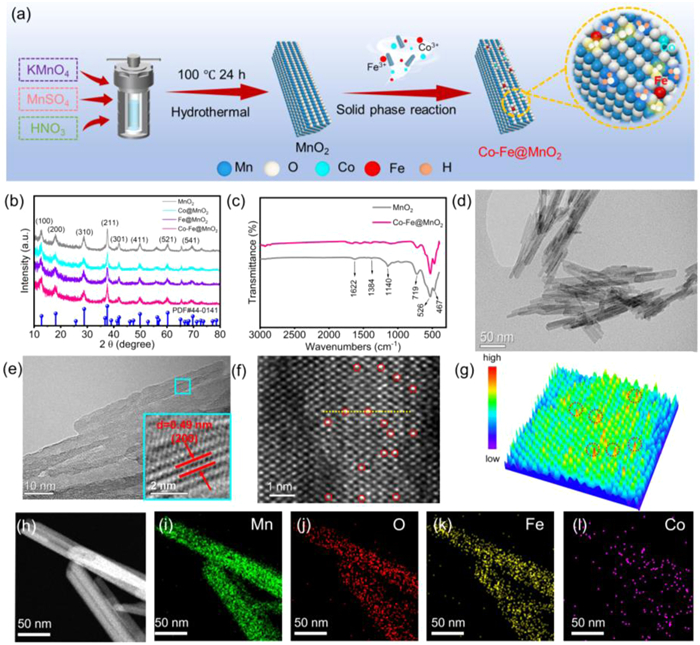
As schematically illustrated in Fig. 1a, pristine α-MnO2 nanorods were first synthesized via a hydrothermal route, followed by the anchoring of atomically dispersed Co and Fe species through a solid-state reaction. X-ray diffraction (XRD) patterns (Fig. 1b) confirm that all modified samples Co@MnO2, Fe@MnO2, and Co-Fe@MnO2 retain the tetragonal crystal structure of α-MnO2 (PDF #44-0141) [23,41]. The absence of peak shifts indicates that Co and Fe species are anchored on the surface rather than incorporated into the MnO2 lattice. Fourier-transform infrared (FTIR) spectroscopy (Fig. 1c) reveals a band at ~1622 cm−1 corresponding to the O-H bending vibration of adsorbed water, a signal at ~1140 cm−1 associated with surface hydroxyl groups, and a peak at ~1384 cm−1 attributed to Mn-OH interactions, confirming the hydroxyl-rich nature of the pristine MnO2 surface [31]. Upon Co/Fe modification, the intensity of hydroxyl-related bands decreases significantly, suggesting partial consumption of surface hydroxyls during metal anchoring [18]. Meanwhile, the Mn-O vibration bands (located at ~467, ~526, and ~719 cm−1) are enhanced, which can be ascribed to overlapping contributions from Mn-O, Co-O, and Fe-O bonds, supporting the successful and uniform dispersion of Co and Fe species [24,42].
Figure 1
Figure 1.
(a) Schematic illustration of the synthesis procedure for Co-Fe@MnO2. (b) XRD patterns of pristine MnO2, Co@MnO2, Fe@MnO2, and Co-Fe@MnO2. (c) FTIR spectra of MnO2 and Co-Fe@MnO2. (d, e) TEM and HRTEM images of Co-Fe@MnO2. (f) HAADF-STEM image. (g) Atomically resolved 3D topographic mapping. (h, i) EDS elemental mappings of Mn, O, Fe, and Co in Co-Fe@MnO2.
Transmission electron microscopy (TEM) images (Fig. S1 in Supporting information) show that the pristine MnO2 exhibits a well-defined nanorod morphology. After Co and Fe modification (Fig. 1d), the nanorod structure remains intact, indicating that the solid-state treatment preserves the original microstructure. High-resolution TEM (HRTEM) imaging (Fig. 1e) reveals lattice fringes with a spacing of 0.49 nm, corresponding to the (002) planes of α-MnO2 [30,43]. No nanoparticles or clusters are observed, consistent with the XRD results and suggesting atomic-level dispersion of Co and Fe. Moreover, the high-angle annular dark-field scanning TEM (HAADF-STEM, Fig. 1f) reveals numerous uniformly distributed bright spots, which can be ascribed to atomically dispersed Co or Fe atoms. The atomic intensity line profile (Fig. S3 in Supporting information) extracted from a selected region further corroborated the atomic level distribution of Co and Fe. Atomic-resolution 3D topography (Fig. 1g) further corroborates the atomic dispersion. Energy-dispersive X-ray spectroscopy (EDS) elemental mappings (Figs. 1h and i) demonstrate the homogeneous distribution of Mn, O, Fe, and Co across the nanorods, with no signs of agglomeration. Inductively coupled plasma optical emission spectrometry (ICP-OES, Table S1 in Supporting information) quantifies the Co and Fe loadings as 0.75 wt% and 1.87 wt%, respectively. This uniform atomic dispersion not only maximizes the exposure of active sites but also promotes synergistic interactions between Co and Fe, thereby enhancing the electrocatalytic performance.
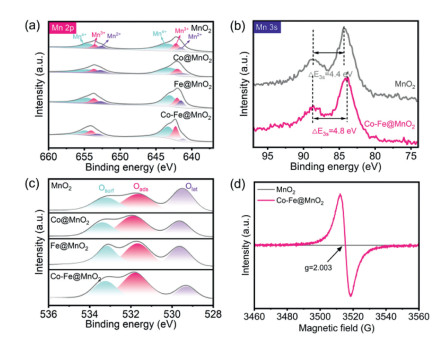
X-ray photoelectron spectroscopy (XPS) was conducted to probe the influence of Co and Fe modification on the surface electronic structure and oxidation states of MnO2. As shown in Fig. 2a, the Mn 2p spectrum exhibits two primary peaks located at binding energies of 641.8 eV (Mn 2p3/2) and 653.9 eV (Mn 2p1/2), which were deconvoluted into contributions from Mn2+, Mn3+, and Mn4+ species [44]. Quantitative analysis (Table S2 in Supporting information) reveals that the (Mn2+ + Mn3+)/Mn4+ ratio increases significantly from 34.12% for pristine MnO2 to 55.42% for Co-Fe@MnO2, indicating a marked reduction in the average Mn oxidation state and the concomitant generation of crystal defects and oxygen vacancies. Such low-valence Mn species are known to promote enhanced electrocatalytic activity compared to higher oxidation states [23]. The Mn 3s spectra (Fig. 2b) further support this trend, where the splitting energy (ΔE3s) increases from 4.4 eV in pristine MnO2 to 4.8 eV in Co-Fe@MnO2. Using the empirical relationship AOS = 8.956 – 1.126 × ΔE3s [20], the average Mn oxidation states were estimated to be 4.0 and 3.6 for pristine MnO2 and Co-Fe@MnO2, respectively. This decrease in AOS underscores the increased proportion of low-valence Mn species, which is closely associated with the formation of surface oxygen vacancies. These results collectively confirm that the Co-Fe dual sites induce significant electronic reconstruction in the MnO2 matrix, accompanied by valence redistribution and defect formation.
Figure 2
Figure 2.
(a) Mn 2p, (b) Mn 3s, and (c) O 1s XPS spectra of MnO2 and Co-Fe@MnO2. (d) EPR spectra comparing oxygen vacancy signals in MnO2 and Co-Fe@ MnO2.
The high-resolution O 1s spectra (Fig. 2c) were fitted into three components corresponding to lattice oxygen (Olat), adsorbed oxygen (Oads), and surface oxygen species (Osurf). As summarized in Table S2, the (Oads + Osurf)/Olat ratio follows the order: Co-Fe@MnO2 > Co@MnO2 > Fe@MnO2 > MnO2, indicating that the Co-Fe modified sample possesses the highest concentration of oxygen vacancies and adsorbed oxygen species. These features are conducive to enhanced adsorption and activation of reaction intermediates during electrocatalysis [18]. Further evidence for oxygen vacancy formation is provided by electron paramagnetic resonance (EPR) spectroscopy (Fig. 2d). The signal intensity at g = 2.003, characteristic of oxygen vacancies, is substantially stronger in Co-Fe@MnO2 than in pristine MnO2, confirming that the introduction of Co and Fe significantly enriches the oxygen vacancy content. Additionally, the XPS spectra of Co 2p and Fe 2p (Fig. S2 in Supporting information) display characteristic peaks consistent with their oxidized states, though the signals are relatively weak due to the low loading amounts of both metals.
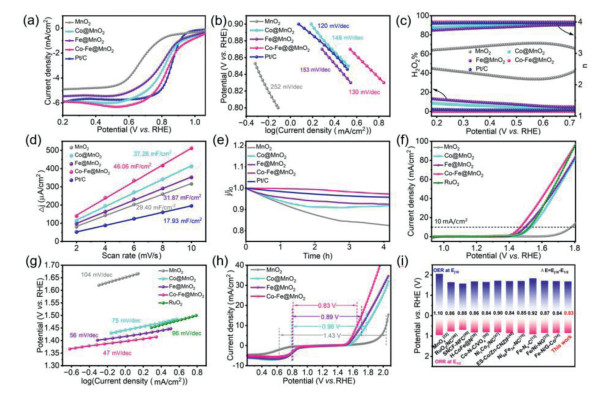
The ORR electrocatalytic performance of the samples was systematically assessed via a three-electrode setup in 0.1 mol/L KOH electrolyte. Cyclic voltammetry (CV) curves (Fig. S4 in Supporting information) show no evident reduction peaks for any sample under N2 atmosphere, while distinct cathodic peaks emerge under O2-saturated conditions. Compared with pristine MnO2, the Co- and Fe-modified samples display positively shifted cathodic peaks, confirming enhanced ORR activity via atomic-scale metal modification. Notably, Co-Fe@MnO2 shows a substantially more positive reduction peak potential, approaching the performance of Pt/C and outperforming the Co@MnO2 and Fe@MnO2. Linear sweep voltammetry (LSV) measurements at 1600 rpm (Fig. 3a) reveal that Co-Fe@MnO2 achieves an E1/2 of 0.85 V, which exceeds those of Co@MnO2 (0.82 V), Fe@MnO2 (0.81 V) and pristine MnO2 (0.68 V), and approaches the performance of Pt/C (0.86 V). It also delivers a high limiting current density (JL) of 5.9 mA/cm2. The Tafel slope for Co-Fe@MnO2 is 130 mV/dec (Fig. 3b), significantly lower than Co@MnO2 (146 mV/dec), Fe@MnO2 (153 mV/dec) and MnO2 (252 mV/dec), reflecting markedly improved ORR kinetics. Rotating ring-disk electrode analysis (Fig. 3c) shows that Co-Fe@MnO2 maintains an electron transfer number approaching 4 (n = 3.99) and an ultralow H2O2 yield (0.6%), paralleling Pt/C and far surpassing MnO2 (n = 3.15, H2O2 = 42%), which is in excellent agreement with the results calculated from the Koutecky-Levich equation (Fig. S4). As shown by the electrochemical impedance spectroscopy analysis (Fig. S5 in Supporting information), Co-Fe@MnO2 exhibits a significantly lower charge transfer resistance (60 Ω) than MnO2 (300 Ω), as well as Co@MnO2 and Fe@MnO2. Moreover, it demonstrates the highest slope in the low-frequency region, confirming its superior electron transfer kinetics and minimal mass transfer resistance [40]. This observed enhancement is largely due to the rise in oxygen vacancy density within the catalyst, which substantially enhances its intrinsic electrical conductivity [45]. As displayed in Fig. 3d, the electrochemically active surface area (ECSA), derived from the measured double-layer capacitance (Cdl), is highest for Co-Fe@MnO2 (46.06 mF/cm2), exceeding Co@MnO2 (37.26 mF/cm2), Fe@MnO2 (31.87 mF/cm2), MnO2 (29.40 mF/cm2) and commercial Pt/C (17.93 mF/cm2). This suggests that atomic-scale Co-Fe co-modification exposes a much higher density of accessible active sites than isolated single-metal modification, demonstrating that performance enhancement originates from synergistic effects rather than additive contributions [7,40]. The long-term stability of all catalysts was evaluated via chronoamperometry (i-t) tests (Fig. 3e). Remarkably, after a prolonged 14,000 s evaluation, Co-Fe@MnO2 exhibited a current retention of 97%, outperforming Co@MnO2, Fe@MnO2, MnO2, and commercial Pt/C. This superior performance validates the exceptional stability of the Co-Fe@MnO2 electrocatalyst [2,35].
Figure 3
Figure 3.
ORR performance: (a) LSV curves in 0.1 mol/L O2-saturated KOH aqueous solution at 1600 rpm for MnO2, Co@MnO2, Fe@MnO2, Co-Fe@MnO2 and commercial Pt/C. (b) Tafel plots. (c) Electron transfer number and peroxide yield derived from RRDE measurements. (d) Comparison of ECSA. (e) Chronoamperometry tests. OER performance: (f) LSV curves in 1 mol/L KOH aqueous solution. (g) Corresponding Tafel slopes for MnO2, Co@MnO2, Fe@MnO2, and Co-Fe@MnO2 and RuO2. (h) Combined ORR and OER polarization curves. (i) Comparison of the bifunctional activity parameter ΔE (Ej10 - E1/2) with previously reported catalysts.
In terms of OER performance, Co-Fe@MnO2 achieves an exceptionally low overpotential of merely 230 mV at 10 mA/cm2 (Fig. 3f), substantially outperforming Co@MnO2 (295 mV), Fe@MnO2 (270 mV), pristine MnO2 (540 mV), and even the benchmark RuO2 (290 mV). The corresponding Tafel slope of 47 mV/dec further corroborates its favorable OER kinetics (Fig. 3g). To evaluate the overall bifunctional performance, the potential gap (ΔE = Ej10 - E1/2) was calculated, with Co-Fe@MnO2 exhibiting the smallest value of 0.83 V among the synthesized catalysts (Fig. 3h). Moreover, in order to further verify the structural stability of Co-Fe@MnO2, SEM tests were conducted before and after the long-term electrochemical durability testing. As shown in Fig. S7 (Supporting information), the nanorod morphology remains basically consistent before and after cycling, indicating its good stability under durability testing. These results not only surpass most previously reported bifunctional electrocatalysts (Fig. 3i) but also underscore their strong potential for practical application in rechargeable Zn-air batteries [13,19,22,33,34,39,46–50]. These electrochemical trends suggest a synergistic complementarity between Co- and Fe-related active sites, where Co primarily enhances OER performance while Fe contributes more significantly to ORR activity. The outstanding bifunctional performance of Co-Fe@MnO2 originates from the dual sites induced electronic reconstruction between atomically dispersed Co and Fe sites, which is the fundamental reason for regulating the local coordination and electronic configuration of the active centers [2]. By utilizing the synergistic effect mediated through both geometric and electronic effects, thereby optimizes the adsorption of oxygen intermediates and boosts the electrocatalytic activity [40].
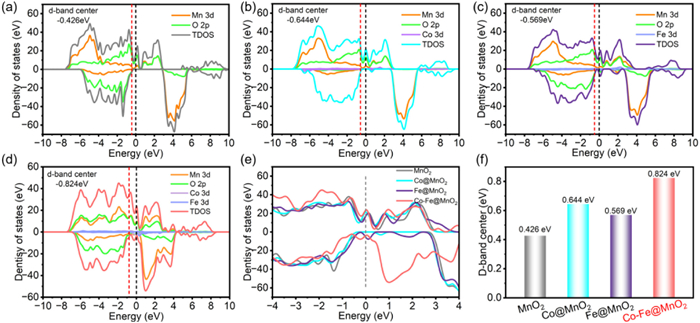
DFT calculations were used to further verify the atomic-scale dual-metal induced electronic reconstruction of Co- and Fe-modified MnO2 catalysts. Initially, the (200) surface slab of the MnO2 unit cell was constructed. Subsequently, Co@MnO2 and Fe@MnO2 were modeled by substituting the hydroxyl hydrogen (-OH) atoms bound to surface Mn sites with Co or Fe atoms, respectively. A Co-Fe@MnO2 model was then obtained by introducing both Co and Fe at neighboring Mn sites to emulate atomic-scale dual-metal dispersion. The density of states (DOS) of each catalyst was calculated (Figs. 4a–d), and the total DOS comparison is shown in Fig. 4e. Near the Fermi level (Ef), Co-Fe@MnO2 exhibits a significantly higher charge density, indicating enriched active electronic states on the surface. This facilitates more efficient adsorption and activation of reactants, thereby accelerating the entire reaction pathway.
Figure 4
Figure 4.
DFT-calculated electronic structures: (a-d) Projected DOS for key species. (e) Total DOS near the Fermi level. (f) Computed d-band center positions for MnO2 and Co-Fe@MnO2.
To fundamentally elucidate the nature of this electronic reconstruction, the state intensity and orbital overlap were thoroughly evaluated. The orbital hybridization between Co/Fe 3d orbitals and the surrounding Mn 3d and O 2p orbitals near the Fermi level induces pronounced interfacial charge redistribution. Co-Fe@MnO2 possesses the lowest d-band center (−0.824 eV) compared to Co@MnO2 (−0.644 eV) and Fe@MnO2 (−0.569 eV), confirming that the synergistic electronic reconstruction derived from atomically dispersed Co and Fe is a decisive factor in its superior bifunctional electrocatalytic activity (Fig. 4f). This theoretical charge redistribution directly accounts for the experimentally observed reduction in the average Mn oxidation state (from +4.0 to +3.6, confirmed by Mn 3s XPS) and the concomitant generation of oxygen vacancies. Consequently, the synergistic interplay between local charge transfer, valence state lowering, and orbital reorganization leads to the downward shift of the d-band center, optimizing the adsorption free energies of key oxygenated intermediates (*OH, *O, and *OOH) [30]. Such optimization favors lower overpotentials for both the ORR and OER, while promoting intermediate desorption and enhancing overall kinetics [16,51]. Therefore, the superior intrinsic catalytic activity of Co-Fe@MnO2 originates from the synergistic coupling of atomically dispersed Co and Fe dual sites, which elevates the electronic-state density near the Fermi level, tailors the d-band center, and thereby optimizes the adsorption free energies of oxygenated intermediates.
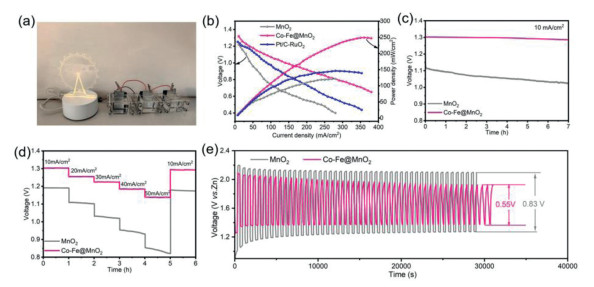
To evaluate the practical viability of the synthesized catalysts, self-assembled ZABs were constructed and subjected to a series of electrochemical tests. As a visual demonstration, the Co-Fe@MnO2-based ZABs efficiently power a small lamp (Fig. 5a), indicating its operational capability. Discharge polarization and power density curves (Fig. 5b) reveal that Co-Fe@MnO2-based battery reaches a maximum power density of 249 mW/cm2 at 360 mA/cm2, substantially surpassing those of pristine MnO2 (120 mW/cm2 at 270 mA/cm2) and the benchmark Pt/C-RuO2 system (147 mW/cm2 at 300 mA/cm2). In addition, the Co-Fe@MnO2 exhibits significantly enhanced operational stability, maintaining a stable discharge voltage over 7 h at 10 mA/cm2, outperforming pristine MnO2 (Fig. 5c). Rate performance tests (Fig. 5d) further demonstrate that Co-Fe@MnO2 delivers higher discharge plateaus than pristine MnO2 across all tested rates. At 50 mA/cm2, the Co-Fe@MnO2-based ZAB delivers a discharge voltage of 1.15 V, far superior to the 0.84 V recorded for MnO2. When the current density is restored to 10 mA/cm2, the voltage returns nearly to its initial value, underscoring excellent rate capability and electrochemical reversibility. Galvanostatic charge-discharge cycling tests at 10 mA/cm2 (Fig. 5e) show the durability of Co-Fe@MnO2, which sustains a narrow voltage gap of only 0.55 V after 30,000 s, much lower than the 0.83 V gap seen with pristine MnO2. The superior ZAB performance further confirms that the improved energy conversion efficiency stems from the electronic reconstruction induced by the α-MnO2 dual-site. These results collectively affirm the strong practical potential of the Co-Fe@MnO2 catalyst for application in high-performance ZABs and related energy conversion technologies.
Figure 5
Figure 5.
ZABs performance: (a) Photograph showing a lamp powered by ZABs using the Co-Fe@MnO2. (b) Discharge polarization and corresponding power density curves. (c) Galvanostatic discharge profiles at 10 mA/cm2. (d) Rate performance. (e) Long-term cycling performance at 10 mA/cm2.
In summary, we have successfully engineered atomically dispersed Co-Fe bimetallic sites anchored on α-MnO2 nanorods, yielding a highly efficient bifunctional electrocatalyst Co-Fe@MnO2 for rechargeable ZABs. The results demonstrate that the Co-Fe@MnO2 catalyst exhibits outstanding ORR performance, with an E1/2 of 0.85 V, a JL of 5.9 mA/cm2, and an electron transfer number close to 4, alongside superior OER activity, requiring an overpotential of merely 230 mV at 10 mA/cm2, markedly surpassing pristine α-MnO2 and its single-metal counterparts. Meanwhile, DFT calculations reveal that the electronic reconstruction driven by the Co-Fe bimetallic site enriches the electronic states near the Fermi level and induces a favorable downward shift in the d-band center, resulting in optimized adsorption of critical oxygen intermediates (*OH, *O, and *OOH), the barrier of the rate-limiting step is lowered, and the overall reaction kinetics are significantly accelerated. Furthermore, the Co-Fe@MnO2-based ZAB enables a peak power density of 249 mW/cm2 at 360 mA/cm2 and exhibits remarkable operational stability in an alkaline electrolyte. As a result, the Co-Fe@MnO2 catalyst displays outstanding bifunctional electrocatalytic performance and enables durable rechargeable ZABs. More importantly, this work establishes a dual-site-induced electronic reconstruction mechanism, providing new insights into the development of multi-metallic atomic catalysts beyond MnO2-based systems.
The authors declare that they have no known competing financial interests or personal relationships that could have appeared to influence the work reported in this paper.
Acknowledgments
This work was supported by the Natural Science Foundation of Shandong Province (Nos. ZR2024QE307 and ZR2024QE312), Hunan Province Graduate Science and Technology Innovation Project (No. CX20240812), Changsha University of Science and Technology Postgraduate Practical Innovation Project (No. CLSJCX25092).
Supplementary materials
Supplementary material associated with this article can be found, in the online version, at doi:10.1016/j.cclet.2026.113292.
Figure 1
(a) Schematic illustration of the synthesis procedure for Co-Fe@MnO2. (b) XRD patterns of pristine MnO2, Co@MnO2, Fe@MnO2, and Co-Fe@MnO2. (c) FTIR spectra of MnO2 and Co-Fe@MnO2. (d, e) TEM and HRTEM images of Co-Fe@MnO2. (f) HAADF-STEM image. (g) Atomically resolved 3D topographic mapping. (h, i) EDS elemental mappings of Mn, O, Fe, and Co in Co-Fe@MnO2.
Figure 2
(a) Mn 2p, (b) Mn 3s, and (c) O 1s XPS spectra of MnO2 and Co-Fe@MnO2. (d) EPR spectra comparing oxygen vacancy signals in MnO2 and Co-Fe@ MnO2.
Figure 3
ORR performance: (a) LSV curves in 0.1 mol/L O2-saturated KOH aqueous solution at 1600 rpm for MnO2, Co@MnO2, Fe@MnO2, Co-Fe@MnO2 and commercial Pt/C. (b) Tafel plots. (c) Electron transfer number and peroxide yield derived from RRDE measurements. (d) Comparison of ECSA. (e) Chronoamperometry tests. OER performance: (f) LSV curves in 1 mol/L KOH aqueous solution. (g) Corresponding Tafel slopes for MnO2, Co@MnO2, Fe@MnO2, and Co-Fe@MnO2 and RuO2. (h) Combined ORR and OER polarization curves. (i) Comparison of the bifunctional activity parameter ΔE (Ej10 - E1/2) with previously reported catalysts.
Figure 4
DFT-calculated electronic structures: (a-d) Projected DOS for key species. (e) Total DOS near the Fermi level. (f) Computed d-band center positions for MnO2 and Co-Fe@MnO2.
Figure 5
ZABs performance: (a) Photograph showing a lamp powered by ZABs using the Co-Fe@MnO2. (b) Discharge polarization and corresponding power density curves. (c) Galvanostatic discharge profiles at 10 mA/cm2. (d) Rate performance. (e) Long-term cycling performance at 10 mA/cm2.


 DownLoad:

 下载:


 下载:

