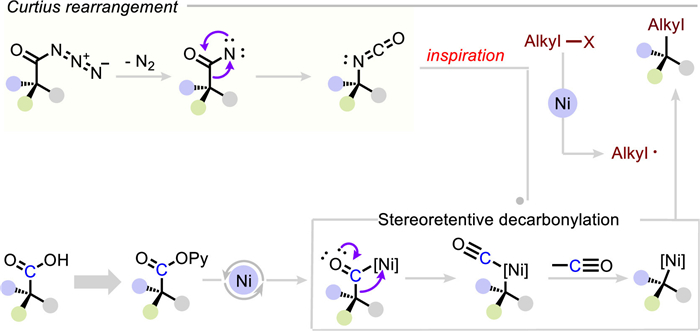
Figure 1.
Ni-catalyzed stereoretentive decarbonylative C(sp3)–C(sp3) cross-coupling.

Ni-catalyzed stereoretentive C(sp3)–C(sp3) cross-coupling
Mengya Yin , Lixin Duan , Zitong Wu , Yaojia Jiang , Tao Tu


The stereocontrolled construction of C(sp3)–C(sp3) bonds remains a fundamental challenge in organic synthesis, particularly in the context of drug discovery, where the fraction of sp3-hybridized carbons has been correlated with improved clinical success rates. While cross-coupling has emerged as a powerful platform for alkyl–alkyl bond formation, the inherent involvement of radical intermediates often results in rapid loss of stereochemical information, thereby limiting the applicability of such methods to enantioenriched substrates. Nevertheless, significant advances have been achieved in very recent years through distinct mechanistic strategies. For instance, Baran and co-workers recently reported a nickel-catalyzed stereoretentive alkyl–alkyl radical coupling, wherein chiral sulfonylhydrazides and alkyl halides undergo an in-cage radical rebound pathway, affording complex chiral molecules in good yields [1]. In 2024, the Weix group disclosed a nickel-catalyzed, nonradical electrophilic coupling of carboxylic acid derivatives, which proceeds through a decarbonylative primary C(sp3)–Ni migratory insertion to establish C(sp3)–C(sp3) bonds [2], in contrast to prior reports that focused predominantly on C(sp2)–C(sp3) bond constructions [3]. This catalytic system has been largely confined to α-primary carboxylic acids for the construction of alkyl–alkyl products; complete retention of stereochemistry for secondary carboxylic acids bearing a α-carbon stereocenter was observed, albeit with substantially diminished yields, predominantly due to competing β-hydride elimination and ketone formation products [4]. Recently in Nature, Wu, Weix and co-workers built upon their previous studies and, through systematic ligand screening, established a new nickel-based catalytic system that enabled stereoretentive decarbonylative C(sp3)–C(sp3) cross-coupling of α-chiral secondary carboxylic acids with alkyl halides, furnishing the alkyl-alkyl products with retention of configuration [5]. The authors demonstrate that acyl–nickel intermediates derived from readily available α-chiral carboxylic acids (e.g., amino acids and hydroxy acids) via a "nickel-Curtius" rearrangement process to afford alkyl–nickel species. This "metallo-Curtius" rearrangement manifold enables the high-fidelity translation of stereochemical information from the chiral carboxylic acid substrate to the coupled product, achieving exceptional levels of enantiospecificity (Fig. 1).
A key enabling factor is the identification of the pyrazolyl–pyridine ligand, which facilitates rapid decarbonylation at ambient temperature and effectively suppresses undesired ketone formation, a competitive pathway that has plagued previous decarbonylative coupling systems. The reaction proceeds under mild conditions and exhibits broad functional-group tolerance, including compatibility with acidic N–H motifs and various oxidatively sensitive functionalities. Mechanistically, the authors provide compelling evidence that the enantiospecificity of the catalytic process is governed by the competition between radical capture (oxidative ligation) and a reversible β-hydride elimination/alkene reinsertion pathway. Through deuterium-labeling experiments, radical clock studies, and the isolation and structural characterization of a key alkyl–nickel(Ⅱ) intermediate, the authors rule out radical-based racemization and establish that the stereochemical outcome is determined by the relative rates of these competing pathways. Based on mechanistic experiments and intermediate isolation, the authors propose the following catalytic cycle (Scheme 1): Metal complex A, formed by the coordination of Ni with a dinitrogen ligand, is subsequently subjected to reductive conditions with Mn to afford the Ni(0) complex B. oxidative addition of the 2-pyridyl ester to Ni(0) generates acylnickel(Ⅱ) intermediate C; this species undergoes rapid and stereoretentive 1,1-migration (decarbonylation) to afford alkylnickel(Ⅱ) species D; subsequent radical capture by D produces dialkylnickel(Ⅲ) intermediate E, which undergoes reductive elimination to release product 3 and regenerate Ni(Ⅰ) (A).
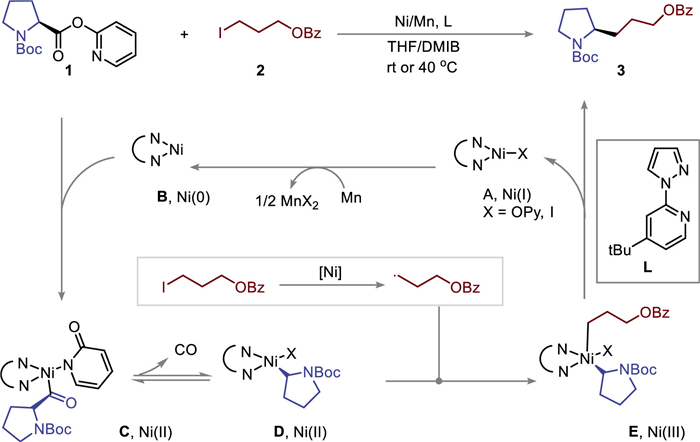
The synthetic utility of this method is underscored by its successful application to a diverse array of cyclic and acyclic α-amino acid derivatives, as well as α-hydroxy acid substrates. The ability to access both cis- and trans-pyrrolidine products with high diastereocontrol, complementing conventional radical-based decarboxylative approaches that often favor the undesired isomer, represents a notable advantage. Furthermore, the method has been demonstrated in the expedient synthesis of key intermediates for natural products and pharmacologically relevant targets, highlighting its potential in complex molecule synthesis. This work constitutes a significant advance in the field of stereocontrolled cross-coupling, offering a practical and general strategy for the utilization of enantiopure carboxylic acids as chiral building blocks. The extension of this "metallo-Curtius" concept to other carboxylic acid derivatives and coupling partners, coupled with further ligand engineering to modulate the kinetics of decarbonylation and racemization, holds promise for broadening the scope and enhancing the efficiency of stereospecific C(sp3)–C(sp3) bond formation.
In summary, the work by Wu and Weix et al. not only addresses a longstanding challenge in stereochemical control but also establishes a new paradigm that bridges classical rearrangement chemistry with modern transition-metal catalysis, thereby enriching the synthetic toolbox for accessing C(sp3)-rich, three-dimensional chemical space. The mechanistic clarity and operational simplicity of the method are expected to facilitate its adoption in both academic and industrial settings.
Mengya Yin: Writing – original draft. Lixin Duan: Validation. Zitong Wu: Validation. Yaojia Jiang: Writing – review & editing. Tao Tu: Writing – review & editing.
The authors declare that they have no known competing financial interests or personal relationships that could have appeared to influence the work reported in this paper.
Financial support from the National Natural Science Foundation of China (No. 22271060) and Key Research and Development Program of Ningxia Hui Autonomous Region (No. 2026BEE02007), the State Key Laboratory of Green Pesticide, Guizhou University, the Department of Chemistry at Fudan University and the School of Chemistry and Chemical Engineering at Ningxia University is gratefully acknowledged.
Y. Wang, J. Sun, Y. Li, et al., Science 392 (2026) 1075–1081. doi: 10.1126/science.aef6981
Z. Huang, M.E. Akana, K.M. Sanders, D.J. Weix, Science 385 (2024) 1331–1337. doi: 10.1126/science.abi4860
J. Wang, L.E. Ehehalt, Z. Huang, et al., J. Am. Chem. Soc. 145 (2023) 9951–9958. doi: 10.1021/jacs.2c11552
J. Wang, B.P. Cary, P.D. Beyer, et al., Angew. Chem. Int. Ed. 58 (2019) 12081–12085. doi: 10.1002/anie.201906000
Z. Huang, T. Wu, Z. Yuan, et al., Nature 655 (2026) 1187–1194. doi: 10.1038/s41586-026-10800-4

 扫一扫看文章


扫一扫关注我们
 DownLoad:

 下载:

 下载: