
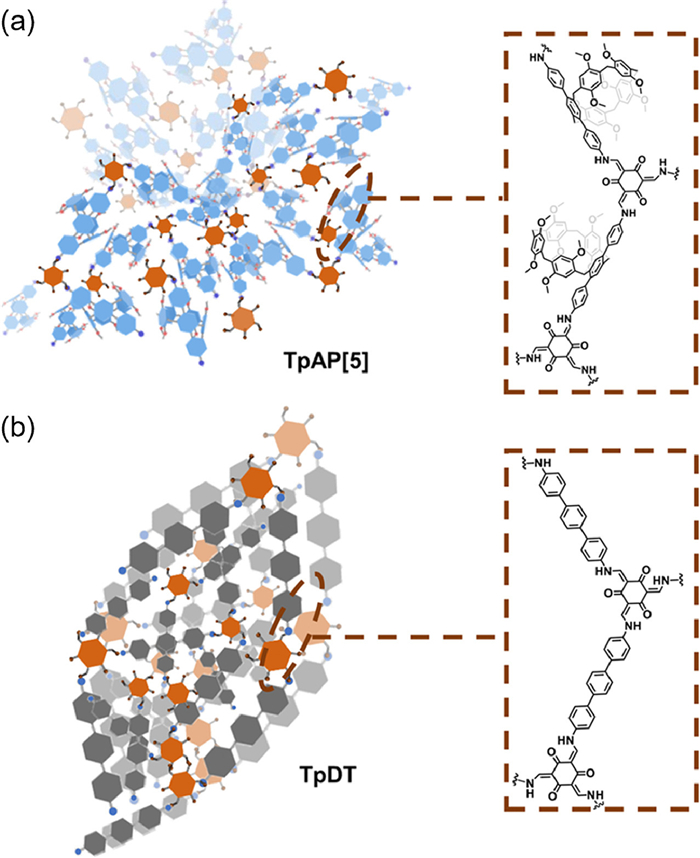
Figure 1.
Cartoon and chemical structure of (a) TpAP[5] and (b) TpDT. Reproduced with permission [8]. Copyright 2025, American Chemical Society.


Sunlight powers nearly all life on Earth. Plants use it to convert water and carbon dioxide into the chemical energy needed for growth, while humans have long dreamed of using sunlight to drive useful chemical reactions in a similarly clean and sustainable way. One particularly attractive target is hydrogen peroxide (H2O2), a familiar chemical found in disinfectants, wastewater treatment, paper bleaching, and many industrial processes [1,2]. Unlike many oxidants, H2O2 breaks down into only water and oxygen after use, making it an environmentally friendly reagent. However, the way it is produced today still relies largely on energy-intensive industrial processes. This challenge has inspired scientists to explore whether sunlight can be used to make H2O2 directly under mild conditions [3-5].
At first glance, simply mixing a light-absorbing material with oxygen may seem sufficient. In reality, photocatalytic H2O2 production is far from straightforward. Light-generated charges are easily lost before they can drive chemical reactions, and the desired reaction often competes with unwanted pathways. This is where supramolecular chemistry offers exciting opportunities. Supramolecular chemistry is often described as “chemistry beyond molecules”. Rather than focusing solely on permanent covalent bonds, it exploits reversible and highly directional interactions, including hydrogen bonding, π–π stacking, electrostatic attraction, and host–guest recognition, to create functional supramolecular motifs and architectures with emergent properties [6,7]. These supramolecular elements can also be incorporated into covalent frameworks, thereby combining the robustness of covalent structures with the dynamic and recognition capabilities of supramolecular chemistry. Through such supramolecular design, materials can harvest sunlight more efficiently, guide charge migration, and create favorable microenvironments for photocatalytic reactions. Accordingly, researchers have developed a range of supramolecular materials, including macrocycle-containing polymers, host–guest systems, molecular cages, and supramolecular polymers. Although these materials differ in structural construction, they share a common principle: Leveraging supramolecular motifs and interactions to organize functional components for more efficient conversion of sunlight into chemical energy. The following examples demonstrate how supramolecular design is opening new possibilities for efficient and sustainable H2O2 production.
In 2025, Yang and co-workers introduced an interesting example of how a familiar supramolecular building block can improve photocatalytic H2O2 production [8]. They incorporated pillar[5]arene, a well-known macrocycle with a hollow, electron-rich cavity, into a porous conjugated polymer (TpAP[5]) (Fig. 1). This design integrates the light-harvesting capability of a porous conjugated polymer with the structural and electronic advantages of the pillar[5]arene macrocycle, creating a photocatalyst that captures sunlight more efficiently and promotes the separation and transfer of photoexcited charges. As a result, TpAP[5] produced H2O2 at a rate of 2343 μmol g−1 h−1 under visible light, more than twice that of a similar polymer without the pillar[5]arene units, while also showing excellent stability during repeated use.
Why does the macrocycle make such a difference? Further studies showed that the incorporated pillar[5]arene units do much more than simply serve as structural building blocks. Their electron-rich conjugated macrocyclic framework and intrinsic cavities facilitate charge separation, reduce charge-transfer resistance, and provide a favorable microenvironment for oxygen activation, thereby making the photocatalytic process more efficient. At the same time, the macrocyclic framework improves the stability of the polymer during continuous light irradiation, allowing it to maintain high activity over extended periods. This work demonstrates that macrocyclic building blocks are not merely structural components but can actively modulate the electronic properties and catalytic microenvironment of conjugated polymers, providing a simple yet powerful strategy for designing more efficient H2O2 photocatalysts.
In 2026, Zhang and co-workers introduced an elegant supramolecular strategy for photocatalytic H2O2 production using porphyrin-based dual-cavity metallacages assembled through coordination-driven self-assembly [9]. Two closely related cages, 6a and 6b, were designed (Fig. 2). Both contain two well-defined cavities that can accommodate aromatic guest molecules, much like tiny molecular containers. The key difference is that 6b incorporates electron-accepting triazine units, allowing it to make better use of visible light and more efficiently separate light-generated charges. As a result, 6b (Fig. 2c) outperformed 6a (Fig. 2b), producing H2O2 at a rate of 2007 μmol g−1 h−1 under visible-light irradiation.
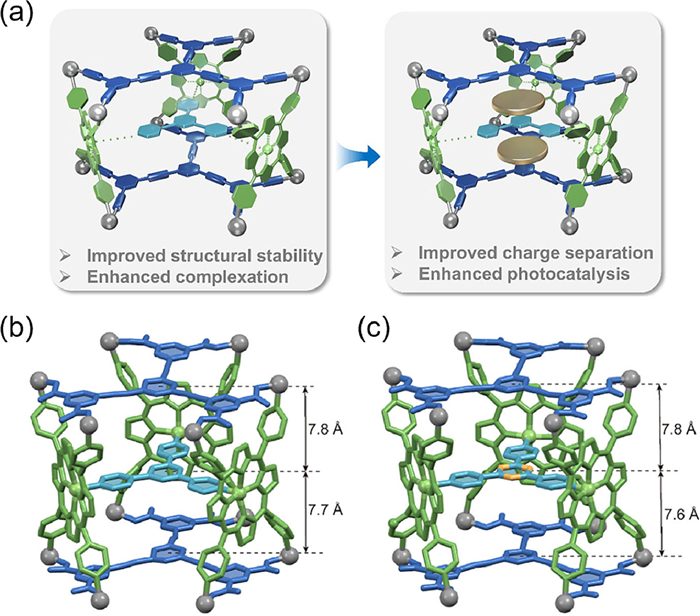
The most intriguing aspect of this work lies in the role of host–guest chemistry. When electron-rich guest molecules were encapsulated inside the cavity of 6b, the photocatalytic activity increased dramatically, with the host–guest complex 6b
In another inspiring example, He and co-workers developed a family of phenothiazine-functionalized covalent organic superphane cages as metal-free photocatalysts for H2O2 production [10]. Unlike conventional polymeric photocatalysts, these discrete molecular cages possess precisely defined three-dimensional structures, allowing researchers to directly relate molecular architecture to photocatalytic performance. Among them, SUPE-ptz-2 was obtained by further reinforcing the parent cage SUPE-ptz-1 through a post-synthetic “tying” strategy, which made the cage more rigid and stable (Fig. 3). This seemingly simple structural modification enabled the photocatalyst to harvest visible light more efficiently and make better use of the absorbed energy. As a result, SUPE-ptz-2 achieved an impressive H2O2 production rate of 11,089 μmol g−1 h−1 in pure water, which further increased to 25,031 μmol g−1 h−1 in the presence of isopropanol.
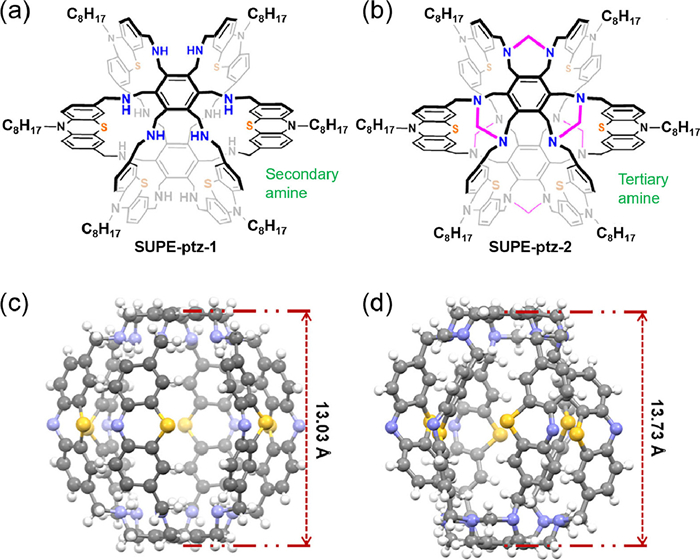
The success of this system comes from the precisely organized cage architecture. Further studies showed that different parts of the cage perform different tasks during photocatalysis: The phenothiazine units help oxidize water, while the amine groups promote oxygen reduction. By separating these two reactions within the same molecular cage, the photocatalyst reduces energy loss and allows light-generated charges to move more efficiently between the active sites. The rigid superphane framework also stabilizes key reaction intermediates, leading to high activity and excellent selectivity for H2O2 production. These findings suggest that precisely designed supramolecular cages offer an attractive strategy for developing efficient sunlight-driven photocatalysts by enabling precise spatial organization of catalytic components and reaction intermediates.
Taking a different approach, Ðorđević and co-workers recently introduced the concept of aggregation-induced photocatalysis (AIP) using supramolecular dye polymers formed from amphiphilic distyrylanthracene derivatives [11]. Rather than constructing rigid porous frameworks or molecular cages, they simply allowed the dye molecules (DSA2+) to self-assemble into well-ordered nanoribbons (Fig. 4). Surprisingly, this spontaneous organization greatly improved the utilization of absorbed light. When the molecules packed together, their motion became restricted, reducing energy loss and allowing more excited states to participate in photocatalytic reactions. As a result, the self-assembled nanoribbons exhibited enhanced fluorescence, more efficiently generated superoxide radicals (O2•−) through photoinduced electron transfer to molecular oxygen, and showed significantly improved photocatalytic activity in water.
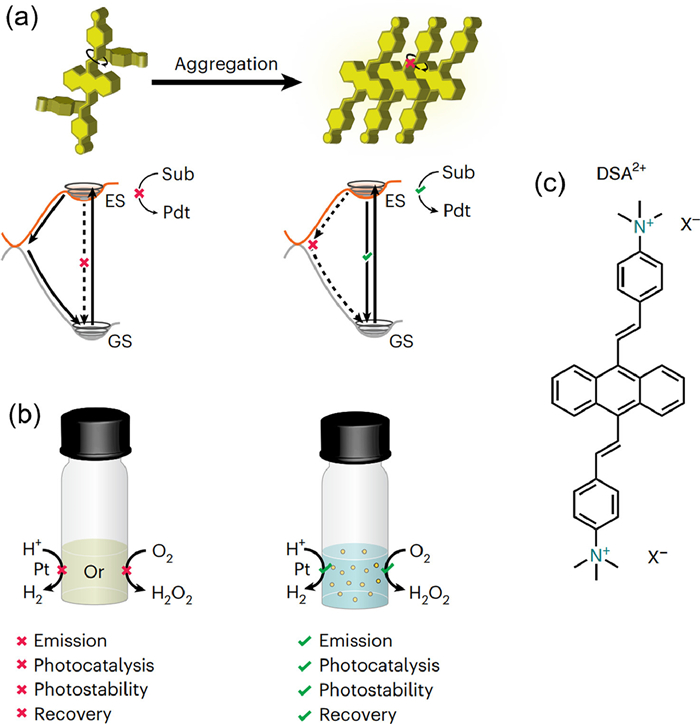
Another attractive feature of this system is its simplicity and adaptability. The photoexcited assemblies efficiently reduced oxygen to O2•−, which subsequently underwent disproportionation or further one-electron reduction to produce H2O2 under visible light. Meanwhile, the sacrificial electron donor (MOPS) regenerated the oxidized chromophore, thereby sustaining the photocatalytic cycle. Even more interestingly, the photocatalytic activity could be tuned by changing the counterions, salt concentration, or assembly conditions, demonstrating how subtle changes in supramolecular organization can strongly influence photocatalytic performance. Perhaps the most important lesson is that designing a better photocatalyst is not always about synthesizing more complicated molecules. Sometimes, simply controlling how molecules assemble can make an equally profound difference.
In summary, the examples discussed here show that the way molecules come together can be just as important as the molecules themselves. Through supramolecular design, supramolecular materials create well-organized architectures that harvest sunlight more efficiently, direct the movement of light-generated charges, and provide favorable environments for photocatalytic H2O2 production. From macrocycle-based polymers and host–guest metallacages to precisely defined molecular cages and self-assembled dye aggregates, these diverse systems demonstrate the remarkable versatility of supramolecular chemistry in transforming simple molecular building blocks into efficient photocatalysts.
Looking ahead, the future of this field will likely depend not only on designing new photoactive molecules but also on discovering smarter ways to organize them. As advances in programmable self-assembly, adaptive supramolecular materials, and bioinspired photocatalysis continue, researchers will gain increasing control over how light energy is captured and converted into chemical energy. By bridging molecular design with functional organization, supramolecular chemistry is expected to play an increasingly important role in sustainable H2O2 production, artificial photosynthesis, and other solar-to-chemical energy conversion technologies.
Xiaomeng Wang: Writing – original draft. Tangxin Xiao: Writing – review & editing, Supervision, Project administration, Conceptualization. Hua Cheng: Writing – review & editing. Leyong Wang: Writing – review & editing, Supervision, Funding acquisition.
The authors declare that they have no known competing financial interests or personal relationships that could have appeared to influence the work reported in this paper.
Z. Du, Z. Zhou, N. Sun, C. Yue, F. Liu, Chin. Chem. Lett. 37 (2026) 111341. doi: 10.1016/j.cclet.2025.111341
H. Lv, Z. Li, P. Yin, P. Wan, M. Zhu, Chin. Chem. Lett. 36 (2025) 110457. doi: 10.1016/j.cclet.2024.110457
C. Wang, X. Xie, F. Qiu, et al., Chin. Chem. Lett. 37 (2026) 111604. doi: 10.1016/j.cclet.2025.111604
Z. Gao, Z. Wang, X. Ji, et al., J. Am. Chem. Soc. 148 (2026) 30265–30277. doi: 10.1021/jacs.6c08119
J. Li, N. Xu, Y. Zhang, H. Dong, C. Li, Chin. Chem. Lett. 36 (2025) 110470. doi: 10.1016/j.cclet.2024.110470
Z. Gao, J.A. Zhang, Z. Zhang, B. Mu, W. Tian, Acc. Chem. Res. 59 (2026) 557–569. doi: 10.1021/acs.accounts.5c00700
X.Y. Wang, Z. Gao, W. Tian, Chin. Chem. Lett. 35 (2024) 109757. doi: 10.1016/j.cclet.2024.109757
Z.Q. Wang, M.H. Li, S. Liang, et al., J. Am. Chem. Soc. 147 (2025) 13618–13628. doi: 10.1021/jacs.5c00768
Y. Huang, S. Jian, Z. Guo, et al., Angew. Chem. Int. Ed. 65 (2026) e9964829. doi: 10.1002/anie.9964829
Z. Long, K. Luo, K. Wang, M. Zhu, Q. He, Adv. Mater. 38 (2026) e20264. doi: 10.1002/adma.202520264
M. Barbieri, D. Cappelletti, L. Vaccarin, et al., Nat. Chem. 18 (2026) 1372–1382. doi: 10.1038/s41557-026-02151-4

Figure 1 Cartoon and chemical structure of (a) TpAP[5] and (b) TpDT. Reproduced with permission [8]. Copyright 2025, American Chemical Society.

Figure 2 (a) Cartoon representation of the porphyrin-based dual-cavity metallacages and their host–guest complexes in photocatalysis. Crystal structures of (b) 6a and (c) 6b. Reproduced with permission [9]. Copyright 2026, Wiley Publisher.

Figure 3 Chemical structures of (a) SUPE-ptz-1 and (b) SUPE-ptz-2. Single-crystal structures of (c) SUPE-ptz-1 and (d) SUPE-ptz-2. Reproduced with permission [10]. Copyright 2026, Wiley Publisher.

Figure 4 (a) Overview of the rigidification in DSA2+ amphiphiles through supramolecular polymerization. (b) Aggregation leads to excited-states enhancement and photocatalysis (H2 or H2O2 photoproduction). (c) Chemical structure of distyrylanthracene (DSA2+) amphiphile. GS, ground state; ES, excited state; Sub, substrate; Pdt, product. Reproduced with permission [11]. Copyright 2026, Nature Publishing Group.

 扫一扫看文章


扫一扫关注我们
 DownLoad:
 下载:
 下载: