
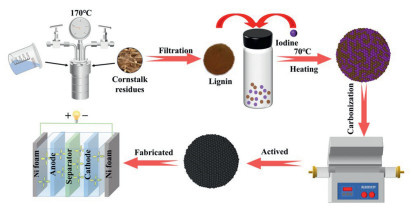
Figure 1.
Schematic diagram of the IALCs preparation process.


Nowadays, with the continuous growth of global energy demand and the increasingly serious environmental problems, the development of efficient and sustainable energy storage technologies has become the focus of both scientific and industrial circles [1-4]. Supercapacitors have shown great potential for applications in renewable energy storage, electric vehicles, and portable electronic devices due to their high-power density, rapid charge-discharging capabilities, and long cycle life [5-8]. However, supercapacitors still suffer from inherent limitations such as low energy density and low specific capacitance compared to traditional batteries, which are the primary barriers to their large-scale applications [9,10]. As the core component of supercapacitors, electrode materials directly determine their energy storage performance. Herein, the primary objective of current research is to develop novel electrode materials that boost the energy density and specific capacitance of supercapacitors without sacrificing performance, cost-effectiveness, or environmental sustainability [11-13].
In recent years, biomass-derived materials have received significant attention due to their renewability, cost-effectiveness, and environmental compatibility. Lignin, as the second most abundant natural polymer in nature, has a global annual output of over 50 million tons [14,15]. However, <5% of lignin is utilized for high-value applications, while the majority is discarded or incinerated as by-products of papermaking black liquor and biomass refining. This not only leads to a waste of resources but also exacerbates environmental pollution. At present, biomass materials have been widely applied on an industrial scale in fields such as adhesives and adsorbents [16,17], especially as renewable electrode materials in the energy storage sector [18-20]. Deng et al. [21]. achieved an electrode with an Rs of 2.4 Ω through a combination of fungal (Phanerochaete chrysosporium) treatment, low-concentration KOH solution treatment, and MXene anchoring. Mao et al. [22]. directly converted lignin into flash graphene (FG) using flash Joule heating (FJH) technology, the specific capacitance of the FG-based supercapacitor was 7.69 mF/cm2 at the current density of 0.2 mA/cm2. Although all the above-mentioned methods can improve the performance of materials to a certain extent, they also have problems such as low graphitization degree of electrode materials and high series resistance, which affect the electrochemical performance of supercapacitors. Therefore, how to optimize the microstructure of lignin-based carbon materials through physical or chemical methods and enhance its graphitization degree to improve its electrochemical activity has become a research hotspot.
Herein, we prepared a kind of lignin-based carbon materials with a high degree of graphitization (IALCs) are successfully synthesized though iodine treatment followed by high-temperature carbonization and activation. The iodine treatment effectively enhances the π-π interactions between lignin molecules, thereby improving the molecular rigidity. Simultaneous thermal analysis, TEM, and Raman spectroscopy results demonstrate that the thermodynamic properties of lignin are significantly enhanced, with an increased number of graphite microcrystals and a higher degree of graphitization. The specific capacitance of IALC increases to 3.1 times than that of the original lignin-based carbon materials, while the equivalent series resistance (Rs) and charge-transfer resistance (Rct) decrease to 0.55 and 0.23 times those of the raw lignin-based carbon materials when applied as electrode materials, respectively. The assembled supercapacitors achieve an energy density of 61.27 mWh/cm2 at a power density of 100 mW/cm2, and exhibits excellent cycling stability with a capacitance retention rate above 90% after 10,000 cycles.
The detailed synthesis procedure for IALCs is illustrated schematically in Fig. 1 and described step-by-step below. Initially, 100 g of cornstalk residues after enzymatic hydrolysis is placed into a 1 L high-pressure reactor. The pulp is prepared using the sulfate method, with an alkali dosage of 18% (calculated as Na2O), a sulfidity of 30%, and a liquid-to-solid ratio of 4:1. The mixture was heated by a gradual heating increment of 1 ℃/min, culminating at 170 ℃ and holding for 2 h. After the reaction is complete, cool the mixture to ambient temperature. The mixture was filtered through a Buchner funnel to collect the filtrate, and hydrochloric acid was subsequently added to adjust the pH of the solution to 2. After 12 h of natural sedimentation, filtration was carried out, and the filter cake was washed with deionized water until the washing solution was neutral. Finally, it was dried at −50 ℃ for 96 h to gain sulfated lignin. Accurately weigh 1, 2, 3, and 4 g of iodine, respectively, into four labeled sample bottles; subsequently, add 4 g of the above prepared lignin to each bottle. Transfer all bottles to a drying oven at 70 ℃ and heat for 12 h. To ensure homogeneous reaction progress, gently invert each bottle manually every 20 min to achieve ILs. After cooling, all the ILs were transferred to a tube furnace, heat it up to 1200 ℃ at 5 ℃/min in a N2 atmosphere, and keep it at this temperature for 2 h to obtain ILCs. Mix ILCs and KOH at a mass ratio of 1:2, and transfer the mixture into a tube furnace where it is heated at a rate of 5 ℃/min to 800 ℃ and held at this temperature for 2 h to achieve activation. After the reaction was completed, the product was subjected to ultrasonically with deionized water until neutral, following by drying to obtain IALCs. The products obtained from the reactions with the ratios of lignin to iodine being 4:0, 4:1, 4:2, 4:3, and 4:4 were respectively named IALC-1, IALC-2, IALC-3, IALC-4, and IALC-5.
The morphologies of IALC-1, IALC-2, IALC-3, IALC-4, and IALC-5 were examined using SEM and TEM, with results presented in Figs. 2a-e, respectively. The surface of untreated lignin appears smooth and flat, lacking distinct pore structures. These results suggest that the morphology of lignin particles undergoes transformation during thermal treatment as a result of melting. At an iodine content of 20%, loose structures initiated on the surface of IALC-2. With further elevation of iodine concentration, the surface of IALCs exhibited increasing looseness, accompanied by the generation of numerous pore structures. The presence of these pores facilitates faster electrolyte ion transport within the electrode material and provides more active sites, thereby enhancing the electrochemical performance. However, when the iodine treatment concentration was excessively increased, sample IALC-5 exhibited structural agglomeration, likely due to the high concentration of iodine causing lignin to adhere and clump together, which may block the pore structures. The EDS analysis of IALC-4 is shown in Fig. 2f. It reveals a uniform distribution of C, O, S, and I throughout the IALC-4 structure, with no evident elemental aggregation. This suggests that the active sites are evenly distributed, indicating consistent electrochemical activity across the material, which contributes to improved cycling stability.
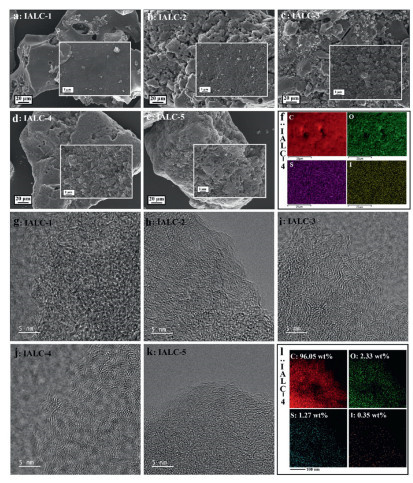
The TEM images of IALCs are shown in Figs. 2g-k. In the absence of I treatment (IALC-1), only trace amounts of graphite-like structure are observed at the edge of the lignin-derived carbon materials. An increase in iodine quantity leads to a gradual enhancement of the graphite-like structure in lignin-derived carbon. The highest quality of the graphite-like structure formation in IALC-4 is achieved at a lignin-to-iodine ratio of 4:3. As the I content continues to increase, the graphite-like structure formed by IALC-5 begins to deteriorate. The observed effect could be attributed to high iodine content, which induces precursor agglomeration. During thermal treatment, non-uniform heat distribution within the lignin material leads to a substantial temperature difference between the core and surface regions, ultimately disrupting graphitization phase development. Fig. 2l shows the TEM-based elemental mapping of IALC-4. The distribution of C, O, and S in the microscopic area of the material is also relatively uniform, with their contents being 96.05%, 2.33%, and 1.27%, respectively. A residual amount of iodine is observed in the material post heat treatment, constituting 0.35% of the total content. Oxygen can enhance the wettability of the electrode surface, and S can improve the conductivity of the material and provide additional active sites. Both I and S can provide additional pseudocapacitance, enhancing the electrochemical performance of the material when used as an electrode.
The crystal structures of IALC-1, IALC-2, IALC-3, IALC-4, and IALC-5 were analyzed using XRD, and their diffraction patterns are presented in Fig. 3a. The diffraction peak observed around 24° corresponds to the (002) plane of the disordered carbon structure, while the peak near 44° corresponds to the (100) plane of the graphitic carbon structure [23,24]. Iodine treatment led to a reduction in the full width at half maximum (FWHM) of the (002) peak and a slight increase in the intensity of the (100) peak. This suggests that the degree of graphitization increases with higher iodine content. Based on the Bragg equation, the d002 values of IALC-1, IALC-2, IALC-3, IALC-4, and IALC-5 were calculated to be 0.3673, 0.3703, 0.3806, 0.3922, and 0.3676 nm, respectively. This increase in interlayer spacing may result from the intercalation of iodine atoms, which leads to structural expansion. Such structural reorganization enables exposure of multiple active sites, which promotes electrolyte ion infiltration and consequently improves the electrochemical performance of the materials. To further validate these findings, Raman spectroscopy was employed to characterize the IALCs samples, and the resulting spectra are shown in Fig. 3b. The Raman spectra of all IALCs samples feature two distinct peaks: The d-band (~1350 cm−1), which is associated with structural disorder in carbon, and the G-band (~1590 cm−1), corresponding to sp2-hybridized graphitic carbon. The IG/ID ratios (R values) of IALC-1, IALC-2, IALC-3, IALC-4, and IALC-5 were determined to be 0.9118, 0.9341, 0.9571, 0.9640, and 0.9725, respectively. The increasing R value suggests a progressive enhancement in the degree of graphitization of the material. The combined SEM, TEM, and XRD analyses demonstrate that iodine treatment of lignin facilitates the formation of a graphite phase structure during subsequent thermal treatment. This leads to enhanced graphite microcrystals abundance and improved degree of graphitization.
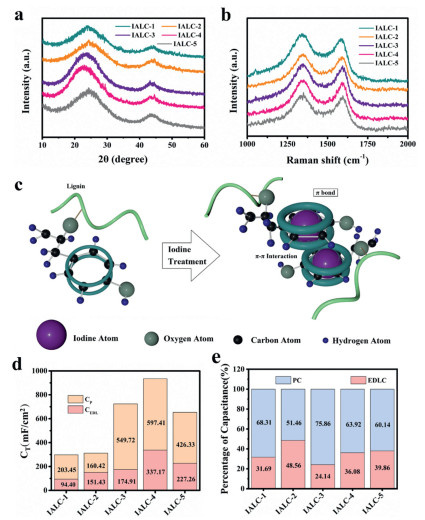
The proposed reaction mechanism for the iodine treatment of lignin is depicted in Fig. 3c. Under high-temperature conditions, elemental iodine volatilizes to forms iodine vapor. One iodine atom can capture a proton from the aromatic rings to generate HI, while another is incorporated into the aromatic system, forming a charge-transfer complex that establishes a p-π conjugated structure. Owing to the strong electron-donating character of iodine, this complex possesses a complete π-electron orbital, which effectively enhances the π-π interaction within the macromolecules framework and alters its thermodynamic properties [25]. This enhancement better preserves the morphology of lignin during the thermal treatment process and facilitates the development of a graphite microcrystalline structure. In addition, residual iodine atoms within the derived carbon can undergo redox reactions during charging and discharging cycles, contributing pseudocapacitance.
To further validate the above mechanism, all samples were analyzed using the Trasatti method and the results are presented in Figs. 3d and e (Eqs. S1–S3 and Fig. S5 in Supporting information) [26-28]. The vertical coordinate represents the total specific capacitance (CT) of the supercapacitors. The CT increased from 297.85 mF/cm2 for IALC-1 to 311.85, 724.63, and 934.58 mF/cm2 for IALC-2, IALC-3, and IALC-4, respectively, with increasing iodine dosage. However, at the highest loading (50%, IALC-5), the CT of IALC-5 decreased to 653.59 mF/cm2, although still surpassing that of IALC-1. The overall electrochemical performance enhancement of lignin-derived carbon after iodination from two synergistic contributions: (1) The electric double-layer capacitance (CEDL) from the promoted graphite phase formation, and (2) the pseudocapacitance (CP) arising from the redox reactions of residual iodine. On one hand, enhanced π-π interactions between aromatic rings promote the transformation of lignin into a graphite-like structure during the carbonization process, increasing the sp2-hybridized carbon content and thereby improving electrical conductivity. Correspondingly, CEDL values rise from 94.40 mF/cm2 (IALC-1) to 151.43 of IALC-2, 174.91 of IALC-3, 337.17 of IALC-4, and 227.26 mF/cm2 of IALC-5, respectively. On the other hand, redox-active residual iodine contributes significantly to CP. While Cp for IALC-1 was 203.45 mF/cm2, it increased dramatically by 2.94 times to 597.41 mF/cm2 for IALC-4. The subsequent decline in CP for IALC-5 (426.33 mF/cm2) is likely due to excessive iodine loading, which causes severe agglomeration, pore structure deterioration, and morphological damage. Fig. 3e presents the capacitance contribution percentages from different electrodes. For IALC-2 (low iodine dose), the increase in CEDL contribution outweighs that of CP, suggesting that iodine primarily promotes the sp2 carbon hybridization at this stage. Consequently, compared to IALC-1, IALC-2 shows a higher CEDL but a lower CP share. As the iodine dosage increases (IALC-3, IALC-4, and IALC-5), redox reactions become more dominant, and the promotion of CP surpasses that of CEDL, indicating that iodine mainly contributes pseudocapacitance under these conditions. Therefore, the CP contribution in IALC-3, IALC-4, and IALC-5 increases compared to IALC-2. Simultaneously, the continuous formation of graphite carbon and improved graphitization degree also lead to a gradual increase in the CEDL proportion for IALC-3, IALC-4, and IALC-5.
A Supercapacitors device was fabricated using IALC-4 as the active material, and its electrochemical performance was evaluated in a 6 M KOH electrolyte. The key results are summarized in Figs. 4a-i. As shown in Fig. 4a, the CV curves of IALC-4//IALC-4 at scan rates from 5 mV/s to 100 mV/s display a quasi-rectangular shape, characteristic of electric double-layer capacitance behavior. Furthermore, the curve retains its nearly rectangular profile even at a high scan rate of 100 mV/s, indicating low equivalent series resistance and rapid charge-discharge dynamics. The GCD curves of IALC-4//IALC-4 in Fig. 4b exhibit well-defined isosceles triangular shapes. The absence of a significant voltage drop at a high current density of 10 mA/cm2 further corroborates the device's low internal impedance. The specific capacitance of the supercapacitors at various current densities, derived from the GCD curves (Fig. 4c), demonstrate outstanding performance. The device achieved a specific capacitance of 437.6 mF/cm2 at 0.2 mA/cm2, equivalent to a single-electrode capacitance of 1750.4 mF/cm2. Remarkably, the single electrode capacitance remained 1062.56 mF/cm2 at a tenfold higher current density (2 mA/cm2), corresponding to a retention rate of 60.7%. Even when the current density was increased fiftyfold to 10 mA/cm2, a high retention rate of 42.2% was maintained, underscoring the material’s excellent rate capability [29,30].
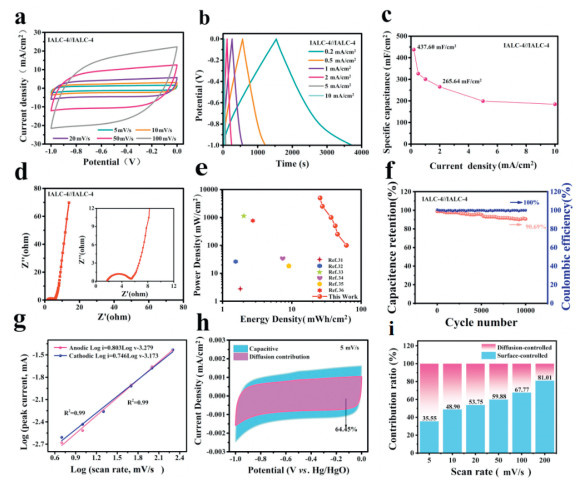
EIS was employed to analyze the charge transfer behavior of the fabricated supercapacitors (Fig. 4d). The high-frequency intercept on the real axis gives a low Rs of 1.84 Ω, while diameter of the semicircle is corresponding to a Rct of 3.91 Ω. These low values confirm the high electrical conductivity and efficient interfacial charge transfer kinetics of the device. In the low-frequency region, the nearly vertical line (indicative of low Warburg impedance) suggests rapid electrolyte ion diffusion within the electrode material. Fig. 4e presents the Ragone plots of the IALC-4//IALC-4 supercapacitor. The device achieves a high energy density 61.27 mWh/cm2 at a power density of 100 mW/cm2. Remarkably, even when the power density is increased to 5000 mW/cm2 a substantial energy density of 25.55 mWh/cm2 is retained, demonstrating a performance that surpasses that of similar supercapacitors reported in recent studies [31-36]. Long cycling stability of the IALC-4//IALC-4 supercapacitors is another key merit (Fig. 4f). After 10,000 charge-discharge cycles, the supercapacitor retained 90.69% of its capacitance and achieved a Coulombic efficiency of 100%, indicating excellent cycling stability. This stability is attributed to the well-developed microcrystalline graphite structure formed via iodine treatment, which possesses excellent mechanical properties and minimizes structural deformation during repeated charge-discharge cycling.
To analyze the energy storage type of the obtained electrode materials, we examined the contribution ratio of surface control and diffusion control to the charge storage process. According to Eq. 1,
|
|
(1) |
it can be determined whether the electrode material exhibits diffusion behavior or capacitive behavior during the charging and discharging process. Here, v and i represent the scan rate and the corresponding peak current of the CV curve, respectively, while a and b are adjustable parameters. As illustrated in Fig. 4g, after fitting calculation, the b values corresponding to the cathode and anode reactions were found to be 0.746 and 0.803 respectively, indicating that the overall capacitance of IALC-4//IALC-4 is mainly influenced by the surface control process. The CV curves at different scan rates were analyzed based on (2), (3) to investigate the charge storage mechanism of the material [37-39].
|
|
(2) |
|
|
(3) |
The Dunn method [40,41] was employed to further quantify the contributions of double-layer capacitance and pseudo capacitance based on the CV data, with the results presented in Figs. 4h and i. The analysis reveals a 35.55% surface-controlled contribution at a low scan rate of 5 mV/s. This is attributed to the pseudocapacitance generated by reversible redox reactions involving iodine species. In addition to providing redox activity, iodine facilitates a higher degree of graphitization, which in turn elevates the electrical conductivity of the carbon matrix. Consequently, when the scan rate increases to 200 mV/s, the surface-controlled contribution rises significantly to 81.01%. This pronounced increase is primarily due to the Faraday redox reaction are kinetically sluggish. As higher scan rate, the shortened charge/discharge timeframe leads to incomplete redox reactions. In contrast, the electric double-layer capacitance stems from rapid, non-Faradaic ion adsorption/desorption at the electrode/electrolyte interface, which is not limited by charge transfer or solid-state diffusion kinetics [42-44]. Therefore, the proportion of the surface-controlled process naturally becomes dominant with increasing scan rates.
In summary, lignin-derived carbon with a low impedance and high degree of graphitization was successfully fabricated via iodine treatment. Structural analyses confirm that iodine-treated carbon materials exhibit a well-graded porous structure, an enhanced graphitization level, superior thermodynamic stability, and a higher density of active sites, in comparison to their untreated counterparts. These synergistic performance advantages contribute to a significant reduction in both Rs and Rct of the optimal material, IALC-4. Specifically, the Rs and Rct values are nearly halved and decreased fourfold, respectively. Consequently, the IALC-4 based electrodes delivered an exceptional specific capacitance of 1090.7 mF/cm2 at a current density of 0.2 mA/cm2. Furthermore, the symmetric supercapacitor assembled with IALC-4 electrodes (IALC-4//IALC-4) achieved a high capacitance of 437.6 mF/cm2 at 0.2 mA/cm2, an impressive energy density of 61.27 mWh/cm2 at a power density of 100 mW/cm2, and maintained 90.69% of its initial capacitance after 10,000 cycles. Overall, this study demonstrates that iodine treatment represents a straightforward and cost-effective strategy for tailoring the graphitization and pore architecture of lignin-based carbon, offering a promising pathway to high-performance electrode materials.
Zhong Dai: Writing – review & editing, Writing – original draft, Methodology, Funding acquisition. Lei Yao: Writing – original draft, Investigation, Formal analysis, Data curation. Sheng Li: Validation, Data curation. Yonglian Xiao: Investigation, Data curation. Lei Pu: Writing – review & editing, Conceptualization. Yuchun Li: Visualization, Software, Resources, Project administration.
The authors declare that they have no known competing financial interests or personal relationships that could have appeared to influence the work reported in this paper.
This work was financially supported by the National Natural Science Foundation of China (No. 22408023), Natural Science Foundation of Hunan Province, China (No. 2024JJ6016), Scientific Research Project of Hunan Provincial Education Department (No. 25A0194) and Postgraduate Scientific Research Innovation Project of Hunan Province (No. CX20251382). The authors extend their gratitude to Ms. Li (from Scientific Compass,
Supplementary material associated with this article can be found, in the online version, at doi:
D. Saha, Y.C. Li, Z.H. Bi, et al., Langmuir 30 (2014) 900–910. doi: 10.1021/la404112m
H. Liu, T. Xu, K. Liu, et al., Ind. Crop. Prod. 165 (2021) 113425. doi: 10.1016/j.indcrop.2021.113425
Q.Q. Lv, Z.W. Tian, W.J. Li, et al., Chin. Chem. Lett. 37 (2026) 110860. doi: 10.1016/j.cclet.2025.110860
S. Saini, P. Chand, A. Joshi, J. Energy. Storage 39 (2021) 102646. doi: 10.1016/j.est.2021.102646
Q. Cao, M. Zhu, J. Chen, ACS Appl. Mater. Interfaces 12 (2020) 1210–1221. doi: 10.1021/acsami.9b14727
Q. Cao, Y. Zhang, J. Chen, et al., Ind. Crop. Prod. 148 (2020) 112181. doi: 10.1016/j.indcrop.2020.112181
C. Zheng, H. Gong, Y. Jiang, et al., ACS Appl. Nano Mater. 6 (2023) 14136–14150. doi: 10.1021/acsanm.3c02028
M. Ghaharpour, F. Abbasi, M. Ghorbani, M.S. Kalajahi, Int. J. Hydrogen. Energ. 218 (2026) 154019. doi: 10.1016/j.ijhydene.2026.154019
C. Wang, B. Yan, J. Zheng, et al., APM 1 (2022) 100018.
H.A. Khan, M. Tawalbeh, B. Aljawrneh, et al., Energy 295 (2024) 131043. doi: 10.1016/j.energy.2024.131043
J.H. Park, H.H. Rana, J.Y. Lee, H.S. Park, J. Mater. Chem. A 7 (2019) 16962–16968. doi: 10.1039/c9ta03519b
R.B. Rakhi, W. Chen, D. Cha, H.N. Alshareef, Adv. Energy Mater. 2 (2012) 381–389. doi: 10.1002/aenm.201100609
S.L. Chen, Y. Hu, S.J. Zhang, et al., Chin. Chem. Lett. 37 (2026) 111301. doi: 10.1016/j.cclet.2025.111301
M. Muddasar, M. Culebras, M.N. Collins, Mater. Today Sustain. 28 (2024) 100990.
Y.Y. Fan, C. Liu, X.C. Kong, et al., Green Energy. Environ. 7 (2022) 1318–1326. doi: 10.1016/j.gee.2021.02.004
X.H. Chen, W Li, A Wang, et al., Int. J. Biol. Macromol. 280 (2024) 135950. doi: 10.1016/j.ijbiomac.2024.135950
C. Zuo, X.Y. Hui, P.A. Xin, et al., Green Chem. 28 (2025) 974–985.
C.X Guo, Y Sun, H.Y Ren, et al., Sep. Purif. Technol. 376 (2025) 133933. doi: 10.1016/j.seppur.2025.133933
I.L. Egun, B. Akinwolemiwa, H. He, et al., Chem. Eng. J. 509 (2025) 161386. doi: 10.1016/j.cej.2025.161386
J. Li, T. Abdiryim, R. Jamal, et al., J. Colloid. Interf. Sci. 698 (2025) 137948. doi: 10.1016/j.jcis.2025.137948
S. Deng, J. Zhang, L. Lin, et al., J. Power Sources 652 (2025) 237587. doi: 10.1016/j.jpowsour.2025.237587
X.F. Mao, Y. Zhang, H. Li, et al., J. Power Source 631 (2025) 236211. doi: 10.1016/j.jpowsour.2025.236211
Y. Fan, F. Fu, D. Yang, W. Liu, X. Qiu, J. Colloid. Interf. Sci. 667 (2024) 147–156. doi: 10.1016/j.jcis.2024.04.099
C.W.J. He, G.J. Yang, L.Y. Ni, et al., Langmuir 40 (2024) 19665–19674. doi: 10.1021/acs.langmuir.4c02328
Y.H. Deng, X.J. Feng, M.S. Zhou, et al., Biomacromolecules 12 (2011) 1116–1125. doi: 10.1021/bm101449b
Z. Sun, M. Zhang, H. Yin, et al., Renew. Energ. 219 (2023) 119375. doi: 10.1016/j.renene.2023.119375
S. Verma, T. Das, V.K. Pandey, B. Verma, J. Mol. Struct. 1266 (2022) 133515. doi: 10.1016/j.molstruc.2022.133515
I.L. Egun, B. Akinwolemiwa, B. Yin, et al., Bioresource Technol. 409 (2024) 131251. doi: 10.1016/j.biortech.2024.131251
T. Huang, Y. Wu, G. Liu, et al., J. Power Source 646 (2025) 237282. doi: 10.1016/j.jpowsour.2025.237282
S. Aryal, K.R. Shrestha, T. Shrestha, et al., J. Mol. Struct. 1323 (2025) 140810. doi: 10.1016/j.molstruc.2024.140810
X. Sun, X. Liu, F. Li, Appl. Surf. Sci. 551 (2021) 149438. doi: 10.1016/j.apsusc.2021.149438
P. Sun, R. Lin, Z. Wang, et al., Nano Energy 31 (2017) 432–440. doi: 10.1016/j.nanoen.2016.11.052
L. Wang, J. Ouyang, Y. Tian, et al., Appl. Surf. Sci. 680 (2025) 161390. doi: 10.1016/j.apsusc.2024.161390
C. Zhao, J. Yang, Y. Zhang, et al., Carbon 243 (2025) 120520. doi: 10.1016/j.carbon.2025.120520
M.d.S. Klem, R. Abreu, T. Pinheiro, et al., Adv. Sustain. Syst. 8 (2024) 2400254. doi: 10.1002/adsu.202400254
C. Chen, Y. Zhang, Y. Li, et al., Energ. Environ. Sci. 10 (2017) 538–545. doi: 10.1039/C6EE03716J
M.R. Karim, H.J. Park, S.Y. Park, et al., J. Energy Storage 103 (2024) 114228. doi: 10.1016/j.est.2024.114228
F.Z Tan, F.F Lu, J.L Wei, et al., J. Bioresour. Bioprod. 11 (2026) 100234.
C. Hu, J. Xu, J. Guo, et al., Chem. Eng. J. 513 (2025) 162829. doi: 10.1016/j.cej.2025.162829
C. Jiang, W. Wu, J. Tang, et al., Ind. Crop. Prod. 225 (2025) 120591. doi: 10.1016/j.indcrop.2025.120591
M Luo, D.T Zhang, K Yang, et al., Fuel. Process. Technol. 238 (2022) 107496. doi: 10.1016/j.fuproc.2022.107496
M.Z.U.R. Faurooqi, M. Ramzan, K. Mahmood, et al., Int. J. Hydrogen. Energ. 181 (2025) 151807. doi: 10.1016/j.ijhydene.2025.151807
L.H. Shao, J.M. Xu, G.M. Wu, Chin. Chem. Lett. (2026), doi: 10.1016/j.cclet.2026.112606.
H. Yaldiz, A.C. Kocal, O. Gultepe, E. Gür, F. Atay, Electrochim. Acta 526 (2025) 146197. doi: 10.1016/j.electacta.2025.146197

Figure 2 (a-e) SEM images of IALCs and their magnified views. (f) Element mapping based on SEM. (g-k) TEM images of IALCs. (l) Element mapping based on TEM.

Figure 3 (a) XRD spectra and (b) Raman spectra of IALCs. (c) Mechanism of iodine-treated lignin, (d) specific capacity and (e) percentage of capacitance contribution evaluated for all the electrodes based on Trasatti analysis.

Figure 4 (a) Cyclic voltammograms of IALC-4//IALC-4 at scan rates ranging from 5 mV/s to 100 mV/s. (b) IALC-4//IALC-4 galvanostatic charge-discharge curves at current densities ranging from 0.2 mA/cm2 to 10 mA/cm2. (c) IALC-4 // Specific capacitance of IALC-4 at different current densities. (d) Nyquist plot of IALC-4//IALC-4. (e) Ragone plots of IALC-4//IALC-4 symmetric supercapacitors and a comparison with the reported carbonaceous materials. (f) Cycling stability and Coulombic efficiency diagram of IALC-4//IALC-4 at a current density of 10 mA/cm2. (g) Relationship between the scanning rate of IALC-4//IALC-4 and the peak current density graph. (h) Surface and diffusion contributions of IALC-4//IALC-4 at a scan rate of 5 mV/s. (i) The relative contribution values of surface control and diffusion control to the charge storage process of IALC-4//IALC-4 at different scan rates.

 扫一扫看文章


扫一扫关注我们
 DownLoad:

 下载:
 下载: