
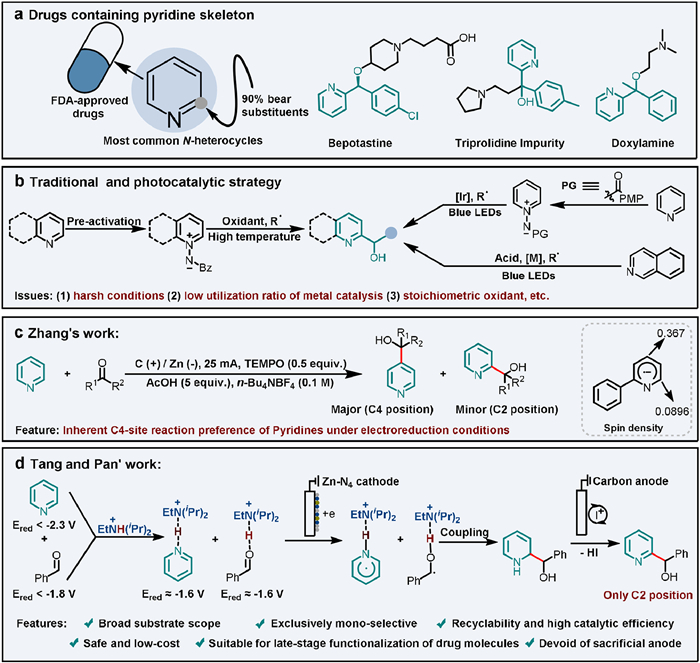
Figure 1.
Tang and Pan's work.


Pyridine is a ubiquitous heterocyclic scaffold found in a number of pharmaceuticals, agrochemicals, and functional materials. Among FDA–approved drugs containing pyridine rings, nearly 90% bear substituents at the C2 position, underscoring the importance of selective C2 functionalisation. In particular, aryl–substituted 2–(hydroxymethyl)pyridines constitute a privileged motif in medicinal chemistry and natural product synthesis [1]. However, direct C2-H hydroxymethylation of pyridines remains a long-standing challenge in organic synthesis. Traditional methods rely on pre-functionalization or stoichiometric reagents, suffering from limitations such as narrow substrate scope and harsh reaction conditions. Although photocatalytic and transition metal-catalyzed systems have made progress, these reactions still rely on activated substrates or strong acid activation, and face problems like low selectivity. The Zhang group developed a room-temperature electrochemical strategy that combines acid activation with TEMPO-mediated oxidative aromatization, achieving highly selective C4-position hydroxylation of pyridines [2]. Electronic spin density calculations indicate that the C4 radical intermediate formed during pyridine reduction, due to its higher spin density, preferentially undergoes C4-selective radical coupling, hindering reactions at the C2 position. Therefore, developing a mild, highly selective, and substrate-scalable C2-H hydroxymethylation method remains an extremely challenging task.
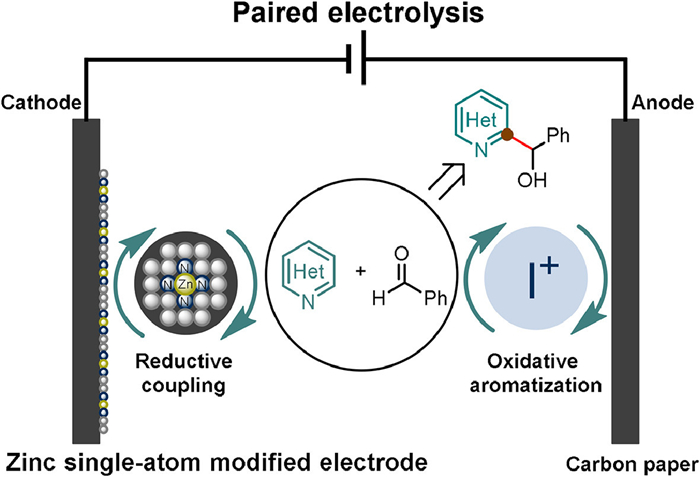
Organic electrocatalysis has emerged as a powerful tool for organic synthesis [3], offering tunable redox potentials and the use of renewable electricity. Single–atom catalysts (SACs), with their 100% metal utilisation, well–defined active sites, and tunable electronic properties, have recently attracted considerable interest in electrosynthesis. When integrated with paired electrolysis, which simultaneously utilises both cathodic and anodic reactions heterogeneous SACs can serve as efficient mediators for complex transformations [4]. In this context, Tang and Pan have developed an innovative paired electrolysis strategy that combines a zinc single–atom cathode with an anodic iodine relay to achieve highly selective C2-H hydroxymethylation of pyridines with aldehydes (Fig. 1), as reported in their recent publication [5].
The key to this success lies in a carefully designed electrocatalyst: Carbon–nanotube–supported single–atom zinc with a Zn-N4 coordination structure (Zn-N4@CNT). In a undivided cell under mild conditions, this cathode works in concert with iodide ions that are oxidised at the anode to reactive iodine species.
The authors propose a five–step relay mechanism: Adsorption of the pyridine and aldehyde substrates onto the catalyst surface, activation by in–situ–generated ammonium salts, single–electron reduction to radical intermediates, radical-radical coupling, and final oxidative dehydrogenation mediated by iodonium ions. This strategy ingeniously circumvents the intrinsic C4-site reactivity bias of pyridines under electrochemical conditions, while boosting metal utilization efficiency. By eliminating the need for stoichiometric oxidants/reductants, pre-activation of pyridines, and reliance on noble metal catalysts, it enables the synthesis of C2-hydroxymethylated products with exceptional regioselectivity and broad substrate compatibility. Furthermore, this protocol is amenable to the late-stage modification and synthesis of pyridine-based pharmaceutical molecules.
The substrate scope of this method is remarkably broad. Using 4–phenylpyridine as a model substrate, the reaction with 33 different carbonyl partners, including aromatic aldehydes, heteroaromatic aldehydes, ketones, cyclohexanone, and even imines, affording the desired 2–hydroxymethylated products in 23%–85% yields. A wide range of functional groups are well tolerated: Electron–donating (-Me, -tBu, -OMe) and electron–withdrawing (-F, -Cl, -CN) substituents, as well as ester (-CO2Me), acetate (-OAc), and alkenyl groups, all survive the reaction conditions. Notably, easily reducible functionalities such as nitriles and esters do not undergo over–reduction, and halogenated substrates show no hydrodehalogenation by–products, highlighting the exceptional chemoselectivity. Even strongly electron–withdrawing aldehydes give slightly lower but still useful yields.
When the pyridine component was varied, 29 different pyridine derivatives, bearing substituents with diverse electronic and steric properties, were converted to the corresponding 2–hydroxymethylated products in 38%−76% yields. Electron–withdrawing groups were found to be more favourable than electron–donating ones, and fused–ring systems such as isoquinolines and quinolines also participated smoothly (58%−71% yield). These results demonstrate the generality of this protocol for the divergent synthesis of aryl–substituted 2–hydroxymethylpyridines.
The practical utility of this electrochemical method is further underscored by its successful application to the late–stage functionalisation of complex bioactive molecules. Ten drug–like substrates, including derivatives of piperonyl alcohol, ibuprofen, dehydroabietic acid, gemfibrozil, ciprofibrate, veratraldehyde, flavanone, acetyl vanillate, 6–acetyl–1,4–benzodioxane, and 4,4′–dimethylbenzophenone, were selectively hydroxymethylated at the pyridine C2 position. Moreover, the herbicide cloquintocet–mexyl and the lipid–lowering drug etofibrate were modified in good yields (61% and 53%, respectively), confirming the method's potential for drug discovery and development. Beyond simple functionalisation, the hydroxyl group of the products enables further diversifications, such as allyl etherification (61%), carbonylation (73%), alkenylation (51%), and bromination (54%). These derivatisations were used to synthesise 1,3–disubstituted imidazo[1,5–a]pyridines with hypoxia–inducible factor–1 inhibitory activity (51% yield) and phenanthridine derivatives of interest in organic electronics (63% yield). Importantly, the protocol is scalable: Without the need for high temperatures or strong acids, the constipation drug bisacodyl was prepared on a gram scale via two simple steps, illustrating its industrial relevance.
Mechanistic investigations shed light on the crucial roles of each component. Control experiments revealed that iodide ions are indispensable: Only trace product formed in their absence, whereas addition of a catalytic amount boosted the yield to 81%. A divided–cell experiment gave only trace product, confirming that the anodic oxidation of iodide to iodonium species is essential for the final dehydrogenation step. Radical trapping with TEMPO captured a carbon–centred radical adduct, and a radical clock experiment gave the expected ring–opened product, supporting a radical pathway. Kinetic isotope effect (KIE) studies indicated that C–H activation is the rate–determining step.
Cyclic voltammetry (CV) experiments showed that addition of equimolar p–toluenesulfonic acid (TsOH) and N,N–diisopropylethylamine (DIPEA), which generate ammonium salts in situ, shifted the reduction potentials of both pyridine and aldehyde substrates to –1.60 V, implying a significant lowering of the reduction barrier via coordination. Density functional theory (DFT) calculations further validated this activation mode. When Zn-N4@CNT was used as the working electrode, enhanced catalytic currents were observed for the proposed intermediates INT 1 and INT 2, indicating strong adsorption and electronic interaction. DFT simulations of the reaction pathways on the Zn–N4@CNT surface identified the pathway involving zero–valent zinc sites as the most energetically favourable, thus establishing the single–atom zinc as the true catalytic species for single–electron transfer.
Based on these experimental and computational results, the Pan team proposed the following catalytic cycle: Pyridine and aldehyde substrates adsorb onto the Zn-N4@CNT surface and interact with ammonium salts to form intermediates INT 1 and INT 2; at the cathode, divalent Zn is reduced to zero–valent Zn, which mediates single–electron reduction of these intermediates to generate radical species INT 3 and INT 4; the resulting monovalent zinc is quickly re–reduced to complete the catalytic cycle. Radical cross–coupling between INT 3 and INT 4 furnishes the addition product C1–a, which then undergoes elimination of HI, driven by the iodonium ions generated at the anode, to give the final hydroxymethylated product. DFT calculations comparing the C2 and C4 pathways strongly support the observed regioselectivity.
In summary, the "Zn single-atom cathode-anode iodine relay" strategy (Fig. 2) developed by the Pan team successfully breaks through the inherent reactivity preference of pyridine at the C4 position by constructing a synergistic mechanism between heterogeneous catalysis and electrochemical oxidation. This strategy enables direct, highly selective C2-H hydroxymethylation of various pyridines and carbonyl compounds under mild, green conditions. Its broad substrate scope, excellent functional group tolerance, scalability, and successful late-stage drug modification highlight its practical value. This strategy addresses the core limitations of traditional methods, highlights the unique advantages of heterogeneous single-atom catalysis in the field of organic electrosynthesis, and provides a new paradigm for the direct C—H functionalization of pyridines. Meanwhile, this system offers an important reference for research on asymmetric reactions at the C2 position of pyridines. By modulating the types of heterogeneous single-atom catalysts in the future, it is expected to explore more efficient pyridine functionalization reaction modes, which will have a profound impact on the fields of synthetic chemistry and drug development.
Meng-Yun He: Writing – original draft. Rong-Nan Yi: Writing – review & editing. Wei-Min He: Writing – review & editing.
The authors declare that they have no known competing financial interests or personal relationships that could have appeared to influence the work reported in this paper.
C.M. Marshall, J.G. Federice, C.N. Bell, et al., J. Med. Chem. 67 (2024) 11622–11655. doi: 10.1021/acs.jmedchem.4c01122
C. Zhang, M. Wang, P.H. Dixneuf, et al., Nat. Commun. 17 (2026) 5154. doi: 10.1038/s41467-026-71858-2
M. Wang, C. Zhang, C. Ci, et al., J. Am. Chem. Soc. 145 (2023) 10967–10973. doi: 10.1021/jacs.3c02776
X. Wang, W. Wei, S. Zhou, et al., Angew. Chem. Int. Ed. 64 (2025) e20250508.
X.D. Liu, M.R. Wang, Y.L. Chen, et al., J. Am. Chem. Soc. 148 (2026) 32155–32166. doi: 10.1021/jacs.6c07265

 扫一扫看文章


扫一扫关注我们
 DownLoad:

 下载:

 下载: