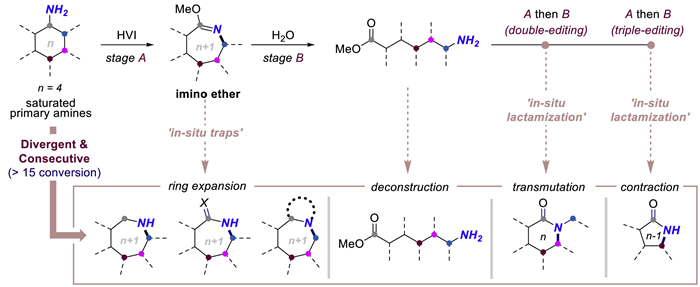
Scheme 1.
Hypervalent iodine(Ⅲ)-mediated divergent skeletal editing of unprotected saturated primary amines.

Skeletal editing of saturated primary amines: A new paradigm for aliphatic N-heterocycles
Lixin Duan , Yajing Shen , Xin He , Caiyun Fang , Tao Tu


In recent years, skeletal editing has undergone dramatic advancement, enabling atom insertions, deletions, and transmutations within (hetero)aromatic rings. Landmark examples include the reagent-controlled editing of quinoline N-oxides [1,2], C to N transmutation in indoles and benzofurans [3], and photochemical permutations for the interconversion of isomeric thiazoles and isothiazoles [4]. A deconstruction–reconstruction strategy has also been developed for pyrimidine diversification [5], and the scope has been extended to non-aromatic oxetanes, enabling oxygen atom swapping to nitrogen-based azetidines, sulfur-based thietanes, and carbon-based cyclobutanes [6]. These studies demonstrate the power of skeletal editing to reprogram molecular scaffolds and accelerate the efficiency of drug development, which in turn facilitates structure-activity relationship (SAR) studies.
Despite these achievements, the efficient and divergent construction of aliphatic (semi-saturated) N-heterocycles via skeletal editing remains a long-standing challenge. Such frameworks are particularly valuable in medicinal chemistry due to their three dimensionality, which often imparts improved target selectivity, metabolic stability, and physicochemical profiles compared to their flat aromatic counterparts [7-10]. Yet, the direct transformation of saturated primary amines, among the most ubiquitous feedstocks, into a broad array of aliphatic N-heterocycles has proven elusive, largely owing to the difficulty of selectively activating the C-N bond and controlling subsequent skeletal rearrangements.
Recently, Zhang and co-workers at the Shanghai Institute of Organic Chemistry (SIOC), Chinese Academic of Sciences, reported a transformative breakthrough achievement that elegantly addresses this challenge (Scheme 1) [11]. They developed a hypervalent iodine(Ⅲ) (HVI)-mediated, divergent and consecutive skeletal editing strategy that converts abundant, unprotected saturated primary amines into nitrogen-containing compounds. These products include saturated N–heterocycles, fused (semi-)saturated N–heterocycles, lactams, and acyclic amino esters, greatly expanding the accessible chemical space. The method proceeds through a versatile imine ether intermediate—the key reactive species formed via HVI-mediated oxidative activation of saturated primary amines, which can be selectively elaborated through multiple pathways with exceptional functional-group tolerance, broad skeletal diversity, and excellent regioselectivity and stereospecificity. Remarkably, the imine ether intermediate is responsible for two plausible core reaction modes simultaneously: It not only enables divergent functionalization to access discrete nitrogen-containing skeletons, but also acts as the pivotal precursor to trigger sequential ring expansion and carbon-to-nitrogen skeletal rearrangement for successive framework remodeling.
Most impressively, the strategy introduces consecutive skeletal editing—a concept originally put forward and experimentally demonstrated in this Science paper (Scheme 2). By enabling one-pot, sequential ring expansion followed by C–to–N transmutation, it provides access to previously inaccessible azacycle scaffolds with excellent retention of stereochemistry, showcasing synthetic applications that were not previously apparent. The realization of consecutive skeletal editing, in particular, marks a defining advance for the field.
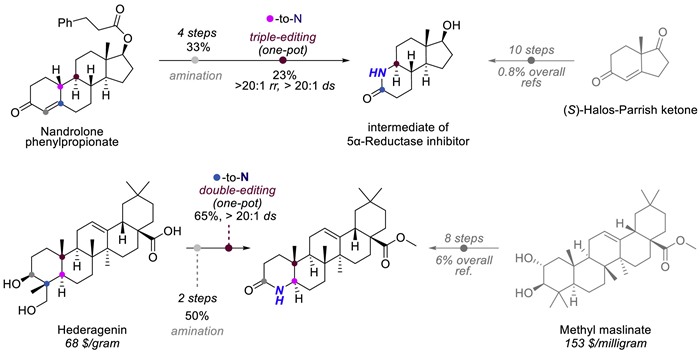
Looking forward, the method developed by Zhang and co–workers opens several exciting directions, including the late-stage editing of complex drug molecules and natural products to accelerate three-dimensional SAR studies, and the extension of this approach to other aliphatic frameworks.
In summary, as the field of skeletal editing continues to evolve from aromatic systems to aliphatic ones, Zhang's work stands as a landmark achievement that will undoubtedly inspire further innovations in the synthesis of medicinally relevant azacycles.
Lixin Duan: Writing – original draft, Investigation. Yajing Shen: Validation, Investigation. Xin He: Validation, Investigation. Caiyun Fang: Validation, Investigation. Tao Tu: Writing – review & editing, Investigation.
The authors declare that they have no known competing financial interests or personal relationships that could have appeared to influence the work reported in this paper.
Financial support from the National Natural Science Foundation of China (No. 22271060), Zhejiang Provincial Key R & D Program (No. 2024C03109) and Key Research and Development Program of Ningxia Hui Autonomous Region (No. 2026BEE02007), the Department of Chemistry at Fudan University and the School of Chemistry, and Chemical Engineering at Ningxia University is gratefully acknowledged.
D. Tian, Y.P. He, L.S. Yang, Z.C. Li, H. Wu, Nat. Chem. 17 (2025) 952–960. doi: 10.1038/s41557-025-01793-0
J. Woo, T. Zeqiri, A.H. Christian, M.C. Ryan, M.D. Levin, J. Am. Chem. Soc. 147 (2025) 20120–20131. doi: 10.1021/jacs.5c06577
Z. Wang, P. Xu, S.M. Guo, C.G. Daniliuc, A. Studer, Nature 642 (2025) 92–98. doi: 10.1038/s41586-025-09019-6
B. Roure, M. Alonso, G. Lonardi, et al., Nature 637 (2025) 860–867. doi: 10.1038/s41586-024-08342-8
B.J.H. Uhlenbruck, C.M. Josephitis, L. de Lescure, R.S. Paton, A. McNally, Nature 631 (2024) 87–93. doi: 10.1038/s41586-024-07474-1
Y.Q. Zhang, S.H. Li, X. Zhang, M.J. Koh, Nature 647 (2025) 906–912. doi: 10.1038/s41586-025-09723-3
Y.N. Gao, M. Shi, Chin. Chem. Lett. 28 (2017) 493–502. doi: 10.1016/j.cclet.2016.12.001
S.X. Zhai, S.X. Qiu, S. Yang, et al., Chin. Chem. Lett. 33 (2022) 276–279. doi: 10.1016/j.cclet.2021.06.081
A.J. Rago, G.B. Dong, Green Synth. Catal. 2 (2021) 216–227.
L. Li, S. Wang, A. Jakhar, Z.H. Shao, Green Synth. Catal. 4 (2023) 124–134.
L.H. Li, S. Su, X. Zheng, L. Zhang, Science 392 (2026) 528–535. doi: 10.1126/science.aee5416

Scheme 1 Hypervalent iodine(Ⅲ)-mediated divergent skeletal editing of unprotected saturated primary amines.

 扫一扫看文章


扫一扫关注我们
 DownLoad:
 下载:

 下载: