Lithium-sulfur and lithium-oxygen batteries hold great promise as next-generation high-energy-density storage systems, but their development is severely limited by the formation and accumulation of insulating solid intermediates (e.g., Li2S2 and Li2O2). These species block electron/ion transport, trigger electrode passivation, and cause premature reaction termination [1-3]. Although single-atom catalysts have been widely studied [4,5], most of them primarily optimize adsorption and thermodynamics. Their capability to improve the intrinsic insulation of intermediates remains limited, and they are prone to deactivation when covered by insulating discharge products. In contrast, dual-atom catalysts activate insulating intermediates through strong orbital coupling, enabling electron conduction, active-site relocation, and continuous full-process catalysis, thereby overcoming the bottleneck of solid-phase reactions.
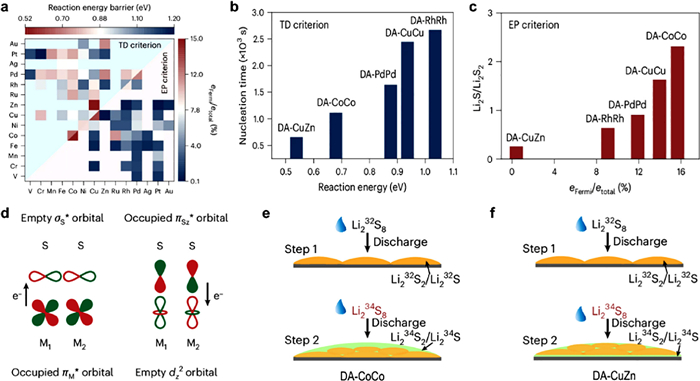
Recently, in Nature Catalysis, Li and colleagues established a novel electronic descriptor by combining theoretical calculations and experiments [6]. Two quantitative criteria were proposed: Thermodynamic reaction energy barriers and electronic Fermi-level electron occupation (Fig. 1a). Calculations on 351 dual-atom catalysts revealed that thermodynamics dominate early nucleation, while electronic conductivity determines the overall reaction sustainability (Figs. 1b and c). In this scenario, electronic characteristics show a much stronger correlation with catalytic activity than thermodynamic barriers. The capability to endow insulating intermediates with favorable electronic conductivity directly dictates the completeness and sustainability of electrochemical reactions. Guided by this electronic criterion, a homonuclear dual-atom cobalt catalyst (DA-CoCo) was rationally designed and synthesized, challenging the prevailing view that heteronuclear dual-atom catalysts possess superior catalytic performance. Theoretical analyses demonstrated that the symmetric electronic structure of DA-CoCo enables efficient σ and π* orbital coupling with Li2S2, which greatly elevates the density of states of reaction intermediates (Fig. 1d). Such electronic modulation converts insulating Li2S2 into a conductive state and provides stable electron transport pathways for subsequent redox reactions. Electrochemical tests further confirmed that DA-CoCo enables efficient electron/ion transport and reconstructs active sites toward the intermediate-electrolyte interface, following a top-layer deposition mechanism, which differs from that of DA-CuZn (Figs. 1e and f). Under harsh conditions, the DA-CoCo Li-S coin cell exhibits ultrahigh areal capacity and ultra-stable cycling. A 1.2 Ah pouch cell delivers a high specific energy of 459 Wh/kg (calculated based on the cell mass excluding the outer packaging), reaching the top level reported. Moreover, DA-CoCo also delivers prominent catalytic performance in Li-O2 systems. It realizes efficient four-electron reaction to form LiOH, affording larger discharge capacity and slower overpotential growth than DA-CuZn via triggering metallization of insulating Li2O2. Nevertheless, broad generalization of the electronic criterion across diverse battery chemistries remains speculative without systematic experimental verification. It is worth noting that the proposed electronic Fermi-level occupation descriptor offers a more general and fundamental criterion than conventional adsorption-energy or reaction-barrier descriptors. Traditional descriptors mainly optimize the thermodynamic favorability of reactions, such as polysulfide conversion, but they often fail to address the core issue of insulating solid intermediates. In contrast, the Fermi-level occupation descriptor directly captures the electronic coupling between the catalyst and these insulating species, governing charge transfer efficiency and the electronic conductivity of the reaction interface. This electronic modulation is the key to overcoming the kinetic bottleneck caused by insulating discharge products, making the criterion particularly powerful for lithium battery systems. However, its predictive power is strongest when electronic effects dominate, and may be weakened in systems limited by mass transport, side reactions, or electrode degradation. Additionally, accurate determination of Fermi-level occupation under real battery operating conditions remains challenging, which may restrict its direct application in complex electrode systems.
Figure 1
Figure 1.
(a) Heatmap plot showing reaction energy barriers (thermodynamic criterion) and eFermi/etotal values (electronic property criterion) of stable DACs. (b) Relationship between nucleation time and reaction energy barrier. (c) Relationship between Li2S conversion (Li2S/Li2S2) and eFermi/etotal. (d) Orbital hybridization schematic between Li2S2 and DA-CoCo. (e) Top deposition pathway of DA-CoCo. (f) Bottom deposition pathway of DA-CuZn. Reproduced with permission [6], Copyright 2026, Springer Nature.
In summary, their work possesses prominent scientific significance and application prospects. It not only establishes an innovative electronic property-oriented catalyst design paradigm that challenges conventional theories, but also offers a feasible solution to address the kinetic limitations of high-density lithium batteries including lithium-sulfur and lithium-oxygen systems. Furthermore, the proposed electronic criterion can be extended to other electrochemical systems with insulating solid products. Despite the outstanding catalytic performance of DA-CoCo toward Li-S electrochemistry, several practical challenges remain to be addressed for subsequent application. First, the structural stability of dual-atom CoCo sites upon prolonged charge/discharge cycling needs further reinforcement under rigorous operating conditions. Second, the optimization of catalyst loading and scalable fabrication still faces obstacles toward industrialization. Third, more systematic tests are required to verify its compatibility with lean electrolyte and high sulfur loading, which are essential for high-energy practical Li-S cells. In addition, precise regulation of atomic coordination constitutes a universal difficulty restricting the controllable synthesis of homonuclear dual-atom catalysts. Future research will focus on tackling the above issues to promote the practical utilization of dual-atom catalysts.
The authors declare that they have no known competing financial interests or personal relationships that could have appeared to influence the work reported in this paper.
Acknowledgments
This work was financially supported by the Starting Research Grant from Changzhi University (to Y. Wang and Q. Zhang). J. Wang acknowledges the funding provided by the Alexander von Humboldt Foundation. Y.-X. Shi acknowledges the funding provided by the Natural Science Research of Jiangsu Higher Education Institutions of China (No. 25KJB150017).
Figure 1
(a) Heatmap plot showing reaction energy barriers (thermodynamic criterion) and eFermi/etotal values (electronic property criterion) of stable DACs. (b) Relationship between nucleation time and reaction energy barrier. (c) Relationship between Li2S conversion (Li2S/Li2S2) and eFermi/etotal. (d) Orbital hybridization schematic between Li2S2 and DA-CoCo. (e) Top deposition pathway of DA-CoCo. (f) Bottom deposition pathway of DA-CuZn. Reproduced with permission [6], Copyright 2026, Springer Nature.


 DownLoad:

 下载:


 下载:

