The construction of curved aromatic frameworks has become a vibrant and rapidly advancing area in synthetic chemistry. These molecules combine structural elegance with substantial synthetic complexity. Their prominence arises from the combination of extended π-conjugation and non-planar geometries, which endows them with unusual optoelectronic characteristics, while molecular strain serves as a potent tool to access unconventional reactivity and broaden synthetic possibilities. Strained carbon nanorings, such as [n]cycloparaphenylenes ([n]CPPs), represent well-defined fragments of armchair carbon nanotubes and exemplify curved π-systems with size-dependent electronic and optical behaviors [1]. The radial orientation of their π-orbitals, significant strain energy, and adjustable cavity dimensions have drawn extensive attention in fields ranging from synthetic chemistry to materials science and supramolecular chemistry.
In contrast, macrocyclic arenes are typically non-conjugated macrocycles, whose value lies not in π-conjugation but in their high synthetic efficiency, structural tunability, and precise control over cavity shape and size. These features make macrocyclic arenes ideal scaffolds for host–guest chemistry and modular assembly [2]. The biphen[n]arenes developed by Li and coworkers exemplify these strengths through a conceptually innovative modular construction strategy. By dividing the macrocyclic framework into interchangeable reaction, functional, and linking modules, this system allows programmable assembly of macrocycles with tunable cavity sizes and depths. Such a "building-block" approach not only streamlines synthesis but also enhances structural diversity and functional expandability, providing a versatile platform for the rational design of advanced supramolecular systems [3].
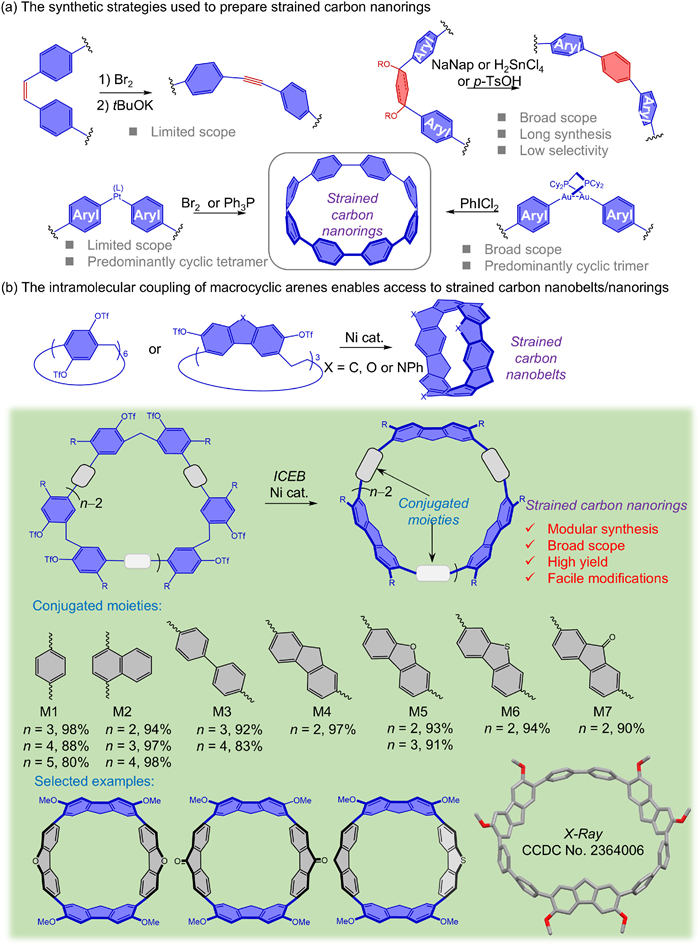
Despite significant progress in the design and synthesis of curved aromatic frameworks, most traditional approaches to constructing strained carbon nanorings face intrinsic limitations. In these methods, because strain energy increases progressively during macrocyclization, the final bond-forming event often occurs at the maximum strain state, often leading to competition between macrocyclization and undesired oligomerization, while the subsequent reductive aromatization can cause rearrangements and limit functional-group tolerance. This not only restricts the reaction scope but also reduces overall synthetic efficiency. Even though recent advances in metal-template strategies have improved yields and selectivities in some cases, significant challenges remain in achieving general applicability and efficient access to highly strained carbon nanorings (Fig. 1a).
Figure 1
Figure 1.
Schematic illustration of preparation of strained and π-conjugated macrocycles. (a) Selected strategies used to prepare strained carbon nanorings. (b) Intramolecular coupling of macrocyclic arenes for the synthesis of strained carbon nanobelts and nanorings, the ICEB strategy is highlighted in the light green box.
Recently, Li and coworkers reported in Nature Synthesis a strategy that addresses this fundamental bottleneck by inverting the conventional logic of [n]CPP construction (Fig. 1b, light green box) [4]. Notably, although previous researchers such as Itami and Chen had successfully constructed highly strained carbon nanobelts via macrocyclic arene approaches, their methods were not extended to the general construction of strained carbon nanorings (Fig. 1b) [5-7]. Instead of forming a highly strained conjugated ring via intermolecular coupling of linear fragments, Li and coworkers first assemble a conformationally preorganized macrocyclic arene and then generate the strained π-system through an intramolecular reductive coupling event. This intramolecular coupling of extended biphen[n]arenes (ICEB) not only overcomes the traditional limitation of strain-induced inefficiency but also avoids costly noble catalysts while leveraging the inherent efficiency of macrocyclic arene synthesis, providing a programmable strategy for constructing strained carbon nanorings.
The conceptual foundation of ICEB lies in the use of extended biphen[n]arenes as preorganized macrocyclic precursors. These macrocycles are assembled via Lewis acid–promoted condensation of suitably functionalized aromatic monomers bearing protected phenolic groups, positioning the reactive sites for final C–C bond formation within the macrocyclic framework. Subsequent hydrolysis of protecting groups, conversion to aryl triflates, and nickel-catalyzed intramolecular reductive coupling transform the macrocycle into a strained and π-conjugated carbon nanoring. Because the key bond formation occurs intramolecularly within a preorganized architecture, entropic penalties are minimized, enabling high yields even for highly strained products. Specifically, this protocol successfully delivers a library of 20 distinct [n]CPP derivatives, including 13 symmetric homo-aromatic nanorings that are obtained with consistently high yields (80%–98%). These examples encompass a wide span of nanoring sizes (n = 6, 8, 9, 12, 15, 16).
Beyond efficiency, the ICEB strategy offers remarkable modularity. By varying the aromatic building blocks incorporated into the macrocycle, including biphenyl, naphthalene, fluorene, heteroaromatics, and carbonyl-containing motifs, the ICEB strategy enables programmable tuning of ring size, curvature, and electronic character. Upon intramolecular cyclization, these modules become integral components of the final nanoring, actively governing its geometry, strain distribution, and conjugation. In addition, the methoxy substituents embedded within the nanorings serve as versatile handles for efficient post-functionalization, further expanding structural diversity. Structural analyses reveal characteristic distortions that accommodate curvature through subtle adjustments of bond angles and dihedral torsions, underscoring the active role of these modules in defining nanoring architecture.
The ICEB strategy further enables the construction of hybrid nanorings from two distinct monomers. Although the initial macrocyclization may produce mixtures of symmetric and asymmetric precursors, the isolated hybrid macrocycles undergo intramolecular coupling efficiently, affording lower-symmetry nanorings that are challenging to access through conventional approaches. This ability to introduce controlled structural asymmetry significantly broadens the design space of functional nanorings, opening opportunities for anisotropic electronic properties and directional host–guest interactions.
Overall, the ICEB strategy offers a conceptually rigorous solution to long-standing challenges in the synthesis of strained carbon nanorings, including reliance on noble metal catalysis, limited functional-group tolerance, rearrangements during reductive aromatization, and diminished efficiency arising from late-stage strain accumulation. By separating macrocycle assembly from strain-inducing conjugation and leveraging modular precursor design, this approach enables high yields, broad substrate scope, and precise structural control.
As the chemistry of curved nanocarbons continues to mature, strategies that integrate preorganization, modularity, and intramolecular bond formation, as exemplified by the ICEB strategy, are poised to influence the next generation of synthetic innovation. The successful application of this methodology to carbon nanoring synthesis further creates opportunities for extending such functional architectures to carbon nanobelts, molecular machines, and emerging applications in optoelectronics and bioimaging [8-10].
The authors declare that they have no known competing financial interests or personal relationships that could have appeared to influence the work reported in this paper.
Acknowledgments
We acknowledge funding from the National Natural Science Foundation of China (No. 22471060), the Natural Science Foundation of Henan (No. 252300421186), and the Postdoctoral Fellowship Program of CPSF (No. GZC20250668).
[1]
R. Jasti, J. Bhattacharjee, J.B. Neaton, et al., J. Am. Chem. Soc. 130 (2008) 17646–17647. doi: 10.1021/ja807126u
Y. Li, Y. Segawa, A. Yagi, et al., J. Am. Chem. Soc. 142 (2020) 12850–12856. doi: 10.1021/jacs.0c06007
[6]
X.S. Du, D.W. Zhang, Y. Guo, et al., Angew. Chem. Int. Ed. 60 (2021) 13021–13028. doi: 10.1002/anie.202102701
[7]
F. Zhang, X.S. Du, D.W. Zhang, et al., Angew. Chem. Int. Ed. 60 (2021) 15291–15295. doi: 10.1002/anie.202104259
[8]
W. Shi, Y. Hu, L. Leanza, et al., Angew. Chem. Int. Ed. 64 (2025) e202421459. doi: 10.1002/anie.202421459
[9]
T.H. Shi, Q.H. Guo, S. Tong, et al., J. Am. Chem. Soc. 142 (2020) 4576–4580. doi: 10.1021/jacs.0c00112
[10]
Y. Yu, Y. Hu, C. Ning, et al., Angew. Chem. Int. Ed. 63 (2024) e202407034. doi: 10.1002/anie.202407034
Figure 1
Schematic illustration of preparation of strained and π-conjugated macrocycles. (a) Selected strategies used to prepare strained carbon nanorings. (b) Intramolecular coupling of macrocyclic arenes for the synthesis of strained carbon nanobelts and nanorings, the ICEB strategy is highlighted in the light green box.


 DownLoad:

 下载:


 下载:

