State Key Laboratory of Advanced Chemical Power Sources (SKL–ACPS), School of Chemistry and Chemical Engineering, Center of Advanced Electrochemical Energy (CAEE), Institute of Advanced Interdisciplinary Studies, Chongqing University, Chongqing 401331, China
* Corresponding authors. E-mail addresses: ldjsicau@163.com (D. Long)
Received Date:
09 March 2026 Accepted Date:
15 June 2026 Revised Date:
09 June 2026 Available Online:
15 December 2026
Abstract:
Plasma-catalytic ammonia (NH3) synthesis has recently emerged as a promising complementary approach to the Haber–Bosch process for mild and electro-driven NH3 production. However, its efficiency is severely limited by the incomplete utilization of plasma-generated reactive species and the lack of tailored catalysts capable of integrating both surface and gas-phase N2 activation pathways within plasma-catalyst coupled systems. In this study, we present Ca2NH, a metal imide catalyst that enables ultra-efficient NH3 synthesis via a dual-mechanism strategy. Owing to its integrated nitride-hydride structure, Ca2NH simultaneously facilitates a surface Mars–van Krevelen pathway for lattice-nitrogen hydrogenation and a gas-phase radical pathway driven by hydrogen radicals released from lattice hydrogen. This coupled mechanism ensures comprehensive N2 activation throughout the reaction space and achieves a remarkable NH3 synthesis rate of 371.8 mg h–1 g–1 under room temperature and atmospheric pressure, outperforming most reported electro–driven catalytic systems. These findings provide an effective strategy for integrating heterogeneous surface reactions with homogeneous radical–mediated pathways to achieve ultra-efficient activation of N2 molecules.
The decarbonization of ammonia (NH3) synthesis is a critical challenge for sustainable transformation of the global chemical and energy industries. As the cornerstone of fertilizer production and a promising carbon-free energy carrier, NH3 is currently synthesized predominantly via the Haber–Bosch process, which operates under high temperatures and pressures and relies heavily on fossil-derived energy, generating substantial CO2 emissions [1-5]. Thus, the development of alternative NH3 synthesis routes compatible with renewable electricity and mild operating conditions is urgently needed. Non-thermal plasma (NTP) catalysis has emerged as a promising strategy to overcome the kinetic limitations associated with N2 activation under room temperature and atmospheric pressure [6-8]. By generating vibrationally excited molecules, ions, and reactive radicals, plasma enables reaction pathways that are inaccessible under thermal equilibrium [9,10]. Despite extensive research efforts, most plasma-catalytic NH3 synthesis systems remain constrained by low energy efficiency and limited NH3 yield. These limitations primarily stem from the lack of tailored catalysts capable of synergistically exploiting plasma-generated species to achieve comprehensive and efficient N2 activation.
Existing plasma-catalytic NH3 synthesis catalysts are predominantly metal-based or metal nitride/oxide materials, which operate through fundamentally distinct N2 activation mechanisms. For nitride-based catalysts (e.g., TiN and VN), N2 activation proceeds via a surface Mars–van Krevelen (MvK) mechanism mediated by nitrogen vacancies (NVs) [11,12]. In this pathway, lattice nitrogen atoms are hydrogenated by H2 plasma to form NH3, generating NVs that are subsequently replenished by N2 plasma to complete the catalytic cycle. Although this mechanism exhibits superior compatibility with plasma conditions and reduces the N2 activation barrier relative to the conventional dissociative/associative pathways of metal-based catalysts, its performance remains inherently constrained by its reliance on surface-active sites and the relatively sluggish hydrogenation of lattice nitrogen, which arises from limited H2 activation capability of nitride materials. In contrast, metal oxides catalysts (e.g., CeO2 and In2O3) excel at H2 activation under plasma discharge, efficiently dissociating H2 and promoting the desorption of surface-adsorbed hydrogen as hydrogen radicals (H•), which are potent reducing agents and direct hydrogen sources that initiate a radical-dominated gas-phase N2 reduction pathway with markedly improved kinetics [13-15]. However, oxides lack intrinsic N2 activation sites and thus function primarily as “radical generators” in plasma-catalytic systems, only indirectly facilitating the reduction of gaseous N2 molecules. Moreover, rapid H2 dissociation and efficient H• production on oxide catalysts typically require high-power plasma discharge, resulting in substantial energy consumption and compromising the sustainability of the process. The independent investigation of nitride and oxide catalysts therefore exposes a fundamental challenge in plasma-catalytic NH3 synthesis: Monofunctional materials are unable to integrate surface-mediated heterogeneous N2 activation with gas-phase homogeneous N2 activation within a single system. Addressing this challenge is essential for enhancing catalytic performance while reducing energy input, as maximizing NH3 synthesis efficiency inherently necessitates the coexistence and synergistic coupling of both surface and gas-phase N2 activation pathways in the plasma-catalytic system.
Metal imide compounds (e.g., Ca2NH) represent an ideal catalyst platform for realizing this integration, as they combine structural and functional characteristics of both nitrides and hydrides in a single material [16,17]. As a nitride-based compound, metal imide possesses a suitable metal–nitrogen (M–N) bond framework that supports the MvK mechanism, where surface N atoms can be hydrogenated to form NH3, generating NVs that capture and activate plasma-excited N2 molecules to regenerate the imide structure, thereby sustaining the surface catalytic cycle. Simultaneously, metal imides exhibit hydride-like hydrogen storage and release properties. Owing to the weak polar covalent nature of their M–H bonds, lattice hydrogen atoms in metal imides can be readily released as H• radicals under plasma discharge. The resulting hydrogen vacancies (HVs) can be subsequently replenished by H2 molecules, establishing a self-sustaining H• release/replenishment cycle that continuously supplies reactive hydrogen species for gas-phase N2 reduction. This dual functionality endows metal imides with the unique ability to activate N2 through two parallel and complementary pathways, specifically an MvK-mediated surface pathway and an H• radical-dominated gas-phase pathway. Specifically, a fraction of N2 molecules is captured and activated on the imide surface via the MvK cycle, while unabsorbed N2 species in the plasma phase are hydrogenated by H• radicals released from the catalyst. The integration of these two mechanisms enables both heterogeneous and homogeneous N2 activation in the plasma environment, thereby overcoming the limitations of single-site or single-pathway mechanisms and achieving comprehensive N2 activation across the entire reaction space. Such synergy not only maximizes the utilization efficiency of plasma-derived hydrogen species but also reduces overall energy input by lowering the activation barriers of both surface and gas-phase processes. Despite their significant potential, metal imides such as Ca2NH have remained largely unexplored in plasma-catalytic NH3 synthesis. To date, no systematic investigations have elucidated their reaction mechanisms or clarified the synergistic effects between surface MvK mechanism and gas-phase radical pathways.
In this work, we report Ca2NH, a typical metal imide, as a dual-functional plasma catalyst for ultra-efficient NH3 synthesis under room temperature and atmospheric pressure. Through kinetic analysis, isotopic labeling, radical trapping, and in situ spectroscopic characterization, we demonstrate that the integrated nitride-hydride nature of Ca2NH enables simultaneous and synergistic surface and gas-phase N2 activation. The synergistic interplay between these two pathways establishes an ultra-efficient N2 activation mode, which accounts for the exceptional catalytic performance of Ca2NH. This study not only introduces a novel catalyst design strategy for next-generation plasma catalysts but also provides fundamental insights into the coupling of surface catalytic reactions and gas-phase radical reactions, paving the way for the development of high-performance plasma-catalytic systems for sustainable N2 fixation.
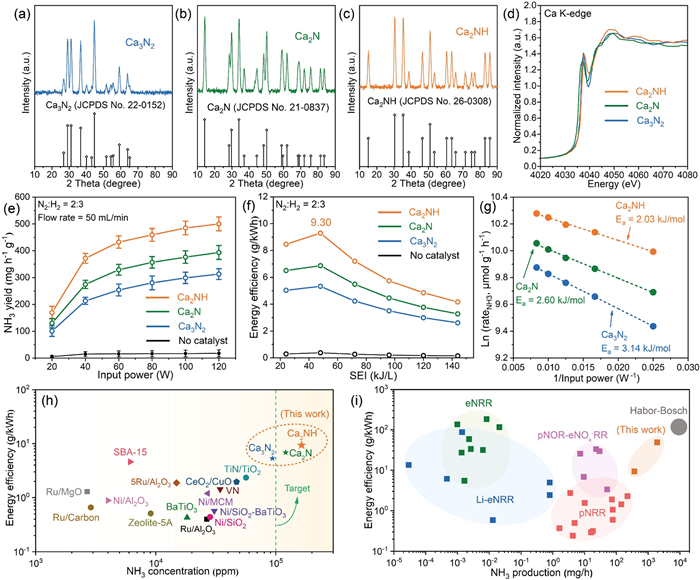
The Ca2NH catalyst was synthesized through a series of facile preparation steps. For comparative studies, the Ca3N2 and Ca2N precursors used during the synthesis were also evaluated as catalyst samples. The Ca3N2 precursor was prepared from commercial calcium nitride powders via a typical liquid-phase exfoliation method [18]. Subsequently, the Ca2N precursor was synthesized through a conventional solid-state reaction using Ca3N2 powder and Ca metal at a molar ratio of 1:1 [19]. The Ca2NH catalyst was then obtained by heating Ca2N powder at 400 ℃ under a flowing N2/H2 mixture. Powder X-ray diffraction (XRD) patterns (Figs. 1a–c) indicate that Ca3N2, Ca2N and Ca2NH exhibit characteristic diffraction peaks corresponding to the cubic Ca3N2 phase (JCPDS No. 22–0152), hexagonal Ca2N phase (JCPDS No. 21–0837), and cubic Ca2NH phase (JCPDS No. 26–0308), respectively. Transmission electron microscopy (TEM) images (Figs. S1a–c in Supporting information) reveal that all three catalysts possess a nanosphere morphology composed of aggregated nanoparticles. High-resolution TEM images (Figs. S1d–f in Supporting information) further display well-defined lattice fringes with spacings of 0.331, 0.182 and 0.293 nm, which can be indexed to the (222) plane of Ca3N2, the (110) plane of Ca2N, and the (222) plane of Ca2NH, respectively. The valence state of Ca in the catalysts were investigated using Ca K-edge X-ray absorption near-edge structure (XANES) spectroscopy. As shown in Fig. 1d, the absorption edge positions of Ca3N2, Ca2N, and Ca2NH fall within the range of 4036−4040 eV, indicating a formal Ca(Ⅱ) oxidation state in all samples [20]. The slightly lower absorption edge position observed for Ca2N can be attributed to its electride nature. Overall, these results demonstrate that the three catalysts possess highly similar crystal structures, morphologies and element valence states; therefore, structural differences are not expected to influence the comparative analysis of their catalytic performance in this study.
Figure 1
Figure 1.
XRD patterns of (a) Ca3N2, (b) Ca2N, and (c) Ca2NH. (d) Ca K–edge XANES spectra of the catalysts. (e) NH3 yield of the catalysts and catalyst-free conditions at varying input powers (gas flow rate = 50 mL/min, N2:H2 = 2:3, catalyst loading = 1 g, reaction temperature = 25 ℃, pressure = 0.1 MPa, sampling time = 1.0 h). (f) Energy efficiency of the catalysts and catalyst-free conditions at varying specific energy inputs (SEI) (gas flow rate = 50 mL/min, N2:H2 = 2:3, catalyst loading = 1 g, reaction temperature = 25 ℃, pressure = 0.1 MPa, sampling time = 1.0 h). (g) The modified Arrhenius plots for the catalytic systems; (h) Reported energy efficiency and NH3 concentration in the plasma-catalytic systems over different catalysts. (i) Comparison of energy efficiency and NH3 concentration in state-of-the-art sustainable ammonia synthesis technologies.
To evaluate the plasma-catalytic performance of the prepared catalysts, their NH3 synthesis activity was first examined in a dielectric barrier discharge (DBD) reactor (Fig. S2 in Supporting information) using a fixed N2/H2 mixture ratio of 2:3 and a catalyst loading of 1 g. As shown in Figs. 1e and f, the Ca2NH catalyst achieved an ultrahigh NH3 yield of 371.8 mg h–1 g–1 and an exceptional energy efficiency of 9.30 g/kWh at an input power of 40 W, representing 1.35- and 1.74-fold enhancements compared with the Ca2N and Ca3N2 catalysts, respectively. Notably, all three catalysts exhibited significantly higher performance than the catalyst-free system, demonstrating the critical role of catalysts in enhancing plasma-assisted ammonia synthesis. Electrical diagnostics (Fig. S3 and Table S1 in Supporting information) reveal that catalyst packing within the discharge zone slightly improved the discharge properties, further confirming the synergistic advantages of catalyst-plasma coupling. Optimization tests conducted under varying gas flow rates and reactant gas ratios (Fig. S4 in Supporting information) ensured that all measurements were performed under optimal reaction conditions while avoiding excessive hydrogen consumption. Furthermore, rigorous control experiments were conducted to confirm that NH3 production originated from plasma catalysis rather than possible experimental contamination (Figs. S5a and b in Supporting information), directly verifying the reliability and validity of the experimental data. The apparent activation energy (Ea) for plasma-catalytic NH3 synthesis was determined using a modified Arrhenius plot (Fig. 1g). Instead of using conventional thermal temperature, this method adopts specific energy input (SEI) as the governing parameter, which correlates the plasma equivalent temperature with discharge power [10]. Compared to the Ca2N (2.60 kJ/mol) and Ca3N2 (3.14 kJ/mol) catalysts, Ca2NH significantly reduced the activation energy to 2.03 kJ/mol, indicating its superior catalytic activity. To preliminarily assess the practical applicability of the Ca2NH catalyst for scalable ammonia production, its catalytic performance was further evaluated under varying catalyst loadings. As illustrated in Fig. S6a (Supporting information), both the NH3 productivity and the energy efficiency increased steadily with increasing catalyst loading under constant plasma discharge conditions (Fig. S6b in Supporting information), highlighting the potential scalability of the metal imide-enhanced plasma system. A comprehensive comparison with previously reported plasma-based NH3 synthesis systems (Fig. 1h and Table S2 in Supporting information) further underscores the advantages of the prepared Ca2NH catalyst, which outperforms most existing plasma catalysts in terms of both NH3 productivity and energy utilization. Notably, the Ca2NH catalyst not only achieved the highest NH3 concentration of 1.63 × 10⁵ ppm among recent reports, but also exceeded the concentration threshold required for small-scale NH3 synthesis units designed to minimize separation and recycling energy costs under atmospheric-pressure operation [6,21]. A summary of NH3 yields and energy efficiencies across various state-of-the-art sustainable technologies is presented in Fig. 1i and Tables S3–S5 (Supporting information). Remarkably, the NH3 synthesis performance of the Ca2NH-plasma system not only surpasses other emerging alternatives such as electrochemical N2 reduction (eNRR), Li-mediated eNRR, and hybrid processes integrating plasma N2 oxidation with electrocatalytic reduction (pNOR-eNOx–RR), but also approaches the production efficiency of the industrial Haber–Bosch process [22]. These results highlight the significant potential of metal imide-enhanced plasma catalysis for future decentralized and energy-efficient ammonia synthesis processes.
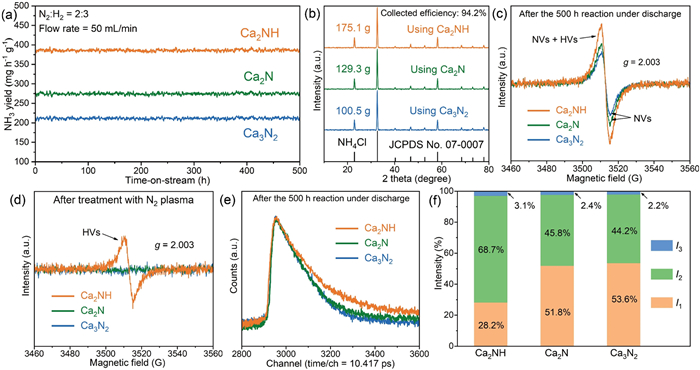
To investigate the durability of the prepared catalysts, long-term stability tests lasting 500 h were carried out. As shown in Fig. 2a, all three catalysts maintained their high NH3 yield throughout the tests, demonstrating excellent stability. XRD patterns and TEM images (Fig. S7 in Supporting information) showed negligible changes in the crystal and morphological structures of the catalysts, further confirming their durability under continuous plasma exposure conditions. In addition, the ammonia produced during the long-term tests were collected using a rotary evaporation method [23]. As shown in Fig. 2b, approximately 94.2% of the produced NH3 was successfully collected as solid ammonium chloride (NH4Cl), and its high purity was verified by XRD analysis. Over the full 500-h plasma-catalytic reaction, the Ca2NH, Ca2N, and Ca3N2 catalyst produced 175.1, 129.3, and 100.5 g of solid NH4Cl products, respectively. These results demonstrate not only the substantial ammonia production capacity of the catalysts, but also their excellent long-term operational stability under plasma conditions. Electron paramagnetic resonance (EPR) spectroscopy and positron annihilation lifetime spectroscopy (PALS) were employed to probe the plasma-induced release of lattice nitrogen and hydrogen from the catalyst surfaces and to investigate the distribution of anion vacancies at the atomic scale. As shown in Fig. 2c, all three catalysts exhibited EPR signals at g = 2.003 after the 500-h longevity tests, corresponding to electrons captured in anion vacancies [12]. In contrast, the fresh catalysts showed no detectable EPR signals (Fig. S8 in Supporting information), confirming that these vacancies were generated during the plasma-catalytic reaction. Notably, the EPR signal intensity of Ca2NH is significantly higher than that of Ca2N and Ca3N2, which may be attributed to the simultaneous formation of both nitrogen and hydrogen vacancies in Ca2NH during the reaction. Furthermore, after treating the used catalysts with N2 plasma, the EPR signals of Ca2N and Ca3N2 disappeared completely, whereas Ca2NH retained a relatively strong vacancy signal (Fig. 2d). This observation provides direct evidence that both nitrogen and hydrogen vacancies are generated in Ca2NH under reaction conditions. PALS measurements further elucidated the characteristic of these defects. As displayed in Fig. 2e, the positron decay in Ca2NH proceeds significantly more slowly than in Ca2N and Ca3N2, indicating that Ca2NH possesses a higher proportion of long-lifetime positrons. According to the previous report, PALS spectra can be deconvoluted into three components of τ1, τ2, and τ3, with the intensities of I1, I2, and I3, respectively [24-26]. Here, τ1 corresponds to free positron annihilation and annihilation within isolated anion vacancies; τ2 arises from positrons trapped by larger size defects, specifically hydrogen-vacancy clusters; and τ3 is attributed to orthopositronium annihilation within large voids. Significantly, Ca2NH exhibits a considerably larger τ2 value of 501.3 ps (Table S6 in Supporting information) along with a markedly higher I2 intensity of 68.7% (Fig. 2f) than Ca2N and Ca3N2. These results indicate that the vacancy clusters on the Ca2NH surface primarily consist of hydrogen vacancies, consistent with their more extensive surface distribution and lower formation energies compared with nitrogen vacancies.
Figure 2
Figure 2.
(a) Stability of the catalysts over a 500-h reaction teat (input power = 40 W, gas flow rate = 50 mL/min, N2:H2 = 2:3, catalyst loading = 1 g, reaction temperature = 25 ℃, pressure = 0.1 MPa). (b) XRD patterns of NH4Cl product obtained after 500 h of reaction with various catalysts. (c) EPR spectra of the catalysts after 500 h of reaction. (d) EPR spectra of the used catalysts after being treated with N2 plasma at 40 W. (e) PALS results of the catalysts after 500 h of reaction. (f) Intensities of I1, I2, and I3 in the catalysts obtained via PALS.
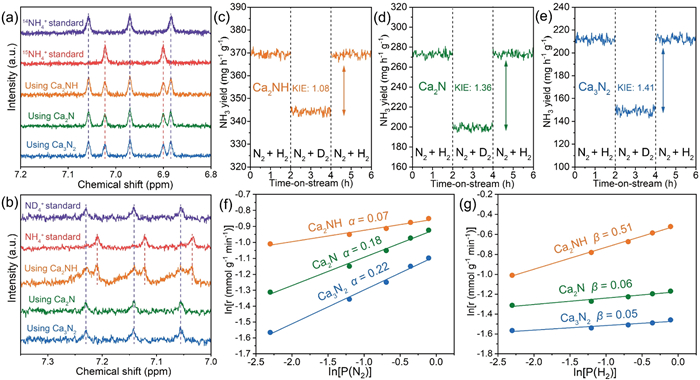
Isotope tracking experiments were performed to determine whether lattice atoms on the catalyst surfaces participate in the plasma-catalytic NH3 synthesis process. As presented in the 1H nuclear magnetic resonance (1H NMR) spectra (Fig. 3a), both 14NH4+ and 15NH4+ were detected when a 15N2/H2 mixture was used as the feed gas in the plasma reactor, providing direct evidence that NH3 synthesis over the prepared catalysts proceeds via the MvK mechanism [27]. Furthermore, when Ca2NH was used as the catalyst and a 14N2/D2 mixture was introduced, distinct peaks at 7.05, 7.14 and 7.23 ppm appeared in the 1H NMR spectrum (Fig. 3b), corresponding to the characteristic signals of ND4+ [28]. In addition, typical NH4+ peaks at 7.03, 7.12, and 7.20 ppm were also observed, indicating that a portion of the hydrogen in the produced ammonia originated from the lattice hydrogen atoms within the Ca2NH catalysts. Following the D2 isotope tracking experiments, the XRD spectrum of the Ca2NH catalyst (Fig. S9 in Supporting information) revealed a slight shift in the crystal planes relative to the fresh samples, consistent with the introduction of deuterium (D) into the lattice. The nearly unchanged spacing between the diffraction peaks confirmed that the crystal structures of Ca2NH remained intact, with deuterium merely substituting for hydrogen in the lattice. These findings further confirm that the lattice hydrogen in Ca2NH actively participated in the hydrogenation of N2 molecules. During the plasma-catalytic NH3 synthesis reaction, lattice hydrogen is released from the Ca2NH catalyst and converted into H• radicals, while H2 plasma replenishes the resulting hydrogen vacancies. This reversible equilibrium between lattice hydrogen and H• radicals not only enhances the reaction efficiency but also contributes to the remarkable catalytic stability of the system.
Figure 3
Figure 3.
(a) 15N2 isotope tracking experiments for various catalysts. (b) D2 isotope tracking experiments for various catalysts. Kinetic isotope effects (H/D) on NH3 synthesis rates for (c) Ca2NH, (d) Ca2N and (e) Ca3N2. The reaction rate dependence on (f) PN2 and (g) PH2 under plasma-catalytic conditions for various catalysts.
To gain deeper insight into the catalytic enhancement of metal imides in NH3 synthesis, kinetic experiments were conducted, beginning with the investigation of the hydrogen/deuterium (H/D) kinetic isotopic effect (KIE) to assess the influence of Ca2NH on H2 dissociation. As shown in Figs. 3c–e, substituting H2 with D2 led to a significant decrease in NH3 production for both Ca2N and Ca3N2 catalysts, with corresponding KIE values of 1.36 and 1.41, respectively. In contrast, the Ca2NH catalyst exhibited a notably lower KIE value of only 1.08, suggesting its superior ability to dissociate H2 molecules and generate H• radicals, which represents an essential factor contributing to its outstanding performance in NH3 synthesis [29,30]. Furthermore, the reaction orders with respect to N2 partial pressure (PN2) were determined to be 0.07, 0.18 and 0.22 for the Ca2NH, Ca2N, and Ca3N2 systems, respectively (Fig. 3f). The extremely low N2 reaction order for the Ca2NH system suggests that N2 hydrogenation is highly favorable in this catalytic system [11]. Additionally, the relatively higher reaction orders for H2 in the NTP-Ca2NH system (Fig. 3g) further support the conclusion that the Ca2NH-enhanced reaction is primarily driven by the reversible equilibrium between lattice hydrogen and H• radicals, which is consistent with the results from the isotope tracking experiments and KIE analysis.
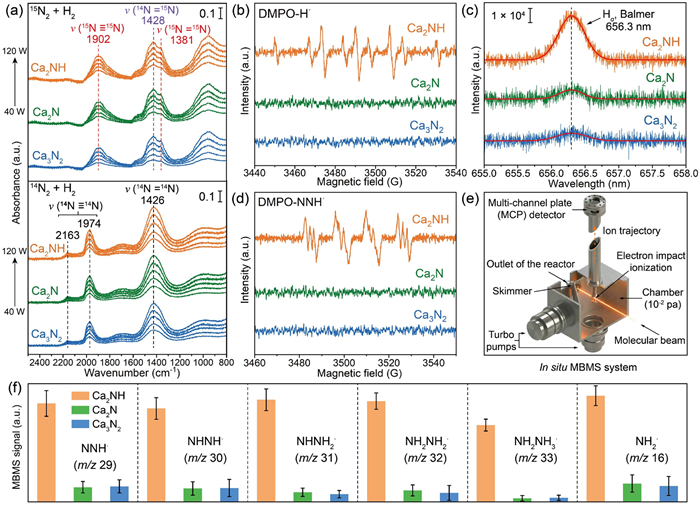
A comprehensive in situ characterization system was employed to further elucidate the origin of the outstanding performance of Ca2NH. In situ diffuse-reflectance infrared Fourier transform spectroscopy (DRIFTS) was first conducted to identify surface intermediates during plasma-catalytic ammonia synthesis. As displayed in Fig. 4a, stretching vibrations corresponding to N≡N (1974 cm−1) and N=N (1426 cm−1) were simultaneously observed, indicating the formation of surface adsorbed NNH species during the reaction. To further confirm this result, isotope substitution experiments were performed using a 15N2/H2 mixture. Notably, the N≡N and N=N stretching bands red-shifted to 1902 and 1381 cm−1, respectively. These shifts are consistent with the expected isotope effect (1974 cm−1 × (14/15)1/2 = 1907 cm−1, 1439 cm−1 × (14/15)1/2 = 1377 cm−1), thereby confirming the formation of surface adsorbed NNH intermediate [31]. The presence of these NNH species is attributed to reaction intermediates generated via the MvK mechanism on the catalyst surfaces. Moreover, 5,5-dimethyl-1-pyrroline-N-oxide (DMPO) was employed as a spin-trapping agent for in situ radical trapping experiments. For the Ca2NH catalyst, a characteristic EPR signal with an intensity ratio of 1:1:2:1:2:1:2:1:1 was observed (Fig. 4b), which can be unambiguously assigned to gaseous H• radicals [32-34]. In contrast, no detectable H• signal was observed when Ca2N or Ca3N2 was used, indicating that the H• concentration in these systems was below the detection limit. These results demonstrate that hydrogen atoms from Ca2NH can be released into the gas phase under plasma exposure, thereby generating H• radicals while simultaneously creating hydrogen vacancies on the catalyst surface. Optical emission spectroscopy (OES) was further employed to validate these findings. As shown in Fig. 4c, the presence of the Hα Balmer emission line confirms the dissociation of H2 into gas-phase H• radical. The significantly stronger OES signal observed for the Ca2NH system is consistent with the EPR results, further supporting the enhanced H• generation over Ca2NH. Therefore, we propose that the Ca2NH catalyst not only synthesizes ammonia through the MvK mechanism but also that H• radicals released from the lattice induce a gas-phase radical pathway for N2 reduction. To further substantiate the existence of this radical-dominated reaction pathway, radical trapping experiments targeting NNH• radicals were performed. As exhibited in Fig. 4d, EPR signals corresponding to gaseous NNH• radicals were exclusively detected in the Ca2NH system. The identification of this key nitrogen-containing intermediate provides compelling evidence that H• radicals derived from Ca2NH participate in N2 reduction through a gas-phase radical pathway [35]. Furthermore, a self-designed in situ molecular-beam mass spectrometry (MBMS) system (Fig. 4e) was employed to directly monitor gas-phase NxHy radicals during plasma-catalytic ammonia synthesis [36]. As shown in Fig. 4f, markedly enhanced signals for NNH• (m/z 29), NHNH• (m/z 30), NHNH2• (m/z 31), NH2NH2• (m/z 32), NH2NH3• (m/z 33) and NH2• (m/z 16) were detected with the Ca2NH catalyst. These findings strongly demonstrate that H• radicals derived from Ca2NH readily hydrogenate N2 molecules to form NNH• intermediates, which are further transformed into a series of NxHy radicals and finally reduced to NH3 through a continuous gas-phase reaction pathway.
Figure 4
Figure 4.
(a) In situ DRIFTS measurements conducted with various catalysts at input powers of 40, 60, 80, 100 and 120 W (gas flow rate = 50 mL/min, N2:H2 = 2:3, catalyst loading = 1 g, reaction temperature = 25 ℃, pressure = 0.1 MPa). (b) DMPO-involved EPR spectra for plasma-induced H• species. (c) OES spectra for the plasma-catalytic system with various catalysts. (d) DMPO-involved EPR spectra for plasma-induced NNH• species. (e) Schematic diagram of the in situ MBMS system. (f) MS signals of gas phase NxHy radicals detected by MBMS during plasma-catalytic ammonia synthesis with various catalysts.
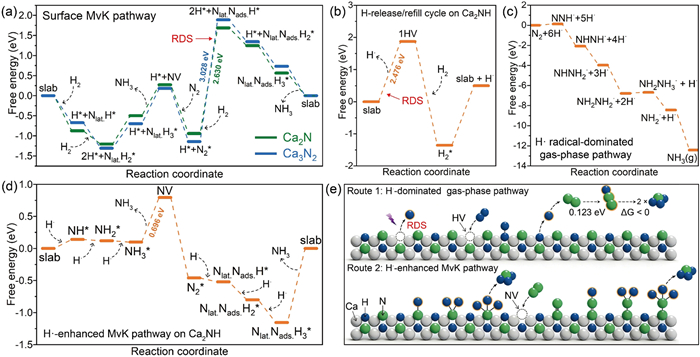
Density functional theory (DFT) calculations were performed to further elucidate the reaction pathways and identify the rate-determining steps (RDS), with insights obtained from the in situ characterization results. These calculations primarily serve to compare the RDS among different catalysts, thereby fundamentally accounting for the differences in reaction rates and the resulting catalytic activity trends. In situ DRIFTS, OES and MBMS measurements collectively confirm that ammonia synthesis proceeds predominantly via a surface MvK mechanism on Ca2N and Ca3N2 surfaces. As illustrated in Fig. 5a, the RDS in this MvK pathway corresponds to the hydrogenation of terminal N atoms in N2 molecules adsorbed at nitrogen vacancies. The calculated thermodynamic energy barriers for the RDS are 2.630 eV for Ca2N and 3.028 eV for Ca3N2. In contrast, for the Ca2NH catalyst, MBMS and DFT results reveal that surface lattice hydrogen atoms can be released into the gas phase under plasma discharge conditions, with an energy barrier of 2.476 eV (Fig. 5b). This process generates H• radicals while simultaneously creating hydrogen vacancies that serve as active sites for H2 adsorption and dissociation. Upon H2 adsorption, one hydrogen atom occupies the surface vacancy, while the other remains weakly bound to it. Subsequent plasma-induced cleavage of the H–H bond produces a lattice hydrogen atom and a gaseous H• radical. This reversible H-release/H-refill cycle enables a continuous and energy-efficient supply of reactive H• species for N2 reduction. The overall gas-phase reaction pathway (Fig. 5c) indicates that, in the presence of abundant H• radicals, N2 molecules are readily hydrogenated to form NNH• radicals with an ultralow energy barrier of 0.123 eV. These NNH• radicals are further converted to a series of NxHy intermediates and ultimately reduced to NH3 through a spontaneous gas-phase reaction pathway. Meanwhile, the released H• radicals also act as reactive hydrogen species that promote the surface MvK mechanism on the Ca2NH catalyst. As shown in Fig. 5d, the H•-involved MvK pathway on Ca2NH exhibits a significantly lower thermodynamic energy barrier compared to the conventional MvK pathways on Ca2N and Ca3N2 surfaces. Within this dual-mechanism strategy, the release of H• radicals from the Ca2NH surface is identified as the RDS of ammonia synthesis. The corresponding energy barrier (2.476 eV) is lower than those associated with the RDS in the conventional MvK pathways on Ca2N (2.630 eV) and Ca3N2 (3.028 eV). These results demonstrate that the Ca2NH catalyst participate in N2 reduction through two parallel and complementary pathways, specifically an H•-enhanced MvK pathway and an H• radical-dominated gas-phase pathway. As depicted in Fig. 5e, a fraction of N2 molecules is captured and activated on the Ca2NH surface via the H•-enhanced MvK mechanism, while unabsorbed N2 molecules in the plasma phase are hydrogenated by H• radicals released from the catalyst. The integration of these pathways enables simultaneous heterogeneous and homogeneous activation of N2 in the plasma environment, thereby overcoming the limitations of single-site or single-pathway mechanisms and achieving comprehensive N2 activation throughout the entire reaction space.
Figure 5
Figure 5.
(a) Free-energy diagram for the MvK pathway on the Ca2N and Ca3N2 catalysts. (b) Free-energy diagram for the plasma-catalytic H-release/H-refill cycle on the Ca2NH catalyst. (c) Free-energy diagram illustrating the H• radical-dominated N2 reduction pathway via plasma-induced gas reactions. (d) Free-energy diagram illustrating the H• radical-enhanced MvK pathway on the Ca2NH catalyst. (e) Schematic diagram of the two plasma-catalytic reaction pathways using the Ca2NH catalyst.
In summary, this work demonstrates that the metal imide Ca2NH acts as a highly effective dual-functional catalyst for plasma-catalytic ammonia synthesis under mild conditions. By integrating nitride-like N2 activation capability with hydride-like H• release behavior, Ca2NH enables the simultaneous progression of two complementary pathways: A surface MvK mechanism and an H• radical-dominated gas-phase reduction route. This coupled mechanism significantly lowers the activation barrier for N2 hydrogenation and maximizes the utilization of plasma-generated reactive species, resulting in an exceptional NH3 yield of 371.8 mg h−1 g−1 and an energy efficiency of 9.30 g/kWh. In situ characterization, isotope labeling, and kinetic analyses collectively reveal that lattice hydrogen in Ca2NH dynamically participates in the reaction through a reversible H-release/H-refill cycle, which continuously supplies H• radicals for both surface and gas-phase N2 activation while sustaining excellent catalyst stability over 500 h of continuous operation. These findings establish metal imides as a promising catalyst platform for plasma catalysis and highlight a general strategy for coupling heterogeneous surface reactions with homogeneous radical pathways to achieve efficient N2 fixation. This work provides new insights into the design of advanced plasma-catalytic systems and paves the way for the development of sustainable, energy-efficient ammonia synthesis technologies compatible with renewable energy sources.
The authors declare that they have no known competing financial interests or personal relationships that could have appeared to influence the work reported in this paper.
Acknowledgments
This study was financially supported by the National Key R&D Program of China (No. 2024YFA1509201), the National Natural Science Foundation of China (Nos. 22579021, 22178034, 22508028), the Fundamental Research Funds for the Central Universities (No. 2025CDJ-IAISYB-048), the Postdoctoral Fellowship Program and China Postdoctoral Science Foundation (No. BX20250316), and the Chongqing Postdoctoral Science Special Foundation (No. 2024CQBSHTB3120).
Supplementary materials
Supplementary material associated with this article can be found, in the online version, at doi:10.1016/j.cclet.2026.113084.
Figure 1
XRD patterns of (a) Ca3N2, (b) Ca2N, and (c) Ca2NH. (d) Ca K–edge XANES spectra of the catalysts. (e) NH3 yield of the catalysts and catalyst-free conditions at varying input powers (gas flow rate = 50 mL/min, N2:H2 = 2:3, catalyst loading = 1 g, reaction temperature = 25 ℃, pressure = 0.1 MPa, sampling time = 1.0 h). (f) Energy efficiency of the catalysts and catalyst-free conditions at varying specific energy inputs (SEI) (gas flow rate = 50 mL/min, N2:H2 = 2:3, catalyst loading = 1 g, reaction temperature = 25 ℃, pressure = 0.1 MPa, sampling time = 1.0 h). (g) The modified Arrhenius plots for the catalytic systems; (h) Reported energy efficiency and NH3 concentration in the plasma-catalytic systems over different catalysts. (i) Comparison of energy efficiency and NH3 concentration in state-of-the-art sustainable ammonia synthesis technologies.
Figure 2
(a) Stability of the catalysts over a 500-h reaction teat (input power = 40 W, gas flow rate = 50 mL/min, N2:H2 = 2:3, catalyst loading = 1 g, reaction temperature = 25 ℃, pressure = 0.1 MPa). (b) XRD patterns of NH4Cl product obtained after 500 h of reaction with various catalysts. (c) EPR spectra of the catalysts after 500 h of reaction. (d) EPR spectra of the used catalysts after being treated with N2 plasma at 40 W. (e) PALS results of the catalysts after 500 h of reaction. (f) Intensities of I1, I2, and I3 in the catalysts obtained via PALS.
Figure 3
(a) 15N2 isotope tracking experiments for various catalysts. (b) D2 isotope tracking experiments for various catalysts. Kinetic isotope effects (H/D) on NH3 synthesis rates for (c) Ca2NH, (d) Ca2N and (e) Ca3N2. The reaction rate dependence on (f) PN2 and (g) PH2 under plasma-catalytic conditions for various catalysts.
Figure 4
(a) In situ DRIFTS measurements conducted with various catalysts at input powers of 40, 60, 80, 100 and 120 W (gas flow rate = 50 mL/min, N2:H2 = 2:3, catalyst loading = 1 g, reaction temperature = 25 ℃, pressure = 0.1 MPa). (b) DMPO-involved EPR spectra for plasma-induced H• species. (c) OES spectra for the plasma-catalytic system with various catalysts. (d) DMPO-involved EPR spectra for plasma-induced NNH• species. (e) Schematic diagram of the in situ MBMS system. (f) MS signals of gas phase NxHy radicals detected by MBMS during plasma-catalytic ammonia synthesis with various catalysts.
Figure 5
(a) Free-energy diagram for the MvK pathway on the Ca2N and Ca3N2 catalysts. (b) Free-energy diagram for the plasma-catalytic H-release/H-refill cycle on the Ca2NH catalyst. (c) Free-energy diagram illustrating the H• radical-dominated N2 reduction pathway via plasma-induced gas reactions. (d) Free-energy diagram illustrating the H• radical-enhanced MvK pathway on the Ca2NH catalyst. (e) Schematic diagram of the two plasma-catalytic reaction pathways using the Ca2NH catalyst.


 DownLoad:

 下载:


 下载:

