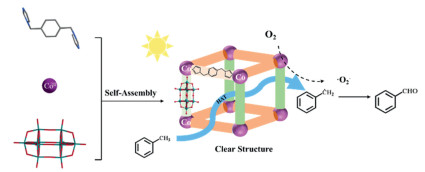
Scheme 1.
Schematic diagram illustrating the self-assembly of POMOF building blocks and the interaction of active sites with O2 and C(sp3)-H bonds.

Atomic-level regulation of POMOF homologous isomer for photocatalytic C-H bond oxidation
Yanjie Lv , Xinyu Zhao , Jing Sun , Huiying Sun , Wenxi Zhang , Yuhan Cui , Xiao Li , Zhongmin Su


The selective oxidation of C(sp3)-H bonds for alkyl aromatics synthesis driven by visible light is a crucial and the environmentally friendly way. The current significant challenge currently exists in the overcoming the oxidation energy barrier of C(sp3)-H bond, while also preventing over oxidation [1–4]. A landmark example is the selective oxidation of toluene to benzaldehyde, which holds substantial industrial significance. However, benzaldehyde is highly susceptible to over oxidation, leading to the formation of benzoic acid or even extensive ring opening decomposition [5,6]. Photocatalysis utilizes light energy to activate molecular oxygen and offers a promising approach to promote selective C(sp3)-H bonds oxidation under mild conditions, in which the core is the development of heterogeneous catalysts with high activity, selectivity, and stability [7–10].
In the field of photocatalytic oxidation of C(sp3)-H bond, polyoxometalate-based metal-organic frameworks (POMOFs) have attracted significant attention owing to their unique electron transfer capabilities and adjustable active sites [11–13]. Clear correlation between structure and performance of POMOFs could be established through atomic level regulation of local coordination chemistry at metal nodes [14–16]. Moreover, as the structural node directly engaged in framework assembly, POMs can benefit for exposing active sites and optimizing reaction pathways directly, which requires atomic control strategies, and the selection of appropriate POMs anions to regulate coordination environment of the metal nodes.
Decatungstate ([W10O32]4-, W10) is widely used due to its unique photoactivity and hydrogen atom transfer capabilities. As a superior photosensitive unit of POMs, the electron-deficient surface of W10 can effectively act as an oxidation center as well as broad light absorption spectrum and prolonged excited state duration [17–19]. The numerous terminal oxygen sites of W10 can offer the potential for diverse coordination modes with metal ions, which make the potential candidate for POMOFs construction [20,21]. Nevertheless, how to precise control the coordination interactions of W10-POMOFs to achieve targeted specific dimensions and pore environments, and the comprehensive elucidation of structure-activity relationship, represent significant arduous task.
In light of the aforementioned considerations, homologous isomeric POMOF systems, namely Co-W10 and OH-Co-W10 were designed and synthesized by self-assembly of W10, Co2+ and the flexible ligand bix (Scheme 1). Co-bix (the single crystal structure is shown in Fig. S1 in Supporting information), Co-W10 and OH-Co-W10 were applied to explore the reaction of toluene catalytic oxidation. Notably, OH-Co-W10 exhibited superior conversion rate (98.1%) and selectivity (97.3%) during the oxidation of toluene to benzaldehyde. Analysis of the single crystal X-ray diffraction structure revealed that Co-W10 structure exhibits two coordination types of cobalt sites, Co2 (CoO2N4) and Co1 (CoN6) (Fig. 1a), and the OH-Co-W10 comprises one coordination type of cobalt site, Co3 (CoON4(OH)) (Fig. 1b). W10 acts as a pillar to open the interlayer channels in the c-axis direction. Ligand bix adopts a trans-conformation and coordinates with Co3 and assembles in the a-axis direction. A hydroxide ion coordinates with one Co3 and occupies the axial position as capping agent, thereby inducing two-dimensional conjugated permeable layered structure with exposed active sites. (Fig. 1c and Fig. S3 in Supporting information). Co1 and Co2 are coordinated by W10 and bix with conformational transformation to form a tightly packed three-dimensional framework (Fig. S2 in Supporting information). Co1 and Co2 coordinate with cis-trans isomers of bix, while Co3 exclusively coordinates with trans-bix. The cis conformation, characterized by tight packing and high energy, contrasts with the low-energy trans conformation. The 2D structure exhibits enhanced electron delocalization and transport pathways (7.91 × 7.54 Å) compared to the 3D structure (Fig. S4 in Supporting information). Furthermore, the open channels in the OH-Co-W10 structure can facilitate rapid substrate adsorption and product desorption, preventing prolonged contact and excessive oxidation risk.
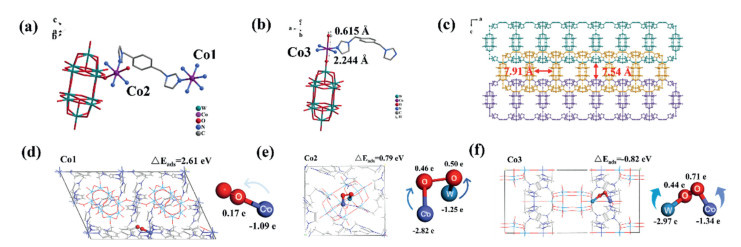
The oxygen adsorption model was constructed and optimized to compare the adsorption energy of Co1, Co2 and Co3 through density functional theory (DFT) calculations. The adsorption energy (Co1 for 2.61 eV, Co2 for 0.79 eV, Co3 for -0.82 eV) gradually changed from positive to negative, and the adsorption of oxygen by the photocatalyst transformed into a spontaneous process [22–26]. The calculation results of the electron transfer quantity show that Co1 lacks a synergistic effect, and the electron transfer is restricted. In the Co-W10 structure, Co1 is coordinated by a CoN6 octahedron, and all the coordination sites are occupied by N atoms (from the bix ligand), and the electronic transfer efficiency of the ligand itself is extremely low. The O2 molecule cannot directly form a chemical adsorption with Co1. The adsorption energy (+2.61 eV) is the result obtained by forcibly placing the O2 molecule near Co1 and optimizing. Under the “W” synergistic effect, the electron transfer efficiency of Co2 increases. Co3 has the largest electron transfer quantity under the hydroxide electron-pushing effect and the “W” synergistic effect (Figs. 1d-f). The homogenization of Co3 coordination patterns in OH-Co-W10 increases the density of active sites, enhances the oxygen activation efficiency, promotes the generation of superoxide radicals and singlet oxygen, and thereby improves the oxidation efficiency of toluene.
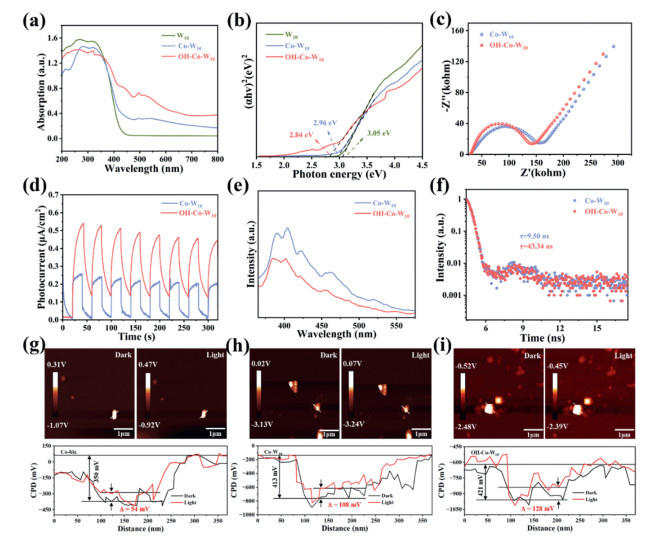
Powder X-ray diffraction (PXRD) analysis indicated that Co-bix, Co-W10 and OH-Co-W10 were pure phases (Figs. S5-S7 in Supporting information). In thermogravimetric analysis (TGA), Co-W10 and OH-Co-W10 can maintain thermal stability before 300 ℃ (Figs. S8 and S9 in Supporting information). For FTIR spectra, the characteristic peaks at 959.59, 887.21 and 780.52 cm-1 are attributed to W=O, W-Ob-W and W-Oc-W, which is mainly from W10 (Figs. S10 and S11 in Supporting information) [27]. X-ray photoelectron spectroscopy (XPS) confirmed that cobalt ions possess +2 and +3 valence states (Figs. S12 and S13 in Supporting information) [28]. The solid UV-vis spectra shows that the main absorption band of OH-Co-W10 (Eg = 2.84 eV) has a significant redshift compared with Co-W10 (Eg = 2.96 eV) and W10 (Eg = 3.05 eV), and the reduction of the band gap proves enhanced light absorption capacity (Figs. 2a and b). Corresponding conduction band and valence band indicate that the conduction band (CB) of OH-Co-W10 is -0.9 V (vs. NHE) (Figs. S14-S16 in Supporting information). The potential of ECB is lower than that of oxygen reduction (O2/·O2-, -0.33 V vs. NHE), which indicates that OH-Co-W10 as N-type semiconductor can promote the semi-reaction of toluene oxidation. Electrochemical impedance spectroscopy (EIS) shows smaller resistance of charge transfer at the OH-Co-W10 interface and higher carrier transfer efficiency (Fig. 2c). OH-Co-W10 exhibits outstanding oxidation and reduction capabilities in the linear sweep voltammetry (LSV) under light irradiation (Fig. S17 in Supporting information) [29]. High transient photocurrent response intensity proves better carrier separation efficiency of OH-Co-W10 (Fig. 2d). Photoluminescence spectroscopy and fluorescence lifetime tests showed the lifetimes of Co-W10 and OH-Co-W10 are 9.50 and 43.34 ns, indicating that the electron-hole recombination efficiency is lower, and catalytic reactions could occur both on the surface and channels of OH-Co-W10 (Figs. 2e and f). Kelvin probe force microscopy (KPFM) further clarifies the dynamic process of charge transfer in photocatalysts. The carriers of N-type semiconductors are mainly electrons. In the dark state, the surface is rich in electrons. Under light conditions, the holes migrate to the surface, neutralizing some of the negative charges, resulting in positive shift in the electric potential [30–33]. By comparing the potential changes, 123 mV of OH-Co-W10 is greater than those of Co-bix (54 mV) and Co-W10 (108 mV). Compared with Co-bix without W10 and tightly structured Co-W10, the potential variation value of OH-Co-W10 is larger, and the accumulation of surface holes is more conducive to the generation of benzyl radicals (Figs. 2g-i).
To further distinguish the contributions of coordination effect, electronic effect and geometric effect to the catalytic performance of OH-Co-W10, a comparative analysis was conducted. Firstly, the coordination effect originated from the hydroxide end-capping on Co3+. In OH-Co-W10, the axial OH- ligand in the unique CoO(N4)(OH) unit has an electron-donating effect, increasing the electron density at the Co site and reducing the O2 adsorption energy to -0.82 eV (spontaneous process, Fig. 1f). In contrast, Co1 (CoN6) and Co2 (CoO2N4) in 3D Co-W10 lack such end-capping groups, and their O2 adsorption energies are +2.61 and +0.79 eV, respectively, indicating that the adsorption is non-spontaneous or weak adsorption. Therefore, the coordination effect is the primary factor determining the oxygen activation ability. Secondly, the electronic effect is mainly dominated by the W10 clusters as the photosensitizer. The narrow bandgap (2.96 eV for Co-W10 and 2.84 eV for OH-Co-W10) and the lower conduction band position (-0.9 V vs. NHE) enable effective electron-hole separation under visible light. However, the electronic effect alone cannot explain the huge performance gap between the two isomers. Both materials exhibit similar transient photocurrent responses and KPFM surface potential changes (Co-W10: 108 mV, OH-Co-W10: 123 mV). The moderate enhancement of OH-Co-W10 is attributed to better electron delocalization in its two-dimensional layered structure, evidenced by a longer fluorescence lifetime (43.3 ns vs. 9.5 ns) and a lower EIS charge transfer resistance. Finally, we found that the geometric effect is unique to the two-dimensional layered structure of OH-Co-W10. It has open interlayer channels (7.91 × 7.54 Å), which can serve as a fast channel for substrate adsorption and product desorption. This geometric feature minimizes the residence time of benzaldehyde at the active site, thereby inhibiting the peroxidation to benzoic acid. 3D Co-W10 has a tightly packed framework and cis configuration of bix ligands, lacking such accessible channels, and thus has lower selectivity.
To assess the efficiency of selective oxidation of the benzyl C(sp3)-H bond in aromatic compounds, Co-W10 and OH-Co-W10 catalysts were used as catalysts in the oxidation reaction of toluene. Employing acetonitrile as the solvent, oxygen as the oxidizing agent, and OH-Co-W10 as the catalyst, toluene achieved a conversion rate of 98.1%, with a benzaldehyde selectivity of 97.3% and 2.7% over-oxidation to benzoic acid, after 48 h of irradiation under 10 W blue LED light. Notably, OH-Co-W10 exhibited significantly enhanced efficiency and selectivity than Co-W10 (Fig. 3a and Fig. S18 in Supporting information). When only W10 was present, the conversion rate and selectivity dropped significantly. The test results at other wavelengths also confirmed that 400 nm was the optimal choice (Table S6 in Supporting information). The results of molecular dynamics show that the catalytic oxidation reaction of toluene by OH-Co-W10 mainly occurs within the 2D confined pores (Fig. S19 in Supporting information). Only a trace amount of toluene conversion rate was observed when no light and catalyst (Fig. 3a), which further highlights the significance of catalysts and light in the photocatalytic oxidation process of toluene. The design of metal coordination modes and dimensional variance have endowed OH-Co-W10 with stronger capability in catalyzing surface oxidation reactions comprehensively. Furthermore, the transport channels of OH-Co-W10 promote rapid substrate adsorption and product desorption, thereby strengthening the selectivity of benzaldehyde.
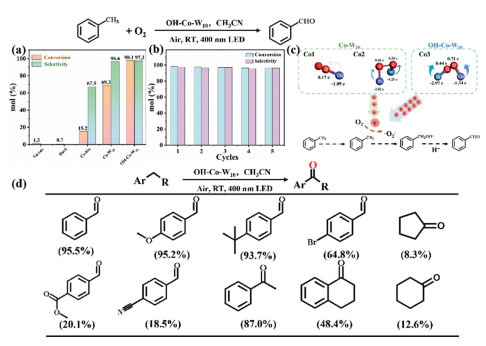
Recyclability, stability and high efficiency are of vital importance for heterogeneous catalysts [34–36]. After five cycles of recycling and reutilization, OH-Co-W10 exhibited only slight decrease in both conversion rate and selectivity (Fig. 3b). Noteworthy, the PXRD and FTIR analyses revealed no significant alterations in the structures before and after the reaction, proving the effectiveness of Co-W10 and OH-Co-W10 as heterogeneous catalysts (Figs. S20-S22 in Supporting information). To clarify the reactive oxygen species (ROS), free radical capture experiments and electron paramagnetic resonance (EPR) tests were conducted utilizing various quenchers (Table S7 and Fig. S23 in Supporting information). The inclusion of AgNO3 notably decreased the yield of toluene oxidation, indicating the involvement of electron transfer (ET) in this process [37–40]. According to the results of density functional theory (DFT) calculations, both W and Co in the Co-W10 and OH-Co-W10 structures can transfer electrons to O2. Among them, a certain type of Co3 in OH-Co-W10 has a higher electron transfer efficiency compared to Co1 and Co2 in Co-W10, which have very low electron transfer amounts. Based on the amount of electron transfer and whether the adsorption occurs spontaneously, it can be determined that OH-Co-W10 has a higher oxygen activation ability. This is also an important reason why OH-Co-W10 has a higher conversion rate in the toluene oxidation reaction. Furthermore, the introduction of p-benzoquinone (scavengers of ·O2-) resulted in a decrease in the conversion rate, suggesting the potential significance of ·O2- as reactive oxygen species for OH-Co-W10 activation (Fig. 3c). As an n-type semiconductor, Co-W10 and OH-Co-W10 have narrow band gap and generates electrons and holes (h+) under illumination. In the subsequent reaction, the photogenerated electrons reduce O2 to ·O2- radicals, while the holes activate toluene to form cationic radicals. These radicals then react with ·O2- radicals and O2 to form benzaldehyde.
A key mechanistic question is whether the electron transfer (ET) pathway is mutually exclusive with the classical hydrogen atom transfer (HAT) mechanism known for decatungstate photocatalysts. In this POMOF systems, the two pathways are not mutually exclusive but operate synergistically. The W10 unit retains its intrinsic HAT activity, as confirmed by the TBADT control experiment (Table S6). Meanwhile, the Co centers act as electron relays, enabling an ET pathway, photogenerated electrons are transferred from W10 to Co and then to O2, generating ·O2-, while the remaining holes oxidize toluene to the benzyl radical. This hybrid mechanism is supported by DFT, KPFM and scavenger experiments. The Co centers, particularly Co3 with the OH- ligand, play a crucial role in facilitating O2 activation and mediating electron transfer, thereby enhancing both activity and selectivity.
When toluene is oxidized in solvents of different polarities, both the conversion rate and selectivity will decrease to varying degrees (Table S8 in Supporting information). This is mainly because a high dielectric constant enhances the separation of photogenerated electrons and holes, reducing the probability of recombination [41–45]. In addition, during the substrate expansion experiment test, methylbenzene with substitution can also be oxidized into the corresponding aldehyde. Among them, electron-donating groups promote the high selectivity of aldehydes. Other substituents produce carbonyl compounds also exhibit high selectivity (Fig. 3d). The efficiency and perfect selectivity of OH-Co-W10 in the oxidation of toluene are comparable to those of most reported catalysts (Tables S9 and S10 in Supporting information).
In summary, we constructed two homologous heterogeneous POMOF systems (Co-W10 and OH-Co-W10) using the hydroxide end-capping strategy. By systematically distributing steric, electronic, and geometric effects, we revealed that the OH- end-capping ligand achieved spontaneous O2 adsorption and activation through the coordination effect on Co3+. At the same time, the electronic effect of the W10 photosensitizer provided efficient charge separation, and the two-dimensional layered structure further enhanced electron delocalization. Additionally, the geometric effect of the two-dimensional open channels promoted the rapid desorption of products and inhibited peroxidation, thereby achieving 97.3% selectivity for benzaldehyde. This work not only provides an efficient catalyst for C(sp3)-H bond oxidation, but also establishes a clear framework for distinguishing various structural effects in POMOF design.
Yanjie Lv: Writing – original draft, Methodology, Investigation, Conceptualization. Xinyu Zhao: Methodology, Investigation. Jing Sun: Writing – review & editing, Supervision, Funding acquisition. Huiying Sun: Software, Funding acquisition. Wenxi Zhang: Investigation. Yuhan Cui: Investigation. Xiao Li: Writing – review & editing, Supervision. Zhongmin Su: Writing – review & editing, Supervision, Funding acquisition.
The authors declare that they have no known competing financial interests or personal relationships that could have appeared to influence the work reported in this paper.
This work was financially supported by the National Natural Science Foundation of China (No. 22271023), Natural Science Foundation of Jilin Province Science and Technology Department (General Project of Free Exploration, No. YDZJ202401564ZYTS), the Science and Technology Research Project of Jilin Provincial Department of Education (No. JJKH20240899KJ).
Supplementary material associated with this article can be found, in the online version, at doi:
Q. Shen, J. Chen, X. Jing, C. Duan, Angew. Chem. Int. Ed. 64 (2025) e202506277. doi: 10.1002/anie.202506277
Y. Yang, X.H. Yang, L.G. Tang, et al., Adv. Mater. 37 (2025) 2502321. doi: 10.1002/adma.202502321
C. Ma, C. Yang, H. Zhuo, et al., J. Am. Chem. Soc. 145 (2023) 10890-10898. doi: 10.1021/jacs.3c03257
M. Zhang, Y. Li, R.K. Gupta, Chin. Chem. Lett. (2025), doi: 10.1016/j.cclet.2025.111897.
W. Qiao, X. Fan, W.F. Liu, et al., J. Am. Chem. Soc. 145 (2023) 5353-5362. doi: 10.1021/jacs.2c13196
T.X. Luan, L.B. Xing, N. Lu, et al., J. Am. Chem. Soc. 147 (2025) 12704-12714. doi: 10.1021/jacs.5c00750
M. Wu, S. Mushina, M. Tan, Chin. Chem. Lett. 37 (2026) 111923. doi: 10.1016/j.cclet.2025.111923
Y. Xu, Y. Lin, S.L. Homölle, et al., J. Am. Chem. Soc. 146 (2024) 24105-24113. doi: 10.1021/jacs.4c08459
Y. Teng, Z. Zhou, J. Chen, Chin. Chem. Lett. 36 (2025) 110430. doi: 10.1016/j.cclet.2024.110430
H.F. Zheng, Y.J. Fan, A.L. Blenko, et al., J. Am. Chem. Soc. 145 (2023) 9994-10000. doi: 10.1021/jacs.3c02703
Y. Liu, C.S. Tang, M. Cheng, et al., ACS Catal. 11 (2021) 13374-13396. doi: 10.1021/acscatal.1c03866
A. Solé-Daura, Y. Benseghir, M.H. Ha-Thi, et al., ACS Catal. 12 (2022) 9244-9255. doi: 10.1021/acscatal.2c02088
X.H. Liu, H. Li, N. Xu, et al., Chin. J. Chem. 42 (2024) 2970-2978. doi: 10.1002/cjoc.202400642
T. Zhang, J.C. Jiao, K.X. Guo, et al., J. Catal. 436 (2024) 115637. doi: 10.1016/j.jcat.2024.115637
G. Ji, L. Zhao, Y. Wang, et al., ACS Catal. 12 (2022) 7821-7832. doi: 10.1021/acscatal.2c01030
D. Nowicka, N. Vadra, E. Wieczorek-Szweda, et al., Coordin. Chem. Rev. 519 (2024) 216091. doi: 10.1016/j.ccr.2024.216091
K. Sheng, Z. Wang, L. Li, et al., J. Am. Chem. Soc. 145 (2023) 10595-10603. doi: 10.1021/jacs.3c00321
J. Zhang, A. Studer, Nat. Commun. 13 (2022) 3886. doi: 10.1038/s41467-022-31617-5
I.B. Perry, T.F. Brewer, P.J. Sarver, et al., Nature 560 (2018) 70-75. doi: 10.1038/s41586-018-0366-x
X. Yan, J. Xu, T. Zhang, et al., Chin. Chem. Lett. 34 (2023) 107851. doi: 10.1016/j.cclet.2022.107851
D.Y. Du, J.S. Qin, S.L. Li, et al., Chem. Soc. Rev. 43 (2014) 4615-4632. doi: 10.1039/C3CS60404G
L.Y. Meng, Y.J. Dong, B. Zhu, et al., Dalton Trans. 51 (2022) 7928-7935. doi: 10.1039/d2dt00927g
X. Song, C. Jin, H. Chen, et al., CCS Chem. 6 (2024) 208-217. doi: 10.31635/ccschem.023.202302859
J. Li, X. Luo, Y. Zhou, et al., Cryst. Growth Des. 18 (2018) 1857-1863. doi: 10.1021/acs.cgd.7b01726
M.Y. Chen, Q.Y. Li, X.Y. Xu, et al., Chem. Eng. J. 494 (2024) 153133. doi: 10.1016/j.cej.2024.153133
H.Y. Sun, Z.L. Lang, Y.N. Zhao, et al., Angew. Chem. Int. Ed. 61 (2022) e202202914. doi: 10.1002/anie.202202914
S.Q. You, Y.J. Dong, B.S. Hou, et al., J. Mater. Chem. C 11 (2023) 7389-7396. doi: 10.1039/d3tc00775h
T. Zhang, Ji. C. Jiao, K.X. Guo, et al., J. Catal. 429 (2024) 115287. doi: 10.1016/j.jcat.2023.115287
X.Y. Chu, S.K. Liu, B.B. Luan, et al., Angew. Chem. Int. Ed. 64 (2025) e202422940. doi: 10.1002/anie.202422940
C.Y. Pan, K.G. Huang, Z.H. Zhi, et al., Adv. Energy Mater. 16 (2026) 2405708. doi: 10.1002/aenm.202405708
M.J. Guo, A. Talebian-Kiakalaieh, E.M. Hashem, et al., Adv. Funct. Mater. 34 (2024) 2406356. doi: 10.1002/adfm.202406356
A. Zahmatkeshsaredorahi, R. Millan-Solsona, D.S. Jakob, L. Collins, X.G. Xu, Nat. Rev. Method. Prime. 5 (2025) 53. doi: 10.1038/s43586-025-00424-9
D.S. Jakob, H. Wang, G. Zeng, et al., Angew. Chem. 132 (2020) 16217-16224. doi: 10.1002/ange.202004211
D.J. Cao, C.T. Gong, Y.K. Han, et al., Angew. Chem. Int. Ed. 64 (2025) e202516908. doi: 10.1002/anie.202516908
B. Chen, B. Li, Y. Su, et al., Angew. Chem. Int. Ed. 64 (2025) e202515924. doi: 10.1002/anie.202515924
M. Cui, D. Wang, J. Guo, et al., J. Am. Chem. Soc. 147 (2025) 32982-32993. doi: 10.1021/jacs.5c10198
J.J. Li, J.Y. Liu, S.Y. Gao, X. Yang, R. Cao, J. Am. Chem. Soc. 147 (2025) 21754-21763. doi: 10.1021/jacs.5c04200
Y.J. Lv, D.X. Peng, W.X. Zhang, et al., J. Catal. 446 (2025) 116088. doi: 10.1016/j.jcat.2025.116088
M. Moreno-Albarracín, A.M. Rodriguez-Jimenez, O. Nuñez, P. Garrido-Barros, Angew. Chem. Int. Ed. 64 (2025) e202510723. doi: 10.1002/anie.202510723
G. Li, P. Fu, Q. Yue, et al., Chem Catal. 2 (2022) 1734-1747.
X. Wu, S. Xie, D. Vangestel, H. Zhao, B. Sels, Angew. Chem. Int. Ed. 63 (2024) e202409826. doi: 10.1002/anie.202409826
G. Zhang, Y. Xu, P. Zhang, C. He, H. Mi, ACS Nano 18 (2024) 29294–29303. doi: 10.1021/acsnano.4c12938
S. Guo, L.H. Kong, P. Wang, et al. Angew. Chem. Int. Ed. 61 (2022) e202206193. doi: 10.1002/anie.202206193
S. Fu, S. Yao, S. Guo, et al., J. Am. Chem. Soc. 143 (2021) 20792-20801. doi: 10.1021/jacs.1c08908
K. Chen, S. Guo, H. Liu, et al., Angew. Chem. Int. Ed. 59 (2020) 12951-12957. doi: 10.1002/anie.202003251

Scheme 1 Schematic diagram illustrating the self-assembly of POMOF building blocks and the interaction of active sites with O2 and C(sp3)-H bonds.

Figure 1 Crystal structure diagram. (a) Asymmetric unit of Co-W10 (The coordination modes of Co1 and Co2). (b) Asymmetric unit of OH-Co-W10 (The coordination mode of Co3 and hydroxide). (c) The two-dimensional (2D) layered structure along the b-axis direction and the mass transfer channels of OH-Co-W10. (d-f) The oxygen adsorption energy and electron transfer amount of Co-W10 (Co1), Co-W10 (Co2), OH-Co-W10(Co3).

Figure 2 (a) UV-vis absorption spectra. (b) Tauc plots. (c) EIS spectra. (d) Transient photocurrent response. (e) PL spectra. (f) Luminescence decay curves. KPFM images of (g) Co-bix, (h) Co-W10, (i) OH-Co-W10 in the dark and under light irradiation and the corresponding contact potential differences.

Figure 3 Performance tests of the photocatalytic C(sp3)-H reaction. (a) Tests with different catalysts and control conditions (20 mg catalyst, 3 mL of acetonitrile, 15 µL of toluene, 100 µL of H2O, 10 W 400 nm LED light). (b) Stability testing of the catalyst for five cycles. (c) Mechanism diagram of photocatalytic oxidation of toluene to benzaldehyde. (d) Substrate extension test under the same conditions.

 扫一扫看文章


扫一扫关注我们
 DownLoad:
 下载:
下载:
 下载:
下载: