Institute of Advanced Materials, Beijing Key Laboratory of Functional Materials for Building Structure and Environment Remediation, Beijing University of Civil Engineering and Architecture, Beijing 100044, China
b.
Beijing Municipal Ecological and Environmental Monitoring Center, Beijing 100048, China
Bio-information storage, defined herein as the preservation of functional biomolecules (e.g., proteins, nucleic acids) whose sequence, structure, and bioactivity carry biologically relevant information, encompasses a broad range of applications in healthcare, biotechnology, forensics, and environmental science. The instability of biomolecules under environmental stressors like temperature fluctuations, enzymatic degradation, UV exposure, and mechanical agitation poses a significant challenge to their long-term storage and functionality. Current preservation strategies include refrigeration, freeze-drying, and chemical stabilization, which often rely on continuous cold chains, specialized equipment, and controlled environments. These requirements limit accessibility in resource-limited settings, disaster zones, and remote field locations, creating a pressing demand for simple, stable, and refrigeration-free preservation technologies.
ZIF-8: A versatile platform for biomolecule encapsulation. In this context, metal-organic frameworks (MOFs) have emerged as promising candidates [1]. Among them, ZIF-8 (zeolitic imidazolate framework-8) has gained particular attention for its ability to encapsulate biomolecules within a robust, porous, crystalline matrix. Synthesized from zinc ions and 2-methylimidazole linkers under mild aqueous conditions, ZIF-8 forms via biomimetic mineralization, creating a protective crystalline framework around target biomolecules. The framework features a sodalite (SOD) topology with internal cage cavities of approximately 11.6 Å in diameter, which can accommodate biomacromolecules, while the pore apertures connecting these cages are much smaller, measuring approximately 3.4 Å. This unique structural feature, i.e., large cages accessible only through narrow windows, enables the framework to act as a molecular sieve, effectively excluding large degradative enzymes (e.g., nucleases, proteases) while allowing the diffusion of small molecules required for encapsulation and release. Furthermore, the framework can be easily and controllably disassembled for efficient biomolecule recovery. This editorial highlights the pivotal role of ZIF-8 in advancing bio-information storage technologies, transitioning from proof-of-concept studies to practical applications.
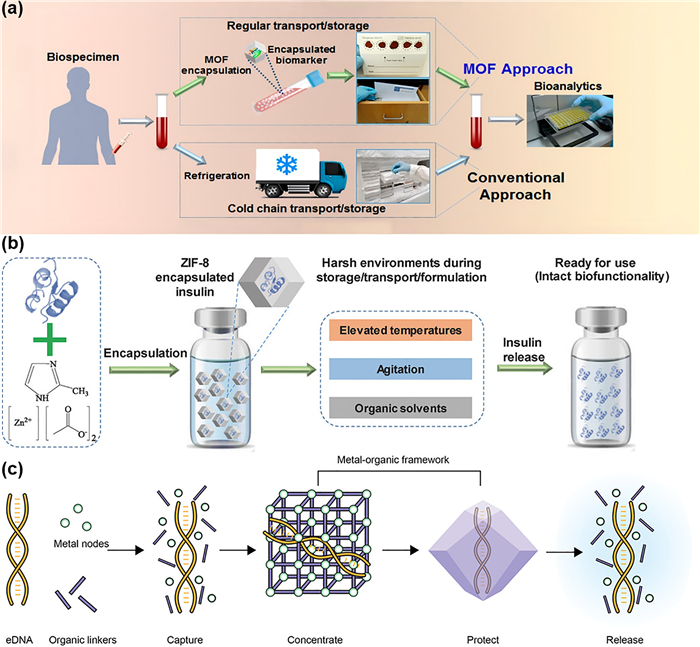
Preserving protein biomarkers for point-of-care diagnostics. A transformative application was demonstrated by Singamaneni and co-workers, who introduced a refrigeration-free method for preserving protein biomarkers in biofluids [2]. Their field-deployable protocol involves proteins and biofluid samples with ZIF-8 precursors, allowing in-situ crystallization around proteins, and drying the composite on paper strips to create stable, lightweight specimens (Fig. 1a). The encapsulated biomarkers like urinary NGAL (neutrophil gelatinase-associated lipocalin) and serum CA-125 (cancer antigen 125) exhibited exceptional stability, retaining over 85% of their activity after four weeks of storage at room temperature or 40 ℃, an efficacy comparable to conventional frozen storage at −20 ℃. The study demonstrated feasibility and robustness by first separating plasma from fresh blood using a hand-powered centrifuge, then subjecting ZIF-8-encapsulated plasma samples spiked with varying CA-125 concentrations to two rigorous tests: Repeated temperature fluctuations (cycles of 25, 40 or 60 ℃) and a 10-day real-world shipping trial across the United States, both of which showed preserved biomarker recovery rates of up to 90%, significantly higher than unencapsulated controls. The core mechanism relies on ZIF-8′s rigid, porous structure, which physically confines and shelters protein molecules, preventing denaturation and degradation. The protective framework is formed directly around the proteins via biomimetic mineralization, ensuring high encapsulation efficiency. Recovery method is straightforward and easy: Mild acidic buffer (pH~6) dissolves the ZIF-8 shell, releasing intact and functional proteins for downstream analysis. This strategy effectively breaks the dependency on the energy-intensive "cold chain, " offering a universal and low-cost alternative for biospecimen preservation.
Figure 1
Figure 1.
Schematic diagram of (a) protein preservation on paper substrates at ambient temperature achieved through an approach combining ZIF-8 encapsulation and dry spot sampling. Adapted with permission [2]. Copyright 2018, American Chemical Society. (b) Protection of insulin structure and bioactivity against environmental stressors via ZIF–8 encapsulation. Adapted with permission [3]. Copyright 2018, Wiley-VCH GmbH. (c) Capturing and Releasing environmental DNA Using ZIF-8. Adapted with permission [4]. Copyright 2024, Wiley-VCH GmbH.
Extending protection to protein therapeutics. Building on this foundation, the same group applied ZIF-8 encapsulation to stabilize a model protein therapeutic—insulin [3]. Using a mild aqueous biomimetic process, insulin was encapsulated with nearly 100% efficiency (Fig. 1b). The ZIF-8 encapsulation demonstrated exceptional preservation performance against multiple stressors like the elevated temperatures (up to 40 ℃ for 4 weeks), mechanical agitation, and exposure to organic solvents. Insulin recovery exceeded 90% under these conditions, comparable to significant degradation in unencapsulated controls. Structural integrity of insulin was confirmed via circular dichroism spectroscopy and HPLC, showing maintained secondary structure. In vivo studies in diabetic mice revealed that ZIF-8-preserved insulin retained bioactivity equivalent to refrigerated insulin, effectively lowering blood glucose levels. Identical to their previous study [2], the preservation mechanism is attributed to the rigid, nanoporous ZIF-8 framework, which confines insulin molecules, restricts conformational mobility, and shields them from denaturing environments. Residual ZIF-8 components exhibited low cytotoxicity and could be completely removed via EDTA-mediated dissociation and filtration prior to administration. This facile, universal approach offers a promising solution for stabilizing protein therapeutics in resource-limited settings without refrigeration.
Capturing and stabilizing environmental DNA. The utility of ZIF-8 extends beyond proteins to nucleic acids, addressing challenges in environmental DNA (eDNA) research. The primary challenges in conventional water eDNA sampling and enrichment stem from the ultra-low concentration and patchy distribution of target DNA, which often requires filtering large volumes of water to achieve reliable detection. This process is hindered by rapid filter clogging in turbid waters and is labor-intensive due to bulky field equipment. After collecting, preventing DNA degradation is critical, yet maintaining an uninterrupted cold chain during transport is logistically difficult and costly. Furthermore, traditional filtration methods can be biased against recovering small, dissolved DNA fragments, while the entire procedure is highly vulnerable to contamination, leading to false positives. Doherty and co-workers developed an equipment-free method to capture and preserve eDNA using ZIF-8 [4]. The method is based on a rapid, one-pot biomimetic mineralization process conducted at room temperature, wherein zinc nitrate and 2-methylimidazole precursors are introduced directly into a water sample. Here, eDNA molecules serve as nucleation sites, promoting the in situ formation of ZIF-8 crystals that encapsulate the DNA within minutes, which bypassed the need for laborious filtration or immediate refrigeration (Fig. 1c). The performance of this strategy is outstanding, achieving capture efficiencies greater than 98% for salmon DNA introduced into diverse aquatic settings such as aquariums, rivers, and seawater. Notably, ZIF-8 encapsulation confers strong protective effects: The confined DNA exhibits complete resistance to DNase I enzymatic degradation and substantial shielding from UV-induced damage. In extended stability trials, species-specific qPCR signals remained detectable in ZIF-8-captured samples stored for 28 days at 37 ℃, whereas untreated controls fell below the detection threshold within just 6 days. Moreover, the encapsulated DNA can be efficiently recovered (≈ 78%–91%) using the chelating agent EDTA, rendering it fully compatible with downstream molecular analyses. As ZIF-8 crystallizes, it physically encloses the DNA, isolating it from environmental degradative agents. Its microporous architecture, with apertures around 3.4 Å, functions as a molecular sieve that excludes larger nucleases while permitting the diffusion of small precursor molecules during synthesis. Additionally, the crystalline MOF matrix acts as a physical barrier against UV radiation. Together, these attributes enable rapid capture, effective concentration, and long-term stabilization of eDNA through a straightforward, field-adaptable protocol. This protocol enables rapid capture, concentration, and long-term stabilization of eDNA, streamlining field workflows.
A subsequent comparative study further evaluated ZIF-8 encapsulation against conventional mixed cellulose ester (MCE) filtration for capturing marine eDNA [5]. After two weeks of ambient storage, ZIF-8-encapsulated samples preserved the overall fish community structure, with no significant difference in composition compared to frozen or lysis-buffer-preserved MCE filters. However, the ZIF-8 method detected fewer amplicon sequence variants and taxa, particularly rare species, revealing several interconnected limitations that warrant attention. First, matrix complexity in seawater including high ionic strength, dissolved organic matter, and suspended particulates can compete with DNA as nucleation sites for ZIF-8 crystallization, potentially reducing both capture efficiency and crystal uniformity. Second, handling losses during scale-up from 15 mL laboratory trials to 1 L field samples proved nontrivial; the multiple transfer steps between vessels increased the risk of inadvertently discarding encapsulated material with the supernatant, a problem exacerbated by the lack of a visible pellet. Third, variability in cargo release and recovery may arise from incomplete EDTA-mediated dissolution of ZIF-8 crystals or from losses during ethanol precipitation, which is difficult to optimize for large volumes without specialized centrifuge equipment. While effective for dominant taxa (capturing > 98% of abundant reads) and offering the undeniable advantages of equipment-free, ambient-temperature preservation, these results underscore that sensitivity for low-abundance targets remains the central challenge, particularly as the field scales toward deployment in complex environmental matrices.
Why ZIF-8 is the rational choice? The preferential selection of ZIF-8 for bio-preservation is not incidental but stems from a combination of favorable properties that address distinct degradation pathways. First, its mild synthesis enables biomimetic mineralization under aqueous, near-physiological conditions without damaging sensitive cargo. Second, its protective efficacy derives from three complementary mechanisms: (ⅰ) Physical confinement, which restricts molecular mobility and suppresses thermal denaturation; (ⅱ) size-selective exclusion, where the ~3.4 Å pore aperture prevents entry of degradative enzymes while permitting small-molecule diffusion; and (ⅲ) UV shielding, provided by the crystalline framework that absorbs and scatters harmful radiation. Third, benign disassembly via mild chelators like ethylenediaminetetraacetic acid (EDTA) allows high recovery of intact biomolecules. While other MOFs offer excellent properties for applications like catalysis, they present significant drawbacks for bio-preservation. ZIF-67, the cobalt analogue of ZIF-8, shares a similar structure but employs cytotoxic cobalt ions, rendering it unsuitable for biomedical or environmental release. Other MOFs like zirconium-based UiO-66 or iron-based MIL-101, offer excellent stability and functionality for catalysis or gas adsorption, however, they often require more aggressive synthesis conditions (e.g., high temperature, acidic modulators) or lack such a facile, biocompatible disassembly pathway, making them less ideal for delicate biomolecule handling.
Future perspectives: From bench to field. In future, to advance ZIF-8-based bio-preservation from laboratory validation to widespread field and clinical application (like temporary storage of biological agents), several critical challenges must be addressed through targeted research and development. The foremost technical hurdle lies in optimizing capture efficiency and sensitivity, particularly for large-volume environmental samples like eDNA, where current protocols suffer from handling losses that disproportionately affect rare, low-abundance targets. This necessitates engineering streamlined workflows, potentially utilizing alternative precipitants like isopropanol to reduce centrifugation volumes, and developing passive, ZIF-8-functionalized concentrators for in-situ enrichment.
Concurrently, the environmental and biological safety of the materials themselves requires a paradigm shift. The future lies in moving beyond ZIF-8 to design a new generation of intrinsically "greener" MOFs, synthesized from fully biocompatible and biodegradable components such as endogenous metal ions (e.g., Ca2+, Mg2+) and natural organic linkers (e.g., cyclodextrins, amino acids). However, this transition is not straightforward and faces significant materials science challenges. Unlike ZIF-8, which forms rapidly under mild, aqueous conditions due to the strong coordination between Zn2+ and imidazolate linkers, many bio-compatible MOFs require more aggressive synthesis conditions (e.g., elevated temperatures, organic solvents, or extended reaction times) that are incompatible with preserving fragile biomolecules during encapsulation. Furthermore, replicating ZIF-8′s unique sieving property, its ~3.4 Å pore aperture that excludes degradative enzymes while allowing small-molecule diffusion, remains a formidable challenge. Achieving a similar balance of mild synthesis, selective porosity, and high stability in a fully biodegradable framework will require innovative reticular chemistry, potentially involving mixed-linker strategies or post-synthetic modification to fine-tune pore architecture and framework robustness without compromising biocompatibility.
Finally, achieving scalable, robust, and user-friendly deployment demands an integrated approach. This goes beyond standardizing production protocols to include the development of all-in-one, portable field kits that encapsulate the entire workflow. Such a kit would likely comprise: (ⅰ) A pre-measured, single-use sachet containing lyophilized ZIF-8 precursors (or the next-generation MOF) to minimize user handling and measurement errors; (ⅱ) a dedicated collection vessel that allows for the direct addition of the precursor mix to the raw sample (e.g., blood, urine, or water) to initiate encapsulation; (ⅲ) an integrated solid-phase extraction or filtration unit to isolate and dry the MOF-biomolecule composite without the need for laboratory centrifuges; and (ⅳ) a pre-packaged, pH-controlled elution buffer cartridge for on-demand recovery of the preserved biomolecules. The primary engineering challenge lies in transitioning from a multi-step, centrifuge-dependent lab protocol to a closed, self-contained system that is immune to user variability, maintains seal integrity against contamination, and functions across a wide range of environmental temperatures. By systematically overcoming these barriers—enhancing performance in complex matrices, ensuring material sustainability through novel MOF design, and creating robust, user-centric deployment systems—the technology can unlock its full potential, extending its application to the preservation of vaccines, cellular therapies, and delicate forensic or archaeological specimens.
CRediT authorship contribution statement
Hong-Yu Chu: Writing – original draft, Validation, Data curation, Conceptualization. Zhi-Bo Wang: Writing – original draft, Formal analysis. Miao Chang: Writing – review & editing. Chong-Chen Wang: Writing – review & editing, Writing – original draft, Conceptualization.
Declaration of competing interest
The authors declare that they have no known competing financial interests or personal relationships that could have appeared to influence the work reported in this paper.
Acknowledgments
This work was supported by National Natural Science Foundation of China (No. 52370025) and Science and Technology Project of Beijing Municipal Ecology and Environment (No. BJST20250207).
[1]
X.H. Yi, H.Y. Chu, C.Y. Wang, et al., Chin. Chem. Lett. 37 (2026) 112243.
C. Wang, G. Sudlow, Z. Wang, et al., Adv. Healthc. Mater. 7 (2018) 1800950. doi: 10.1002/adhm.201800950
[4]
L.I. FitzGerald, E.E. Hahn, M. Wallace, et al., Small 4 (2024) 2400432. doi: 10.1002/smsc.202400432
[5]
L.I. FitzGerald, K.M. West, C.M. Doherty, et al., Environ. DNA 7 (2025) e70151. doi: 10.1002/edn3.70151
Figure 1
Schematic diagram of (a) protein preservation on paper substrates at ambient temperature achieved through an approach combining ZIF-8 encapsulation and dry spot sampling. Adapted with permission [2]. Copyright 2018, American Chemical Society. (b) Protection of insulin structure and bioactivity against environmental stressors via ZIF–8 encapsulation. Adapted with permission [3]. Copyright 2018, Wiley-VCH GmbH. (c) Capturing and Releasing environmental DNA Using ZIF-8. Adapted with permission [4]. Copyright 2024, Wiley-VCH GmbH.


 DownLoad:

 下载:


 下载:

