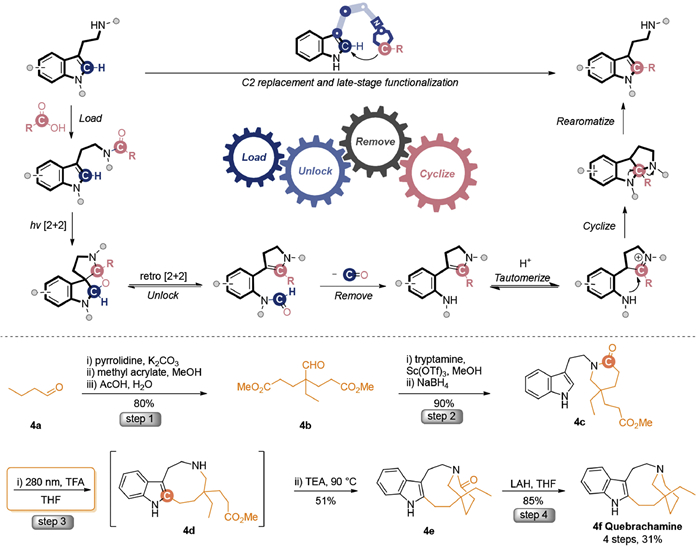
Scheme 1.
Tryptamine-directed photochemical single-carbon replacement at indole C2. Top: The load-unlock-remove-cyclize cascade. Bottom: Four-step total synthesis of quebrachamine.

Cutting and replacing a single carbon: Tryptamine-directed photochemistry edits the indole skeleton
Lixin Duan , Xin He , Haibo Zhu , Caiyun Fang , Tao Tu


Indole is one of the most prevalent heterocyclic scaffolds in medicinal chemistry and natural products. > 70 FDA-approved drugs and numerous bioactive alkaloids feature an indole core. The late-stage modification of intact indole frameworks, rather than redesigning synthesis routes from simple precursors, is therefore an attractive strategy for accessing homologues, analogues, and corresponding derivatives [1,2]. Skeletal editing, which inserts, deletes, or replaces individual atoms within a molecular framework, complements peripheral C–H functionalization and offers disconnections that are otherwise difficult to access [3,4].
In indole skeletal editing, most strategies developed so far rely on highly reactive carbene or nitrene intermediates generated from external reagents. In the carbene manifold, the classical Ciamician-Dennstedt reaction and its modern variants insert a one-carbon unit into the C2–C3 bond of indoles, converting them into quinolines or related six-membered heterocycles [5-7]. In parallel, nitrene-based approaches enable nitrogen-atom insertion into indoles or arenes, providing access to N-enriched molecules under metal-catalyzed or photocatalytic conditions [8-11]. Collectively, these advances have established powerful precedents for indole skeletal editing, while highlighting the opportunity for a substrate-organized strategy that could guide atom-level remodeling.
Professor Huiying Zeng at Lanzhou University and Professor Chao-Jun Li at McGill University recently reported an elegant intramolecular solution to this challenge [12]. Their key insight is to allow the substrate to direct its own skeletal editing: The ethylamine side chain inherent to tryptamines serves as a molecular robotic arm. After a carboxylic acid partner is appended to this side chain via simple amidation, irradiation at 280 nm under TFA-promoted conditions triggers a self-contained four-step cascade in a single pot (Scheme 1, top). First, an intramolecular [2 + 2] photocycloaddition between the amide carbonyl and the indole C2–C3 bond generates a strained oxetane, which then undergoes retro-[2 + 2] fragmentation to dearomatize the indole framework. A second photoexcitation subsequently extrudes the original C2 carbon as carbon monoxide. Finally, acid-promoted tautomerization, cyclization, and rearomatization reassemble the indole ring around the newly delivered carbon atom, thereby achieving single-carbon excision and replacement and late-stage functionalization at the C2 position in one operation.
The reaction exhibits broad scope, accommodating diverse carboxylic acid coupling partners and structurally varied tryptamine derivatives with good functional-group tolerance. Its synthetic value is most clearly illustrated by a concise total synthesis of quebrachamine, a monoterpenoid indole alkaloid featuring a strained nine-membered azonane ring that has made short synthetic access difficult [13]. Starting from n-butanal, a dual Michael addition with methyl acrylate gives a quaternary diester aldehyde, which is condensed with tryptamine and subsequently reduced to the corresponding amide precursor. A single photochemical skeletal-editing step then constructs the nine-membered azonane ring. Subsequent triethylamine-promoted intramolecular amidation and lithium aluminum hydride reduction complete the synthesis in four steps with an overall yield of 31% (Scheme 1, bottom), representing a substantial improvement over the previous shortest route of nine steps. This concise synthesis highlights the potential of this skeletal-editing strategy for the total synthesis of structurally complex natural products.
More broadly, this work reframes indole skeletal editing as a problem of substrate organization, rather than merely one of reagent reactivity. By using the native ethylamine side chain of tryptamines as a molecular robotic arm, the authors bring the incoming carbon fragment into close proximity with the indole core and guide a sequence of carbon excision, carbon replacement, and C2 functionalization through a controlled intramolecular cascade. The work therefore provides not only a practical route to C2-diversified indoles, but also a broader design principle for skeletal editing: The molecular robotic arm can be used to guide otherwise difficult atom-level remodeling events with high precision.
Lixin Duan: Writing – original draft, Investigation. Xin He: Validation, Investigation. Haibo Zhu: Validation, Investigation. Caiyun Fang: Writing – review & editing, Visualization. Tao Tu: Writing – review & editing, Validation, Investigation.
The authors declare that they have no known competing financial interests or personal relationships that could have appeared to influence the work reported in this paper.
Financial support from the National Natural Science Foundation of China (No. 22271060) and Natural Science Foundation of Ningxia (No. 2025AAC050034), Key Research and Development Program of Ningxia Hui Autonomous Region (No. 2026BEE02007), the Department of Chemistry at Fudan University and the School of Chemistry, and Chemical Engineering at Ningxia University is gratefully acknowledged.
L. Guillemard, N. Kaplaneris, L. Ackermann, M.J. Johansson, Nat. Rev. Chem. 5 (2021) 522–545. doi: 10.1038/s41570-021-00300-6
S. Khalid, M. Bilal, N. Rasool, M. Imran, Chin. Chem. Lett. 35 (2024) 109498. doi: 10.1016/j.cclet.2024.109498
S.H. Kennedy, B.D. Dherange, K.J. Berger, M.D. Levin, Nature 593 (2021) 223–227. doi: 10.1038/s41586-021-03448-9
Z. Liu, X. Zhang, P. Sivaguru, X. Bi, Acc. Chem. Res. 58 (2025) 130–149. doi: 10.1021/acs.accounts.4c00709
B.D. Dherange, P.Q. Kelly, J.P. Liles, M.S. Sigman, M.D. Levin, J. Am. Chem. Soc. 143 (2021) 11337–11344. doi: 10.1021/jacs.1c06287
H. Guo, S. Qiu, P. Xu, Angew. Chem. Int. Ed. 63 (2024) e202317104. doi: 10.1002/anie.202317104
S. Liu, Y. Yang, Q. Song, et al., Nat. Chem. 16 (2024) 988–997. doi: 10.1038/s41557-024-01468-2
X. Zhang, Q. Song, S. Liu, et al., Nat. Chem. 17 (2025) 215–225. doi: 10.1038/s41557-024-01680-0
J.C. Reisenbauer, O. Green, A. Franchino, P. Finkelstein, B. Morandi, Science 377 (2022) 1104–1109. doi: 10.1126/science.add1383
Z. Zhang, Q. Li, Z. Cheng, N. Jiao, C. Zhang, Nat. Commun. 15 (2024) 6016. doi: 10.1038/s41467-024-50383-0
J. Li, P. Tang, Y. Fan, H. Lu, Science 389 (2025) 275–281. doi: 10.1126/science.adl4755
L. Zhang, Y. Lang, Z. Luo, et al., Science 392 (2026) 512–518. doi: 10.1126/science.aec3587
X.Y. Liu, Y. Qin, Green Synth. Catal. 3 (2022) 25–39.

 扫一扫看文章


扫一扫关注我们
 DownLoad:

 下载:
 下载: